EP0153405B1 - Systeme de culture de cellules - Google Patents
Systeme de culture de cellules Download PDFInfo
- Publication number
- EP0153405B1 EP0153405B1 EP84903320A EP84903320A EP0153405B1 EP 0153405 B1 EP0153405 B1 EP 0153405B1 EP 84903320 A EP84903320 A EP 84903320A EP 84903320 A EP84903320 A EP 84903320A EP 0153405 B1 EP0153405 B1 EP 0153405B1
- Authority
- EP
- European Patent Office
- Prior art keywords
- module
- cell
- cells
- fluid
- circulation means
- Prior art date
- Legal status (The legal status is an assumption and is not a legal conclusion. Google has not performed a legal analysis and makes no representation as to the accuracy of the status listed.)
- Expired
Links
- 238000004113 cell culture Methods 0.000 title claims description 47
- 239000012528 membrane Substances 0.000 claims abstract description 37
- 239000012530 fluid Substances 0.000 claims abstract description 36
- 230000010261 cell growth Effects 0.000 claims abstract description 35
- 235000015097 nutrients Nutrition 0.000 claims abstract description 35
- 239000007789 gas Substances 0.000 claims abstract description 34
- 239000000126 substance Substances 0.000 claims abstract description 7
- 239000000463 material Substances 0.000 claims abstract description 5
- 210000004027 cell Anatomy 0.000 claims description 84
- 239000002609 medium Substances 0.000 claims description 32
- 239000001963 growth medium Substances 0.000 claims description 27
- 238000000926 separation method Methods 0.000 claims description 13
- 230000001413 cellular effect Effects 0.000 claims description 6
- 238000010276 construction Methods 0.000 claims description 6
- 239000013529 heat transfer fluid Substances 0.000 claims description 5
- 238000001727 in vivo Methods 0.000 claims description 5
- 238000000034 method Methods 0.000 claims description 5
- 210000003722 extracellular fluid Anatomy 0.000 claims description 4
- 239000011148 porous material Substances 0.000 claims description 4
- 230000002503 metabolic effect Effects 0.000 claims description 3
- 210000001519 tissue Anatomy 0.000 claims description 2
- 239000002912 waste gas Substances 0.000 claims description 2
- 230000002792 vascular Effects 0.000 claims 2
- 230000015572 biosynthetic process Effects 0.000 claims 1
- 238000000338 in vitro Methods 0.000 claims 1
- 238000012544 monitoring process Methods 0.000 claims 1
- 210000000056 organ Anatomy 0.000 claims 1
- 238000004519 manufacturing process Methods 0.000 abstract description 8
- 239000000203 mixture Substances 0.000 abstract description 5
- 239000000758 substrate Substances 0.000 abstract description 5
- 230000007613 environmental effect Effects 0.000 abstract description 3
- 239000007787 solid Substances 0.000 abstract description 2
- 230000001105 regulatory effect Effects 0.000 abstract 2
- 229960000074 biopharmaceutical Drugs 0.000 abstract 1
- 239000003814 drug Substances 0.000 abstract 1
- 230000002452 interceptive effect Effects 0.000 abstract 1
- 239000000047 product Substances 0.000 description 39
- 210000003462 vein Anatomy 0.000 description 14
- 210000001367 artery Anatomy 0.000 description 13
- 238000011109 contamination Methods 0.000 description 6
- 239000000306 component Substances 0.000 description 5
- 238000011084 recovery Methods 0.000 description 5
- 125000006850 spacer group Chemical group 0.000 description 5
- 239000000725 suspension Substances 0.000 description 5
- 230000012010 growth Effects 0.000 description 4
- 239000011324 bead Substances 0.000 description 3
- 230000008901 benefit Effects 0.000 description 3
- 238000000746 purification Methods 0.000 description 3
- IJGRMHOSHXDMSA-UHFFFAOYSA-N Atomic nitrogen Chemical compound N#N IJGRMHOSHXDMSA-UHFFFAOYSA-N 0.000 description 2
- 210000001736 capillary Anatomy 0.000 description 2
- 238000010924 continuous production Methods 0.000 description 2
- 239000000835 fiber Substances 0.000 description 2
- 230000002209 hydrophobic effect Effects 0.000 description 2
- 238000003475 lamination Methods 0.000 description 2
- 239000007788 liquid Substances 0.000 description 2
- 239000002245 particle Substances 0.000 description 2
- 210000002966 serum Anatomy 0.000 description 2
- 241000894007 species Species 0.000 description 2
- 241000894006 Bacteria Species 0.000 description 1
- OKTJSMMVPCPJKN-UHFFFAOYSA-N Carbon Chemical compound [C] OKTJSMMVPCPJKN-UHFFFAOYSA-N 0.000 description 1
- 241000196324 Embryophyta Species 0.000 description 1
- 241001465754 Metazoa Species 0.000 description 1
- 240000004808 Saccharomyces cerevisiae Species 0.000 description 1
- 150000001413 amino acids Chemical class 0.000 description 1
- 210000004102 animal cell Anatomy 0.000 description 1
- 230000000712 assembly Effects 0.000 description 1
- 238000000429 assembly Methods 0.000 description 1
- 229910052799 carbon Inorganic materials 0.000 description 1
- 239000006143 cell culture medium Substances 0.000 description 1
- 230000005779 cell damage Effects 0.000 description 1
- 208000037887 cell injury Diseases 0.000 description 1
- 230000019522 cellular metabolic process Effects 0.000 description 1
- 239000002801 charged material Substances 0.000 description 1
- 150000001875 compounds Chemical class 0.000 description 1
- 239000000356 contaminant Substances 0.000 description 1
- 238000001816 cooling Methods 0.000 description 1
- 238000001514 detection method Methods 0.000 description 1
- 238000009792 diffusion process Methods 0.000 description 1
- 230000000694 effects Effects 0.000 description 1
- 210000003527 eukaryotic cell Anatomy 0.000 description 1
- 230000002349 favourable effect Effects 0.000 description 1
- 239000012467 final product Substances 0.000 description 1
- 239000012634 fragment Substances 0.000 description 1
- 230000004927 fusion Effects 0.000 description 1
- 239000011521 glass Substances 0.000 description 1
- 238000003306 harvesting Methods 0.000 description 1
- 238000010438 heat treatment Methods 0.000 description 1
- 239000012510 hollow fiber Substances 0.000 description 1
- 210000005260 human cell Anatomy 0.000 description 1
- 210000004754 hybrid cell Anatomy 0.000 description 1
- BHEPBYXIRTUNPN-UHFFFAOYSA-N hydridophosphorus(.) (triplet) Chemical compound [PH] BHEPBYXIRTUNPN-UHFFFAOYSA-N 0.000 description 1
- 208000015181 infectious disease Diseases 0.000 description 1
- 238000012007 large scale cell culture Methods 0.000 description 1
- 210000004962 mammalian cell Anatomy 0.000 description 1
- 239000012533 medium component Substances 0.000 description 1
- 229910052757 nitrogen Inorganic materials 0.000 description 1
- 239000013618 particulate matter Substances 0.000 description 1
- 230000037361 pathway Effects 0.000 description 1
- 230000000737 periodic effect Effects 0.000 description 1
- 239000012466 permeate Substances 0.000 description 1
- 229920002492 poly(sulfone) Polymers 0.000 description 1
- 210000001236 prokaryotic cell Anatomy 0.000 description 1
- 102000004169 proteins and genes Human genes 0.000 description 1
- 108090000623 proteins and genes Proteins 0.000 description 1
- 230000000241 respiratory effect Effects 0.000 description 1
- 230000004044 response Effects 0.000 description 1
- 230000035939 shock Effects 0.000 description 1
- 239000007858 starting material Substances 0.000 description 1
- 230000001960 triggered effect Effects 0.000 description 1
- 239000002699 waste material Substances 0.000 description 1
Images




Classifications
-
- C—CHEMISTRY; METALLURGY
- C12—BIOCHEMISTRY; BEER; SPIRITS; WINE; VINEGAR; MICROBIOLOGY; ENZYMOLOGY; MUTATION OR GENETIC ENGINEERING
- C12M—APPARATUS FOR ENZYMOLOGY OR MICROBIOLOGY; APPARATUS FOR CULTURING MICROORGANISMS FOR PRODUCING BIOMASS, FOR GROWING CELLS OR FOR OBTAINING FERMENTATION OR METABOLIC PRODUCTS, i.e. BIOREACTORS OR FERMENTERS
- C12M29/00—Means for introduction, extraction or recirculation of materials, e.g. pumps
- C12M29/04—Filters; Permeable or porous membranes or plates, e.g. dialysis
-
- C—CHEMISTRY; METALLURGY
- C12—BIOCHEMISTRY; BEER; SPIRITS; WINE; VINEGAR; MICROBIOLOGY; ENZYMOLOGY; MUTATION OR GENETIC ENGINEERING
- C12M—APPARATUS FOR ENZYMOLOGY OR MICROBIOLOGY; APPARATUS FOR CULTURING MICROORGANISMS FOR PRODUCING BIOMASS, FOR GROWING CELLS OR FOR OBTAINING FERMENTATION OR METABOLIC PRODUCTS, i.e. BIOREACTORS OR FERMENTERS
- C12M23/00—Constructional details, e.g. recesses, hinges
- C12M23/34—Internal compartments or partitions
-
- C—CHEMISTRY; METALLURGY
- C12—BIOCHEMISTRY; BEER; SPIRITS; WINE; VINEGAR; MICROBIOLOGY; ENZYMOLOGY; MUTATION OR GENETIC ENGINEERING
- C12M—APPARATUS FOR ENZYMOLOGY OR MICROBIOLOGY; APPARATUS FOR CULTURING MICROORGANISMS FOR PRODUCING BIOMASS, FOR GROWING CELLS OR FOR OBTAINING FERMENTATION OR METABOLIC PRODUCTS, i.e. BIOREACTORS OR FERMENTERS
- C12M23/00—Constructional details, e.g. recesses, hinges
- C12M23/44—Multiple separable units; Modules
Definitions
- the cells to be cultured in this invention are prokaryotic and eukaryotic cells such as bacteria, yeast, plant, animal and human cells. These cells may be derived in any manner, that is, isolated from nature, mutated, in the naturally-occurring form, genetically engineered or modified, transformed or non-transformed, hybrids formed by fusion between portions of cells or whole cells of the same or different species. These cells may be attached to the substrate, grown in suspension, or in suspension attached to another substrate, such as microcarrier bead. The cultures may consist of a single cell line or a plurality of cell lines of the same or different species.
- Microcarrier systems have several disadvantages, such as cell damage from collision of beads, mingling of the desired cell product with the nutrient medium, cell fragments and other contaminants, and the difficulty of achieving continuous production of the desired product.
- U.S. Patent 4,225,671 describes a cell culture apparatus in which a stack of parallel flat membranes defines separate, typically alternating, cell culture medium, and cell growth spaces. These membranes are spaced widely apart (2 mm), so excessive quantities of nutrient must be provided to ensure the nourishment of the cells most distal from the membrane. Since the membranes are supported only at their edges, the maximum surface area of each membrane is limited by the tensile strength of the membrane. Thus production capacity is limited. In addition the membrane is not designed to restrict the flow of the cell product into the nutrient medium and the product is collected in that medium. Because the cell product is mingled with the culture medium, product, recovery and purification is complex and results in a low yield of product.
- U.S. Patent 3,948,732 shows a spacer structure which is convoluted to offer internal support to the substrate surfaces. It does not, however, recognize the importance of a fluid path separate from that of the nutrient medium.
- One object of the invention is to provide a closed sterile system for cell culture in order to prevent both exposure of personnel to the cells and the contamination or infection of the cell culture by wild strains entering from the outside environment.
- Another object of the invention is to provide a system for cell culture which more closely approximates a continuous system than those known previously, thus increasing the average or steady-state output of product and minimizing opportunities for contamination.
- Another object of the invention is to simulate the supply of nutrient to and exchange of gases by cells in vivo, wherein cells are typically less than 200 um from the capillaries, the sources of nutrients and respiratory gases.
- Another object of the invention is to provide a cell culture assembly in which the maximum distance between a cell and the nearest source of nutrients and dissolved gases approximates that typical of the cells in vivo.
- Another object of the invention is to provide a cell culture assembly which can be economically manufactured.
- Another object of the invention is to provide a cell culture assembly and cell culture system which lends itself to the growth of cells at high densities.
- Another object of the invention is to provide a cell culture assembly and cell culture system in which fluctuations in cell growth and production of the desired product are reduced.
- Another object of the invention is to provide a cell culture system in which nutrient supply, heat transfer, gas transfer, cell growth and product collection functions are integrated.
- Another object of the invention is to provide a cell culture system in which those functions are performed by separate modules of similar construction, and thus more economical to fabricate.
- Another object of the invention is to provide multi-layered modules for cell culture and related purposes which can be assembled by lamination into an essentially rigid block structure.
- Another object of the invention is to provide a cell culture assembly and cell culture system in which the nutrient medium circulation path is independent from the path carrying the cell product, metabolic products from the component of the culture medium and the cells themselves.
- Another object of the invention is to provide a cell culture system in which the cells' environmental conditions are continuously monitored . and any departures from the desired range of value in any environmental parameter are automatically indicated and corrected.
- Another object of this invention is to provide a laminated structure for the fluid paths such that high strength and reliability are attained.
- Another object of this invention is to provide a laminated structure that may be increased in size to accommodate large scale cell culture.
- Another object of this invention is to provide a cell culture assembly which does not require large volumes of medium.
- the cell culture system comprises a series of connected modules which provide a favorable. location for cell growth and maintain the environment of the cells so as to promote continued production of the desired product.
- the modules will be heat transfer, gas transfer, cell culture and cell- product separation modules.
- Multiple separate and independent circulation loops exist within the cell culture system. In a given module 'only two of these circulation loops are operational. Means are provided for continuous circulation of nutrient culture medium through all of these modules (except for the cell-product separation module).
- separate and independent means (secondary or auxiliary loops) exist for (a) the passage of gases through the gas transfer module, (b) the passage of heat through the heat transfer module, (c) the introduction of cells into the cell culture module, and (d) the withdrawal of product from the cell growth module into the cell-product separation module.
- secondary or auxiliary loops exist for (a) the passage of gases through the gas transfer module, (b) the passage of heat through the heat transfer module, (c) the introduction of cells into the cell culture module, and (d) the withdrawal of product from the cell growth module into the cell-product separation module.
- a separate and independent means exists for the transfer of the separator cell product(s) into a collection vessel to be held for further processing.
- the modules are preferably fabricated in a similar manner to achieve similar structures.
- the common structure of the preferred modules is described below as the basic module.
- the various modules differ from the basic module in the nature of the separator sheets 11 of Figure 4 or sheets 43 of Figure 15, and in the nature of the fluids circulated in the auxiliary circulation system. All of the modules except the cell-product separation module are connected and serviced by the nutrient medium circulatory system.
- the modules of the present invention provide a large surface area, relative to the volume occupied by the modules, for cell growth and or attachment.
- the modules of the present invention are sterile, disposable, and replaceable.
- a sterile, disposable temperature control module In accordance with one of the features of the system there is provided a sterile, disposable temperature control module. This feature allows a constant temperature fluid to circulate on one side of the non-porous membrane to control the temperature of the growth medium on the opposite side of the membrane without contact or contamination.
- another sterile, disposable module for the exchange of gases with the growth medium by diffusion of the gases across either a hydrophobic or hydrophilic membrane.
- another sterile, disposable module to provide an environment and source of suitable growth medium.
- the cells are then cultivated on the opposite side of the membrane free from many of the contaminates in the growth medium.
- another sterile, disposable module that incorporates a microporous filter to retain any free cells in the case of substrate attached cells or in the case of suspension cells to retain the free mobile cell culture and provide a closed loop thus allowing circulation back through the growth module.
- the soluble products are then eluted off the opposite side.
- the available contact surface area of the modules may be varied from 200 sq cm to 80,000 sq cm.
- a means for growing cells in a totally enclosed environment to decrease the probability of contamination of the external environment by cells or cell products, and to decrease the probability of contamination of the cellular environment by foreign particulate matter or biological organisms.
- This system which is comprised of individual disposable modules also provides a means for disposing of individual contaminated units in an efficient manner which minimizes the threat to the environment. Further, since the system allows the culture of high densities of cells in a small volume the necessity for handling large numbers of culture vessels and the medium required to feed them is reduced resulting in a lowered risk of compromising the laboratory and surrounding environment.
- a selective semi-permeable membrane to separate the cell nutrient flow path from the cell growth and cellular production path and thus permits the collection of cell product in a more highly concentrated form free of certain nutrient medium components which would dilute the cell product were the two pathways common.
- a means for the collection of the concentrated cell product that permits less complicated and less costly methods to be used in the recovery and purification of the product because smaller volumes must be processed.
- the use of a highly concentrated starting material for recovery and purification generally promotes more efficient recovery of final product in terms of purity and recovery.
- a means for periodic reversal of the nutrient medium flow and cell production collection flow to provide more efficient exchange of nutrient medium and cell waste products and thereby permit growth of greater cell numbers and thus increase the amount of product produced per unit of cell growth area.
- assemblies wherein the boundaries of the channels constrain the cells and fluids in such a manner that the cells are never more than 200 pm from the nearest source of nutrients.
- the basic module preferably has a large number of narrow parallel channels which are preferably formed by the superposition of the various sheets ( Figures 1-6) of the assembly, as more fully set forth below.
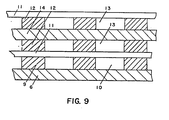
- a secondary sheet 9, as shown in Figure 3 has a plurality of narrow, parallel slots 10. This sheet is disposed between a separator sheet 11 ( Figure 4) and a primary sheet 6 ( Figure 2). As can be seen in Figure 9, these three sheets cooperate to bound a plurality of channels 10 in sheet 9 whose depth is that of sheet 9. These channels 10 will be referred to by reason of their function, as auxiliary capillaries. The number, spacing, width and depth of these auxiliary capillaries is preferably chosen in view of the function of the module in which they appear. The result is that numerous parallel channels are formed on each side of the separator sheets. The flow through the capillaries.
- a secondary sheet 12 (Figure 5) is disposed between a separator sheet 11 and a primary sheet 14 ( Figure 6) to create channels 13, the media capillaries. As can be seen in Figure 9 these three sheets cooperate to a bound a plurality of channels 13 in sheet 12, whose depth is that of sheet 12; and that said channels are separate and independent and communicate across said membrane.
- auxiliary primary sheet 6 ( Figure 2) between the secondary sheet 9 and either a cover plate 5 or another secondary sheet 11 creates two larger channels 7 and 8, referred to as the auxiliary vein 7 and the auxiliary artery 8.
- the disposition of the media primary sheet 14 between the secondary sheet 12 and either a cover plate or another secondary sheet 11 creates a media vein 15 and a media artery 16.
- Cover plate 5 as shown in Figures 1 and 7, has as auxiliary inlet 1, an auxiliary outlet 2, a medium inlet 3, and medium outlet 4.
- auxiliary inlet 1 an auxiliary outlet 2
- medium inlet 3 an auxiliary outlet 4
- only the ports on the top cover plate are in use, while the ports on the bottom cover plate are capped.
- some top plate ports and some bottom plate ports as shown in Figure 8, moreover, the precise location of these outlets and inlets may be varied as deemed appropriate.
- top and bottom are for convenience and do not refer to the orientation of the module.
- the modules are preferably constructed by lamination of the sheets. It is not necessary that all of the sheets comprising the module be made from the same material.
- the media and auxiliary capillary channels have the same dimensions.
- the channels in the appropriate sheets may be aligned with each other, or they may be offset in the direction perpendicular to their longest dimension. This offset may increase mechanical strength.
- the perpendicular construction has a similar advantage.
- auxiliary capillaries and another complete set of veins and arteries are provided.
- Fluids permeating separator sheet 43 (Figure 15) are collected first in the auxiliary capillaries 10 ( Figure 14) and are thence extracted from auxiliary inlet and auxiliary outlet 1, 2 ( Figures 12, 17) through the arteries and veins 8, 7 ( Figures 13, 15, 16).
- Suitable culture media for the cultivation of various types of cells are known and may be used in the method and apparatus of this invention.
- Culture media typically are composed of assimilable sources of elements such as carbon, nitrogen, and phosphorous and may include amino acids and blood serum, by way of example.
- the composition of the culture medium may be varied from time to time to control cell metabolism and reproduction.
- the pH of the medium may be controlled or monitored.
- auxiliary circulatory system varies from one type of module to another. Fluid enters at auxiliary inlet 1 and flows into the auxiliary arteries 8 of ( Figure 2). It is then distributed by auxiliary capillaries 10 ( Figure 3). The fluid is collected by the auxiliary veins 7 and withdrawn through auxiliary outlet 2.
- each secondary sheet defines a minimum of 20 capillaries 10 or 13 ( Figures 3, 14 and 5, 16 respectively), and these capillaries are, 7 thousandths of an inch (178 pm) deep and no more than 25 centimeters in length.
- the width and spacing are less important, but we have successfully used a width of 760 to 1650 pm, and a spacing of 1270 to 2540 pm. The width, depth and spacing may be varied, in response to the growth needs of the cells.
- the minimum dimensions are defined by the typical dimensions of a single cell of the type of cells to be cultivated.
- the maximum dimension can not be so great as to unduly limit the nourishment of cells at the distal wall of the cell growth spaces from the membrane.
- the depth should be similar to the maximum distance separating cells from capillaries in vivo, and it is thought that 500 pm is the upper limit if the advantages of this structure are to be achieved. Peferably, it should be less than 200 pm, however the depth may be increased to 1000 microns to accomodate "microcarriers", or other large hybrid cells.
- veins arteries and veins
- capillaries are utilized hereto suggest the relative dimensions of these channels and the veins, whether they carry fluid into or out of the module, and to emphasize that the system and its component modules are meant to simulate certain of the characteristics of the supply of nutrients to and exchange of gases by cells in vivo.
- fluid is here used to refer to both liquids and gases, whether pure or mixed, and to include liquids or gases carrying substances in solution or in suspension.
- the following will be a description of the heat transfer module, gas transfer module, cell growth module and the cell- product separation module. It should be assumed that all modules will have the structure of the basic module, except as set forth below.
- the separator sheet 11 ( Figure 4) or separator sheet ( Figure 15) is nonporous, and preferably of polysulfone, or other suitable film with good heat transfer characteristics (greater than 11.7 J/sec per square centimeter).
- the auxiliary arteries, veins and capillaries conduct a heat transfer fluid, which mediates the temperature of the nutrient medium 27 in the nutrient medium capillaries 13 of module 18 as a result of heat transfer across separator sheet 11 or sheet 43.
- the temperature at which the culture medium is maintained may be varied in accordance with the growth characteristics of the cells, and hence the heat transfer fluid may have either a heating effect or a cooling function.
- the fluid temperature is maintained in a conventional manner.
- the separator sheet 11 ( Figure 4) or separator sheet 43 ( Figure 15) is a porous film which may be either hydrophobic or hydrophilic in nature; and which has the ability to flow at least 7 * 10E-6 mi/min-sq-cm-mm Hg.
- the auxiliary arteries conduct life-sustaining gases into the auxiliary capillaries 10. These gases then pass across the separator sheet 11 or 43 into media capillaries 13 to be carried eventually to the cells in module 20 ( Figure 8). Waste gases carried by the medium 27 from module 20 are carried eventually to module 19 where they pass across the sheet 11 or 43, into the auxiliary capillaries 10 and thence are removed from the system via auxiliary veins of the gas module 19.
- the gas mixture circulated by the gas transport module may be air, or an artificial mixture of various elemental and compound gases.
- cell culture encompasses both conditions for cell conservation and metabolic production and conditions providing for cell growth.
- the separator sheet 11 Figure 4 or separator sheet 43 Figure 15 is a porous film which is hydrophilic in nature; but which has a known and selected porosity.
- the porosity is such to restrict the flow of substances of known molecular weights and/or charge, whose passage across the separator sheet 11 or sheet 43 from the media capillaries into the auxiliary capillaries is not desired.
- a membrane having a 10,000 dalton nominal cutoff may be used to restrict the entrance of serum components including proteins having nominal molecular weights more than 10,000 daltons into the cell growth spaces, defined by- the auxiliary capillaries.
- Membranes having higher or lower molecular weight cutoffs can be used to restrict the transfer of desired molecular weight materials from adjacent chambers.
- different charge densities may be applied to the membranes to restrict the transfer of charged materials across adjacent membranes.
- the auxiliary artery conducts new cells suspended in extra-cellular fluid, into the auxiliary capillaries of module 20, the cell growth or culture spaces, where they may adhere to the walls of the capillaries or may remain in suspension or attached to microcarriers.
- the separator sheet 11 ( Figure 4) or separator sheet 43 ( Figure 15) is a porous membrane which is hydrophilic in nature, and has the ability to retain particles of a known size.
- a membrane having a pore size of 5 urn could be used to restrict cells having a mean size of greater than 5 11m to the cell growth module. This pore size would permit transfer of the cell products across the membrane into a collection means, which may be a holding vessel or additional processing apparatus.
- the conduit 16 of module 21 distributes fluid received from inlet 3 (sometimes referred to as media inlet 3) to the capillary channels 13 (sometimes referred to as media capillaries).
- the fluid 32 then moves along separator sheet 11 or 43, which retains particles greater than the rated size. Part of this fluid 32 passes through the membrane and is collected in the auxiliary channels 10 and collected in the auxiliary conduits 7 and 8 thence passed to collection means 31 from auxiliary connections 1 and 2.
- the cell culture system The cell culture system
- the heat transfer fluid 23 is pumped to inlet 1 of the temperature control module 18 by pump 25 and returned to the incubator from outlet 2.
- Controlled gases from reservoir 29 are introduced to auxiliary inlet 1 of module 19 by pressure and exit through sensor (30, 34) from outlet 2 module 19to reservoir 29.
- Located in the incubator 22 is a media reservoir 26 containing medium 27.
- Medium 27 is pumped using a diaphragm pump 24 to inlet 3 of the temperature control module 18 then from outlet 4 of module 18 to inlet 3 of the gas exchange module 19. Collected at outlet 4 of module 19; and fed to inlet 3 of the cell growth module 20, and finally it is collected at outlet 4 and returned to reservoir 26, through sensor block 30.
- the cells are introduced by opening valve 36 to inlet 1 of the cell growth module 20.
- the extracellular fluid which includes both product and loose cells, is pumped to inlet 3 of the cell/product separation module 21, by pump 28 from outlet 2 module 20.
- the loose cells and product are separated by separator 11 or sheet 43 ( Figure 15) and the product is conducted to collection means 31.
- the remaining extracellular fluid is returned to inlet 1 module 20.
- the cells themselves may be removed through a valve 36 after outlet 4 of module 21. This allows the harvest of cells to be ruptured to release product(s) not normally secreted by the cells.
- the product may be removed from collection means 31 through valve 35.
- an automatic control subsystem is provided.
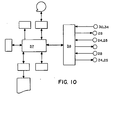
- a microprocessor 37 of Figure 10 is connected to sensor blocks 30 and 34 via an A/D, D/A convertor 38 so as to monitor the pressures, gases, pH, temperature, and dissolved gas content and to pumps 24, 25 and 28 such that it will monitor, alarm, and react if any of the state variables enter an unacceptable range. This is especially important for preserving the safe atmosphere for the personnel using the equipment.
- Alarm means are connected to the microprocessor and triggered when an unacceptable state is reached. By control means connected to said pumps, it causes corrective measures to be taken.
- This automated system enhances the safety of the closed system by virtue of the controls, alarms and ability to shut down the system on detection of failure. This feature thus provides an additional safety factor for the personnel in the production environment.
- any of the individual modules may be used in a cell culture system which is not characterized by modularity.
- a device having the structure of the cell growth module as described in the above may be used as a cell growth assembly in a non-modular cell culture system.
Landscapes
- Health & Medical Sciences (AREA)
- Organic Chemistry (AREA)
- Life Sciences & Earth Sciences (AREA)
- Engineering & Computer Science (AREA)
- Bioinformatics & Cheminformatics (AREA)
- Chemical & Material Sciences (AREA)
- Zoology (AREA)
- Wood Science & Technology (AREA)
- Sustainable Development (AREA)
- Microbiology (AREA)
- Biotechnology (AREA)
- Biomedical Technology (AREA)
- Biochemistry (AREA)
- General Engineering & Computer Science (AREA)
- General Health & Medical Sciences (AREA)
- Genetics & Genomics (AREA)
- Clinical Laboratory Science (AREA)
- Apparatus Associated With Microorganisms And Enzymes (AREA)
Abstract
Claims (20)
Priority Applications (1)
| Application Number | Priority Date | Filing Date | Title |
|---|---|---|---|
| AT84903320T ATE34406T1 (de) | 1983-08-31 | 1984-08-22 | Zellkulturanlage. |
Applications Claiming Priority (2)
| Application Number | Priority Date | Filing Date | Title |
|---|---|---|---|
| US52799783A | 1983-08-31 | 1983-08-31 | |
| US527997 | 1983-08-31 |
Publications (2)
| Publication Number | Publication Date |
|---|---|
| EP0153405A1 EP0153405A1 (fr) | 1985-09-04 |
| EP0153405B1 true EP0153405B1 (fr) | 1988-05-18 |
Family
ID=24103833
Family Applications (1)
| Application Number | Title | Priority Date | Filing Date |
|---|---|---|---|
| EP84903320A Expired EP0153405B1 (fr) | 1983-08-31 | 1984-08-22 | Systeme de culture de cellules |
Country Status (6)
| Country | Link |
|---|---|
| EP (1) | EP0153405B1 (fr) |
| JP (1) | JPS61500052A (fr) |
| AU (1) | AU3318084A (fr) |
| DE (1) | DE3471324D1 (fr) |
| IL (1) | IL72823A (fr) |
| WO (1) | WO1985001062A1 (fr) |
Families Citing this family (9)
| Publication number | Priority date | Publication date | Assignee | Title |
|---|---|---|---|---|
| GB8508976D0 (en) * | 1985-04-04 | 1985-05-09 | Davies G A | Reactor unit |
| US4829002A (en) * | 1986-05-12 | 1989-05-09 | Baxter International Inc. | System for metering nutrient media to cell culture containers and method |
| FR2647118A1 (fr) * | 1989-05-22 | 1990-11-23 | Gourdon Pierre | Cytogenerateur modulaire |
| GB8921458D0 (en) * | 1989-09-22 | 1989-11-08 | Univ Strathclyde | Cell culture apparatus |
| US5611214A (en) * | 1994-07-29 | 1997-03-18 | Battelle Memorial Institute | Microcomponent sheet architecture |
| BE1009306A5 (fr) * | 1995-04-28 | 1997-02-04 | Baxter Int | Bioreacteur. |
| DE19721477A1 (de) * | 1997-05-23 | 1998-11-26 | Abb Patent Gmbh | Mikrobieller Membranreaktor zur Verwendung in Fließsystemen |
| GB0814035D0 (en) * | 2008-07-31 | 2008-09-10 | Univ Heriot Watt | Apparatus and method for biological sample culture or testing |
| US20180104940A1 (en) * | 2015-04-17 | 2018-04-19 | National Institute Of Advanced Industrial Science And Technology | Crosslinked polymer structure and use for same |
Family Cites Families (3)
| Publication number | Priority date | Publication date | Assignee | Title |
|---|---|---|---|---|
| GB1128181A (en) * | 1965-01-20 | 1968-09-25 | Goran Heden | An apparatus for dialysis, heat exchange or gas exchange |
| US4416993A (en) * | 1981-06-11 | 1983-11-22 | Mcleod & Miller (Engineers) Limited | Apparatus with semi-permeable membrane, and method for cultivating micro-organisms |
| JPS59154999A (ja) * | 1983-02-21 | 1984-09-04 | Shoichi Shimizu | 生物化学反応方法および生物化学反応装置 |
-
1984
- 1984-08-22 DE DE8484903320T patent/DE3471324D1/de not_active Expired
- 1984-08-22 WO PCT/US1984/001350 patent/WO1985001062A1/fr not_active Ceased
- 1984-08-22 EP EP84903320A patent/EP0153405B1/fr not_active Expired
- 1984-08-22 JP JP59503289A patent/JPS61500052A/ja active Pending
- 1984-08-22 AU AU33180/84A patent/AU3318084A/en not_active Abandoned
- 1984-08-31 IL IL72823A patent/IL72823A/xx unknown
Also Published As
| Publication number | Publication date |
|---|---|
| EP0153405A1 (fr) | 1985-09-04 |
| DE3471324D1 (en) | 1988-06-23 |
| JPS61500052A (ja) | 1986-01-16 |
| IL72823A (en) | 1988-02-29 |
| AU3318084A (en) | 1985-03-29 |
| IL72823A0 (en) | 1984-11-30 |
| WO1985001062A1 (fr) | 1985-03-14 |
Similar Documents
| Publication | Publication Date | Title |
|---|---|---|
| US4661458A (en) | Cell culture system | |
| US4720462A (en) | Culture system for the culture of solid tissue masses and method of using the same | |
| US6214574B1 (en) | Cross-flow filtration and culture method | |
| US4937196A (en) | Membrane bioreactor system | |
| US6468792B1 (en) | Process and device for culturing and/or treating cells | |
| US6228607B1 (en) | Bioreactor | |
| US5786215A (en) | Method for culturing animal cells | |
| EP0419234A2 (fr) | Appareil pour la culture de cellules | |
| EP0416061B1 (fr) | Unité de culture cellulaire avec APPAREIL D'OXYGENATION DE MILIEU DE CULTURE | |
| EP0363262A1 (fr) | Incubateur de cellules | |
| US20130115588A1 (en) | Integrated bioreactor and separation system and methods of use therof | |
| JPS59175877A (ja) | 培養方法および培養システム | |
| EP0360837B1 (fr) | Reacteur de croissance de cellules comprenant trois compartiments formes de membranes hydrophobes et hydrophiles | |
| JPH0463584A (ja) | バイオリアクター装置 | |
| JP2004504023A (ja) | 動物細胞の体外培養用細胞培養室およびバイオリアクタ | |
| EP0153405B1 (fr) | Systeme de culture de cellules | |
| WO1990005179A1 (fr) | Recipient de culture et d'entretien de cellules, a membrane matricielle a points | |
| ITMI20011865A1 (it) | Dispositivo per bio-reattore | |
| WO1996026264A1 (fr) | Bioreacteur | |
| EP0380610B1 (fr) | Bioreacteur | |
| AU5639490A (en) | Cell culture system | |
| AU778141B2 (en) | Method for cultivating cells, a membrane module, utilization of a membrane module and reaction system for cultivation of said cells | |
| JP2619885B2 (ja) | 細胞培養方法およびその装置 | |
| JPH02255079A (ja) | 細胞培養装置 | |
| AU611703B2 (en) | Cell growth reactor with three compartments formed by hydrophobic and hydrophilic membranes |
Legal Events
| Date | Code | Title | Description |
|---|---|---|---|
| PUAI | Public reference made under article 153(3) epc to a published international application that has entered the european phase |
Free format text: ORIGINAL CODE: 0009012 |
|
| 17P | Request for examination filed |
Effective date: 19850426 |
|
| AK | Designated contracting states |
Designated state(s): AT BE CH DE FR GB LI LU NL SE |
|
| 17Q | First examination report despatched |
Effective date: 19860131 |
|
| GRAA | (expected) grant |
Free format text: ORIGINAL CODE: 0009210 |
|
| AK | Designated contracting states |
Kind code of ref document: B1 Designated state(s): AT BE CH DE FR GB LI LU NL SE |
|
| REF | Corresponds to: |
Ref document number: 34406 Country of ref document: AT Date of ref document: 19880615 Kind code of ref document: T |
|
| REF | Corresponds to: |
Ref document number: 3471324 Country of ref document: DE Date of ref document: 19880623 |
|
| ET | Fr: translation filed | ||
| PG25 | Lapsed in a contracting state [announced via postgrant information from national office to epo] |
Ref country code: LU Free format text: LAPSE BECAUSE OF NON-PAYMENT OF DUE FEES Effective date: 19880831 |
|
| PGFP | Annual fee paid to national office [announced via postgrant information from national office to epo] |
Ref country code: LU Payment date: 19890220 Year of fee payment: 5 |
|
| PLBE | No opposition filed within time limit |
Free format text: ORIGINAL CODE: 0009261 |
|
| STAA | Information on the status of an ep patent application or granted ep patent |
Free format text: STATUS: NO OPPOSITION FILED WITHIN TIME LIMIT |
|
| 26N | No opposition filed | ||
| PG25 | Lapsed in a contracting state [announced via postgrant information from national office to epo] |
Ref country code: AT Effective date: 19890822 |
|
| PGFP | Annual fee paid to national office [announced via postgrant information from national office to epo] |
Ref country code: FR Payment date: 19890828 Year of fee payment: 6 |
|
| PGFP | Annual fee paid to national office [announced via postgrant information from national office to epo] |
Ref country code: SE Payment date: 19890829 Year of fee payment: 6 |
|
| PG25 | Lapsed in a contracting state [announced via postgrant information from national office to epo] |
Ref country code: BE Effective date: 19890831 |
|
| PGFP | Annual fee paid to national office [announced via postgrant information from national office to epo] |
Ref country code: NL Payment date: 19890831 Year of fee payment: 6 Ref country code: GB Payment date: 19890831 Year of fee payment: 6 |
|
| PGFP | Annual fee paid to national office [announced via postgrant information from national office to epo] |
Ref country code: CH Payment date: 19890927 Year of fee payment: 6 |
|
| PGFP | Annual fee paid to national office [announced via postgrant information from national office to epo] |
Ref country code: DE Payment date: 19890929 Year of fee payment: 6 |
|
| BERE | Be: lapsed |
Owner name: CELL ENVIRONMENTAL SYSTEMS LTD Effective date: 19890831 |
|
| PG25 | Lapsed in a contracting state [announced via postgrant information from national office to epo] |
Ref country code: GB Effective date: 19900822 |
|
| PG25 | Lapsed in a contracting state [announced via postgrant information from national office to epo] |
Ref country code: SE Effective date: 19900823 |
|
| PG25 | Lapsed in a contracting state [announced via postgrant information from national office to epo] |
Ref country code: LI Effective date: 19900831 Ref country code: CH Effective date: 19900831 |
|
| PG25 | Lapsed in a contracting state [announced via postgrant information from national office to epo] |
Ref country code: NL Effective date: 19910301 |
|
| NLV4 | Nl: lapsed or anulled due to non-payment of the annual fee | ||
| GBPC | Gb: european patent ceased through non-payment of renewal fee | ||
| PG25 | Lapsed in a contracting state [announced via postgrant information from national office to epo] |
Ref country code: FR Effective date: 19910430 |
|
| REG | Reference to a national code |
Ref country code: CH Ref legal event code: PL |
|
| PG25 | Lapsed in a contracting state [announced via postgrant information from national office to epo] |
Ref country code: DE Effective date: 19910501 |
|
| REG | Reference to a national code |
Ref country code: FR Ref legal event code: ST |
|
| EUG | Se: european patent has lapsed |
Ref document number: 84903320.4 Effective date: 19910410 |