EP0153785A2 - Procédé de fabrication de corps tubulaires et dispositif pour le mise en oeuvre de ce procédé - Google Patents
Procédé de fabrication de corps tubulaires et dispositif pour le mise en oeuvre de ce procédé Download PDFInfo
- Publication number
- EP0153785A2 EP0153785A2 EP85200214A EP85200214A EP0153785A2 EP 0153785 A2 EP0153785 A2 EP 0153785A2 EP 85200214 A EP85200214 A EP 85200214A EP 85200214 A EP85200214 A EP 85200214A EP 0153785 A2 EP0153785 A2 EP 0153785A2
- Authority
- EP
- European Patent Office
- Prior art keywords
- hollow mold
- solid phase
- binder
- phase
- powder
- Prior art date
- Legal status (The legal status is an assumption and is not a legal conclusion. Google has not performed a legal analysis and makes no representation as to the accuracy of the status listed.)
- Granted
Links
Images
Classifications
-
- C—CHEMISTRY; METALLURGY
- C03—GLASS; MINERAL OR SLAG WOOL
- C03B—MANUFACTURE, SHAPING, OR SUPPLEMENTARY PROCESSES
- C03B19/00—Other methods of shaping glass
- C03B19/06—Other methods of shaping glass by sintering, e.g. by cold isostatic pressing of powders and subsequent sintering, by hot pressing of powders, by sintering slurries or dispersions not undergoing a liquid phase reaction
-
- C—CHEMISTRY; METALLURGY
- C03—GLASS; MINERAL OR SLAG WOOL
- C03B—MANUFACTURE, SHAPING, OR SUPPLEMENTARY PROCESSES
- C03B19/00—Other methods of shaping glass
- C03B19/04—Other methods of shaping glass by centrifuging
-
- C—CHEMISTRY; METALLURGY
- C03—GLASS; MINERAL OR SLAG WOOL
- C03B—MANUFACTURE, SHAPING, OR SUPPLEMENTARY PROCESSES
- C03B37/00—Manufacture or treatment of flakes, fibres, or filaments from softened glass, minerals, or slags
- C03B37/01—Manufacture of glass fibres or filaments
- C03B37/012—Manufacture of preforms for drawing fibres or filaments
- C03B37/0128—Manufacture of preforms for drawing fibres or filaments starting from pulverulent glass
- C03B37/01285—Manufacture of preforms for drawing fibres or filaments starting from pulverulent glass by centrifuging
-
- C—CHEMISTRY; METALLURGY
- C03—GLASS; MINERAL OR SLAG WOOL
- C03B—MANUFACTURE, SHAPING, OR SUPPLEMENTARY PROCESSES
- C03B2201/00—Type of glass produced
- C03B2201/06—Doped silica-based glasses
- C03B2201/30—Doped silica-based glasses doped with metals, e.g. Ga, Sn, Sb, Pb or Bi
- C03B2201/31—Doped silica-based glasses doped with metals, e.g. Ga, Sn, Sb, Pb or Bi doped with germanium
-
- C—CHEMISTRY; METALLURGY
- C03—GLASS; MINERAL OR SLAG WOOL
- C03B—MANUFACTURE, SHAPING, OR SUPPLEMENTARY PROCESSES
- C03B2201/00—Type of glass produced
- C03B2201/06—Doped silica-based glasses
- C03B2201/30—Doped silica-based glasses doped with metals, e.g. Ga, Sn, Sb, Pb or Bi
- C03B2201/32—Doped silica-based glasses doped with metals, e.g. Ga, Sn, Sb, Pb or Bi doped with aluminium
Definitions
- the invention relates to a method for producing tubular bodies, in which a mixture of the material of the body to be formed in powder form (solid phase) with a binder in the liquid phase is introduced into a hollow mold with a geometry corresponding to the geometry of the body to be formed, such that that the hollow mold is rotated about its longitudinal axis, the powder-binder mixture being deposited on the inner wall of the hollow mold and excess binder being removed, after which the resulting green body is processed further.
- the invention further relates to a device for performing such a method.
- a method of the type described in the opening paragraph is known from GB-PS 682 580. This known method is used to make porous glass tubes, e.g. as a filter for laboratory purposes, where it is important that the pore distribution and pore size between the melted glass particles are as uniform as possible and that the pores have to be interconnected.
- suspensions of glass powder of as uniform a grain size as possible in a binder preventing the solid particles from settling e.g. an aqueous glycerol solution, with the addition of wetting agents and agents which prevent foaming of the suspension, is constantly stirred in order to keep the solid particles within the suspension in a desired distribution state corresponding to the later porosity, before they are introduced into the centrifuge and form a loose bond of separated solid particles on the inner wall.
- Such a method is not suitable if solid particles are to be separated on a centrifuge inner wall, which must be present in the densest possible solid packing.
- a process for the production of glass bodies, which is to be used as a so-called preform for the production of optical fibers, which likewise works with the centrifugal separation of glass particles, but not in a suspension, but dry, on the inner wall of a centrifuge is known from DE- PS 32 40 355 known.
- the solid particles are kept dry as a bulk body during centrifugal centrifugal force on the inner surface of a support body.
- the bulk of the bulk body must then be stabilized in shape by means of heating and / or by applying hardening adhesives.
- the shape-stabilized bulk material must then be pressed into a fine-pored solid, since the density of the solid particles achieved by the bulk material is not sufficient for the requirements that must be placed on a preform for optical fibers.
- the disadvantages associated with this known method are that firstly the shape of the bulk material has to be stabilized, but that the density of the solid body packing required for a preform for optical fibers also has to be produced by a subsequent pressing process.
- the subsequent pressing process for forming a fine-pored solid has the disadvantage that it represents an additional process step or the disadvantage that a defined inhomogeneous refractive index distribution initially produced by pouring grains of different substances could be impaired.
- the invention has for its object to improve the above-mentioned method in such a way that tubular bodies can be produced which have a very high packing density of the solid particles in the deposited layer, with which layers of solid particles of different chemical composition are defined and are deposited in a high packing density can, without the defined arrangement of chemically different solid particle layers being disturbed by subsequent processing steps of the green body and which makes it possible, in particular, to produce SiO 2 tubes of high density, homogeneity and purity, which just have such a low porosity that subsequent cleaning is influenced of gases can be carried out well and sintering to quartz glass tubes, in particular of a quality required for the production of optical waveguides, is made possible.
- the binder and the solid phase are introduced into the hollow mold one after the other via metering devices, the liquid phase first being deposited on the inner wall of the hollow mold.
- binders can first be deposited in the form of a liquid film on the inner wall of the hollow mold.
- the binder can comprise liquids of different types. Any indifferent liquid can be used for this purpose, e.g. Water, organic liquids, optionally with the addition of dispersants, stabilizers or the like, which are well known to the person skilled in the art.
- indifferent liquid e.g. Water, organic liquids, optionally with the addition of dispersants, stabilizers or the like, which are well known to the person skilled in the art.
- the powdery solid phase can then be deposited on the binder layer.
- the solid particles are driven onto the liquid film by centrifugal forces, where wetting can take place and the fine particles are coated with dispersant and are prevented from premature coagulation.
- the solid particles drift separately from one another to the inner wall of the hollow mold, where they are deposited with a high packing density (50 to 90% of the theoretically possible packing density).
- the gaps remain filled with the liquid phase, which can contain a dispersant and a binder.
- the powder can be introduced continuously in the axial direction.
- the addition of the liquid phase can also be carried out continuously via separate feeds and can be dimensioned such that the deposited solid particle layer is always only covered with a thin film of liquid.
- the advantages here are that the process time can be considerably reduced compared to a single addition of the required amount of liquid phase, since the deposition time is proportional to the viscosity of the liquid phase and the film thickness. This measure minimizes the separation of solid particles of different densities and dimensions.
- the hollow mold to be coated on the inside can be rotatable about its longitudinal axis both in the horizontal and in the vertical position.
- the binder and the solid phase are introduced into the hollow mold simultaneously via the metering devices, excess liquid phase being sucked off during the process.
- green bodies that are subsequently to be sintered into transparent glass must have a very uniform grain distribution in the axial and radial directions. This is the only way to reduce shrinkage cracks when drying these green bodies consisting of submicroscopic particles. Since finished obtainable known solid particulate starting materials that are used for the production of optical waveguides to have broad particle size distributions maintain (eg grain diameter of 5 to 500 nm), it is necessary first to a classification of the A make usgangspulver.
- Such classification can be carried out, for example, by mixing 1200 g of a commercially available starting material for the production of optical waveguides (highly disperse SiO 2 powder) in 2000 cm 3 of aqueous ammonia solution and dispersing them under the action of ultrasound for 30 minutes. Such a suspension is centrifuged in a large laboratory centrifuge at 2.2 ⁇ 10 4 g for 30 minutes, the clear solution is poured off and the sedimented bodies are dried at 120 ° C. for one hour. Then the Classification into fine, medium and coarse powder, by dividing the sediment body into three parts according to the separated grain fractions. Each third of the original sediment body can now be successfully used alone as a starting material for producing a green body by the method according to the invention.
- a sliding film is applied to the inner wall of the hollow mold prior to the application of powder and binder to make it easier to demould the green body.
- the sliding film can preferably consist of high molecular weight hydrocarbons, for example paraffin.
- paraffin for example, a paraffin with a melting point of 46 to 50 0 C is used;
- the green body sedimented on the inner wall of the hollow mold can then be removed from the mold very easily by slightly heating the hollow mold with, for example, a hot air blower or, for example, by immersing it in hot water.
- single- or multi-phase liquid-binder mixtures are used as binders, inorganic / organic solutions, organic substances or else a hydrophobic liquid being preferably used as binders.
- a hydrophobic liquid is, for example, a paraffin liquid at room temperature. Against all expectations, solid particle transport takes place in the binder. It is assumed that the OH groups adsorbed on the surface of, for example, SiO 2 solid particles play a role here, for example that sufficient solid particle stability is achieved by bridging.
- demolding can easily be achieved by heating the hollow mold to approximately 100 to 150 ° C.
- UV-curing polymers which are thin at room temperature are practical for an industrial production process.
- the solid phase is a material suitable for optical waveguides, in particular highly disperse SiO 2 powder with a grain size in the range from 5 to 500 nm, preferably from 10 to 200 nm without or with suitable for setting a desired refractive index. Endowment.
- the doping can be done, for example, by adding Ge0 2 powder.
- the powder ceramic material e.g. for the production of optical waveguides, introduced in batches of different chemical compositions into the hollow mold, in particular in such a way that layers of different compositions are deposited on the inner wall of the hollow mold in accordance with a desired refractive index profile.
- the production of the solid phase is carried out via a chemical process in the gas phase immediately before its deposition on the inner wall of the hollow mold, in such a way that gaseous starting substances are heated and reactive in or immediately before the hollow mold acting as a centrifuge are implemented, the gas phase acting as a dispersant for the resulting solid phase.
- SiH 4 and 0 2 are advantageously used as gaseous starting substances;
- those skilled in the art are also aware of the halides of silicon for such processes.
- the solid particles that arise during the process flow directly into the acceleration field of the centrifuge and sediment on the inner wall of the hollow mold.
- One advantage of this "in situ * process is the precise meterability of the solid particles and their almost ideal dispersion in the gas phase. The disadvantage of a convective gas flow can thereby be compensated for.
- a device for carrying out the method according to the invention is characterized by a hollow mold which can be driven as a centrifuge and which can be closed by two aperture diaphragms arranged perpendicular to the longitudinal axis of the hollow mold, through the openings of which at least one tube each can be displaced as metering devices along the longitudinal axis of the hollow mold, such that a Part of the tube (s) remains outside the hollow mold and can be fed from there with substances to be introduced into the interior of the hollow mold and the other part of the tube (tubes) located in the interior with at least one outlet opening (nozzle) each is provided, through which substances in the tubes first enter the interior of the hollow mold and can be separated by centrifugal forces on the inner wall of the hollow mold, the hollow mold being a tube according to advantageous developments of the invention, which can be closed at the end with the aperture diaphragms, the centrifugal drive of the hollow mold is carried out with the aid of a motor with the axis of which the hollow mold is connected, or the centr
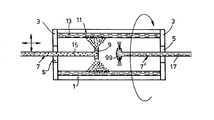
- the figure shows a schematic representation of a centrifuge arrangement with a hollow shape for the production of tubular bodies after the invention.
- a liquid phase 17 is first introduced and by centrifugation evenly in the form of a liquid film 13 on the Distributed inner wall 11 of the tube used as a hollow mold 1.
- a metering device movable in the axial and radial direction in the form of at least one tube 7 with outlet openings 9 feeds powdery starting material 15 to the interior of the tube acting as a hollow mold 1.
- the solid particles are driven onto the liquid film 13 by centrifugal forces, where wetting can take place and the fine particles are coated with dispersant and are prevented from premature coagulation.
- the solid particles drift separately from one another in the direction of the inner wall 11 of the hollow mold 1, where they are deposited with a high packing density (50 to 90% of the theoretically possible packing density).
- the gaps remain with the liquid phase, e.g. Contains dispersants and a binder.
- the solid particle input can be continuously shifted in the axial direction.
- the addition of the liquid phase 17 can also be carried out continuously via a separate metering device in the form of a further tube 7 'via a nozzle 99 and can be dimensioned such that the separated solid particle layer is always only covered with a thin film of liquid is.
- the process time can be considerably reduced compared to a single addition of the required liquid phase, since the deposition time is proportional to the viscosity of the liquid and the film thickness. This measure minimizes the separation of solid particles of different densities and dimensions.
- the hollow mold to be coated on the inside can be rotated about its longitudinal axis in both the horizontal and vertical position.
- a rotating, high-strength metal pipe e.g. made of steel or aluminum, with a total length of 160 mm and an outer diameter of 60 mm, the end faces of which are provided with removable aperture diaphragms with a thickness of 5 mm, at a rotation frequency of initially 1000 rpm introduced about 120 ml of a 15% polyvinyl alcohol solution (degree of polymerization 350).
- the liquid After the liquid has been uniformly distributed over the inner wall of the tube, the liquid is moved in the axial direction Dosing device 210 g of finely divided, highly disperse S i0 2 powder at a dosing rate of 1 g / min, also distributed evenly by moving the dosing device back and forth at a speed of 5 m / min while increasing the rotation frequency of the tube to 30,000 rpm. After sedimentation of the solid particles under centrifugal acceleration, which in this case is about 20,000 times greater than the acceleration due to gravity, the excess liquid film lying above the separator is suctioned off and the separated green body by slightly heating the substrate tube, for example to 50 to 100 ° C. demolded.
- a thin layer of a sliding film is recommended at the beginning of the process on the inner wall of the tube, eg from paraffin.
- the green body obtained in this way is characterized by great geometric accuracy and an almost location-independent density. The latter and the fact that after drying at 120 ° C and expulsion of the binder by slow heating to 500 0 C at a heating rate of 150 ° C / h, a small open pore structure is available, a subsequent chlorine cleaning of the green body and the sintering possible to quartz glass tubes.
- Impurities can be, for example, H 2 0 or disruptive metal compounds.
- Such impurities have been removed at 800 0 C in a saturated at room temperature with SOC1 2 0 2 flow a flow rate of 1 to 2 1 / min.
- the impurities are chlorinated and escape as a volatile phase.
- the sintering of the slightly open-pore green body to transparent, bubble-free glass was carried out at 1500 ° C with a lowering speed of 3mm / min under a helium / chlorine (1 to 3%) atmosphere of a pressure of 10 5 Pa and a flow rate of 1 1 / min .
- a high-purity, transparent quartz glass tube with a high surface quality was obtained by this process.
- An accelerated production of green bodies based on SiO 2 / binder can be achieved in such a way that the liquid phase (see Example 1) is also continuously fed during the addition of solid particles, such that only a thin film of liquid (1 mm, preferably 10 up to 100pm) above the already separated solid particles.
- This measure makes it possible, on the one hand, to increase the speed of adding solid particles to 5 g / min without problems and, furthermore, to reduce segregation of different sizes of solid particles during the short sedimentation time.
- the demolding from the hollow mold can be carried out by heating the hollow mold to approximately 100 to 150 ° C.
- thermoplastic or thermosetting plastics instead of a hydrophobic liquid as the binder, it is also advantageous to use thermoplastic or thermosetting plastics as the dispersion matrix and binder. It has proven to be interesting to use UV-curing lacquers which are thin at room temperature and only harden when exposed to UV radiation.
- pipes can also be produced from any other materials, e.g. made of aluminum oxide or iron.
- Highly pure and dimensionally accurate quartz tubes as can be produced by the present method, can be used in the production of optical waveguides, but also in the production of halogen and gas discharge lamps.
Landscapes
- Chemical & Material Sciences (AREA)
- Engineering & Computer Science (AREA)
- Manufacturing & Machinery (AREA)
- Materials Engineering (AREA)
- Organic Chemistry (AREA)
- Life Sciences & Earth Sciences (AREA)
- General Life Sciences & Earth Sciences (AREA)
- Geochemistry & Mineralogy (AREA)
- Dispersion Chemistry (AREA)
- Manufacturing Of Tubular Articles Or Embedded Moulded Articles (AREA)
- Glass Melting And Manufacturing (AREA)
- Manufacture, Treatment Of Glass Fibers (AREA)
Applications Claiming Priority (2)
| Application Number | Priority Date | Filing Date | Title |
|---|---|---|---|
| DE3406148 | 1984-02-21 | ||
| DE19843406148 DE3406148A1 (de) | 1984-02-21 | 1984-02-21 | Verfahren zur herstellung von rohrfoermigen koerpern und vorrichtung zur durchfuehrung des verfahrens |
Publications (3)
| Publication Number | Publication Date |
|---|---|
| EP0153785A2 true EP0153785A2 (fr) | 1985-09-04 |
| EP0153785A3 EP0153785A3 (en) | 1987-05-27 |
| EP0153785B1 EP0153785B1 (fr) | 1989-07-12 |
Family
ID=6228324
Family Applications (1)
| Application Number | Title | Priority Date | Filing Date |
|---|---|---|---|
| EP85200214A Expired EP0153785B1 (fr) | 1984-02-21 | 1985-02-20 | Procédé de fabrication de corps tubulaires et dispositif pour le mise en oeuvre de ce procédé |
Country Status (5)
| Country | Link |
|---|---|
| US (1) | US5182052A (fr) |
| EP (1) | EP0153785B1 (fr) |
| JP (1) | JPS60215533A (fr) |
| CA (1) | CA1247321A (fr) |
| DE (2) | DE3406148A1 (fr) |
Cited By (16)
| Publication number | Priority date | Publication date | Assignee | Title |
|---|---|---|---|---|
| US4900497A (en) * | 1987-02-05 | 1990-02-13 | Leda Logarithmic Electrical Devices For Automation S.R.L. | Process for producing electric resistors having a wide range of specific resistance values |
| EP1016636A1 (fr) * | 1998-12-28 | 2000-07-05 | Hoya Corporation | Procédé de fabrication d une preforme pour fibres optiques et procédé de fabrication d une fibre optique |
| WO2000038897A1 (fr) * | 1998-12-23 | 2000-07-06 | Kingspan Research And Developments Limited | Procede de moulage rotatif et appareil correspondant |
| US6713601B2 (en) | 2000-09-12 | 2004-03-30 | Cyclics Corporation | Species modification in macrocyclic polyester oligomers, and compositions prepared thereby |
| US6855798B2 (en) | 2000-09-01 | 2005-02-15 | Cyclics Corporation | Methods for converting linear polyesters to macrocyclic oligoester compositions and macrocyclic oligoesters |
| US6906147B2 (en) | 2002-03-20 | 2005-06-14 | Cyclics Corporation | Catalytic systems |
| US6960626B2 (en) | 2000-01-21 | 2005-11-01 | Cyclics Corporation | Intimate physical mixtures containing macrocyclic polyester oligomer and filler |
| US6962968B2 (en) | 2002-12-20 | 2005-11-08 | Cyclics Corporation | Purification of macrocyclic oligoesters |
| US6994914B2 (en) | 2000-01-21 | 2006-02-07 | Cyclics Corporation | Macrocyclic polyester oligomers and processes for polymerizing the same |
| US7071291B2 (en) | 2001-06-27 | 2006-07-04 | Cyclics Corporation | Isolation, formulation and shaping of macrocyclic oligoesters |
| US7151143B2 (en) | 2000-01-21 | 2006-12-19 | Cyclics Corporation | Blends containing macrocyclic polyester oligomer and high molecular weight polymer |
| US7256241B2 (en) | 2000-01-21 | 2007-08-14 | Cyclics Corporation | Methods for polymerizing macrocyclic polyester oligomers using catalyst promoters |
| US7304123B2 (en) | 2001-06-27 | 2007-12-04 | Cyclics Corporation | Processes for shaping macrocyclic oligoesters |
| US7615511B2 (en) | 2001-10-09 | 2009-11-10 | Cyclics Corporation | Organo-titanate catalysts for preparing pure macrocyclic oligoesters |
| US7750109B2 (en) | 2000-09-01 | 2010-07-06 | Cyclics Corporation | Use of a residual oligomer recyclate in the production of macrocyclic polyester oligomer |
| US7767781B2 (en) | 2000-09-01 | 2010-08-03 | Cyclics Corporation | Preparation of low-acid polyalkylene terephthalate and preparation of macrocyclic polyester oligomer therefrom |
Families Citing this family (9)
| Publication number | Priority date | Publication date | Assignee | Title |
|---|---|---|---|---|
| DE3702025A1 (de) * | 1987-01-24 | 1988-08-04 | Philips Patentverwaltung | Verfahren und vorrichtung zur herstellung von rotationssymmetrischen poroesen festkoerpern |
| DE19844023A1 (de) * | 1998-09-25 | 2000-04-20 | Alcatel Sa | Vorrichtung zum Beschichten einer optischen Faser |
| ATE331599T1 (de) * | 2000-05-12 | 2006-07-15 | Matregen Corp | Verfahren zur herstellung von strukturen durch gebrauch von zentrifugalen kräften |
| US7797966B2 (en) * | 2000-12-29 | 2010-09-21 | Single Crystal Technologies, Inc. | Hot substrate deposition of fused silica |
| US20020083739A1 (en) * | 2000-12-29 | 2002-07-04 | Pandelisev Kiril A. | Hot substrate deposition fiber optic preforms and preform components process and apparatus |
| US20020083740A1 (en) * | 2000-12-29 | 2002-07-04 | Pandelisev Kiril A. | Process and apparatus for production of silica grain having desired properties and their fiber optic and semiconductor application |
| US20020117625A1 (en) * | 2001-02-26 | 2002-08-29 | Pandelisev Kiril A. | Fiber optic enhanced scintillator detector |
| US7021083B2 (en) * | 2003-01-29 | 2006-04-04 | Fitel Usa Corp. | Manufacture of high purity glass tubes |
| CN101708950B (zh) * | 2009-12-02 | 2012-06-06 | 单军成 | 一种低羟基紫色石英管及其生产方法 |
Family Cites Families (12)
| Publication number | Priority date | Publication date | Assignee | Title |
|---|---|---|---|---|
| US2714227A (en) * | 1950-09-11 | 1955-08-02 | Corning Glass Works | Method of making fritted glass tubes |
| GB682580A (en) * | 1950-09-11 | 1952-11-12 | Corning Glass Works | Method of making fritted glass tubes |
| US3150219A (en) * | 1959-08-25 | 1964-09-22 | Schmidt William Karl | Process of making plastic pipes |
| US3689614A (en) * | 1970-01-28 | 1972-09-05 | Abex Corp | Centrifugal molding of ceramic tubes containing metal fibers |
| DE2263589C2 (de) * | 1972-12-27 | 1974-05-30 | Heraeus Schott Quarzschmelze Gmbh, 6450 Hanau | Verfahren zum Herstellen von Hohlzylindern, insbesondere von Rohren, aus Quarzglas und Vorrichtung zur Durchführung des Verfahrens |
| DE2637937A1 (de) * | 1976-08-23 | 1978-03-02 | Siemens Ag | Herstellung von lichtleitfasern nach einem fluessigphasen-abscheidungsverfahren |
| FR2429040A1 (fr) * | 1978-06-23 | 1980-01-18 | Editions Filmees | Procede de fabrication de preforme pour fibres optiques |
| IT1119362B (it) * | 1979-09-10 | 1986-03-10 | Cselt Centro Studi Lab Telecom | Procedimento ed apparecchiatura per la produzione di preforme per fibre ottiche |
| FR2473497B2 (fr) * | 1980-01-09 | 1985-07-05 | Editions Filmees | Procede et installation de fabrication de preforme pour fibres optiques |
| FR2490211B1 (fr) * | 1980-09-17 | 1990-09-21 | Passaret Michel | |
| DE3240355C1 (de) * | 1982-11-02 | 1983-11-17 | Heraeus Quarzschmelze Gmbh, 6450 Hanau | Verfahren zur Herstellung eines laenglichen Glaskoerpers mit inhomogener Brechungsindexverteilung |
| DE3702025A1 (de) * | 1987-01-24 | 1988-08-04 | Philips Patentverwaltung | Verfahren und vorrichtung zur herstellung von rotationssymmetrischen poroesen festkoerpern |
-
1984
- 1984-02-21 DE DE19843406148 patent/DE3406148A1/de active Granted
-
1985
- 1985-02-14 CA CA000474303A patent/CA1247321A/fr not_active Expired
- 1985-02-15 US US06/702,206 patent/US5182052A/en not_active Expired - Fee Related
- 1985-02-20 EP EP85200214A patent/EP0153785B1/fr not_active Expired
- 1985-02-20 DE DE8585200214T patent/DE3571429D1/de not_active Expired
- 1985-02-21 JP JP60031642A patent/JPS60215533A/ja active Granted
Cited By (21)
| Publication number | Priority date | Publication date | Assignee | Title |
|---|---|---|---|---|
| US4900497A (en) * | 1987-02-05 | 1990-02-13 | Leda Logarithmic Electrical Devices For Automation S.R.L. | Process for producing electric resistors having a wide range of specific resistance values |
| WO2000038897A1 (fr) * | 1998-12-23 | 2000-07-06 | Kingspan Research And Developments Limited | Procede de moulage rotatif et appareil correspondant |
| EP1016636A1 (fr) * | 1998-12-28 | 2000-07-05 | Hoya Corporation | Procédé de fabrication d une preforme pour fibres optiques et procédé de fabrication d une fibre optique |
| US6994914B2 (en) | 2000-01-21 | 2006-02-07 | Cyclics Corporation | Macrocyclic polyester oligomers and processes for polymerizing the same |
| US7230044B2 (en) | 2000-01-21 | 2007-06-12 | Cyclics Corporation | Intimate physical mixtures containing macrocyclic polyester oligomer and filler |
| US7151143B2 (en) | 2000-01-21 | 2006-12-19 | Cyclics Corporation | Blends containing macrocyclic polyester oligomer and high molecular weight polymer |
| US6960626B2 (en) | 2000-01-21 | 2005-11-01 | Cyclics Corporation | Intimate physical mixtures containing macrocyclic polyester oligomer and filler |
| US7256241B2 (en) | 2000-01-21 | 2007-08-14 | Cyclics Corporation | Methods for polymerizing macrocyclic polyester oligomers using catalyst promoters |
| US7022806B2 (en) | 2000-09-01 | 2006-04-04 | Cyclics Corporation | Methods for converting linear polyesters to macrocyclic oligoester compositions and macrocyclic oligoesters |
| US7750109B2 (en) | 2000-09-01 | 2010-07-06 | Cyclics Corporation | Use of a residual oligomer recyclate in the production of macrocyclic polyester oligomer |
| US7309756B2 (en) | 2000-09-01 | 2007-12-18 | Cyclics Corporation | Methods for converting linear polyesters to macrocyclic oligoester compositions and macrocyclic oligoesters |
| US7767781B2 (en) | 2000-09-01 | 2010-08-03 | Cyclics Corporation | Preparation of low-acid polyalkylene terephthalate and preparation of macrocyclic polyester oligomer therefrom |
| US6855798B2 (en) | 2000-09-01 | 2005-02-15 | Cyclics Corporation | Methods for converting linear polyesters to macrocyclic oligoester compositions and macrocyclic oligoesters |
| US6713601B2 (en) | 2000-09-12 | 2004-03-30 | Cyclics Corporation | Species modification in macrocyclic polyester oligomers, and compositions prepared thereby |
| US7304123B2 (en) | 2001-06-27 | 2007-12-04 | Cyclics Corporation | Processes for shaping macrocyclic oligoesters |
| US7071291B2 (en) | 2001-06-27 | 2006-07-04 | Cyclics Corporation | Isolation, formulation and shaping of macrocyclic oligoesters |
| US7666517B2 (en) | 2001-06-27 | 2010-02-23 | Cyclics Corporation | Isolation, formulation, and shaping of macrocyclic oligoesters |
| US7615511B2 (en) | 2001-10-09 | 2009-11-10 | Cyclics Corporation | Organo-titanate catalysts for preparing pure macrocyclic oligoesters |
| US7186666B2 (en) | 2002-03-20 | 2007-03-06 | Cyclics Corporation | Catalytic systems |
| US6906147B2 (en) | 2002-03-20 | 2005-06-14 | Cyclics Corporation | Catalytic systems |
| US6962968B2 (en) | 2002-12-20 | 2005-11-08 | Cyclics Corporation | Purification of macrocyclic oligoesters |
Also Published As
| Publication number | Publication date |
|---|---|
| JPH0475172B2 (fr) | 1992-11-30 |
| DE3406148C2 (fr) | 1987-09-03 |
| DE3571429D1 (en) | 1989-08-17 |
| CA1247321A (fr) | 1988-12-28 |
| US5182052A (en) | 1993-01-26 |
| EP0153785B1 (fr) | 1989-07-12 |
| DE3406148A1 (de) | 1985-09-05 |
| JPS60215533A (ja) | 1985-10-28 |
| EP0153785A3 (en) | 1987-05-27 |
Similar Documents
| Publication | Publication Date | Title |
|---|---|---|
| EP0153785B1 (fr) | Procédé de fabrication de corps tubulaires et dispositif pour le mise en oeuvre de ce procédé | |
| EP1210294B1 (fr) | DISPERSION DE SiO2 A HAUT COEFFICIENT DE CHARGE, PROCEDES PERMETTANT DE LA PREPARER | |
| DE69322331T2 (de) | Herstellen eines Silicaglasproduktes durch ein Sol-Gel-Verfahren | |
| EP0187405A2 (fr) | Procédé pour la fabrication de fibres optiques | |
| EP1074513A2 (fr) | Matériaux frittés et leurs procédés de fabrication et leurs utilisations, dispersions de granules de silice et leurs utilisations, ainsi que utilisations de granules de silice | |
| DE29823926U1 (de) | Lichtwellenleiterglashalbzeug und Vorrichtung zur Herstellung eines rohrförmigen Gliedes zur Lichtwellenleiterproduktion | |
| EP0276886B1 (fr) | Procédé et dispositif de fabrication de corps solides poreux à symétrie de révolution | |
| EP1324959B1 (fr) | Corps faconne en sio2, postcompacte electrophoretiquement, procede de fabrication et utilisation dudit corps | |
| EP0209927B1 (fr) | Procédé de préparation de corps en verre | |
| EP0200243B1 (fr) | Procédé et dispositif pour la fabrication de corps en verre | |
| EP0200242B1 (fr) | Procédé et dispositif pour la fabrication de corps en verre | |
| DE69815324T2 (de) | Verfahren zur herstellung von hochreinem quarzglas durch ein sol-gelverfahren | |
| EP0249278B1 (fr) | Procédé de production de corps en verre ou céramique | |
| EP0220774A1 (fr) | Procédé de préparation d'objets en verre à symétrie de révolution | |
| EP0197586A2 (fr) | Procédé et dispositifs pour la fabrication de corps en verre | |
| DE69126689T2 (de) | Verfahren und Vorrichtung zum Herstellen einer optischen Wellenleitervorform aus Silicaglas | |
| DE69809167T2 (de) | Verfahren zum Herstellen eines Körpers aus Silica durch Extrusion eines Sol-gels | |
| EP0196718B1 (fr) | Procédé et dispositif pour la fabrication de corps en verre | |
| EP2118646A1 (fr) | Revêtement pour colonnes chromatographiques monolithiques | |
| EP0265024B1 (fr) | Procédé de fabrication de corps de forme en céramique ou en verre | |
| EP0209945B1 (fr) | Procédé de fabrication de fibres optiques | |
| EP1444174B1 (fr) | Procede de production d'un revetement sur une fibre creuse | |
| DE3805193C2 (fr) | ||
| EP1843155B1 (fr) | Fabrication de colonnes de séparation monolithiques | |
| EP1754053B1 (fr) | Capillaires tubulaires ouverts comportant une couche de connexion |
Legal Events
| Date | Code | Title | Description |
|---|---|---|---|
| PUAI | Public reference made under article 153(3) epc to a published international application that has entered the european phase |
Free format text: ORIGINAL CODE: 0009012 |
|
| AK | Designated contracting states |
Designated state(s): DE FR GB IT NL |
|
| PUAL | Search report despatched |
Free format text: ORIGINAL CODE: 0009013 |
|
| AK | Designated contracting states |
Kind code of ref document: A3 Designated state(s): DE FR GB IT NL |
|
| 17P | Request for examination filed |
Effective date: 19870720 |
|
| RAP1 | Party data changed (applicant data changed or rights of an application transferred) |
Owner name: N.V. PHILIPS' GLOEILAMPENFABRIEKEN Owner name: PHILIPS PATENTVERWALTUNG GMBH |
|
| 17Q | First examination report despatched |
Effective date: 19880511 |
|
| GRAA | (expected) grant |
Free format text: ORIGINAL CODE: 0009210 |
|
| AK | Designated contracting states |
Kind code of ref document: B1 Designated state(s): DE FR GB IT NL |
|
| REF | Corresponds to: |
Ref document number: 3571429 Country of ref document: DE Date of ref document: 19890817 |
|
| ITF | It: translation for a ep patent filed | ||
| GBT | Gb: translation of ep patent filed (gb section 77(6)(a)/1977) | ||
| ET | Fr: translation filed | ||
| ITTA | It: last paid annual fee | ||
| PGFP | Annual fee paid to national office [announced via postgrant information from national office to epo] |
Ref country code: NL Payment date: 19900228 Year of fee payment: 6 |
|
| PLBE | No opposition filed within time limit |
Free format text: ORIGINAL CODE: 0009261 |
|
| STAA | Information on the status of an ep patent application or granted ep patent |
Free format text: STATUS: NO OPPOSITION FILED WITHIN TIME LIMIT |
|
| 26N | No opposition filed | ||
| PG25 | Lapsed in a contracting state [announced via postgrant information from national office to epo] |
Ref country code: NL Effective date: 19910901 |
|
| NLV4 | Nl: lapsed or anulled due to non-payment of the annual fee | ||
| REG | Reference to a national code |
Ref country code: FR Ref legal event code: CD |
|
| PGFP | Annual fee paid to national office [announced via postgrant information from national office to epo] |
Ref country code: GB Payment date: 19960131 Year of fee payment: 12 |
|
| PGFP | Annual fee paid to national office [announced via postgrant information from national office to epo] |
Ref country code: FR Payment date: 19960228 Year of fee payment: 12 |
|
| PGFP | Annual fee paid to national office [announced via postgrant information from national office to epo] |
Ref country code: DE Payment date: 19960424 Year of fee payment: 12 |
|
| PG25 | Lapsed in a contracting state [announced via postgrant information from national office to epo] |
Ref country code: GB Effective date: 19970220 |
|
| GBPC | Gb: european patent ceased through non-payment of renewal fee |
Effective date: 19970220 |
|
| PG25 | Lapsed in a contracting state [announced via postgrant information from national office to epo] |
Ref country code: FR Effective date: 19971030 |
|
| PG25 | Lapsed in a contracting state [announced via postgrant information from national office to epo] |
Ref country code: DE Effective date: 19971101 |
|
| REG | Reference to a national code |
Ref country code: FR Ref legal event code: ST |