EP0154182A2 - Elektronische Schaltung geeignet zur Ausführung einer Reihe von Divisionen ohne unzulässige Fehler - Google Patents
Elektronische Schaltung geeignet zur Ausführung einer Reihe von Divisionen ohne unzulässige Fehler Download PDFInfo
- Publication number
- EP0154182A2 EP0154182A2 EP85101228A EP85101228A EP0154182A2 EP 0154182 A2 EP0154182 A2 EP 0154182A2 EP 85101228 A EP85101228 A EP 85101228A EP 85101228 A EP85101228 A EP 85101228A EP 0154182 A2 EP0154182 A2 EP 0154182A2
- Authority
- EP
- European Patent Office
- Prior art keywords
- quotient
- partial
- provisional
- quotients
- divisor
- Prior art date
- Legal status (The legal status is an assumption and is not a legal conclusion. Google has not performed a legal analysis and makes no representation as to the accuracy of the status listed.)
- Granted
Links
Images


Classifications
-
- G—PHYSICS
- G06—COMPUTING OR CALCULATING; COUNTING
- G06F—ELECTRIC DIGITAL DATA PROCESSING
- G06F7/00—Methods or arrangements for processing data by operating upon the order or content of the data handled
- G06F7/38—Methods or arrangements for performing computations using exclusively denominational number representation, e.g. using binary, ternary, decimal representation
- G06F7/48—Methods or arrangements for performing computations using exclusively denominational number representation, e.g. using binary, ternary, decimal representation using non-contact-making devices, e.g. tube, solid state device; using unspecified devices
- G06F7/52—Multiplying; Dividing
- G06F7/535—Dividing only
-
- G—PHYSICS
- G06—COMPUTING OR CALCULATING; COUNTING
- G06F—ELECTRIC DIGITAL DATA PROCESSING
- G06F7/00—Methods or arrangements for processing data by operating upon the order or content of the data handled
- G06F7/38—Methods or arrangements for performing computations using exclusively denominational number representation, e.g. using binary, ternary, decimal representation
- G06F7/48—Methods or arrangements for performing computations using exclusively denominational number representation, e.g. using binary, ternary, decimal representation using non-contact-making devices, e.g. tube, solid state device; using unspecified devices
- G06F7/491—Computations with decimal numbers radix 12 or 20.
- G06F7/4915—Multiplying; Dividing
- G06F7/4917—Dividing
-
- G—PHYSICS
- G06—COMPUTING OR CALCULATING; COUNTING
- G06F—ELECTRIC DIGITAL DATA PROCESSING
- G06F7/00—Methods or arrangements for processing data by operating upon the order or content of the data handled
- G06F7/38—Methods or arrangements for performing computations using exclusively denominational number representation, e.g. using binary, ternary, decimal representation
- G06F7/48—Methods or arrangements for performing computations using exclusively denominational number representation, e.g. using binary, ternary, decimal representation using non-contact-making devices, e.g. tube, solid state device; using unspecified devices
- G06F7/52—Multiplying; Dividing
- G06F7/535—Dividing only
- G06F7/537—Reduction of the number of iteration steps or stages, e.g. using the Sweeny-Robertson-Tocher [SRT] algorithm
- G06F7/5375—Non restoring calculation, where each digit is either negative, zero or positive, e.g. SRT
Definitions
- This invention relates to an electronic circuit for use in dividing a dividend by a divisor to calculate a quotient and, in particular, to an electronic circuit capable of calculating the quotient by the use of an approximate reciprocal of the divisor.
- an electronic circuit of the type described is proposed by H. Matsumoto in Japanese Unexamined Patent Publication No. Syo 57-41,737, namely, 41,737/1982.
- the electronic circuit it is possible to calculate an eventual quotient which has a plurality of digits, N in number, for g-ary numbers and which is divisible into first through N-th partial quotients for the respective digits.
- the proposed electronic circuit carries out current division between a dividend and a divisor with reference to an approximate reciprocal of the divisor and a correction factor which is given by a product between the approximate reciprocal and the divisor and is therefore nearly equal to unity.
- the correction factor is therefore calculated by a multiplying circuit.
- the dividend is multiplied by the approximate reciprocal by the multiplying circuit to produce a primitive quotient which is equal to a product between the dividend and the approximate reciprocal.
- the primitive quotient is processed by the multiplying circuit into the first through the N-th partial quotients in accordance with a predetermined algorithm.
- the multiplying circuit may be an adder and should repeatedly be used to calculate the correction factor, the primitive quotients, and so-on. Consequently, the next following division can not be started until the current division is finished. Thus, the electronic circuit can not achieve a high throughput on processing the division.
- An electronic circuit to which this invention is applicable is for use in dividing a dividend by a divisor to calculate an eventual quotient which has a plurality of digits, N in number, and is divisible into first through N-th partial quotients for the respective digits.
- the electronic circuit includes reciprocal calculating means responsive to the divisor for calculating an approximate reciprocal of the divisor.
- the electronic circuit comprises first calculating means responsive to the divisor and the approximate reciprocal for calculating a correction factor which is equal to a product of the divisor and the approximate reciprocal, second calculating means responsive to the dividend and the approximate reciprocal for calculating a first provisional quotient which is equal to a product of the dividend and the approximate reciprocal, processing means responsive to the correction factor and the first provisional quotient for processing the first provisional quotient with reference to the correction factor to produce a succession of the first through the N-th partial quotients, and collecting means for collecting the succession of first through N-th partial quotients into the eventual quotient.
- a conventional electronic circuit will be described for a better understanding of this invention.
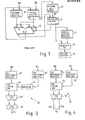
- the illustrated electronic circuit is substantially equivalent to that mentioned in the preamble of the instant specification and is supplied with a dividend RR and a divisor RD to produce an eventual or final quotient Q which has a plurality of digits, N in number, and which is divisible into first through N-th partial quotients Q 1 , Q 2 , ..., and Q for the respective digits.
- each digit be represented by a g-ary number having a base of g.
- each of the dividend RR and the divisor RD is also of the g-ary number.
- each of the dividend RR, the divisor RD, and the partial quotients Q i is represented by a hexadecimal number and given in the form of a binary electric signal.
- the base g is equal to sixteen and each digit can be represented by four bits.
- the dividend RR and the divisor RD are at first kept in a dividend register 11 and a divisor register 12 in a known manner, respectively.
- the divisor RD is partially sent to a reciprocal table memory 14 which memorizes a reciprocal table for conversion of various divisors into the corresponding approximate reciprocals. Accessed by a part of the divisor RD, the reciprocal table memory 14 produces a selected one of the approximate reciprocals.
- the selected approximate reciprocal is supplied to an arithmetic logic unit (ALU) 15 through a multiplier register 16.
- ALU arithmetic logic unit
- the divisor RD is multiplied by the selected approximate reciprocal to calculate a correction factor C which is near to unity.
- the dividend RR is multiplied by the selected approximate reciprocal to calculate a first provisional quotient R 1 which has a plurality of digits and which may approximate the eventual quotient Q.
- a rounding operation is carried out as regards the first provisional quotient R 1 to derive a first partial provisional quotient P1 from the first provisional quotient R l .
- a second provisional quotient R 2 is calculated with reference to the correction factor C, the first provisional quotient R 1 , and the first partial provisional quotient P 1 .
- the first partial provisional quotient P I is modified into the first partial quotient Q 1 with reference to the first partial provisional quotient P 1 and the second provisional quotient R 2 in a manner disclosed by H. Matsumoto.
- an i-th provisional quotient R i is calculated from an (i - l)-th provisional quotient R i-1 , an (i - l)-th partial provisional quotient P i-1 , and the correction factor C in accordance with a recurrence formula given by:
- the above-mentioned calculation is carried out by the use of the arithmetic logic unit 15.
- the arithmetic logic unit 15 is successively and repeatedly operated to calculate the correction factor C, the provisional quotients R (suffix omitted), the partial provisional quotients P and the like.
- the arithmetic logic unit 15 is supplied with first, second, and third input signals depicted at A, B, and M and can selectively carry out calculations as will become clear as the description proceeds.
- the selected approximate reciprocal and the divisor RD are supplied from the multiplier register 16 and the divisor register 12 to the arithmetic logic unit 15.
- the arithmetic logic unit 15 calculates a product of the selected approximate reciprocal and the divisor RD with the selected approximate reciprocal left in the multiplier register 16.
- the product is representative of the correction factor C and is kept in the divisor register 12.
- the correction factor C takes a negative value in consideration of procedure to-be.
- the dividend RR and the selected approximate reciprocal are supplied to the arithmetic logic unit 15 as the second and the third input signals B and M from the dividend register 11 and the multiplier register 16 respectively. Multiplication is carried out between the dividend RR and the selected approximate reciprocal in the arithmetic logic unit 15 to calculate the first provisional quotient R 1 .
- the first provisional quotient R 1 is delivered to the dividend register 11 to be stored therein.
- the first provisional quotient R 1 is sent to the arithmetic logic unit 15 to be subjected to the rounding operation.
- the rounding operation is carried out at a predetermined digit with reference to the number of g.
- the first partial provisional quotient P1 is calculated by the arithmetic logic unit 15 to be delivered to the multiplier register 16.
- the first partial provisional quotient P 1 is sent to a partial quotient register 17 with the first partial quotient P 1 left in the multiplier register 16.
- the arithmetic logic unit 15 calculates the second provisional quotient R 2 in accordance with the recurrence formula (1) in response to the first provisional quotient R 1 , the first partial provisional quotient P 1 , and the correction factor C.
- the second provisional quotient R 2 is delivered from the arithmetic logic unit 15 to the dividend register 11.
- the second provisional quotient R 2 is further delivered to the arithmetic logic unit 15 with the second provisional quotient R 2 kept in the dividend register 11.
- the rounding operation is again carried out to derive the second partial provisional quotient P 2 from the second provisional quotient R 2 .
- the second partial provisional quotient P 2 is sent to the multiplier register 16.
- a correction circuit 18 modifies the first partial provisional quotient P 1 into the first partial quotient Q1 in consideration of the second partial provisional quotient P 2 .
- the first partial quotient Q 1 is kept in a quotient register 19.
- the arithmetic logic unit 15 should be successively and iteratively put into operation during carrying out the division. Therefore, the division is time consuming with the illustrated electronic circuit.
- an electronic circuit according to a preferred embodiment of this invention is similar in operation to that illustrated in Fig. 1 except that a succession of divisions can continuously be carried out in the electronic circuit of Fig. 2. This means that, when a current one of the divisions is succeeded by the following division, the following division can be started before completion of the current division.
- the electronic circuit illustrated in Fig. 2 comprises first and second registers 31 and 32 which are loaded with the dividend RR and the divisor RD in the known manner, respectively.
- each of the dividend RR and the divisor RD is assumed to be a hexadecimal number and to be represented by a binary number of four bits. It is also assumed that the dividend RR is normalized within a range smaller than 2 3 while the divisor RD is normalized within another range smaller than unity and not smaller than 2 -1 .
- the first and the second registers 31 and 32 be loaded with (02) 16 and (O.AE) 16 as the dividend RR and the divisor RD, respectively.
- the divisor RD is partially sent to a memory which is similar to the reciprocal table memory 14 illustrated in Fig. 1 and which is indicated at 34. Accessed by the divisor RD, the memory 34 produces an approximate reciprocal RC corresponding to the divisor RD.
- the approximate reciprocal RC may be equal to (1.78) 16 corresponding to (O.AE) 16 .
- the approximate reciprocal RC is delivered from the memory 34 to first and second multiplication circuit 36 and 37.
- the first multiplication circuit 36 multiplies the divisor RD by the approximate reciprocal RC to calculate a correction factor (depicted at C1) which is equal to a product of the approximate reciprocal RC and the divisor RD.
- the correction factor C l is equal to (-O.AE) 16 x (1.78) 16 , namely, (-0.FF)16.
- the approximate reciprocal RC is given to the first calculation circuit 36 in the form of a negative number so as to facilitate the following procedure. Production of the negative number is possible in the known manner and will not be described any longer. Let the illustrated multiplication circuit 36 be operable in accordance with Booth algorithm known in the art.
- first and second additional registers 41 and 42 are loaded with the divisor RD and the approximate reciprocal RC, respectively.
- the approximate reciprocal RC is assumed to be represented by eight parallel bits of m 0 , m l , ..., and m 7 and to take the form of (m 0 m 1 .m 2 m 3 m 4 m 5 m 6 m 7 ) 2 .
- the approximate reciprocal RC is sent to a complement calculator, namely, complementor 44 to calculate that complement of the approximate reciprocal RC which may be two's complement.
- the complementor 44 In order to stand for the two's complement of the approximate reciprocal RC, the complementor 44 at first calculates one's complement of the approximate reciprocal RC given by ( m 0 m 1 m 2 m 3 m 4 m 5 m 6 m 7 ) 2 and adds an extra bit m 8 to the one's complement with a logic "1" level kept at the extra bit m 8 .
- the two's complement is represented by nine parallel bits m 0 through m 8 .
- the two's complement of the approximate reciprocal RC serves as a multiplier while the divisor RD serves as a multiplicand.
- the Booth algorithm is useful for reducing the number of partial products inevitably occurring on carrying out multiplication.
- the multiplier is divided into a plurality of bit groups each of which consists of three bits and which can take eight kinds of patterns. Predetermined multiplying factors are assigned to the respective patterns in accordance with Table 1.
- a first factor generator 46 assigns a selected one of the multiplying factors listed on Table 1 to each bit group of the two's complement in consideration of each pattern of the bit groups.
- the selected multiplying factors are multiplied by weights determined with reference to positions of the bit groups. In the example being illustrated, the weights of 1, 2 -2 , 2 -4 , and 2 6 are assigned to the respective groups in the following manner.
- the selected multiplying factors multiplied by the weights serve as partial multipliers by which the dividend RR given as the multiplicand is multiplied in the first factor generator 46.
- a set of partial products are sent from the first factor generator 46 to a carry saving adder (CSA) 48 of a multiple input type.
- the carry saving adder 48 calculates a sum of the partial products independently of a carry resulting from the calculation in the known manner to produce an end sum and an end carry.
- the end sum and the end carry are summed up in a carry lookahead adder (CLA) 49 to be produced as the correction factor C 1 equal to (- O.FF9 ) 16 ..
- CLA carry lookahead adder
- the second multiplication circuit 37 is operable simultaneously with the first multiplication circuit 36 in response to the dividend RR and the approximate reciprocal RC.
- the dividend RR and the approximate reciprocal RC are stored in first and second subsidiary registers 51 and 52, respectively, and sent to a second factor generator 54.
- the second factor generator 54 is operable in a manner similar to the first factor generator 46 to produce additional partial products in consideration of the multiplying factors listed on Table 1 and the weights as mentioned before.
- the additional partial products are supplied to an additional carry saving adder 56 of a multiple input type to be summed up.
- the additional carry saving adder 56 produces a first sum RS 1 of the partial products and a first carry CA 1 both of which appear as a first provisional quotient R 1 equal to a product of the dividend RR and the approximate reciprocal RC.
- the illustrated second multiplication circuit 37 carries out multiplication of (02) 16 and (1.78)16 given as the dividend RR and the approximate reciprocal RC, respectively, to produce the first provisional quotient R 1 equal to (2.FO)16.
- the approximate reciprocal RC of (1.78) 16 is represented by eight bits of (10.111100) 2 in the binary notation and is stored in the second subsidiary register 52.
- first through fourth ones (101), (111), (110), and (000) of the bit groups are successively formed from the most significant bit of the approximate reciprocal RC to the extra bit thereof and given the multiplying factors of -1, 0, -1, and 0, respectively, in accordance with Table 1.
- the multiplying factors of -1, 0, -1, and 0 are multiplied by 2 0 , 2 -2 , 2 -4 , and 2 -6 to produce first through fourth partial reciprocals, respectively.
- the dividend RR of ( 02 ) 16 is represented by (000010.0) 2 in the binary notation and is multiplied in the second factor generator 54 by the first through the fourth partial reciprocals to calculate first through fourth ones of the additional partial products, respectively.
- the first through the fourth additional partial products are summed up in the additional carry saving adder 56 in the above-mentioned manner.
- the first sum RS 1 and the first carry CA 1 appear in the form of (111000.11101110) and (001010.00000010) 2 , respectively.
- the multiplying factors and the weights may be assigned to the dividend RR of (000010.0) 2 .
- the multiplying factors of 0, 1, and -2 and the weights of 2 4 , 2 2 , and 2 0 are assigned to three of the bit groups of the dividend RR.
- the first sum RS 1 and the first carry CA 1 are partially sent to a first adder circuit 61 for calculating a first partial provisional quotient P 1 which may be modified as will become clear as the description proceeds.
- a first adder circuit 61 for calculating a first partial provisional quotient P 1 which may be modified as will become clear as the description proceeds.
- nine upper bits of the first sum RS 1 and the first carry CA 1 are supplied to the first adder circuit 61 to be added to each other.
- a result of addition becomes equal to (000010.1) 2 when taken to the first place under the binary point and is produced as the first partial provisional quotient P l .
- the first partial provisional quotient P 1 is delivered to a first partial divider 64 1 and a first correction circuit 66 1 both of which will be operable in a manner to be described later.
- the first partial provisional quotient P 1 is processed together with the first provisional quotient R 1 (Fig. 4) in a manner similar to that mentioned in conjunction with Fig. 1.
- the first partial divider 64 comprises first, second, third, and fourth local registers 71, 72, 73, and 74 supplied with the first carry CAl, the first sum RS 1 , the first partial provisional quotient P 1 , and the correction factor C l , respectively.
- the first partial provisional quotient P1 of (000010.1) is processed in a third factor generator 78 in the manner described in conjunction with Table 1. More specifically, the multiplying factors of 0, 1, and -1 are selected for the respective groups of the first partial provisional quotient P 1 in accordance with Table 1 and assigned with the weights of 2 4 , 2 2 , and 2 0 to form first, second, and third partial multiplicands represented by 0.2 4 , 1.2 2 , and -1.2 0 , respectively.
- the third factor generator 78 multiplies the first through the third partial multiplicands by the correction factor C l of (-O.FF9)16 to calculate first, second, and third partial local products, respectively.
- a local carry saving adder 79 sums up the first through the third partial local products to supply an output carry saving adder 81 with a local sum LS and a local carry LC.
- a combination of the local sum LS and the local carry LC is representative of a product of the correction factor C l and the first partial provisional quotient P l .
- the local sum LS and the local carry LC are equal to (111100.111111100101) and (000000.000000110000), respectively.
- the output carry saving adder 81 is also supplied with the first sum RS l and the first carry CA 1 as the first provisional quotient R 1 .
- the output carry saving adder 81 carries out addition of the local sum LS, the local carry LC, the first sum RS 1 , and the first carry CA 1 to produce a second sum RS 2 and a second carry CA 2 as the second provisional quotient R 2 .
- the second sum RC 2 and the second carry CA 2 are therefore equal to (111100.11010101) 2 and (000010.01000000) 2 , respectively.
- the correction factor C 1 stored in the fourth local register 74 is shifted to an output register 83 and is produced simultaneously with the second provisional quotient R 2 .
- the output register 83 serves to adjust timing of the correction factor C 1 and to produce a timing adjusted factor C 2 .
- a sign detector 86 is illustrated in Fig. 5, the sign detector 86 is useless in the first partial divider 64 1 and will therefore be described later.
- the second sum RS 2 and the second carry CA 2 are partially sent to a first quotient adder 91 1 .
- the first quotient adder 91 1 adds nine upper bits of the second carry CA 2 to nine upper bits of the second sum RS 2 to calculate the second partial provisional quotient P 2 .
- the second partial provisional quotient P 2 becomes equal to (111111.0) 2 when taken to the first place of the binary point.
- the second partial provisional quotient P 2 is supplied to a second partial divider 64 2 together with the second sum RS 2 , the second carry CS 2 , and the timing adjusted factor C 2 which are all given from the first partial divider 64 1 .
- the sign bit PT indicates a sign of the second provisional quotient R 2 .
- the sign bit PT takes the logic "1” because the logic "1" is placed at the most significant bit when the second sum RS 2 is added to the second carry CA 2 , as readily understood from the above.
- the second partial divider 64 2 produces a third provisional quotient R 3 equal to a combination of a third sum RS 3 and a third carry CA 3 along with another timing adjusted factor C 3 , like the first partial divider 64 1 .
- the sign bit PT is delivered from the second partial divider 64 2 to the first correction circuit 66 1 along with the first partial provisional quotient P 1 .
- the first correction circuit 66 1 adds (-1) to the first partial provisional quotient P 1 when the sign bit PT takes the logic "1.” Otherwise, the first correction circuit 66. adds "0000" to the first partial provisional quotient P 1 , namely, allows the first partial provisional quotient P 1 to pass therethrough.
- the sign bit PT is rendered by a wiring (indicated at 93) into four parallel bits each of which takes the same logic "1” or "0" as the sign bit PT. Therefore, the sign bit PT is produced through the wiring 93 as a first value x representative of either (1111) or (0000).
- the first partial provisional quotient P 1 of (000010.1) 2 is sent through a timing adjusting register 94 to a selector 96.
- the selector 96 selects five lower bits of (00101) from the first partial provisional quotient P 1 and divides the five lower bits into four upper bits (0010) and the least significant bit (1) which may be called second and third values y and c, respectively.
- An adder circuit 97 calculates a sum of the first through the third values x, y, and c. From this fact, it is readily understood that the adder circuit 97 selectively carries out a round-up and a round-off operation when the least significant bit takes the logic "1" and "0,” respectively. Thus, the sum of the first through the third values x, y, and c is produced as the first partial quotient Q 1 modified or corrected in consideration of the sign bit PT representative of the sign of the second partial provisional quotient R 2 . As to the example, the first partial quotient Q 1 becomes equal to (0010) because a result of addition between the second and the third values y and c becomes equal to (0011) and is added to the first value x of (1111).
- the third sum RS 3 and the third carry CA 3 are partially sent to a second quotient adder 91 2 .
- the second quotient adder 91 2 calculates a third partial provisional quotient P 3 in the manner described in connection to the first quotient adder 91 1 .
- the third partial provisional quotient P 3 is represented by (000001.0).
- the third sum RS 3 and the third carry CA 3 are also sent from the second partial divider 64 2 as the third provisional quotient R 3 to a third partial divider 64 3 together with another time adjusted factor e 3 .
- the third partial divider 64 3 calculates a fourth provisional quotient R 4 represented by a fourth sum RS 4 and a fourth carry CA 4 in the manner described in conjunction with the second partial divider 64 2 .
- the third partial divider 64 3 detects the sign of the third partial quotient R 3 to supply a second correction circuit 66 2 with the sign bit PT.
- a timing adjusted factor C 4 is transferred in the manner mentioned with reference to Fig. 5.
- the second partial quotient Q 2 is produced from the second correction circuit 66 2 .
- the second partial quotient Q 2 becomes (1111) 2 because the five lower bits of the second partial provisional quotient P 2 is equal to (1111.0) and the sign of the third provisional quotient R 3 takes the logic "0.”
- an (N + l)-th partial quotient Q N+1 is unnecessary for the illustrated electronic circuit and, therefore, may not be calculated.
- an (N + l)-th partial divider is unnecessary and only a sign bit PT may be derived from the (N + l)-th sum RS N+1 and the (N + l)-th carry CA N+1 .
- an additional sign detector 101 is connected to the N-th partial divider 64 N to detect the sign of the (N + l)-th provisional quotient R N+1 equal to a sum of the (N + l)-th sum RS N+1 and the (N + l)-th carry CA N+1 .
- the sign bit PT is supplied from the additional sign detector 101 to the N-th correction circuit 66 N to correct the N-th partial provisional quotient P N .
- the N-th partial quotient Q N is produced from the N-th correction circuit 66 N .
- the first through the N-th correction circuits 66 1 to 66 N correct the first through the N-th partial provisional quotients P 1 to P N with reference to the second through the (N + l)-th provisional quotients R 2 to R N+1 , respectively.
- circuit elements between the first adder circuit 61 and the N-th correction circuit 66 N are operable in response to the correction factor C 1 and the first provisional quotient R 1 supplied from the first and the second multiplication circuits 36 and 37, respectively, and serve to process the first provisional quotient R 1 with reference to the correction factor C 1 to successively produce a succession of the first through the N-th partial quotients. Therefore, a combination of the above-mentioned elements may be called a processing circuit for processing the first provisional quotient R 1 .
- the first through the N-th partial dividers 64 1 to 64 N are connected in cascade to one another, as shown in Fig. 2.
- the first through the N-th partial quotients Q l to Q N are time sequentially supplied from the respective correction circuits 66 1 to 66 N to a synchronization circuit 105.
- the synchronization circuit 105 serves to arrange the first through the N-th partial quotients Q l to Q N and to synchronously produce them in parallel.
- the synchronization circuit 105 is operable to collect the first through the N-th partial quotients Q l to Q N into the eventual quotient Q and may comprise first through N-th shift registers which provide different delays, respectively.
- the eventual quotient Q is kept in a result register 106.
- the second partial quotient Q 2 is calculated in cooperation with the first quotient adder 91 1 , the third partial divider 64 3 , and the second correction circuit 66 2 .
- operation for a single division is successively progressive from an upper part of the electronic circuit illustrated in Fig. 2 to a lower part thereof.
- only a part of the electronic circuit is used for the single division with the remaining part kept inactive. This means that a plurality of divisions can successively be carried out in the electronic circuit as is the case with the pipeline method. Accordingly, it is possible for the illustrated electronic circuit to improve a throughput for processing divisions.
- the g-ary number may be a binary number or the like.
- Multiplication may be carried out in accordance with any other algorithms than Booth algorithm.
Landscapes
- Engineering & Computer Science (AREA)
- Physics & Mathematics (AREA)
- General Physics & Mathematics (AREA)
- Theoretical Computer Science (AREA)
- Computational Mathematics (AREA)
- Mathematical Analysis (AREA)
- Mathematical Optimization (AREA)
- Pure & Applied Mathematics (AREA)
- Computing Systems (AREA)
- General Engineering & Computer Science (AREA)
- Complex Calculations (AREA)
Applications Claiming Priority (2)
| Application Number | Priority Date | Filing Date | Title |
|---|---|---|---|
| JP19502/84 | 1984-02-07 | ||
| JP59019502A JPS60164837A (ja) | 1984-02-07 | 1984-02-07 | 除算装置 |
Publications (3)
| Publication Number | Publication Date |
|---|---|
| EP0154182A2 true EP0154182A2 (de) | 1985-09-11 |
| EP0154182A3 EP0154182A3 (en) | 1986-06-11 |
| EP0154182B1 EP0154182B1 (de) | 1991-07-31 |
Family
ID=12001144
Family Applications (1)
| Application Number | Title | Priority Date | Filing Date |
|---|---|---|---|
| EP85101228A Expired - Lifetime EP0154182B1 (de) | 1984-02-07 | 1985-02-06 | Elektronische Schaltung geeignet zur Ausführung einer Reihe von Divisionen ohne unzulässige Fehler |
Country Status (4)
| Country | Link |
|---|---|
| US (1) | US4725974A (de) |
| EP (1) | EP0154182B1 (de) |
| JP (1) | JPS60164837A (de) |
| DE (1) | DE3583621D1 (de) |
Cited By (5)
| Publication number | Priority date | Publication date | Assignee | Title |
|---|---|---|---|---|
| EP0377992A3 (de) * | 1989-01-13 | 1992-01-08 | International Business Machines Corporation | Gleitkommadivisions-Verfahren und -Anordnung |
| US5249149A (en) * | 1989-01-13 | 1993-09-28 | International Business Machines Corporation | Method and apparatus for performining floating point division |
| EP0411491B1 (de) * | 1989-08-02 | 1999-03-03 | Cyrix Corporation | Verfahren und Gerät zur Ausführung von Divisionen mit Hilfe eines Multiplizierers rechteckigen Seitenverhältnisses |
| GB2582144A (en) * | 2019-03-11 | 2020-09-16 | Graphcore Ltd | Execution unit |
| US11340868B2 (en) | 2019-03-11 | 2022-05-24 | Graphcore Limited | Execution unit for evaluating functions using newton raphson iterations |
Families Citing this family (15)
| Publication number | Priority date | Publication date | Assignee | Title |
|---|---|---|---|---|
| US4881193A (en) * | 1986-09-04 | 1989-11-14 | Hitachi, Ltd. | Rational number operation unit for reduction |
| US4991132A (en) * | 1987-12-17 | 1991-02-05 | Matsushita Electric Industrial Co., Ltd. | Apparatus for executing division by high-speed convergence processing |
| JPH0833816B2 (ja) * | 1988-10-08 | 1996-03-29 | 日本電気株式会社 | 固定小数点除算方式 |
| US5065352A (en) * | 1989-08-16 | 1991-11-12 | Matsushita Electric Industrial Co., Ltd. | Divide apparatus employing multiplier with overlapped partial quotients |
| JPH0535773A (ja) * | 1991-07-30 | 1993-02-12 | Nec Corp | ベクトル除算方式とその装置 |
| EP0530936B1 (de) * | 1991-09-05 | 2000-05-17 | Cyrix Corporation | Verfahren und Anordnung zur vorteilierten Division |
| FR2690771A1 (fr) * | 1992-04-29 | 1993-11-05 | Philips Electronique Lab | Processeur neuronal muni de moyens pour normaliser des données. |
| US5377134A (en) * | 1992-12-29 | 1994-12-27 | International Business Machines Corporation | Leading constant eliminator for extended precision in pipelined division |
| GB2296350B (en) * | 1994-12-21 | 1999-10-06 | Advanced Risc Mach Ltd | Data processing divider |
| US5768170A (en) * | 1996-07-25 | 1998-06-16 | Motorola Inc. | Method and apparatus for performing microprocessor integer division operations using floating point hardware |
| US6732135B1 (en) * | 1999-02-01 | 2004-05-04 | Hewlett-Packard Development Company, L.P. | Method and apparatus for accumulating partial quotients in a digital processor |
| US6360241B1 (en) | 1999-02-01 | 2002-03-19 | Compaq Information Technologies Goup, L.P. | Computer method and apparatus for division and square root operations using signed digit |
| US6941334B2 (en) * | 2002-02-01 | 2005-09-06 | Broadcom Corporation | Higher precision divide and square root approximations |
| KR100480724B1 (ko) * | 2002-10-31 | 2005-04-07 | 엘지전자 주식회사 | 가변 스텝사이즈 적응형 역수기 |
| CN113254072B (zh) * | 2021-05-27 | 2023-04-07 | 上海阵量智能科技有限公司 | 数据处理器、数据处理方法、芯片、计算机设备及介质 |
Family Cites Families (6)
| Publication number | Priority date | Publication date | Assignee | Title |
|---|---|---|---|---|
| US3828175A (en) * | 1972-10-30 | 1974-08-06 | Amdahl Corp | Method and apparatus for division employing table-lookup and functional iteration |
| JPS5520508A (en) * | 1978-06-29 | 1980-02-14 | Panafacom Ltd | Processor for division |
| JPS5741737A (en) * | 1980-08-22 | 1982-03-09 | Nec Corp | Dividing device |
| JPS57172444A (en) * | 1981-04-15 | 1982-10-23 | Hitachi Ltd | Approximate quotient correcting circuit |
| JPS58140846A (ja) * | 1982-02-16 | 1983-08-20 | Hitachi Ltd | 2進化10進数除算装置 |
| JPS58213343A (ja) * | 1982-06-07 | 1983-12-12 | Nec Corp | 除算装置 |
-
1984
- 1984-02-07 JP JP59019502A patent/JPS60164837A/ja active Granted
-
1985
- 1985-02-06 DE DE8585101228T patent/DE3583621D1/de not_active Expired - Lifetime
- 1985-02-06 EP EP85101228A patent/EP0154182B1/de not_active Expired - Lifetime
- 1985-02-07 US US06/699,307 patent/US4725974A/en not_active Expired - Fee Related
Cited By (9)
| Publication number | Priority date | Publication date | Assignee | Title |
|---|---|---|---|---|
| EP0377992A3 (de) * | 1989-01-13 | 1992-01-08 | International Business Machines Corporation | Gleitkommadivisions-Verfahren und -Anordnung |
| US5249149A (en) * | 1989-01-13 | 1993-09-28 | International Business Machines Corporation | Method and apparatus for performining floating point division |
| EP0411491B1 (de) * | 1989-08-02 | 1999-03-03 | Cyrix Corporation | Verfahren und Gerät zur Ausführung von Divisionen mit Hilfe eines Multiplizierers rechteckigen Seitenverhältnisses |
| GB2582144A (en) * | 2019-03-11 | 2020-09-16 | Graphcore Ltd | Execution unit |
| GB2582144B (en) * | 2019-03-11 | 2021-03-10 | Graphcore Ltd | Execution Unit Comprising Processing Pipeline for Evaluating a Plurality of Types of Functions |
| US11029962B2 (en) | 2019-03-11 | 2021-06-08 | Graphcore Limited | Execution unit |
| US11340868B2 (en) | 2019-03-11 | 2022-05-24 | Graphcore Limited | Execution unit for evaluating functions using newton raphson iterations |
| US11561799B2 (en) | 2019-03-11 | 2023-01-24 | Graphcore Limited | Execution unit |
| US11847428B2 (en) | 2019-03-11 | 2023-12-19 | Graphcore Limited | Execution unit for evaluating functions using Newton Raphson iterations |
Also Published As
| Publication number | Publication date |
|---|---|
| JPH0368416B2 (de) | 1991-10-28 |
| EP0154182A3 (en) | 1986-06-11 |
| JPS60164837A (ja) | 1985-08-27 |
| DE3583621D1 (de) | 1991-09-05 |
| US4725974A (en) | 1988-02-16 |
| EP0154182B1 (de) | 1991-07-31 |
Similar Documents
| Publication | Publication Date | Title |
|---|---|---|
| US4725974A (en) | Electronic circuit capable of accurately carrying out a succession of divisions in a pipeline fashion | |
| EP0411491B1 (de) | Verfahren und Gerät zur Ausführung von Divisionen mit Hilfe eines Multiplizierers rechteckigen Seitenverhältnisses | |
| US4707798A (en) | Method and apparatus for division using interpolation approximation | |
| US5065352A (en) | Divide apparatus employing multiplier with overlapped partial quotients | |
| US5307303A (en) | Method and apparatus for performing division using a rectangular aspect ratio multiplier | |
| US5909385A (en) | Multiplying method and apparatus | |
| EP0723218A2 (de) | Arithmetisches Verarbeitungsgerät und dazu benutztes Verfahren | |
| EP0356153B1 (de) | Verfahren und Gerät zur Radix-2**n-Division mit überlappender Quotientenbitauswahl und gleichzeitiger Rundung und Korrektur des Quotienten | |
| US5060182A (en) | Method and apparatus for performing the square root function using a rectangular aspect ratio multiplier | |
| US5132925A (en) | Radix-16 divider using overlapped quotient bit selection and concurrent quotient rounding and correction | |
| US4374427A (en) | Divisor transform type high-speed electronic division system | |
| WO1997045787A1 (en) | A novel division algorithm for floating point or integer numbers | |
| JPH05204611A (ja) | プリスケール式除算を実行するための方法及び装置 | |
| JPH04205026A (ja) | 除算回路 | |
| US6298368B1 (en) | Method and apparatus for efficient calculation of an approximate square of a fixed-precision number | |
| US5307302A (en) | Square root operation device | |
| CA1321650C (en) | Floating point unit computation techniques | |
| US5159566A (en) | Method and apparatus for performing the square root function using a rectangular aspect ratio multiplier | |
| JP2019121172A (ja) | 演算回路 | |
| US4190894A (en) | High speed parallel multiplication apparatus with single-step summand reduction | |
| US5377134A (en) | Leading constant eliminator for extended precision in pipelined division | |
| US6317772B1 (en) | Split remainder divider | |
| JP2737933B2 (ja) | 除算装置 | |
| JPS6155691B2 (de) | ||
| KR100291978B1 (ko) | 적합연산장치 |
Legal Events
| Date | Code | Title | Description |
|---|---|---|---|
| PUAI | Public reference made under article 153(3) epc to a published international application that has entered the european phase |
Free format text: ORIGINAL CODE: 0009012 |
|
| 17P | Request for examination filed |
Effective date: 19850206 |
|
| AK | Designated contracting states |
Designated state(s): BE DE FR GB IT NL |
|
| PUAL | Search report despatched |
Free format text: ORIGINAL CODE: 0009013 |
|
| AK | Designated contracting states |
Kind code of ref document: A3 Designated state(s): BE DE FR GB IT NL |
|
| 17Q | First examination report despatched |
Effective date: 19881221 |
|
| GRAA | (expected) grant |
Free format text: ORIGINAL CODE: 0009210 |
|
| AK | Designated contracting states |
Kind code of ref document: B1 Designated state(s): BE DE FR GB IT NL |
|
| REF | Corresponds to: |
Ref document number: 3583621 Country of ref document: DE Date of ref document: 19910905 |
|
| ET | Fr: translation filed | ||
| ITF | It: translation for a ep patent filed | ||
| PLBE | No opposition filed within time limit |
Free format text: ORIGINAL CODE: 0009261 |
|
| STAA | Information on the status of an ep patent application or granted ep patent |
Free format text: STATUS: NO OPPOSITION FILED WITHIN TIME LIMIT |
|
| 26N | No opposition filed | ||
| PGFP | Annual fee paid to national office [announced via postgrant information from national office to epo] |
Ref country code: BE Payment date: 19990118 Year of fee payment: 15 |
|
| PGFP | Annual fee paid to national office [announced via postgrant information from national office to epo] |
Ref country code: FR Payment date: 19990209 Year of fee payment: 15 |
|
| PGFP | Annual fee paid to national office [announced via postgrant information from national office to epo] |
Ref country code: GB Payment date: 19990211 Year of fee payment: 15 |
|
| PGFP | Annual fee paid to national office [announced via postgrant information from national office to epo] |
Ref country code: DE Payment date: 19990212 Year of fee payment: 15 |
|
| PGFP | Annual fee paid to national office [announced via postgrant information from national office to epo] |
Ref country code: NL Payment date: 19990224 Year of fee payment: 15 |
|
| PG25 | Lapsed in a contracting state [announced via postgrant information from national office to epo] |
Ref country code: GB Free format text: LAPSE BECAUSE OF NON-PAYMENT OF DUE FEES Effective date: 20000206 |
|
| PG25 | Lapsed in a contracting state [announced via postgrant information from national office to epo] |
Ref country code: BE Free format text: LAPSE BECAUSE OF NON-PAYMENT OF DUE FEES Effective date: 20000228 |
|
| BERE | Be: lapsed |
Owner name: NEC CORP. Effective date: 20000228 |
|
| PG25 | Lapsed in a contracting state [announced via postgrant information from national office to epo] |
Ref country code: NL Free format text: LAPSE BECAUSE OF NON-PAYMENT OF DUE FEES Effective date: 20000901 |
|
| GBPC | Gb: european patent ceased through non-payment of renewal fee |
Effective date: 20000206 |
|
| PG25 | Lapsed in a contracting state [announced via postgrant information from national office to epo] |
Ref country code: FR Free format text: LAPSE BECAUSE OF NON-PAYMENT OF DUE FEES Effective date: 20001031 |
|
| NLV4 | Nl: lapsed or anulled due to non-payment of the annual fee |
Effective date: 20000901 |
|
| PG25 | Lapsed in a contracting state [announced via postgrant information from national office to epo] |
Ref country code: DE Free format text: LAPSE BECAUSE OF NON-PAYMENT OF DUE FEES Effective date: 20001201 |
|
| REG | Reference to a national code |
Ref country code: FR Ref legal event code: ST |