EP0154196A1 - Verfahren zur Ausbildung einer verschleissfesten Schicht auf einem Substrat - Google Patents
Verfahren zur Ausbildung einer verschleissfesten Schicht auf einem Substrat Download PDFInfo
- Publication number
- EP0154196A1 EP0154196A1 EP85101377A EP85101377A EP0154196A1 EP 0154196 A1 EP0154196 A1 EP 0154196A1 EP 85101377 A EP85101377 A EP 85101377A EP 85101377 A EP85101377 A EP 85101377A EP 0154196 A1 EP0154196 A1 EP 0154196A1
- Authority
- EP
- European Patent Office
- Prior art keywords
- weight
- accordance
- substrate
- alloy
- eutectic alloy
- Prior art date
- Legal status (The legal status is an assumption and is not a legal conclusion. Google has not performed a legal analysis and makes no representation as to the accuracy of the status listed.)
- Granted
Links
- 239000000758 substrate Substances 0.000 title claims abstract description 62
- 238000000034 method Methods 0.000 title claims abstract description 48
- 239000002245 particle Substances 0.000 claims abstract description 57
- 239000000956 alloy Substances 0.000 claims abstract description 41
- 229910045601 alloy Inorganic materials 0.000 claims abstract description 41
- 239000011230 binding agent Substances 0.000 claims abstract description 31
- 238000010438 heat treatment Methods 0.000 claims abstract description 31
- 239000006023 eutectic alloy Substances 0.000 claims abstract description 30
- -1 acryl Chemical group 0.000 claims abstract description 27
- 238000005245 sintering Methods 0.000 claims abstract description 14
- 239000012298 atmosphere Substances 0.000 claims abstract description 11
- 239000011347 resin Substances 0.000 claims description 32
- 229920005989 resin Polymers 0.000 claims description 32
- 239000000853 adhesive Substances 0.000 claims description 14
- 230000001070 adhesive effect Effects 0.000 claims description 14
- 239000000203 mixture Substances 0.000 claims description 12
- 239000007791 liquid phase Substances 0.000 claims description 9
- IJGRMHOSHXDMSA-UHFFFAOYSA-N Atomic nitrogen Chemical compound N#N IJGRMHOSHXDMSA-UHFFFAOYSA-N 0.000 claims description 8
- 229920001577 copolymer Polymers 0.000 claims description 6
- 239000002904 solvent Substances 0.000 claims description 6
- 150000002148 esters Chemical class 0.000 claims description 4
- 239000007789 gas Substances 0.000 claims description 4
- 125000005641 methacryl group Chemical group 0.000 claims description 4
- 229910052804 chromium Inorganic materials 0.000 claims description 3
- 229910052758 niobium Inorganic materials 0.000 claims description 3
- 229910052757 nitrogen Inorganic materials 0.000 claims description 3
- 229910052698 phosphorus Inorganic materials 0.000 claims description 3
- 229910052721 tungsten Inorganic materials 0.000 claims description 3
- 229910052720 vanadium Inorganic materials 0.000 claims description 3
- 229910017263 Mo—C Inorganic materials 0.000 claims description 2
- 229910052796 boron Inorganic materials 0.000 claims description 2
- 125000000524 functional group Chemical group 0.000 claims description 2
- 229910052750 molybdenum Inorganic materials 0.000 claims description 2
- 239000000178 monomer Substances 0.000 claims description 2
- 229910052759 nickel Inorganic materials 0.000 claims description 2
- 229920000642 polymer Polymers 0.000 claims description 2
- 229910052715 tantalum Inorganic materials 0.000 claims description 2
- 238000004898 kneading Methods 0.000 claims 1
- 229910052748 manganese Inorganic materials 0.000 claims 1
- 238000005096 rolling process Methods 0.000 claims 1
- 229910052710 silicon Inorganic materials 0.000 claims 1
- 229910052719 titanium Inorganic materials 0.000 claims 1
- YXFVVABEGXRONW-UHFFFAOYSA-N Toluene Chemical compound CC1=CC=CC=C1 YXFVVABEGXRONW-UHFFFAOYSA-N 0.000 description 12
- 239000000126 substance Substances 0.000 description 12
- 239000011269 tar Substances 0.000 description 9
- CSCPPACGZOOCGX-UHFFFAOYSA-N Acetone Chemical compound CC(C)=O CSCPPACGZOOCGX-UHFFFAOYSA-N 0.000 description 7
- 229910000831 Steel Inorganic materials 0.000 description 6
- 239000011248 coating agent Substances 0.000 description 6
- 238000000576 coating method Methods 0.000 description 6
- 238000001816 cooling Methods 0.000 description 6
- 230000003247 decreasing effect Effects 0.000 description 6
- 239000010959 steel Substances 0.000 description 6
- 230000002411 adverse Effects 0.000 description 5
- 238000006243 chemical reaction Methods 0.000 description 5
- 239000013078 crystal Substances 0.000 description 5
- 230000000694 effects Effects 0.000 description 5
- 230000005496 eutectics Effects 0.000 description 5
- 239000012071 phase Substances 0.000 description 5
- 229910052742 iron Inorganic materials 0.000 description 4
- 239000000463 material Substances 0.000 description 4
- 238000002844 melting Methods 0.000 description 4
- 230000008018 melting Effects 0.000 description 4
- 230000035939 shock Effects 0.000 description 4
- ZWEHNKRNPOVVGH-UHFFFAOYSA-N 2-Butanone Chemical compound CCC(C)=O ZWEHNKRNPOVVGH-UHFFFAOYSA-N 0.000 description 3
- UFHFLCQGNIYNRP-UHFFFAOYSA-N Hydrogen Chemical compound [H][H] UFHFLCQGNIYNRP-UHFFFAOYSA-N 0.000 description 3
- 239000002390 adhesive tape Substances 0.000 description 3
- BHEPBYXIRTUNPN-UHFFFAOYSA-N hydridophosphorus(.) (triplet) Chemical compound [PH] BHEPBYXIRTUNPN-UHFFFAOYSA-N 0.000 description 3
- 239000001257 hydrogen Substances 0.000 description 3
- 229910052739 hydrogen Inorganic materials 0.000 description 3
- 239000010935 stainless steel Substances 0.000 description 3
- SMZOUWXMTYCWNB-UHFFFAOYSA-N 2-(2-methoxy-5-methylphenyl)ethanamine Chemical compound COC1=CC=C(C)C=C1CCN SMZOUWXMTYCWNB-UHFFFAOYSA-N 0.000 description 2
- NIXOWILDQLNWCW-UHFFFAOYSA-N 2-Propenoic acid Natural products OC(=O)C=C NIXOWILDQLNWCW-UHFFFAOYSA-N 0.000 description 2
- 239000004925 Acrylic resin Substances 0.000 description 2
- 229920000178 Acrylic resin Polymers 0.000 description 2
- XKRFYHLGVUSROY-UHFFFAOYSA-N Argon Chemical compound [Ar] XKRFYHLGVUSROY-UHFFFAOYSA-N 0.000 description 2
- 229920005822 acrylic binder Polymers 0.000 description 2
- 239000002998 adhesive polymer Substances 0.000 description 2
- 238000003763 carbonization Methods 0.000 description 2
- 238000010586 diagram Methods 0.000 description 2
- 229910001873 dinitrogen Inorganic materials 0.000 description 2
- 239000011295 pitch Substances 0.000 description 2
- 238000010008 shearing Methods 0.000 description 2
- 239000003522 acrylic cement Substances 0.000 description 1
- 239000004840 adhesive resin Substances 0.000 description 1
- 229920006223 adhesive resin Polymers 0.000 description 1
- 229910052786 argon Inorganic materials 0.000 description 1
- 238000009835 boiling Methods 0.000 description 1
- 239000003638 chemical reducing agent Substances 0.000 description 1
- 239000011280 coal tar Substances 0.000 description 1
- 238000006482 condensation reaction Methods 0.000 description 1
- 238000010924 continuous production Methods 0.000 description 1
- 230000007797 corrosion Effects 0.000 description 1
- 238000005260 corrosion Methods 0.000 description 1
- 238000009792 diffusion process Methods 0.000 description 1
- 150000002431 hydrogen Chemical class 0.000 description 1
- 238000007689 inspection Methods 0.000 description 1
- 150000001247 metal acetylides Chemical class 0.000 description 1
- 239000013528 metallic particle Substances 0.000 description 1
- 238000002156 mixing Methods 0.000 description 1
- 239000012299 nitrogen atmosphere Substances 0.000 description 1
- 238000006068 polycondensation reaction Methods 0.000 description 1
- 238000002360 preparation method Methods 0.000 description 1
- 238000003825 pressing Methods 0.000 description 1
- 229920006395 saturated elastomer Polymers 0.000 description 1
- 238000007493 shaping process Methods 0.000 description 1
- 229920001169 thermoplastic Polymers 0.000 description 1
- 239000004416 thermosoftening plastic Substances 0.000 description 1
Images

Classifications
-
- C—CHEMISTRY; METALLURGY
- C23—COATING METALLIC MATERIAL; COATING MATERIAL WITH METALLIC MATERIAL; CHEMICAL SURFACE TREATMENT; DIFFUSION TREATMENT OF METALLIC MATERIAL; COATING BY VACUUM EVAPORATION, BY SPUTTERING, BY ION IMPLANTATION OR BY CHEMICAL VAPOUR DEPOSITION, IN GENERAL; INHIBITING CORROSION OF METALLIC MATERIAL OR INCRUSTATION IN GENERAL
- C23C—COATING METALLIC MATERIAL; COATING MATERIAL WITH METALLIC MATERIAL; SURFACE TREATMENT OF METALLIC MATERIAL BY DIFFUSION INTO THE SURFACE, BY CHEMICAL CONVERSION OR SUBSTITUTION; COATING BY VACUUM EVAPORATION, BY SPUTTERING, BY ION IMPLANTATION OR BY CHEMICAL VAPOUR DEPOSITION, IN GENERAL
- C23C24/00—Coating starting from inorganic powder
- C23C24/08—Coating starting from inorganic powder by application of heat or pressure and heat
- C23C24/10—Coating starting from inorganic powder by application of heat or pressure and heat with intermediate formation of a liquid phase in the layer
- C23C24/103—Coating with metallic material, i.e. metals or metal alloys, optionally comprising hard particles, e.g. oxides, carbides or nitrides
- C23C24/106—Coating with metal alloys or metal elements only
-
- B—PERFORMING OPERATIONS; TRANSPORTING
- B22—CASTING; POWDER METALLURGY
- B22F—WORKING METALLIC POWDER; MANUFACTURE OF ARTICLES FROM METALLIC POWDER; MAKING METALLIC POWDER; APPARATUS OR DEVICES SPECIALLY ADAPTED FOR METALLIC POWDER
- B22F7/00—Manufacture of composite layers, workpieces, or articles, comprising metallic powder, by sintering the powder, with or without compacting wherein at least one part is obtained by sintering or compression
- B22F7/02—Manufacture of composite layers, workpieces, or articles, comprising metallic powder, by sintering the powder, with or without compacting wherein at least one part is obtained by sintering or compression of composite layers
- B22F7/04—Manufacture of composite layers, workpieces, or articles, comprising metallic powder, by sintering the powder, with or without compacting wherein at least one part is obtained by sintering or compression of composite layers with one or more layers not made from powder, e.g. made from solid metal
-
- C—CHEMISTRY; METALLURGY
- C22—METALLURGY; FERROUS OR NON-FERROUS ALLOYS; TREATMENT OF ALLOYS OR NON-FERROUS METALS
- C22C—ALLOYS
- C22C33/00—Making ferrous alloys
- C22C33/02—Making ferrous alloys by powder metallurgy
- C22C33/0257—Making ferrous alloys by powder metallurgy characterised by the range of the alloying elements
-
- C—CHEMISTRY; METALLURGY
- C23—COATING METALLIC MATERIAL; COATING MATERIAL WITH METALLIC MATERIAL; CHEMICAL SURFACE TREATMENT; DIFFUSION TREATMENT OF METALLIC MATERIAL; COATING BY VACUUM EVAPORATION, BY SPUTTERING, BY ION IMPLANTATION OR BY CHEMICAL VAPOUR DEPOSITION, IN GENERAL; INHIBITING CORROSION OF METALLIC MATERIAL OR INCRUSTATION IN GENERAL
- C23C—COATING METALLIC MATERIAL; COATING MATERIAL WITH METALLIC MATERIAL; SURFACE TREATMENT OF METALLIC MATERIAL BY DIFFUSION INTO THE SURFACE, BY CHEMICAL CONVERSION OR SUBSTITUTION; COATING BY VACUUM EVAPORATION, BY SPUTTERING, BY ION IMPLANTATION OR BY CHEMICAL VAPOUR DEPOSITION, IN GENERAL
- C23C24/00—Coating starting from inorganic powder
-
- Y—GENERAL TAGGING OF NEW TECHNOLOGICAL DEVELOPMENTS; GENERAL TAGGING OF CROSS-SECTIONAL TECHNOLOGIES SPANNING OVER SEVERAL SECTIONS OF THE IPC; TECHNICAL SUBJECTS COVERED BY FORMER USPC CROSS-REFERENCE ART COLLECTIONS [XRACs] AND DIGESTS
- Y10—TECHNICAL SUBJECTS COVERED BY FORMER USPC
- Y10T—TECHNICAL SUBJECTS COVERED BY FORMER US CLASSIFICATION
- Y10T428/00—Stock material or miscellaneous articles
- Y10T428/12—All metal or with adjacent metals
- Y10T428/12014—All metal or with adjacent metals having metal particles
- Y10T428/12028—Composite; i.e., plural, adjacent, spatially distinct metal components [e.g., layers, etc.]
- Y10T428/12063—Nonparticulate metal component
-
- Y—GENERAL TAGGING OF NEW TECHNOLOGICAL DEVELOPMENTS; GENERAL TAGGING OF CROSS-SECTIONAL TECHNOLOGIES SPANNING OVER SEVERAL SECTIONS OF THE IPC; TECHNICAL SUBJECTS COVERED BY FORMER USPC CROSS-REFERENCE ART COLLECTIONS [XRACs] AND DIGESTS
- Y10—TECHNICAL SUBJECTS COVERED BY FORMER USPC
- Y10T—TECHNICAL SUBJECTS COVERED BY FORMER US CLASSIFICATION
- Y10T428/00—Stock material or miscellaneous articles
- Y10T428/12—All metal or with adjacent metals
- Y10T428/12014—All metal or with adjacent metals having metal particles
- Y10T428/12028—Composite; i.e., plural, adjacent, spatially distinct metal components [e.g., layers, etc.]
- Y10T428/12063—Nonparticulate metal component
- Y10T428/12104—Particles discontinuous
- Y10T428/12111—Separated by nonmetal matrix or binder [e.g., welding electrode, etc.]
-
- Y—GENERAL TAGGING OF NEW TECHNOLOGICAL DEVELOPMENTS; GENERAL TAGGING OF CROSS-SECTIONAL TECHNOLOGIES SPANNING OVER SEVERAL SECTIONS OF THE IPC; TECHNICAL SUBJECTS COVERED BY FORMER USPC CROSS-REFERENCE ART COLLECTIONS [XRACs] AND DIGESTS
- Y10—TECHNICAL SUBJECTS COVERED BY FORMER USPC
- Y10T—TECHNICAL SUBJECTS COVERED BY FORMER US CLASSIFICATION
- Y10T428/00—Stock material or miscellaneous articles
- Y10T428/12—All metal or with adjacent metals
- Y10T428/12493—Composite; i.e., plural, adjacent, spatially distinct metal components [e.g., layers, joint, etc.]
- Y10T428/12771—Transition metal-base component
- Y10T428/12861—Group VIII or IB metal-base component
- Y10T428/12951—Fe-base component
-
- Y—GENERAL TAGGING OF NEW TECHNOLOGICAL DEVELOPMENTS; GENERAL TAGGING OF CROSS-SECTIONAL TECHNOLOGIES SPANNING OVER SEVERAL SECTIONS OF THE IPC; TECHNICAL SUBJECTS COVERED BY FORMER USPC CROSS-REFERENCE ART COLLECTIONS [XRACs] AND DIGESTS
- Y10—TECHNICAL SUBJECTS COVERED BY FORMER USPC
- Y10T—TECHNICAL SUBJECTS COVERED BY FORMER US CLASSIFICATION
- Y10T428/00—Stock material or miscellaneous articles
- Y10T428/12—All metal or with adjacent metals
- Y10T428/12493—Composite; i.e., plural, adjacent, spatially distinct metal components [e.g., layers, joint, etc.]
- Y10T428/12771—Transition metal-base component
- Y10T428/12861—Group VIII or IB metal-base component
- Y10T428/12951—Fe-base component
- Y10T428/12972—Containing 0.01-1.7% carbon [i.e., steel]
Definitions
- the present invention relates to a process for forming a wear-resistant, sintered layer on a metallic substrate. More specifically, the present invention pertains to a process for forming on a metallic surface a wear-resistant layer by applying a sheet of wear-resistant alloy particles to the substrate and heat the substrate to a sintering temperature.
- the process is disadvantageous in that the alloy particles cannot be satisfactorily supported on the substrate in the progress of the process in a temperature wherein the resin binder is dissipated under heat. Thus, when it is disired to form a coating on an inclined surface, a curved surface or a downwardly faced surface, the alloy particles may fall from the substrate during the process.
- a further problem in the process be is that the alloy sheet has a tendency of shrinking in the sintering process so taht there is a difficulty in dimensional control. Thus, it is required to carry out after the sintering process.
- Japanese patent publication 55-21802 there is taught to provide a sintered tape by mixing metallic particles such as particles of WC or TiC with a resin binder, shaping into a tape configuration and heating in a press to a sintering temperature, and thereafter attach the sintered tape by means of mechanical fasteness to a mold in which a substrate is molded.
- the process is not advantageous in that increased number of steps are required to carry out the process and that it is difficult ensure a required adhisive power of the sintered layer to the substrate.
- Another object of the present invention is to provide a process of forming a metallic substrate with a securely attached wear-resistant coating.
- the above and other objects can be accomplished by a process in which a metallic substrate is applied at a surface with a sheet containing particles of wear-resistant eutectic alloy and heated to have the eutectic alloy particles sintered.
- the process in accordance with the present invention comprises steps of providing on a surface of a metallic substrate a particulate alloy sheet containing 94 to 99 weight % of eutectic alloy particles and 6 to 1 weight % of acryl binder, heating in a non-oxidating atmosphere to a temperature of 150 to 380°C and holding at the temperature for at least 5 minutes, and heating to a sintering temperature of the alloy particles.
- a particulate eutectic alloy sheet containing 85 to 97 volume % of eutectic alloy particles and 15 to 3 volume % of acryl binder mixed with the alloy particles with addition of a solvent shows a strong adhesion to the metallic substrate even under a temperature higher than 400°C.
- the alloy particle sheet thus formed is satisfactory in respect of adhesive power in case where the workpiece is not subjected to vibrations and shock loads during the heating process.
- the works are unavoidably subjected to vibrations and shock loads.
- the adhesive power may be sufficient to hold the sheet on the substrate as far as the temperature is below 200 o C where the resin binder shows a high adhesive power.
- the adhesive power of the resin is decreased so that the sheet may possibly be removed from the substrate during the process.
- the process of the invention can effectively solve the problem.
- the wear-resistant alloy particles which can be used in the process of the present invention be of such nature that it provide the substrate surface with an increased wear resistance when sintered on the substrate.
- M is one or more of Mo, B and P. It is preferable to contain P because it shows a strong diffusion to the substrate as C does.
- the eutectic alloy may additionally include Cr, V, Nb, W and Ni.
- the eutectic alloy should preferably be of such a type which has 10 to 50 volume % of liquid phase in a temperature between 1000 and 1150°C, the liquid phase having a good wettability to the substrate. With the liquid phase less than 10 volume %, there will be a shortage of the liquid phase so that it will become difficult to obtain an effective adhesion to the substrate. Further, it will become difficult to maintain a required configuration.
- the P content itself has an effect of lowering the melting point. Further, it is coupled with the Fe and C contents to produce phosphorous eutectic crystals which are effective to improve the wear resistance.
- the P content less than 0.5 weight %, the liquid phase will be less than 10 volume % so that there will be insufficient adhesion to the substrate.
- the P content greater than 2.5 weight %, a network of phosphorous eutectic crystals will be produced resulting in a remarkable descrease in tenacity. Thus, it is required that the P content be between 0.5 and 2.5 weight %.
- the C content is effective to obtain a strong adhesion to the substrate. It is further coupled with the Fe and P contents to improve the strength of the substrate and to form a hard layer.
- the C content produces with the P content the aforementioned phosphorous eutectic crystals to thereby increase the density and produce a good adhesion to the substrate.
- With the C content less than 1.5 weight % there will be produced less quantity of crystallites of low melting point so that the adhesion to the substrate will become insufficient.
- With the C content greater than 4.0 weight % there will be produced an excessive amount of liquired shape so that it will become difficult to maintain the shape. Further, there will be produced a network of carbides with rough grains which will cause a decrease in tenacity.
- the Mo content contributes in increasing the strength of the substrate and forming a hard phase. Further, it is coupled with the Fe and C contents to decrease the melting point. With the Mo content less than 2.5 weight %, a sufficient amount of hard phase will not be produced. Further, there will be a shortage of liquid phase. Thus, the wear- resistance will be decreased and the adhesion to the sbustrate will weakened. With the Mo content greater than 10.5 weight % , there will be an excessive amount of liquid phase which will make the material brittle. Thus, it is recommendable that the Mo content be between 2.5 and 10.5 weight %.
- the B content functions to produce a hard phase and lower the melting point by being coupled with the Fe and C contents.
- the B content less than 0.5 weight %, there will be an insufficient amount of ternary eutectic crystals so that the wear resistance and the anit-seizure property will be adversely affected.
- the B content greater than 3.0 weight %, the material will become very brittle.
- Si may additionally be used to improve fluidity of molten alloy in the sintering process and obtain a good wettable property to the substrate. With the Si content greater than 5.0 weight %, there will be an adverse effect on the hardness and the wear resistant property. Ni may be added to strengthen the substrate, howerver, with the Ni content greater than 5.0 weight %, there will be a decrease in the hard phase so that the seizure resistant property will be adversely affected. Mn has a similar function as Ni does so that it is preferred that it be added in an amount less than 5.0 weight %.
- the particle size has a large influence on the porosity of the sintered layer. It is preferred that the particle size be finer than 150 mesh. With the particle size coarser than 150 mesh, the porosity of the sintered layer will accordingly be increased giving adverse effects on the wear resistance of the sintered layer.
- the acryl binder for the alloy particle sheet may preferably be selected from polymers of acryl esters and methacryl esters, copolymers of acryl esters and methacryl esters, and copolymers of these esters and monomers having functional groups copolymerizable with these esters.
- the binder is mixed with the alloy particles in an amount 6 to 1 weight % for 94 to 99 weight % of the alloy particles. With the binder content less than 1 weight %, the sheet will become too brittle so that flexibility of the sheet cannot be maintained. With the binder content greater than 6 weight %, there will be an adverse effect on the porosity of the sintered layer due to the excessive quantity of the resin. Further, a satisfactory adhesion to the substrate will not be obtained.
- the alloy particle sheet can be prepared in various ways.
- a solvent such as acetone, toluene and methylethylketone may be mixed with the binder in an amount of 100 to 1000 part in weight for 100 part in weight of the binder and formed into a sheet configuration in a mold with an intervention of a separating paper between the mixture and the mold. Thereafter, the solvent is evaporated and the binder sheet is rolled into a thickness of 0.5 to 5.0mm.
- the binder may be mixed with the alloy particles without using any solvent and agitated under heat if required. Then, the mixture is formed into a sheet.
- the alloy particle sheets can readily be adhered to the substrate surface by pressing the sheets on the substrate.
- the acryl resin which is of the same type as the binder in the sheet may be in advance applied to the substrate and/or to the sheet so that the sheet is adhered to the substrate through the resin.
- the adhesive resin may be applied in the form of a tape.
- the heating be carried out under a non-oxidating atmosphere such as the atmosphere of inactive gas, for example, nitrogen and argon, under a reductant gas, for example, hydrogen, or under vacuum.
- a non-oxidating atmosphere such as the atmosphere of inactive gas, for example, nitrogen and argon
- a reductant gas for example, hydrogen, or under vacuum.
- the rate of heating is lower than 40°C/min. With a higher heating rate, components of low boiling point in the binder is suddenly evoporated so that the particle sheets may possible be broken, or bubbles may be produced in the interface between the substrate and the sheet possibly causing removal of the sheet.
- the present invention is characterised by the fact that a preheating is carried out before the temperature is increased to the sintering temperature.
- the preheating may be carried out by holding the workpiece under a temperature of 150 to 380 o C, preferably, 200 to 350°C for more than 5 minutes.
- the acryl resin in the sheets and the acryl resin applied between the substrate and the sheet are subjected to a pyrolytic polycondensation without being completely burnt producing tar or pitch-like substances. These substances function to maintain an adequate adhesive power even under a temperature higher than 300°C to hold the sheets in place.
- the alloy particle sheet is removed from the substrate even when the preheated workpiece is transferred during the sintering process and subjected to vibrations or shock loads during the transportation.
- the preheating temperature lower than 150°C
- the pyrolytic reaction will not be produced to a sufficient extent so that adequate amount of tar or pitch-like substances will not be obtained.
- the preheating temperature higher than 380 o C the resin is rapidly thermally decomposed so that an adequate quantity of tar or pitch-like substances cannot be produced.
- a preheating time less than 5 minutes will be insufficient to produce an adequate quantity of the aforementioned substances.
- the preheating time may be determined in accordance with the temperature and'the type of the resin. In general, it is not necessary to hold the workpiece under the preheating temperature for more than 120 minutes.
- the coating produced in accordance with the process of the present invention has a good wear-resistant property and does not cause a damage or scratch on the cooperating surface.
- the layers of the alloy particles can be held firmly on the substrate when the workpiece is being heated from the room temperature to the sintering temperature.
- the mixture is rolled into a sheet of 2 mm thick and 4.8g/cm 3 in density.
- test piece of lcm long and lcm wide.
- Each test piece is adhered throughout its surface to a vertical surface of a steel substrate surface with an intervention of an adhesive sheet of 10 micron thick which is comprised of the same resin as in the test piece. Since the weight of the test piece is approximately 0.96g so that the bonded surface is subjected to a shearing stress of 0.96g/cm 2 . It will therefore be understood that the test piece will not fall off if the adhesive power is greater than the shearing stress.
- test pieces (1), (2), (3) and (4) have been prepared in accordance with the aforementioned procedure.
- the test piece (1) has been held as it is without applying any further treatment.
- the test pieces (2), (3) and (4) have been heated in an atmosphere of hydrogen gas at a--heating rate of 5°C/min. respectively to 300°C, 250°C and 380°C and maintained at the temperatures for 60 minutes.
- the test pieces (2), (3) and (4) as well as the test pieces (1) have been heated in a nitrogen at-mosphere at a heating rate of 10 O C/min. and the shear strengths have been measured at various temperatures.
- the results are shown in Figure 1.
- the shear strength of the test piece (1) is approximately 5000g/cm 2 at the room temperature but it is decreased to aproximately 3000g/cm 2 at 100°C since the binder and the adhesive tape are softened.
- the resin starts to be dissolved and the shear strength is further decreased since a pyrolytic reaction of the resin starts at this temperature.
- the shear strength is remarkably decreased due to an abrupt pyrolytic reaction of the resin so that the sheet falls off.
- the adhesive power is lower than the shear stress caused by the weight of the alloy particle sheet.
- the shear strengths of the test pieces (2), (3) and (4) gradually decrease as the temperature increase to 400 o C since there occur certain degree of pyrolytic reactions in the unresolved portions of the resin. Further, the shear strengths decrease between 400 and 700 o C as the temperature increases because the carbonization of the tar and the pitch-like substances progresses. However, the shear strength does not fall below approximately lg/cm 2 . Above 700°C, it will be noted that the shear strengths increase because sintering processes progress. At about 1000°C, the eutectic crystals in the alloy are molten to produce liquid phases which diffuse in the substrate and solidify therein. Thus, the shear strength is remarkably increased.
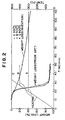
- the acryl resin which has been used as the binder and as the adhesive tape has been heated is various ways in a nitrogen gas atmosphere and tested in respect of changes in weight.
- the results are shown in Figure 2.
- the test pieces A, B and C have been heated respectively to 300°C, 400°C and 500°C at a heating rate of 15°C/min. and maintained at the temperature.
- the weight decrease of the acryl resin is approximately 7% at 300°C, but the weight decrease will be come approximately 90% when the resin is further heated to 400 0 C due to an abrupt pyrolytic reaction.
- the weight decrease is only approximately 40%.
- test piece A there are produced the tar and pitch-like substances due to the pyrolytic condensation reaction and it is considered that these substances function to maintain the adhesive power under 400 to 700°C.
- test pieces B and C which are heated to 400°C and 500°C, respectively, approximately 90% of resin is dissolved so that little quantity of ' tar and pitch-like substances are produced.
- the alloy particle sheet falls off in the heating process unless a preheating step is carried out.
- the acryl resin which has been used as the binder and the adhesive tape in the Test 1 has been heated in a nitrogen atmosphere, at a heating rate of 15°C/min. to 300°C and maintained at the temperature for 60 minutes. Thereafter, the resin has been heated at a heating rate of 15°C/min. to 500°C and 700°C. After cooling, the material is analyzed. The results are shown in Table 1.
- the H/C ratio of a so-called pitch is greater than 1.0 in case of asphalts and 0.5 to 0.6 in case of coal tar pitches.
- the H/C ratio is 0.77.
- the test piece E it will be noted, from the fact that the H/C ratio is 0.18, that the tar and pitch-like substances are decreased due to carbonization.
- Test pieces F, G and H are prepared from the acryl resin used in the Test 1.
- the test pieces have been heated at a heating rate of 15°C/min. to 300°C and maintained at the temperature for 60 minutes.
- the test piece F has been cooled.
- the test pieces G and H have been heated respectively to 400°C and 600 o C. After cooling, the resin has been analyzed. The results are shown in Table 2.
- the sheet is then cut into test pieces of lcm long and lcm wide. Each test piece is adhered throughout its surface to a vertical surface of a steel substrate surface with an intervention of an adhesive sheet of 10 micron thick which is comprised of the same resin as in the test piece.
- the test pieces are then heated in a hydrogen atmosphere at a heating rate of 15°C/min. to 300°C and maintained at the temperature for 60 minutes. Thereafter, the test pieces are heated at a heating rate of 15°C/min. to 1090 0 C and maintained at the temperature for 20 minutes. After cooling, it has been confirmed that the alloy particle sheets have not fallen off the substrates. Further, it has been observed that the substrate is formed with a sintered layer of 1.60 to 1.65 mm thick, HRC 62 to 65 in hardness and 7.60 to 7.75 g/cm 3 in density.
- a mixture of 58.8 weight % of the ternary eutectic alloy paticles as used in the Example 1, 39.2 weight % of SUS 410 particles and 2.0 weight % of acrylic adhesive binder is added with toluene in an amount of 300 part in weight for 100 part in weight of the binder and then kneaded.
- the mixture is then rolled and press-formed into a sheet of 1.0 mm thick and 4.65 g/cm 3 in density.
- the sheet is then cut into test pieces of lcm square.
- the test pieces are then adhered to vertical surfaces of steel substrates through adhesive polymer sheets of 30 microns thick of the resin as used in the test pieces.
- the test pieces are then heated in a hydrogen atmosphere at a heating rate of 20°C/min.
- the test pieces are further heated at a heating rate of 15°C/min. to 1080°C and maintained at the temperature for 15 minutes. Then, the test pieces are gradually cooled. It has been found that the alloy particle sheets have not been fallen off the substrates and that sintered layers of 0.80 to 0.82 mm thick, HRC 61 to 63 in hardness and 7.6 to 7.7 g/cm 3 in density have been formed on the substrate.
- a mixture of 38.6 weight % of particles of the eutectic alloy as used in the Example 1, 57.9 weight % of particles finer than 150 mesh of SUS 410 corrosion resistant steel and 3.5 weight % of acrylic resin binder has been kneaded with an addition of toluene and rolled into a sheet of 4.80 g/cm 3 in density and 1.5 mm in thickness.
- the sheet has then been cut into test pieces, each being of lcm long and lcm wide and the test pieces have been attached to vertical surfaces of steel substrates through adhesive polymer sheets, each being of 50 microns having the composition same as that of the resin used in the alloy particle sheet. Thereafter, each test piece has been heated at a heating rate of 10°C/min.
- the test piece has been heated at a heating rate of 15°C/min. to 1100°C and maintained at the temperature for 20 minutes. After gradual cooling, it has been observed that the alloy particle sheet has not fallen off the substrate and the substrate surfaces have been formed with a sintered layers of 1.30 to 1.35mm thick, HRC 60 to 62 in hardness and 7.5 to 7.7g/cm 3 in density.
- a mixture of 47.5 weight % of particles of the eutectic alloy used in the Example 1, 47.5 weight % of particles finer than 150 mesh of SUS 410 corrosion resistnat steel and 5 weight % of acrylic resin binder has been kneaded a room temperature and rolled into a sheet of 1.5 mm thick and 4.35g/cm3 in denisty. The sheet has then been cut into test pieces of lcm long and lcm wide. The test pieces has then been directly attached to vertical surfaces of steel substrate. The test pieces has then been heated in vacuum at a heating rate of 15 0 C/min. to 300°C and maintained at the temperature for 60 minutes, and then heated at a heating rate of 10°C/min. to 1090°C and maintained at the temperature for 20 minutes.
- test pieces have been cooled down at a cooling rate of 3°C/min. to 900°C and maintained at the temperature for 20 minutes and cooled by a nitrogen gas flow. It has been observed that the alloy sheets have not fallen off and the subsrates have been formed with sintered layers of 1.30 to 1.35mm thick, HRC 63 to 65 in hardness and 7.60 to 7.75g/cm 3 in density.
Landscapes
- Chemical & Material Sciences (AREA)
- Engineering & Computer Science (AREA)
- Materials Engineering (AREA)
- Mechanical Engineering (AREA)
- Metallurgy (AREA)
- Organic Chemistry (AREA)
- Chemical Kinetics & Catalysis (AREA)
- Composite Materials (AREA)
- Manufacturing & Machinery (AREA)
- Powder Metallurgy (AREA)
Applications Claiming Priority (2)
| Application Number | Priority Date | Filing Date | Title |
|---|---|---|---|
| JP33751/84 | 1984-02-24 | ||
| JP59033751A JPS60181202A (ja) | 1984-02-24 | 1984-02-24 | 金属基体表面に焼結層を形成する方法 |
Publications (2)
| Publication Number | Publication Date |
|---|---|
| EP0154196A1 true EP0154196A1 (de) | 1985-09-11 |
| EP0154196B1 EP0154196B1 (de) | 1989-05-24 |
Family
ID=12395125
Family Applications (1)
| Application Number | Title | Priority Date | Filing Date |
|---|---|---|---|
| EP85101377A Expired EP0154196B1 (de) | 1984-02-24 | 1985-02-08 | Verfahren zur Ausbildung einer verschleissfesten Schicht auf einem Substrat |
Country Status (4)
| Country | Link |
|---|---|
| US (1) | US4670215A (de) |
| EP (1) | EP0154196B1 (de) |
| JP (1) | JPS60181202A (de) |
| DE (1) | DE3570458D1 (de) |
Cited By (2)
| Publication number | Priority date | Publication date | Assignee | Title |
|---|---|---|---|---|
| EP0229529A1 (de) * | 1985-12-31 | 1987-07-22 | Eaton Corporation | Pulver zum Auftragsschweissen |
| RU2173731C1 (ru) * | 2000-04-24 | 2001-09-20 | Мордовский государственный университет им. Н.П. Огарева | Способ восстановления отверстий деталей из чугунов |
Families Citing this family (12)
| Publication number | Priority date | Publication date | Assignee | Title |
|---|---|---|---|---|
| US4851188A (en) * | 1987-12-21 | 1989-07-25 | United Technologies Corporation | Method for making a turbine blade having a wear resistant layer sintered to the blade tip surface |
| US5141702A (en) * | 1990-03-13 | 1992-08-25 | Olin Corporation | Method of making coated electrical connectors |
| US5165592A (en) * | 1992-03-31 | 1992-11-24 | J & L Plate, Inc. | Method of making refiner plate bars |
| US5366138A (en) * | 1993-05-05 | 1994-11-22 | Alloy Technology International Inc. | Wear resistant die face and method |
| US5722306A (en) * | 1995-06-07 | 1998-03-03 | Alloy Technology International Inc. | Method for making a pelletizer knife and blank |
| US6752165B2 (en) | 2000-03-08 | 2004-06-22 | J & L Fiber Services, Inc. | Refiner control method and system |
| US6502774B1 (en) | 2000-03-08 | 2003-01-07 | J + L Fiber Services, Inc. | Refiner disk sensor and sensor refiner disk |
| US6778936B2 (en) | 2000-03-08 | 2004-08-17 | J & L Fiber Services, Inc. | Consistency determining method and system |
| US6938843B2 (en) | 2001-03-06 | 2005-09-06 | J & L Fiber Services, Inc. | Refiner control method and system |
| US7104480B2 (en) * | 2004-03-23 | 2006-09-12 | J&L Fiber Services, Inc. | Refiner sensor and coupling arrangement |
| US7695582B2 (en) * | 2005-04-28 | 2010-04-13 | General Electric Company | Method of forming ceramic layer |
| US20100089530A1 (en) * | 2008-10-13 | 2010-04-15 | Gm Global Technology Operations, Inc. | Methods of forming fluid barriers over powder metal parts and increasing wear resistance thereof |
Citations (7)
| Publication number | Priority date | Publication date | Assignee | Title |
|---|---|---|---|---|
| AT306477B (de) * | 1969-05-14 | 1973-04-10 | Castolin Sa | Verfahren zur Herstellung von haftfesten Deckschichten aus verschleißfesten Legierungen auf metallischen Oberflächen |
| US3881878A (en) * | 1973-03-30 | 1975-05-06 | Hitachi Metals Ltd | Large-sized and large thickness composite sleeves |
| CH602330A5 (de) * | 1976-08-26 | 1978-07-31 | Bbc Brown Boveri & Cie | |
| GB1549960A (en) * | 1976-09-30 | 1979-08-08 | Eutectic Corp | Alloy-coated ferrous metal substrate |
| CH616960A5 (en) * | 1976-02-25 | 1980-04-30 | Sulzer Ag | Components resistant to high-temperature corrosion. |
| GB2068416A (en) * | 1980-01-14 | 1981-08-12 | Tainton Co | Mechanical plating |
| CH632790A5 (en) * | 1977-03-28 | 1982-10-29 | Avco Everett Res Lab Inc | Modification of metal surfaces |
Family Cites Families (8)
| Publication number | Priority date | Publication date | Assignee | Title |
|---|---|---|---|---|
| JPS5215242B2 (de) * | 1973-02-09 | 1977-04-27 | ||
| JPS5551418B2 (de) * | 1974-03-01 | 1980-12-24 | ||
| JPS5183834A (ja) * | 1975-01-21 | 1976-07-22 | Fukuda Metal Foil Powder | Joseigokinnyoruhyomenkokaho |
| US4066451A (en) * | 1976-02-17 | 1978-01-03 | Erwin Rudy | Carbide compositions for wear-resistant facings and method of fabrication |
| JPS5521802A (en) * | 1978-08-01 | 1980-02-16 | Tokyo Shibaura Electric Co | High frequency heater |
| JPS5547335A (en) * | 1978-09-27 | 1980-04-03 | Sumitomo Chem Co Ltd | Manufacturing method of fiber reinforced metal based composite material |
| US4261745A (en) * | 1979-02-09 | 1981-04-14 | Toyo Kohan Co., Ltd. | Method for preparing a composite metal sintered article |
| US4259112A (en) * | 1979-04-05 | 1981-03-31 | Dwa Composite Specialties, Inc. | Process for manufacture of reinforced composites |
-
1984
- 1984-02-24 JP JP59033751A patent/JPS60181202A/ja active Granted
-
1985
- 1985-02-08 EP EP85101377A patent/EP0154196B1/de not_active Expired
- 1985-02-08 DE DE8585101377T patent/DE3570458D1/de not_active Expired
- 1985-02-19 US US06/702,604 patent/US4670215A/en not_active Expired - Fee Related
Patent Citations (7)
| Publication number | Priority date | Publication date | Assignee | Title |
|---|---|---|---|---|
| AT306477B (de) * | 1969-05-14 | 1973-04-10 | Castolin Sa | Verfahren zur Herstellung von haftfesten Deckschichten aus verschleißfesten Legierungen auf metallischen Oberflächen |
| US3881878A (en) * | 1973-03-30 | 1975-05-06 | Hitachi Metals Ltd | Large-sized and large thickness composite sleeves |
| CH616960A5 (en) * | 1976-02-25 | 1980-04-30 | Sulzer Ag | Components resistant to high-temperature corrosion. |
| CH602330A5 (de) * | 1976-08-26 | 1978-07-31 | Bbc Brown Boveri & Cie | |
| GB1549960A (en) * | 1976-09-30 | 1979-08-08 | Eutectic Corp | Alloy-coated ferrous metal substrate |
| CH632790A5 (en) * | 1977-03-28 | 1982-10-29 | Avco Everett Res Lab Inc | Modification of metal surfaces |
| GB2068416A (en) * | 1980-01-14 | 1981-08-12 | Tainton Co | Mechanical plating |
Non-Patent Citations (1)
| Title |
|---|
| PATENT ABSTRACTS OF JAPAN, unexamined applications, C field, vol. 5, no. 195, December 11, 1981 THE PATENT OFFICE JAPANESE GOVERNMENT page 154 C 83 *JP-A-56-119 765 8SHOWA DENKO K.K.) * * |
Cited By (2)
| Publication number | Priority date | Publication date | Assignee | Title |
|---|---|---|---|---|
| EP0229529A1 (de) * | 1985-12-31 | 1987-07-22 | Eaton Corporation | Pulver zum Auftragsschweissen |
| RU2173731C1 (ru) * | 2000-04-24 | 2001-09-20 | Мордовский государственный университет им. Н.П. Огарева | Способ восстановления отверстий деталей из чугунов |
Also Published As
| Publication number | Publication date |
|---|---|
| DE3570458D1 (en) | 1989-06-29 |
| JPH0125804B2 (de) | 1989-05-19 |
| JPS60181202A (ja) | 1985-09-14 |
| EP0154196B1 (de) | 1989-05-24 |
| US4670215A (en) | 1987-06-02 |
Similar Documents
| Publication | Publication Date | Title |
|---|---|---|
| US4596746A (en) | Powder sheet for sintering | |
| EP0154196B1 (de) | Verfahren zur Ausbildung einer verschleissfesten Schicht auf einem Substrat | |
| DE69808324T2 (de) | Verfahren zur herstellung eines diamant-siliciumcarbid-siliciumkomposits und ein nach diesem verfahren hergestelltes komposit | |
| US4259112A (en) | Process for manufacture of reinforced composites | |
| Fujita et al. | Microstructure and properties of titanium alloy produced in the newly developed blended elemental powder metallurgy process | |
| CA1096895A (en) | Molten silicon infiltration reaction products | |
| US4933240A (en) | Wear-resistant carbide surfaces | |
| EP1117625A1 (de) | Verfahren zur herstellung eines diamantkomposits und ein durch dasselbe hergestelltes komposit | |
| US3877884A (en) | Dispersion strengthened aluminum bearing material | |
| JPS6343441B2 (de) | ||
| US5594931A (en) | Layered composite carbide product and method of manufacture | |
| EP0154183B1 (de) | Verfahren zum Ausbilden einer verschleissfesten Schicht auf einem Träger | |
| EP0154486B1 (de) | Acrylpolymerzusammensetzung zum Binden von Metallbanden | |
| GB2179369A (en) | Sintered aluminium alloy | |
| EP0181979B1 (de) | Gesinterter Presskörper mit grosser Härte und Verfahren zu seiner Herstellung | |
| EP0161854B1 (de) | Verfahren zum Verbinden einer Legierung und einer Metallplatte mit einer Harzzusammensetzung | |
| Bhaumik et al. | Microstructure and mechanical properties of WC TiN Co and WC TiN Mo2C Co (Ni) cemented carbides | |
| DE69601829T2 (de) | Verfahren zur Herstellung einer Beschichtung auf Basis von TiB2 und so hergestelltes beschichtetes Produkt | |
| JPH07502072A (ja) | 炭化ホウ素−銅サーメットおよびそれの製造方法 | |
| JPS63500107A (ja) | 高速度鋼を基礎とする焼結合金 | |
| CA1057914A (en) | Wear-resistant composite material and method of making an article thereof | |
| KR100657798B1 (ko) | 다이아몬드-실리콘 카바이드-실리콘 복합체의 제조 방법및 이 방법에 의해 제조된 복합체 | |
| JPH03504742A (ja) | 耐摩耗性表面を有するサンドイッチ製品の製法 | |
| CA1285776C (en) | High hardness sintered compact and process for producing the same | |
| JPH0211646B2 (de) |
Legal Events
| Date | Code | Title | Description |
|---|---|---|---|
| PUAI | Public reference made under article 153(3) epc to a published international application that has entered the european phase |
Free format text: ORIGINAL CODE: 0009012 |
|
| 17P | Request for examination filed |
Effective date: 19850208 |
|
| AK | Designated contracting states |
Designated state(s): DE FR GB |
|
| 17Q | First examination report despatched |
Effective date: 19870211 |
|
| RAP1 | Party data changed (applicant data changed or rights of an application transferred) |
Owner name: NITTO DENKO CORPORATION Owner name: MAZDA MOTOR CORPORATION |
|
| GRAA | (expected) grant |
Free format text: ORIGINAL CODE: 0009210 |
|
| RAP1 | Party data changed (applicant data changed or rights of an application transferred) |
Owner name: NITTO DENKO CORPORATION Owner name: MAZDA MOTOR CORPORATION |
|
| AK | Designated contracting states |
Kind code of ref document: B1 Designated state(s): DE FR GB |
|
| REF | Corresponds to: |
Ref document number: 3570458 Country of ref document: DE Date of ref document: 19890629 |
|
| ET | Fr: translation filed | ||
| PLBE | No opposition filed within time limit |
Free format text: ORIGINAL CODE: 0009261 |
|
| STAA | Information on the status of an ep patent application or granted ep patent |
Free format text: STATUS: NO OPPOSITION FILED WITHIN TIME LIMIT |
|
| 26N | No opposition filed | ||
| PGFP | Annual fee paid to national office [announced via postgrant information from national office to epo] |
Ref country code: FR Payment date: 19950111 Year of fee payment: 11 |
|
| PGFP | Annual fee paid to national office [announced via postgrant information from national office to epo] |
Ref country code: GB Payment date: 19950131 Year of fee payment: 11 |
|
| PG25 | Lapsed in a contracting state [announced via postgrant information from national office to epo] |
Ref country code: GB Effective date: 19960208 |
|
| PGFP | Annual fee paid to national office [announced via postgrant information from national office to epo] |
Ref country code: DE Payment date: 19960215 Year of fee payment: 12 |
|
| GBPC | Gb: european patent ceased through non-payment of renewal fee |
Effective date: 19960208 |
|
| PG25 | Lapsed in a contracting state [announced via postgrant information from national office to epo] |
Ref country code: FR Effective date: 19961031 |
|
| REG | Reference to a national code |
Ref country code: FR Ref legal event code: ST |
|
| PG25 | Lapsed in a contracting state [announced via postgrant information from national office to epo] |
Ref country code: DE Effective date: 19971101 |