EP0154242A2 - Substituierte Phenoxypropionsäure-Derivate - Google Patents
Substituierte Phenoxypropionsäure-Derivate Download PDFInfo
- Publication number
- EP0154242A2 EP0154242A2 EP85101792A EP85101792A EP0154242A2 EP 0154242 A2 EP0154242 A2 EP 0154242A2 EP 85101792 A EP85101792 A EP 85101792A EP 85101792 A EP85101792 A EP 85101792A EP 0154242 A2 EP0154242 A2 EP 0154242A2
- Authority
- EP
- European Patent Office
- Prior art keywords
- carbon atoms
- formula
- alkyl
- oder
- represents hydrogen
- Prior art date
- Legal status (The legal status is an assumption and is not a legal conclusion. Google has not performed a legal analysis and makes no representation as to the accuracy of the status listed.)
- Withdrawn
Links
- 0 *C[C@](CCC1)*1=C Chemical compound *C[C@](CCC1)*1=C 0.000 description 3
Classifications
-
- C—CHEMISTRY; METALLURGY
- C07—ORGANIC CHEMISTRY
- C07D—HETEROCYCLIC COMPOUNDS
- C07D213/00—Heterocyclic compounds containing six-membered rings, not condensed with other rings, with one nitrogen atom as the only ring hetero atom and three or more double bonds between ring members or between ring members and non-ring members
- C07D213/02—Heterocyclic compounds containing six-membered rings, not condensed with other rings, with one nitrogen atom as the only ring hetero atom and three or more double bonds between ring members or between ring members and non-ring members having three double bonds between ring members or between ring members and non-ring members
- C07D213/04—Heterocyclic compounds containing six-membered rings, not condensed with other rings, with one nitrogen atom as the only ring hetero atom and three or more double bonds between ring members or between ring members and non-ring members having three double bonds between ring members or between ring members and non-ring members having no bond between the ring nitrogen atom and a non-ring member or having only hydrogen or carbon atoms directly attached to the ring nitrogen atom
- C07D213/60—Heterocyclic compounds containing six-membered rings, not condensed with other rings, with one nitrogen atom as the only ring hetero atom and three or more double bonds between ring members or between ring members and non-ring members having three double bonds between ring members or between ring members and non-ring members having no bond between the ring nitrogen atom and a non-ring member or having only hydrogen or carbon atoms directly attached to the ring nitrogen atom with hetero atoms or with carbon atoms having three bonds to hetero atoms with at the most one bond to halogen, e.g. ester or nitrile radicals, directly attached to ring carbon atoms
- C07D213/62—Oxygen or sulfur atoms
- C07D213/63—One oxygen atom
- C07D213/64—One oxygen atom attached in position 2 or 6
- C07D213/643—2-Phenoxypyridines; Derivatives thereof
-
- A—HUMAN NECESSITIES
- A01—AGRICULTURE; FORESTRY; ANIMAL HUSBANDRY; HUNTING; TRAPPING; FISHING
- A01N—PRESERVATION OF BODIES OF HUMANS OR ANIMALS OR PLANTS OR PARTS THEREOF; BIOCIDES, e.g. AS DISINFECTANTS, AS PESTICIDES OR AS HERBICIDES; PEST REPELLANTS OR ATTRACTANTS; PLANT GROWTH REGULATORS
- A01N39/00—Biocides, pest repellants or attractants, or plant growth regulators containing aryloxy- or arylthio-aliphatic or cycloaliphatic compounds, containing the group or, e.g. phenoxyethylamine, phenylthio-acetonitrile, phenoxyacetone
- A01N39/02—Aryloxy-carboxylic acids; Derivatives thereof
-
- A—HUMAN NECESSITIES
- A01—AGRICULTURE; FORESTRY; ANIMAL HUSBANDRY; HUNTING; TRAPPING; FISHING
- A01N—PRESERVATION OF BODIES OF HUMANS OR ANIMALS OR PLANTS OR PARTS THEREOF; BIOCIDES, e.g. AS DISINFECTANTS, AS PESTICIDES OR AS HERBICIDES; PEST REPELLANTS OR ATTRACTANTS; PLANT GROWTH REGULATORS
- A01N43/00—Biocides, pest repellants or attractants, or plant growth regulators containing heterocyclic compounds
- A01N43/34—Biocides, pest repellants or attractants, or plant growth regulators containing heterocyclic compounds having rings with one nitrogen atom as the only ring hetero atom
- A01N43/40—Biocides, pest repellants or attractants, or plant growth regulators containing heterocyclic compounds having rings with one nitrogen atom as the only ring hetero atom six-membered rings
-
- A—HUMAN NECESSITIES
- A01—AGRICULTURE; FORESTRY; ANIMAL HUSBANDRY; HUNTING; TRAPPING; FISHING
- A01N—PRESERVATION OF BODIES OF HUMANS OR ANIMALS OR PLANTS OR PARTS THEREOF; BIOCIDES, e.g. AS DISINFECTANTS, AS PESTICIDES OR AS HERBICIDES; PEST REPELLANTS OR ATTRACTANTS; PLANT GROWTH REGULATORS
- A01N43/00—Biocides, pest repellants or attractants, or plant growth regulators containing heterocyclic compounds
- A01N43/48—Biocides, pest repellants or attractants, or plant growth regulators containing heterocyclic compounds having rings with two nitrogen atoms as the only ring hetero atoms
- A01N43/50—1,3-Diazoles; Hydrogenated 1,3-diazoles
-
- A—HUMAN NECESSITIES
- A01—AGRICULTURE; FORESTRY; ANIMAL HUSBANDRY; HUNTING; TRAPPING; FISHING
- A01N—PRESERVATION OF BODIES OF HUMANS OR ANIMALS OR PLANTS OR PARTS THEREOF; BIOCIDES, e.g. AS DISINFECTANTS, AS PESTICIDES OR AS HERBICIDES; PEST REPELLANTS OR ATTRACTANTS; PLANT GROWTH REGULATORS
- A01N47/00—Biocides, pest repellants or attractants, or plant growth regulators containing organic compounds containing a carbon atom not being member of a ring and having no bond to a carbon or hydrogen atom, e.g. derivatives of carbonic acid
- A01N47/08—Biocides, pest repellants or attractants, or plant growth regulators containing organic compounds containing a carbon atom not being member of a ring and having no bond to a carbon or hydrogen atom, e.g. derivatives of carbonic acid the carbon atom having one or more single bonds to nitrogen atoms
- A01N47/28—Ureas or thioureas containing the groups >N—CO—N< or >N—CS—N<
- A01N47/34—Ureas or thioureas containing the groups >N—CO—N< or >N—CS—N< containing the groups, e.g. biuret; Thio analogues thereof; Urea-aldehyde condensation products
-
- C—CHEMISTRY; METALLURGY
- C07—ORGANIC CHEMISTRY
- C07C—ACYCLIC OR CARBOCYCLIC COMPOUNDS
- C07C335/00—Thioureas, i.e. compounds containing any of the groups, the nitrogen atoms not being part of nitro or nitroso groups
- C07C335/04—Derivatives of thiourea
- C07C335/24—Derivatives of thiourea containing any of the groups, X being a hetero atom, Y being any atom
- C07C335/26—Y being a hydrogen or a carbon atom, e.g. benzoylthioureas
-
- C—CHEMISTRY; METALLURGY
- C07—ORGANIC CHEMISTRY
- C07D—HETEROCYCLIC COMPOUNDS
- C07D233/00—Heterocyclic compounds containing 1,3-diazole or hydrogenated 1,3-diazole rings, not condensed with other rings
- C07D233/04—Heterocyclic compounds containing 1,3-diazole or hydrogenated 1,3-diazole rings, not condensed with other rings having one double bond between ring members or between a ring member and a non-ring member
- C07D233/28—Heterocyclic compounds containing 1,3-diazole or hydrogenated 1,3-diazole rings, not condensed with other rings having one double bond between ring members or between a ring member and a non-ring member with hetero atoms or with carbon atoms having three bonds to hetero atoms with at the most one bond to halogen, e.g. ester or nitrile radicals, directly attached to ring carbon atoms
- C07D233/30—Oxygen or sulfur atoms
- C07D233/42—Sulfur atoms
Definitions
- the invention relates to new substituted phenoxypropionic acid derivatives, several processes for their preparation and their use as herbicides.
- the substituted phenoxypropionic acid derivatives of the formula (I) contain at least one asymmetrically substituted carbon atom and can therefore exist in various enantiomeric forms.
- the invention relates both to the possible individual isomers and to mixtures of these isomers.
- the substituted phenoxypropionic acid derivatives of the formula (I) according to the invention have substantially better herbicidal properties than the 2- / 4- (2,4-dichlorophenoxy) phenoxy7-propionic acid methyl ester known from the prior art, which is a highly effective active ingredient of the same type of action is.
- a further group of particularly preferred compounds according to the invention are those compounds of the formulas (Ia) and (Ib) in which the asymmetrically substituted carbon atom of the propionic acid unit has the R configuration.
- the relevant substances can be represented by the formulas characterize.
- the asymmetrically substituted carbon atom is identified by an ( * ).
- phenoxypropionic acid chlorides required as starting materials in process (a) according to the invention are defined by the formula (II).
- X 1 , X 2 and Z preferably have those meanings which have already been mentioned preferably for these radicals in connection with the description of the substances of the formula (I) according to the invention.
- phenoxypropionic acid chlorides of the formula (II) are known or can be prepared in a simple manner by known processes (cf. German Offenlegungsschriften 22 23 894, 24 33 067, 25 46 251, 26 46 124, 26 28 384 and 28 02 818 as well as European publications 0 000 483 and 0 001 473).
- the phenoxypropionic acid chlorides of the formula (II) are obtained, for example, by using phenol derivatives of the formula
- Formula (III) defines the compounds which are further required as starting materials in process (a) according to the invention.
- R preferably has those meanings which are already in Connection with the description of the substances of the formula (I) according to the invention were preferably mentioned for this radical.
- Process (a) according to the invention is carried out using diluents.
- aprotic organic solvents can be used as diluents.
- reaction according to process (a) according to the invention can be carried out either in the presence or in the absence of acid binders. If one works in the presence of acid binders, practically all customary acid binders come into consideration as such acid acceptors.
- Alkali metal and alkaline earth metal hydroxides such as sodium, potassium, and calcium hydroxide
- alkali metal and alkaline earth metal carbonates or hydrogen carbonates such as sodium carbonate and hydrogen carbonate, potassium carbonate and calcium carbonate
- aliphatic, aromatic and heterocyclic amines such as trimethyl, triethyl, tripropyl and tributyl amine, N, N-dimethylbenzylamine, pyridine, 2-methylpyridine, 2,4,6-trimethylpyridine, 2-methyl-5-ethylpyridine, diazabicyclooctane (DABCO), diazabicyclonones (DBN) and diazabicycloundecene (DBU).
- DABCO diazabicyclooctane
- DBN diazabicyclonones
- DBU diazabicycloundecene
- reaction temperatures can be varied within a substantial range in process (a). In general, temperatures between -50 ° C and + 200 ° C, preferably between -20 ° C and + 150 ° C.
- Process (a) is generally carried out at normal pressure.
- process (a) generally between 0.8 and 4.0 mol, preferably between 0.9 and 3.0 mol, of starting compound of formula (III) are used per mole of starting compound of formula (II). If one works in the presence of acid binders, these are used in an equivalent amount or in an excess, based on phenoxypropionyl chloride of the formula (II).
- the reaction is generally carried out by combining the components and then at an elevated temperature can react. If one works in the presence of an acid binder, the components are optionally combined with cooling, and the reaction mixture is then optionally stirred at elevated temperature. The subsequent workup is carried out using customary methods.
- the procedure is such that the solid residue is filtered off, extracted with an organic solvent and the combined organic phases are washed and concentrated.
- the products obtained can be freed of any impurities that may still be present by customary measures, such as recrystallization or by chromatography.
- Formula (IV) defines the phenoxypropionic acid derivatives required as starting materials in process (b) according to the invention.
- X 1 , x 2 , Y and Z preferably have those meanings which have already been mentioned for these radicals in connection with the description of the substances of the formula (I) according to the invention.
- optically active compounds are used to prepare optically active compounds of the formula (IV) Phenoxypropionoyl chlorides of formula (II) used.
- R 2 and R 3 preferably have those meanings which have already been mentioned preferably in connection with the description of the substances of the formula (I) according to the invention for these radicals.
- the amines of the formula (V) are known.
- reaction temperatures can also be varied within a substantial range when carrying out process (b) according to the invention. In general, temperatures between 0 ° C and 100 ° C, preferably between 10 ° C and 80 ° C.
- the process according to the invention is generally carried out under atmospheric pressure.
- the active compounds according to the invention can be used as defoliants, desiccants, haulm killers and in particular as weed killers. Weeds in the broadest sense are understood to mean all plants that grow up in places where they are undesirable. Whether the substances according to the invention act as total or selective herbicides depends essentially on the amount used.
- the compounds are suitable for total weed control, e.g. on industrial and track systems and on paths and squares with and without tree cover.
- the compounds for weed control in permanent crops e.g. Forestry, ornamental trees, fruit, wine, citrus, nut, banana, coffee, tea, rubber, oil palm, cocoa, berry fruit and hop plants and for selective weed control in annual crops.
- the active compounds according to the invention are particularly suitable for combating grasses in dicotyledonous crop plants such as cotton, rapeseed, soybeans, sugar beets and in cereals such as wheat.
- the active compounds can be converted into the customary formulations, such as solutions, emulsions, wettable powders, suspensions, powders, dusts, pastes, soluble powders, granules, suspension emulsion concentrates, active substance-impregnated natural and synthetic substances and very fine encapsulations in polymeric substances.
- formulations are made in a known manner, e.g. by mixing the active ingredients with extenders, that is to say liquid solvents and / or solid carriers, optionally using surface-active agents, that is to say emulsifiers and / or dispersants and / or foam-generating agents.
- extenders that is to say liquid solvents and / or solid carriers
- surface-active agents that is to say emulsifiers and / or dispersants and / or foam-generating agents.
- organic solvents can also be used as auxiliary solvents.
- auxiliary solvents e.g. organic solvents
- aromatics such as xylene, toluene, or alkylnaphthalenes
- chlorinated aromatics and chlorinated aliphatic hydrocarbons such as chlorobenzenes, chlorethylenes or methylene chloride
- aliphatic hydrocarbons such as cyclohexane or paraffins, e.g.
- Petroleum fractions mineral and vegetable oils, alcohols such as butanol or glycol and their ethers and esters, ketones such as acetone, methyl ethyl ketone, methyl isobutyl ketone or cyclohexanone, strongly polar solvents such as dimethylformamide and dimethyl sulfoxide, and water.
- alcohols such as butanol or glycol and their ethers and esters
- ketones such as acetone, methyl ethyl ketone, methyl isobutyl ketone or cyclohexanone
- strongly polar solvents such as dimethylformamide and dimethyl sulfoxide, and water.
- Montmorillonite or diatomaceous earth and synthetic stone powder such as highly disperse silica, aluminum oxide and silicates, are suitable as solid carriers for granules: e.g. broken and fractionated natural rocks such as calcite, marble, pumice, sepiolite, dolomite and synthetic granules from inorganic and organic flours as well as granules from organic material such as sawdust, coconut shells, corn cobs and tobacco stems; as emulsifying and / or foaming agents are possible: e.g. non-ionic and anionic emulsifiers, such as polyoxyethylene fatty acid esters, polyoxyethylene fatty alcohol ethers, e.g.
- Alkylaryl polyglycol ethers alkyl sulfonates, alkyl sulfates, aryl sulfonates and protein hydrolyzates; Possible dispersants are: e.g. Lignin sulfite liquor and methyl cellulose.
- Adhesives such as carboxymethyl cellulose, natural and synthetic powdery, granular or latex-shaped polymers, such as gum arabic, polyvinyl alcohol, polyvinyl acetate, and natural phospholipids, such as cephalins and lecithins and synthetic phospholipids, can be used in the formulations.
- Other additives can be mineral and vegetable oils.
- Dyes such as inorganic pigments, e.g. Iron oxide, titanium oxide, ferrocyan blue and organic dyes such as alizarin, azo and metal phthalocyanine dyes and trace nutrients such as salts of iron, manganese, boron, copper, cobalt, molybdenum and zinc can be used.
- the formulations generally contain between 0.1 and 95 percent by weight of active compound, preferably between 0.5 and 90%.
- the active compounds according to the invention can also be used for weed control in a mixture with known herbicides, finished formulations or tank mixes being possible.
- Known herbicides such as e.g. 4-amino-6- (1,1-dimethylethyl) -3-ethylthio-1,2,4-triazin-5 (4H) one, 1-amino-6-ethylthio-3- (2,2-dimethylpropyl) - 1,3,5-triazine-2,4 (1H, 3H) -dione or N- (2-benzothiazolyl) -N, N'-dimethyl-urea for weed control in cereals; 4-amino-3-methyl-6-phenyl-1,2,4-triazin-5 (4H) -one for weed control in sugar beets and 4-amino-6- (1,1-dimethylethyl) -3-methylthio-1 , 2,4-triazin-5 (4H) -one for weed control in soybeans, in question. Surprisingly, some mixtures also show a synergistic effect.
- a mixture with other known active compounds such as fungicides, insecticides, acaricides, nematicides, bird repellants, plant nutrients and agents which improve soil structure, is also possible.
- the active compounds can be used as such, in the form of their formulations or in the use forms prepared therefrom by further dilution, such as ready-to-use solutions, suspensions, emulsions, powders, pastes and granules. They are used in the usual way, e.g. by pouring, spraying, spraying, sprinkling.
- the active compounds according to the invention can be applied both before and after emergence of the plants. They can also be worked into the soil before sowing. It is used especially after the plants have emerged.
- the amount of active ingredient used can vary over a wide range. It essentially depends on the type of effect desired. In general, the application rates are between 0.01 and 10 kg of active ingredient per hectare of soil, preferably between 0.05 and 5 kg per ha.
- Solvent 5 parts by weight of acetone emulsifier: 1 part by weight of alkylaryl polyglycol ether
- active compound 1 part by weight of active compound is mixed with the stated amount of solvent, the stated amount of emulsifier is added and the concentrate is diluted with Water to the desired concentration.
- Test plants which have a height of 5-15 cm are sprayed with the active substance preparation, so that the respectively desired amounts of active substance are applied per unit area.
- the concentration of the spray liquor is chosen so that the desired amounts of active compound are applied in 2000 l of water / ha. After three weeks, the degree of damage to the plants is rated in% damage compared to the development of the untreated control.
Landscapes
- Life Sciences & Earth Sciences (AREA)
- Organic Chemistry (AREA)
- Chemical & Material Sciences (AREA)
- Health & Medical Sciences (AREA)
- Plant Pathology (AREA)
- Engineering & Computer Science (AREA)
- Dentistry (AREA)
- General Health & Medical Sciences (AREA)
- Wood Science & Technology (AREA)
- Zoology (AREA)
- Environmental Sciences (AREA)
- Pest Control & Pesticides (AREA)
- Agronomy & Crop Science (AREA)
- Organic Low-Molecular-Weight Compounds And Preparation Thereof (AREA)
- Agricultural Chemicals And Associated Chemicals (AREA)
- Pyridine Compounds (AREA)
Abstract
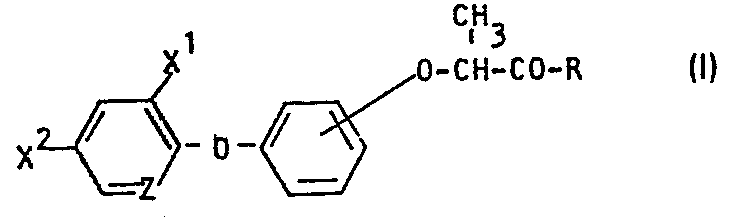
- X' für Wasserstoff oder Halogen steht,
- X2 für Trifluormethyl oder Halogen steht,
- Z für Stickstoff oder den Rest CX steht, worin
- X für Wasserstoff oder Halogen steht und
- R für den Rest der Formel
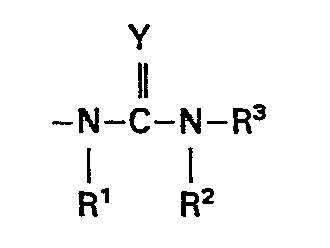
- Y für Sauerstoff oder Schwefel steht,
- R' für Wasserstoff, Alkyl mit 1 bis 6 Kohlenstoffatomen
- oder Aryl steht,
- R2 für Wasserstoff, Alkyl mit 1 bis 6 Kohlenstoffatomen, Alkenyl mit 3 bis 8 Kohlenstoffatomen oder gegebenenfalls substituiertes Aryl steht, oder
- R' und R gemeinsam für eine gegebenenfalls substituierte Alkylenkette mit 2 bis 4 Kohlenstoffatomen stehen, und
- R3 für Wasserstoff, Alkyl mit 1 bis 6 Kohlenstoffatomen oder für gegebenenfalls substituiertes Aryl steht, oder
- R für den Rest der Formel
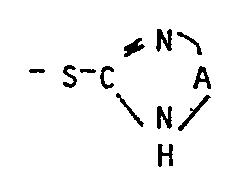
- A für eine gegebenenfalls substituierte Alkylenkette mit 2 bis 4 Kohlenstoffatomen steht, oder
- R für den Rest der Formel
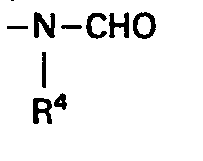
- R4 für Wasserstoff oder Alkyl mit 1 bis 6 Kohlenstoffatomen steht,
- mehrere Verfahren zur Herstellung der neuen Stoffe und deren Verwendung als Herbizide.
Description
- Die Erfindung betrifft neue substituierte Phenoxypropionsäure-Derivate, mehrere Verfahren zu ihrer Herstellung und ihre Verwendung als Herbizide.
- Es ist bereits bekannt geworden, daß zahlreiche Phenoxypropionsäure-Derivate herbizide Eigenschaften besitzen (vgl. DE-OS 22 23 894). So kann zum Beispiel der 2-Z4-(2,4-Dichlorphenoxy)-phenoxy7-propionsäure- methylester zur Unkrautbekämpfung eingesetzt werden. Die Wirkung dieses Stoffes ist jedoch insbesondere beim Einsatz niedriger Aufwandmengen nicht immer ausreichend.
- Es wurden nun neue substituierte Phenoxypropionsäure-Derivate der Formel

- X1 für Wasserstoff oder Halogen steht,
- x2 für Trifluormethyl oder Halogen steht,
- Z für Stickstoff oder den Rest CX steht, worin
- X für Wasserstoff oder Halogen steht und
- R für den Rest der Formel

- Y für Sauerstoff oder Schwefel steht,
- R1 für Wasserstoff , Alkyl mit 1 bis 6 Kohlenstoffatomen oder Aryl steht,
- R 2 für Wasserstoff, Alkyl mit 1 bis 6 Kohlenstoffatomen, Alkenyl mit 3 bis 8 Kohlenstoffatomen oder gegebenenfalls substituiertes Aryl steht, oder
- R1 und R 2 gemeinsam für eine gegebenenfalls substituierte Alkylenkette mit 2 bis 4 Kohlenstoffatomen stehen, und
- R 3 für Wasserstoff, Alkyl mit 1 bis 6 Kohlenstoffatomen oder für gegebenenfalls substituiertes Aryl steht, oder
- R für den Rest der Formel

- A für eine gegebenenfalls substituierte Alkylenkette mit 2 bis 4 Kohlenstoffatomen steht, oder
- R für den Rest der Formel
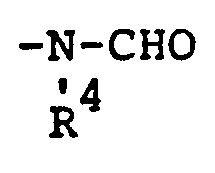
- R 4 für Wasserstoff oder Alkyl mit 1 bis 6 Kohlenstoffatomen steht,
gefunden. - Die substituierten Phenoxypropionsäure-Derivate der Formel (I) enthalten mindestens ein asymmetrisch substituiertes Kohlenstoffatom und können deshalb in verschiedenen enantiomeren Formen vorliegen. Die Erfindung betrifft sowohl die möglichen einzelnen Isomeren als auch Gemische dieser Isomeren.
- Weiterhin wurde gefunden, daß man neue substituierte Phenoxypropionsäure-Derivate der Formel (I) erhält, wenn man
- a) Phenoxypropionsäurechloride der Formel

- X1, X und Z die oben angegebene Bedeutung haben,
mit Verbindungen der Formel
- R die oben angegebene Bedeutung hat, in Gegenwart eines Verdünnungsmittels und gegebenenfalls in Gegenwart eines Säurebindemittels umsetzt,
oder - X1, X und Z die oben angegebene Bedeutung haben,
- b) Phenoxypropionsäure-Derivate der Formel

- X 1, X2, Y und Z die oben angegebene Bedeutung haben,
- mit Aminen der Formel

- R 2 und R3 die oben angegebene Bedeutung haben,
gegebenenfalls in Gegenwart eines Verdünnungsmittels umsetzt. - Schließlich wurde gefunden, daß sich die neuen substituierten Phenoxypropionsäure-Derivate der Formel (I) durch eine hervorragende herbizide Wirksamkeit auszeichnen.
- Überraschenderweise besitzen die erfindungsgemäßen substituierten Phenoxypropionsäure-Derivate der Formel (I) wesentlich bessere herbizide Eigenschaften als der aus dem Stand der Technik bekannte 2-/4-(2,4-Dichlorphenoxy)-phenoxy7-propionsäure-methylester, welcher ein hochwirksamer Wirkstoff gleicher Wirkungsart ist.
- Die erfindungsgemäßen substituierten Phenoxypropionsäure-Derivate sind durch die Formel (I) allgemein definiert. In dieser Formel steht
- X vorzugsweise für Wasserstoff, Fluor, Chlor und Brom,
- x2 vorzugsweise für Trifluormethyl, Fluor, Chlor und Brom,
- Z für Stickstoff oder den Rest CX, worin X vorzugsweise für Wasserstoff, Fluor, Chlor oder Brom steht, und
- R für den Rest der Formel

- Y für Sauerstoff oder Schwefel steht,
- R1 vorzugsweise für Wasserstoff oder geradkettiges, verzweigtes Alkyl mit 1 bis 4 Kohlenstoffatomen oder Phenyl steht,
- R2 vorzugsweise für Wasserstoff, geradkettiges oder verzweigtes Alkyl mit 1 bis 4 Kohlenstoffatomen, Alkenyl mit 3 bis 6 Kohlenstoffatomen oder für gegebenenfalls durch Halogen und/oder Alkyl mit 1 bis 4 Kohlenstoffatomen substituiertes Phenyl steht, oder
- R und R 2 gemeinsam vorzugsweise für eine gegebenenfalls durch Halogen und/oder Alkyl mit 1 bis 4 Kohlenstoffatomen substituierte Alkylenkette mit 2 oder 3 Kohlenstoffatomen stehen, und
- R3 vorzugsweise für Wasserstoff, geradkettiges oder verzweigtes Alkyl mit 1 bis 4 Kohlenstoffatomen oder für gegebenenfalls durch Halogen und/ oder Alkyl mit 1 bis 4 Kohlenstoffatomen substituiertes Phenyl steht,
oder - R steht für den Rest der Formel

- A vorzugsweise für eine gegebenenfalls durch Alkyl mit 1 oder 2 Kohlenstoffatomen und/oder Halogen substituierte Alkylenkette mit 2 bis 4 Kohlenstoffatomen steht, oder
- R steht für den Rest der Formel

- R4 vorzugsweise für Wasserstoff oder geradkettiges oder verzweigtes Alkyl mit 1 bis 4 Kohlenstoffatomen steht.
- Besonders bevorzugt sind diejenigen substituierten Phenoxypropionsäure-Derivate der Formel (I) in denen
- X1 für Wasserstoff, Fluor oder Chlor steht,
- X2 für Trifluormethyl, Fluor oder Chlor steht,
- Z für Stickstoff oder den Rest CX steht, worin X für Wasserstoff, Fluor oder Chlor steht, und
- R für den Rest der Formel

- Y für Sauerstoff oder Schwefel steht,
- R für Wasserstoff, Methyl, Ethyl, n-Propyl, iso-Propyl, n-Butyl, sek.-Butyl, iso-Butyl, tert.-Butyl oder Phenyl steht,
- R 2 für Wasserstoff, Methyl, Ethyl, n-Propyl, iso-Propyl, n-Butyl, sek.-Butyl, iso-Butyl, tert.-Butyl, geradkettiges oder verzweigtes Alkenyl mit 3 bis 5 Kohlenstoffatomen oder für gegebenenfalls durch Fluor, Chlor, Methyl, Ethyl, n-Propyl und/oder iso-Propyl substituiertes Phenyl steht, oder
- R und R 2 gemeinsam für eine gegebenenfalls durch Chlor, Methyl und/oder Ethyl substituierte Alkylenkette mit 2 oder 3 Kohlenstoffatomen stehen, und
- R 3 für Wasserstoff, Methyl, Ethyl, n-Propyl, iso-Propyl, n-Butyl, sek.-Butyl, iso-Butyl, tert.-Butyl oder für gegebenenfalls durch Fluor,
- Chlor, Methyl, Ethyl, n-Propyl und/oder iso-
- Propyl substituiertes Phenyl steht, oder
- R für den Rest der Formel

- A für eine gegebenenfalls durch Chlor, Methyl und/ oder Ethyl substituierte Alkylenkette mit 2 oder 3 Kohlenstoffatomen steht,
oder - R für den Rest der Formel

- Eine besonders bevorzugte Gruppe von substituierten Phenoxypropionsäure-Derivaten sind auch die Verbindungen der Formel

- X1, X 2, Z und R diejenigen Bedeutungen haben, die oben als bevorzugt genannt wurden.
- Eine weitere Gruppe besonders bevorzugter erfindungsgemäßer Stoffe sind die Verbindungen der Formel

- X 1, X2, Z und R diejenigen Bedeutungen haben, die oben als bevorzugt genannt wurden.
- Eine weitere Gruppe besonders bevorzugter erfindungsgemäßer Verbindungen sind schließlich diejenigen Verbindungen der Formeln (Ia) und (Ib), in denen das asymmetrisch substituierte Kohlenstoffatom der Propionsäure-Einheit die R-Konfiguration aufweist. Die betreffenden Stoffe lassen sich durch die Formeln


- Verwendet man 2-[4-(4-Trifluormethylphenoxy)-phenoxy]-propionsäurechlorid und N-Methyl-thioharnstoff als Ausgangssubstanzen, so kann der Verlauf des erfindungsgemäßen Verfahrens (a) durch das folgende Formelschema wiedergegeben werden.

- Verwendet man 2-L4-(2-Chlor-4-trifluormethyl-phenoxy)-phenoxy7-propionsäureisothiocyanat und n-Butylamin als Ausgangsstoffe, so kann der Verlauf des erfindungsgemäßen Verfahrens (b) durch das folgende Formelschema wiedergegeben werden:

- Die bei dem erfindungsgemäßen Verfahren (a) als Ausgangsstoffe benötigten Phenoxypropionsäurechloride sind durch die Formel (II) definiert. In dieser Formel haben X1, X2 und Z vorzugsweise diejenigen Bedeutungen, die bereits im Zusammenhang mit der Beschreibung der erfindungsgemäßen Stoffe der Formel (I) vorzugsweise für diese Reste genannt wurden.
- Als Beispiele für Verbindungen der Formel (II) seien im einzelnen genannt:
- 2-[4-(4-Trifluormethyl-phenoxy)-phenoxy], 2-L4-(2,4-Dichlorphenoxy)-phenoxy7-, 2-[4-(2,6-Dichlor-4-tri- fluormethylphenoxy)-phenoxy7-, 2-[4-(2-Chlor-4-trifluormethyl-phenoxy)-, 2-[4-(3,5-Dichlor-pyridyl-2-oxy)-phenoxy7-, 2-[4-(3-Chlor-5-trifluormethyl-pyridyl-2- oxy)-phenoxy/- und 2-[4-(5-Trifluormethyl-pyridyl-2- oxy)-phenoxy7-propionsäurechlorid sowie 2-[3-(4-Trifluormethyl-phenoxy)-phenoxy7-, 2-L3-(2,4-Dichlorphe- noxy)-phenoxy7-, 2-[3-(2,6-Dichlor-4-trifluormethyl- phenoxy)-phenoxy7-, 2-[3-(2-Chlor-4-trifluormethyl- phenoxy)-phenoxy7-, 2-[3-(3,5-Dichlor-pyridyl-2-oxy)-phenoxy7-, 2-[3-(3-Chlor-5-trifluormethyl-pyridyl-2- oxy)-phenoxy7- und 2-[3-(5-Trifluormethyl-pyridyl-2- oxy)-phenoxy7-propionsäurechlorid.
- Die Phenoxypropionsäurechloride der Formel (II) sind bekannt oder lassen sich nach bekannten Verfahren in einfacher Weise herstellen (vgl. Deutsche Offenlegungsschriften 22 23 894, 24 33 067, 25 46 251, 26 46 124, 26 28 384 und 28 02 818 sowie Europäische Offenlegungsschriften 0 000 483 und 0 001 473).
- Man erhält die Phenoxypropionsäurechloride der Formel (II) zum Beispiel dadurch, daß man Phenol-Derivate der Formel

- in welcher
- X1, x2 und Z die oben angegebene Bedeutung haben,
- mit Propionsäure-Derivaten der Formel

- R5 für Methyl oder Ethyl steht und
- Q für Chlor, Brom, Mesylat oder Tosylat steht,
- X1, X 2, R5 und Z die oben angegebene Bedeutung haben,
- mit starken Basen, wie zum Beispiel Natriumhydroxid, in Gegenwart eines Verdünnungsmittels, wie zum Beispiel Methanol, Ethanol, Benzol, Toluol oder Xylol, gegebenenfalls im Gemisch mit Wasser bei Temperaturen zwischen 20°C und 140°C verseift, dann mit einer Säure, wie zum Beispiel Salzsäure ansäuert und die dabei entstehenden Säuren der Formel

- X1, X und Z die oben angegebene Bedeutung haben,
- Zur Herstellung von optisch aktiven Phenoxypropionsäurechloriden der Formel

- X1, X2 und Z die oben angegebene Bedeutung haben, ist es erforderlich, bei dem oben beschriebenen Verfahren optisch aktive Propionsäure-Derivate der Formel

- Q und R5die oben angegebene Bedeutung haben,
- Die bei dem erfindungsgemäßen Verfahren (a) weiterhin als Ausgangsstoffe benötigten Verbindungen sind durch die Formel (III) definiert. In dieser Formel hat R vorzugsweise diejenigen Bedeutungen, die bereits im Zusammenhang mit der Beschreibung der erfindungsgemäßen Stoffe der Formel (I) vorzugsweise für diesen Rest genannt wurden.
- Die Verbindungen der Formel (III) sind bekannt.
- Das erfindungsgemäße Verfahren (a) wird unter Verwendung von Verdünnungsmitteln durchgeführt. Als Verdünnungsmittel kommen hierbei praktisch alle inerten, aprotischen organischen Solventien infrage. Vorzugsweise verwendbar sind aliphatische und aromatische, gegebenenfalls halogenierte Kohlenwasserstoffe, wie Pentan, Hexan, Heptan, Cyclohexan, Benzol, Toluol, Xylol, Methylenchlorid, Chloroform, Tetrachlorkohlenstoff, Chlorbenzol und Dichlorbenzol, Ether, wie Diethylether, Diisopropylether, 1,2-Dimethoxy-ethan, Tetrahydrofuran und Dioxan, Ester, wie Essigsäuremethylester und -ethylester, Nitrile, wie Acetonitril und Propionitril, Amide, wie Dimethylformamid und Dimethylacetamid, sowie Dimethylsulfoxid und Sulfolan.
- Die Umsetzung nach dem erfindungsgemäßen Verfahren (a) kann sowohl in Anwesenheit als auch in Abwesenheit von Säurebindemitteln vorgenommen werden. Arbeitet man in Gegenwart von Säurebindemitteln, so kommen als derartige Säureakzeptoren praktisch alle üblichen Säurebindemittel in Betracht.
- Besonders bevorzugt verwendbar sind Alkalimetall- und Erdalkalimetallhydroxide, wie z.B. Natrium-, Kalium-und Calcium-hydroxid, Alkalimetall- und Erdalkalimetallcarbonate bzw. -hydrogen-carbonate, wie z.B. Natriumcarbonat und -hydrogencarbonat, Kaliumcarbonat und Calciumcarbonat, sowie aliphatische, aromatische und heterocyclische Amine, wie z.B. Trimethyl-, Triethyl-, Tripropyl- und Tributyl-amin, N,N-Dimethyl-benzylamin, Pyridin, 2-Methylpyridin, 2,4,6-Trimethyl-pyridin, 2-Methyl-5-ethyl-pyridin, Diazabicyclooctan (DABCO), Diazabicyclononen (DBN) und Diazabicycloundecen (DBU).
- Die Reaktionstemperaturen können bei dem Verfahren (a) innerhalb eines größeren Bereiches variiert werden. Im allgemeinen arbeitet man bei Temperaturen zwischen -50°C und +200°C, vorzugsweise zwischen -20°C und +150°C.
- Das Verfahren (a) wird im allgemeinen bei Normaldruck durchgeführt.
- Zur Durchführung des erfindungsgemäßen Verfahrens (a) setzt man pro Mol an Ausgangsverbindung der Formel (II) im allgemeinen zwischen 0,8 und 4,0 Mol, vorzugsweise zwischen 0,9 und 3,0 Mol Ausgangsverbindung der Formel (III) ein. Arbeitet man in Gegenwart von Säurebindemitteln, so werden diese in äquivalenter Menge oder auch in einem Überschuß, bezogen auf Phenoxypropionsäurechlorid der Formel (II), eingesetzt. Die Durchführung der Umsetzung erfolgt beim Arbeiten ohne Säurebindemittel im allgemeinen in der Weise, daß man die Komponenten zusammengibt und dann bei erhöhter Temperatur reagieren läßt. Arbeitet man in Gegenwart eines Säurebindemittels, so werden die Komponenten gegebenenfalls unter Kühlung zusammengegeben, und das Reaktionsgemisch wird danach gegebenenfalls bei erhöhter Temperatur gerührt. Die anschließende Aufarbeitung erfolgt nach üblichen Methoden. Im allgemeinen geht man so vor, daß man den festen Rückstand abfiltriert, mit einem organischen Lösungsmittel extrahiert und die vereinigten organischen Phasen wäscht und einengt. Es ist jedoch auch möglich, das Reaktionsgemisch nach beendeter Umsetzung mit Wasser zu verdünnen, das entstehende Gemisch mit einem mit Wasser wenig mischbaren organischen Lösungsmittel zu extrahieren, die vereinigten organischen Phasen zu waschen und dann einzuengen. Die dabei anfallenden Produkte können durch übliche Maßnahmen, wie Umkristallisation oder auf chromatographischem Wege von eventuell noch enthaltenen Verunreinigungen befreit werden.
- Die bei dem erfindungsgemäßen Verfahren (b) als Ausgangsstoffe benötigten Phenoxypropionsäure-Derivate sind durch die Formel (IV) definiert. In dieser Formel haben X1, x2, Y und Z vorzugsweise diejenigen Bedeutungen, die bereits im Zusammenhang mit der Beschreibung der erfindungsgemäßen Stoffe der Formel (I) vorzugsweise für diese Reste genannt wurden.
- Die Verbindungen der Formel (IV) sind bekannt oder lassen sich nach im Prinzip bekannten Verfahren in einfacher Weise herstellen. So erhält man Phenoxypropionsäure-Derivate der Formel (IV) zum Beispiel dadurch, daß man Phenoxypropionsäurechloride der Formel

- X1, X 2 und Z die oben angegebene Bedeutung haben,
- entweder mit Isocyanaten oder Isothiocyanaten der Formel

- Y die oben angegebene Bedeutung hat und
- M für Natrium oder Kalium steht,
- Zur Herstellung von optisch aktiven Verbindungen der Formel (IV) werden die entsprechenden optisch aktiven Phenoxypropionsäurechloride der Formel (II) eingesetzt.
- Die bei der Durchführung des erfindungsgemäßen Verfahrens (b) als Reaktionskomponenten benötigten Verbindungen sind durch die Formel (V) definiert. In dieser Formel haben R2 und R3 vorzugsweise diejenigen Bedeutungen, die bereits im Zusammenhang mit der Beschreibung der erfindungsgemäßen Stoffe der Formel (I) vorzugsweise für diese Reste genannt wurden. Die Amine der Formel (V) sind bekannt.
- Als Verdünnungsmittel können bei der Durchführung des erfindungsgemäßen Verfahrens (b) alle inerten, aprotischen organischen Lösungsmittel verwendet werden. Vorzugsweise in Betracht kommen alle diejenigen Solventien, die bereits im Zusammenhang mit der Beschreibung des erfindungsgemäßen Verfahrens (a) vorzugsweise genannt wurden.
- Die Reaktionstemperaturen können auch bei der Durchführung des erfindungsgemäßen Verfahrens (b) innerhalb eines größeren Bereiches variiert werden. Im allgemeinen arbeitet man bei Temperaturen zwischen 0°C und 100°C, vorzugsweise zwischen 10°C und 80°C.
- Das erfindungsgemäße Verfahren wird im allgemeinen unter Atmosphärendruck durchgeführt.
- Bei der Durchführung des erfindungsgemäßen Verfahrens (b) setzt man die Komponenten der Formeln (IV) und (V) im allgemeinen in äquivalenten Mengen ein. Es ist jedoch auch möglich, eine der beiden Komponenten im einem Überschuß einzusetzen. Die Aufarbeitung erfolgt nach üblichen Methoden.
- Die erfindungsgemäßen Wirkstoffe können als Defoliants, Desiccants, Krautabtötungsmittel und insbesondere als Unkrautvernichtungsmittel verwendet werden. Unter Unkraut im weitesten Sinne sind alle Pflanzen zu verstehen, die an Orten aufwachsen, wo sie unerwünscht sind. Ob die erfindungsgemäßen Stoffe als totale oder selektive Herbizide wirken, hängt im wesentlichen von der angewendeten Menge ab.
- Die erfindungsgemäßen Wirkstoffe können z.B. bei den folgenden Pflanzen verwendet werden:
- Dikotyle Unkräuter der Gattungen: Sinapis, Lepidium, Galium, Stellaria, Matricaria, Anthemis, Galinsoga, Chenopodium, Urtica, Senecio, Amaranthus, Portulaca, Xanthium, Convolvulus, Ipomoea, Polygonum, Sesbania, Ambrosia, Cirsium, Carduus, Sonchus, Solanum, Rorippa, Rotala, Lindernia, Lamium, Veronica, Abutilon, Emex, Datura, Viola, Galeopsis, Papaver, Centaurea.
- Dikotyle Kulturen der Gattungen: Gossypium, Glycine, Beta, Daucus, Phaseolus, Pisum, Solanum, Linum, Ipomoea, Vicia, Nicotiana, Lycopersicon, Arachis, Brassica, Lactuca, Cucumis, Cucurbita.
- Monokotyle Unkräuter der Gattungen: Echinochloa, Setaria, Panicum, Digitaria, Phleum, Poa, Festuca, Eleusine, Brachiaria, Lolium, Bromus, Avena, Cyperus, Sorghum, Agropyron, Cynodon, Monochoria, Fimbristylis, Sagittaria, Eleocharis, Scirpus, Paspalum, Ischaemum, Sphenoclea, Dactyloctenium, Agrostis, Alopecurus, Apera.
- Monokotyle Kulturen der Gattungen: Oryza, Zea, Triticum, Hordeum, Avena, Secale, Sorghum, Panicum, Saccharum, Ananas, Asparagus, Allium.
- Die Verwendung der erfindungsgemäßen Wirkstoffe ist jedoch keineswegs auf diese Gattungen beschränkt, sondern erstreckt sich in gleicher Weise auch auf andere Pflanzen.
- Die Verbindungen eignen sich in Abhängigkeit von der Konzentration zur Totalunkrautbekämpfung z.B. auf Industrie-und Gleisanlagen und auf Wegen und Plätzen mit und ohne Baumbewuchs. Ebenso können die Verbindungen zur Unkrautbekämpfung in Dauerkulturen, z.B. Forst-, Ziergehölz-, Obst-, Wein-, Citrus-, Nuß-, Bananen-, Kaffee-, Tee-, Gummi-, ölpalm-, Kakao-, Beerenfrucht- und Hopfenanlagen und zur selektiven Unkrautbekämpfung in einjährigen Kulturen eingesetzt werden.
- Die erfindungsgemäßen Wirkstoffe eignen sich insbesondere zur Gräserbekämpfung in dikotylen Kulturpflanzen wie Baumwolle, Raps, Sojabohnen, Zuckerrüben sowie in Getreide, wie zum Beispiel Weizen.
- Die Wirkstoffe können in die üblichen Formulierungen überführt werden, wie Lösungen, Emulsionen, Spritzpulver, Suspensionen, Pulver, Stäubemittel, Pasten, lösliche Pulver, Granulate, Suspensions-Emulsions-Konzentrate, wirkstoffimprägnierte Natur- und synthetische Stoffe sowie Feinstverkapselungen in polymeren Stoffen.
- Diese Formulierungen werden in bekannter Weise hergestellt, z.B. durch Vermischen der Wirkstoffe mit Streckmitteln, also flüssigen Lösungsmitteln und/oder festen Trägerstoffen, gegebenenfalls unter Verwendung von oberflächenaktiven Mitteln, also Emulgiermitteln und/oder Dispergiermitteln und/oder schaumerzeugenden Mitteln.
- Im Falle der Benutzung von Wasser als Streckmittel können z.B. auch organische Lösungsmittel als Hilfslösungsmittel verwendet werden. Als flüssige Lösungsmittel kommen im wesentlichen in Frage: Aromaten, wie Xylol, Toluol, oder Alkylnaphthaline, chlorierte Aromaten und chlorierte aliphatische Kohlenwasserstoffe, wie Chlorbenzole, Chlorethylene oder Methylenchlorid, aliphatische Kohlenwasserstoffe, wie Cyclohexan oder Paraffine, z.B. Erdölfraktionen, mineralische und pflanzliche öle, Alkohole, wie Butanol oder Glycol sowie deren Ether und Ester, Ketone wie Aceton, Methylethylketon, Methylisobutylketon oder Cyclohexanon, stark polare Lösungsmittel, wie Dimethylformamid und Dimethylsulfoxid, sowie Wasser.
- Als feste Trägerstoffe kommen in Frage:
- z. B. Ammoniumsalze und natürliche Gesteinsmehle, wie Kaoline, Tonerden, Talkum, Kreide, Quarz, Attapulgit,
- Montmorillonit oder Diatomeenerde und synthetische Gesteinsmehle, wie hochdisperse Kieselsäure, Aluminiumoxid und Silikate, als feste Trägerstoffe für Granulate kommen in Frage: z.B. gebrochene und fraktionierte natürliche Gesteine wie Calcit, Marmor, Bims, Sepiolith, Dolomit sowie synthetische Granulate aus anorganischen und organischen Mehlen sowie Granulate aus organischem Material wie Sägemehl, Kokosnußschalen, Maiskolben und Tabakstengeln; als Emulgier- und/oder schaumerzeugende Mittel kommen in Frage: z.B. nichtionogene und anionische Emulgatoren, wie Polyoxyethylen-Fettsäure-Ester, Polyoxyethylen-FettalkoholEther, z.B. Alkylaryl-polyglykolether, Alkylsulfonate, Alkylsulfate, Arylsulfonate sowie Eiweißhydrolysate; als Dispergiermittel kommen in Frage: z.B. Lignin-Sulfitablaugen und Methylcellulose.
- Es können in den Formulierungen Haftmittel wie Carboxymethylcellulose, natürliche und synthetische pulvrige, körnige oder latexförmige Polymere verwendet werden, wie Gummiarabicum, Polyvinylalkohol, Polyvinylacetat, sowie natürliche Phospholipide, wie Kephaline und Lecithine und synthetische Phospholipide. Weitere Additive können mineralische und vegetabile öle sein.
- Es können Farbstoffe wie anorganische Pigmente, z.B. Eisenoxid, Titanoxid, Ferrocyanblau und organische Farbstoffe, wie Alizarin-, Azo- und Metallphthalocyaninfarbstoffe und Spurennährstoffe wie Salze von Eisen, Mangan, Bor, Kupfer, Kobalt, Molybdän und Zink verwendet werden.
- Die Formulierungen enthalten im allgemeinen zwischen 0,1 und 95 Gewichtsprozent Wirkstoff, vorzugsweise zwischen 0,5 und 90 %.
- Die erfindungsgemäßen Wirkstoffe können als solche oder in ihren Formulierungen auch in Mischung mit bekannten Herbiziden zur Unkrautbekämpfung Verwendung finden, wobei Fertigformulierungen oder Tankmischungen möglich sind.
- Für die Mischungen kommen bekannte Herbizide wie z.B. 4-Amino-6-(1,1 -dimethylethyl)-3-ethylthio-1,2,4-triazin-5(4H)on, 1-Amino-6-ethylthio-3-(2,2-dimethylpropyl)-1,3,5-triazin-2,4(1H,3H)-dion oder N-(2-Benzthiazolyl)-N,N'-dimethyl-harnstoff zur Unkrautbekämpfung in Getreide; 4-Amino-3-methyl-6-phenyl-1,2,4-triazin-5(4H)-on zur Unkrautbekämpfung in Zuckerrüben und 4-Amino-6-(1,1-dimethylethyl)-3-methylthio-1,2,4-triazin-5(4H)-on zur Unkrautbekämpfung in Sojabohnen, in Frage. Einige Mischungen zeigen überraschenderweise auch synergistische Wirkung.
- Auch eine Mischung mit anderen bekannten Wirkstoffen, wie Fungiziden, Insektiziden, Akariziden, Nematiziden, Schutzstoffen gegen Vogelfraß, Pflanzennährstoffen und Bodenstrukturverbesserungsmitteln ist möglich.
- Die Wirkstoffe können als solche, in Form ihrer Formulierungen oder den daraus durch weiteres Verdünnen bereiteten Anwendungsformen, wie gebrauchsfertige Lösungen, Suspensionen, Emulsionen, Pulver, Pasten und Granulate angewandt werden. Die Anwendung geschieht in üblicher Weise, z.B. durch Gießen, Spritzen, Sprühen, Streuen.
- Die erfindungsgemäßen Wirkstoffe können sowohl vor als auch nach dem Auflaufen der Pflanzen appliziert werden. Sie können auch vor der Saat in den Boden eingearbeitet werden. Die Anwendung erfolgt insbesondere nach dem Auflaufen der Pflanzen.
- Die angewandte Wirkstoffmenge kann in einem größeren Bereich schwanken. Sie hängt im wesentlichen von der Art des gewünschten Effektes ab. Im allgemeinen liegen die Aufwandmengen zwischen 0,01 und 10 kg Wirkstoff pro Hektar Bodenfläche, vorzugsweise zwischen 0,05 und 5 kg pro ha.
- Die Herstellung und die Verwendung der erfindungsgemäßen Wirkstoffe geht aus den nachfolgenden Beispielen hervor.
-

- Ein Gemisch aus 173 g (0,5 Mol) 2-L4-(4-Trifluormethyl- phenoxy)-phenoxy7-propionsäurechlorid und 126 g (1,4 Mol) N-Methyl-thioharnstoff in 150 ml Toluol wurde unter Rühren 4 Stunden unter Rückfluß erhitzt. Nach dem Abkühlen wurde vom ausgefallenen Niederschlag abfiltriert.
- Der Rückstand wurde mit Methylenchlorid ausgekocht, und die so erhaltene Methylenchlorid-Lösung wurde nach dem Filtrieren mit der Toluolphase vereinigt. Die organische Phase wurde unter vermindertem Druck eingeengt, und der verbleibende Rückstand wurde erneut in Methylenchlorid gelöst. Man wusch die organische Phase zweimal mit Wasser und engte dann unter vermindertem Druck ein. Der verbleibende Rückstand wurde aus einem Gemisch von Cyclohexan und Isopropanol (1:1) umkristallisiert. Man erhielt auf diese Weise 180 g (90 % der Theorie) an 1-t2-[4-(4-Trifluormethyl-phenoxy)-phenoxy]-propionyl)-3-methyl-thioharnstoff in Form einer Festsubstanz vom Schmelzpunkt 100°C.
-

- In ein Gemisch aus 9 g (0,1 Mol) N-Methylthioharnstoff und 12 g (0,15 Mol) Pyridin in 50 ml Dimethylformamid wurden bei 20°C unter Rühren und unter gelegentlicher Kühlung 35 g (0,1 Mol) 2-[4-(4-Trifluormethyl-phenoxy)-phenoxy7-propionsäurechlorid eingetropft. Man ließ 1 Stunde bei 20°C nachrühren und arbeitete dann auf, indem man das Reaktionsgemisch in Wasser goß und mit Methylenchlorid extrahierte. Die organische Phase wurde mit verdünnter wäßriger Salzsäure gewaschen und dann unter vermindertem Druck eingeengt. Das anfallende Produktgemisch wurde mit Hilfe einer Säule chromatographisch getrennt (Laufmittel: Chloroform/Essigester = 9:1).
- Durch Eindampfen des zuerst aufgefangenen Eluates wurden 10,5 g (26,4 % der Theorie) an 1-(2-L4-(4-Trifluormethyl-phenoxy)-phenoxv7-3-methyl-thioharnstoff (= Verbindung gemäß Beispiel 1) erhalten. Fp. = 100°C.
- Durch Eindampfen des danach auslaufenden Eluates wurden 12 g (30,2 % der Theorie) an 1-(2-[4-(4-Trifluormethyl-phenoxy)-phenoxy]-propionyl)-1-methyl-thioharnstoff erhalten. Fp. = 143°C.
- Nach den in dem Beispielen 1 und 2 angegebenen Methoden wurden auch die in der folgenden Tabelle 1 formelmäßig aufgeführten Stoffe der Formel (I) hergestellt.


- Nach den vorstehend angegebenen Methoden werden auch die in den folgenden Beispielen aufgeführten Stoffe erhalten.
-
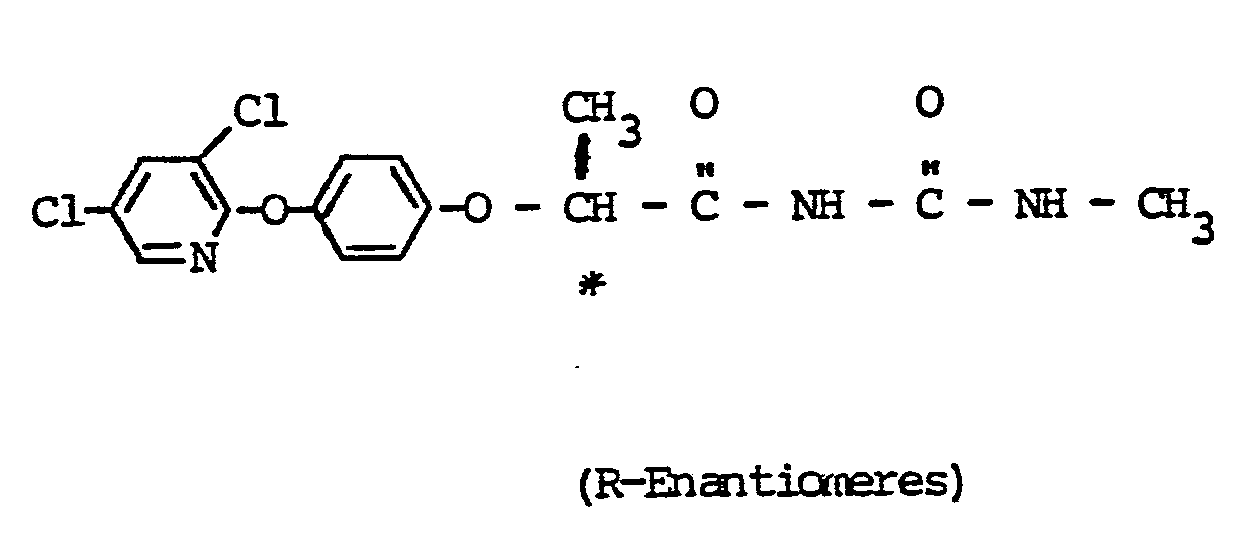
- Schmelzpunkt: 102°C
- Drehwert: [α ]23 D = + 75,8° ( C = 0,515 / CHCl3)
-

- schmelzpunkt: 83°C
- Drehwert: [α] 23 D = + 49,5° (C = 1,008 / CHCl3) D
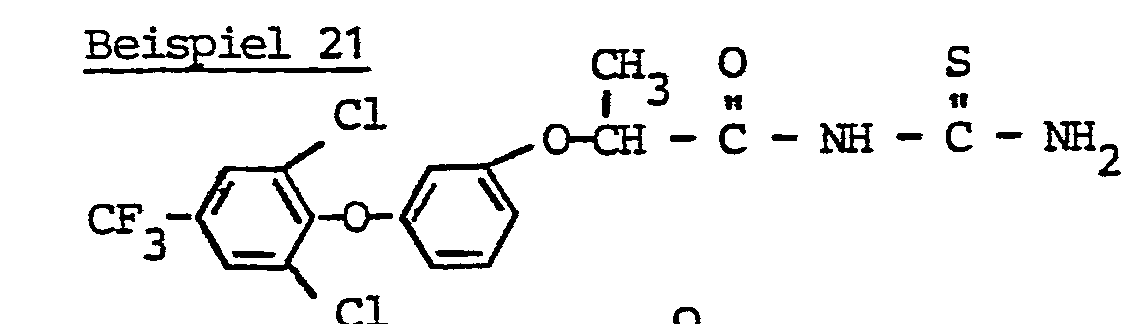
- Schmelzpunkt: 152 - 154°C

- Die Verbindung der angegebenen Formel wurde nach der im Beispiel 1 beschriebenen Methode hergestellt. Schmelzpunkt: 130°C
- In dem nachstehend beschriebenen biologischen Test wurde die folgende Verbindung als Vergleichssubstanz eingesetzt:

- 2-[4-(2,4-Dichlorphenoxy)-phenoxy]-propionsäure- methylester
- Lösungsmittel: 5 Gewichtsteile Aceton Emulgator: 1 Gewichtsteil Alkylarylpolyglykolether
- Zur Herstellung einer zweckmäßigen Wirkstoffzubereitung vermischt man 1 Gewichtsteil Wirkstoff mit der angegebenen Menge Lösungsmittel, gibt die angegebene Menge Emulgator zu und verdünnt das Konzentrat mit Wasser auf die gewünschte Konzentration.
- Mit der Wirkstoffzubereitung spritzt man Testpflanzen, welche eine Höhe von 5 - 15 cm haben, so daß die jeweils gewünschten Wirkstoffmengen pro Flächeneinheit ausgebracht werden. Die Konzentration der Spritzbrühe wird so gewählt, daß in 2000 1 Wasser/ha die jeweils gewünschten Wirkstoffmengen ausgebracht werden. Nach drei Wochen wird der Schädigungsgrad der Pflanzen bonitiert in % Schädigung im Vergleich zur Entwicklung der unbehandelten Kontrolle.
- Es bedeuten:
- 0 % = keine Wirkung (wie unbehandelte Kontrolle)
- 100 % = totale Vernichtung
- In diesem Test zeigen die Wirkstoffe gemäß Beispielen (1), (2), (3) und (5 bei der Bekämpfung von Avena fatua, Digitaria, Echinochloa und Setaria in Zuckerrüben, Baumwolle und Soja eine bessere selektive herbizide Wirksamkeit als die Vergleichssubstanz (A).
gegebenenfalls in Gegenwart eines Säureakzeptors, wie z.B. Kaliumcarbonat und gegebenenfalls in Gegenwart eines Verdünnungsmittels, wie zum Beispiel Acetonitril, bei Temperaturen zwischen 0°C und 120°C umsetzt und die dabei entstehenden Ester der Formel

mit Chlorierungsmitteln, wie zum Beispiel Thionylchlorid, gegebenenfalls in Gegenwart eines inerten Verdünnungsmittels, wie zum Beispiel Tetrachlormethan, und gegebenenfalls in Gegenwart eines Katalysators, wie zum Beispiel Dimethylformamid, bei Temperaturen zwischen 20°C und 100°C umsetzt.
einzusetzen. Bei dieser Umsetzung findet am asymmetrisch substituierten Kohlenstoffatom der Propionsäure-Einheit eine Walden'sche Umkehr statt. Dieses hat zur Folge, daß durch Umsetzung eines Phenols der Formel (VI) mit einem S-Enantiomeren eines Propionsäure-Derivates der Formel (VII) das entsprechende R-Enantiomere eines Esters der Formel (VIII) und schließlich auch das R-Enantiomere eines Phenoxypropionsäurechlorids der Formel (II) entsteht. Andererseits bildet sich durch Umsetzung eines Phenols der Formel (VI) mit einem R-Enantiomeren eines Propionsäure-Derivates der Formel (VII) zunächst das entsprechende S-Enantiomere eines Esters der Formel (VIII) und dann das entsprechende S-Enantiomere eines Phenoxypropionsäurechlorids der Formel (II).
oder mit Trimethylsilyl-isothiocyanat der Formel

Claims (10)


oder


dadurch gekennzeichnet, daß man




gegebenenfalls in Gegenwart eines Verdünnungsmittels umsetzt.


Applications Claiming Priority (2)
| Application Number | Priority Date | Filing Date | Title |
|---|---|---|---|
| DE19843407493 DE3407493A1 (de) | 1984-03-01 | 1984-03-01 | Substituierte phenoxypropionsaeure-derivate |
| DE3407493 | 1984-03-01 |
Publications (2)
| Publication Number | Publication Date |
|---|---|
| EP0154242A2 true EP0154242A2 (de) | 1985-09-11 |
| EP0154242A3 EP0154242A3 (de) | 1986-08-13 |
Family
ID=6229249
Family Applications (1)
| Application Number | Title | Priority Date | Filing Date |
|---|---|---|---|
| EP85101792A Withdrawn EP0154242A3 (de) | 1984-03-01 | 1985-02-19 | Substituierte Phenoxypropionsäure-Derivate |
Country Status (12)
| Country | Link |
|---|---|
| EP (1) | EP0154242A3 (de) |
| JP (1) | JPS60222449A (de) |
| KR (1) | KR850006937A (de) |
| BR (1) | BR8500880A (de) |
| DE (1) | DE3407493A1 (de) |
| DK (1) | DK94885A (de) |
| ES (1) | ES8602645A1 (de) |
| HU (1) | HU194018B (de) |
| IL (1) | IL74472A0 (de) |
| PH (1) | PH20967A (de) |
| PT (1) | PT79989B (de) |
| ZA (1) | ZA851527B (de) |
Family Cites Families (2)
| Publication number | Priority date | Publication date | Assignee | Title |
|---|---|---|---|---|
| CS185694B2 (en) * | 1974-07-17 | 1978-10-31 | Ishihara Sangyo Kaisha | Herbicidal agent |
| US4330321A (en) * | 1981-03-16 | 1982-05-18 | The Dow Chemical Company | Compounds and method for selectively controlling grassy weeds in broadleaved crops |
-
1984
- 1984-03-01 DE DE19843407493 patent/DE3407493A1/de not_active Withdrawn
-
1985
- 1985-02-15 PH PH31862A patent/PH20967A/en unknown
- 1985-02-19 EP EP85101792A patent/EP0154242A3/de not_active Withdrawn
- 1985-02-20 PT PT79989A patent/PT79989B/pt unknown
- 1985-02-26 JP JP60035428A patent/JPS60222449A/ja active Pending
- 1985-02-27 KR KR1019850001241A patent/KR850006937A/ko not_active Withdrawn
- 1985-02-28 BR BR8500880A patent/BR8500880A/pt unknown
- 1985-02-28 DK DK94885A patent/DK94885A/da not_active Application Discontinuation
- 1985-02-28 IL IL74472A patent/IL74472A0/xx unknown
- 1985-02-28 ZA ZA851527A patent/ZA851527B/xx unknown
- 1985-02-28 HU HU85747A patent/HU194018B/hu unknown
- 1985-02-28 ES ES540800A patent/ES8602645A1/es not_active Expired
Also Published As
| Publication number | Publication date |
|---|---|
| DK94885A (da) | 1985-09-02 |
| IL74472A0 (en) | 1985-05-31 |
| HU194018B (en) | 1988-01-28 |
| KR850006937A (ko) | 1985-10-25 |
| HUT37866A (en) | 1986-03-28 |
| ZA851527B (en) | 1985-11-27 |
| PT79989A (en) | 1985-03-01 |
| PT79989B (en) | 1987-01-13 |
| PH20967A (en) | 1987-06-10 |
| JPS60222449A (ja) | 1985-11-07 |
| ES540800A0 (es) | 1985-12-01 |
| ES8602645A1 (es) | 1985-12-01 |
| DK94885D0 (da) | 1985-02-28 |
| EP0154242A3 (de) | 1986-08-13 |
| DE3407493A1 (de) | 1985-09-05 |
| BR8500880A (pt) | 1985-10-15 |
Similar Documents
| Publication | Publication Date | Title |
|---|---|---|
| EP0096354B1 (de) | Substituierte Pyridyl-phenyl-ether | |
| EP0112531B1 (de) | Optisch aktive Phenoxypropionsäure-Derivate | |
| EP0168608A2 (de) | Substituierte Carbonsäureanilide | |
| EP0151945A1 (de) | Phenoxypropionyloxyalkanphosphonsäureester | |
| EP0175199A2 (de) | Phenoxypropionsäure-Derivate | |
| EP0151429A2 (de) | Optisch active Phenoxypropionsäure-Derivate | |
| EP0095117A1 (de) | Phenoxypropionsäure-Derivate, Verfahren zu ihrer Herstellung und ihre Verwendung als Herbizide | |
| EP0089538B1 (de) | Optisch aktive Phenoxybenzoesäure-Derivate, Verfahren zu ihrer Herstellung und ihre Verwendung als Herbizide | |
| EP0127808A1 (de) | Optisch aktive Phenoxypropionsäure-Derivate | |
| EP0126358A2 (de) | Optisch aktive Propionsäure-ester-Derivate | |
| DE3220524A1 (de) | 4,4'-disubstituierte diphenylether, verfahren zu ihrer herstellung und ihre verwendung als herbizide | |
| DE3425123A1 (de) | Optisch aktive phenoxypropionsaeure-derivate | |
| EP0095683A1 (de) | Trifluormethylphenoxy-phenyl-Derivate, Verfahren zu ihrer Herstellung und ihre Verwendung als Herbizide | |
| EP0283762A1 (de) | Neue Thiazolylether- und -thioetherderivate | |
| EP0100425A1 (de) | Substituierte Diphenylether, Verfahren zu ihren Herstellung und ihre Verwendung als Herbizide | |
| DE3502266A1 (de) | Optisch aktive phenoxypropionsaeure-derivate | |
| DE3407493A1 (de) | Substituierte phenoxypropionsaeure-derivate | |
| EP0127048A2 (de) | Optisch aktive Diphenylether-Derivate | |
| DE3513488A1 (de) | Herbizide mittel | |
| DE3221215A1 (de) | (pyridyloxy-phenoxy)-oximino-verbindungen, verfahren zu ihrer herstellung und ihre verwendung als herbizide | |
| EP0126361A1 (de) | Optisch aktive Propionsäure-Derivate | |
| DE3219821A1 (de) | Substituierte diphenylether, verfahren zu ihrer herstellung und ihre verwendung als herbizide | |
| EP0129050A1 (de) | Optisch aktive Diphenylether-Derivate | |
| DE3425702A1 (de) | Optisch aktive phenoxypropionsaeure-derivate | |
| DE3228099A1 (de) | Pyridyloxy-oximino-derivate |
Legal Events
| Date | Code | Title | Description |
|---|---|---|---|
| PUAI | Public reference made under article 153(3) epc to a published international application that has entered the european phase |
Free format text: ORIGINAL CODE: 0009012 |
|
| 17P | Request for examination filed |
Effective date: 19850219 |
|
| AK | Designated contracting states |
Designated state(s): AT BE CH DE FR GB IT LI NL |
|
| PUAL | Search report despatched |
Free format text: ORIGINAL CODE: 0009013 |
|
| AK | Designated contracting states |
Kind code of ref document: A3 Designated state(s): AT BE CH DE FR GB IT LI NL |
|
| 17Q | First examination report despatched |
Effective date: 19870226 |
|
| STAA | Information on the status of an ep patent application or granted ep patent |
Free format text: STATUS: THE APPLICATION HAS BEEN WITHDRAWN |
|
| 18W | Application withdrawn |
Withdrawal date: 19870327 |
|
| RIN1 | Information on inventor provided before grant (corrected) |
Inventor name: KRAATZ, UDO, DR. Inventor name: SANTEL, HANS-JOACHIM, DR. Inventor name: SCHMIDT, ROBERT R, DR. Inventor name: EUE, LUDWIG, DR. Inventor name: FUEHRER, WOLFGANG, DR. |