EP0154246A1 - Phasenträger für die Verteilungschromatographie von Makromolekülen, Verfahren zu ihrer Herstellung und ihre Verwendung - Google Patents
Phasenträger für die Verteilungschromatographie von Makromolekülen, Verfahren zu ihrer Herstellung und ihre Verwendung Download PDFInfo
- Publication number
- EP0154246A1 EP0154246A1 EP85101804A EP85101804A EP0154246A1 EP 0154246 A1 EP0154246 A1 EP 0154246A1 EP 85101804 A EP85101804 A EP 85101804A EP 85101804 A EP85101804 A EP 85101804A EP 0154246 A1 EP0154246 A1 EP 0154246A1
- Authority
- EP
- European Patent Office
- Prior art keywords
- phase
- particles
- base
- coated
- dextran
- Prior art date
- Legal status (The legal status is an assumption and is not a legal conclusion. Google has not performed a legal analysis and makes no representation as to the accuracy of the status listed.)
- Granted
Links
- 229920002521 macromolecule Polymers 0.000 title claims abstract description 15
- 238000000034 method Methods 0.000 title claims abstract description 13
- 238000002360 preparation method Methods 0.000 title abstract description 3
- 238000004810 partition chromatography Methods 0.000 title 1
- 239000002245 particle Substances 0.000 claims abstract description 59
- 229920002307 Dextran Polymers 0.000 claims abstract description 33
- 239000000463 material Substances 0.000 claims abstract description 27
- 238000009826 distribution Methods 0.000 claims abstract description 20
- 238000004587 chromatography analysis Methods 0.000 claims abstract description 17
- -1 polyethylene Polymers 0.000 claims abstract description 12
- 239000004698 Polyethylene Substances 0.000 claims abstract description 8
- 229920000573 polyethylene Polymers 0.000 claims abstract description 8
- 238000013375 chromatographic separation Methods 0.000 claims abstract description 4
- 229920001222 biopolymer Polymers 0.000 claims abstract description 3
- 229920002401 polyacrylamide Polymers 0.000 claims description 17
- VYPSYNLAJGMNEJ-UHFFFAOYSA-N Silicium dioxide Chemical compound O=[Si]=O VYPSYNLAJGMNEJ-UHFFFAOYSA-N 0.000 claims description 9
- 229920002678 cellulose Polymers 0.000 claims description 7
- 239000001913 cellulose Substances 0.000 claims description 7
- 239000002344 surface layer Substances 0.000 claims description 7
- HRPVXLWXLXDGHG-UHFFFAOYSA-N Acrylamide Chemical compound NC(=O)C=C HRPVXLWXLXDGHG-UHFFFAOYSA-N 0.000 claims description 6
- 229920001577 copolymer Polymers 0.000 claims description 6
- 239000000178 monomer Substances 0.000 claims description 6
- 229920000642 polymer Polymers 0.000 claims description 6
- 239000000741 silica gel Substances 0.000 claims description 6
- 229910002027 silica gel Inorganic materials 0.000 claims description 6
- 239000000243 solution Substances 0.000 claims description 6
- 125000000391 vinyl group Chemical group [H]C([*])=C([H])[H] 0.000 claims description 6
- 229920000936 Agarose Polymers 0.000 claims description 5
- BPQQTUXANYXVAA-UHFFFAOYSA-N Orthosilicate Chemical compound [O-][Si]([O-])([O-])[O-] BPQQTUXANYXVAA-UHFFFAOYSA-N 0.000 claims description 5
- 239000000203 mixture Substances 0.000 claims description 5
- 239000011248 coating agent Substances 0.000 claims description 4
- 238000000576 coating method Methods 0.000 claims description 4
- 238000010559 graft polymerization reaction Methods 0.000 claims description 4
- 238000004519 manufacturing process Methods 0.000 claims description 4
- 229920000193 polymethacrylate Polymers 0.000 claims description 4
- 229920002554 vinyl polymer Polymers 0.000 claims description 4
- QVGXLLKOCUKJST-UHFFFAOYSA-N atomic oxygen Chemical compound [O] QVGXLLKOCUKJST-UHFFFAOYSA-N 0.000 claims description 3
- 230000007717 exclusion Effects 0.000 claims description 3
- 239000001301 oxygen Substances 0.000 claims description 3
- 229910052760 oxygen Inorganic materials 0.000 claims description 3
- 238000007717 redox polymerization reaction Methods 0.000 claims description 3
- SMZOUWXMTYCWNB-UHFFFAOYSA-N 2-(2-methoxy-5-methylphenyl)ethanamine Chemical compound COC1=CC=C(C)C=C1CCN SMZOUWXMTYCWNB-UHFFFAOYSA-N 0.000 claims description 2
- NIXOWILDQLNWCW-UHFFFAOYSA-N 2-Propenoic acid Natural products OC(=O)C=C NIXOWILDQLNWCW-UHFFFAOYSA-N 0.000 claims description 2
- CERQOIWHTDAKMF-UHFFFAOYSA-N Methacrylic acid Chemical compound CC(=C)C(O)=O CERQOIWHTDAKMF-UHFFFAOYSA-N 0.000 claims description 2
- 125000005396 acrylic acid ester group Chemical group 0.000 claims description 2
- 230000000274 adsorptive effect Effects 0.000 claims description 2
- 239000007864 aqueous solution Substances 0.000 claims description 2
- 239000000470 constituent Substances 0.000 claims description 2
- FQPSGWSUVKBHSU-UHFFFAOYSA-N methacrylamide Chemical compound CC(=C)C(N)=O FQPSGWSUVKBHSU-UHFFFAOYSA-N 0.000 claims description 2
- 125000005397 methacrylic acid ester group Chemical group 0.000 claims description 2
- TWNQGVIAIRXVLR-UHFFFAOYSA-N oxo(oxoalumanyloxy)alumane Chemical compound O=[Al]O[Al]=O TWNQGVIAIRXVLR-UHFFFAOYSA-N 0.000 claims description 2
- 239000002685 polymerization catalyst Substances 0.000 claims description 2
- 229920001059 synthetic polymer Polymers 0.000 claims description 2
- 239000002585 base Substances 0.000 description 30
- 238000000926 separation method Methods 0.000 description 20
- 239000000523 sample Substances 0.000 description 14
- 239000002202 Polyethylene glycol Substances 0.000 description 11
- 229920001223 polyethylene glycol Polymers 0.000 description 11
- IJGRMHOSHXDMSA-UHFFFAOYSA-N Atomic nitrogen Chemical compound N#N IJGRMHOSHXDMSA-UHFFFAOYSA-N 0.000 description 8
- 239000000969 carrier Substances 0.000 description 8
- 210000004027 cell Anatomy 0.000 description 8
- 108091032973 (ribonucleotides)n+m Proteins 0.000 description 6
- 238000002474 experimental method Methods 0.000 description 6
- VMHLLURERBWHNL-UHFFFAOYSA-M Sodium acetate Chemical compound [Na+].CC([O-])=O VMHLLURERBWHNL-UHFFFAOYSA-M 0.000 description 5
- 239000000499 gel Substances 0.000 description 5
- XLYOFNOQVPJJNP-UHFFFAOYSA-N water Chemical compound O XLYOFNOQVPJJNP-UHFFFAOYSA-N 0.000 description 5
- 108020004566 Transfer RNA Proteins 0.000 description 4
- 239000007978 cacodylate buffer Substances 0.000 description 4
- 230000000052 comparative effect Effects 0.000 description 4
- 150000002009 diols Chemical class 0.000 description 4
- 229910052757 nitrogen Inorganic materials 0.000 description 4
- 108020004707 nucleic acids Proteins 0.000 description 4
- 150000007523 nucleic acids Chemical class 0.000 description 4
- 102000039446 nucleic acids Human genes 0.000 description 4
- 229920002477 rna polymer Polymers 0.000 description 4
- 235000017281 sodium acetate Nutrition 0.000 description 4
- 239000001632 sodium acetate Substances 0.000 description 4
- PXIPVTKHYLBLMZ-UHFFFAOYSA-N Sodium azide Chemical compound [Na+].[N-]=[N+]=[N-] PXIPVTKHYLBLMZ-UHFFFAOYSA-N 0.000 description 3
- 230000000694 effects Effects 0.000 description 3
- 239000010410 layer Substances 0.000 description 3
- 238000005192 partition Methods 0.000 description 3
- 102000004169 proteins and genes Human genes 0.000 description 3
- 108090000623 proteins and genes Proteins 0.000 description 3
- 238000011160 research Methods 0.000 description 3
- 230000005526 G1 to G0 transition Effects 0.000 description 2
- 239000004353 Polyethylene glycol 8000 Substances 0.000 description 2
- 241000726445 Viroids Species 0.000 description 2
- GWXLDORMOJMVQZ-UHFFFAOYSA-N cerium Chemical compound [Ce] GWXLDORMOJMVQZ-UHFFFAOYSA-N 0.000 description 2
- 238000010790 dilution Methods 0.000 description 2
- 239000012895 dilution Substances 0.000 description 2
- 239000012153 distilled water Substances 0.000 description 2
- 229940085678 polyethylene glycol 8000 Drugs 0.000 description 2
- 235000019446 polyethylene glycol 8000 Nutrition 0.000 description 2
- 238000006116 polymerization reaction Methods 0.000 description 2
- 150000003839 salts Chemical class 0.000 description 2
- IHQKEDIOMGYHEB-UHFFFAOYSA-M sodium dimethylarsinate Chemical compound [Na+].C[As](C)([O-])=O IHQKEDIOMGYHEB-UHFFFAOYSA-M 0.000 description 2
- 238000001179 sorption measurement Methods 0.000 description 2
- 238000003756 stirring Methods 0.000 description 2
- 239000000725 suspension Substances 0.000 description 2
- PAWQVTBBRAZDMG-UHFFFAOYSA-N 2-(3-bromo-2-fluorophenyl)acetic acid Chemical compound OC(=O)CC1=CC=CC(Br)=C1F PAWQVTBBRAZDMG-UHFFFAOYSA-N 0.000 description 1
- NLHHRLWOUZZQLW-UHFFFAOYSA-N Acrylonitrile Chemical compound C=CC#N NLHHRLWOUZZQLW-UHFFFAOYSA-N 0.000 description 1
- 241000894006 Bacteria Species 0.000 description 1
- 229910052684 Cerium Inorganic materials 0.000 description 1
- KCXVZYZYPLLWCC-UHFFFAOYSA-N EDTA Chemical compound OC(=O)CN(CC(O)=O)CCN(CC(O)=O)CC(O)=O KCXVZYZYPLLWCC-UHFFFAOYSA-N 0.000 description 1
- 239000005909 Kieselgur Chemical class 0.000 description 1
- HBBGRARXTFLTSG-UHFFFAOYSA-N Lithium ion Chemical compound [Li+] HBBGRARXTFLTSG-UHFFFAOYSA-N 0.000 description 1
- GYCMBHHDWRMZGG-UHFFFAOYSA-N Methylacrylonitrile Chemical compound CC(=C)C#N GYCMBHHDWRMZGG-UHFFFAOYSA-N 0.000 description 1
- GRYLNZFGIOXLOG-UHFFFAOYSA-N Nitric acid Chemical compound O[N+]([O-])=O GRYLNZFGIOXLOG-UHFFFAOYSA-N 0.000 description 1
- 241000700605 Viruses Species 0.000 description 1
- 239000002253 acid Substances 0.000 description 1
- 239000003513 alkali Substances 0.000 description 1
- 125000003275 alpha amino acid group Chemical group 0.000 description 1
- 150000001413 amino acids Chemical class 0.000 description 1
- 229920001586 anionic polysaccharide Polymers 0.000 description 1
- 150000004836 anionic polysaccharides Chemical class 0.000 description 1
- 230000015572 biosynthetic process Effects 0.000 description 1
- 239000000872 buffer Substances 0.000 description 1
- 239000012876 carrier material Substances 0.000 description 1
- 125000002091 cationic group Chemical group 0.000 description 1
- 150000001768 cations Chemical class 0.000 description 1
- 210000003850 cellular structure Anatomy 0.000 description 1
- 230000003247 decreasing effect Effects 0.000 description 1
- 238000002405 diagnostic procedure Methods 0.000 description 1
- 239000003792 electrolyte Substances 0.000 description 1
- 238000010828 elution Methods 0.000 description 1
- 210000003527 eukaryotic cell Anatomy 0.000 description 1
- 238000011049 filling Methods 0.000 description 1
- 239000012634 fragment Substances 0.000 description 1
- 239000007789 gas Substances 0.000 description 1
- 238000010438 heat treatment Methods 0.000 description 1
- 239000011147 inorganic material Substances 0.000 description 1
- 238000011835 investigation Methods 0.000 description 1
- 150000002500 ions Chemical class 0.000 description 1
- 238000002955 isolation Methods 0.000 description 1
- 150000002605 large molecules Chemical class 0.000 description 1
- 238000004460 liquid liquid chromatography Methods 0.000 description 1
- 229910001416 lithium ion Inorganic materials 0.000 description 1
- 238000002156 mixing Methods 0.000 description 1
- 230000007935 neutral effect Effects 0.000 description 1
- 229910017604 nitric acid Inorganic materials 0.000 description 1
- 230000003287 optical effect Effects 0.000 description 1
- 239000011368 organic material Substances 0.000 description 1
- 238000010587 phase diagram Methods 0.000 description 1
- 239000000419 plant extract Substances 0.000 description 1
- 238000010926 purge Methods 0.000 description 1
- 241000894007 species Species 0.000 description 1
- 239000000126 substance Substances 0.000 description 1
- 238000012360 testing method Methods 0.000 description 1
- UEUXEKPTXMALOB-UHFFFAOYSA-J tetrasodium;2-[2-[bis(carboxylatomethyl)amino]ethyl-(carboxylatomethyl)amino]acetate Chemical compound [Na+].[Na+].[Na+].[Na+].[O-]C(=O)CN(CC([O-])=O)CCN(CC([O-])=O)CC([O-])=O UEUXEKPTXMALOB-UHFFFAOYSA-J 0.000 description 1
- 238000013519 translation Methods 0.000 description 1
- 238000005406 washing Methods 0.000 description 1
Images


Classifications
-
- B—PERFORMING OPERATIONS; TRANSPORTING
- B01—PHYSICAL OR CHEMICAL PROCESSES OR APPARATUS IN GENERAL
- B01J—CHEMICAL OR PHYSICAL PROCESSES, e.g. CATALYSIS OR COLLOID CHEMISTRY; THEIR RELEVANT APPARATUS
- B01J20/00—Solid sorbent compositions or filter aid compositions; Sorbents for chromatography; Processes for preparing, regenerating or reactivating thereof
- B01J20/30—Processes for preparing, regenerating, or reactivating
- B01J20/32—Impregnating or coating ; Solid sorbent compositions obtained from processes involving impregnating or coating
- B01J20/3231—Impregnating or coating ; Solid sorbent compositions obtained from processes involving impregnating or coating characterised by the coating or impregnating layer
- B01J20/3242—Layers with a functional group, e.g. an affinity material, a ligand, a reactant or a complexing group
- B01J20/3268—Macromolecular compounds
- B01J20/327—Polymers obtained by reactions involving only carbon to carbon unsaturated bonds
-
- B—PERFORMING OPERATIONS; TRANSPORTING
- B01—PHYSICAL OR CHEMICAL PROCESSES OR APPARATUS IN GENERAL
- B01D—SEPARATION
- B01D15/00—Separating processes involving the treatment of liquids with solid sorbents; Apparatus therefor
- B01D15/08—Selective adsorption, e.g. chromatography
- B01D15/26—Selective adsorption, e.g. chromatography characterised by the separation mechanism
- B01D15/30—Partition chromatography
-
- B—PERFORMING OPERATIONS; TRANSPORTING
- B01—PHYSICAL OR CHEMICAL PROCESSES OR APPARATUS IN GENERAL
- B01J—CHEMICAL OR PHYSICAL PROCESSES, e.g. CATALYSIS OR COLLOID CHEMISTRY; THEIR RELEVANT APPARATUS
- B01J20/00—Solid sorbent compositions or filter aid compositions; Sorbents for chromatography; Processes for preparing, regenerating or reactivating thereof
- B01J20/28—Solid sorbent compositions or filter aid compositions; Sorbents for chromatography; Processes for preparing, regenerating or reactivating thereof characterised by their form or physical properties
- B01J20/28002—Solid sorbent compositions or filter aid compositions; Sorbents for chromatography; Processes for preparing, regenerating or reactivating thereof characterised by their form or physical properties characterised by their physical properties
- B01J20/28004—Sorbent size or size distribution, e.g. particle size
-
- B—PERFORMING OPERATIONS; TRANSPORTING
- B01—PHYSICAL OR CHEMICAL PROCESSES OR APPARATUS IN GENERAL
- B01J—CHEMICAL OR PHYSICAL PROCESSES, e.g. CATALYSIS OR COLLOID CHEMISTRY; THEIR RELEVANT APPARATUS
- B01J20/00—Solid sorbent compositions or filter aid compositions; Sorbents for chromatography; Processes for preparing, regenerating or reactivating thereof
- B01J20/281—Sorbents specially adapted for preparative, analytical or investigative chromatography
-
- B—PERFORMING OPERATIONS; TRANSPORTING
- B01—PHYSICAL OR CHEMICAL PROCESSES OR APPARATUS IN GENERAL
- B01J—CHEMICAL OR PHYSICAL PROCESSES, e.g. CATALYSIS OR COLLOID CHEMISTRY; THEIR RELEVANT APPARATUS
- B01J20/00—Solid sorbent compositions or filter aid compositions; Sorbents for chromatography; Processes for preparing, regenerating or reactivating thereof
- B01J20/281—Sorbents specially adapted for preparative, analytical or investigative chromatography
- B01J20/286—Phases chemically bonded to a substrate, e.g. to silica or to polymers
-
- B—PERFORMING OPERATIONS; TRANSPORTING
- B01—PHYSICAL OR CHEMICAL PROCESSES OR APPARATUS IN GENERAL
- B01J—CHEMICAL OR PHYSICAL PROCESSES, e.g. CATALYSIS OR COLLOID CHEMISTRY; THEIR RELEVANT APPARATUS
- B01J20/00—Solid sorbent compositions or filter aid compositions; Sorbents for chromatography; Processes for preparing, regenerating or reactivating thereof
- B01J20/30—Processes for preparing, regenerating, or reactivating
- B01J20/32—Impregnating or coating ; Solid sorbent compositions obtained from processes involving impregnating or coating
- B01J20/3202—Impregnating or coating ; Solid sorbent compositions obtained from processes involving impregnating or coating characterised by the carrier, support or substrate used for impregnation or coating
- B01J20/3204—Inorganic carriers, supports or substrates
-
- B—PERFORMING OPERATIONS; TRANSPORTING
- B01—PHYSICAL OR CHEMICAL PROCESSES OR APPARATUS IN GENERAL
- B01J—CHEMICAL OR PHYSICAL PROCESSES, e.g. CATALYSIS OR COLLOID CHEMISTRY; THEIR RELEVANT APPARATUS
- B01J20/00—Solid sorbent compositions or filter aid compositions; Sorbents for chromatography; Processes for preparing, regenerating or reactivating thereof
- B01J20/30—Processes for preparing, regenerating, or reactivating
- B01J20/32—Impregnating or coating ; Solid sorbent compositions obtained from processes involving impregnating or coating
- B01J20/3202—Impregnating or coating ; Solid sorbent compositions obtained from processes involving impregnating or coating characterised by the carrier, support or substrate used for impregnation or coating
- B01J20/3206—Organic carriers, supports or substrates
- B01J20/3208—Polymeric carriers, supports or substrates
- B01J20/321—Polymeric carriers, supports or substrates consisting of a polymer obtained by reactions involving only carbon to carbon unsaturated bonds
-
- B—PERFORMING OPERATIONS; TRANSPORTING
- B01—PHYSICAL OR CHEMICAL PROCESSES OR APPARATUS IN GENERAL
- B01J—CHEMICAL OR PHYSICAL PROCESSES, e.g. CATALYSIS OR COLLOID CHEMISTRY; THEIR RELEVANT APPARATUS
- B01J20/00—Solid sorbent compositions or filter aid compositions; Sorbents for chromatography; Processes for preparing, regenerating or reactivating thereof
- B01J20/30—Processes for preparing, regenerating, or reactivating
- B01J20/32—Impregnating or coating ; Solid sorbent compositions obtained from processes involving impregnating or coating
- B01J20/3202—Impregnating or coating ; Solid sorbent compositions obtained from processes involving impregnating or coating characterised by the carrier, support or substrate used for impregnation or coating
- B01J20/3206—Organic carriers, supports or substrates
- B01J20/3208—Polymeric carriers, supports or substrates
- B01J20/3212—Polymeric carriers, supports or substrates consisting of a polymer obtained by reactions otherwise than involving only carbon to carbon unsaturated bonds
-
- B—PERFORMING OPERATIONS; TRANSPORTING
- B01—PHYSICAL OR CHEMICAL PROCESSES OR APPARATUS IN GENERAL
- B01J—CHEMICAL OR PHYSICAL PROCESSES, e.g. CATALYSIS OR COLLOID CHEMISTRY; THEIR RELEVANT APPARATUS
- B01J20/00—Solid sorbent compositions or filter aid compositions; Sorbents for chromatography; Processes for preparing, regenerating or reactivating thereof
- B01J20/30—Processes for preparing, regenerating, or reactivating
- B01J20/32—Impregnating or coating ; Solid sorbent compositions obtained from processes involving impregnating or coating
- B01J20/3214—Impregnating or coating ; Solid sorbent compositions obtained from processes involving impregnating or coating characterised by the method for obtaining this coating or impregnating
- B01J20/3217—Resulting in a chemical bond between the coating or impregnating layer and the carrier, support or substrate, e.g. a covalent bond
- B01J20/3219—Resulting in a chemical bond between the coating or impregnating layer and the carrier, support or substrate, e.g. a covalent bond involving a particular spacer or linking group, e.g. for attaching an active group
-
- B—PERFORMING OPERATIONS; TRANSPORTING
- B01—PHYSICAL OR CHEMICAL PROCESSES OR APPARATUS IN GENERAL
- B01J—CHEMICAL OR PHYSICAL PROCESSES, e.g. CATALYSIS OR COLLOID CHEMISTRY; THEIR RELEVANT APPARATUS
- B01J20/00—Solid sorbent compositions or filter aid compositions; Sorbents for chromatography; Processes for preparing, regenerating or reactivating thereof
- B01J20/30—Processes for preparing, regenerating, or reactivating
- B01J20/32—Impregnating or coating ; Solid sorbent compositions obtained from processes involving impregnating or coating
- B01J20/3231—Impregnating or coating ; Solid sorbent compositions obtained from processes involving impregnating or coating characterised by the coating or impregnating layer
- B01J20/3242—Layers with a functional group, e.g. an affinity material, a ligand, a reactant or a complexing group
- B01J20/3268—Macromolecular compounds
- B01J20/3278—Polymers being grafted on the carrier
-
- B—PERFORMING OPERATIONS; TRANSPORTING
- B01—PHYSICAL OR CHEMICAL PROCESSES OR APPARATUS IN GENERAL
- B01J—CHEMICAL OR PHYSICAL PROCESSES, e.g. CATALYSIS OR COLLOID CHEMISTRY; THEIR RELEVANT APPARATUS
- B01J20/00—Solid sorbent compositions or filter aid compositions; Sorbents for chromatography; Processes for preparing, regenerating or reactivating thereof
- B01J20/30—Processes for preparing, regenerating, or reactivating
- B01J20/32—Impregnating or coating ; Solid sorbent compositions obtained from processes involving impregnating or coating
- B01J20/3231—Impregnating or coating ; Solid sorbent compositions obtained from processes involving impregnating or coating characterised by the coating or impregnating layer
- B01J20/3242—Layers with a functional group, e.g. an affinity material, a ligand, a reactant or a complexing group
- B01J20/3268—Macromolecular compounds
- B01J20/328—Polymers on the carrier being further modified
- B01J20/3282—Crosslinked polymers
-
- B—PERFORMING OPERATIONS; TRANSPORTING
- B01—PHYSICAL OR CHEMICAL PROCESSES OR APPARATUS IN GENERAL
- B01J—CHEMICAL OR PHYSICAL PROCESSES, e.g. CATALYSIS OR COLLOID CHEMISTRY; THEIR RELEVANT APPARATUS
- B01J20/00—Solid sorbent compositions or filter aid compositions; Sorbents for chromatography; Processes for preparing, regenerating or reactivating thereof
- B01J20/30—Processes for preparing, regenerating, or reactivating
- B01J20/32—Impregnating or coating ; Solid sorbent compositions obtained from processes involving impregnating or coating
- B01J20/3231—Impregnating or coating ; Solid sorbent compositions obtained from processes involving impregnating or coating characterised by the coating or impregnating layer
- B01J20/3287—Layers in the form of a liquid
-
- B—PERFORMING OPERATIONS; TRANSPORTING
- B01—PHYSICAL OR CHEMICAL PROCESSES OR APPARATUS IN GENERAL
- B01J—CHEMICAL OR PHYSICAL PROCESSES, e.g. CATALYSIS OR COLLOID CHEMISTRY; THEIR RELEVANT APPARATUS
- B01J20/00—Solid sorbent compositions or filter aid compositions; Sorbents for chromatography; Processes for preparing, regenerating or reactivating thereof
- B01J20/30—Processes for preparing, regenerating, or reactivating
- B01J20/32—Impregnating or coating ; Solid sorbent compositions obtained from processes involving impregnating or coating
- B01J20/3231—Impregnating or coating ; Solid sorbent compositions obtained from processes involving impregnating or coating characterised by the coating or impregnating layer
- B01J20/3289—Coatings involving more than one layer of same or different nature
-
- B—PERFORMING OPERATIONS; TRANSPORTING
- B01—PHYSICAL OR CHEMICAL PROCESSES OR APPARATUS IN GENERAL
- B01J—CHEMICAL OR PHYSICAL PROCESSES, e.g. CATALYSIS OR COLLOID CHEMISTRY; THEIR RELEVANT APPARATUS
- B01J2220/00—Aspects relating to sorbent materials
- B01J2220/50—Aspects relating to the use of sorbent or filter aid materials
- B01J2220/54—Sorbents specially adapted for analytical or investigative chromatography
-
- B—PERFORMING OPERATIONS; TRANSPORTING
- B01—PHYSICAL OR CHEMICAL PROCESSES OR APPARATUS IN GENERAL
- B01J—CHEMICAL OR PHYSICAL PROCESSES, e.g. CATALYSIS OR COLLOID CHEMISTRY; THEIR RELEVANT APPARATUS
- B01J2220/00—Aspects relating to sorbent materials
- B01J2220/50—Aspects relating to the use of sorbent or filter aid materials
- B01J2220/58—Use in a single column
-
- Y—GENERAL TAGGING OF NEW TECHNOLOGICAL DEVELOPMENTS; GENERAL TAGGING OF CROSS-SECTIONAL TECHNOLOGIES SPANNING OVER SEVERAL SECTIONS OF THE IPC; TECHNICAL SUBJECTS COVERED BY FORMER USPC CROSS-REFERENCE ART COLLECTIONS [XRACs] AND DIGESTS
- Y10—TECHNICAL SUBJECTS COVERED BY FORMER USPC
- Y10S—TECHNICAL SUBJECTS COVERED BY FORMER USPC CROSS-REFERENCE ART COLLECTIONS [XRACs] AND DIGESTS
- Y10S435/00—Chemistry: molecular biology and microbiology
- Y10S435/803—Physical recovery methods, e.g. chromatography, grinding
Definitions
- the invention relates to phase supports for the distribution chromatography of macromolecules, in particular in the aqueous polyethylene glycol-dextran two-phase system, processes for their preparation and their use.
- Cationic or anionic polysaccharide-based gels bind the dextran-rich phase as well as cellulose, but can only be used for isocratic separation processes, since the phase is rejected as soon as the electrical phase potential changes in the course of the gradient elution with various salts in the mobile, polyethylene-rich phase .
- the object of the present invention is therefore to provide phase supports with a universal application for the distribution chromatography of macromolecules, which enable excellent separation in a simple manner, are easy to produce and are just as suitable for the separation of low and high molecular weight ribonucleic acids as for subcellular units and whole cells, especially for virus research and viroid research is of great importance.
- phase supports which comprise base support particles whose surface is coated with a firmly adhering material with affinity for one of the phases of the phase system for the distribution chromatography.
- the invention therefore relates to the phase carriers according to the main claim.
- the subclaims relate to particularly preferred embodiments of this subject matter of the invention and to a method for producing these phase carriers and their use.
- the invention thus relates to phase supports for the distribution chromatography of macromolecules, in particular single-stranded nucleic acids and in particular proteins, as well as subcellular units and whole cells, which consist of non-adsorptive, carrier-insoluble in the phase system with an average particle size in the range from 7 to 2000 ⁇ m, the surface of which consists of a in the phase system insoluble, firmly adhering material is coated with affinity for one of the phases of the phase system for the distribution chromatography.
- the base carrier particles are coated with a firmly adhering material with affinity for one of the phases, namely the dextran phase of the polyethylene glycol-dextran two-phase system, with the result that the dextran phase is inevitably bound to and in the surface of these combination particles Way even for extremely large molecules up to whole cells.
- the base carrier particles provide the required mechanical stability of the phase carrier.
- the base carrier particles consist of an inorganic and / or organic material, for example of aluminum oxide, a silicate, diatomaceous earth, silica gel, cellulose, cellulose derivatives, crosslinked dextran, crosslinked agarose or a polymer or copolymer based on monomers such as Acrylic acid, acrylamide, acrylic acid esters, acrylonitrile, methacrylic acid, methacrylamide, methacrylic acid esters, methacrylonitrile and / or vinyl compounds or mixtures of these monomers.
- an inorganic and / or organic material for example of aluminum oxide, a silicate, diatomaceous earth, silica gel, cellulose, cellulose derivatives, crosslinked dextran, crosslinked agarose or a polymer or copolymer based on monomers such as Acrylic acid, acrylamide, acrylic acid esters, acrylonitrile, methacrylic acid, methacrylamide, methacrylic acid esters, methacrylonitrile and / or vinyl compounds or mixtures
- the base carrier particles consist of one of these specified materials in hydroxylated form, since in this way it is readily possible to firmly connect the surface layer to the base carrier particles, namely a chemical bond between the material of the surface layer and that of the base carrier particles to reach.
- base carrier particles made from a diol-substituted silica gel, a hydrophilized polymethacrylate, a silicate with a starch-like coating or a porous vinyl-based polymer.
- the base support particles of the phase support according to the invention have an average particle size of 7 to 100 ⁇ m and in particular of 10 to 50 ⁇ m with particular advantage.
- the base carrier particles are coated with a polymeric material which is particularly advantageously chemically bound to the material of the base carrier particles. It has proven to be particularly advantageous to coat the base support particles with a synthetic polymer or copolymer which is formed by grafting the monomeric components onto the base support particles det. For this purpose, aptropropene polyacrylamide and in particular linear or weakly crosslinked polyacrylamide have proven to be the most suitable for the desired separation effect.
- Another object of the invention is a method for producing this phase support, which consists in chemically combining the base support particles of the type described above with the polymeric material applied in the form of a surface layer. This is preferably carried out in such a way that the base support particles are provided with the surface layer of the polymeric material by graft polymerization.
- the base carrier particles are suspended from a hydroxylated material of the type specified above in a solution containing the monomer or monomers, whereupon the grafting of the polymeric material is effected in the course of a redox polymerization with exclusion of oxygen.
- cerium (IV) ions as the polymerization catalyst, since this material causes the formation of the free radicals which favor the polymerization exclusively on the surface of the base support particles, so that the polymerization takes place in the form of a graft polymerization.
- the acrylamide used to form the preferred polyacrylamide as the surface layer is preferably used in the form of an aqueous solution.
- phase supports according to the invention are suitable for the separation of low and high molecular weight ribonucleic acids, of double-stranded nucleic acids, of subcellular units and whole cells, so that they are used for the isolation of viroid RNA from crude plant extracts and for chromatographic separation subcellular units and whole cells under other can be used for medical-diagnostic purposes.
- the invention therefore also relates to the use of the phase carriers defined above for the separation-chromatographic separation of macromolecules, biopolymers, subcellular units and whole cells in aqueous two-phase and multi-phase systems based on polymers, as described, for example, by P.A. Albertson ("Partition of Cell Particles and Macromolecules” (1971), 2nd Ed. Almquist & Wiksell, Sweden, pp. 18-30) have been described, in particular in aqueous two-phase polyethylene glycol-dextran systems.
- This example illustrates the production of a phase carrier according to the invention.
- a three-necked flask equipped with a gas inlet tube, a dropping funnel and a vacuum connection is charged with a solution of 50 g of acrylamide in 500 ml of distilled water, and 20 g of base carrier particles made from a diol-substituted silica gel (Lichrosorb® diol from Merck) with a particle size of 10 ⁇ m are suspended therein Solution. Then you purge with purified nitrogen for 5 minutes, evacuate and refill with nitrogen. These steps of evacuating and filling with nitrogen are repeated twice, after which 15 ml of a 0.2 M solution of cerium (TV) ammonium nitrate in 1 N nitric acid are added with stirring.
- TV cerium
- base carrier particles made of the materials specifically mentioned above are provided with a polyacrylamide layer, it not being necessary to carry out the above-mentioned dilution of the polyacrylamide-coated carrier with non-coated material.
- base support from “Lichrosorb®” this dilution is required to make the coated M to a-TERIAL filterable, and thus to favor the coating of the dextran phase.
- phase carriers according to the invention were compared with phase carriers which consist only of the base carrier particles of the corresponding phase carrier according to the invention.
- phase carriers were coated with the dextran phase of the polyethylene glycol dextran system as follows.
- the washed material was in the pressure filter at 37 ° C with 2.5 volumes of the dextran phase of the polyethylene glycol dextran system (prepared by dissolving 66.3 g of Dextran T500 and 5.4 g of polyethylene glycol 8000 in 428.3 ml of 0.2 M Sodium acetate in the cacodylate buffer described in Example 1), after which the excess phase with the polyethylene glycol-rich upper phase of the same system (prepared by dissolving 3 g of Dextran T500, 71.7 g of polyethylene glycol 8000 in 925.3 ml of 0.2 M sodium acetate in the cacodylate buffer). After suspending of the material in 3 volumes of the upper phase, the phase support obtained in this way was slurried into a suitable chromatography tube with a heating jacket thermostatted at 37 ° C.
- the separation takes place in the polyethylene glycol dextran system "D" from 6.20% by weight of dextran, 4.40% by weight of polyethylene glycol and 89.40% by weight of water, which in the lower phase consists of 13.25% by weight % Dextran, 1.07% by weight polyethylene glycol and 85.68% by weight water and in the upper phase from 0.30% by weight dextran, 7.17% by weight polyethylene glycol and 92.53% by weight. -% water (this and similar polyethylene glycol dextran systems are known from the above-mentioned literature reference PA Albertson, see in particular the phase diagram on page 264).
- the distribution coefficient can be influenced in particular by the ion composition, ie by adding different amounts salts, the lithium ions increasing the partition coefficient K, while the other alkali cations have the opposite effect.
- the separation takes place at a temperature of 37 ° C in the thermostatted chromatography column.
- sample amounts are given in OD 254 units, ie as optical density at a wavelength of 254 nm, where 25 OD 254 correspond to 1 mg of RNA.
- phase supports according to the invention have an unexpectedly advantageous suitability for the separation of biological macromolecules, which could not be foreseen in any way, and can be used with great advantage for separation processes and medical diagnostic processes.
Landscapes
- Chemical & Material Sciences (AREA)
- Analytical Chemistry (AREA)
- Chemical Kinetics & Catalysis (AREA)
- Organic Chemistry (AREA)
- Inorganic Chemistry (AREA)
- Solid-Sorbent Or Filter-Aiding Compositions (AREA)
- Treatment Of Liquids With Adsorbents In General (AREA)
- Peptides Or Proteins (AREA)
Abstract
Description
- Gegenstand der Erfindung sind Phasenträger für die Verteilungschromatographie von Makromolekülen insbesondere im wäßrigen Polyethylenglykol-Dextran-Zweiphasensystem, Verfahren zu ihrer Herstellung und ihre Verwendung.
- Es ist bekannt, daß man biologische Makromoleküle, subzelluläre Einheiten, Bakterien und eukaryotische Zellen durch Gegenstromverteilung im wäßrigen Polyethylenglykol-Dextran-System trennen kann (P.A. Albertson "Partition of Cell Particles and Macromolecules" (1971), 2nd Ed., Almquist & Wiksell, Stockholm). Diese Gegenstromverteilungsverfahren sind nun aber apparativ äußerst aufwendig und zeitraubend, insbesondere wenn bei kleinen Verteilungskoeffizienten eine große Vielzahl von Gegenstromverteilungsstufen notwendig ist, um die gewünschte Trennung zu erreichen. Es wurden daher bereits Versuche unternommen, diesen Gegenstromverteilungsprozeß durch ein verteilungschrcnatographisches Verfahren zu ersetzen, da es in dieser Weise wesentlich einfacher möglich ist, eine Vielzahl von Trennungsstufen zu erreichen. Allerdings scheiterten diese Versuche bislang an geeigneten Trägern für die stationäre Phase.
- Bislang konnten lediglich doppelsträngige Nucleinsäuren im wäßrigen Polyethylenglykol-Dextran-System unter Verwendung von Cellulose als Träger für die dextranreiche stationäre Phase chromatographisch getrennt werden (W. Müller, H.J. Schuetz, C. Guerrier-Takada, P.E. Cole und R. Potts, Nucleic Acids Research, Vol. 7, Nr. 8 (1979) 2483 bis 2499 und W. Müller und G. Kütemeier, Eur. J. Biochem. 128 (1982), 231 bis 238). Bei diesen Untersuchungen der Flüssig/Flüssig-Chromatographie von DNA-Fragmenten wurde als Trägermaterialien für die dextranreiche Phase des wäßrigen Polyethylenglykol-Dextran-Systems eine Reihe von Materialien eingesetzt, von denen sich insbesondere Cellulose als geeignet erwiesen hat, da es eine ausreichende Affinität für die dextranreiche Phase zeigt. Für Proteine und proteinhaltige Zellbestandteile sind diese Phasenträger aber wegen ihrer ausgeprägten Adsorptionseigenschaften nicht anwendbar; auch bei Ribonucleinsäuren machen sich adsorptionsbedingte Störeffekte schon bemerkbar. Kationische oder anionische Gele auf Polysaccharidbasis binden die dextranreiche Phase zwar ähnlich gut wie Cellulose, sind jedoch nur für isokratische Trennprozesse zu benutzen, da die Phase abgestoßen wird, sobald sich das elektrische Phasenpotential im Zuge der Gradientenelution mit verschiedenen Salzen in der mobilen, polyethylenreichen Phase ändert.
- Unter den neutralen Gelen, die als potentielle Phasenträger für eine solche Verteilungschromatographie in Frage kämen, sind-poröse Mischpolymere auf Vinylbasis (Fraktogele der Firma Merck, Darmstadt) sowie die Polyacrylamidgele (Biogele der Firma Biorad). Erstere binden für eine generelle Anwendung eine zu geringe Menge der Dextranphasen, während im letzteren Falle die gebundene Phase für Makromoleküle kaum zugänglich ist. Dieser Sachverhalt wird auch in der oben angesprochenen Literaturstelle Eur. J. Biochem. 128 (1982), Seite 233 deutlich hervorgehoben. Diese Unzugänglichkeit der gebundenen Phase gilt auch für Polyacrylamid-Agarose-Kombinationsgele (beispielsweise die AcA-Ultrogele der Firma IDF).
- Die Aufgabe der vorliegenden Erfindung besteht somit darin, Phasenträger mit universellem Anwendungsbereich für die Verteilungschromatographie von Makromolekülen zu schaffen, die eine hervorragende Trennung in einfacher Weise ermöglichen, leicht herzustellen sind und für die Trennung von nieder- und hochmolekularen Ribonucleinsäuren ebenso geeignet sind wie für subzelluläre Einheiten und ganze Zellen, was namentlich für die Virusforschung und Viroidforschung von großer Bedeutung ist.
- Es hat sich nunmehr gezeigt, daß diese Aufgaben mit Hilfe von Phasenträgern gelöst werden kann, die Grundträgerteilchen umfassen, deren Oberfläche mit einem fest anhaftenden Material mit Affinität für eine der Phasen des Phasensystems für die Verteilungschromatographie beschichtet ist.
- Gegenstand der Erfindung sind daher die Phasenträger gemäß Hauptanspruch. Die Unteransprüche betreffen besonders bevorzugte Ausführungsformen dieses Erfindungsgegenstandes sowie ein Verfahren zur Herstellunq dieser Phasenträger und deren Verwendung.
- Die Erfindung betrifft somit Phasenträger für die Verteilungschromatographie von Makromolekülen, namentlich einsträngigen Nucleinsäuren und insbesondere Proteinen sowie subzellulären Einheiten und ganzen Zellen, die aus nichtadsorptiven, in dem Phasensystem unlöslichen Grundträgerteilchen mit einer durchschnittlichen Teilchengröße im Bereich von 7 bis 2000 um bestehen, deren Oberfläche mit einem in dem Phasensystem unlöslichen, fest anhaftenden Material mit Affinität für eine der Phasen des Phasensystems für die Verteilungschromatographie beschichtet ist.
- Bei dem erfindungsgemäßen Phasenträger sind die Grundträgerteilchen mit einem festanhaftenden Material mit Affinität für eine der Phasen, namentlich die Dextranphase des Polyethylenglykol-Dextran-Zweiphasensystems, beschichtet, was zur Folge hat, daß bei diesen Kombinationsteilchen die Dextranphase zwangsläufig an der Oberfläche gebunden wird und in dieser Weise auch für extrem große Moleküle bis zu ganzen Zellen zugänglich wird. Auf der anderen Seite sorgen die Grundträgerteilchen für die erforderliche mechanische Stabilität des Phasenträgers.
- Gemäß einer bevorzugten Ausführungsform der Erfindung bestehen die Grundträgerteilchen aus einem anorganischen und/oder organischen Material, beispielsweise aus Aluminiumoxid, einem Silicat, Kieselgur, Kieselgel, Cellulose, Cellulosederivaten, vernetztem Dextran, vernetzter Agarose oder einem Polymer oder Copolymer auf der Grundlage von Monomeren, wie Acrylsäure, Acrylamid, Acrylsäureestern, Acrylnitril, Methacrylsäure, Methacrylamid, Methacrylsäureestern, Methacrylnitril und/oder Vinylverbindungen oder Gemischen aus diesen Monomeren. Besonders bevorzugt ist es, daß die Grundträgerteilchen aus einem dieser angegebenen Materialien in hydroxylierter Form bestehen, da es in dieser Weise ohne weiteres möglich ist, die Oberflächenschicht fest mit den Grundträgerteilchen zu verbinden, namentlich eine chemische Bindung zwischen dem Material der Oberfächenschicht und dem der Grundträgerteilchen zu erreichen.
- Besonders vorteilhaft ist es, Grundträgerteilchen aus einem diolsubstituierten Kieselgel, einem hydrophilisierten Polymethacrylat, einem Silicat mit stärkeartiger Beschichtung oder einem porösen Polymer auf Vinylbasis einzusetzen.
- Mit besonderem Vorteil besitzen die Grundträgerteilchen des erfindungsgemäßen Phasenträgers eine durchschnittliche Teilchengröße von 7 bis 100 um und insbesondere von 10 bis 50 um.
- Einer weiteren bevorzugten Ausführungsform der Erfindung zufolge sind die Grundträgerteilchen mit einem polymeren Material beschichtet, das mit besonderem Vorteil chemisch an das Material der Grundträgerteilchen gebunden ist. Dabei hat es sich als besonders vorteilhaft erwiesen, die Grundträgerteilchen mit einem synthetischen Polymer oder Copolymer zu beschichten, welches durch Aufpfropfen der monomeren Bestandteile auf die Grundträgerteilchen gebildet wird. Für diesen Zweck hat sich aurgeptroprtes Polyacrylamid und insbesondere lineares oder schwach vernetztes Polyacrylamid am für den angestrebten Trenneffekt geeignetsten erwiesen.
- Ein weiterer Gegenstand der Erfindung ist ein Verfahren zur Herstellung dieses Phasenträgers, welches darin besteht, die Grundträgerteilchen der oben beschriebenen Art chemisch mit dem in Form einer Oberflächenschicht aufgebrachten polymeren Material zu verbinden. Vorzugsweise wird dies in der Weise durchgeführt, daß man die Grundträgerteilchen durch Pfropfpolymerisation mit der Oberflächenschicht aus dem polymeren Material versieht.
- Gemäß einer bevorzugten Ausführungsform dieses Verfahrens werden die Grundträgerteilchen aus einem hydroxylierten Material der oben angegebenen Art in einer das bzw. die Monomeren enthaltenden Lösung suspendiert, worauf das Aufpfropfen des polymeren Materials im Zuge einer Redoxpolymerisation unter Sauerstoffausschluß bewirkt wird. Dabei kann man bei diesem Verfahren mit Vorteil als Polymerisationskatalysator Cer(IV)-ionen verwenden, da dieses Material die Bildung der die Polymerisation begünstigenden freien Radikale ausschließlich an der Oberfläche der Grundträgerteilchen bewirkt, so däB die Polymerisation in Form einer Pfropfpolymerisation abläuft. Bezüglich Einzelheiten dieses an sich bekannten Verfahrens darf auf G. Mino und S. Kaizerman in Journal of Polymer Science, Vol. XXXI, Nr. 122 (1958), 242 bis 243 verwiesen werden.
- Bei dieser Verfahrensführung setzt man das zur Bildung des als Oberflächenschicht bevorzugten Polyacrylamids verwendete Acrylamid vorzugsweise in Form einer wäßrigen Lösung ein.
- Es hat sich gezeigt, daß bei der oben angesprochenen Redoxpolymerisation in Gegenwart von Cer(IV)-ionen die Pfropfpolymerisation von Acrylamid unter sorgfältigem Sauerstoffausschluß innerhalb von 30 bis 240 Minuten eine genügend dichte Polyacrylamidschicht auf den Grundträgerteilchen ergibt, die zur Bindung einer ausreichenden Menge der Dextranphase für die Verteilungschromatographie im wäßrigen Polyethylenglykol-Dextran-System ausreicht.
- Im einzelnen wurden die folgenden Träger mit Erfolg mit einer Polyacrylamidschicht versehen:
- "Superose® ": Vernetzte Agarose der Firma Pharmacia, Teilchengröße 25 bis 40 µm,
- "Lichrosorb®"-Diol: Diolsubstituiertes Kieselgel der Firma Merck, Teilchengröße 10 µm,
- "Separon Hema 1000®": Hydrophilisiertes Polymethacrylat der Laboratory Instruments Works, Prag, Teilchengröße 16 bis 21 um,
- "TSK-SIL 3000®": Silicatträger mit stärkeartiger Beschichtung der Firma Toyo Soda, Teilchengröße 10 um (unter anderem Inhalt der "Blauen Säule" der Firma LKB),
- "TSK-HW-40(S)®, -55(S) -65(S) und -75(S)": Poröse Mischpolymere auf Vinylbasis, 1m Äq OH/g , der Firma Toyo Soda, erhältlich als "Fractogele" der Firma Merck, Teilchengröße 25 bis 40 um.
- Es hat sich gezeigt, daß die erfindungsgemäßen Phasenträger für die Trennung von nieder- und hochmolekularen Ribonucleinsäuren, von doppelsträngigen Nucleinsäuren, von subzellulären Einheiten und ganzen Zellen geeignet sind, so daß sie für die Isolierung von Viroid-RNA aus pflanzlichen Rohextrakten und für die chromatographische Trennung subzellulärer Einheiten und ganzen Zellen unter anderem für medizinisch-diagnostische Zwecke angewandt werden können.
- Gegenstand der Erfindung ist daher auch die Verwendung der oben definierten Phasenträger zur verteilungschromatographischen Trennung von Makromolekülen, Biopolymeren, subzellulären Einheiten und ganzen Zellen in wäßrigen Zwei-und Mehrphasensystemen auf Polymerbasis, wie sie beispielsweise von P.A. Albertson ("Partition of Cell Particles and Macromolecules" (1971), 2nd Ed. Almquist & Wiksell, Stockholm, S. 18-30) beschrieben worden sind, insbesondere in wäßrigen Polyethylenglykol-Dextran-Zweiphasensystemen.
- Die folgenden Beispiele dienen der weiteren Erläuterung der Erfindung.
- Dieses Beispiel verdeutlicht die Herstellung eines erfindungsgemäßen Phasenträgers.
- Man beschickt einen mit einem Gaseinleitungsrohr, einem Tropftrichter und einem Vakuumanschluß versehenen Dreihalskolben mit einer Lösung von 50g Acrylamid in 500 ml destilliertem Wasser und suspendiert 20g Grundträgerteilchen aus einem diolsubstituierten Kieselgel (Lichrosorb®-Diol der Firma Merck) mit einer Teilchengröße von 10 µm in dieser Lösung. Dann spült man zunächst während 5 Minuten mit nachgereinigtem Stickstoff, evakuiert und füllt erneut mit Stickstoff. Diese Maßnahmen des Evakuierens und Befüllens mit Stickstoff wiederholt man zweimal,wonach man 15m1 einer 0,2 M Lösung von Cer(TV)-ammoniumnitrat in 1 N Salpetersäure unter Rühren zusetzt. Man leitet unter mäßigem Rühren während 60 Minuten Stickstoff durch die Suspension, wobei die Intensität der gelben Farbe der Cer(IV)-ionen deutlich abnimmt. Dann versetzt man die Suspension unter Luftzutritt mit weiteren 20g der Grundträgerteilchen und filtriert nach dem Mischen unter Druck über ein Blaubandfilter (Schleicher & Schüll Nr. 5893) ab. Nach dem Waschen mit 400ml destilliertem Wasser wäscht man mit rund 400 ml einer 0,2 M Natriumacetatlösung in einem Cacodylat-Puffer (10 mM Natriumcacodylat/1 mM Ethylendiamintetraessiqsäure, pH-Wert = 6).
- In gleicher Weise versieht man Grundträgerteilchen aus den oben spezifisch angesprochenen Materialien mit einer Polyacrylamidschicht, wobei es nicht notwendig ist, die oben angegebene Verdünnung des polyacrylamidbeschichteten Trägers mit nichtbeschichtetem Material durchzuführen. Im Fall von Grundträgerteilchen aus "Lichrosorb®" ist diese Verdünnung erforderlich, um das beschichtete Ma-terial filtrierbar zu machen und somit die Beschichtung mit der Dextranphase zu begünstigen.
- Zur Verdeutlichung der Trenneigenschaften des erfindungsgemäßen Phasenträgers wurden Vergleichsversuche durchgeführt, bei denen die erfindungsgemäßen Phasenträger Phasenträgern gegenübergestellt wurden, die lediglich aus den Grundträgerteilchen des entsprechenden erfindungsgemäßen Phasenträgers bestehen.
- Zunächst wurden die Phasenträger mit der Dextranphase des Polyethylenglykol-Dextran-Systems wie folgt beschichtet.
- Das gewaschene Material wurde im Druckfilter bei 37°C mit 2,5 Volumen der Dextranphase des Polyethylenglykol-Dextran-Systems (hergestellt durch Lösen von 66,3 g Dextran T500 und 5,4 g Polyethylenglykol 8000 in 428,3 ml 0,2 M Natriumacetat in dem in Beispiel 1 beschriebenen Cacodylat-Puffer) gespült, wonach der Phasenüberschuß mit der polyethylenglykolreichen Oberphase des gleichen Systems (hergestellt durch Lösen von 3 g Dextran T500, 71,7 g Polyethylenglykol 8000 in 925,3 ml 0,2 M Natriumacetat in dem Cacodylat-Puffer) ausgewaschen wurde. Nach dem Suspendieren des Materials in 3 Volumen Oberphase wurde der in dieser Weise erhaltene Phasenträger in ein geeignetes Chromatographierohr mit einem auf 37°C thermostatisierten Heizmantel eingeschlämmt.
- Dann wurden die Trenneigenschaften der in dieser Weise mit der Dextranphase versehenen unbeschichteten Grundträgerteilchen einerseits bzw. der erfindungsgemäßen Phasenträger andererseits untersucht, und zwar unter Verwendung eines Probenmaterials auf der Grundlage eines Gemisches aus Transfer-RNA (tRNA) und 5sRNA. Beide RNA-Komponenten gehören zu den löslichen Ribonucleinsäuren und besitzen die folgenden Eigenschaften:
- tRNA: Molgewicht = 30 000, besteht aus 40 bis 60 gleich großen Spezies, die sich in ihrer Aminosäureakzeptoraktivität unterscheiden.
- 5sRNA: Molgewicht = 43 000, bei den meisten Organismen einheitliche RNA, die eine Rolle bei der Übertragung einer RNA-Basensequenz in eine Aminosäuresequenz spielt.
- Die Trennung erfolgt in dem Polyethylenglykol-Dextran-System "D" aus 6,20 Gew.-% Dextran, 4,40 Gew.-% Polyethylenglykol und 89,40 Gew.-% Wasser, welches in der Unterphase aus 13,25 Gew.-% Dextran, 1,07 Gew.-% Polyethylenglykol und 85,68 Gew.-% Wasser und in der Oberphase aus 0,30 Gew.-% Dextran, 7,17 Gew.-% Polyethylenglykol und 92,53 Gew.-% Wasser besteht (dieses und ähnliche Polyethylenglykol-Dextran-Systeme sind aus der oben angesprochenen Literaturstelle P.A. Albertson bekannt, siehe insbesondere das Phasendiagramm auf Seite 264). Bei diesem Polyethylenglykol-Dextran-Zweiphasensystem läßt sich der Verteilungskoeffizient insbesondere durch die Ionenzusammensetzung beeinflussen, d. h. durch die Zugabe unterschiedlicher Salze, wobei die Lithiumionen den Verteilungskoeffizienten K steigern, während die anderen Alkalikationen den entgegengesetzten Effekt ausüben.
- Bei der hier durchgeführten Trennung werden daher im Phasenpaar die folgenden Elektrolyte verwendet:
- 10 mM Natrium-Cacodylat-Puffer mit einem pH-Wert von 6,0
- 3 mM Natriumazid
- 1 mM Natriumsalz der Ethylendiamintetraessigsäure
- + 0,2 M Natriumacetat.
- Die Trennung erfolgt bei einer Temperatur von 37°C in der thermostatisierten Chromatographiesäule.
- Die Probenmengen sind in OD254-Einheiten angegeben, d. h. als optische Dichte bei einer Wellenläne von 254 nm, wobei 25 OD254 1 mg RNA entsprechen.
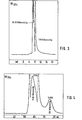
- Die bei diesen Trennungen erhaltenen Ergebnisse sind in den beigefügten Fig. 1 bis 6 dargestellt, wobei diese Figuren im einzelnen folgendes zeigen:
- Fig. 1 Vergleichsversuch: Chromatographie einer 10 OD254-Probe an einer Säule, die mit Grundträgerteilchen aus nicht mit Polyacrylamid beschichtetem "Lichrosorb® "-Diol gefüllt ist. Säulenvolumen: 55 ml, Flußrate: 18 ml/h;
- Fig. 2 Erfindungsgemäßer Versuch: Trennung einer farbstoffhaltigen 50 OD254-Probe an einer Säule, die mit polyacrylamidbeschichteten Grundträgerteilchen aus "Lichrosorb® "-Diol beschickt ist. Säulenvolumen: 8,4 ml, Flußrate: 15 ml/h;
- Fig. 3 Vergleichsversuch: Chromatographie einer 19 OD2,4-Probe an einer mit Grundträgerteilchen aus "Superose® " beschichteten Säule, Säulenvolumen: 10 ml, Flußrate: 9 ml/h;
- Fig. 4 Erfindungsgemäßer Versuch: Trennung einer 50 OD254-Probe an einer Säule, die mit Polyacrylamid beschichteten "Superose® "-Teilchen beschickt ist, Säulenvolumen: 60 ml, Flußrate: 20 ml/h;
- Fig. 5 Vergleichsversuch: Chromatographie einer 35 OD254-Probe an einer mit Grundträgerteilchen aus "TSK-HW-40(S)" beschickten Säule, Säulenvolumen: 65 ml, Flußrate: 15 ml/h;
- Fig. 6 Erfindungsgemäßer Versuch: Trennung einer 35 OD254-Probe an einer Säule, die mit Polyacrylamid beschichteten "TSK-HW-40(S)"-Grundträgerteilchen beschickt ist, Säulenvolumen: 65 ml, Flußrate: 15 ml/h.
- Aus den obigen Figuren ist ersichtlich, daß mit Hilfe der erfindungsgemäßen Phasenträger im Vergleich zu Säulen, die die unbeschichteten Grundträgerteilchen enthalten, eine überraschend saubere Trennung der Bestandteile des eingesetzten Trenngemisches möglich ist. Damit ist aber ersichtlich, daß die erfindungsgemäßen Phasenträger eine unerwartet vorteilhafte Eignung für die Trennung von biologischen Makromolekülen besitzen, die in keiner Weise vorausgesehen werden konnte, und mit großem Vorteil für Trennverfahren und medinzinisch-diagnostische Verfahren angewandt werden können.
Claims (17)
Applications Claiming Priority (2)
| Application Number | Priority Date | Filing Date | Title |
|---|---|---|---|
| DE3407814 | 1984-03-02 | ||
| DE19843407814 DE3407814A1 (de) | 1984-03-02 | 1984-03-02 | Phasentraeger fuer die verteilungschromatographie von makromolekuelen, verfahren zu ihrer herstellung und ihre verwendung |
Publications (2)
| Publication Number | Publication Date |
|---|---|
| EP0154246A1 true EP0154246A1 (de) | 1985-09-11 |
| EP0154246B1 EP0154246B1 (de) | 1988-07-13 |
Family
ID=6229473
Family Applications (1)
| Application Number | Title | Priority Date | Filing Date |
|---|---|---|---|
| EP85101804A Expired EP0154246B1 (de) | 1984-03-02 | 1985-02-20 | Phasenträger für die Verteilungschromatographie von Makromolekülen, Verfahren zu ihrer Herstellung und ihre Verwendung |
Country Status (9)
| Country | Link |
|---|---|
| US (1) | US4756834A (de) |
| EP (1) | EP0154246B1 (de) |
| JP (1) | JPS61501310A (de) |
| AU (1) | AU569147B2 (de) |
| CA (1) | CA1238626A (de) |
| CS (1) | CS259875B2 (de) |
| DE (2) | DE3407814A1 (de) |
| IL (1) | IL74470A (de) |
| WO (1) | WO1985003885A1 (de) |
Cited By (3)
| Publication number | Priority date | Publication date | Assignee | Title |
|---|---|---|---|---|
| US5453186A (en) * | 1988-03-31 | 1995-09-26 | Merck Patent Gesellschaft Mit Beschrankter Haftung | Separating materials |
| DE102011001743A1 (de) * | 2011-04-01 | 2012-10-04 | Technische Universität Dortmund | Verfahren zur Trennung/Reinigung von Biomolekühlen |
| CN103798227A (zh) * | 2014-02-11 | 2014-05-21 | 中国农业科学院烟草研究所 | 一种锦紫苏类病毒离体常温保存方法 |
Families Citing this family (20)
| Publication number | Priority date | Publication date | Assignee | Title |
|---|---|---|---|---|
| JP2767251B2 (ja) * | 1988-04-01 | 1998-06-18 | 三菱化学株式会社 | 複合化分離剤及びその製造方法 |
| IE911670A1 (en) * | 1990-05-17 | 1991-11-20 | Adeza Biomedical Corp | Highly reflective biogratings and method |
| SE9101149D0 (sv) | 1991-04-17 | 1991-04-17 | Pharmacia Lkb Biotech | Beads for down stream processing |
| WO1994000214A1 (en) * | 1992-06-19 | 1994-01-06 | Sepracor Inc. | Passivated and stabilized porous supports and methods for the preparation and use of same |
| US6706188B2 (en) | 1993-05-03 | 2004-03-16 | Amersham Biociences Ab | Process and means for down stream processing |
| DE59406939D1 (en) * | 1993-07-16 | 1998-10-22 | Merck Patent Gmbh | Trennmaterialien für die hydrophobe chromatographie |
| DE4333674A1 (de) * | 1993-10-02 | 1995-04-06 | Merck Patent Gmbh | Nukleotidhaltiges Sorbens für die Affinitätschromatographie |
| DE4333821A1 (de) * | 1993-10-04 | 1995-04-06 | Merck Patent Gmbh | Ionenaustauscher |
| DE4334353A1 (de) * | 1993-10-08 | 1995-04-13 | Merck Patent Gmbh | Verfahren und Träger für die Gelpermeationschromatographie |
| US5674946A (en) * | 1993-10-08 | 1997-10-07 | Merck Patent Gesellschaft Mit Beschrankter Haftung | Epoxy derivatives of polyacrylamides |
| US6994791B2 (en) * | 2002-06-27 | 2006-02-07 | Akzo Nobel N.V. | Adsorbent material and method of preparing an adsorbent material |
| GB0316742D0 (en) * | 2003-07-17 | 2003-08-20 | Fermentas Uab | Electrophoretic gels and their manufacture |
| EP2152405B2 (de) * | 2007-05-25 | 2017-04-05 | Merck Patent GmbH | Mischpfropfpolymere für die kationenaustauschchromatographie |
| WO2008156410A1 (en) * | 2007-06-19 | 2008-12-24 | Ge Healthcare Bio-Sciences Ab | Polymer two phase system and use thereof |
| JP5631869B2 (ja) * | 2008-05-30 | 2014-11-26 | メルク パテント ゲゼルシャフト ミット ベシュレンクテル ハフツングMerck Patent Gesellschaft mit beschraenkter Haftung | 水酸基を含まないポリマー上におけるCe(IV)で開始されるグラフト重合 |
| WO2014043644A1 (en) | 2012-09-17 | 2014-03-20 | Alltech Associates, Inc. | Functionalized particulate support material and methods of making and using the same |
| RU2015114330A (ru) | 2012-09-17 | 2016-11-10 | У.Р. Грейс Энд Ко.-Конн. | Хроматографические среды и устройства |
| US11229896B2 (en) | 2014-01-16 | 2022-01-25 | W.R. Grace & Co.—Conn. | Affinity chromatography media and chromatography devices |
| JP6914189B2 (ja) | 2014-05-02 | 2021-08-04 | ダブリュー・アール・グレース・アンド・カンパニー−コーンW R Grace & Co−Conn | 官能化担体材料並びに官能化担体材料を作製及び使用する方法 |
| CN107921407B (zh) | 2015-06-05 | 2022-07-05 | 格雷斯公司 | 生物处理吸附澄清剂及其制备和使用方法 |
Citations (7)
| Publication number | Priority date | Publication date | Assignee | Title |
|---|---|---|---|---|
| US3478886A (en) * | 1967-03-31 | 1969-11-18 | Atomic Energy Commission | Graft-copolymer column support material for liquid-liquid partition chromatography |
| GB1310872A (en) * | 1969-01-13 | 1973-03-21 | Simpson C F | Liquid partition chromatography |
| US3983299A (en) * | 1974-03-04 | 1976-09-28 | Purdue Research Foundation | Bonded carbohydrate stationary phases for chromatography |
| DE2709094A1 (de) * | 1977-03-02 | 1978-09-07 | Boehringer Mannheim Gmbh | Adsorbens fuer die affinitaetsspezifische trennung von makromolekularen stoffen, verfahren zu seiner herstellung und seine verwendung |
| DE2712344A1 (de) * | 1977-03-21 | 1978-09-28 | Mueller Werner | Loeslicher komplexbildner fuer die affinitaetsspezifische trennung von makromolekularen stoffen, verfahren zu seiner herstellung und seine verwendung |
| US4140653A (en) * | 1975-09-30 | 1979-02-20 | Toyo Soda Manufacturing Co., Ltd. | Solid support for liquid chromatography |
| US4159966A (en) * | 1977-12-27 | 1979-07-03 | The Dow Chemical Company | Chromatographic column packing |
Family Cites Families (16)
| Publication number | Priority date | Publication date | Assignee | Title |
|---|---|---|---|---|
| GB1478971A (en) * | 1973-07-05 | 1977-07-06 | Univ Strathclyde | Solute-adsorptive material |
| CA1060728A (en) * | 1973-07-26 | 1979-08-21 | Jack Fennimore | Treatment of particulate carbon with biocompatible polymer |
| US3954678A (en) * | 1974-07-11 | 1976-05-04 | E. I. Du Pont De Nemours And Company | Semipermeable microcapsules containing a silica gel |
| JPS5247355B2 (de) * | 1974-10-15 | 1977-12-01 | ||
| JPS5211184A (en) * | 1975-07-17 | 1977-01-27 | Yoshiaki Motozato | Two-layer spherical gel particles for molecular sieve |
| JPS5247358A (en) * | 1975-10-14 | 1977-04-15 | Nec Home Electronics Ltd | Phase lock loop circuit |
| US4076619A (en) * | 1975-10-30 | 1978-02-28 | Polymetrics International Inc. | Hydrophilic acrylic polymers as marine filters, algae growth catalysts, and breeding stimulus for fish and invertebrates |
| US4171283A (en) * | 1976-08-04 | 1979-10-16 | Kuraray Co., Ltd. | Hemoperfusion adsorbents |
| US4330440A (en) * | 1977-02-08 | 1982-05-18 | Development Finance Corporation Of New Zealand | Activated matrix and method of activation |
| US4111838A (en) * | 1977-09-09 | 1978-09-05 | Eastman Kodak Company | Composition for chromatography |
| US4245005A (en) * | 1979-02-28 | 1981-01-13 | Purdue Research Foundation | Pellicular coated support and method |
| EP0048110B1 (de) * | 1980-09-11 | 1986-06-11 | United Kingdom Atomic Energy Authority | Selektive Abtrennung mit zusammengesetzten Materialien |
| JPS57150433A (en) * | 1981-03-12 | 1982-09-17 | Kuraray Co Ltd | Carrier for immobilizing physiologically active material and selective adsorbent, selective electrode and analytical column using said carrier |
| JPS57171257A (en) * | 1981-04-14 | 1982-10-21 | Mitsubishi Gas Chem Co Inc | Packing for liquid chromatography |
| CA1204720A (en) * | 1982-09-30 | 1986-05-20 | Hajimu Kitahara | Packing materials for chromatographic use and a method for analysis of an enantiomer mixture using the same |
| CS248505B1 (en) * | 1983-06-23 | 1987-02-12 | Marie Tlustakova | Method of biocompatible layer production on surface of porous synthetic sorbents' particles |
-
1984
- 1984-03-02 DE DE19843407814 patent/DE3407814A1/de not_active Withdrawn
-
1985
- 1985-02-20 AU AU39953/85A patent/AU569147B2/en not_active Ceased
- 1985-02-20 DE DE8585101804T patent/DE3563693D1/de not_active Expired
- 1985-02-20 EP EP85101804A patent/EP0154246B1/de not_active Expired
- 1985-02-20 JP JP60500924A patent/JPS61501310A/ja active Pending
- 1985-02-20 WO PCT/EP1985/000054 patent/WO1985003885A1/de not_active Ceased
- 1985-02-28 CA CA000475468A patent/CA1238626A/en not_active Expired
- 1985-02-28 IL IL74470A patent/IL74470A/xx unknown
- 1985-03-01 CS CS851471A patent/CS259875B2/cs unknown
-
1987
- 1987-07-20 US US07/075,500 patent/US4756834A/en not_active Expired - Fee Related
Patent Citations (7)
| Publication number | Priority date | Publication date | Assignee | Title |
|---|---|---|---|---|
| US3478886A (en) * | 1967-03-31 | 1969-11-18 | Atomic Energy Commission | Graft-copolymer column support material for liquid-liquid partition chromatography |
| GB1310872A (en) * | 1969-01-13 | 1973-03-21 | Simpson C F | Liquid partition chromatography |
| US3983299A (en) * | 1974-03-04 | 1976-09-28 | Purdue Research Foundation | Bonded carbohydrate stationary phases for chromatography |
| US4140653A (en) * | 1975-09-30 | 1979-02-20 | Toyo Soda Manufacturing Co., Ltd. | Solid support for liquid chromatography |
| DE2709094A1 (de) * | 1977-03-02 | 1978-09-07 | Boehringer Mannheim Gmbh | Adsorbens fuer die affinitaetsspezifische trennung von makromolekularen stoffen, verfahren zu seiner herstellung und seine verwendung |
| DE2712344A1 (de) * | 1977-03-21 | 1978-09-28 | Mueller Werner | Loeslicher komplexbildner fuer die affinitaetsspezifische trennung von makromolekularen stoffen, verfahren zu seiner herstellung und seine verwendung |
| US4159966A (en) * | 1977-12-27 | 1979-07-03 | The Dow Chemical Company | Chromatographic column packing |
Cited By (4)
| Publication number | Priority date | Publication date | Assignee | Title |
|---|---|---|---|---|
| US5453186A (en) * | 1988-03-31 | 1995-09-26 | Merck Patent Gesellschaft Mit Beschrankter Haftung | Separating materials |
| DE102011001743A1 (de) * | 2011-04-01 | 2012-10-04 | Technische Universität Dortmund | Verfahren zur Trennung/Reinigung von Biomolekühlen |
| CN103798227A (zh) * | 2014-02-11 | 2014-05-21 | 中国农业科学院烟草研究所 | 一种锦紫苏类病毒离体常温保存方法 |
| CN103798227B (zh) * | 2014-02-11 | 2016-03-16 | 中国农业科学院烟草研究所 | 一种锦紫苏类病毒离体常温保存方法 |
Also Published As
| Publication number | Publication date |
|---|---|
| DE3407814A1 (de) | 1985-09-12 |
| DE3563693D1 (en) | 1988-08-18 |
| AU3995385A (en) | 1985-09-24 |
| US4756834A (en) | 1988-07-12 |
| WO1985003885A1 (fr) | 1985-09-12 |
| JPS61501310A (ja) | 1986-07-03 |
| CS259875B2 (en) | 1988-11-15 |
| IL74470A0 (en) | 1985-05-31 |
| IL74470A (en) | 1988-11-30 |
| CS147185A2 (en) | 1988-04-15 |
| AU569147B2 (en) | 1988-01-21 |
| CA1238626A (en) | 1988-06-28 |
| EP0154246B1 (de) | 1988-07-13 |
Similar Documents
| Publication | Publication Date | Title |
|---|---|---|
| EP0154246B1 (de) | Phasenträger für die Verteilungschromatographie von Makromolekülen, Verfahren zu ihrer Herstellung und ihre Verwendung | |
| DE69325266T2 (de) | Superporöse polysaccharidgele | |
| DE2638764C3 (de) | Verwendung eines Austauscherharzes zum Auftrennen von Proteinen | |
| EP0104210B1 (de) | Chromatographische trennung von nucleinsäuren | |
| DE2840503C2 (de) | Verfahren zur Herstellung eines festen porösen Materials für chromatographische Zwecke | |
| DE3851616T2 (de) | Makroporöse Polymermembranen, ihre Herstellung und Verwendung zur Abtrennung von Polymere. | |
| DE2501831C2 (de) | Verfahren zur Herstellung von einheitlich geformten, porösen, runden Polyacrylatperlen | |
| DE3007869C2 (de) | ||
| DE69832166T2 (de) | Matrix zur trennung und nutzung der matrix zur trennung | |
| EP0991940B1 (de) | Verwendung monolithischer sorbentien für präparative chromatographische trennverfahren | |
| DE60015137T2 (de) | Mit material gefülllte geschäumte substanz | |
| DE2839170C2 (de) | Chromatographisches Material | |
| DE60012311T2 (de) | Negativ geladene membranen | |
| DE69010124T2 (de) | Trennmembran und Trennverfahren. | |
| EP0616639A1 (de) | Vorrichtung und verfahren zur isolierung und reinigung von nukleinsäuren | |
| EP3347125B1 (de) | Adsorptionsmedium, verfahren zu dessen herstellung, sowie verwendung desselben zur aufreinigung von biomolekülen | |
| DE69113266T2 (de) | Adsorbentmittel. | |
| DE3882797T2 (de) | Schwach affinitives Adsorbens für Affinitätschromatographie. | |
| DE68904732T2 (de) | Ionenaustausch und trennungsmethode. | |
| DE3609021A1 (de) | Chromatographisches trennmedium fuer die schnelle analyse von kleinen proben | |
| DE68908147T2 (de) | Feine teilchen von poröser ionenaustauschercellulose, herstellungsverfahren und affinitätsträger. | |
| DE2321784C2 (de) | Verfahren zur Herstellung von vernetzten Gelose- oder Agarose-Gelen sowie deren Verwendung | |
| EP1242816B1 (de) | Chromatographiematerial und verfahren unter verwendung desselben | |
| DE60131710T2 (de) | Verfahren zur Adsorption und Entfernung, und Verwendung eines Adsorbers für endogene Cannabinoide | |
| DE68914898T2 (de) | Selektive Entfernung chemischer Spezies aus einem Fluid. |
Legal Events
| Date | Code | Title | Description |
|---|---|---|---|
| PUAI | Public reference made under article 153(3) epc to a published international application that has entered the european phase |
Free format text: ORIGINAL CODE: 0009012 |
|
| AK | Designated contracting states |
Designated state(s): BE CH DE FR GB IT LI NL SE |
|
| 17P | Request for examination filed |
Effective date: 19860111 |
|
| 17Q | First examination report despatched |
Effective date: 19861216 |
|
| ITF | It: translation for a ep patent filed | ||
| GRAA | (expected) grant |
Free format text: ORIGINAL CODE: 0009210 |
|
| AK | Designated contracting states |
Kind code of ref document: B1 Designated state(s): BE CH DE FR GB IT LI NL SE |
|
| GBT | Gb: translation of ep patent filed (gb section 77(6)(a)/1977) | ||
| REF | Corresponds to: |
Ref document number: 3563693 Country of ref document: DE Date of ref document: 19880818 |
|
| ET | Fr: translation filed | ||
| PLBE | No opposition filed within time limit |
Free format text: ORIGINAL CODE: 0009261 |
|
| STAA | Information on the status of an ep patent application or granted ep patent |
Free format text: STATUS: NO OPPOSITION FILED WITHIN TIME LIMIT |
|
| 26N | No opposition filed | ||
| PGFP | Annual fee paid to national office [announced via postgrant information from national office to epo] |
Ref country code: NL Payment date: 19900228 Year of fee payment: 6 |
|
| PGFP | Annual fee paid to national office [announced via postgrant information from national office to epo] |
Ref country code: BE Payment date: 19900301 Year of fee payment: 6 |
|
| ITTA | It: last paid annual fee | ||
| PG25 | Lapsed in a contracting state [announced via postgrant information from national office to epo] |
Ref country code: BE Effective date: 19910228 |
|
| PG25 | Lapsed in a contracting state [announced via postgrant information from national office to epo] |
Ref country code: NL Effective date: 19910901 |
|
| NLV4 | Nl: lapsed or anulled due to non-payment of the annual fee | ||
| PGFP | Annual fee paid to national office [announced via postgrant information from national office to epo] |
Ref country code: FR Payment date: 19911223 Year of fee payment: 8 |
|
| PGFP | Annual fee paid to national office [announced via postgrant information from national office to epo] |
Ref country code: GB Payment date: 19920210 Year of fee payment: 8 |
|
| PGFP | Annual fee paid to national office [announced via postgrant information from national office to epo] |
Ref country code: SE Payment date: 19920214 Year of fee payment: 8 |
|
| PGFP | Annual fee paid to national office [announced via postgrant information from national office to epo] |
Ref country code: CH Payment date: 19920224 Year of fee payment: 8 |
|
| PGFP | Annual fee paid to national office [announced via postgrant information from national office to epo] |
Ref country code: DE Payment date: 19920302 Year of fee payment: 8 |
|
| PG25 | Lapsed in a contracting state [announced via postgrant information from national office to epo] |
Ref country code: GB Effective date: 19930220 |
|
| PG25 | Lapsed in a contracting state [announced via postgrant information from national office to epo] |
Ref country code: SE Effective date: 19930221 |
|
| PG25 | Lapsed in a contracting state [announced via postgrant information from national office to epo] |
Ref country code: LI Effective date: 19930228 Ref country code: CH Effective date: 19930228 |
|
| GBPC | Gb: european patent ceased through non-payment of renewal fee |
Effective date: 19930220 |
|
| PG25 | Lapsed in a contracting state [announced via postgrant information from national office to epo] |
Ref country code: FR Effective date: 19931029 |
|
| REG | Reference to a national code |
Ref country code: CH Ref legal event code: PL |
|
| PG25 | Lapsed in a contracting state [announced via postgrant information from national office to epo] |
Ref country code: DE Effective date: 19931103 |
|
| REG | Reference to a national code |
Ref country code: FR Ref legal event code: ST |
|
| EUG | Se: european patent has lapsed |
Ref document number: 85101804.4 Effective date: 19930912 |