EP0154470A2 - Verfahren und Anlage zur Herstellung von Salpetersäure - Google Patents
Verfahren und Anlage zur Herstellung von Salpetersäure Download PDFInfo
- Publication number
- EP0154470A2 EP0154470A2 EP85301215A EP85301215A EP0154470A2 EP 0154470 A2 EP0154470 A2 EP 0154470A2 EP 85301215 A EP85301215 A EP 85301215A EP 85301215 A EP85301215 A EP 85301215A EP 0154470 A2 EP0154470 A2 EP 0154470A2
- Authority
- EP
- European Patent Office
- Prior art keywords
- reactor
- carbon dioxide
- nitric acid
- volume
- absorber
- Prior art date
- Legal status (The legal status is an assumption and is not a legal conclusion. Google has not performed a legal analysis and makes no representation as to the accuracy of the status listed.)
- Ceased
Links
Images
Classifications
-
- C—CHEMISTRY; METALLURGY
- C01—INORGANIC CHEMISTRY
- C01B—NON-METALLIC ELEMENTS; COMPOUNDS THEREOF; METALLOIDS OR COMPOUNDS THEREOF NOT COVERED BY SUBCLASS C01C
- C01B21/00—Nitrogen; Compounds thereof
- C01B21/20—Nitrogen oxides; Oxyacids of nitrogen; Salts thereof
- C01B21/24—Nitric oxide (NO)
- C01B21/26—Preparation by catalytic or non-catalytic oxidation of ammonia
Definitions
- This invention relates to a process and a plant for manufacturing nitric acid.
- nitric acid is manufactured by a three stage process, viz:-
- stage 1 is carried out by passing the ammonia and air over a platinum or platinum alloy catalyst at 650-1000C with a very short contact time which reduces undesirable side reactions which occur on prolonged contact.
- a platinum or platinum alloy catalyst at 650-1000C with a very short contact time which reduces undesirable side reactions which occur on prolonged contact.
- Normally 94-96% of the ammonia is converted to nitric oxide although this varies according to the pressure of the reaction which is typically between 1 and 11 bar.
- the remainder of the ammonia is, for the most part, converted to nitrogen.
- the ratio of ammonia to air is adjusted so that the mixture entering the reactor is non-explosive, typically containing less than 13.5% (by volume) ammonia.
- stage 2 additional air is injected and the oxidation of the nitric oxide proceeds as the gases are cooled from stage 1 temperature to between 0-100°C.
- stage 3 the nitrogen peroxide is introduced into an absorber where it reacts with water to produce nitric acid and nitric oxide.
- the nitric oxide is re-oxidised by the surplus air present in the absorber and the nitrogen peroxide thus produced reacts with the water to provide more nitric acid and nitric oxide. This process is repeated until the remaining nitrogen oxides reach a low partial pressure.
- stage 1 is typically carried out at 1-4 bar.
- the nitric oxide is then compressed to 4-10 bar prior to stage 2.
- This split pressure process takes advantage of the higher conversion to nitric oxide available at low pressure and the favourable effects of higher pressure in stages 2 and 3.
- the unabsorbed gas (tail gas) from stage 3 is usually reheated, expanded through a turbine to recover pressure energy and then, vented to atmosphere.
- This tail gas normally contains nitrogen, unreacted surplus oxygen, argon, and a trace of water vapour, together with up to 0.5% (by volume) of nitrogen oxides.
- the pollution caused by the nitrogen oxides is rapidly becoming unacceptable and various proposals have been made for dealing with this problem.
- US-PS-3,927,182 proposes a scheme in which the air in stage 1 is replaced by commercial grade oxygen (98%).
- the reaction mixture of ammonia and oxygen is maintained below its explosive limit and at the desired reaction temperature by recycling all the tail gas with the exception of a small purge stream to remove impurities which would otherwise accummulate in the system.
- the volume of nitrogen oxide emission is drastically reduced by the substitution of air by oxygen, the total volume of gas entering the reactor and the absorber is somewhat greater than that required when ammonia and air are used.
- the size of the reactor and the absorber are increased for a given nitric acid production rate.
- the present invention aims, in its broadest embodiment, to provide a process and a plant in which the total volume of gas entering the reactor and the absorber for a given rate of production of nitric acid is lower than that required by either of the plants described above.
- the present invention achieves the aforesaid advantage and, at the same time, reduces atmospheric emission to levels similar to those achieved in US-PS-3,927,182.
- a process for manufacturing nitric acid which comprises the steps of reacting ammonia with oxygen in a reactor in the presence of a diluent and a catalyst to produce a gas rich in nitric oxide, characterised in that said diluent comprises carbon dioxide.
- the oxygen may be pure or may simply be oxygen enriched air or oxygen containing other impurities.
- the carbon dioxide comprises from 10 to 90% (by volume) and more preferably from -20-to -70% (by volume) of the gas entering the reactor.
- the use of carbon dioxide can substantially reduce the flow rate through the catalytic reactor and the absorber.
- the gas rich in nitric oxide is typically reacted with oxygen to form a nitrogen peroxide containing gas which is then reacted with water in an absorber to form a solution of nitric acid.
- the unabsorbed gas leaving the absorber is referred to as "tail gas".
- tail gas from the absorber could be vented via a turbine to atmosphere it is preferable to recycle the bulk (typically 0.1 to 99.99% and preferably 5.0 to 99.9% (by volume) of the tail gas to the reactor. It is, of course, necessary to purge a certain amount of the tail gas to remove accumulated nitrogen, argon and nitrogen oxides and to make good this loss with a make-up stream of carbon dioxide.
- the tail gas contains between 1.0 and 99.9 (by volume) carbon dioxide, and more generally between 5.0 and 99.0%.
- the present invention also provides a plant for manufacturing nitric acid which comprises a catalytic reactor adapted to react ammonia and oxygen to form nitric oxide characterised in that said catalytic reactor is connected to a source rich in carbon dioxide.
- said source rich in carbon dioxide contains from 1.0 to 99.999 and preferably, from 5.0 to 99.999% (by volume) carbon dioxide.
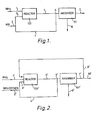
- ammonia at 177°C and 10.88 bar is fed through a pipe 1 into a reactor 100 which contains a platinum catalyst.
- Preheated air at 230°C and 10.88 bar is introduced through pipe 2 and part is passed through pipe 3 into the reactor 100 where it reacts with the air at 937°C to form a gas rich in nitric oxide.
- Approximately 94.5% (by volume) of the ammonia is converted to nitric oxide.
- the remaining gas (the tail gas) which comprises essentially nitrogen from the feed air, oxygen, argon and water vapour, together with nitrogen from side reactions of the ammonia in reactor 10 and nitrogen oxides are vented via a turbine to atmosphere through pipe 7.
- the tail gas which comprises essentially nitrogen from the feed air, oxygen, argon and water vapour, together with nitrogen from side reactions of the ammonia in reactor 10 and nitrogen oxides are vented via a turbine to atmosphere through pipe 7.
- the temperature, pressure, composition and flowrate of various streams of a plant for manufacturing 0.9090 x 10 6 kg/day (1002 short tons/day) of nitric acid in accordance with Figure 1 are set out in Table 1. It will be noted that the total flow to the reactor 100 is 6200 kg moles/hr and that the total flow at junction 6, prior to reaction is 6370.6 kg/ moles/hr. It will also be noted that the absorber 101 has been designed to reduce nitrogen oxides (expressed as nitric oxide for simplicity) to 0.043% of the dry tail gas, a more stringent design than in the non-recycle case described in US-PS-3,927,182, to comply with increasingly stringent environmental requirements.
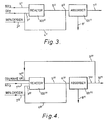
- FIG. 2 there is shown a flowsheet of a plant similar to that shown in US-PS-3,927,182.
- the air feed is replaced with a stream of 98% pure oxygen (balance argon) from a cryogenic air separation plant.
- Tail gas is recycled to the reactor 100' via pipe 9' and serves both to reduce the concentration of ammonia in the mixture to below the explosive limit and to maintain the temperature in the reactor 100' at the desired level of 937°C.
- 94.5% (by volume) of the ammonia is converted to nitric oxide and the dry tail gas contains the same 0.043% of nitrogen oxides for the purposes of comparison with Table 1.
- FIG 3 there is shown a flowsheet of one embodiment of a plant in accordance with the invention.
- the plant appears generally similar to that shown in Figure 2 except that the recycle pipe 9' has been omitted and substantially pure carbon dioxide fed to the reactor 100'.
- the flow of carbon dioxide is set so that the temperature in the reactor 100' is 937°C as before.
- 94.5% (by volume) of the ammonia is converted to nitric oxide.
- the dry tail gas contains 0.06% (by volume) of nitrogen oxides so as to give the same 2.3 kg mole/hr of nitrogen oxides discharged as in Table 1.
- Table 5 shows the molar flows and partial pressures of oxygen and nitric oxide in pipes 5, 5' and 5"' and at junctions 6, 6' and 6"' immediately prior to reaction.
- the pipe 3 " ' could be dispensed with.
- the oxygen for reaction with the ammonia would be provided via lines 4"' and 9"'. This would, of course, increase the volume of the recycle stream through line 9"' by a factor of about 1.34.
- the oxygen and carbon dioxide vented via pipe 10"' are increased and the nitric oxide partial pressure in the gas downstream of junction 6"' falls.
- there are substantial increases in oxygen partial pressure at the exit of the absorber and this, in turn, accelerates the termolecular oxidation reaction between the nitric oxide from the reactor and the oxygen.
- the reactor and the absorber in the embodiments described operate at substantially the same pressure
- the addition of carbon dioxide is also beneficial in dual pressure plants, particularly in the low pressure reactor.
- the advantages of using carbon dioxide may also be employed to improve ammonia-nitric oxide conversion efficiency by lowering the total pressure in the reactor, or by giving more flexibility in the choice of ammonia: oxygen: inert gas ratios used.
- the percentage of nitrogen oxides in the tail gas can be allowed to rise substantially and still meet environmental regulations as to the total quantity of nitrogen oxide vented. When this occurs it. leads to a substantial reduction in' the height of the absorber.
Landscapes
- Chemical & Material Sciences (AREA)
- Organic Chemistry (AREA)
- Chemical Kinetics & Catalysis (AREA)
- Inorganic Chemistry (AREA)
- Organic Low-Molecular-Weight Compounds And Preparation Thereof (AREA)
- Physical Or Chemical Processes And Apparatus (AREA)
- Saccharide Compounds (AREA)
- Catalysts (AREA)
Applications Claiming Priority (2)
| Application Number | Priority Date | Filing Date | Title |
|---|---|---|---|
| GB08405454A GB2154994B (en) | 1984-03-01 | 1984-03-01 | Process for manufacturing nitric acid from ammounin and oxygen |
| GB8405454 | 1984-03-01 |
Publications (2)
| Publication Number | Publication Date |
|---|---|
| EP0154470A2 true EP0154470A2 (de) | 1985-09-11 |
| EP0154470A3 EP0154470A3 (de) | 1986-06-25 |
Family
ID=10557448
Family Applications (1)
| Application Number | Title | Priority Date | Filing Date |
|---|---|---|---|
| EP85301215A Ceased EP0154470A3 (de) | 1984-03-01 | 1985-02-22 | Verfahren und Anlage zur Herstellung von Salpetersäure |
Country Status (4)
| Country | Link |
|---|---|
| EP (1) | EP0154470A3 (de) |
| JP (1) | JPS60195010A (de) |
| GB (1) | GB2154994B (de) |
| NO (1) | NO850721L (de) |
Cited By (9)
| Publication number | Priority date | Publication date | Assignee | Title |
|---|---|---|---|---|
| WO2003070634A1 (de) * | 2002-02-22 | 2003-08-28 | Uhde Gmbh | Verfahren zur herstellung von salpetersäure |
| WO2019038045A1 (de) * | 2017-08-25 | 2019-02-28 | Thyssenkrupp Industrial Solutions Ag | Verfahren zur herstellung von salpetersäure und vorrichtung zur herstellung von salpetersäure |
| WO2019036771A1 (en) * | 2017-08-24 | 2019-02-28 | Yara International Asa | PROCESS FOR PRODUCING NITRIC ACID |
| EP4392367B1 (de) | 2021-08-25 | 2025-08-13 | Yara International ASA | Doppeldrucksystem zur herstellung von salpetersäure und verfahren zum betrieb davon |
| EP4392366B1 (de) | 2021-08-25 | 2025-08-13 | Yara International ASA | Mono-drucksystem zur herstellung von salpetersäure und verfahren zu dessen betrieb |
| EP4392371B1 (de) | 2021-08-25 | 2025-10-01 | Yara International ASA | Monodrucksystem zur herstellung von salpetersäure und verfahren zum betrieb davon |
| EP4392370B1 (de) | 2021-08-25 | 2025-10-01 | Yara International ASA | Mono-drucksystem zur herstellung von salpetersäure und verfahren zu dessen betrieb |
| EP4392369B1 (de) | 2021-08-25 | 2025-10-01 | Yara International ASA | Doppeldrucksystem zur herstellung von salpetersäure und verfahren zum betrieb davon |
| JP2026525679A (ja) * | 2023-07-28 | 2026-07-31 | スタミカーボン・ベー・フェー | 吸収セクションへの酸素供給を伴う硝酸生産 |
Family Cites Families (6)
| Publication number | Priority date | Publication date | Assignee | Title |
|---|---|---|---|---|
| GB325475A (en) * | 1928-11-12 | 1930-02-12 | Ig Farbenindustrie Ag | Improvements in the manufacture and production of nitrous oxide from ammonia |
| FR825708A (fr) * | 1934-12-03 | 1938-03-11 | Production de l'hydrogène à partir de l'oxyde de carbone et des gaz qui le renferment | |
| DE1034598B (de) * | 1953-09-11 | 1958-07-24 | Basf Ag | Verfahren zur Herstellung hochkonzentrierter Stickoxyde |
| US3927182A (en) * | 1971-02-25 | 1975-12-16 | James Basil Powell | Process for making nitric acid by the ammonia oxidation-nitric oxide oxidation-water absorption method |
| CA992724A (en) * | 1972-03-30 | 1976-07-13 | Robert E. Kenson | Catalyst and process for ammonia oxidation |
| GB1426875A (en) * | 1972-06-05 | 1976-03-03 | Ici Ltd | Oxidation of ammonia |
-
1984
- 1984-03-01 GB GB08405454A patent/GB2154994B/en not_active Expired
-
1985
- 1985-02-22 JP JP3300185A patent/JPS60195010A/ja active Pending
- 1985-02-22 EP EP85301215A patent/EP0154470A3/de not_active Ceased
- 1985-02-22 NO NO850721A patent/NO850721L/no unknown
Cited By (10)
| Publication number | Priority date | Publication date | Assignee | Title |
|---|---|---|---|---|
| WO2003070634A1 (de) * | 2002-02-22 | 2003-08-28 | Uhde Gmbh | Verfahren zur herstellung von salpetersäure |
| US7258849B2 (en) | 2002-02-22 | 2007-08-21 | Uhde Gmbh | Method for the production of nitric acid |
| WO2019036771A1 (en) * | 2017-08-24 | 2019-02-28 | Yara International Asa | PROCESS FOR PRODUCING NITRIC ACID |
| WO2019038045A1 (de) * | 2017-08-25 | 2019-02-28 | Thyssenkrupp Industrial Solutions Ag | Verfahren zur herstellung von salpetersäure und vorrichtung zur herstellung von salpetersäure |
| EP4392367B1 (de) | 2021-08-25 | 2025-08-13 | Yara International ASA | Doppeldrucksystem zur herstellung von salpetersäure und verfahren zum betrieb davon |
| EP4392366B1 (de) | 2021-08-25 | 2025-08-13 | Yara International ASA | Mono-drucksystem zur herstellung von salpetersäure und verfahren zu dessen betrieb |
| EP4392371B1 (de) | 2021-08-25 | 2025-10-01 | Yara International ASA | Monodrucksystem zur herstellung von salpetersäure und verfahren zum betrieb davon |
| EP4392370B1 (de) | 2021-08-25 | 2025-10-01 | Yara International ASA | Mono-drucksystem zur herstellung von salpetersäure und verfahren zu dessen betrieb |
| EP4392369B1 (de) | 2021-08-25 | 2025-10-01 | Yara International ASA | Doppeldrucksystem zur herstellung von salpetersäure und verfahren zum betrieb davon |
| JP2026525679A (ja) * | 2023-07-28 | 2026-07-31 | スタミカーボン・ベー・フェー | 吸収セクションへの酸素供給を伴う硝酸生産 |
Also Published As
| Publication number | Publication date |
|---|---|
| JPS60195010A (ja) | 1985-10-03 |
| NO850721L (no) | 1985-09-02 |
| GB2154994A (en) | 1985-09-18 |
| EP0154470A3 (de) | 1986-06-25 |
| GB8405454D0 (en) | 1984-04-04 |
| GB2154994B (en) | 1987-10-07 |
Similar Documents
| Publication | Publication Date | Title |
|---|---|---|
| US3927182A (en) | Process for making nitric acid by the ammonia oxidation-nitric oxide oxidation-water absorption method | |
| US4578214A (en) | Process for ammonia syngas manufacture | |
| KR100319437B1 (ko) | 질산을 제조하기 위해 산소를 직접 주입하는 방법 | |
| US6040460A (en) | High productivity process to produce maleic anhydride from n-butane | |
| KR970020946A (ko) | 농축 공기 개질 및 합성 루프에로의 질소 주입에 의한 암모니아 제법 | |
| US20250091976A1 (en) | Method of producing formaldehyde | |
| US4122156A (en) | Process for the production of carbon disulfide from sulfur dioxide removed from a flue gas | |
| US5194239A (en) | Oxygen-based noncatalytic sulfuric acid process | |
| US4320103A (en) | Flexible integrated method for the production of ammonia and urea | |
| GB2154994A (en) | Process for manufacturing nitric acid from ammounin and oxygen | |
| US4840783A (en) | Process for the production of hydrogen by catalytic reforming of methanol with water vapor | |
| US3943236A (en) | Reforming process for carbon monoxide | |
| US4798716A (en) | Sulfur recovery plant and process using oxygen | |
| CN101653688A (zh) | 一种混合气脱除co2、h2s的工艺流程 | |
| PL211115B1 (pl) | Sposób wytwarzania kwasu octowego z metanolu i tlenku węgla oraz zespół urządzeń do stosowania tego sposobu | |
| US5688970A (en) | Process to recycle exhaust gases from n-butane conversion into maleic anhydride | |
| US4271136A (en) | Process for the production of ammonia | |
| US4056603A (en) | Process for increasing ammonia production | |
| GB2157688A (en) | Methanol production process using air | |
| US3421854A (en) | Manufacture of nitrogen tetroxide | |
| GB1597070A (en) | Production of ammonia | |
| US6333411B1 (en) | Method for production of hydroxylammonium phosphate in the synthesis of caprolactam | |
| CA1114133A (en) | Process for producing aqueous solution of calcium nitrite | |
| US3102001A (en) | Process for the production of hydrocyanic acid | |
| US4218397A (en) | Method for eliminating the explosibility of tail gas from the urea synthesis plant |
Legal Events
| Date | Code | Title | Description |
|---|---|---|---|
| PUAI | Public reference made under article 153(3) epc to a published international application that has entered the european phase |
Free format text: ORIGINAL CODE: 0009012 |
|
| AK | Designated contracting states |
Designated state(s): DE FR NL SE |
|
| PUAL | Search report despatched |
Free format text: ORIGINAL CODE: 0009013 |
|
| AK | Designated contracting states |
Kind code of ref document: A3 Designated state(s): DE FR NL SE |
|
| 17P | Request for examination filed |
Effective date: 19860729 |
|
| 17Q | First examination report despatched |
Effective date: 19870916 |
|
| STAA | Information on the status of an ep patent application or granted ep patent |
Free format text: STATUS: THE APPLICATION HAS BEEN REFUSED |
|
| 18R | Application refused |
Effective date: 19880321 |
|
| RIN1 | Information on inventor provided before grant (corrected) |
Inventor name: MOSELEY, FRED |