EP0154477A2 - Vorrichtung zum Einsetzen von Giesstüllen in Dosen - Google Patents
Vorrichtung zum Einsetzen von Giesstüllen in Dosen Download PDFInfo
- Publication number
- EP0154477A2 EP0154477A2 EP85301240A EP85301240A EP0154477A2 EP 0154477 A2 EP0154477 A2 EP 0154477A2 EP 85301240 A EP85301240 A EP 85301240A EP 85301240 A EP85301240 A EP 85301240A EP 0154477 A2 EP0154477 A2 EP 0154477A2
- Authority
- EP
- European Patent Office
- Prior art keywords
- tops
- indexing
- spout
- mounting
- exit
- Prior art date
- Legal status (The legal status is an assumption and is not a legal conclusion. Google has not performed a legal analysis and makes no representation as to the accuracy of the status listed.)
- Granted
Links
Images



Classifications
-
- B—PERFORMING OPERATIONS; TRANSPORTING
- B21—MECHANICAL METAL-WORKING WITHOUT ESSENTIALLY REMOVING MATERIAL; PUNCHING METAL
- B21D—WORKING OR PROCESSING OF SHEET METAL OR METAL TUBES, RODS OR PROFILES WITHOUT ESSENTIALLY REMOVING MATERIAL; PUNCHING METAL
- B21D51/00—Making hollow objects
- B21D51/16—Making hollow objects characterised by the use of the objects
- B21D51/38—Making inlet or outlet arrangements of cans, tins, baths, bottles, or other vessels; Making can ends; Making closures
- B21D51/40—Making outlet openings, e.g. bung holes
- B21D51/42—Making or attaching spouts
Definitions
- This invention relates to machines for inserting pouring spouts into containers and more particularly to machines for inserting pouring spouts into the tops or caps of containers, hereinafter generally referred to as "tops”.
- Machines for inserting spouts into containers have been known for a substantial period of time. Most of the better machines, however, place spouts on the sides of containers. It is a much more difficult task to place the spouts on the top of the container, especially if the containers are round.
- One of the problems associated with placing a spout on the top of a container and especially a round container is that is is necessary to coordinate the position of the spout with the closed container. This is easier to do if the container is a one-piece unit in which the top is folded to form the top or if the container is rectangular in shape so that the spout can always be oriented on one particular wall of the container.
- the container is usually filled with its contents before placing the top on the container and this makes the handling of the containers much more difficult. Since the containers are filled with material rather than being empty, any possible tipping of a container will result in the spilling of material along the production line. Further, if the containers are filled prior to placing the top on the container then there must be sychronization between the delivery of the container tops which have pouring spouts inserted in them and the speed of the assembly line in which the containers are filled.
- This invention accordingly provides a machine for inserting pouring spouts into container tops comprising:
- tops are fed to an indexing means, which may be in the form of a work table, through an inlet arrangement which coordinates the position of the tops with the position of the indexing means.
- Mounting apparatus is provided to mount the tops on the indexing means, which indexing means moves the tops in a coordinated sequence to work positions where the pouring spouts are inserted in the tops.
- the indexing means then moves the tops to an ejecting position where ejecting apparatus removes the tops with installed pouring spouts from the indexing means.
- the pouring spouts on the tops may be placed in the desired position and the tops properly oriented as the tops leave the machine.
- a pneumatic assembly provides for the delivery of the container tops to the indexing means and for transfer of the container tops with the installed spouts away from the indexing means. Operation of the indexing means should be coordinated with the mounting apparatus, ejecting apparatus and the inserting apparatus by a power transmission system which may include an indexing gear box.
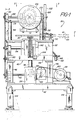
- Fig. 1 shows the spout inserting machine generally indicated as 20, having a frame generally indicated at 40, on which is mounted an upper platform to which leads an inlet apparatus which feeds a series of blank or empty circular caps or tops to an indexing table which then moves the caps inserted in the table to work positions where pouring spouts are placed in the caps. The table then continues its movement to bring the caps, which have had spouts inserted, to the outlet station of the apparatus.
- the indexing table and the apparatus to mount and eject the caps, and the apparatus to insert the spouts into the caps are all powered by means of a drive which is connected by appropriate power transmission means to the various components.
- a complimentary pneumatic system is used to transport the caps along the inlet to the machine and along the outlet from the machine.
- the frame generally indicated at 40 consists of a lower platform 42 supported by bottom legs 44, which lower platform supports lower legs 46 that support a mid-platform 48, which. in turn, support an upper platform 50 by means of upper legs 52 which rest on the mid-platform.
- Upper platform 50 supports a pedestal 54 by means of four ped- astal legs 56.
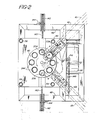
- An indexing table, generally indicated at 80, is mounted above the upper platform and is in communication with an inlet ramp 41 and an exit ramp 121.
- Mounted on pedestal 54 are a series of large flywheel-cam wheels, namely an inlet/outlet cam 102, a first station cam 104-, and a second station cam 106.
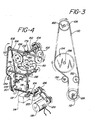
- the inlet/outlet cam and the other rotating cams are driven by means of a cam drive sprocket 108 connected by means of a drive timing chain 110 to the back side of the input shaft 112 of an indexing gearbox 114.
- the indexing gearbox has sequenced output shaft 116 which is connected to the indexing table 80 to drive the indexing table 80 in a sequenced manner for purposes to be described later.
- a drive motor 118 having an output shaft which turns a drive pulley 120 is connected by a belt to a speed reducer 122, which symbolically is shown as having a shaft which is then connected to an input shaft 124 of the indexing gear box after being connected by the speed reducer pulley 126.
- a drive sprocket 128 is connected to the constant speed back side of the indexing gear box input shaft 112.
- Drive sprocket 128 drives chain 110 through two idler sprockets, 130 and 132 respectively, and the chain then engages spout drive sprocket 134, which is connected to a spout drive shaft 136 which is connected by means of a bevel gear arrangement, generally indicated at 138, to a series of shafts and cams which are used to draw in the blank pouring spouts 140 to the work stations.
- the blank spouts are kept on a reel 142 mounted to the mid-platform 48 by means of a bracket 144, as is shown in Figure 2.
- an air supply having an inlet 146 has a standard filter 148, and air regulator 152, which lead into a manifold 156 from which an inlet jet 158, a mounting jet 160, and an ejection jet 162, and outlet jet 164 branch off.
- the cam drive sprocket 108 drives cam drive shaft 166, which is secured to the pedestal 54 by appropriate bearings and bearing housings 168 and 170.
- Drive shaft 166 drives a bevel drive gear 172 and continues on to drive the inlet/outlet cam 102.
- Inlet/outlet cam 102 is fastened to main cam drive shaft 166 by means of a a hub and clamping ring arrangement.
- the hub, 174 is secured to the shaft by means of a clamp screw not shown, and the plurality of retaining nuts connect the front of inlet/ outlet cam 102 to a clamp ring which is shown in phantom.
- the retaining nuts therefore, hold the inlet/outlet cam (and the other cams in a similar manner) to the clamp ring by a frictional fit. Tightening of the retaining nuts 176 will therefore hold the cam fixed with relation to the angular position of the shaft. However, for timing purposes should it be desired to vary the position of the cam with relation to the shaft, the retaining nuts 176 can be loosened so as to allow the inlet/outlet cam 102 to slide relative to the shaft.
- the clamp ring will also slide with the nuts since it is held on merely by a frictional fit to the back of the hub 174; Once the proper position of the cam has been set, then tightening up of the retaining nuts 176 will again fix the cam in the proper attitude or relationship to the shaft for co-ordinating the sequenced operations of the apparatus.
- Bevel drive gear 172 drives bevel driven gears, 178 and 180 respectively, which drive the first station drive shaft 182 and the second station drive shaft 184.
- the bevel driven gears for stations one and two are twice as large as the bevel drive gear for the main cam drive shaft and, therefore, the-station one and two drive shafts will rotate at a speed of half the speed of the main inlet/outlet drive shaft.
- a cam groove 186 is formed in the back of inlet/outlet cam 102 and a similar groove is formed in the station one and station two cams.
- FIG. 6 we see in phantom the inlet/ outlet cam 102 and the cam groove 186, shown in phantom, and we see a cam follower 188 mounted on an elevator 190, which will be raised and lowered along mounting and ejecting guide rods 192 and 194.respectively, as the cam follower 188 moves the elevator 19U. The elevator will move up and down the mounting guide rods 192 and ejecting guide rods 194 as the cam follower 188 moves up and down in the cam groove 186.
- the guide rods are mounted in a guide rod support 196 fastened to the peaestal by means of fastening bolts 198.
- a mounting plunger 200, and an ejecting plunger 202 ride on mounting and ejecting guide rods 192 and 194 respectively.
- the mounting plunger acts to transfer blank caps from the inlet ramp 41 to the indexing table 80, which in turn, will carry them to work stations one and two, indicated at 204 and 206 respectively, and then to the exit ramp 121.
- the elevators at work stations one and two will operate at half the speed of the inlet/outlet elevator 190 carrying the mounting and ejecting plungers.
- the sequencing and gearing operation enables a single inlet ramp and mounting mechanism to mount enough caps on the indexing table to provide work for two spout inserting operations.
- the ejection operation including the injection plunger, works twice as fast as the spout inserting operations, and therefore, there is a synchronized harmony between the mounting and ejecting operations and the spout inserting operations,
- the apparatus for inserting the spout into the cap is essentially the same as that shown in U.S. Patent No. 4,072,117, issued February 7, 1978 to Frederick Plaessmann, which is incorporated herein by reference.
- the major difference is that the orientation of the spout inserting apparatus is varied in order to provide for the horizontal insertion of the spout versus the vertical insertion of the spout, as was previously done in the referenced patent.
- the mounting plunger 200 is mounted on the inlet/outlet elevator 190, and rides up and down on a mounting guide rod 192.
- a bushing 208 is connected to the top of elevator 190, and attached to the plunger 200 is an ear 212 having a slot 214.
- the plunger 200 is connected to the elevator 190 by means of a mounting bolt 216 which passes through upper plate 201 of the plunger and threads into elevator 190.
- the ear 212 is connected to upper plate 201 by a cap screw extending down into the upper plate.
- the ear has a slot 214 at one end and is bent so that the other end of it forms the part through which the cap screw extends down to fasten it to the upper plate 201 of the mounting plunger.
- An arm 218, is slidably connected at one end to ear slot 214 and is pivoted about pivot 220 to hold a timing finger 222 at the far end of the rod.
- Timing finger 222 will, therefore, move up and down-in opposition to the movement of the mounting plunger 200, because of the central pivoting arrangement by which arm 218 is mounted.
- the pivot 220 is supported by pivot support 224 and the mounting finger itself can be adjusted since it is threadably mounted within the end of timing arm 218.
- the end of timing finger 222 passes through slot 226 in finger guide 228 to enable the mounting finger to come very close to the bottom surface of inlet ramp 41 in order that the timing finger can restrain the empty caps 230 which are in the inlet ramp.
- inlet ramp 41 has a bottom surface on which the empty caps 230 will be directed by means of the inlet jet 158 mounted in a holder 232.
- the jet will urge the empty cap towards the mounting plunger.
- the timing finger will hold the cap because of either the pressure of the timing finger against the bottom of the cap, or as is more probably the case, the contact of the timing finger with the raised side wall of the cap.
- the timing finger will be raised to allow the empty cap to be driven by the force of inlet jet 158 until it will come in contact with the vertical side wall of the mounting plunger, which is now in its lower position.
- the empty cap 230 When the mounting plunger raises to the upper position, the empty cap 230 will then be urged toward the backstop 234 connected to the end of the inlet ramp 41. Additionally, the upper surface 236 of the inlet ramp has a camming surface 238, or a positioning cam, that will force the empty cap downward as it moves toward backstop 234 into the receptacle in the waiting plate 240, which is the end of the inlet ramp.
- the empty cap 230 has been urged to move to the end of the inlet ramp, and has been forced by positioning cam surface 238, of the upper surface 236 of the inlet ramp, downward into the receptacle in the waiting plate 240.
- Backstop 234 prevents the cap from moving out of registration with the path of travel for the mounting plunger.
- Backstop 234 has a ramp-like tapered head mounted on a projecting stem.
- the head is secured to the stem by means of a flathead screw or a set screw which passes through a slot in the head. Therefore, by loosening the screw the backstop can be moved toward the pivot arm or away from the pivot arm as desired to accommodate caps of different diameter.
- the arrangement of the timing finger with the position of the mounting plunger and the waiting plate provides a system which insures an accurate supply, in sequential order, of empty caps which are to be processed.
- the next cap in sequence will be moved to rest against the side of the mounting plunger and air from the inlet jet will push the next cap against the cap that is resting against the side of the mounting plunger.
- mounting jet 160 will urge the waiting empty cap into the receptacle in the waiting plate and hold the cap in stationary position, while the cap behind the cap in the waiting plate is held in an on-call position by the timing finger 222.
- the mounting plunger 200 will not descend to force the empty cap from the receptacle of the waiting plate into the receptacle of the indexing table, shown as 244, until the indexing table has moved into position and is in a stationary position, ready to receive the empty cap.
- a stabilizing plate 246 is fixedly mounted to upper platform 50 by means of a support 2 4 8.
- the stabilizing plate has a flat surface parallel to, and very close to, the bottom of the indexing table so that there is no possibility for the cap to be misaligned by extending down below the bottom of the indexing table 80.
- stripping fingers 239 can be provided to the inlet ramp adjacent the mounting plunger to prevent misalignment of any inlet caps which have not yet travelled to the waiting plate and been positioned in the receptacle of the waiting plate, but which are waiting to proceed to that position.
- the stripping finger prevents these caps, which often are abutting the mounting plunger, from being drawn upward in the inlet ramp as the mounting plunger itself rises after inserting a cap into the indexing table.
- the reason that the empty cap can interfere with the mounting plunger as it rises, is that when the mounting plunger travels down to force the cap from the waiting plate into the receptacle in the indexing table, the timing finger will be raised and, therefore, the air jet will push the cap up to an abutting position with the lowered mounting plunger. When the mounting plunger rises the timing finger will again be lowered to hold the next cap in a waiting position. However, in the meantime, as the mounting plunger starts to rise, the next cap has been freed and is resting against the mounting plunger and- is being urged against the mounting plunger by the jet.
- the stripping fingers prevent the cap from being lifted off the inlet ramp into a cocked position where it might not be able to co-act properly in coordination with the positioning cam 238.
- the stripping fingers 239 therefore, keep the cap in a proper position with the top of the cap against the bottom of the inlet ramp so that the bottom or ends of the cap side walls will clear the bottom of the inlet plunger and allow the cap to slide into position in the waiting table where it can then be forced out onto the indexing ramp.
- Figs. 12 and 13 there are two different configurations that can be used for the receptacles of the indexing table to hold the caps.
- the receptacle 244 of the indexing table 80 is also shown in Fig. 12.
- the receptacle is a one piece unit adapted to fit into an aperture in the indexing table. It has tapered side walls 250 and an overhang in the upper diameter 252, so that the diameter of the overhang is smaller than the maximum diameter 254.
- the retaining overhang diameter 252 is also larger than the diameter 256 at the bottom of the receptacle or cap receiver, so that the side walls of the cap have the ability to expand, and therefore, relax the tension on the flat or top part of the cap.
- the entire receptacle for the cap is connected to the indexing table by means of retaining screws 257.
- cap receiver for the indexing table
- the cap receiver generally indicated at 259, has parallel side walls 258 and is mounted in the receptacle for the indexing table by means of shoulders 260.
- the top of the cap will tend to bow out because of the cylindrical diameter of the walls which tend to put a stress on the cap. Additionally, the side walls of the cap in the cylindrical walls 258 would tend to wrinkle in order to conform from an initially tapered configuration to the rigid cylindrical configuration. The wrinkling is necessary to take up the additional material as the bottom ends of the cap are compressed.
- the taper on the cap receiver or the crimping of the sides of the cap in the cylindrical cap receiver will maintain orientation of the cap on the indexing table as the indexing table moves around. It is important that the cap be firmly held with relation to the indexing table as it moves through the various stations of the operation.
- the natural tendencies of relaxation of the sides of the cap will tend to cause the cap to be held snug against the side of the tapered walls of the cap receiver. Therefore, there will be no tendency for the cap to rotate in the indexing table.
- Either cap receptacle shown in F ig. 12 or 13 can be varied in size to accommodate caps of different diameters and can also be used to accommodate caps which are not necessarily circular in shape. So for example, the apparatus is equally adaptable for caps which are of rectangular or oval shape.
- the outlet ramp or exit ramp includes a swivel arrangement for the righthand portion of the upper surface of the exit ramp.
- a cap screw which is also the pivot for the entire upper section.
- a pin extends up from exit ramp support 278 so that when you back off on the hand knob 62, the entire right upper section of the exit ramp can be lifted off the pin and can swing away, as shown in phantom, to allow access to the exit ramp to unjam any caps that are located in the exit ramp upstream of the exit guide or cap opening finger.
- the configuration shown is intended for use when it is desired to have the caps exit the apparatus with the pouring spout in the closed position.
- the ejecting plunger 202 is connected to elevator 190 by a top plate 203 in the manner shown in Fig. 7.
- Ejecting plunger 202 moves up and down on ejecting guide rod 194.
- the ear 191 that holds the opening finger 282 to top plate 203 is similar to the ear that holds or connects to the pivot arm on the mounting plunger. It is connected to the horizontal top plate 203 of the exit plunger 202 in a manner similar to the mounting plunger.
- Air passages 266 are formed in the bottom of the ejecting plunger 202 s to allow for air from the ejection jet L62 to be used to push the completed or processed cap 268 along the exit ramp 121 after the ejecting plunger has pushed the completed cap 268 from the cap receiver, in the indexing table, and down onto the exit ramp 121.
- the walls of the cap will relax, so that the diameter at the top of the cap will be greater than the diameter of the receptacle in the indexing table and thereby, will insure that the cap is not picked up by the ejecting plunger as it rises up ejecting guide rod 194. Instead, the completed cap 268 will lie in the bottom of exit ramp 121 and will be urged toward the outlet end of the exit ramp by the action of ejection jet 162.
- the top of the exit ramp underneath the indexing table which is in registration with the cap receiving receptacle, is of a diameter that is so small that when the cap with the inserted spout is pushed down by the exit plunger below the indexing table and into the exit ramp, the passage formed by the two halves of the top end of the exit ramp is smaller than the size of the largest diameter that the cap will relax to, so therefore, the cap cannot be brought back up into the indexing table or above the level of the exit ramp by the exit plunger as it returns. This prevents the cap from being skewed be tween the indexing table and the exit ramp, and being hung up there and jamming the outlet of the machine.
- the side walls of the inserted pouring spout will extend above the top of the exit ramp and will pass around the closed spout guide 274, which is held over the groove formed in the top of the exit ramp by means of support 276.
- the exit ramp is mounted to the top of upper platform 50 by means of a series of supports 278.
- the closed spout guide 274 extends into the diverging portion of the upper covers of the exit ramp to allow for clearance and access to the caps, in case there is any skewing or misalignment of the caps. Also, the closed spout guide 274 extends down to be flush with the top of the under surface of the top of the exit ramp so that it will provide an adequate guide for the caps as they leave the exit ramp. This deep positioning of the closed spout guide compensates for the shorter wings on the closure portion of the spout.
- spout clearance slot 280 formed in the bottom of exit ramp 121 to allow for the projecting portions of the spout 270.
- the caps therefore, will be urged by means of ejection jet 162 and outlet jet 164 (not shown in Fig. 8) to the end of exit ramp 121 where they would then be ready for transportation for further processing in an operation which is of no part of this invention.
- a separate mounting collar 191 is connected to ejecting plunger 202 and has a connecting arm 281, which in turn supports an opening finger 282.
- ejection jet 162 will urge the cap toward the end of the ejection ramp until the closed forward end of the spout will abut spout stopper 284.
- the spout will then be held in this position until the next downward movement of ejecting plunger 202, at which point the opening finger 282 will press against the front or ends of the spout to push the spout to the open position, as shown in the phantom lines.
- the outlet jet 164 is mounted in the exit ramp support 165. If the spout 270 is in the open position then outlet jet 164, located below the bottom of the exit ramp, will catch the open spout like the side of a sail and rapidly propel the cap out. If the spout is in the closed position then the air trom discharge nozzle 162, going down the exit ramp, will be sufficient by itself to cause the spout to continue down the ramp guided by the closed spout guide.
- the outlet jet 164 is necessary if the spout is open because the cap and the spout have been brought to a stop by the spout stopper, and remain stopped until the opening finger presses down the spout to the open position. Then the open spout with the cap must be restarted down the exit ramp and that is the purpose of the outlet jet 164.
- the invention does not require elaborate means of synchronizing or indexing the transportation of the caps to be processed as they are brought to the machine. They can be brought to the machine under the urging of a simple air jet. Further, as the caps without spouts are fed to the machine, they are fed sequentially in such a way as to prevent any possibility of jamming or having multiple caps jammed into the sequencing operation of the machine. Further, because of the effective synchronization of the caps at the inlet of the machine with the mounting plunger, there is no possibility of the snowballing effect of one stuck cap tending to have an ever increasing effect on the caps waiting to be processed.
- the synchronization and gearing provides for rugged, dependable and durable operation.
- the speeds can easily be controlled by means of changing the speed reducing pulley and by making minor variations in the speed of the speed reducer unit, so that the equipment can provide a wide range of operating speeds.
- variations in the indexing gear box will enable variation of the number of work stations that can be handled by the indexing table.
- the sequencing of the outlet operation is also noteworthy in the reliability and simplicity of how it is accomplished. once again, a minimum of operations are performed on the cap in order to have the cap removed from the indexing table, where the spout inserting process was performed, and moved onward to the end ot the exit ramp.
Landscapes
- Engineering & Computer Science (AREA)
- Mechanical Engineering (AREA)
- Sealing Of Jars (AREA)
- Auxiliary Devices For And Details Of Packaging Control (AREA)
- Making Paper Articles (AREA)
- Filling Of Jars Or Cans And Processes For Cleaning And Sealing Jars (AREA)
- External Artificial Organs (AREA)
- Control And Other Processes For Unpacking Of Materials (AREA)
Priority Applications (1)
| Application Number | Priority Date | Filing Date | Title |
|---|---|---|---|
| AT85301240T ATE37811T1 (de) | 1984-03-06 | 1985-02-25 | Vorrichtung zum einsetzen von giesstuellen in dosen. |
Applications Claiming Priority (2)
| Application Number | Priority Date | Filing Date | Title |
|---|---|---|---|
| US586862 | 1984-03-06 | ||
| US06/586,862 US4583899A (en) | 1984-03-06 | 1984-03-06 | Apparatus for inserting pouring spouts into container tops |
Publications (3)
| Publication Number | Publication Date |
|---|---|
| EP0154477A2 true EP0154477A2 (de) | 1985-09-11 |
| EP0154477A3 EP0154477A3 (en) | 1986-03-05 |
| EP0154477B1 EP0154477B1 (de) | 1988-10-12 |
Family
ID=24347395
Family Applications (1)
| Application Number | Title | Priority Date | Filing Date |
|---|---|---|---|
| EP85301240A Expired EP0154477B1 (de) | 1984-03-06 | 1985-02-25 | Vorrichtung zum Einsetzen von Giesstüllen in Dosen |
Country Status (6)
| Country | Link |
|---|---|
| US (1) | US4583899A (de) |
| EP (1) | EP0154477B1 (de) |
| JP (1) | JP2525567B2 (de) |
| AT (1) | ATE37811T1 (de) |
| CA (1) | CA1293891C (de) |
| DE (1) | DE3565480D1 (de) |
Families Citing this family (7)
| Publication number | Priority date | Publication date | Assignee | Title |
|---|---|---|---|---|
| JPH0788067B2 (ja) * | 1987-04-06 | 1995-09-27 | 凸版印刷株式会社 | プラスチツクリング取付け装置 |
| US5022954A (en) * | 1989-10-04 | 1991-06-11 | Seal Spout Corporation | Apparatus for applying labels to containers |
| US5556004A (en) * | 1994-11-01 | 1996-09-17 | Seal Spout Corporation | Ninety degree pouring spout |
| US5707196A (en) * | 1994-11-01 | 1998-01-13 | Seal Spout Corporation | Cap making apparatus and method |
| USD374400S (en) | 1994-11-01 | 1996-10-08 | Seal Spout Corporation | Ninety degree spout |
| JP4716891B2 (ja) * | 2006-02-16 | 2011-07-06 | 株式会社細川洋行 | 揮発性薬剤徐放積層体 |
| US20100140334A1 (en) * | 2008-11-21 | 2010-06-10 | Brucker Ii Henry J | Pour spout |
Family Cites Families (9)
| Publication number | Priority date | Publication date | Assignee | Title |
|---|---|---|---|---|
| US2061575A (en) * | 1933-11-13 | 1936-11-24 | American Can Co | Pouring spout can cover machine |
| US2972184A (en) * | 1957-11-29 | 1961-02-21 | Andrew & Waitkens Machine Co I | Machine for mounting spouts in the tops of containers |
| US3381645A (en) * | 1966-02-01 | 1968-05-07 | Seal Spout Corp | Container pouring spout inserting machine |
| US3385248A (en) * | 1966-02-21 | 1968-05-28 | Seal Spout Corp | Machine for attaching spouts to containers |
| US3438348A (en) * | 1966-10-12 | 1969-04-15 | Augustus L Merolle | Method and apparatus for producing lug type closure caps |
| US3523512A (en) * | 1968-04-05 | 1970-08-11 | Seal Spout Corp | Machine for inserting pouring spouts and sifters on cartons |
| US4072117A (en) * | 1976-09-15 | 1978-02-07 | Seal-Spout Corporation | Canister indexing spout-inserting machine |
| US4210091A (en) * | 1977-09-28 | 1980-07-01 | Mario Erba | Automatic machine for continuously producing tinned strap caps fitted with opening devices and devices therefor |
| US4364255A (en) * | 1980-10-20 | 1982-12-21 | The Stolle Corporation | Controlled oriented discharge of cups from a blanking and forming press |
-
1984
- 1984-03-06 US US06/586,862 patent/US4583899A/en not_active Expired - Lifetime
- 1984-11-05 CA CA000467070A patent/CA1293891C/en not_active Expired - Lifetime
- 1984-12-31 JP JP59281931A patent/JP2525567B2/ja not_active Expired - Lifetime
-
1985
- 1985-02-25 EP EP85301240A patent/EP0154477B1/de not_active Expired
- 1985-02-25 AT AT85301240T patent/ATE37811T1/de not_active IP Right Cessation
- 1985-02-25 DE DE8585301240T patent/DE3565480D1/de not_active Expired
Also Published As
| Publication number | Publication date |
|---|---|
| CA1293891C (en) | 1992-01-07 |
| JPS60190339A (ja) | 1985-09-27 |
| US4583899A (en) | 1986-04-22 |
| DE3565480D1 (en) | 1988-11-17 |
| EP0154477A3 (en) | 1986-03-05 |
| ATE37811T1 (de) | 1988-10-15 |
| JP2525567B2 (ja) | 1996-08-21 |
| EP0154477B1 (de) | 1988-10-12 |
Similar Documents
| Publication | Publication Date | Title |
|---|---|---|
| US6338371B1 (en) | Apparatus for conveying, supplying, and filling unshaped containers, and method for conveying and supplying the same | |
| US3888067A (en) | Banding machine | |
| US4896480A (en) | Method and apparatus for placing a cover on a box | |
| US3601954A (en) | Apparatus for conveying and filling capsules | |
| EP0014173A2 (de) | Kapselmaschine | |
| US5275524A (en) | Apparatus for cutting and removing package material | |
| CN110979879B (zh) | 一种真空采血管打印贴标装置 | |
| EP0154477B1 (de) | Vorrichtung zum Einsetzen von Giesstüllen in Dosen | |
| US4274532A (en) | Can handling system | |
| US3867807A (en) | Carrier applicator machine for bottles | |
| US5157896A (en) | Modularly constructed automatic packaging machine | |
| US4456115A (en) | Syringe inspection apparatus | |
| US4806055A (en) | Apparatus for inserting pouring spouts into container tops | |
| US4231209A (en) | Self-synchronizing bottle carrier applicator | |
| RU2004132575A (ru) | Устройство для подачи и отвода емкостей | |
| US3935967A (en) | Apparatus for feeding shell-like articles | |
| US6286568B1 (en) | Transportation, feeding and filling apparatus of irregular-formed vessels and transportation and feeding method | |
| US3340591A (en) | Bottle collar applying mechanism | |
| JPS6233168B2 (de) | ||
| US4482282A (en) | Apparatus and method for supplying articles | |
| JPH11513648A (ja) | 缶蓋の供給装置 | |
| US4274194A (en) | Machine for assembling elastic bulbs to fragile tubular elements | |
| US4050222A (en) | Envelope opening apparatus | |
| US4500247A (en) | Syringe inspection apparatus | |
| JP2000072232A (ja) | 給びん装置 |
Legal Events
| Date | Code | Title | Description |
|---|---|---|---|
| PUAI | Public reference made under article 153(3) epc to a published international application that has entered the european phase |
Free format text: ORIGINAL CODE: 0009012 |
|
| AK | Designated contracting states |
Designated state(s): AT BE CH DE FR GB IT LI LU NL SE |
|
| PUAL | Search report despatched |
Free format text: ORIGINAL CODE: 0009013 |
|
| AK | Designated contracting states |
Kind code of ref document: A3 Designated state(s): AT BE CH DE FR GB IT LI LU NL SE |
|
| 17P | Request for examination filed |
Effective date: 19860818 |
|
| 17Q | First examination report despatched |
Effective date: 19870505 |
|
| GRAA | (expected) grant |
Free format text: ORIGINAL CODE: 0009210 |
|
| AK | Designated contracting states |
Kind code of ref document: B1 Designated state(s): AT BE CH DE FR GB IT LI LU NL SE |
|
| PG25 | Lapsed in a contracting state [announced via postgrant information from national office to epo] |
Ref country code: SE Effective date: 19881012 |
|
| REF | Corresponds to: |
Ref document number: 37811 Country of ref document: AT Date of ref document: 19881015 Kind code of ref document: T |
|
| REF | Corresponds to: |
Ref document number: 3565480 Country of ref document: DE Date of ref document: 19881117 |
|
| ITF | It: translation for a ep patent filed | ||
| ET | Fr: translation filed | ||
| PG25 | Lapsed in a contracting state [announced via postgrant information from national office to epo] |
Ref country code: LU Free format text: LAPSE BECAUSE OF NON-PAYMENT OF DUE FEES Effective date: 19890228 |
|
| PLBE | No opposition filed within time limit |
Free format text: ORIGINAL CODE: 0009261 |
|
| STAA | Information on the status of an ep patent application or granted ep patent |
Free format text: STATUS: NO OPPOSITION FILED WITHIN TIME LIMIT |
|
| 26N | No opposition filed | ||
| ITTA | It: last paid annual fee | ||
| PGFP | Annual fee paid to national office [announced via postgrant information from national office to epo] |
Ref country code: FR Payment date: 19960222 Year of fee payment: 12 |
|
| PGFP | Annual fee paid to national office [announced via postgrant information from national office to epo] |
Ref country code: CH Payment date: 19960226 Year of fee payment: 12 |
|
| PGFP | Annual fee paid to national office [announced via postgrant information from national office to epo] |
Ref country code: AT Payment date: 19960228 Year of fee payment: 12 |
|
| PGFP | Annual fee paid to national office [announced via postgrant information from national office to epo] |
Ref country code: BE Payment date: 19960313 Year of fee payment: 12 |
|
| PGFP | Annual fee paid to national office [announced via postgrant information from national office to epo] |
Ref country code: NL Payment date: 19960328 Year of fee payment: 12 |
|
| PGFP | Annual fee paid to national office [announced via postgrant information from national office to epo] |
Ref country code: DE Payment date: 19960416 Year of fee payment: 12 |
|
| PG25 | Lapsed in a contracting state [announced via postgrant information from national office to epo] |
Ref country code: AT Effective date: 19970225 |
|
| PG25 | Lapsed in a contracting state [announced via postgrant information from national office to epo] |
Ref country code: LI Effective date: 19970228 Ref country code: CH Effective date: 19970228 Ref country code: BE Effective date: 19970228 |
|
| BERE | Be: lapsed |
Owner name: SEAL SPOUT CORP. Effective date: 19970228 |
|
| PG25 | Lapsed in a contracting state [announced via postgrant information from national office to epo] |
Ref country code: NL Effective date: 19970901 |
|
| REG | Reference to a national code |
Ref country code: CH Ref legal event code: PL |
|
| PG25 | Lapsed in a contracting state [announced via postgrant information from national office to epo] |
Ref country code: FR Effective date: 19971030 |
|
| PG25 | Lapsed in a contracting state [announced via postgrant information from national office to epo] |
Ref country code: DE Effective date: 19971101 |
|
| NLV4 | Nl: lapsed or anulled due to non-payment of the annual fee |
Effective date: 19970901 |
|
| REG | Reference to a national code |
Ref country code: FR Ref legal event code: ST |
|
| REG | Reference to a national code |
Ref country code: GB Ref legal event code: IF02 |
|
| PGFP | Annual fee paid to national office [announced via postgrant information from national office to epo] |
Ref country code: GB Payment date: 20031224 Year of fee payment: 20 |
|
| PG25 | Lapsed in a contracting state [announced via postgrant information from national office to epo] |
Ref country code: GB Free format text: LAPSE BECAUSE OF EXPIRATION OF PROTECTION Effective date: 20050224 |
|
| REG | Reference to a national code |
Ref country code: GB Ref legal event code: PE20 |