EP0154832A2 - Decontamination using electrolysis - Google Patents
Decontamination using electrolysis Download PDFInfo
- Publication number
- EP0154832A2 EP0154832A2 EP85101645A EP85101645A EP0154832A2 EP 0154832 A2 EP0154832 A2 EP 0154832A2 EP 85101645 A EP85101645 A EP 85101645A EP 85101645 A EP85101645 A EP 85101645A EP 0154832 A2 EP0154832 A2 EP 0154832A2
- Authority
- EP
- European Patent Office
- Prior art keywords
- decontamination solution
- metal ions
- solution
- passing
- porous
- Prior art date
- Legal status (The legal status is an assumption and is not a legal conclusion. Google has not performed a legal analysis and makes no representation as to the accuracy of the status listed.)
- Withdrawn
Links
Images
Classifications
-
- G—PHYSICS
- G21—NUCLEAR PHYSICS; NUCLEAR ENGINEERING
- G21F—PROTECTION AGAINST X-RADIATION, GAMMA RADIATION, CORPUSCULAR RADIATION OR PARTICLE BOMBARDMENT; TREATING RADIOACTIVELY CONTAMINATED MATERIAL; DECONTAMINATION ARRANGEMENTS THEREFOR
- G21F9/00—Treating radioactively contaminated material; Decontamination arrangements therefor
- G21F9/04—Treating liquids
- G21F9/06—Processing
- G21F9/12—Processing by absorption; by adsorption; by ion-exchange
-
- G—PHYSICS
- G21—NUCLEAR PHYSICS; NUCLEAR ENGINEERING
- G21F—PROTECTION AGAINST X-RADIATION, GAMMA RADIATION, CORPUSCULAR RADIATION OR PARTICLE BOMBARDMENT; TREATING RADIOACTIVELY CONTAMINATED MATERIAL; DECONTAMINATION ARRANGEMENTS THEREFOR
- G21F9/00—Treating radioactively contaminated material; Decontamination arrangements therefor
- G21F9/001—Decontamination of contaminated objects, apparatus, clothes, food; Preventing contamination thereof
- G21F9/002—Decontamination of the surface of objects with chemical or electrochemical processes
- G21F9/004—Decontamination of the surface of objects with chemical or electrochemical processes of metallic surfaces
-
- C—CHEMISTRY; METALLURGY
- C25—ELECTROLYTIC OR ELECTROPHORETIC PROCESSES; APPARATUS THEREFOR
- C25F—PROCESSES FOR THE ELECTROLYTIC REMOVAL OF MATERIALS FROM OBJECTS; APPARATUS THEREFOR
- C25F3/00—Electrolytic etching or polishing
- C25F3/02—Etching
Definitions
- This invention generally relates to decontamination procedures for the riddance of radioactive elements from containers in nuclear reactors; more particularly, it concerns eliminating deposits which contain radioactive elements which gradually build up in the cooling systems of nuclear reactors.
- a decontamination solution which is an aqueous solution of a chelate, such as ethylenediaminetetraacetic acid (EDTA), and a solvent agent, such as a mixture of oxalic acid and citric acid.
- EDTA ethylenediaminetetraacetic acid
- the chelate forms a complex with the metal ions from the deposits and reacts with them, and, thus, preventing them from precipitating out of the solution at another location in the cooling system.
- the decontamination solution is circulated between the cooling system and a cation exchange resin.
- the chelated metal ions are deposited on the cation exchange resin, freeing the chelate to solubilize additional metal ions in the deposit.
- the difficulty with this prior art decontamination process is that both the chelates and the cation exchange resin compete for the metal ions. As a result, the metal ions do not readily leave the chelate and attach themselves to the ion exchange column. This means that long resin contact times are required, and that the ion exchange column effluent may contain relatively high metal ion concentrations. For example, an effluent concentration of about 200 to about 250 ppm of iron and about 20 to about 30 ppm of cobalt is typical for a decontamination solution consisting of 0.2% EDTA, 0.15% citric acid, and 0.15% oxalic acid.
- the metal ions are removed by passing the decontamination solution through a porous DC electrode. Achieved in this manner are a higher DF and lower solution radiation levels, offering a substantial advantage in the ease with which the equipment can be handled and disposed of.
- the process and apparatus of this invention are also faster than prior art systems because the lower metal ion concentration produces a faster metal ion dissolution rate from the deposits. As a result, less valuable down time is needed for decontamination.
- the invention in its broad form comprises a method of decontaminating metal surfaces which have a radioactive coating thereon which contains metal ions, comprising: (A) passing an aqueous decontamination .solution containing at least one chelate for said metal ions over said coating to solubilize said metal ions; (B) passing said aqueous decontamination solution through a porous DC electrode to remove said metal ions from said solution; and (C) again passing said aqueous decontamination solution over said coating.
- a further advantage of the invention is that the porous electrode reduces the ferric ion to the ferrous ion, which is much less corrosive.
- the ferrous ion is a reducing agent and helps to dissolve the metal ions in the lattice by a single electron transfer process, thereby rendering soluble the oxides that make up the bulk of the deposits.
- the ferric ion in the lattice is reduced to the ferrous ion which is more soluble than the ferric ion.
- the removal of the metal ions results in a more uniform dissolution rate of the metal ions in the deposits so there is less corrosion of the metal surfaces in the cooling system and they are less pitted at the end of the decontamination process.
- the decontamination solution in feed tank 1 is forced through line 2 by pump 3 into the apparatus to be decontaminated or a tank containing the apparatus to be decontaminated 4.
- the decontamination solution is then forced through line 5 by pump 6 into line 7. If valve 8 is open and valve 9 is closed, the solution passes through line 10 into electrolysis unit 11 then back to tank 1 through line 12. If valve 8 is closed and valve 9 is open, the solution is forced through ion exchange column 13 by pump 14 before passing through electrolysis unit 11 and back to feed tank 1.
- the process of this invention applies any decontamination solution which contains a chelate for metal ions.
- Chelates are complexing agents generally having an equilibrium constant for metal ions of greater than about I01 8 .
- Examples of such chelates include EDTA, trans, 1,2-diaminocyclohexanetetraacetic acid (DCTA), oxybis (ethylenediaminetetraacetic acid) (EEDTA), and nitrilotriacetic acid (NTA).
- a typical decontamination solution will also contain one or more solubilizing agents. These are generally weak organic acids, such as citric acid or oxalic acid.
- the electrodes used in the electrolysis unit can be made of stainless steel, "Inconel” (trademark) alloy, nickel, or any other suitable conductor. Stainless steel is preferred as it has good corrosion resistance and is readily available.
- the electrode must be porous, and is in the form of particles or a mesh. A mesh is preferred as it has a higher surface area and a higher electric gradient. If particles are used they can be packed or in the form of a fluidized bed.
- the electrode is the cathode in the direct current electric circuit of the electrolysis unit.
- the decontamination solution is circulated between the metal surfaces to be decontaminated and the electrolysis unit. It is preferable to pass the decontamination solution through a cation exchange column before it enters the electrolysis unit in order to reduce the concentration of metal ion entering the electrolysis unit.
- About 1 gallon of the decontamination solution per cubic foot of mesh in the electrolysis unit is a suitable operating parameter, though more or less could also be used.
- the electrolysis unit is operated using direct current at about 1 to about 10 volts.
- the temperature of the decontamination solution need not be adjusted, and it will typically be at about 75 to 150°C.
- the electrode in the electrolysis unit is exhausted when a pressure drop is detected across it and it must then be replaced.
- the metal ions on the electrode can be recovered, but .usually this is not worth the trouble and the contaminated electrode is disposed of as solid waste. If recovery is desired it can be accomplished in an inorganic acid or a strong organic acid.
Landscapes
- Engineering & Computer Science (AREA)
- Chemical & Material Sciences (AREA)
- Chemical Kinetics & Catalysis (AREA)
- Electrochemistry (AREA)
- Physics & Mathematics (AREA)
- High Energy & Nuclear Physics (AREA)
- General Engineering & Computer Science (AREA)
- Life Sciences & Earth Sciences (AREA)
- Food Science & Technology (AREA)
- General Chemical & Material Sciences (AREA)
- Materials Engineering (AREA)
- Metallurgy (AREA)
- Organic Chemistry (AREA)
- Water Treatment By Electricity Or Magnetism (AREA)
- Cleaning And De-Greasing Of Metallic Materials By Chemical Methods (AREA)
- Solid-Sorbent Or Filter-Aiding Compositions (AREA)
- Electrodes For Compound Or Non-Metal Manufacture (AREA)
- Electrolytic Production Of Non-Metals, Compounds, Apparatuses Therefor (AREA)
Abstract
Description
- This invention generally relates to decontamination procedures for the riddance of radioactive elements from containers in nuclear reactors; more particularly, it concerns eliminating deposits which contain radioactive elements which gradually build up in the cooling systems of nuclear reactors.
- In order to safely maintain and repair the cooling system of a nuclear reactor, it is necessary to remove these radioactive deposits. This is typically accomplished in prior art by treating them with an oxidizing solution, such as one containing an alkaline permanganate. This is followed by treatment with a decontamination solution which is an aqueous solution of a chelate, such as ethylenediaminetetraacetic acid (EDTA), and a solvent agent, such as a mixture of oxalic acid and citric acid. The chelate forms a complex with the metal ions from the deposits and reacts with them, and, thus, preventing them from precipitating out of the solution at another location in the cooling system. The decontamination solution is circulated between the cooling system and a cation exchange resin. The chelated metal ions are deposited on the cation exchange resin, freeing the chelate to solubilize additional metal ions in the deposit.
- The difficulty with this prior art decontamination process is that both the chelates and the cation exchange resin compete for the metal ions. As a result, the metal ions do not readily leave the chelate and attach themselves to the ion exchange column. This means that long resin contact times are required, and that the ion exchange column effluent may contain relatively high metal ion concentrations. For example, an effluent concentration of about 200 to about 250 ppm of iron and about 20 to about 30 ppm of cobalt is typical for a decontamination solution consisting of 0.2% EDTA, 0.15% citric acid, and 0.15% oxalic acid. Laboratory data indicates that the presence of these metal ions in the ion exchange resin effluent significantly reduces the level to which the cooling system can be decontaminated. The data shows that while a DF (decontamination factor, which is equal to radioactivity before treatment divided by radioactivity after treatment) of about 20 would be obtainable if these metal ions were removed, a DF of about 14 is actually obtained because iron and cobalt are not effectively removed and the solution radioactivity of the solution levels remain high.
- Disclosed herein are method and apparatus for decontaminating metal surfaces using solutions containing chelates, which method is more effective than prior art processes. In the process of this invention the metal ions are removed by passing the decontamination solution through a porous DC electrode. Achieved in this manner are a higher DF and lower solution radiation levels, offering a substantial advantage in the ease with which the equipment can be handled and disposed of. The process and apparatus of this invention are also faster than prior art systems because the lower metal ion concentration produces a faster metal ion dissolution rate from the deposits. As a result, less valuable down time is needed for decontamination.
- The invention in its broad form comprises a method of decontaminating metal surfaces which have a radioactive coating thereon which contains metal ions, comprising: (A) passing an aqueous decontamination .solution containing at least one chelate for said metal ions over said coating to solubilize said metal ions; (B) passing said aqueous decontamination solution through a porous DC electrode to remove said metal ions from said solution; and (C) again passing said aqueous decontamination solution over said coating.
- A further advantage of the invention is that the porous electrode reduces the ferric ion to the ferrous ion, which is much less corrosive. Also, the ferrous ion is a reducing agent and helps to dissolve the metal ions in the lattice by a single electron transfer process, thereby rendering soluble the oxides that make up the bulk of the deposits. For example, the ferric ion in the lattice is reduced to the ferrous ion which is more soluble than the ferric ion.
- Finally, the removal of the metal ions results in a more uniform dissolution rate of the metal ions in the deposits so there is less corrosion of the metal surfaces in the cooling system and they are less pitted at the end of the decontamination process.
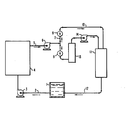
- The accompanying drawing is a schematic diagram illustrating a certain presently preferred embodiment of the process and apparatus of this invention, given by way of example.
- In the drawing, the decontamination solution in feed tank 1 is forced through line 2 by
pump 3 into the apparatus to be decontaminated or a tank containing the apparatus to be decontaminated 4. The decontamination solution is then forced through line 5 by pump 6 into line 7. If valve 8 is open and valve 9 is closed, the solution passes throughline 10 into electrolysis unit 11 then back to tank 1 throughline 12. If valve 8 is closed and valve 9 is open, the solution is forced through ion exchange column 13 bypump 14 before passing through electrolysis unit 11 and back to feed tank 1. - The process of this invention applies any decontamination solution which contains a chelate for metal ions. Chelates are complexing agents generally having an equilibrium constant for metal ions of greater than about I01 8 . Examples of such chelates include EDTA, trans, 1,2-diaminocyclohexanetetraacetic acid (DCTA), oxybis (ethylenediaminetetraacetic acid) (EEDTA), and nitrilotriacetic acid (NTA). In addition, a typical decontamination solution will also contain one or more solubilizing agents. These are generally weak organic acids, such as citric acid or oxalic acid.
- The electrodes used in the electrolysis unit can be made of stainless steel, "Inconel" (trademark) alloy, nickel, or any other suitable conductor. Stainless steel is preferred as it has good corrosion resistance and is readily available. The electrode must be porous, and is in the form of particles or a mesh. A mesh is preferred as it has a higher surface area and a higher electric gradient. If particles are used they can be packed or in the form of a fluidized bed. The electrode is the cathode in the direct current electric circuit of the electrolysis unit.
- In the process of this invention the decontamination solution is circulated between the metal surfaces to be decontaminated and the electrolysis unit. It is preferable to pass the decontamination solution through a cation exchange column before it enters the electrolysis unit in order to reduce the concentration of metal ion entering the electrolysis unit. About 1 gallon of the decontamination solution per cubic foot of mesh in the electrolysis unit is a suitable operating parameter, though more or less could also be used. The electrolysis unit is operated using direct current at about 1 to about 10 volts. The temperature of the decontamination solution need not be adjusted, and it will typically be at about 75 to 150°C. The electrode in the electrolysis unit is exhausted when a pressure drop is detected across it and it must then be replaced. The metal ions on the electrode can be recovered, but .usually this is not worth the trouble and the contaminated electrode is disposed of as solid waste. If recovery is desired it can be accomplished in an inorganic acid or a strong organic acid.
Claims (9)
Applications Claiming Priority (2)
| Application Number | Priority Date | Filing Date | Title |
|---|---|---|---|
| US06/585,062 US4537666A (en) | 1984-03-01 | 1984-03-01 | Decontamination using electrolysis |
| US585062 | 1996-01-16 |
Publications (2)
| Publication Number | Publication Date |
|---|---|
| EP0154832A2 true EP0154832A2 (en) | 1985-09-18 |
| EP0154832A3 EP0154832A3 (en) | 1986-04-30 |
Family
ID=24339896
Family Applications (1)
| Application Number | Title | Priority Date | Filing Date |
|---|---|---|---|
| EP85101645A Withdrawn EP0154832A3 (en) | 1984-03-01 | 1985-02-15 | Decontamination using electrolysis |
Country Status (7)
| Country | Link |
|---|---|
| US (1) | US4537666A (en) |
| EP (1) | EP0154832A3 (en) |
| JP (1) | JPS60205300A (en) |
| KR (1) | KR850007162A (en) |
| CA (1) | CA1252415A (en) |
| ES (1) | ES8703211A1 (en) |
| ZA (1) | ZA851098B (en) |
Cited By (1)
| Publication number | Priority date | Publication date | Assignee | Title |
|---|---|---|---|---|
| EP0612863A1 (en) * | 1993-02-26 | 1994-08-31 | Rockwell International Corporation | Reducing agent regeneration system and method |
Families Citing this family (26)
| Publication number | Priority date | Publication date | Assignee | Title |
|---|---|---|---|---|
| US4654170A (en) * | 1984-06-05 | 1987-03-31 | Westinghouse Electric Corp. | Hypohalite oxidation in decontaminating nuclear reactors |
| USRE34613E (en) * | 1985-05-28 | 1994-05-24 | Recytec Sa | Process for decontaminating radioactively contaminated metal or cement-containing materials |
| EP0224510B1 (en) * | 1985-05-28 | 1991-01-16 | Recytec S.A. | Process for decontaminating radioactively contaminated metalic or cement-containing materials |
| US4681705A (en) * | 1985-10-15 | 1987-07-21 | Carolina Power & Light Company | Decontamination of radioactively contaminated liquids |
| US4792385A (en) * | 1987-11-03 | 1988-12-20 | Westinghouse Electric Corp. | Electrolytic decontamination apparatus and encapsulation process |
| JPH0317288A (en) * | 1989-06-13 | 1991-01-25 | Daicel Chem Ind Ltd | Electrolytic cleaning solution for stamper |
| CH678767A5 (en) * | 1989-06-30 | 1991-10-31 | Jozef Hanulik Dipl Chem | |
| US5024805A (en) * | 1989-08-09 | 1991-06-18 | Westinghouse Electric Corp. | Method for decontaminating a pressurized water nuclear reactor system |
| JPH0727073B2 (en) * | 1990-03-20 | 1995-03-29 | 森川産業株式会社 | Decontamination method and decontamination apparatus for objects contaminated with radioactivity, and decontamination method and decontamination apparatus for materials used for the decontamination |
| US5078842A (en) * | 1990-08-28 | 1992-01-07 | Electric Power Research Institute | Process for removing radioactive burden from spent nuclear reactor decontamination solutions using electrochemical ion exchange |
| CH682023A5 (en) * | 1990-10-26 | 1993-06-30 | Recytec Sa | |
| US5292456A (en) * | 1992-03-20 | 1994-03-08 | Associated Universities, Inc. | Waste site reclamation with recovery of radionuclides and metals |
| US5306399A (en) * | 1992-10-23 | 1994-04-26 | Electric Power Research Institute | Electrochemical exchange anions in decontamination solutions |
| US5832393A (en) * | 1993-11-15 | 1998-11-03 | Morikawa Industries Corporation | Method of treating chelating agent solution containing radioactive contaminants |
| US5489735A (en) * | 1994-01-24 | 1996-02-06 | D'muhala; Thomas F. | Decontamination composition for removing norms and method utilizing the same |
| US5814204A (en) * | 1996-10-11 | 1998-09-29 | Corpex Technologies, Inc. | Electrolytic decontamination processes |
| DE19818772C2 (en) | 1998-04-27 | 2000-05-31 | Siemens Ag | Process for reducing the radioactivity of a metal part |
| US7384529B1 (en) | 2000-09-29 | 2008-06-10 | The United States Of America As Represented By The United States Department Of Energy | Method for electrochemical decontamination of radioactive metal |
| TW529041B (en) * | 2000-12-21 | 2003-04-21 | Toshiba Corp | Chemical decontamination method and treatment method and apparatus of chemical decontamination solution |
| US6682646B2 (en) | 2002-03-25 | 2004-01-27 | Electric Power Research Institute | Electrochemical process for decontamination of radioactive materials |
| US20050230267A1 (en) * | 2003-07-10 | 2005-10-20 | Veatch Bradley D | Electro-decontamination of contaminated surfaces |
| EP2596502B1 (en) * | 2010-07-21 | 2020-03-04 | Atomic Energy of Canada Limited | Reactor decontamination system and process |
| US9617646B2 (en) | 2012-11-14 | 2017-04-11 | Elwha Llc | Comminution water contaminant removal system |
| JP6434318B2 (en) * | 2015-01-16 | 2018-12-05 | 株式会社神戸製鋼所 | Tank decontamination method |
| JP6591225B2 (en) * | 2015-08-03 | 2019-10-16 | 株式会社東芝 | Decontamination method |
| RU2713733C1 (en) * | 2019-06-27 | 2020-02-07 | Федеральное государственное унитарное предприятие "Горно-химический комбинат" (ФГУП "ГХК") | Method for decontamination of graphite radioactive wastes |
Family Cites Families (6)
| Publication number | Priority date | Publication date | Assignee | Title |
|---|---|---|---|---|
| US3244605A (en) * | 1963-07-05 | 1966-04-05 | Dow Chemical Co | Purification of aqueous caustic solutions |
| US3459646A (en) * | 1968-06-25 | 1969-08-05 | Ppg Industries Inc | Alkali metal hydroxide purification |
| US3650925A (en) * | 1969-06-02 | 1972-03-21 | Ppg Industries Inc | Recovery of metals from solution |
| US4193853A (en) * | 1979-05-15 | 1980-03-18 | The United States Of America As Represented By The United States Department Of Energy | Decontaminating metal surfaces |
| GB2077482B (en) * | 1980-06-06 | 1983-06-08 | Us Energy | Coolant system decontamination |
| JPS5851977A (en) * | 1981-09-25 | 1983-03-26 | Hitachi Ltd | Regeneration of chemical decontaminating liquid |
-
1984
- 1984-03-01 US US06/585,062 patent/US4537666A/en not_active Expired - Fee Related
-
1985
- 1985-02-13 ZA ZA851098A patent/ZA851098B/en unknown
- 1985-02-15 EP EP85101645A patent/EP0154832A3/en not_active Withdrawn
- 1985-02-26 ES ES540718A patent/ES8703211A1/en not_active Expired
- 1985-02-27 CA CA000475279A patent/CA1252415A/en not_active Expired
- 1985-02-28 KR KR1019850001266A patent/KR850007162A/en not_active Ceased
- 1985-03-01 JP JP60038952A patent/JPS60205300A/en active Granted
Cited By (1)
| Publication number | Priority date | Publication date | Assignee | Title |
|---|---|---|---|---|
| EP0612863A1 (en) * | 1993-02-26 | 1994-08-31 | Rockwell International Corporation | Reducing agent regeneration system and method |
Also Published As
| Publication number | Publication date |
|---|---|
| KR850007162A (en) | 1985-10-30 |
| EP0154832A3 (en) | 1986-04-30 |
| ES8703211A1 (en) | 1987-02-01 |
| US4537666A (en) | 1985-08-27 |
| CA1252415A (en) | 1989-04-11 |
| ES540718A0 (en) | 1987-02-01 |
| JPH039438B2 (en) | 1991-02-08 |
| ZA851098B (en) | 1985-09-25 |
| JPS60205300A (en) | 1985-10-16 |
Similar Documents
| Publication | Publication Date | Title |
|---|---|---|
| US4537666A (en) | Decontamination using electrolysis | |
| US4514270A (en) | Process for regenerating cleaning fluid | |
| EP0032416B2 (en) | Descaling process | |
| US4217192A (en) | Decontamination of metals using chemical etching | |
| EP0789831B1 (en) | Decontamination process | |
| JPH0153440B2 (en) | ||
| US5024805A (en) | Method for decontaminating a pressurized water nuclear reactor system | |
| US6147274A (en) | Method for decontamination of nuclear plant components | |
| EP0324862B1 (en) | Nuclear fuel reprocessing plant | |
| JP2002513163A (en) | How to lower the radioactivity level of metal parts | |
| US5752206A (en) | In-situ decontamination and recovery of metal from process equipment | |
| EP0859671B1 (en) | Method for decontamination of nuclear plant components | |
| WO1997017146A9 (en) | Method for decontamination of nuclear plant components | |
| JP4306999B2 (en) | Dissolution / decontamination method | |
| US5102511A (en) | Method of decontaminating radioactive metallic wastes | |
| US5545795A (en) | Method for decontaminating radioactive metal surfaces | |
| JPS62130396A (en) | How to remove oxide film containing radioactive materials | |
| RU1783585C (en) | Radioactive decontamination of stainless steel | |
| JPH01287286A (en) | Corrosion prevention method in highly corrosive liquids | |
| JPS61231496A (en) | Decontamination method for radioactive metal waste | |
| JP2854706B2 (en) | Chemical decontamination waste liquid treatment method | |
| JPH0240200B2 (en) | ||
| Wedman et al. | Electrolytic decontamination of conductive materials for hazardous waste management | |
| JPH05192667A (en) | Treatment of waste chemical solution | |
| JPH05164890A (en) | How to shut down a boiling water reactor plant |
Legal Events
| Date | Code | Title | Description |
|---|---|---|---|
| PUAI | Public reference made under article 153(3) epc to a published international application that has entered the european phase |
Free format text: ORIGINAL CODE: 0009012 |
|
| AK | Designated contracting states |
Designated state(s): BE CH DE FR GB IT LI SE |
|
| PUAL | Search report despatched |
Free format text: ORIGINAL CODE: 0009013 |
|
| AK | Designated contracting states |
Kind code of ref document: A3 Designated state(s): BE CH DE FR GB IT LI SE |
|
| 17P | Request for examination filed |
Effective date: 19860917 |
|
| 17Q | First examination report despatched |
Effective date: 19880318 |
|
| STAA | Information on the status of an ep patent application or granted ep patent |
Free format text: STATUS: THE APPLICATION IS DEEMED TO BE WITHDRAWN |
|
| 18D | Application deemed to be withdrawn |
Effective date: 19890829 |
|
| RIN1 | Information on inventor provided before grant (corrected) |
Inventor name: MURRAY, ALEXANDER PETER Inventor name: SNYDER, THOMAS STEPHEN |