EP0154936A2 - Hervorstehender polycristalliner Diamant, der in einem Meisselkörper montiert ist - Google Patents
Hervorstehender polycristalliner Diamant, der in einem Meisselkörper montiert ist Download PDFInfo
- Publication number
- EP0154936A2 EP0154936A2 EP85102568A EP85102568A EP0154936A2 EP 0154936 A2 EP0154936 A2 EP 0154936A2 EP 85102568 A EP85102568 A EP 85102568A EP 85102568 A EP85102568 A EP 85102568A EP 0154936 A2 EP0154936 A2 EP 0154936A2
- Authority
- EP
- European Patent Office
- Prior art keywords
- matrix material
- diamond
- diamond body
- cutter
- drill bit
- Prior art date
- Legal status (The legal status is an assumption and is not a legal conclusion. Google has not performed a legal analysis and makes no representation as to the accuracy of the status listed.)
- Granted
Links
Images


Classifications
-
- E—FIXED CONSTRUCTIONS
- E21—EARTH OR ROCK DRILLING; MINING
- E21B—EARTH OR ROCK DRILLING; OBTAINING OIL, GAS, WATER, SOLUBLE OR MELTABLE MATERIALS OR A SLURRY OF MINERALS FROM WELLS
- E21B10/00—Drill bits
- E21B10/46—Drill bits characterised by wear resisting parts, e.g. diamond inserts
- E21B10/56—Button-type inserts
- E21B10/567—Button-type inserts with preformed cutting elements mounted on a distinct support, e.g. polycrystalline inserts
- E21B10/5673—Button-type inserts with preformed cutting elements mounted on a distinct support, e.g. polycrystalline inserts having a non planar or non circular cutting face
-
- E—FIXED CONSTRUCTIONS
- E21—EARTH OR ROCK DRILLING; MINING
- E21B—EARTH OR ROCK DRILLING; OBTAINING OIL, GAS, WATER, SOLUBLE OR MELTABLE MATERIALS OR A SLURRY OF MINERALS FROM WELLS
- E21B10/00—Drill bits
- E21B10/46—Drill bits characterised by wear resisting parts, e.g. diamond inserts
Definitions
- the invention relates to field of earth boring tools, and more particularly to diamond drill bits incorporating synthetic diamond cutting elements.
- the PCD products are fabricated from synthetic and/or appropriately sized natural diamond crystals under heat and pressure and in the presence of a solvent/catalyst to form the polycrystalline structure.
- the polycrystalline structures includes sintering aid material distributed essentially in the interstices where adjacent crystals have not bonded together.
- the resulting diamond sintered product is porous, porosity being achieved by dissolving out the nondiamond material or at least a portion thereof, as disclosed for example, in U. S. 3,745,623; 4,104,344 and 4,224,380.
- a material may be described as a porous PCD,'as referenced in U.S. 4,224,380.
- Polycrystalline diamonds have been used in drilling products either. as individual elements or as relatively thin PCD tables supported on a cemented tungsten carbide (WC) support backings.
- the PCD compact is supported on a cylindrical slug about 13.3 mm in diameter and about 3 mm long, with a .PCD table of about 0.5 to 0.6 mm in cross section on the face of the cutter.
- a stud cutter the PCD table also is supported by a cylindrical substrate of tungsten carbide of about 3 mm by 13.3 mm in diameter by 26mm in overall length.
- the natural diamond could be either surface-set in a predetermined orientation, or impregnated, i.e., diamond is distributed throughout the matrix in grit or fine particle form.
- porous PCD compacts and those said to be temperature stable up to about 1200 C are available in a variety of shapes, e.g., cylindrical and triangular.
- the triangular material typically is about 0.3 carats in weight, measures 4mm on a side and is about 2.6mm thick. It is suggested by the prior art that the triangular porous PCD compact be surface-set on the face with a minimal point exposure, i.e., less than 0.5mm above the adjacent metal matrix face for rock drills. Larger one per carat synthetic triangular diamonds have also become available, measuring 6 mm on a side and 3.7 mm thick, but no recommendation has been made as to the.
- the triangular element be set completely below the metal matrix.
- the triangular element be set in a radial orientation with the base at about the level of the metal matrix. The degree o?r ?r?rfexposure recommended thus depended on the type of rock formation to be cut.
- the difficulties with such placements are several.
- the 3ifficulties may be understood by considering the dynamics of the drilling operation.
- a fluid such as water, air or drilling mud is pumped through the center of the tool, radially outwardly across the tool face, radially around the outer surface (gage) and then back up the bore.
- the drilling fluid clears the tool face of cuttings and to some extent cools the cutter face.
- the cuttings may not be cleared from the face, especially where the formation is soft or sticky.
- the clearance' between the cutting surface-formation interface and the tool body face is relatively small and if no provision is made for chip clearance, there may be bit clearing problems.
- the weight on the drill bit normally the weight of the drill string and principally the weight of the drill collar, and the effect of the fluid which tends to lift the bit off the bottom. It has been reported, for example, that the pressure beneath a diamond bit may be as much as 1000 psi greater than the pressure above the bit, resulting in a hydraulic lift, and in some cases the .hydraulic lift force exceeds 50% of the applied load while drilling.
- Still another advantage is the provision of a dri lling tool in which thermally stable PCD elements of a defined predetermined geometry are so positioned and supported in a metal matrix as to be effectively locked into the matrix in order to provide reasonably long life of the tooling by preventing loss of PCD elements other than by normal wear.
- the invention is a cutter in a drill bit made of matrix material comprising a diamond body 'disposed in the matrix material of the drill bit and exposed above the surface of the drill bit.
- the diamond body has a predetermined geometric configuration and is disposed in the matrix material in such a fashion to establish at least two loccking points between the diamond body and the matrix material.
- the manner in which the diamond body is disposed in the matrix material is dependent in part on the geometry of the diamond body.
- the diamond body is oriented in the matrix material so that at least one surface or portion of a surface of the diamond body is acutely inclined with respect to the normal to the surface of the matrix material at the_ location of the diamond body.
- the matrix material thus forms a locking wedge over the diamond body where it is acutely inclined with respect to the normal to the matrix surface at the location of the diamond body on the bit.
- the invention is illustrated below in a plurality of geometric shapes including triangular prismatic shapes elements, prismatic rectangular elements, cylindrical elements, ovulate elements, and plate-like elements.
- the invention can be incorporated in free-form shapes which incorporate a negatively curved surface which produces a lip or pedestal extending and disposed below the surface of the matrix material or the bit face.
- the invention is the embedding and interlocking of a hard cutting element into a bit body. More particularly, the invention comprises the embedding and interlocking of a polycrystalline synthetic, diamond (PCD) element into a matrix body bit such that the diamond element is substantially exposed above the surface of the matrix.
- PCD polycrystalline synthetic, diamond
- the embedment and interlocking of the diamond element is provided in such a way, as described in greater detail below that at least two locking points are provided between the diamond element and the matrix by virtue of the embedment and geometric configuration of the diamond element.
- the locking points provide means of interlocking the diamond element into the matrix in order to prevent movement or dislodging of the diamond matrix therefrom in substantially any direction including particularly the direction normal to the surface of the matrix.
- Figure 1 is a pictorial perspective of a matrix body drill 11.
- Bit face 17 is characterised by a gage 19, shoulder portion 21, flank 23, nose 25 and apex 27. These portions of bit face 17 are also provided with conventional junk slots 29 and collectors and waterways 31 in communication with an axial crowfoot (not shown). Between waterways and collectors 31 are lands or pads 33 in which a plurality of diamond elements 35 are disposed according to the invention.
- the surface of lands 33 is defined as the matrix surface and is generally planar in the localized area of each diamond element 35.
- Element -10 is configured as a triangular prism characterised by two opposing triangular end faces 12, only one of which is shown in Figure 2, and three adjacent rectangular sides 14, again only one of which is illustrated in Figure 2.
- Element 10 is prismatic, meaning that the shape of element 10 is generated by translating one triangular end face 12 in a parallel linear direction as defined by longitudinal axis 16.
- Such PCD elements are well known to the art and are manufactured under the trademark "GEOSET" by General Electric Company.
- element 10 is embedded in and interlocked with matrix 18 of bit 11 of Figure 1.
- PCD element 10 is raised well above surface 20 of matrix 18, typically by more than 30% of height 22 of element 10:
- element 10 may be mounted within matrix 18 and raised above the surface by more than 0.068 inch (1.73 mm).
- height 22 is 0.35 inch (5.20 mm).
- height 22 is 0.35 inch (5.20 mm).
- more than one-third of the linear dimension which is approximately perpendicular to the matrix surface is exposed.
- Element 10 is mounted and interlocked in matrix 18 by having one side 14 forming a base 14a opposing the dihedral angle forming an apical idge 24.
- Base 14a is disposed within matrix 1 8 below surface 20 by less than 30% of height 22, or in the case of the example of a 2103 "GEOSET" by less than 0.061 inch (1.56 mm).
- Apical ridge 24 forms the most outwardly extended portion of element 10 and element 10 can be set on face 20 of the matrix bit in any orientation as desired without departing from the scope of the invention.
- apical ridge 24 may be set lying in a direction parallel to the angular advance of element 10 as defined by the rotation of bit 11.
- apical ridge 24 may be set at right angles to the direction of advance of element 10 as defined by the rotation of the bit. This setting is then defined as a tangential setting. In both cases longituidnal axis 16 of element 10 is oriented generally parallel to surface 20 of matrix 18 at the point of attachment of element 10 thereto.
- triangular prismatic element 10 is locked within matrix 18 by at least two locking points 26, only one of which is illustrated in Figure 2. Locking embedded below surface 20 " into matrix material 18. In the case of triangular prismatic element 10, locking point 26 is actually an entire surface. The second locking point is a like portion of the adjacent surface 14 (not shown in Figure 2) which two surfaces join to form the dihedral angle defining the apical edge 24 of element 10. Locking point 26 is thus in the embodiment of Figure 2 an inclined surface portion below surface 20.
- Element 10 is fabricated or molded into the matrix body bit by conventional infiltration techniques. As a result, matrix material 18 forms an innerlocking abutment against the sloped surface of locking point 26 thereby providing a wedged shaped lock on element 10.
- Matrix material 18 forms integral overlying wedges so that element 10 is locked into matrix 18 with respect to all directions. That is, a force in any direction tending to remove element 10 from surface 20 would be resisted by locking points 26.
- end surfaces 12 were perpendicular surfaces to longitudinal axis 16 and thus locking points 26 were formed only on opposing surfaces 14 below surface 20.
- end surfaces 12 may be inclined with respect to longitudinally axes 16 thereby providing two additional spaced apart locking points, which together with locking points 26, would form two othogonal pairs of such locking points, or in the case of Figure 2 locking surface portions.
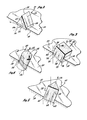
- rectangular prismatic element 28 is shown as a cubic diamond element, which may either be a natural cubic element or may be synthetically manufactured. In either case, element 28 is disposed within matrix material 18 below surface 20 in such a manner that at least two locking points 30 and 32 are provided. Locking point 30 is formed at one corner 34 of cubic element 28 while locking point 32 is formed at the adjacent corners 36, one of which is illustrated in Figure 3. Element 28 is disposed within matrix 18 at an angle so that its normal axis of symmetry 38 is inclined with respect to surface 20 at the point of attachment of element 28 to the matrix bit.
- the inclination of axis 38 causes at least one of the four basal corners, in this case corner 34, to be cocked up at an angle so as to be disposed within matrix 18 at lesser depth than at least one other corner of cubic element 28.
- the inclination of axis 38 is such that no face of cubic element 28 is perpendicular to surface 20.
- the inclination of axis 38 causes corner 34 to be the highest corner followed by adjacent corners 36 and lastly, by lowest opposing' corner 40.
- the angular orientation of axis 38 thus causes edge 42, which is adjacent to corner 34, to be inclined upwardly through surface 20 of matrix material 18 at an acute angle.
- locking point 30 at corner 34 is a surface portion in the proximity of corner 34 of adjacent sides 44 which join together to form the dihedral angle 46 and edge 42.
- locking points 30 and 32 are merged to include lower surface portion of side 44 in the proximity of and adjacent to basal edge 48 from corner 34 to adjacent corner 36.
- the embedment of cubic element 28 within matrix material 18 also provides a means of resisting any forces imparted on element 28 in a direction parallel to surface 20.
- Cubic element 28 is not locked into matrix 18 only in the direction of axis 38. Resistance to these parallel or azimuthal forces which may be applied to element 28 would also be provided if axis of symmetry .38 were substantially perpendicular to surface 20. However, in this last case, locking point 30 would have disappeared and there would be no mechanical means, other than cohesion, micromechanical attachment or other bonding between element 28 and matrix material 18 which would retain or lock element 28 in matrix material 18.
- FIG. 4 a right circular cylindrical element, generally denoted by reference numeral 50, is illustrated.
- Cylindrical element 50 is characterised by a longitudinal axis of symmetry 52.
- Element 50 is disposed within matrix 18 below surface 20 in such a manner that axis 52 is inclined at an acute angle to surface 20.
- a locking point or more strictly speaking a plurality of locking points are formed on the lower surface of element 50 in the proximity of base 56.
- base 56 is shown as a flat circular base while the opposing end of cylindrical element 50 is illustrated as being generally domed.
- the shape of opposing end 58 can be arbitrarily chosen.
- a locking point 54 is formed on an inclined surface portion of cylindrical element below surface 20 of matrix 18.
- Matrix material 18 is molded about the embedded portion of cylindrical element 50 and thereby forms a locking wedge against the acutely inclined surface portions.
- Figure 5 shows a perspective view of a triangular prismatic element 10 which was shown and described in connection with Figure 2 disposed below surface 20 into matrix material 18 in such a manner that longitudinal axis 16 is acutely inclined with respect to the normal to surface 20 rather than being perpendicular thereto as shown in Figure 2.
- At least one corner 60 is thus defined as being the highest corner of element 10 which is embedded within matrix material 18.
- Adjacent corner 62 is disposed within matrix material 18 at a greater depth as determined by the size of element 10 and the angular orientation of longitudinal axis 16 with respect to the surface normal.
- At least one locking point 64 and, in fact, a plurality of locking points are then formed on that portion of side 14 disposed beneath surface 20.
- locking points 64 are formed on two adjacent sides 14 which join together to form the dihedral edge 24.
- Matrix material 18 is molded about surface 14 once again forming an overlying wedge which locks element 10 onto surface 20 and which resists substantially all forces which may be exerted upon element 10 which might tend to remove it from surface 20.
- ovulate element 66 is characterised by a major longitudinal axis 68 which'defines a direction of preferential or maximum elongation.
- the angular orientation of major axis 68 of relements 66 is inclined sufficiently with respect to the normal to surface 20 such that at least two locking points, again a surface portion defining the plurality of locking points 70, are defined below surface 20 on element 66.
- ovulate element 66 is such that it begins to fall away from the normal to surface 20 as it approaches surface 20 from beneath.
- matrix material 18 is molded thereover and thus again forms a wedging mechanical lock to retain element 66 in matrix material 18.
- a locking resisting force exist for all directions except one, major axis 68.
- Figures 2-6 are each rgenerally characterised by a diamond element having a longitudinal axis lying along a direction of major elongation of the element or at least in a direction of equal elongation as in t?r?rhe case of cubic element 28 in Figure 3.
- a right circular diamond disk generally denoted by reference numeral 72 is embedded within matrix material 18 and exposed above surface 20 according to the invention.
- 72 is characterised by an axis of symmetry 74.
- Axis 74 is again acutely aligned with respect to the normal at surface 20 so that one edge 76 is well exposed above matrix surface 20 while the diametrically opposing edge 78 is embedded within matrix material 18 below surface 20.
- At least two locking points are formed at a portion of the upper surface of disk 72 in the proximity of edge 78 and below surface 20.
- disk 72 is embedded in surface 20 of the matrix bit at an inclined angle such that the leading edge is fully exposed while the trailing edge is fully embedded with portions of the edges of disk 72 between diametric points 76 and 78 either being exposed or embedded to lesser or greater degrees depending on their proximity to diametrically opposed points 76 and 78 respectively. Therefore, disk 72 is securely locked within matrix 18 against both azimuthal forces and normal forces to surface 20.
- FIG. 8 The invention is further illustrated in the embodiment of Figure 8 wherein a right circular cylindrical element 50 as described in connection with the embodiment of Figure 4 is disposed into matrix 18 below surface 20.
- the exposed end 58 of cylinder 50 is shown as having a domed shape purely for convenience and not as a means of limiting the invention.
- the opposing end or base 56 is disposed at least partially within matrix material 18 so that at least two, and actually a plurality of locking points 82, are formed thereon.
- at least a portion of cylinder 50 is embedded deeply enough such tht the diameter of a perpendicularly cross section to axis 52 is below surface 20.
- FIG. 9 wherein a triangular prismatic element, generally denoted by reference numeral 86, is disposed below surface 20 in matrix material 18 so that a plurality of locking points 88 are formed on its surface.
- Element 86 is similar to that described in connection with Figures 2 and 5, with the exception that element 86 has been elongated along longitudinal axis 90.
- the embodiment of Figure 9 should be interpreted to include element 10 of Figures 2 and 5 as well.
- triangular element 86 of Figure 8 includes at least a portion embedded below surface 20 of matrix 18. At each point on the embedded portion of side 92, the slope of side 92 falls away fro ⁇ the normal to surface 20 as surface 20 is approached from below.
- matrix material 18 is molded over side 92 thereby forming a wedge-shaped lock over the embedded portion of side 92 and thus, the plurality of locking points 88. Meanwhile, a substantial forward portion of element 86 is completely exposed above surface 20 of matrix 18. In fact, it is not necessary that trailing corner 94 be flush with surface 20 as illustrated in Figure 9. Instead, trailing corner 94 may be disposed well above surface 20 as well, locking points 88 remain established as long as any portion of adjacent sides 92 remain disposed below surface 20 into matrix 18.
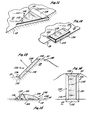
- FIG. 10 wherein yet another embodiment is illustrated showing an elongated rectangular prismatic element, generally denoted by reference numeral 96.
- element 96 is embedded below surface 20 into matrix 18 with opposing sides 98 generally parallel to the normal to surface 20.
- one end surface 100 is substantially or fully exposed above surface 20 while the opposing end surface 102, only the edge of which is shown in Figure 10, is disposed beneath surface 20.
- matrix material 18 is disposed over at least a portion of one end of element 96 and forms a plurality of locking points 104.
- a wedged-shape extension of matrix 18 is integrally formed over submerged end 102 thus providing the mechanical locking which prevents any substantial dislodgment of element 96 from surface 20.
- element 96 has been shown as having a substantially elongated longitudinal axis 106, although it must be understood that the proportions of element 96 are arbitrarily fixed and could be chosen to include the embodiment of Figure 3, which is cubic, as well.
- Triangular element 108 is characterised by a longitudinal axis 110 in a direction iormal to parallel and opposing end faces 112.
- the thickness of element 108 or the distance between opposing end faces 112 is smaller than the distance of the sides or height of triangular Element 108 thereby resulting in a flat plate-like triangular element.
- element 108 is substantially exposed above surface 20 of matrix 18 and locked therein by a plurality of locking points 114.
- Locking points 114 are formed on a lower portion of end surface 112 which is disposed below surface 20 by virtue of the acute angular orientation of element 108 and its longitudinal axis 110 from the normal. Matrix material 18 forms an integral edge over this lower portion of element 108 thus defining and forming locking points 114.
- Element 116 includes at least two opposing parallel surfaces 118, the upper of which is shown in the view of Figure 12. Between opposing parallel surfaces 118 are four sides forming two opposing pairs, 120 and 122, at least one of which pairs 120 has a trapezoidal shape.
- side 120 is trapezoidal
- side 122 is generally rectangular as would be produced by truncating the triangular prismatic element 10 of Figure 2 along a plane parallel to base 14a.
- a plurality of locking points 124 are formed along lower edge of sides 122 in the same manner as locking points 26 are formed in the embodiment of Figure 2 with respect to element 10.
- element 116 is locked within the matrix 18 in substantially the same manner.
- FIG. 13 and 14 wherein a trapezoidal prismatic element 126 is shown as embedded in an inclined orientation in the matrix 18 and is locked therein by having portions below surface 20. More particularly, element 126 is shown in the illustrated embodiment of Figures 12 and 13 as fully trapezoidal in the sense that parallel rectangular faces 128 are connected by four adjacent trapezoidal-shaped faces formed in opposing pairs, namely surfaces 130 and 132. However, it must be expressly understood that the somewhat simpler trapezoidal element 116 of Figure 12 could be employed with appropriate modifications according to the invention in a substantially similar embodiment to that shown and described in connection with Figures 13 and 14.
- element 126 is disposed within an inclined portion 134 of matrix material 18 which portion 134'of matrix material 18 forms an inclined slope or support into which element 126 is embedded and locked.
- the embodiments of Figures 13 and 14 incorporate the concept of an inclined land on the bit face. Supported cutter or tooth structures are distinguishable and are better shown in the following incorporated applications assigned to the same assignee of the present invention:
- one end surface 132 as shown in Figures 13 and 14 is fully exposed and is generally coplanar with surface 20.
- the upper parallel rectangular side 128 is fully exposed as well.
- each of the three remaining side surfaces 130 and the opposing end surface 132 are embedded within matrix 18 below surface 20.
- On each of these embedded surfaces a plurality of locking points 136 are thus formed by the integral extension of matrix 18 over underlying sides 130 and 132.
- a plurality of locking points 136 are defined and established which will prevent the movement of element 126 not only in any azimuthal direction across surface 20, but in the vertical direction as well.
- Figure 15 illustrates a perspective view of a curvalinear, free-form synthetic diamond element generally denoted by reference numeral 138.
- Element 138 in the illustrated embodiment is shown as having an elongated body characterised by a smooth apical surface 140 and a rounded nose portion 142 which may be oriented in the direction of cutting as defined by rotation of the drill bit. From apical surface 140, the sides of element 138 sloped downwardly and are flared outwardly to form a generally flat basal surface 144 and a peripheral lip 146. The surface adjoining the sides of element 138 with lip 146 are thus characterised by a negative curvature evidenced through segment 148. Element 138 is therefore disposed within matrix 18 below surface 20 so that lip 146 is substantially or fully embedded therein, including at least a portion of the negatively curved surface 148.
- Matrix material 18 is therefore molded about and above lip 146, which forms a pedestal embedded into matrix 18.
- the remaining portion of diamond element 138 is fully exposed above matrix surface 20. Therefore, along the entire periphery of lip 146, a plurality of locking points 150 are defined and established which provide a means of mechanically locking diamond element 138 onto and below surface 20.
- many other free-form shapes other than that one which is arbitrarily chosen here to illustrate the invention in the embodiment of Figure 15 could be devised as well without departing from the teaching of the invention.
Landscapes
- Engineering & Computer Science (AREA)
- Life Sciences & Earth Sciences (AREA)
- Mining & Mineral Resources (AREA)
- Geology (AREA)
- Mechanical Engineering (AREA)
- Physics & Mathematics (AREA)
- Environmental & Geological Engineering (AREA)
- Fluid Mechanics (AREA)
- General Life Sciences & Earth Sciences (AREA)
- Geochemistry & Mineralogy (AREA)
- Chemical & Material Sciences (AREA)
- Crystallography & Structural Chemistry (AREA)
- Earth Drilling (AREA)
- Carbon And Carbon Compounds (AREA)
- Drilling Tools (AREA)
Applications Claiming Priority (2)
| Application Number | Priority Date | Filing Date | Title |
|---|---|---|---|
| US59036684A | 1984-03-16 | 1984-03-16 | |
| US590366 | 1984-03-16 |
Publications (3)
| Publication Number | Publication Date |
|---|---|
| EP0154936A2 true EP0154936A2 (de) | 1985-09-18 |
| EP0154936A3 EP0154936A3 (en) | 1986-06-11 |
| EP0154936B1 EP0154936B1 (de) | 1990-05-09 |
Family
ID=24361960
Family Applications (1)
| Application Number | Title | Priority Date | Filing Date |
|---|---|---|---|
| EP85102568A Expired EP0154936B1 (de) | 1984-03-16 | 1985-03-07 | Hervorstehender polycristalliner Diamant, der in einem Meisselkörper montiert ist |
Country Status (5)
| Country | Link |
|---|---|
| EP (1) | EP0154936B1 (de) |
| JP (1) | JPS60212588A (de) |
| CA (1) | CA1248939A (de) |
| DE (1) | DE3577586D1 (de) |
| NO (1) | NO167224C (de) |
Cited By (12)
| Publication number | Priority date | Publication date | Assignee | Title |
|---|---|---|---|---|
| EP0285678A1 (de) * | 1985-08-02 | 1988-10-12 | Eastman Teleco Company | Bohrmeissel für weiche bis harte Formationen |
| BE1000489A3 (fr) * | 1986-03-27 | 1988-12-27 | Shell Int Research | Outil de forage rotatif. |
| EP0391683A1 (de) * | 1989-04-05 | 1990-10-10 | De Beers Industrial Diamond Division (Pty) Limited | Bohrmeissel |
| US5135061A (en) * | 1989-08-04 | 1992-08-04 | Newton Jr Thomas A | Cutting elements for rotary drill bits |
| WO1992014906A1 (en) * | 1991-02-23 | 1992-09-03 | Brit Bit Limited | Improvements relating to drill bits |
| WO1999004128A3 (en) * | 1997-07-15 | 1999-04-08 | Kennametal Inc | Rotatable cutting bit assembly with cutting inserts |
| US6044920A (en) * | 1997-07-15 | 2000-04-04 | Kennametal Inc. | Rotatable cutting bit assembly with cutting inserts |
| US6176332B1 (en) | 1998-12-31 | 2001-01-23 | Kennametal Inc. | Rotatable cutting bit assembly with cutting inserts |
| EP1388641A1 (de) * | 2002-08-08 | 2004-02-11 | HILTI Aktiengesellschaft | Hartstoffeinsatz mit polykristalliner Diamantschicht |
| US9279290B2 (en) | 2012-12-28 | 2016-03-08 | Smith International, Inc. | Manufacture of cutting elements having lobes |
| US11828108B2 (en) | 2016-01-13 | 2023-11-28 | Schlumberger Technology Corporation | Angled chisel insert |
| US20240401413A1 (en) * | 2023-05-30 | 2024-12-05 | Ulterra Drilling Technologies, L.P. | Drill bits and other downhole drilling tools with non-cylindrical cutter pockets |
Families Citing this family (3)
| Publication number | Priority date | Publication date | Assignee | Title |
|---|---|---|---|---|
| ZA864402B (en) * | 1985-06-18 | 1987-02-25 | De Beers Ind Diamond | Abrasive tool |
| US9056799B2 (en) | 2010-11-24 | 2015-06-16 | Kennametal Inc. | Matrix powder system and composite materials and articles made therefrom |
| US10508503B2 (en) | 2016-09-23 | 2019-12-17 | Baker Hughes, A Ge Company, Llc | Cutting elements, earth-boring tools including the cutting elements, and methods of forming the earth-boring tools |
Family Cites Families (4)
| Publication number | Priority date | Publication date | Assignee | Title |
|---|---|---|---|---|
| US3709308A (en) * | 1970-12-02 | 1973-01-09 | Christensen Diamond Prod Co | Diamond drill bits |
| SU483863A1 (ru) * | 1973-01-03 | 1980-06-15 | Всесоюзный Научно-Исследоваельский И Проектный Институт Тугоплавких Металлов И Твердых Сплавов | Способ изготовлени алмазного бурового инструмента |
| JPS5382601A (en) * | 1976-12-28 | 1978-07-21 | Tokiwa Kogyo Kk | Rotary grinding type excavation drill head |
| US4234048A (en) * | 1978-06-12 | 1980-11-18 | Christensen, Inc. | Drill bits embodying impregnated segments |
-
1985
- 1985-03-04 CA CA000475707A patent/CA1248939A/en not_active Expired
- 1985-03-07 EP EP85102568A patent/EP0154936B1/de not_active Expired
- 1985-03-07 DE DE8585102568T patent/DE3577586D1/de not_active Expired - Lifetime
- 1985-03-14 NO NO851019A patent/NO167224C/no unknown
- 1985-03-15 JP JP60050665A patent/JPS60212588A/ja active Pending
Cited By (16)
| Publication number | Priority date | Publication date | Assignee | Title |
|---|---|---|---|---|
| EP0285678A1 (de) * | 1985-08-02 | 1988-10-12 | Eastman Teleco Company | Bohrmeissel für weiche bis harte Formationen |
| BE1000489A3 (fr) * | 1986-03-27 | 1988-12-27 | Shell Int Research | Outil de forage rotatif. |
| US4926950A (en) * | 1986-03-27 | 1990-05-22 | Shell Oil Company | Method for monitoring the wear of a rotary type drill bit |
| EP0391683A1 (de) * | 1989-04-05 | 1990-10-10 | De Beers Industrial Diamond Division (Pty) Limited | Bohrmeissel |
| US5025871A (en) * | 1989-04-05 | 1991-06-25 | Aulette Stewart | Drilling method and rotary drill bit crown |
| US5135061A (en) * | 1989-08-04 | 1992-08-04 | Newton Jr Thomas A | Cutting elements for rotary drill bits |
| WO1992014906A1 (en) * | 1991-02-23 | 1992-09-03 | Brit Bit Limited | Improvements relating to drill bits |
| US6044920A (en) * | 1997-07-15 | 2000-04-04 | Kennametal Inc. | Rotatable cutting bit assembly with cutting inserts |
| WO1999004128A3 (en) * | 1997-07-15 | 1999-04-08 | Kennametal Inc | Rotatable cutting bit assembly with cutting inserts |
| US6109377A (en) * | 1997-07-15 | 2000-08-29 | Kennametal Inc. | Rotatable cutting bit assembly with cutting inserts |
| EP1170460A3 (de) * | 1997-07-15 | 2003-01-29 | Kennametal Inc. | Rotierender Bohrmeissel mit Schneideelementen |
| US6176332B1 (en) | 1998-12-31 | 2001-01-23 | Kennametal Inc. | Rotatable cutting bit assembly with cutting inserts |
| EP1388641A1 (de) * | 2002-08-08 | 2004-02-11 | HILTI Aktiengesellschaft | Hartstoffeinsatz mit polykristalliner Diamantschicht |
| US9279290B2 (en) | 2012-12-28 | 2016-03-08 | Smith International, Inc. | Manufacture of cutting elements having lobes |
| US11828108B2 (en) | 2016-01-13 | 2023-11-28 | Schlumberger Technology Corporation | Angled chisel insert |
| US20240401413A1 (en) * | 2023-05-30 | 2024-12-05 | Ulterra Drilling Technologies, L.P. | Drill bits and other downhole drilling tools with non-cylindrical cutter pockets |
Also Published As
| Publication number | Publication date |
|---|---|
| EP0154936A3 (en) | 1986-06-11 |
| NO167224B (no) | 1991-07-08 |
| NO851019L (no) | 1985-09-17 |
| DE3577586D1 (de) | 1990-06-13 |
| EP0154936B1 (de) | 1990-05-09 |
| NO167224C (no) | 1991-10-16 |
| CA1248939A (en) | 1989-01-17 |
| JPS60212588A (ja) | 1985-10-24 |
Similar Documents
| Publication | Publication Date | Title |
|---|---|---|
| CA1206470A (en) | Tooth configuration for an earth boring bit | |
| EP0127077B1 (de) | Drehbohrmeissel | |
| US4512426A (en) | Rotating bits including a plurality of types of preferential cutting elements | |
| US4673044A (en) | Earth boring bit for soft to hard formations | |
| US4529047A (en) | Cutting tooth and a rotating bit having a fully exposed polycrystalline diamond element | |
| US6000483A (en) | Superabrasive cutting element with enhanced durability and increased wear life, and apparatus so equipped | |
| US6401844B1 (en) | Cutter with complex superabrasive geometry and drill bits so equipped | |
| EP0154936B1 (de) | Hervorstehender polycristalliner Diamant, der in einem Meisselkörper montiert ist | |
| US5881830A (en) | Superabrasive drill bit cutting element with buttress-supported planar chamfer | |
| US5467836A (en) | Fixed cutter bit with shear cutting gage | |
| US5346026A (en) | Rolling cone bit with shear cutting gage | |
| US4491188A (en) | Diamond cutting element in a rotating bit | |
| EP0117241A1 (de) | Bohrmeissel und Schneidelement | |
| US4515226A (en) | Tooth design to avoid shearing stresses | |
| EP0117552A2 (de) | Diamantdrehbohrmeissel | |
| EP0291314A2 (de) | Schneidelement und Drehbohrmeissel mit einem derartigen Element | |
| US4898252A (en) | Cutting structures for rotary drill bits | |
| CA1218355A (en) | Tooth design using cylindrical diamond cutting elements | |
| EP0350045B1 (de) | Bohrmeissel mit Verbundschneidelementen | |
| EP0370199A1 (de) | Bohrmeissel mit polykristallinem Diamantsand | |
| CA1256856A (en) | Earth boring bit for soft to hard formations | |
| CN114763734A (zh) | 切削元件及钻头 | |
| JPS6332955B2 (de) |
Legal Events
| Date | Code | Title | Description |
|---|---|---|---|
| PUAI | Public reference made under article 153(3) epc to a published international application that has entered the european phase |
Free format text: ORIGINAL CODE: 0009012 |
|
| AK | Designated contracting states |
Designated state(s): BE DE FR GB |
|
| PUAL | Search report despatched |
Free format text: ORIGINAL CODE: 0009013 |
|
| AK | Designated contracting states |
Kind code of ref document: A3 Designated state(s): BE DE FR GB |
|
| 17P | Request for examination filed |
Effective date: 19861204 |
|
| 17Q | First examination report despatched |
Effective date: 19880209 |
|
| RAP1 | Party data changed (applicant data changed or rights of an application transferred) |
Owner name: EASTMAN CHRISTENSEN COMPANY |
|
| GRAA | (expected) grant |
Free format text: ORIGINAL CODE: 0009210 |
|
| AK | Designated contracting states |
Kind code of ref document: B1 Designated state(s): BE DE FR GB |
|
| REF | Corresponds to: |
Ref document number: 3577586 Country of ref document: DE Date of ref document: 19900613 |
|
| ET | Fr: translation filed | ||
| PGFP | Annual fee paid to national office [announced via postgrant information from national office to epo] |
Ref country code: GB Payment date: 19910215 Year of fee payment: 7 |
|
| PLBE | No opposition filed within time limit |
Free format text: ORIGINAL CODE: 0009261 |
|
| STAA | Information on the status of an ep patent application or granted ep patent |
Free format text: STATUS: NO OPPOSITION FILED WITHIN TIME LIMIT |
|
| PGFP | Annual fee paid to national office [announced via postgrant information from national office to epo] |
Ref country code: FR Payment date: 19910321 Year of fee payment: 7 |
|
| PGFP | Annual fee paid to national office [announced via postgrant information from national office to epo] |
Ref country code: DE Payment date: 19910327 Year of fee payment: 7 |
|
| 26N | No opposition filed | ||
| PGFP | Annual fee paid to national office [announced via postgrant information from national office to epo] |
Ref country code: BE Payment date: 19910626 Year of fee payment: 7 |
|
| PG25 | Lapsed in a contracting state [announced via postgrant information from national office to epo] |
Ref country code: GB Effective date: 19920307 |
|
| PG25 | Lapsed in a contracting state [announced via postgrant information from national office to epo] |
Ref country code: BE Effective date: 19920331 |
|
| BERE | Be: lapsed |
Owner name: EASTMAN CHRISTENSEN CY Effective date: 19920331 |
|
| GBPC | Gb: european patent ceased through non-payment of renewal fee | ||
| PG25 | Lapsed in a contracting state [announced via postgrant information from national office to epo] |
Ref country code: FR Effective date: 19921130 |
|
| PG25 | Lapsed in a contracting state [announced via postgrant information from national office to epo] |
Ref country code: DE Effective date: 19921201 |
|
| REG | Reference to a national code |
Ref country code: FR Ref legal event code: ST |