EP0155110A2 - Viterbi-Dekoder mit einem Mehrheitsgatter zur Wiedergabe eines dekodierten Signals - Google Patents
Viterbi-Dekoder mit einem Mehrheitsgatter zur Wiedergabe eines dekodierten Signals Download PDFInfo
- Publication number
- EP0155110A2 EP0155110A2 EP85301282A EP85301282A EP0155110A2 EP 0155110 A2 EP0155110 A2 EP 0155110A2 EP 85301282 A EP85301282 A EP 85301282A EP 85301282 A EP85301282 A EP 85301282A EP 0155110 A2 EP0155110 A2 EP 0155110A2
- Authority
- EP
- European Patent Office
- Prior art keywords
- time slots
- viterbi decoder
- predetermined number
- circuit
- path
- Prior art date
- Legal status (The legal status is an assumption and is not a legal conclusion. Google has not performed a legal analysis and makes no representation as to the accuracy of the status listed.)
- Withdrawn
Links
- 230000015654 memory Effects 0.000 claims abstract description 28
- 230000007704 transition Effects 0.000 description 15
- 238000010586 diagram Methods 0.000 description 8
- 230000005540 biological transmission Effects 0.000 description 3
- 230000004044 response Effects 0.000 description 2
- 230000001186 cumulative effect Effects 0.000 description 1
- 230000002950 deficient Effects 0.000 description 1
- 230000000694 effects Effects 0.000 description 1
- 238000013139 quantization Methods 0.000 description 1
Images

Classifications
-
- H—ELECTRICITY
- H03—ELECTRONIC CIRCUITRY
- H03M—CODING; DECODING; CODE CONVERSION IN GENERAL
- H03M13/00—Coding, decoding or code conversion, for error detection or error correction; Coding theory basic assumptions; Coding bounds; Error probability evaluation methods; Channel models; Simulation or testing of codes
- H03M13/37—Decoding methods or techniques, not specific to the particular type of coding provided for in groups H03M13/03 - H03M13/35
- H03M13/39—Sequence estimation, i.e. using statistical methods for the reconstruction of the original codes
- H03M13/41—Sequence estimation, i.e. using statistical methods for the reconstruction of the original codes using the Viterbi algorithm or Viterbi processors
Definitions
- This invention relates to a Viterbi decoder, namely, a device for use in correcting and decoding convolutional codes in compliance with the Viterbi decoding algorithm known in the art.
- a convolutional encoder and a Viterbi decoder associated therewith are capable of reducing code error rates and increasing an effective signal-to-noise ratio in a digital communication system.
- a conventional Viterbi decoder comprises a correlator; an ACS (addition, comparison, and selection) circuit including a metric memory; a path memory; and a decoded data detecting circuit connected to. the path and the metric memories.
- first and second Exclusive OR circuits 16 and 17 are coupled to the shift register 15 to feed Exclusive OR output signals to a switching circuit 18 which delivers the encoded code sequence to the encoder output terminal 12.
- the encoded code sequence has a constraint length of three.
- Each message digit of the original message is encoded into an encoded code word of two symbols.
- the original message is encoded into the encoded code sequence with an encoding rate of 1/2.
- Each encoded code word is a convolutional code word.
- a correlator calculates during the j-th time slot t(j) correlation measures between a received code word (x(j) , y(j)) and the convolutional code words labelled along two transition paths, such as Pi'i(j), respectively, which enter the state node representative of the received code word under consideration.
- each correlation measure may be given by the number of same symbols in the two code words for which the correlation measure is calculated.
- first through fourth servivor paths are possible which enter the first through the fourth state nodes Sl to S4, respectively.
- Information bits descriptive of the first through the fourth survivor paths and consequently associated with the first through the fourth survivor paths will be called first through fourth information bits and designated-by Dl, D2, D3, and D4, respectively. Only one of the four servivor paths and therefore one of the first through the fourth information bits Dl to D4 alone is selected in each time slot.
- First through fourth metrics are possible for the first through the fourth survivor paths, respectively, and will be designated by Ml, M2, M3, and M4. Only one of the four metrics Ml through M4 actually increases in each time slot.
- a path memory is for memorizing the survivor paths in terms of the information bits Dl through D4 which are associated with the respective survivor paths.
- a metric memory which is included in the ACS circuit, memorizes the metrics Ml through M4. The path and the metric memories are referred to on detecting each decoded datum of the decoded signal in each time slot.
- the path memory may therefore memorize the survivor paths for the predetermined number of time slots at each time slot.
- the predetermined number of time slots may alternatively be called a discarding or discontinuance path length because the survivor path or paths prior to the predetermined number of time slots are discarded.
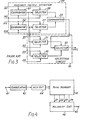
- the decoded data detecting circuit of the conventional Viterbi decoder is for convolutional codes of the constraint length of three and the encoding rate of 1/2 and comprises a maximum metric detector 20 and a selection circuit 30.
- the detector 20 comprises first through third comparators 21, 22, and 23 and first and second selectors 26 and 27.
- the first comparator 21 produces a first selecting signal which indicates the greater of, for example, the first and the second metrics Ml and M2 supplied from the metric memory.
- the first selector 26 selects the greater of the first and the second metrics Ml and M2.
- the second comparator 22 produces a second selecting signal indicative of the greater of the third and the fourth metrics M3 and M4 supplied from the metric memory.
- the second selector 27 selects the greater of the third and the fourth metrics M3- and M4.
- the third comparator 23 produces a third selecting signal which indicates the greater of the metrics selected by the first and the second selectors 26 and 27, respectively.
- Additional first through third selectors 31, 32, and 33 constituting the selection circuit 30 are responsive to the first through the third selecting signals, respectively, for eventually selecting one of the information bits Dl through D4 supplied from the path memory that corresponds to the greatest of the metrics Ml through M4 and consequently represents the currently selected survivor path which indicates either of the message digits 0 and 1 as a decoded datum DEC.
- a Viterbi decoder has decoder input and output terminals 41 and 42 which are supplied with the received code sequence and the decoded signal, respectively.
- the above-described correlator, the ACS circuit, and the path memory are depicted at 43, 44, and 45.
- the correlator 43 calculates two correlation measures at each time slot when the constraint length is three.
- the ACS circuit 44 produces a path signal representative of one of the first through the fourth information bits Dl, D2, D3, and D4 at each time slot in the manner described hereinabove.
- the ACS circuit 44 need not produce the metrics Ml through M4 for a majority circuit described hereinafter.
- a combination of the correlator 43 and the ACS circuit 44 is therefore responsive to the received code words for selecting, at successive time slots, the first through the fourth survivor paths to produce the information bits Dl through D4 which are descriptive of the respective survivor paths and therefore associated therewith.
- the path signal is delivered to the path memory 45.
- the path memory 45 memorizes the information bits Dl through D4 as representatives of the survivor paths of the predetermined number B of time slots which include the time slot in question as a latest one of the predetermined number of time slots.
- a majority circuit 46 is for deciding, at each time slot, a majority of the information bits Dl through D4 supplied from the path memory 45 for the survivor paths . of the predetermined number of time slots.
- the majority circuit 46 may select a predetermined one of the information bits 0 and 1 if the number of the information bits 0's and the number of the information bits 1's are equal to each other in the information bits Dl through D4. At any-rate, the majority circuit 46 thereby produces a decoded datum of the decoded signal.
- the decoded datum is obtained in this manner at each current time slot by the majority decision because the information bits Dl through D4 descriptive of the survivor paths entering those of the state nodes converge to the decoded data and little contribute to the currently decided decoded datum which are more than the predetermined number of time slots prior to the current time slot.
- the majority circuit 46 serves as the decoded data detecting circuit illustrated with reference to Fig. 3. In other words, the majority circuit 46 need not use the metrics Ml through M4.
- the majority circuit 46 may be a majority decision memory comprising an integrated circuit available on the market.
- the majority circuit 46 may comprise a combination of AND and OR gates. When the constraint length is three, the majority circuit 46 is implemented by four AND gates and a single OR gate.
- the Viterbi decoder is operable by an internal high-speed clock sequence, it is possible to implement the majority circuit 46 by a parallel-to-series converter and a counter.
- the converter may comprise a shift register. In any event, the majority circuit 46 is realized by a simple circuit on a small hardware scale.
- Table 2 the number of read-only memories or memory is listed for various constaint lengths K for a majority decision memory.
- Table 3 shows the numbers of circuit elements for a majority circuit 46 comprising the parallel-to-series converter and the counter.
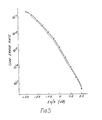
- code error rates were measured for a conventional Viterbi decoder and a Viterbi decoder of the type illustrated with reference to Fig. 4.
- the predetermined number B was 41 depending on the definition of the number B.
- the code error rates are plotted by dots for the conventional Viterbi decoder and by crosses for the Viterbi decoder according to this invention. It will be appreciated that the Viterbi decoder according to this invention has as excellent a code error rate as the conventional Viterbi decoder.
- the survivor path is selected at each state node from more than two transition paths when the convolutional code sequence has a constraint length of more than three.
Landscapes
- Physics & Mathematics (AREA)
- Probability & Statistics with Applications (AREA)
- Engineering & Computer Science (AREA)
- Theoretical Computer Science (AREA)
- Error Detection And Correction (AREA)
Applications Claiming Priority (2)
| Application Number | Priority Date | Filing Date | Title |
|---|---|---|---|
| JP36820/84 | 1984-02-27 | ||
| JP59036820A JPS60180222A (ja) | 1984-02-27 | 1984-02-27 | 符号誤り訂正装置 |
Publications (2)
| Publication Number | Publication Date |
|---|---|
| EP0155110A2 true EP0155110A2 (de) | 1985-09-18 |
| EP0155110A3 EP0155110A3 (de) | 1988-06-01 |
Family
ID=12480388
Family Applications (1)
| Application Number | Title | Priority Date | Filing Date |
|---|---|---|---|
| EP85301282A Withdrawn EP0155110A3 (de) | 1984-02-27 | 1985-02-26 | Viterbi-Dekoder mit einem Mehrheitsgatter zur Wiedergabe eines dekodierten Signals |
Country Status (4)
| Country | Link |
|---|---|
| US (1) | US4715037A (de) |
| EP (1) | EP0155110A3 (de) |
| JP (1) | JPS60180222A (de) |
| CA (1) | CA1240060A (de) |
Cited By (5)
| Publication number | Priority date | Publication date | Assignee | Title |
|---|---|---|---|---|
| US4763328A (en) * | 1985-10-29 | 1988-08-09 | Fujitsu Limited | Viterbi decoder and method for testing the viterbi decoder |
| EP0234558A3 (en) * | 1986-02-24 | 1988-11-17 | Fujitsu Limited | Path trace viterbi decoder |
| DE3736125A1 (de) * | 1987-10-26 | 1989-05-03 | Licentia Gmbh | Entzerrer fuer zeitvariante oder langsam zeitvariante kanaele |
| EP0580199A1 (de) * | 1992-07-03 | 1994-01-26 | Koninklijke Philips Electronics N.V. | Adaptiver Viterbi-Detektor |
| GB2344264A (en) * | 1998-10-20 | 2000-05-31 | Hewlett Packard Co | Data decoder and method of recovering data |
Families Citing this family (11)
| Publication number | Priority date | Publication date | Assignee | Title |
|---|---|---|---|---|
| US4884272A (en) * | 1988-02-10 | 1989-11-28 | Mcconnell Peter R H | Maximum likelihood diversity receiver |
| JPH02196524A (ja) * | 1989-01-26 | 1990-08-03 | Japan Radio Co Ltd | ビタビ復号方式 |
| US5068859A (en) * | 1989-06-19 | 1991-11-26 | California Institute Of Technology | Large constraint length high speed viterbi decoder based on a modular hierarchial decomposition of the deBruijn graph |
| FR2669445B1 (fr) * | 1990-11-15 | 1993-01-08 | Alcatel Radiotelephone | Dispositif prevu pour le traitement de l'algorithme de viterbi comprenant un processeur et un operateur specialise. |
| US5491705A (en) * | 1992-06-18 | 1996-02-13 | The United States Of America As Represented By The Secretary Of The Air Force | De bruijn graph based VLSI viterbi decoder |
| US5729559A (en) * | 1995-03-27 | 1998-03-17 | Motorola, Inc. | Method and apparatus for correcting errors using multiple estimates |
| US5920597A (en) * | 1996-09-16 | 1999-07-06 | Ericsson Inc. | Decoding technique for tail biting codes |
| GB2341764B (en) * | 1998-09-19 | 2003-09-10 | Mitel Semiconductor Ltd | Read arrangements |
| JP2003264467A (ja) * | 2002-03-08 | 2003-09-19 | Matsushita Electric Ind Co Ltd | ビタビ復号回路 |
| KR101212856B1 (ko) * | 2006-01-07 | 2012-12-14 | 삼성전자주식회사 | 통신 시스템에서 데이터를 복호하는 방법 및 장치 |
| US7673224B2 (en) * | 2006-09-12 | 2010-03-02 | Agere Systems Inc. | Low power viterbi decoder using a novel register-exchange architecture |
Family Cites Families (10)
| Publication number | Priority date | Publication date | Assignee | Title |
|---|---|---|---|---|
| US3662338A (en) * | 1970-02-01 | 1972-05-09 | Radiation Inc | Modified threshold decoder for convolutional codes |
| US3831142A (en) * | 1972-06-28 | 1974-08-20 | Nasa | Method and apparatus for decoding compatible convolutional codes |
| US3789360A (en) * | 1972-10-13 | 1974-01-29 | Harris Intertype Corp | Convolutional decoder |
| US3873971A (en) * | 1973-10-31 | 1975-03-25 | Motorola Inc | Random error correcting system |
| US3872432A (en) * | 1974-04-10 | 1975-03-18 | Itt | Synchronization circuit for a viterbi decoder |
| US4178550A (en) * | 1977-06-03 | 1979-12-11 | Bell Telephone Laboratories, Incorporated | Method and apparatus to permit substantial cancellation of interference between a received first and second signal |
| US4240156A (en) * | 1979-03-29 | 1980-12-16 | Doland George D | Concatenated error correcting system |
| US4536878A (en) * | 1982-09-20 | 1985-08-20 | Sperry Corporation | Bit serial convolutional decoder for VLSI implementation |
| US4500994A (en) * | 1982-10-04 | 1985-02-19 | Motorola, Inc. | Multi-rate branch metric processor for maximum-likelihood convolutional decoder |
| US4545054A (en) * | 1983-09-09 | 1985-10-01 | Harris Corporation | Diode-configured Viterbi algorithm error correcting decoder for convolutional codes |
-
1984
- 1984-02-27 JP JP59036820A patent/JPS60180222A/ja active Granted
-
1985
- 1985-02-25 US US06/705,073 patent/US4715037A/en not_active Expired - Lifetime
- 1985-02-26 CA CA000475105A patent/CA1240060A/en not_active Expired
- 1985-02-26 EP EP85301282A patent/EP0155110A3/de not_active Withdrawn
Cited By (6)
| Publication number | Priority date | Publication date | Assignee | Title |
|---|---|---|---|---|
| US4763328A (en) * | 1985-10-29 | 1988-08-09 | Fujitsu Limited | Viterbi decoder and method for testing the viterbi decoder |
| EP0234558A3 (en) * | 1986-02-24 | 1988-11-17 | Fujitsu Limited | Path trace viterbi decoder |
| DE3736125A1 (de) * | 1987-10-26 | 1989-05-03 | Licentia Gmbh | Entzerrer fuer zeitvariante oder langsam zeitvariante kanaele |
| EP0580199A1 (de) * | 1992-07-03 | 1994-01-26 | Koninklijke Philips Electronics N.V. | Adaptiver Viterbi-Detektor |
| GB2344264A (en) * | 1998-10-20 | 2000-05-31 | Hewlett Packard Co | Data decoder and method of recovering data |
| GB2344264B (en) * | 1998-10-20 | 2003-08-06 | Hewlett Packard Co | Data decoder and method of recovering data |
Also Published As
| Publication number | Publication date |
|---|---|
| JPS60180222A (ja) | 1985-09-14 |
| EP0155110A3 (de) | 1988-06-01 |
| US4715037A (en) | 1987-12-22 |
| JPH0316046B2 (de) | 1991-03-04 |
| CA1240060A (en) | 1988-08-02 |
Similar Documents
| Publication | Publication Date | Title |
|---|---|---|
| US4614933A (en) | Viterbi decoder with the pipeline processing function | |
| US4715037A (en) | Viterbi decoder comprising a majority circuit in producing a decoded signal | |
| US4583078A (en) | Serial Viterbi decoder | |
| US4805174A (en) | Error correcting coder/decoder | |
| US5406570A (en) | Method for a maximum likelihood decoding of a convolutional code with decision weighting, and corresponding decoder | |
| US4606027A (en) | Error correction apparatus using a Viterbi decoder | |
| JP2527163B2 (ja) | デ−タワ−ド伝送システム | |
| US5436918A (en) | Convolutional encoding/decoding apparatus with fixed bit insertion | |
| US4500994A (en) | Multi-rate branch metric processor for maximum-likelihood convolutional decoder | |
| CA2293079C (en) | A repeatable data error correction system | |
| US5446746A (en) | Path memory apparatus of a viterbi decoder | |
| EP0529909B1 (de) | Fehlerkorrektur-Kodierung/Dekodierungsverfahren und -gerät | |
| US6408420B1 (en) | Viterbi decoding method and apparatus thereof | |
| US5930298A (en) | Viterbi decoder for decoding depunctured code | |
| US5822340A (en) | Method for decoding data signals using fixed-length decision window | |
| US7035356B1 (en) | Efficient method for traceback decoding of trellis (Viterbi) codes | |
| US5944849A (en) | Method and system capable of correcting an error without an increase of hardware | |
| JP3259725B2 (ja) | ビタビ復号装置 | |
| EP0748057B1 (de) | Bitfehler zählverfahren und zähler | |
| FI100564B (fi) | Menetelmä transitiometriikan muodostamiseksi ja solukkoradiojärjestelm än vastaanotin | |
| US6510538B1 (en) | Method and apparatus for Viterbi decoding of punctured codes | |
| US6411663B1 (en) | Convolutional coder and viterbi decoder | |
| Clark et al. | Two recent applications of error-correction coding to communications systems design | |
| KR0170199B1 (ko) | 순환길쌈부호의 복호방법 | |
| KR100333336B1 (ko) | 비터비 복호기의 역추적 방법 |
Legal Events
| Date | Code | Title | Description |
|---|---|---|---|
| PUAI | Public reference made under article 153(3) epc to a published international application that has entered the european phase |
Free format text: ORIGINAL CODE: 0009012 |
|
| 17P | Request for examination filed |
Effective date: 19850301 |
|
| AK | Designated contracting states |
Designated state(s): DE FR GB IT NL |
|
| PUAL | Search report despatched |
Free format text: ORIGINAL CODE: 0009013 |
|
| AK | Designated contracting states |
Kind code of ref document: A3 Designated state(s): DE FR GB IT NL |
|
| 17Q | First examination report despatched |
Effective date: 19891017 |
|
| STAA | Information on the status of an ep patent application or granted ep patent |
Free format text: STATUS: THE APPLICATION IS DEEMED TO BE WITHDRAWN |
|
| 18D | Application deemed to be withdrawn |
Effective date: 19900807 |
|
| RIN1 | Information on inventor provided before grant (corrected) |
Inventor name: YAGI, TOSHIHARAC/O NEC CORPORATION |