EP0155163A2 - Procédé de conditionnement allongé de coke retardé - Google Patents
Procédé de conditionnement allongé de coke retardé Download PDFInfo
- Publication number
- EP0155163A2 EP0155163A2 EP85301652A EP85301652A EP0155163A2 EP 0155163 A2 EP0155163 A2 EP 0155163A2 EP 85301652 A EP85301652 A EP 85301652A EP 85301652 A EP85301652 A EP 85301652A EP 0155163 A2 EP0155163 A2 EP 0155163A2
- Authority
- EP
- European Patent Office
- Prior art keywords
- coke
- drum
- conditioning
- decoking
- drums
- Prior art date
- Legal status (The legal status is an assumption and is not a legal conclusion. Google has not performed a legal analysis and makes no representation as to the accuracy of the status listed.)
- Granted
Links
Images
Classifications
-
- C—CHEMISTRY; METALLURGY
- C10—PETROLEUM, GAS OR COKE INDUSTRIES; TECHNICAL GASES CONTAINING CARBON MONOXIDE; FUELS; LUBRICANTS; PEAT
- C10B—DESTRUCTIVE DISTILLATION OF CARBONACEOUS MATERIALS FOR PRODUCTION OF GAS, COKE, TAR, OR SIMILAR MATERIALS
- C10B47/00—Destructive distillation of solid carbonaceous materials with indirect heating, e.g. by external combustion
-
- C—CHEMISTRY; METALLURGY
- C10—PETROLEUM, GAS OR COKE INDUSTRIES; TECHNICAL GASES CONTAINING CARBON MONOXIDE; FUELS; LUBRICANTS; PEAT
- C10B—DESTRUCTIVE DISTILLATION OF CARBONACEOUS MATERIALS FOR PRODUCTION OF GAS, COKE, TAR, OR SIMILAR MATERIALS
- C10B57/00—Other carbonising or coking processes; Features of destructive distillation processes in general
- C10B57/005—After-treatment of coke, e.g. calcination desulfurization
-
- C—CHEMISTRY; METALLURGY
- C10—PETROLEUM, GAS OR COKE INDUSTRIES; TECHNICAL GASES CONTAINING CARBON MONOXIDE; FUELS; LUBRICANTS; PEAT
- C10B—DESTRUCTIVE DISTILLATION OF CARBONACEOUS MATERIALS FOR PRODUCTION OF GAS, COKE, TAR, OR SIMILAR MATERIALS
- C10B55/00—Coking mineral oils, bitumen, tar, and the like or mixtures thereof with solid carbonaceous material
Definitions
- anisotropic coke commonly known as needle coke
- the above procedures known as “temperature soaking” or “drying out” of the coke, are employed to condition or improve specific properties of the anisotropic coke.
- the improved properties include 1) lower volatile matter content, 2) increased hardness, and 3) increased crystallinity, resulting in a lower coefficient of thermal expansion.
- the amount of in situ coke conditioning is limited by the sizing of the drum to meet process unit capacity requirements. Since the drum must be fully decoked and prepared to receive feedstock within a fixed operating cycle, the time usually allowed for coke conditioning is typically less than 8 hours. Thus, the amount by which specific properties of the coke can be improved is limited.
- the method according to the present invention utilizes additional reaction chambers or coke drums to permit extending the allotted time for conditioning of the coke and, thus, permit greater improvement in the properties of the coke.
- additional reaction chambers or coke drums to permit extending the allotted time for conditioning of the coke and, thus, permit greater improvement in the properties of the coke.
- the desired quantity of coke conventionally requires a two coke drum process unit employing an overall cycle of 48 hours for each drum
- the use of a third drum permits extended conditioning of the coke.
- each drum is employed sequentially and alternately for 24 hours of coke formation and 24 hours conditioning and decoking.
- the third drum sized identically to the other two permits each drum to operate sequentially and alternately in the following mode: 1) 24 hours coke formation, 2) 24 hours conditioning and 3) 24 hours decoking.
- each of these time allotments can be varied to achieve desired requirements of process capacity, cycle time and product improvement.
- the required size of the coke drum can also be decreased by an appropriate amount resulting from the number or fractional number of coking formation segments permitted by the overall cycle.
- the coke drums could be sized at 75 percent of the capacity required for the 24 hour cycles.
- the overall unit production of coke could be increased by one-third if each of the 3 operations were reduced to 18 hours from 24 hours.
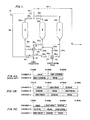
- the reference numeral 10 generally indicates apparatus for use in connection with the coking process according to the present invention.
- An inlet line 12 provides coke feedstock from a source, such as the residual bottoms of crude oil from a refining process. The residual bottoms are typically heated to a temperature of about 900°F - 1000OF in a conventional furnace, from which the hot oil is discharged.
- the inlet line 12 receives such a discharge and directs it through a main inlet valve 14 to a multi-position switch valve 16 which directs the flow of the coke feedstock to one of a plurality of connecting lines 18a, 18b or 18c.
- the connecting lines connect the valve 16 to conditioning chambers or coke drums A, B and C, respectively.
- Valves 20a, 20b and 20c are positioned in the connecting lines to isolate the flow therethrough.
- a conditioning feed inlet line 22 is provided to direct hot conditioning fluid, such as coker products or a portion thereof as hot vapor to the coke drums A, B and C through a switch valve 23 and connecting lines 24a, 24b and 24c respectively.
- the conditioning fluid improves the coke by lowering its volatile matter content, increasing its hardness, and increasing its crystallinity, which lowers its coefficient of thermal expansion.
- Isolation valves 26a, 26b and 26c are provided in the connecting lines 24a-c, respectively. It should be noted that the conditioning feed lines 24a-c are not required for all types of conditioning processes. For example, the coke can be conditioned merely by maintaining it at a high temperature, such as above 750°F. Outlet lines 28a, 28b and 28c extend from the coke drums A, B and C to permit the removal of light products from the coking process, thereby leaving only coke in the coke drums. The outlets 28a, 28b and 28c are connected to a common delivery line 30 through pairs of isolation valves 29a, 29b and 29c, the isolation valves being employed in pairs to account for valve leakage.
- a warm-up line 32 is connected directly from the coke feedstock inlet 12 to the delivery line 30, and flow therethrough is controlled by valves 34 and 36.
- the hot vapors of the feedstock are allowed to flow into one of the coke drums A, B or C through its respective outlet line 28a, b or c to preheat the coke drum and, thereby, to avoid the thermal shock that can result if the hot feedstock is fed to a drum which is at ambient temperatures.
- the main inlet valve 14 is opened to allow the flow of coke feedstock through the inlet line 12 to the switch valve 16.
- the switch valve 16 directs the flow to one of the three coke drums, for example, coke drum A, through the associated valve, in this case valve 20a. At this time, the switch valve 16 prevents the flow of feedstock to any other drum.
- the valve 20b controlling the flow of feedstock to coke drum B is opened, the switch valve 16 is operated to direct the incoming feedstock through the line 18b and the valve 20b, and the valve 20a controlling the flow to the coke drum A is closed.
- the valve 20c When coke drum B is full of coke, the valve 20c is opened, the switch valve 16 is operated to direct the flow of feedstock through the line 18c, and the valve 20b is closed. When the coking operation in coke drum B is completed, the same operation takes place with respect to coke drum C.
- the switch valve 16 may be operated manually, or automatically.
- the conditioning may include the flow of coker products comprising hot vapor derived from a coker fractionator through the coke drum containing the formed coke.
- steam can be used as a conditioning fluid.
- the conditioning fluid strips the highly volatile matter from the coke and maintains the coke at a high temperature. Without the flow of the conditioning material or the application of heat from some other source, the temperature of the coke would fall rapidly.
- the feed of conditioning fluid through the inlet line 22 to the switch valve 23 is directed by the switch valve through the isolation valve 26c and the connecting line 24c to the coke drum.
- the switch valve 23 When the conditioning of the coke in coke drum C is complete, the switch valve 23 is moved to a position in which the flow of conditioning fluid is directed to coke drum A. Similarly, when the conditioning of the coke in coke drum A is completed, the switch valve 23 can be operated to direct the flow of conditioning fluid to coke drum B. The switch valve 23 may be operated manually or automatically.
- coke drum B While coke is being allowed to form in coke drum A and conditioned in coke drum C, coke drum B can be decoked. Decoking involves the removal of the coke from the drum, such as by the use of high impact water jets to hydraulically bore and cut the coke.
- a conventional coking process as can be seen from Fig. 2A, only two conditioning chambers or coke drums A and B are employed, and the coke forming process, including the feeding of the coke feedstock to the coke drum, occurs in one coke drum, while conditioning and decoking take place in the other drum.
- coking takes place for approximately 24 hours and conditioning and decoking combined take place for 24 hours.
- the time available for conditioning is typically less than 8 hours.
- Figs. 2B and 2C the use of an additional coke drum, drum C, in connection with the process according to the present invention, permits a much greater conditioning time.
- coking or coke formation is allowed to occur for 24 hours, as it was in the prior art process.
- conditioning and decoking are each able to last for a 24 hour period.
- the same amount of conditioned coke is delivered from the process of Fig. 2B as was delivered from the process of Fig. 2A, but a much greater conditioning time is available.
- the allowing of the coke to form in coke drum A is simultaneous, for the same 24 hour period, with the decoking of coke drum B and the conditioning of the coke in coke drum C to improve one or more of its properties.
- the conditioning of the coke in coke drum A is simultaneous for a 24 hour period with the coking in coke drum B and the decoking of coke drum C; and the decoking of coke drum A is simultaneous with the conditioning of coke drum B and the coking in coke drum C.
- the overall operating cycle of the process according to the present invention can be reduced, for example, to 54 hours and, thus, provide a greater output of conditioned coke than was possible with the prior art system.
- the coking period is reduced from 24 hours to approximately 18 hours, as are the conditioning and decoking periods.
- the 36 hours provided for the conditioning and decoking periods together is still 50% greater than the 24 hour combined conditioning.
Landscapes
- Chemical & Material Sciences (AREA)
- Engineering & Computer Science (AREA)
- Oil, Petroleum & Natural Gas (AREA)
- Materials Engineering (AREA)
- Organic Chemistry (AREA)
- Chemical Kinetics & Catalysis (AREA)
- General Chemical & Material Sciences (AREA)
- Combustion & Propulsion (AREA)
- Coke Industry (AREA)
Applications Claiming Priority (2)
| Application Number | Priority Date | Filing Date | Title |
|---|---|---|---|
| US58863584A | 1984-03-12 | 1984-03-12 | |
| US588635 | 1984-03-12 |
Publications (3)
| Publication Number | Publication Date |
|---|---|
| EP0155163A2 true EP0155163A2 (fr) | 1985-09-18 |
| EP0155163A3 EP0155163A3 (en) | 1986-01-29 |
| EP0155163B1 EP0155163B1 (fr) | 1988-12-14 |
Family
ID=24354669
Family Applications (1)
| Application Number | Title | Priority Date | Filing Date |
|---|---|---|---|
| EP85301652A Expired EP0155163B1 (fr) | 1984-03-12 | 1985-03-11 | Procédé de conditionnement allongé de coke retardé |
Country Status (5)
| Country | Link |
|---|---|
| EP (1) | EP0155163B1 (fr) |
| JP (1) | JPS60195186A (fr) |
| KR (1) | KR900005089B1 (fr) |
| CA (1) | CA1239368A (fr) |
| DE (1) | DE3566811D1 (fr) |
Cited By (4)
| Publication number | Priority date | Publication date | Assignee | Title |
|---|---|---|---|---|
| EP0282261A1 (fr) * | 1987-03-09 | 1988-09-14 | Conoco Phillips Company | Procédé pour améliorer la densité et la résistance à la pression de coke |
| US4822479A (en) * | 1986-11-21 | 1989-04-18 | Conoco Inc. | Method for improving the properties of premium coke |
| WO2015016804A1 (fr) * | 2012-11-01 | 2015-02-05 | Fluor Technologies Corporation | Système de cokéfaction à tambours multiples |
| US9852389B2 (en) | 2012-11-01 | 2017-12-26 | Fluor Technologies Corporation | Systems for improving cost effectiveness of coking systems |
Families Citing this family (2)
| Publication number | Priority date | Publication date | Assignee | Title |
|---|---|---|---|---|
| CN1282728C (zh) | 2001-08-24 | 2006-11-01 | 康菲石油公司 | 用于生产更均匀和更高质量焦炭的方法 |
| KR102664755B1 (ko) * | 2017-11-14 | 2024-05-08 | 차이나 페트로리움 앤드 케미컬 코포레이션 | 코킹 시스템 및 코킹 공정 |
Family Cites Families (3)
| Publication number | Priority date | Publication date | Assignee | Title |
|---|---|---|---|---|
| US2199759A (en) * | 1937-06-16 | 1940-05-07 | Standard Oil Co | Manufacture of coke |
| US3391076A (en) * | 1966-04-21 | 1968-07-02 | Marathon Oil Co | Single unit delayed coking and calcining process |
| ZA818168B (en) * | 1980-12-05 | 1982-10-27 | Lummus Co | Coke production |
-
1985
- 1985-02-07 CA CA000473762A patent/CA1239368A/fr not_active Expired
- 1985-02-15 JP JP60026635A patent/JPS60195186A/ja active Pending
- 1985-02-19 KR KR1019850001091A patent/KR900005089B1/ko not_active Expired
- 1985-03-11 DE DE8585301652T patent/DE3566811D1/de not_active Expired
- 1985-03-11 EP EP85301652A patent/EP0155163B1/fr not_active Expired
Cited By (5)
| Publication number | Priority date | Publication date | Assignee | Title |
|---|---|---|---|---|
| US4822479A (en) * | 1986-11-21 | 1989-04-18 | Conoco Inc. | Method for improving the properties of premium coke |
| EP0282261A1 (fr) * | 1987-03-09 | 1988-09-14 | Conoco Phillips Company | Procédé pour améliorer la densité et la résistance à la pression de coke |
| EP0374318A1 (fr) * | 1987-11-27 | 1990-06-27 | Conoco Phillips Company | Procédé pour modifier les propriétés de coke de qualité supérieure |
| WO2015016804A1 (fr) * | 2012-11-01 | 2015-02-05 | Fluor Technologies Corporation | Système de cokéfaction à tambours multiples |
| US9852389B2 (en) | 2012-11-01 | 2017-12-26 | Fluor Technologies Corporation | Systems for improving cost effectiveness of coking systems |
Also Published As
| Publication number | Publication date |
|---|---|
| EP0155163B1 (fr) | 1988-12-14 |
| DE3566811D1 (en) | 1989-01-19 |
| KR900005089B1 (ko) | 1990-07-19 |
| CA1239368A (fr) | 1988-07-19 |
| EP0155163A3 (en) | 1986-01-29 |
| KR850007079A (ko) | 1985-10-30 |
| JPS60195186A (ja) | 1985-10-03 |
Similar Documents
| Publication | Publication Date | Title |
|---|---|---|
| US4929339A (en) | Method for extended conditioning of delayed coke | |
| US2289351A (en) | Method of cleaning heater tubes | |
| EP0155163A2 (fr) | Procédé de conditionnement allongé de coke retardé | |
| US4518486A (en) | Concurrent production of two grades of coke using a single fractionator | |
| US6241855B1 (en) | Upflow delayed coker charger heater and process | |
| EP0250136A2 (fr) | Procédé de cokéfaction retardée | |
| GB1592631A (en) | Coking drum and process for forming graphite coke | |
| CN101775300A (zh) | 一种延迟焦化过程的控制方法 | |
| US2554818A (en) | Simultaneously firing a coke-oven battery with rich and lean fuel gases | |
| US8349169B2 (en) | Method and apparatus for decoking tubes in an oil refinery furnace | |
| US1369673A (en) | Coking- retort-oven | |
| US2316931A (en) | Continuous process for cracking and polymerizing petroleum oils | |
| US2072524A (en) | Process for converting hydrocarbon oils | |
| US2216471A (en) | Process for converting mineral oils | |
| WO1998036036A1 (fr) | Cokefaction retardee avec recyclage externe | |
| US2378387A (en) | Coking retort oven | |
| US1670103A (en) | Process for cracking petroleum oil | |
| US4828682A (en) | Coking process | |
| US2099919A (en) | Process for the treatment of hydrocarbon oil | |
| US2228130A (en) | Horizontal chamber or retort oven | |
| US2071723A (en) | Art of cracking hydrocarbons | |
| US2978386A (en) | Method of preserving refractory materials | |
| US1419908A (en) | Coking coal | |
| US2055212A (en) | Expander for cracking hydrocarbon oils | |
| US2001301A (en) | Method for converting hydrocarbon oils |
Legal Events
| Date | Code | Title | Description |
|---|---|---|---|
| PUAI | Public reference made under article 153(3) epc to a published international application that has entered the european phase |
Free format text: ORIGINAL CODE: 0009012 |
|
| AK | Designated contracting states |
Designated state(s): DE FR GB IT NL |
|
| PUAL | Search report despatched |
Free format text: ORIGINAL CODE: 0009013 |
|
| AK | Designated contracting states |
Designated state(s): DE FR GB IT NL |
|
| 17P | Request for examination filed |
Effective date: 19860701 |
|
| 17Q | First examination report despatched |
Effective date: 19870722 |
|
| GRAA | (expected) grant |
Free format text: ORIGINAL CODE: 0009210 |
|
| AK | Designated contracting states |
Kind code of ref document: B1 Designated state(s): DE FR GB IT NL |
|
| REF | Corresponds to: |
Ref document number: 3566811 Country of ref document: DE Date of ref document: 19890119 |
|
| ITF | It: translation for a ep patent filed | ||
| ET | Fr: translation filed | ||
| PLBI | Opposition filed |
Free format text: ORIGINAL CODE: 0009260 |
|
| 26 | Opposition filed |
Opponent name: COMBUSTION ENGINEERING, INC. Effective date: 19890913 |
|
| NLR1 | Nl: opposition has been filed with the epo |
Opponent name: COMBUSTION ENGINEERING, INC. |
|
| PGFP | Annual fee paid to national office [announced via postgrant information from national office to epo] |
Ref country code: GB Payment date: 19910304 Year of fee payment: 7 |
|
| PGFP | Annual fee paid to national office [announced via postgrant information from national office to epo] |
Ref country code: FR Payment date: 19910320 Year of fee payment: 7 |
|
| ITTA | It: last paid annual fee | ||
| PGFP | Annual fee paid to national office [announced via postgrant information from national office to epo] |
Ref country code: NL Payment date: 19910331 Year of fee payment: 7 |
|
| PGFP | Annual fee paid to national office [announced via postgrant information from national office to epo] |
Ref country code: DE Payment date: 19910402 Year of fee payment: 7 |
|
| RDAG | Patent revoked |
Free format text: ORIGINAL CODE: 0009271 |
|
| STAA | Information on the status of an ep patent application or granted ep patent |
Free format text: STATUS: PATENT REVOKED |
|
| 27W | Patent revoked |
Effective date: 19910324 |
|
| GBPR | Gb: patent revoked under art. 102 of the ep convention designating the uk as contracting state | ||
| NLR2 | Nl: decision of opposition | ||
| APAH | Appeal reference modified |
Free format text: ORIGINAL CODE: EPIDOSCREFNO |