EP0155183A2 - Appareil de traitement géométrique - Google Patents
Appareil de traitement géométrique Download PDFInfo
- Publication number
- EP0155183A2 EP0155183A2 EP85301745A EP85301745A EP0155183A2 EP 0155183 A2 EP0155183 A2 EP 0155183A2 EP 85301745 A EP85301745 A EP 85301745A EP 85301745 A EP85301745 A EP 85301745A EP 0155183 A2 EP0155183 A2 EP 0155183A2
- Authority
- EP
- European Patent Office
- Prior art keywords
- triangle
- interference
- triangles
- determinant
- operation unit
- Prior art date
- Legal status (The legal status is an assumption and is not a legal conclusion. Google has not performed a legal analysis and makes no representation as to the accuracy of the status listed.)
- Withdrawn
Links
Images








Classifications
-
- G—PHYSICS
- G06—COMPUTING OR CALCULATING; COUNTING
- G06T—IMAGE DATA PROCESSING OR GENERATION, IN GENERAL
- G06T17/00—Three-dimensional [3D] modelling for computer graphics
- G06T17/20—Finite element generation, e.g. wire-frame surface description, tesselation
Definitions
- This invention relates to geometric processing apparatus that is, for example, adapted to.graphic output and modelling systems. More particularly, the present invention relates to a geometric processing apparatus for detecting interference condition among figures.
- the present invention seeks to provide a geometric processing apparatus which is capable of uniformly determining the interference of figures that are represented by sets of planes.
- a geometric processing apparatus characterised by comprising: a data converter means for dividing a plane forming a graphic model into a plurality of triangles (T O ,T A ) by diagonal lines drawn from a vertex thereof, and for producing vertex coordinates of the triangles; a normal vector operation means for receiving data from said data converter means and finding normal vectors pointing outwards of said triangles and infinity point coordinates thereof; an interference test operation means for calculating values of 4 x 4 determinants as well as logic values of the determinants; and interference point coordinate calculation means for operating on the result of said interference test operation means, the arrangement being such that, in operation, vertex coordinates of two triangles extracted from the graphic model for determining the interference condition and infinity point coordinates thereof, are selected to define a triangle, a 4 x 4 determinant is constituted by a vertex coordinate of said triangle and by a coordinate of another given point, said 4 x 4 determinant is operated by said interference test operation means and said interference point coordinate calculation
- the interference test operation means may comprise a first determinant operation unit for examining the relation between two planes that include the triangles.
- the interference test operation means may further comprise a second determinant operation unit for determining whether the two triangles which exist on the same plane interfere with each other.
- the interference test operation means preferably comprises a third determinant operation unit for determining, when a plane including a first triangle interferes with a plane including a second triangle in the three-dimensional manner, whether the first and second triangles interfere with each other.
- the interference test operation means comprises a fourth determinant operation unit for determining whether the first triangle interferes with a side of the second triangle.
- interference test operation means comprising a fifth determinant operation unit for determining whether the first triangle interferes with a line segment that does not exist on the plane which includes the first triangle.
- boundary planes L, M forming polygons that represnt figures are, respectively, divided into triangles T O , T1 , T21 ... and T A , TB , T , ... with their vertex as a starting point and other vertices as ending points. If the triangle TO representing one figure is regarded as a major triangle, the triangle T A representing another figure is regarded as a dependent triangle, and whether the two figures interfere with each other or not is determined by calculating 4 x 4 determinants. When they interfere, coordinates of the interference points are determined.
- FIG 1 is a block diagram of one embodiment of a geometric processing apparatus according to the present invention.
- An operating unit 2 for operating normal vector pointing outwards uses data of vertex coordinates from the data converter unit 1, finds the areas of the triangles, finds the vectors that represent the directions of triangles with the side toward the reader as the positive direction when the vertices are followed in the counterclockwise direction, i.e., finds normal vectors pointing outwards of the triangles where and finds homogeneous coordinates [n X , n Y , n Z , 0] of points at infinity in the direction of the normal vector pointing outwards.
- Reference numeral 3 denotes an interference test operation unit which, based upon the vertex data of triangles and normal vectors pointing outwards, determines the interference condition among the interior of triangles, sides and vertices relying upon the 4 x 4 determinant, which writes the interference condition onto an interference condition table (Table 2), and which, when they interfere simultaneously, requests an interference point coordinate calculation unit 4 to calculate interference point coordinates.
- Table 2 an interference condition table
- FIG. 2 is a block diagram of the interference test operation unit 3.
- a first determinant operation unit 31 examines the relation between two planes that include triangles.
- the first determinant operation unit 31 constitutes a determinant which is given by determinant (1) above in order to determine whether three vertices V A , V B and V C of the triangle T A exist on the plane which include the triangle T O , and whether vertices V 0 , V 1 and V 2 of the triangle T exist on the plane that includes the triangle T A , based upon three vertices V0 , V 1 , V2 and three vertices V A , V B , V C of the triangles T O and T A .
- the first determinant operation unit 31 examines whether the following condition: holds true relying upon the 4 x 4 determinants. When the above condition holds true, the first determinant operation unit 31 determines that the two triangles T O ,T A exist on the same plane, and direct data to a second determinant operation unit 32. When the above condition does not hold true, the first determinant operation unit 31 determines that the planes which include triangles interfere with each other in a three-dimensional manner, and sends data to a third determinant operation unit 33. The second determinant operation unit 32 determines whether the two triangles T0 and TA that exist on the same plane interfere with each other, i.e. whether they overlap at least partially or not.
- the second determinant operation unit 32 sends data relating to three sides E O , E 1 , E2 and vertices V O , V 1 , V 2 of the triangle T O , and the data related to three sides E , E B , E and vertices V , V , V of the triangle T A to a fifth determinant operation unit 35 which determines whether the two triangles T 0 , T A interfere with each other on a plane.
- the determined results are sent to the interference condition table (Table 2).
- the third determinant operation unit 33 when a plane including the triangle T O interferes with a plane that includes the triangle T A in a three-dimensional manner, determines whether the triangle T 0 and the triangle T A interfere with each other or not.
- the third determinant operation unit 33 sends data relating to the three sides E 0 , E 1 , E 2 and end points V 0 , V 1 , V 2 of the triangle T O , and the data relating to the three sides E A , E B , E C and end points V A , V B , V C of the triangle T A to a fourth determinant operation unit 34 which determines whether the two triangles T 0 and T A interfere with each other or not.
- the thus determined results are sent to the interference condition table (Table 2).
- the fourth determinant operation unit 34 determines whether the triangle T O interferes with a line segment that exists independently of the triangle, ie. whether the triangle T O interferes with the side E A of the triangle T A .
- the fourth determinant operation unit 34 determines whether a starting point coordinate V A and an ending point coordinate V B of the side E A establish the following condition for the triangle T O , relying upon the 4 x 4 determinants. When the above condition holds true, the fourth determinant operation unit 34 determines that they are on the same plane, and transfers the data to the fifth determinant operation unit 35.
- the fourth determinant operation unit 34 determines that they are not on the same plane, and transfers the data to a sixth determinant operation unit 36 and, at the same time, sends the determined results to the third determinant operation unit 33.
- the fifth determinant operation unit 35 examines the relation between the triangle T O and the side E A that exists on a plane that includes the triangle T O .
- the fifth determinant operation unit 35 expands the triangle T O into three sides E 0 , E 1 , E 2 , transfers the data to a seventh determinant operation unit 37 to have the latter determine whether the sides E 0 , E , E 2 interfere with the side EA of the triangle T A or not, and, at the same time, transfers the data to an eighth determinant operation unit 38 to have the latter determine whether the coordinates V A , V B of the side E A exist inside the triangle T O or not.
- the interference condition of the triangle T O and T A is determined, and the determined results are sent to the interference condition table (Table 2) and to the second and fourth determinant operation units 32,34.
- the sixth determinant operation unit determines whether the triangle T 0 interferes with the line segment E A that does not exist on the plane which includes the triangle T O .
- the sixth determinant operation unit 36 determines whether a starting point exists on one side of the plane which includes the triangle T O , an ending point exists on the other side, and whether either the ending point or the starting point exist inside the space defined by three planes formed by the starting point or the ending point of the segment and by two vertices of the triangle.
- the sixth determinant operation unit 36 determines whether the following condition holds true or not, relying upon the 4 x 4 determinants.
- the sixth determinant operation unit 36 determines that the triangle T O interferes with the line segment E A , and produces the determined results to the interference condition table and further requests, at the same time, the interference point calculation unit 4 to calculate the coordinates of interference points.
- the seventh determinant operation unit 37 determines whether two line segments that exist on the same plane interfere with each other or not.
- the seventh determinant operation unit 37 assumes two triangles under the conditions where the line segment E A is defined by two end points V A , V B , the line segment E O is defined by two end points V 0 , V 1 , one line segment serves as a side, and end points of the other line segment serve as vertices, and determines whether the following condition holds true, relying upon the 4 x 4 determinants.
- the seventh determinant operation unit 37 determines that the two line segment interfere with each other on a plane, and requests the interference point calculation unit 4 to calculate the coordinate of the interference point and, at the same time, sends the determined result to the interference condition table and to the fifth determinant operation unit 35.
- the eighth determinant operation unit 38 determines whether a point V A that exists on a plane which includes a triangle is located inside or outside the triangle TO.
- the eighth determinant operation unit 38 assumes a triangle formed by the point V A and the sides E 0 , E I , E 2 of the triangle T O , and determines whether the following condition holds true, relying upon the 4 x 4 determinants. When the above condition holds true, the eighth determinant operation unit 38 determines that the point exists inside the triangle. When the above condition does not hold true, the eighth determinant operation 38 determines that the point exists outside the triangle, and sends the determined results to the interference condition table and to the fifth determinant operation unit 35.
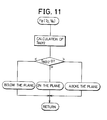
- a ninth determinant operation unit 39 determines in what relation a point exists with respect to a plane which includes a triangle. The ninth determinant operation unit 39 determines the following conditions with respect to the triangle and the point, relying upon the 4 x 4 determinants. If the condition (a) holds true, the ninth determinant operation unit 39 determines that the point exists above the plane, if the condition (b) holds true the ninth determinant operation unit 39 determines that the point exists on the plane, and if the condition (c) holds true the ninth determinant operation unit 39 determines that the point exists below the plane. The ninth determinant operation unit 39 then sends the determined results to'the interference condition table (Table 2) and to the sixth, seventh and eighth determinant operation units 36,37,38.
- Table 2 the interference condition table
- the ninth determinant operation unit 39 further determines whether the vertex of the original figure is convex or concave, i.e., calculates the conditions with regard to a vertex (e.g. V ) of a polygon and the neighbouring two vertices (e.g. V , V 2 ). If the condition (a') holds true, the ninth determinant operation unit 39 determines that the vertex is convex, if the condition (b') holds true, the ninth determinant operation unit 39 determines that the vertex is linear, and if the condition (c') holds true, the ninth determinant operation unit 39 determines that the vertex is concave.
- a vertex e.g. V
- V 2 the neighbouring two vertices
- the interference point coordinate calculation unit 4 performs the operation in accordance with an equation for the request of interference point calculation from the seventh determinant operation unit 37, and which performs the operation in accordance with the equation for the request from the sixth determinant operation unit 36, in order to find interference point coordinate P (x, y, z).
- the intereference point coordinate calculation unit 4 then sends outputs to an interference point coordinate table (Table 3).
- An output unit 5 produces data of the interference condition, and stores outputs from the interference test operation unit 3 and from the interference point coordinate calculation unit 4 in the interference condition table and in the interference point coordinate table.
- the output unit 5 further stores in an arranged manner the volume of a tetrahedron formed by a triangle incidentally calculated through the step of operation and by another point as well as unit normal vectors pointing outwards in a characteristics value table (Table 4).
- the data converter unit 1 Upon receipt of data representing two models having an interference condition which is to be examined, the data converter unit 1 divides the respective models into a plurality of triangles by diagonal lines, to produce coordinate data of vertices V 0 , V 1 , V2 and V A , V B , V C of the triangles T O , T A . Based upon the coordinate data, the operating unit 2, operates normal vectors N O , N A pointing outwards and, at the same time, normalises the vector values to store them in the characteristic value table (Table 4).
- the interference test operation unit 3 Upon receipt of data related to vertices V 0 , V 1 , V 2 and V A , V B , V of triangles T O , T A , and outwardly pointing normal vectors N O , N A , the interference test operation unit 3 executes an interference test. Based upon the data of vertices V 0 , V 1 , V 2 and V , V , V C , the first determinant operation unit 31 performs the operation in accordance with condition (2)
- the first determinant operation unit 31 determines that the triangles T 0 and T A exist on the same plane, and transfers the operation to the second determinant operation unit 32.
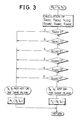
- the first determinant operation unit 31 determines that the triangles T O and T A do not exist on the same plane, and transfers the operation to the third determinant operation unit 33 ( Figure 3).
- the second determinant operation unit 32 expands the triangle T 0 into three sides E 0 , E 1 , E 2 and vertices V 0 , V 1 , V 2 , expands the triangle T A into three sides E A , E B , E C and vertices V A , V B , V , and once transfers the control to the fifth determinant operation unit 35.
- the fifth determinant operation unit 35 expands the triangle T O that is received from the second determinant operation unit 32 into three sides and transfers them to the seventh determinant operation unit 37.
- the fifth determinant operation unit 35 further expands the three sides E , E B , E C into end points V A , V , V , and transfers them to the eighth determinant operation unit 38.
- the seventh determinant operation unit 37 determines whether the sides forming the triangles are interfering with each other. When the sides interfere, the seventh determinant operation unit 37 requests the interference point coordinate calculation unit 4 to calculate the interference point coordinates. The eighth determinant operation unit 38 determines whether the end points V , V B , V C exist inside or outside the triangle T O . The determined results of the seventh determinant operation unit 37 and of the eighth determinant operation unit 38 are sent to the fifth determinant operation unit 35 which determines whether the triangle T O interferes with the side E A of the triangle T A .
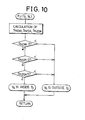
- the thus determined result is sent to the second determinant operation unit 32 with determines whether the triangle T O and the triangle T A interfere with each other on the same plane ( Figures 4, 7 and 9).
- the determined results are sent to the interference condition table (Table 2), and the interference point coordinates are sent to the interference point coordinate table (Table 3) and are stored therein respectively.
- the third determinant operation unit 33 expands the triangle T O into three sides E 0 , E 1 , E 2 and vertices V , V 1 , V 2 , and once transfers the control to the fourth determinant operation unit 34 which determines whether the triangle T O that is received and the side EA of the triangle T A exist on the same plane or not. When they exist on the same plane, the fourth determinant operatin unit 34 transfers the control to the fifth determinant operation unit 35 which executes the interference test on the plane through the same steps as mentioned in I above.
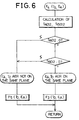
- the fourth determinant operation unit 34 transfers the control to the sixth determinant operation unit 36 which determines whether the triangle T O and the side E A interfere in a three-dimensional manner or not.
- the sixth determinant operation unit 36 requests the interference point calculation unit 4 to calculate the coordinates of interference points.
- the determined results of the fifth and sixth determinant operation units 35,36 are sent again to the fourth determinant operation unit 34 which determines whether the triangle TO and the side E A interfere with each other or not.
- the determined result of the fourth determinant operation unit 34 is further sent to the third determinant operation unit 33 which determines whether the triangles T O and T A interfere with each other in a three-dimensional manner or not ( Figures 5, 6 and 8).
- the determined results are sent to the interference condition table (Table 2), and coordinates of interference points are sent to the interference point coordinate table (Table 3), and are stored therein, respectively.
- the ninth determinant operation unit 39 Based upon the data from the sixth, seventh and eighth determinant operation units 36,37,38, the ninth determinant operation unit 39 performs side tests ( Figure 11) of points for a plane that includes triangles and performs concavity tests ( Figure 12).
- figures of which the interference condition is to be investigated are divided into triangles by diagonal lines drawn from vertices thereof to obtain data related to the vertex coordinates thereof, normal vectors pointing outwards, and points at infinity of the vectors. Therefore, interference condition among complex figures can be determined through the uniform process relying upon the 4 x 4 determinant operation. Accordingly, a graphic processing operation can be executed simply and at high speeds, making it possible to form, analyze and display polyhedral models at high speeds and easily.
Landscapes
- Physics & Mathematics (AREA)
- Engineering & Computer Science (AREA)
- Computer Graphics (AREA)
- Geometry (AREA)
- Software Systems (AREA)
- General Physics & Mathematics (AREA)
- Theoretical Computer Science (AREA)
- Image Generation (AREA)
Applications Claiming Priority (2)
| Application Number | Priority Date | Filing Date | Title |
|---|---|---|---|
| JP59048489A JPS60193080A (ja) | 1984-03-14 | 1984-03-14 | 図形演算処理方式 |
| JP48489/84 | 1984-03-14 |
Publications (2)
| Publication Number | Publication Date |
|---|---|
| EP0155183A2 true EP0155183A2 (fr) | 1985-09-18 |
| EP0155183A3 EP0155183A3 (fr) | 1989-09-20 |
Family
ID=12804799
Family Applications (1)
| Application Number | Title | Priority Date | Filing Date |
|---|---|---|---|
| EP85301745A Withdrawn EP0155183A3 (fr) | 1984-03-14 | 1985-03-13 | Appareil de traitement géométrique |
Country Status (3)
| Country | Link |
|---|---|
| EP (1) | EP0155183A3 (fr) |
| JP (1) | JPS60193080A (fr) |
| CA (1) | CA1237524A (fr) |
Families Citing this family (1)
| Publication number | Priority date | Publication date | Assignee | Title |
|---|---|---|---|---|
| JPS62264307A (ja) * | 1986-05-13 | 1987-11-17 | Fanuc Ltd | 法線ベクトル演算方法 |
-
1984
- 1984-03-14 JP JP59048489A patent/JPS60193080A/ja active Pending
-
1985
- 1985-03-08 CA CA000476109A patent/CA1237524A/fr not_active Expired
- 1985-03-13 EP EP85301745A patent/EP0155183A3/fr not_active Withdrawn
Non-Patent Citations (2)
| Title |
|---|
| COMPUTERS & GRAPHICS, vol. 7, no. 3/4, 1983, pages 225-232, Pergamon Press LTD, Exeter, GB; F. YAMAGUCHI et al.: "A solid modelling system: Freedom II" * |
| IBM TECHNICAL DISCLOSURE BULLETIN, vol. 14, no. 1, June 1971, pages 70-73, New York, US; A. APPEL et al.: "Determining intersection lines of intersecting polyhedra" * |
Also Published As
| Publication number | Publication date |
|---|---|
| EP0155183A3 (fr) | 1989-09-20 |
| CA1237524A (fr) | 1988-05-31 |
| JPS60193080A (ja) | 1985-10-01 |
Similar Documents
| Publication | Publication Date | Title |
|---|---|---|
| US5309521A (en) | Method and apparatus for generating a character curve by dividing and developing a bezier curve | |
| US6089742A (en) | Method and apparatus for controlling robots and the like using a bubble data hierarchy placed along a medial axis | |
| US5363479A (en) | System and method for rendering bezier splines | |
| US4631690A (en) | Multiprocessor computer system for forming a color picture from object elements defined in a hierarchic data structure | |
| US5739826A (en) | Polygon display based on x coordinates of edges on scan line | |
| EP0637001A2 (fr) | Procédé et appareil pour générer un modèle d'objets solides | |
| US5237649A (en) | Method and system for acquiring interpolation points from straight short vectors representing figure in curve fitting | |
| CA2032847C (fr) | Systeme d'affichage d'objets en trois dimensions et methode connexe | |
| US6043825A (en) | Method of displaying 3D networks in 2D with out false crossings | |
| US4860220A (en) | Apparatus for displaying three-dimensional objects | |
| EP1011075A2 (fr) | Procédé et dispositif de mise à jour de la position de noeud | |
| EP0155183A2 (fr) | Appareil de traitement géométrique | |
| US6078330A (en) | Solid model construction method and apparatus | |
| JP2736879B2 (ja) | 三次元図形データ削減方法 | |
| JPS63118982A (ja) | 多角形に対する点の内外判定演算処理方法 | |
| EP0212774A2 (fr) | Système d'affichage | |
| JPH07121579A (ja) | 有限要素メッシュ生成方法 | |
| JP2657301B2 (ja) | メッシング方法および装置 | |
| JP3039387B2 (ja) | 3次元cadにおけるb−スプライン曲線と直線との交点算出装置 | |
| JPH06231217A (ja) | 有限要素メッシュ生成方法 | |
| JPH05324921A (ja) | 曲線形成方法および装置 | |
| CN115359206B (zh) | 一种形变识别方法、装置及电子设备 | |
| JP3823596B2 (ja) | 動作シミュレーション用データの圧縮方法 | |
| JP2734644B2 (ja) | 自由曲面間の交線算出方式 | |
| JPH03144781A (ja) | コンピュータ・グラフィック装置 |
Legal Events
| Date | Code | Title | Description |
|---|---|---|---|
| PUAI | Public reference made under article 153(3) epc to a published international application that has entered the european phase |
Free format text: ORIGINAL CODE: 0009012 |
|
| AK | Designated contracting states |
Designated state(s): DE FR GB |
|
| RAP1 | Party data changed (applicant data changed or rights of an application transferred) |
Owner name: YAMAGUCHI, FUJIO Owner name: SEIKO INSTRUMENTS INC. |
|
| PUAL | Search report despatched |
Free format text: ORIGINAL CODE: 0009013 |
|
| AK | Designated contracting states |
Kind code of ref document: A3 Designated state(s): DE FR GB |
|
| 17P | Request for examination filed |
Effective date: 19900226 |
|
| 17Q | First examination report despatched |
Effective date: 19911112 |
|
| STAA | Information on the status of an ep patent application or granted ep patent |
Free format text: STATUS: THE APPLICATION IS DEEMED TO BE WITHDRAWN |
|
| 18D | Application deemed to be withdrawn |
Effective date: 19920324 |
|
| RIN1 | Information on inventor provided before grant (corrected) |
Inventor name: YAMAGUCHI, FUJIO |