EP0155335A1 - Verfahren zur Herstellung von 3,5-Dimethoxy-4-alkoxybenzaldehyden - Google Patents
Verfahren zur Herstellung von 3,5-Dimethoxy-4-alkoxybenzaldehyden Download PDFInfo
- Publication number
- EP0155335A1 EP0155335A1 EP84103119A EP84103119A EP0155335A1 EP 0155335 A1 EP0155335 A1 EP 0155335A1 EP 84103119 A EP84103119 A EP 84103119A EP 84103119 A EP84103119 A EP 84103119A EP 0155335 A1 EP0155335 A1 EP 0155335A1
- Authority
- EP
- European Patent Office
- Prior art keywords
- aldehyde
- formula
- dimethoxy
- copper
- formula iii
- Prior art date
- Legal status (The legal status is an assumption and is not a legal conclusion. Google has not performed a legal analysis and makes no representation as to the accuracy of the status listed.)
- Withdrawn
Links
- 238000000034 method Methods 0.000 title claims abstract description 23
- 238000002360 preparation method Methods 0.000 title claims description 5
- 150000001299 aldehydes Chemical class 0.000 claims abstract description 25
- RGHHSNMVTDWUBI-UHFFFAOYSA-N 4-hydroxybenzaldehyde Chemical compound OC1=CC=C(C=O)C=C1 RGHHSNMVTDWUBI-UHFFFAOYSA-N 0.000 claims abstract description 20
- 125000000956 methoxy group Chemical group [H]C([H])([H])O* 0.000 claims abstract description 10
- 125000004435 hydrogen atom Chemical group [H]* 0.000 claims abstract description 4
- WQDUMFSSJAZKTM-UHFFFAOYSA-N Sodium methoxide Chemical compound [Na+].[O-]C WQDUMFSSJAZKTM-UHFFFAOYSA-N 0.000 claims description 20
- 239000000203 mixture Substances 0.000 claims description 15
- WKBOTKDWSSQWDR-UHFFFAOYSA-N Bromine atom Chemical group [Br] WKBOTKDWSSQWDR-UHFFFAOYSA-N 0.000 claims description 12
- XLYOFNOQVPJJNP-UHFFFAOYSA-N water Substances O XLYOFNOQVPJJNP-UHFFFAOYSA-N 0.000 claims description 10
- 241001104043 Syringa Species 0.000 claims description 7
- KCXVZYZYPLLWCC-UHFFFAOYSA-N EDTA Chemical compound OC(=O)CN(CC(O)=O)CCN(CC(O)=O)CC(O)=O KCXVZYZYPLLWCC-UHFFFAOYSA-N 0.000 claims description 5
- 230000031709 bromination Effects 0.000 claims description 5
- 238000005893 bromination reaction Methods 0.000 claims description 5
- 238000012546 transfer Methods 0.000 claims description 5
- VAYGXNSJCAHWJZ-UHFFFAOYSA-N dimethyl sulfate Chemical compound COS(=O)(=O)OC VAYGXNSJCAHWJZ-UHFFFAOYSA-N 0.000 claims description 4
- VMQMZMRVKUZKQL-UHFFFAOYSA-N Cu+ Chemical compound [Cu+] VMQMZMRVKUZKQL-UHFFFAOYSA-N 0.000 claims description 3
- 125000000217 alkyl group Chemical group 0.000 claims description 3
- 239000002168 alkylating agent Substances 0.000 claims description 3
- 229940100198 alkylating agent Drugs 0.000 claims description 3
- 125000004432 carbon atom Chemical group C* 0.000 claims description 3
- 150000004696 coordination complex Chemical class 0.000 claims description 3
- 238000002955 isolation Methods 0.000 claims description 3
- 239000003446 ligand Substances 0.000 claims description 3
- 159000000000 sodium salts Chemical class 0.000 claims description 3
- XTIGGAHUZJWQMD-UHFFFAOYSA-N 1-chloro-2-methoxyethane Chemical compound COCCCl XTIGGAHUZJWQMD-UHFFFAOYSA-N 0.000 claims description 2
- JPVYNHNXODAKFH-UHFFFAOYSA-N Cu2+ Chemical class [Cu+2] JPVYNHNXODAKFH-UHFFFAOYSA-N 0.000 claims description 2
- 239000004472 Lysine Substances 0.000 claims description 2
- KDXKERNSBIXSRK-UHFFFAOYSA-N Lysine Natural products NCCCCC(N)C(O)=O KDXKERNSBIXSRK-UHFFFAOYSA-N 0.000 claims description 2
- 229910052783 alkali metal Inorganic materials 0.000 claims description 2
- 150000001340 alkali metals Chemical class 0.000 claims description 2
- 150000001408 amides Chemical class 0.000 claims description 2
- 150000001412 amines Chemical class 0.000 claims description 2
- 150000001413 amino acids Chemical class 0.000 claims description 2
- 125000001246 bromo group Chemical group Br* 0.000 claims description 2
- 239000003795 chemical substances by application Substances 0.000 claims description 2
- 150000008280 chlorinated hydrocarbons Chemical class 0.000 claims description 2
- 229910052736 halogen Inorganic materials 0.000 claims description 2
- 150000002367 halogens Chemical class 0.000 claims description 2
- 238000006386 neutralization reaction Methods 0.000 claims description 2
- 238000000746 purification Methods 0.000 claims description 2
- CYTQBVOFDCPGCX-UHFFFAOYSA-N trimethyl phosphite Chemical compound COP(OC)OC CYTQBVOFDCPGCX-UHFFFAOYSA-N 0.000 claims description 2
- -1 inorganic acid halide Chemical class 0.000 claims 2
- 229910001513 alkali metal bromide Inorganic materials 0.000 claims 1
- 230000003197 catalytic effect Effects 0.000 claims 1
- 150000004699 copper complex Chemical class 0.000 claims 1
- 150000003948 formamides Chemical class 0.000 claims 1
- 150000003949 imides Chemical class 0.000 claims 1
- OJMIONKXNSYLSR-UHFFFAOYSA-N phosphorous acid Chemical class OP(O)O OJMIONKXNSYLSR-UHFFFAOYSA-N 0.000 claims 1
- OPHQOIGEOHXOGX-UHFFFAOYSA-N 3,4,5-trimethoxybenzaldehyde Chemical compound COC1=CC(C=O)=CC(OC)=C1OC OPHQOIGEOHXOGX-UHFFFAOYSA-N 0.000 abstract description 7
- 238000007086 side reaction Methods 0.000 abstract description 2
- 230000002452 interceptive effect Effects 0.000 abstract 1
- ZMXDDKWLCZADIW-UHFFFAOYSA-N N,N-Dimethylformamide Chemical compound CN(C)C=O ZMXDDKWLCZADIW-UHFFFAOYSA-N 0.000 description 18
- OKKJLVBELUTLKV-UHFFFAOYSA-N Methanol Chemical compound OC OKKJLVBELUTLKV-UHFFFAOYSA-N 0.000 description 9
- KFZMGEQAYNKOFK-UHFFFAOYSA-N Isopropanol Chemical compound CC(C)O KFZMGEQAYNKOFK-UHFFFAOYSA-N 0.000 description 8
- GDTBXPJZTBHREO-UHFFFAOYSA-N bromine Substances BrBr GDTBXPJZTBHREO-UHFFFAOYSA-N 0.000 description 8
- 229910052794 bromium Inorganic materials 0.000 description 8
- 239000002904 solvent Substances 0.000 description 8
- YNAVUWVOSKDBBP-UHFFFAOYSA-N Morpholine Chemical compound C1COCCN1 YNAVUWVOSKDBBP-UHFFFAOYSA-N 0.000 description 6
- YXFVVABEGXRONW-UHFFFAOYSA-N Toluene Chemical compound CC1=CC=CC=C1 YXFVVABEGXRONW-UHFFFAOYSA-N 0.000 description 6
- IOLCXVTUBQKXJR-UHFFFAOYSA-M potassium bromide Chemical compound [K+].[Br-] IOLCXVTUBQKXJR-UHFFFAOYSA-M 0.000 description 6
- KZNICNPSHKQLFF-UHFFFAOYSA-N succinimide Chemical compound O=C1CCC(=O)N1 KZNICNPSHKQLFF-UHFFFAOYSA-N 0.000 description 6
- SXRHGLQCOLNZPT-UHFFFAOYSA-N 3,5-dibromo-4-hydroxybenzaldehyde Chemical compound OC1=C(Br)C=C(C=O)C=C1Br SXRHGLQCOLNZPT-UHFFFAOYSA-N 0.000 description 5
- SCYULBFZEHDVBN-UHFFFAOYSA-N 1,1-Dichloroethane Chemical compound CC(Cl)Cl SCYULBFZEHDVBN-UHFFFAOYSA-N 0.000 description 4
- ZAMOUSCENKQFHK-UHFFFAOYSA-N Chlorine atom Chemical compound [Cl] ZAMOUSCENKQFHK-UHFFFAOYSA-N 0.000 description 4
- FAPWRFPIFSIZLT-UHFFFAOYSA-M Sodium chloride Chemical compound [Na+].[Cl-] FAPWRFPIFSIZLT-UHFFFAOYSA-M 0.000 description 4
- 239000003513 alkali Substances 0.000 description 4
- 230000015572 biosynthetic process Effects 0.000 description 4
- 238000006243 chemical reaction Methods 0.000 description 4
- 239000000460 chlorine Substances 0.000 description 4
- 229910052801 chlorine Inorganic materials 0.000 description 4
- OPQARKPSCNTWTJ-UHFFFAOYSA-L copper(ii) acetate Chemical compound [Cu+2].CC([O-])=O.CC([O-])=O OPQARKPSCNTWTJ-UHFFFAOYSA-L 0.000 description 4
- 239000000047 product Substances 0.000 description 4
- YMWUJEATGCHHMB-UHFFFAOYSA-N Dichloromethane Chemical compound ClCCl YMWUJEATGCHHMB-UHFFFAOYSA-N 0.000 description 3
- 239000003054 catalyst Substances 0.000 description 3
- 239000007795 chemical reaction product Substances 0.000 description 3
- 238000004519 manufacturing process Methods 0.000 description 3
- 239000012452 mother liquor Substances 0.000 description 3
- 229960002317 succinimide Drugs 0.000 description 3
- MWOOGOJBHIARFG-UHFFFAOYSA-N vanillin Chemical compound COC1=CC(C=O)=CC=C1O MWOOGOJBHIARFG-UHFFFAOYSA-N 0.000 description 3
- FGQOOHJZONJGDT-UHFFFAOYSA-N vanillin Natural products COC1=CC(O)=CC(C=O)=C1 FGQOOHJZONJGDT-UHFFFAOYSA-N 0.000 description 3
- 235000012141 vanillin Nutrition 0.000 description 3
- QGZKDVFQNNGYKY-UHFFFAOYSA-N Ammonia Chemical compound N QGZKDVFQNNGYKY-UHFFFAOYSA-N 0.000 description 2
- HEDRZPFGACZZDS-UHFFFAOYSA-N Chloroform Chemical compound ClC(Cl)Cl HEDRZPFGACZZDS-UHFFFAOYSA-N 0.000 description 2
- WSFSSNUMVMOOMR-UHFFFAOYSA-N Formaldehyde Chemical compound O=C WSFSSNUMVMOOMR-UHFFFAOYSA-N 0.000 description 2
- CPELXLSAUQHCOX-UHFFFAOYSA-N Hydrogen bromide Chemical compound Br CPELXLSAUQHCOX-UHFFFAOYSA-N 0.000 description 2
- MHAJPDPJQMAIIY-UHFFFAOYSA-N Hydrogen peroxide Chemical compound OO MHAJPDPJQMAIIY-UHFFFAOYSA-N 0.000 description 2
- KWYUFKZDYYNOTN-UHFFFAOYSA-M Potassium hydroxide Chemical compound [OH-].[K+] KWYUFKZDYYNOTN-UHFFFAOYSA-M 0.000 description 2
- LSNNMFCWUKXFEE-UHFFFAOYSA-N Sulfurous acid Chemical compound OS(O)=O LSNNMFCWUKXFEE-UHFFFAOYSA-N 0.000 description 2
- 230000029936 alkylation Effects 0.000 description 2
- 238000005804 alkylation reaction Methods 0.000 description 2
- 239000000543 intermediate Substances 0.000 description 2
- 239000012071 phase Substances 0.000 description 2
- 229940072033 potash Drugs 0.000 description 2
- 235000015320 potassium carbonate Nutrition 0.000 description 2
- BWHMMNNQKKPAPP-UHFFFAOYSA-L potassium carbonate Substances [K+].[K+].[O-]C([O-])=O BWHMMNNQKKPAPP-UHFFFAOYSA-L 0.000 description 2
- 238000010992 reflux Methods 0.000 description 2
- 238000010405 reoxidation reaction Methods 0.000 description 2
- 239000011347 resin Substances 0.000 description 2
- 229920005989 resin Polymers 0.000 description 2
- 239000011780 sodium chloride Substances 0.000 description 2
- 239000000126 substance Substances 0.000 description 2
- 238000003786 synthesis reaction Methods 0.000 description 2
- IEDVJHCEMCRBQM-UHFFFAOYSA-N trimethoprim Chemical compound COC1=C(OC)C(OC)=CC(CC=2C(=NC(N)=NC=2)N)=C1 IEDVJHCEMCRBQM-UHFFFAOYSA-N 0.000 description 2
- 229960001082 trimethoprim Drugs 0.000 description 2
- YWWDBCBWQNCYNR-UHFFFAOYSA-N trimethylphosphine Chemical compound CP(C)C YWWDBCBWQNCYNR-UHFFFAOYSA-N 0.000 description 2
- 0 *c1cc(C=O)cc(*)c1O Chemical compound *c1cc(C=O)cc(*)c1O 0.000 description 1
- FEWLNYSYJNLUOO-UHFFFAOYSA-N 1-Piperidinecarboxaldehyde Chemical compound O=CN1CCCCC1 FEWLNYSYJNLUOO-UHFFFAOYSA-N 0.000 description 1
- VZSRBBMJRBPUNF-UHFFFAOYSA-N 2-(2,3-dihydro-1H-inden-2-ylamino)-N-[3-oxo-3-(2,4,6,7-tetrahydrotriazolo[4,5-c]pyridin-5-yl)propyl]pyrimidine-5-carboxamide Chemical compound C1C(CC2=CC=CC=C12)NC1=NC=C(C=N1)C(=O)NCCC(N1CC2=C(CC1)NN=N2)=O VZSRBBMJRBPUNF-UHFFFAOYSA-N 0.000 description 1
- PJUXPMVQAZLJEX-UHFFFAOYSA-N 2-(carboxymethylamino)benzoic acid Chemical compound OC(=O)CNC1=CC=CC=C1C(O)=O PJUXPMVQAZLJEX-UHFFFAOYSA-N 0.000 description 1
- CPELXLSAUQHCOX-UHFFFAOYSA-M Bromide Chemical compound [Br-] CPELXLSAUQHCOX-UHFFFAOYSA-M 0.000 description 1
- RYGMFSIKBFXOCR-UHFFFAOYSA-N Copper Chemical compound [Cu] RYGMFSIKBFXOCR-UHFFFAOYSA-N 0.000 description 1
- 101100520660 Drosophila melanogaster Poc1 gene Proteins 0.000 description 1
- DGAQECJNVWCQMB-PUAWFVPOSA-M Ilexoside XXIX Chemical compound C[C@@H]1CC[C@@]2(CC[C@@]3(C(=CC[C@H]4[C@]3(CC[C@@H]5[C@@]4(CC[C@@H](C5(C)C)OS(=O)(=O)[O-])C)C)[C@@H]2[C@]1(C)O)C)C(=O)O[C@H]6[C@@H]([C@H]([C@@H]([C@H](O6)CO)O)O)O.[Na+] DGAQECJNVWCQMB-PUAWFVPOSA-M 0.000 description 1
- CKLJMWTZIZZHCS-REOHCLBHSA-N L-aspartic acid Chemical compound OC(=O)[C@@H](N)CC(O)=O CKLJMWTZIZZHCS-REOHCLBHSA-N 0.000 description 1
- KDXKERNSBIXSRK-YFKPBYRVSA-N L-lysine Chemical compound NCCCC[C@H](N)C(O)=O KDXKERNSBIXSRK-YFKPBYRVSA-N 0.000 description 1
- BVHLGVCQOALMSV-JEDNCBNOSA-N L-lysine hydrochloride Chemical compound Cl.NCCCC[C@H](N)C(O)=O BVHLGVCQOALMSV-JEDNCBNOSA-N 0.000 description 1
- 101100520662 Saccharomyces cerevisiae (strain ATCC 204508 / S288c) PBA1 gene Proteins 0.000 description 1
- 125000003545 alkoxy group Chemical group 0.000 description 1
- 235000001014 amino acid Nutrition 0.000 description 1
- LHIJANUOQQMGNT-UHFFFAOYSA-N aminoethylethanolamine Chemical compound NCCNCCO LHIJANUOQQMGNT-UHFFFAOYSA-N 0.000 description 1
- 229910021529 ammonia Inorganic materials 0.000 description 1
- 235000003704 aspartic acid Nutrition 0.000 description 1
- OQFSQFPPLPISGP-UHFFFAOYSA-N beta-carboxyaspartic acid Natural products OC(=O)C(N)C(C(O)=O)C(O)=O OQFSQFPPLPISGP-UHFFFAOYSA-N 0.000 description 1
- 238000009835 boiling Methods 0.000 description 1
- WOWHHFRSBJGXCM-UHFFFAOYSA-M cetyltrimethylammonium chloride Chemical compound [Cl-].CCCCCCCCCCCCCCCC[N+](C)(C)C WOWHHFRSBJGXCM-UHFFFAOYSA-M 0.000 description 1
- 239000008139 complexing agent Substances 0.000 description 1
- 238000006482 condensation reaction Methods 0.000 description 1
- 229910052802 copper Inorganic materials 0.000 description 1
- 239000010949 copper Substances 0.000 description 1
- 238000004821 distillation Methods 0.000 description 1
- 238000007429 general method Methods 0.000 description 1
- 229910000042 hydrogen bromide Inorganic materials 0.000 description 1
- 229960003646 lysine Drugs 0.000 description 1
- 229960005337 lysine hydrochloride Drugs 0.000 description 1
- 229910052751 metal Inorganic materials 0.000 description 1
- 239000002184 metal Substances 0.000 description 1
- 125000002496 methyl group Chemical group [H]C([H])([H])* 0.000 description 1
- XJRBAMWJDBPFIM-UHFFFAOYSA-N methyl vinyl ether Chemical group COC=C XJRBAMWJDBPFIM-UHFFFAOYSA-N 0.000 description 1
- 150000007522 mineralic acids Chemical class 0.000 description 1
- LCEDQNDDFOCWGG-UHFFFAOYSA-N morpholine-4-carbaldehyde Chemical compound O=CN1CCOCC1 LCEDQNDDFOCWGG-UHFFFAOYSA-N 0.000 description 1
- 238000005580 one pot reaction Methods 0.000 description 1
- 150000002894 organic compounds Chemical class 0.000 description 1
- 239000012074 organic phase Substances 0.000 description 1
- 230000003647 oxidation Effects 0.000 description 1
- 238000007254 oxidation reaction Methods 0.000 description 1
- XHXFXVLFKHQFAL-UHFFFAOYSA-N phosphoryl trichloride Chemical compound ClP(Cl)(Cl)=O XHXFXVLFKHQFAL-UHFFFAOYSA-N 0.000 description 1
- BDAWXSQJJCIFIK-UHFFFAOYSA-N potassium methoxide Chemical compound [K+].[O-]C BDAWXSQJJCIFIK-UHFFFAOYSA-N 0.000 description 1
- 238000012545 processing Methods 0.000 description 1
- 239000012429 reaction media Substances 0.000 description 1
- 238000001953 recrystallisation Methods 0.000 description 1
- 238000005185 salting out Methods 0.000 description 1
- 238000000926 separation method Methods 0.000 description 1
- 239000011734 sodium Substances 0.000 description 1
- JHJLBTNAGRQEKS-UHFFFAOYSA-M sodium bromide Inorganic materials [Na+].[Br-] JHJLBTNAGRQEKS-UHFFFAOYSA-M 0.000 description 1
- 238000010561 standard procedure Methods 0.000 description 1
- 238000006467 substitution reaction Methods 0.000 description 1
- KCDXJAYRVLXPFO-UHFFFAOYSA-N syringaldehyde Chemical compound COC1=CC(C=O)=CC(OC)=C1O KCDXJAYRVLXPFO-UHFFFAOYSA-N 0.000 description 1
- COBXDAOIDYGHGK-UHFFFAOYSA-N syringaldehyde Natural products COC1=CC=C(C=O)C(OC)=C1O COBXDAOIDYGHGK-UHFFFAOYSA-N 0.000 description 1
- FAGUFWYHJQFNRV-UHFFFAOYSA-N tetraethylenepentamine Chemical compound NCCNCCNCCNCCN FAGUFWYHJQFNRV-UHFFFAOYSA-N 0.000 description 1
- RXJKFRMDXUJTEX-UHFFFAOYSA-N triethylphosphine Chemical group CCP(CC)CC RXJKFRMDXUJTEX-UHFFFAOYSA-N 0.000 description 1
- WVLBCYQITXONBZ-UHFFFAOYSA-N trimethyl phosphate Chemical compound COP(=O)(OC)OC WVLBCYQITXONBZ-UHFFFAOYSA-N 0.000 description 1
- 238000005406 washing Methods 0.000 description 1
Classifications
-
- C—CHEMISTRY; METALLURGY
- C07—ORGANIC CHEMISTRY
- C07C—ACYCLIC OR CARBOCYCLIC COMPOUNDS
- C07C47/00—Compounds having —CHO groups
- C07C47/52—Compounds having —CHO groups bound to carbon atoms of six—membered aromatic rings
- C07C47/575—Compounds having —CHO groups bound to carbon atoms of six—membered aromatic rings containing ether groups, groups, groups, or groups
-
- C—CHEMISTRY; METALLURGY
- C07—ORGANIC CHEMISTRY
- C07C—ACYCLIC OR CARBOCYCLIC COMPOUNDS
- C07C45/00—Preparation of compounds having >C = O groups bound only to carbon or hydrogen atoms; Preparation of chelates of such compounds
- C07C45/61—Preparation of compounds having >C = O groups bound only to carbon or hydrogen atoms; Preparation of chelates of such compounds by reactions not involving the formation of >C = O groups
- C07C45/63—Preparation of compounds having >C = O groups bound only to carbon or hydrogen atoms; Preparation of chelates of such compounds by reactions not involving the formation of >C = O groups by introduction of halogen; by substitution of halogen atoms by other halogen atoms
-
- C—CHEMISTRY; METALLURGY
- C07—ORGANIC CHEMISTRY
- C07C—ACYCLIC OR CARBOCYCLIC COMPOUNDS
- C07C45/00—Preparation of compounds having >C = O groups bound only to carbon or hydrogen atoms; Preparation of chelates of such compounds
- C07C45/61—Preparation of compounds having >C = O groups bound only to carbon or hydrogen atoms; Preparation of chelates of such compounds by reactions not involving the formation of >C = O groups
- C07C45/67—Preparation of compounds having >C = O groups bound only to carbon or hydrogen atoms; Preparation of chelates of such compounds by reactions not involving the formation of >C = O groups by isomerisation; by change of size of the carbon skeleton
- C07C45/68—Preparation of compounds having >C = O groups bound only to carbon or hydrogen atoms; Preparation of chelates of such compounds by reactions not involving the formation of >C = O groups by isomerisation; by change of size of the carbon skeleton by increase in the number of carbon atoms
- C07C45/70—Preparation of compounds having >C = O groups bound only to carbon or hydrogen atoms; Preparation of chelates of such compounds by reactions not involving the formation of >C = O groups by isomerisation; by change of size of the carbon skeleton by increase in the number of carbon atoms by reaction with functional groups containing oxygen only in singly bound form
-
- C—CHEMISTRY; METALLURGY
- C07—ORGANIC CHEMISTRY
- C07C—ACYCLIC OR CARBOCYCLIC COMPOUNDS
- C07C45/00—Preparation of compounds having >C = O groups bound only to carbon or hydrogen atoms; Preparation of chelates of such compounds
- C07C45/61—Preparation of compounds having >C = O groups bound only to carbon or hydrogen atoms; Preparation of chelates of such compounds by reactions not involving the formation of >C = O groups
- C07C45/67—Preparation of compounds having >C = O groups bound only to carbon or hydrogen atoms; Preparation of chelates of such compounds by reactions not involving the formation of >C = O groups by isomerisation; by change of size of the carbon skeleton
- C07C45/68—Preparation of compounds having >C = O groups bound only to carbon or hydrogen atoms; Preparation of chelates of such compounds by reactions not involving the formation of >C = O groups by isomerisation; by change of size of the carbon skeleton by increase in the number of carbon atoms
- C07C45/70—Preparation of compounds having >C = O groups bound only to carbon or hydrogen atoms; Preparation of chelates of such compounds by reactions not involving the formation of >C = O groups by isomerisation; by change of size of the carbon skeleton by increase in the number of carbon atoms by reaction with functional groups containing oxygen only in singly bound form
- C07C45/71—Preparation of compounds having >C = O groups bound only to carbon or hydrogen atoms; Preparation of chelates of such compounds by reactions not involving the formation of >C = O groups by isomerisation; by change of size of the carbon skeleton by increase in the number of carbon atoms by reaction with functional groups containing oxygen only in singly bound form being hydroxy groups
-
- C—CHEMISTRY; METALLURGY
- C07—ORGANIC CHEMISTRY
- C07C—ACYCLIC OR CARBOCYCLIC COMPOUNDS
- C07C47/00—Compounds having —CHO groups
- C07C47/52—Compounds having —CHO groups bound to carbon atoms of six—membered aromatic rings
- C07C47/56—Compounds having —CHO groups bound to carbon atoms of six—membered aromatic rings containing hydroxy groups
- C07C47/565—Compounds having —CHO groups bound to carbon atoms of six—membered aromatic rings containing hydroxy groups all hydroxy groups bound to the ring
Definitions
- the invention relates to a new simplified process for the preparation of 3,5-dimethoxy-4-alkoxybenzaldehydes of the general formula I. in which R represents a lower alkyl or lower alkoxyethylene group, in particular a methyl or methoxyethylene group, from the corresponding 4-hydroxybenzaldehyde.
- R represents a lower alkyl or lower alkoxyethylene group, in particular a methyl or methoxyethylene group, from the corresponding 4-hydroxybenzaldehyde.
- “Lower alkyl” or “lower alkoxy” is understood here to mean a group having 1 to 6 carbon atoms, preferably 1 to 3 carbon atoms.
- 3,5-Dimethoxy-4-alkoxybenzaldehydes in particular 3,4,5-trimethoxybenzaldehydes, are important intermediates for the production of pharmaceutical chemicals, such as trimethoprim.
- Processes are already known for the production of these aldehydes in which vanillin or 4-hydroxybenzaldehyde are known is brominated and the bromine atom is substituted with sodium methylate.
- Corresponding methods of this type are described, for example, in D.V. Rao, F.A. Stuber, Synthesis 1983, 308, US-A-4 218 567, DE-PS 723 412 and DE-OS 26 27 874.
- the object of the present invention is to overcome the disadvantages of the known processes described above and to obtain the desired 3,5-dimethoxy-4-alkoxybenzaldehyde with very good yield and suitable quality for the production of pharmaceutical chemicals, for example trimethoprim.
- the economy of bromination of the 4-hydroxybenzaldehyde is to be improved, and both bromine atoms of the bromine molecule are to be introduced into the organic compound, whereby savings in terms of the expensive bromine can be obtained.
- the replacement of the aromatically bound bromine in the aldehyde by the methoxy group without resin formation with a reduced amount of solvent should also take place, and the alkylation leading to the end product should also be able to be carried out as a one-pot reaction.
- This object is achieved in a process of the type mentioned at the outset by adding a 4-hydroxybenzaldehyde of the general formula II in which R 1 represents a hydrogen atom or a methoxy group, to an aldehyde of the general formula III in which R 2 represents a methoxy group or a bromine atom, brominated, the aldehyde of the formula II obtained with alkali metal alcoholate in the presence of a metal complex in syringa aldehyde of the formula IV transferred and that the syringaldehyde obtained vorzua mecanic without isolation of this intermediate to the desired 3,5-dimethoxy-4-y alkoxybenzaldeh d alkvliert.
- a 4-hydroxybenzaldehyde of the general formula II in which R 1 represents a hydrogen atom or a methoxy group to an aldehyde of the general formula III in which R 2 represents a methoxy group or a bromine atom, brominated.
- the bromination of the aldehyde of the formula II is preferably carried out in the presence of a halogen transfer agent,
- the reaction temperature is in the range from 10 to 80 ° C, preferably in the range from 30 to 70 ° C. According to a preferred embodiment of the process according to the invention, the reoxidation of the hydrogen bromide formed can be carried out with chlorine, surprisingly no product with aromatically bound chlorine being formed.
- the aldehyde III can be obtained with a yield of more than 90%, and it is characterized by high purity.
- the product obtained is white in this case. If the reoxidation is carried out according to a less preferred embodiment of the process according to the invention with hydrogen peroxide, the yield is lower and the aldehyde is colored violet by oxidation products.
- the bromine present in the aldehyde III is substituted by methoxy groups, which leads to the syringa aldehyde of the formula IV.
- This substitution is achieved by reacting the aldehyde III with alkali alcoholate in the presence of a metal complex.
- Sodium methylate and potassium methylate are suitable as alkali alcoholates.
- a methanolic sodium methylate solution which is as concentrated as possible is introduced with a complexing agent, and while the methanol is distilled off, a solution of the aldehyde of the formula III in a high-boiling solvent, such as in particular dimethylformamide (DMF), formylpiperidine or formylmorpholine, is added dropwise in the presence of a metal catalyst mixture.
- a high-boiling solvent such as in particular dimethylformamide (DMF), formylpiperidine or formylmorpholine
- Copper (I) and / or copper (II) salts with a mono- or multidentate ligand or mixtures are preferably used as the catalyst mixture of used.
- Suitable ligands are, for example, amines, such as in particular morpholine, aminoethylethanolamine, tetraethylene pentamine, trialkylphosphines such as triethyl- or trimethylphosphine, ethylenediaminetetraacetic acid (EDTA), and amino acids, such as lysine, aspartic acid or N (2-carboxyphenyl) glycine.
- the syringa aldehyde obtained in the second step is preferably alkylated without its isolation after neutralization of the excess alkali alcoholate with an inorganic acid chloride, such as phosphorus oxytrichloride, in the same reaction medium with a customary alkylating agent.
- an inorganic acid chloride such as phosphorus oxytrichloride
- dimethyl sulfate or 2-methoxyethyl chloride is preferably used.
- the alkylation is preferably carried out at temperatures from 0 to 60 ° C., in particular from 5 to 30 ° C.
- the syringa aldehyde III is isolated as the sodium salt and alkylated without purification under phase transfer conditions using one of the alkylating agents mentioned above.
- the implementation under phase transfer conditions takes place according to general methods, described in Synthesis 1973, pages 441 and 447.
- the 3,5-dimethoxy-4-alkoxybenzaldehyde obtained in the last stage of the process according to the invention is isolated from a suitable solvent, such as isopropanol, by standard methods, for example precipitation and recrystallization.
- a suitable solvent such as isopropanol
- a second fraction of 9.6 g can be obtained from the dichloroethane mother liquor, so that a yield of 90.7% is achieved.
- the solvent is removed as far as possible in vacuo and the residue is made up to 0.9 1 with water at 80.degree.
- the product is filtered off with suction at 20 ° C. and washed with 5% NaCl solution.
- the crude syringaaldehyde sodium salt is suspended in 100 ml of water, 200 ml of toluene and 3 ml of a 25% solution of cetyltrimethylammonium chloride solution and 1 mol of dimethyl sulfate is added at 50 ° C. After 30 minutes, half of a solution of 72 g of potash in 70 ml of water is added.
- the upper organic phase is separated off, washed with dil. HC1 and concentrated.
- the sump is crystallized from isopropanol and suction filtered at 5 ° C.
Landscapes
- Chemical & Material Sciences (AREA)
- Organic Chemistry (AREA)
- Chemical Kinetics & Catalysis (AREA)
- Organic Low-Molecular-Weight Compounds And Preparation Thereof (AREA)
- Low-Molecular Organic Synthesis Reactions Using Catalysts (AREA)
Abstract
Es wird ein Verfahren zur Herstellung von 3,5-Dimethoxy-4-alkoxybenzaldehyden und insbesondere von 3,4,5-Trimethoxybenzaldehyd, ausgehend von einem 4-Hydroxybenzaldehyd der Formel II <IMAGE> in der R¹ für ein Wasserstoffatom oder eine Methoxygruppe steht, beschrieben. Das erfindungsgemäße Verfahren liefert den angestrebten Aldehyd in sehr guter Ausbeute und ohne das Auftreten von störenden Nebenreaktionen.
Description
- Die Erfindung betrifft ein neues vereinfachtes Verfahren zur Herstellung von 3,5-Dimethoxy-4-alkoxybenzaldehyden der allgemeinen Formel I

- 3,5-Dimethoxy-4-alkoxybenzaldehyde, insbesondere 3,4,5-Trimethoxybenzaldehyde, stellen wichtige Zwischenprodukte zur Herstellung von Pharmachemikalien, wie zum Beispiel Trimethoprim, dar. Zur Herstellung dieser Aldehyde sind bereits Verfahren bekannt, bei denen Vanillin oder 4-Hydroxybenzaldehyd bromiert wird und das Bromatom mit Natriummethylat substituiert wird. Entsprechende Verfahren dieser Art werden zum Beispiel in D.V. Rao, F.A. Stuber, Synthesis 1983, 308, der US-A-4 218 567, der DE-PS 723 412 und der DE-OS 26 27 874 beschrieben.
- Diese bekannten Verfahren sind aber mit mehreren Nachteilen behaftet.
- So benötigen sie zum Beispiel relativ große Reaktionsvolumina wegen der geringen Löslichkeit des bromierten 4-Hydroxybenzaldehyds. Weiterhin läuft die Umsetzung nicht vollständig zu Ende ab, so daß das angestrebte Endprodukt nur mit niedrigen Ausbeuten erhalten werden kann. Ein weiterer Nachteil besteht darin, daß diese Verfahren mit Kupfer(I)-Salzen als Katalysator arbeiten, die bei der Umsetzung als metalli- sches Kupfer ausfallen. Auch treten Nebenreaktionen auf, bei denen eine Methoxygruppe oxidativ als Formalin abgespalten wird, die zu Kondensationsreaktionen unter Harzbildung Anlaß gibt. Schließlich ist die nachträgliche einwandfreie Trennung des bromierten 4-Hydroxybenzaldehyds und Syringaaldehyd äußerst schwierig, und man erhält kein für pharmazeutische Zwecke verwendbares Endprodukt.
- Demgegenüber liegt der vorliegenden Erfindung die Aufgabe zugrunde, die oben beschriebenen Nachteile der bekannten Verfahren zu überwinden und den angestrebten 3,5-Dimethoxy-4-alkoxybenzaldehyd mit sehr guter Ausbeute und geeigneter Qualität für die Herstellung der Pharmachemikalien, beispielsweise des Trimethoprims, zu erhalten. Insbesondere soll die Wirtschaftlichkeit bei der Bromierung des 4-Hydroxybenzaldehyds verbessert werden, und beide Bromatome des Brommoleküls sollen in die organische Verbindung eingeführt werden, wodurch Einsparungen hinsichtlich des teuren Broms erhalten werden können. Auch soll der Austausch des aromatisch gebundenen Broms in dem Aldehyd durch die Methoxygruppe ohne Harzbildung bei verringerter Lösungsmittelmenge geschehen, und die zum Endprodukt führende Alkylierung soll auch als Eintopfreaktion durchgeführt werden können.
- Diese Aufgabe wird bei einem Verfahren der eingangs erwähnten Art dadurch gelöst, daß man einen 4-Hydroxybenzaldehyd der allgemeinen Formel II


- In der ersten Stufe des erfindungsgemäßen Verfahrens wird ein 4-Hydroxybenzaldehyd der allgemeinen Formel II


- beispielsweise Succinimid oder fl-Bromsuccinimid, oder eines anderen Amids, und in einem Gemisch eines mit Wasser nicht mischbaren Lösungsmittels mit Wasser und einem Alkalibromid, wie Natrium- oder Kaliumbromid. Als mit Wasser nicht mischbares Lösungsmittel wird vorzugsweise ein chlorierter Kohlenwasserstoff, wie Chloroform, Methylenchlorid oder Dichlorethan, verwendet. Die Umsetzungstemperatur liegt im Bereich von 10 bis 80°C, vorzugsweise im Bereich von 30 bis 70°C. Gemäß einer bevorzugten Ausführungsform des erfindungsgemäßen Verfahrens kann die Rückoxidation des entstandenen Bromwasserstoffs mit Chlor durchgeführt werden, wobei überraschenderweise kein Produkt mit aromatisch gebundenem Chlor entsteht. In diesem Falle kann der Aldehyd III mit einer Ausbeute von mehr als 90% erhalten werden, und er zeichnet sich durch hohe Reinheit aus. Das erhaltene Produkt ist in diesem Falle weiß. Führt man die Rückoxidation gemäß einer weniger bevorzugten Ausführungsform des erfindungsgemäßen Verfahrens mit Wasserstoffperoxid durch, dann ist die Ausbeute geringer, und der Aldehyd ist durch Oxidationsprodukte violett gefärbt.
- In der zweiten Stufe des erfindungsgemäßen Verfahrens wird das im Aldehyd III vorhandene Brom durch Methoxygruppen substituiert, wodurch man zu dem Syringaaldehyd der Formel IV gelangt. Diese Substitution gelingt dadurch, daß man den Aldehyd III mit Alkalialkoholat in Gegenwart eines Metallkomplexes umsetzt. Als Alkalialkoholat kommen Natriummethylat und Kaliummethylat in Betracht.
- Die Verwendung von Natriummethylat in Lösung von Methanol wird bevorzugt. Gemäß einer bevorzugten
- Ausführungsform des erfindungsgemäßen Verfahrens wird eine möglichst konzentrierte methanolische Natriummethylatlösung mit einem Komplexbildner vorgelegt, und unter Abdestillieren des Methanols wird eine Lösung des Aldehyds der Formel III in einem hochsiedenden Lösungsmittel, wie insbesondere Dimethylformamid (DMF), Formylpiperidin oder Formylmorpholin, in Gegenwart eines Metallkatalysatorgemisches zugetropft.
- Als Katalysatorgemisch werden vorzugsweise Kupfer(I)- und/oder Kupfer-(II)-Salze mit einem ein- oder mehrzähnigen Liganden oder Gemische davon eingesetzt. Geeignete Liganden sind zum Beispiel Amine, wie insbesondere Morpholin, Aminoethylethanolamin, Tetraethylenpentamin, Trialkylphosphine, wie Triethyl- oder Trimethylphosphin, Ethylendiamintetraessigsäure (EDTA), und Aminosäuren, wie Lysin, Asparaginsäure oder N(2-Carboxyphenyl)glycin.
- In der letzten Stufe des erfindungsgemäßen Verfahrens wird der in der zweiten Stufe erhaltene Syringaaldehyd vorzugsweise ohne dessen Isolierung nach Neutralisation des überschüssigen Alkalialkoholats mit einem anorganischen Säurechlorid, wie zum Beispiel Phosphoroxytrichlorid, in dem gleichen Reaktionsmedium mit einem üblichen Alkylierungsmittel alkyliert. Als solches wird vorzugsweise Dimethylsulfat oder 2-Methoxyethylchlorid verwendet. Die Alkylierung erfolgt vorzugsweise bei Temperaturen von 0 bis 60°C, insbesondere von 5 bis 30°C.
- Nach einer weniger bevorzugten Ausführungsform des erfindungsgemäßen Verfahrens wird der Syringaaldehyd III als Natriumsalz isoliert und ohne Reinigung unter Phasentransferbedingungen mit einem der oben genannten Alkylierungsmittel alkyliert. Die Umsetzung bei Phasentransferbedingungen erfolgt nach allgemeinen Methoden, beschrieben in Synthesis 1973, Seiten 441 und 447.
- Der in der letzten Stufe des erfindungsgemäßen Verfahrens erhaltene 3,5-Dimethoxy-4-alkoxybenzaldehyd wird nach Standardmethoden, beispielsweise Ausfällung und Umkristallisation, aus einem geeigneten Lösungsmittel, wie Isopropanol, isoliert.
- Die Erfindung wird in den Beispielen erläutert.
- Zu einem Gemisch aus 0,4 1 Dichlorethan, 200 g Vanillin (1,31 mol), 2,6 g Succinimid, 0,2 1 Wasser und 50 g Kaliumbromid gibt man bei maximal 40°C 120 g Brom innerhalb 1 h. Dann leitet man in 1 bis 3 h 44 g Chlor ein, bis ein Bromüberschuß sichtbar wird, der mit Sulfit zerstört wird. Man saugt bei 20'C ab und wäscht mit Wasser und Isopropanol nach.
- Ausbeute: 266 g; Fp. 159,3 - 161,9°C
- Aus der Dichlorethanmutterlauge läßt sich eine zweite Fraktion von 9,6 g gewinnen, so daß eine Ausbeute von 90,7% erreicht wird.
- In einer Destillationsapparatur werden vorgelegt: 0,49 1 5,5 mol Natriummethylat, 10 ml DMF, 3 g Ethylendiamintetraessigsäure und 3 ml Trimethylphosphit. Bei 90 bis 95°C läßt man in 1 bis 2 h eine 60°C warme Lösung aus 250 ml Dimethylformamid, 231 g Bromvanillin, 8 g Kupfer(II)-acetat, 5,5 g Lysinhydrochlorid und 4 ml Morpholin zutropen, während Methanol abdestilliert. Dann kocht man noch 2 h unter Rückfluß. Das Lösungsmittel wird im Vakuum möglichst weit abgezogen, und der Rückstand wird mit Wasser bei 80°C auf 0,9 1 aufgefüllt. Nach Zusatz von 50 g Kochsalz saugt man bei 20°C ab und wäscht mit 5% NaCl-Lösung nach. Das rohe Syringaaldehyd-Natriumsalz wird in 100 ml Wasser, 200 ml Toluol und 3 ml einer 25%igen Lösung von Cetyltrimethylammoniumchloridlösung suspendiert und bei 50°C mit 1 mol Dimethylsulfat versetzt. Nach 30 min gibt man die Hälfte einer Lösung aus 72 g Pottasche in 70 ml Wasser zu.
- Nach 15 min werden 0,5 mol DMS, der Rest der Pottaschelösung und wieder 0,5 mol DMS zugegeben, wobei C02 entweicht. Man rührt 1 h bei 50°C, bis kein CO2 mehr entweicht, und zerstört überschüssiges Dimethylsulfat mit Ammoniak.
- Die obere organische Phase wird abgetrennt, mit verd. HC1 gewaschen und eingeengt. Den Sumpf kristallisiert man aus Isopropanol und saugt bei 5°C ab.
- Ausbeute: 122 g; Fp. 73,9 - 75,8°C
- Aus der Mutterlauge läßt sich eine zweite Fraktion von 28 g gewinnen. Gesamtausbeute: 150 g = 76,5% d.Th.
- Zu einem Gemisch aus 3 1 Dichlorethan, 1,2 1 Wasser, 240 g Kaliumbromid, 6 g Succinimid und 734 g p-Hydroxybenzaldehyd (6 mol) gibt man in 0,5 h 13,2 Val Brom (336 ml), wobei die Temperatur auf 60°C steigt. In 2 h leitet man 10,8 Val Chlor (383 g) bei 60 bis 80°C ein, kocht 1/2 h unter Rückfluß, zerstört den Bromüberschuß mit Sulfit und saugt bei 10°C ab. Nach Waschen mit Wasser und Isopropanol erhält man 1,47 kg 3,5-Dibrom-4-hydroxybenzaldehyd.
- Fp. 183 - 183,4°C
- Aus der Mutterlauge lassen sich noch 69 g gewinnen.
- Ausbeute: 1,52 kg = 91% d.Th.
- In 3,6 mol Natriummethylatlösung (656 ml), 20 ml DMF und 3 ml Phosphorigsäuretrimethylester werden 56 g 3,5-Dibrom-4-benzaldehyd bei 90°C vorgelegt. In 2 bis 3 h tropft man bei 90 - 95°C unter Destillatabnahme eine erwärmte Lösung aus 223 g 3,5-Dibrom-4-hydroxybenzaldehyd, 8 g Kupfer(II)acetat, 10 ml Morpholin und 14,8 g Ethylendiamintetraessigsäure in 0,4 1 DMF so zu, daß das Gemisch gut rührfähig bleibt. Man läßt noch 2 h nachreagieren, kühlt auf 40 bis 60°C und neutralisiert mit 30 ml POC13. Dann zieht man etwa 0,2 1 Lösungsmittel ab. Man kühlt auf 5°C, g-ibt 2 mol DMS hinzu. Bei 10 bis 20°C tropft man 0,6 mol Natriummethylatlösung in 1 h zu, wobei am Ende die Temperatur auf 20°C steigen soll. Dann gibt man bei 20 bis 30°C noch so viel Natriummethylatlösung zu, daß das Gemisch ständig alkalisch reagiert. Dann zieht man den Rest der Lösungsmittel möglichst weit ab, gibt 0,2 1 Toluol zu und füllt mit Wasser auf 1 1 auf. Die weitere Aufarbeitung erfolgt wie in Stufe b) von
- Gesamtausbeute: 141 g = 72% d.Th.
Claims (6)
1. Verfahren zur Herstellung von 3,5-Dimethoxy-4-alkoxybenzaldehyden der allgemeinen Formel I

in der R eine Niedrigalkyl- oder Niedrigalkoxyethylengruppe mit maximal 6 Kohlenstoffatomen bedeutet, dadurch gekennzeichnet , daß man einen 4-Hydroxybenzaldehyd der allgemeinen Formel II

in der R1 für ein Wasserstoffatom oder eine Methoxygruppe steht, zu einem Aldehyd der allgemeinen Formel III

in der R2 eine Methoxygruppe oder ein Bromatom bedeutet, bromiert, den erhaltenen Aldehyd der Formel II mit Alkalialkoholat in Gegenwart eines Metallkomplexes in -Syringaaldehyd der Formel IV
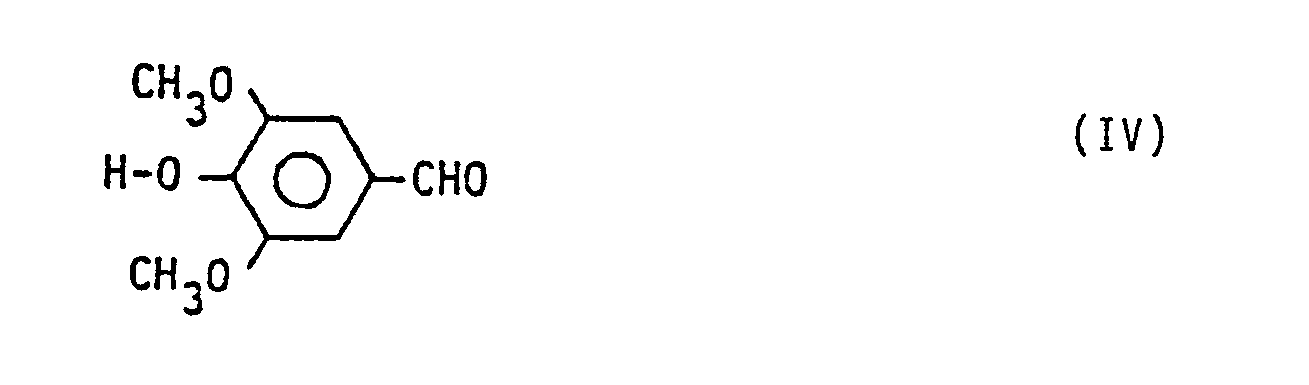
überführt und daß man den erhaltenen Syringaaldehyd zu dem gewünschten 3,5-Dimethoxy-4-alkoxybenzaldehyd alkyliert.
2. Verfahren nach Anspruch 1, dadurch gekennzeichnet, daß man in der ersten Stufe die Bromierung des Aldehyds der Formel II in einem Gemisch eines chlorierten Kohlenwasserstoffs und Wasser in Gegenwart eines Alkalibromids und eines Halogenüberträgers, wie zum Bei- - spiel eines Amids oder Imids, bei 10 bis 80"C durchführt.
3. Verfahren nach Anspruch 1 oder 2, dadurch gekennzeichnet , daß man in der zweiten Stufe beim Austausch der Bromatome im Aldehyd der Formel III Natriummethylat und eine katalytische Menge Trimethylphosphit vorlegt und bei 90 bis 95°C unter Destillatabnahme eine Lösung des Aldehyds der Formel III in einem dialkylierten Formamid in Gegenwart eines Kupferkomplexes eingibt.
4. Verfahren nach den Ansprüchen 1 bis 3, dadurch gekennzeichnet , daß man in der zweiten Stufe ein Kupfer(I)- oder Kupfer(II)salz mit Liganden, wie einem Amin, Phosphitderivaten, einer Aminosäure, bevorzugt Lysin oder EDTA oder Gemischen derselben, einsetzt.
5. Verfahren nach den Ansprüchen 1 bis 4, dadurch gekennzeichnet , daß man das Zwischenprodukt der Formel III ohne Isolierung nach Neutralisation des überschüssigen Natriummethylats mit einem anorganischen Säurehalogenid, wie zum Beispiel POC13, mit einem üblichen Alkylierungsmittel, wie zum Beispiel Dimethylsulfat oder 2-Methoxyethylchlorid, alkyliert.
6. Verfahren nach Anspruch 1, dadurch gekennzeichnet, daß man den Syringaaldehyd der Formel IV als Natriumsalz isoliert und ohne Reinigung unter Phasentransferbedingungen alkyliert.
Priority Applications (2)
| Application Number | Priority Date | Filing Date | Title |
|---|---|---|---|
| EP84103119A EP0155335A1 (de) | 1984-03-21 | 1984-03-21 | Verfahren zur Herstellung von 3,5-Dimethoxy-4-alkoxybenzaldehyden |
| JP12655584A JPS60199847A (ja) | 1984-03-21 | 1984-06-21 | 3,5−ジメトキシ−4−アルコキシベンツアルデヒドの製法 |
Applications Claiming Priority (1)
| Application Number | Priority Date | Filing Date | Title |
|---|---|---|---|
| EP84103119A EP0155335A1 (de) | 1984-03-21 | 1984-03-21 | Verfahren zur Herstellung von 3,5-Dimethoxy-4-alkoxybenzaldehyden |
Publications (1)
| Publication Number | Publication Date |
|---|---|
| EP0155335A1 true EP0155335A1 (de) | 1985-09-25 |
Family
ID=8191838
Family Applications (1)
| Application Number | Title | Priority Date | Filing Date |
|---|---|---|---|
| EP84103119A Withdrawn EP0155335A1 (de) | 1984-03-21 | 1984-03-21 | Verfahren zur Herstellung von 3,5-Dimethoxy-4-alkoxybenzaldehyden |
Country Status (2)
| Country | Link |
|---|---|
| EP (1) | EP0155335A1 (de) |
| JP (1) | JPS60199847A (de) |
Cited By (15)
| Publication number | Priority date | Publication date | Assignee | Title |
|---|---|---|---|---|
| FR2652808A1 (de) * | 1989-10-09 | 1991-04-12 | Rhone Poulenc Chimie | |
| EP0434516A3 (en) * | 1989-12-20 | 1991-10-09 | Rhone-Poulenc Chimie | Process for the preparation of mono- or poly-alkoxylated aromatic compounds |
| EP0434517A3 (en) * | 1989-12-20 | 1991-10-16 | Rhone-Poulenc Chimie | Process for the preparation of mono- or poly-alkoxylated aromatic compounds |
| EP0455545A1 (de) * | 1990-05-04 | 1991-11-06 | Rhone-Poulenc Chimie | Verfahren zur Herstellung von mono- oder polyalkoxylierten aromatischen Verbindungen |
| EP0463946A1 (de) * | 1990-06-27 | 1992-01-02 | Rhone-Poulenc Chimie | Verfahren zur Herstellung von polyalkoxylierten aromatischen Verbindungen |
| FR2663925A1 (fr) * | 1990-06-27 | 1992-01-03 | Rhone Poulenc Chimie | Procede de preparation d'alkoxybenzaldehydes. |
| AU621036B2 (en) * | 1986-11-28 | 1992-03-05 | Orion-Yhtyma Oy | Catechol derivatives |
| US5112861A (en) * | 1986-11-28 | 1992-05-12 | Orion-Yhtyma Oy | Method of treating parkinson's disease using pentanedione derivatives |
| FR2669026A1 (fr) * | 1990-11-09 | 1992-05-15 | Rhone Poulenc Chimie | Procede de preparation d'alkoxybenzaldehydes. |
| FR2669025A1 (fr) * | 1990-11-09 | 1992-05-15 | Rhone Poulenc Chimie | Procede de preparation d'alkoxybenzaldehydes. |
| FR2669024A1 (fr) * | 1990-11-09 | 1992-05-15 | Rhone Poulenc Chimie | Procede de preparation d'alkoxybenzaldehydes. |
| EP0488860A1 (de) * | 1990-11-30 | 1992-06-03 | Rhone-Poulenc Chimie | Verfahren zur Herstellung von polyalkoxylierten aromatischen Verbindungen |
| FR2669924A1 (fr) * | 1990-11-30 | 1992-06-05 | Rhone Poulenc Chimie | Procede de preparation de composes aromatiques polyalkoxyles. |
| US5283352A (en) * | 1986-11-28 | 1994-02-01 | Orion-Yhtyma Oy | Pharmacologically active compounds, methods for the preparation thereof and compositions containing the same |
| US5489614A (en) * | 1987-11-27 | 1996-02-06 | Orion-Yhtyma Oy | Catechol derivatives, their physiologically acceptable salts, esters and use |
Citations (4)
| Publication number | Priority date | Publication date | Assignee | Title |
|---|---|---|---|---|
| DE723412C (de) * | 1940-05-12 | 1942-09-02 | Fahlberg List Ag Chemische Fab | Verfahren zur Methoxylierung von p-Kresol und p-Oxybenzaldehyd |
| US2496803A (en) * | 1947-01-15 | 1950-02-07 | Du Pont | Production of veratraldehyde from vanillin |
| CH572879A5 (en) * | 1972-09-27 | 1976-02-27 | Hoffmann La Roche | 3,4,5-trimethoxybenzaldehyde prepn - from vanillin |
| US4218567A (en) * | 1978-05-30 | 1980-08-19 | Hoffmann-La Roche Inc. | Process for aromatic ethers |
-
1984
- 1984-03-21 EP EP84103119A patent/EP0155335A1/de not_active Withdrawn
- 1984-06-21 JP JP12655584A patent/JPS60199847A/ja active Pending
Patent Citations (4)
| Publication number | Priority date | Publication date | Assignee | Title |
|---|---|---|---|---|
| DE723412C (de) * | 1940-05-12 | 1942-09-02 | Fahlberg List Ag Chemische Fab | Verfahren zur Methoxylierung von p-Kresol und p-Oxybenzaldehyd |
| US2496803A (en) * | 1947-01-15 | 1950-02-07 | Du Pont | Production of veratraldehyde from vanillin |
| CH572879A5 (en) * | 1972-09-27 | 1976-02-27 | Hoffmann La Roche | 3,4,5-trimethoxybenzaldehyde prepn - from vanillin |
| US4218567A (en) * | 1978-05-30 | 1980-08-19 | Hoffmann-La Roche Inc. | Process for aromatic ethers |
Non-Patent Citations (1)
| Title |
|---|
| SYNTHESIS, 1983, Seite 308; D.V. RAO et al.: "An efficient synthesis of 3,4,5-trimethoxybenzaldehyde from Vanillin" * |
Cited By (18)
| Publication number | Priority date | Publication date | Assignee | Title |
|---|---|---|---|---|
| US5283352A (en) * | 1986-11-28 | 1994-02-01 | Orion-Yhtyma Oy | Pharmacologically active compounds, methods for the preparation thereof and compositions containing the same |
| US5446194A (en) * | 1986-11-28 | 1995-08-29 | Orion-Yhtyma Oy | Pharmacologically active catechol derivatives |
| AU621036B2 (en) * | 1986-11-28 | 1992-03-05 | Orion-Yhtyma Oy | Catechol derivatives |
| US5112861A (en) * | 1986-11-28 | 1992-05-12 | Orion-Yhtyma Oy | Method of treating parkinson's disease using pentanedione derivatives |
| US5489614A (en) * | 1987-11-27 | 1996-02-06 | Orion-Yhtyma Oy | Catechol derivatives, their physiologically acceptable salts, esters and use |
| EP0423010A1 (de) * | 1989-10-09 | 1991-04-17 | Rhone-Poulenc Chimie | Verfahren zur Herstellung von Alkoxybenzaldehyden |
| FR2652808A1 (de) * | 1989-10-09 | 1991-04-12 | Rhone Poulenc Chimie | |
| EP0434516A3 (en) * | 1989-12-20 | 1991-10-09 | Rhone-Poulenc Chimie | Process for the preparation of mono- or poly-alkoxylated aromatic compounds |
| EP0434517A3 (en) * | 1989-12-20 | 1991-10-16 | Rhone-Poulenc Chimie | Process for the preparation of mono- or poly-alkoxylated aromatic compounds |
| EP0455545A1 (de) * | 1990-05-04 | 1991-11-06 | Rhone-Poulenc Chimie | Verfahren zur Herstellung von mono- oder polyalkoxylierten aromatischen Verbindungen |
| FR2663925A1 (fr) * | 1990-06-27 | 1992-01-03 | Rhone Poulenc Chimie | Procede de preparation d'alkoxybenzaldehydes. |
| EP0463946A1 (de) * | 1990-06-27 | 1992-01-02 | Rhone-Poulenc Chimie | Verfahren zur Herstellung von polyalkoxylierten aromatischen Verbindungen |
| FR2669025A1 (fr) * | 1990-11-09 | 1992-05-15 | Rhone Poulenc Chimie | Procede de preparation d'alkoxybenzaldehydes. |
| FR2669024A1 (fr) * | 1990-11-09 | 1992-05-15 | Rhone Poulenc Chimie | Procede de preparation d'alkoxybenzaldehydes. |
| FR2669026A1 (fr) * | 1990-11-09 | 1992-05-15 | Rhone Poulenc Chimie | Procede de preparation d'alkoxybenzaldehydes. |
| EP0488860A1 (de) * | 1990-11-30 | 1992-06-03 | Rhone-Poulenc Chimie | Verfahren zur Herstellung von polyalkoxylierten aromatischen Verbindungen |
| FR2669925A1 (fr) * | 1990-11-30 | 1992-06-05 | Rhone Poulenc Chimie | Procede de preparation de composes aromatiques polyalkoxyles. |
| FR2669924A1 (fr) * | 1990-11-30 | 1992-06-05 | Rhone Poulenc Chimie | Procede de preparation de composes aromatiques polyalkoxyles. |
Also Published As
| Publication number | Publication date |
|---|---|
| JPS60199847A (ja) | 1985-10-09 |
Similar Documents
| Publication | Publication Date | Title |
|---|---|---|
| DE69707537T2 (de) | Verfahren zur Herstellung von 5-substituierten Tetrazolen | |
| DE2850680A1 (de) | Verfahren zur herstellung von nitrodiarylamin | |
| DE1240846B (de) | Verfahren zur Herstellung von Sulfamiden | |
| DE2842263A1 (de) | Herstellung chromogener pyridinverbindungen | |
| DE2740331C3 (de) | 2-(-4-Cyano-piperanzino)-4-amino-6,7-dimethoxy-chinazolin und dessen Verwendung zur Herstellung von 2-[4-(2-Furoyl)piperazin-o]-4-amino-6,7-dimethoxychinazolin | |
| DE69917443T2 (de) | Methoden zur hochselektiven o-alkylierung von amiden mit hilfe von kupfersalzen | |
| DE2841644C2 (de) | ||
| DE1104965B (de) | Verfahren zur Herstellung von Derivaten des Urazols | |
| EP0152598B1 (de) | Cyanomethyl-(2-cyano-ethyl)-(3-hydroxy-propyl)-amin, seine Verwendung zur Herstellung von 1-(3-Hydroxy-propyl)-1,4-diazepan und 1,4 Bis-[3-(3,4,5-trimethoxy-benzoyloxy)-propyl]-diazepan | |
| DE69016857T2 (de) | Verfahren zur Herstellung von NiNi-Diakyl- 1,8-Naphthalendiamin. | |
| CH638516A5 (en) | Process for preparing substituted aminoquinazoline derivatives | |
| DE2834312C2 (de) | Verfahren zur Herstellung von 2[N-(2-Hydroxyäthyl)-N-niederalkylaminomethyl]-benzhydrolen | |
| EP0222205B1 (de) | Verfahren zur Herstellung von Imidazolyl-methan-Derivaten | |
| DE1695092C3 (de) | N-(4-Sulfonamidophenyl)-a-alkylsuccin!mideund deren Salze mit Basen, Verfahren zu ihrer Herstellung und pharmazeutische Zusammensetzungen | |
| DE1620305A1 (de) | Verfahren zur Herstellung von 3-Aminoisoxazolderivaten | |
| DE2000509C3 (de) | Verfahren zur Herstellung von 1-(N-Cyanoäthylamino)-benzolen | |
| DE2521649C2 (de) | 3-Amino-4-carbalkoxybenzoesäure- 4'-phenoxyanilide, Verfahren zu ihrer Herstellung und ihre Verwendung | |
| DE2814330B2 (de) | Verfahren zur Herstellung von 2,6-Dichlorpyridin-Derivaten | |
| DE3434553C2 (de) | ||
| DE2640616C3 (de) | Verfahren zur Herstellung von N-Acyl-2-aiylglycinen | |
| CH639959A5 (de) | 2,4-diamino-5-thiobenzylpyrimidine, verfahren zu ihrer herstellung und diese verbindungen enthaltende arzneimittel. | |
| EP0552759A1 (de) | Verfahren zur Herstellung von 4,6-Dialkoxypyrimidinen | |
| DE1811785C3 (de) | 2- (p-Toluolsulfona mfdo) -5-nitrobenzophenon, Verfahren zu seiner Herstellung und seine Verwendung | |
| DE2162917A1 (de) | Verfahren zur Herstellung von Benzamid-Derivaten | |
| AT366389B (de) | Verfahren zur herstellung von neuen n-phosphonomethylglycin-triestern |
Legal Events
| Date | Code | Title | Description |
|---|---|---|---|
| PUAI | Public reference made under article 153(3) epc to a published international application that has entered the european phase |
Free format text: ORIGINAL CODE: 0009012 |
|
| AK | Designated contracting states |
Designated state(s): AT BE CH DE FR GB IT LI LU NL SE |
|
| 17P | Request for examination filed |
Effective date: 19860127 |
|
| 17Q | First examination report despatched |
Effective date: 19860724 |
|
| STAA | Information on the status of an ep patent application or granted ep patent |
Free format text: STATUS: THE APPLICATION IS DEEMED TO BE WITHDRAWN |
|
| 18D | Application deemed to be withdrawn |
Effective date: 19861204 |
|
| RIN1 | Information on inventor provided before grant (corrected) |
Inventor name: LIEBENOW, WALTER, DR. Inventor name: AHRENS, KURT HENNING, DR. Inventor name: GRAFE, INGOMAR, DR. |