EP0155399A2 - Circuit de protection contre l'exécution non-autorisée d'un programme - Google Patents
Circuit de protection contre l'exécution non-autorisée d'un programme Download PDFInfo
- Publication number
- EP0155399A2 EP0155399A2 EP84115954A EP84115954A EP0155399A2 EP 0155399 A2 EP0155399 A2 EP 0155399A2 EP 84115954 A EP84115954 A EP 84115954A EP 84115954 A EP84115954 A EP 84115954A EP 0155399 A2 EP0155399 A2 EP 0155399A2
- Authority
- EP
- European Patent Office
- Prior art keywords
- key
- microprocessor
- circuit
- commands
- code
- Prior art date
- Legal status (The legal status is an assumption and is not a legal conclusion. Google has not performed a legal analysis and makes no representation as to the accuracy of the status listed.)
- Withdrawn
Links
Images


Classifications
-
- G—PHYSICS
- G06—COMPUTING OR CALCULATING; COUNTING
- G06F—ELECTRIC DIGITAL DATA PROCESSING
- G06F21/00—Security arrangements for protecting computers, components thereof, programs or data against unauthorised activity
- G06F21/70—Protecting specific internal or peripheral components, in which the protection of a component leads to protection of the entire computer
- G06F21/71—Protecting specific internal or peripheral components, in which the protection of a component leads to protection of the entire computer to assure secure computing or processing of information
-
- G—PHYSICS
- G06—COMPUTING OR CALCULATING; COUNTING
- G06F—ELECTRIC DIGITAL DATA PROCESSING
- G06F21/00—Security arrangements for protecting computers, components thereof, programs or data against unauthorised activity
- G06F21/10—Protecting distributed programs or content, e.g. vending or licensing of copyrighted material ; Digital rights management [DRM]
- G06F21/12—Protecting executable software
- G06F21/121—Restricting unauthorised execution of programs
- G06F21/123—Restricting unauthorised execution of programs by using dedicated hardware, e.g. dongles, smart cards, cryptographic processors, global positioning systems [GPS] devices
-
- G—PHYSICS
- G06—COMPUTING OR CALCULATING; COUNTING
- G06F—ELECTRIC DIGITAL DATA PROCESSING
- G06F9/00—Arrangements for program control, e.g. control units
- G06F9/06—Arrangements for program control, e.g. control units using stored programs, i.e. using an internal store of processing equipment to receive or retain programs
- G06F9/30—Arrangements for executing machine instructions, e.g. instruction decode
- G06F9/30145—Instruction analysis, e.g. decoding, instruction word fields
Definitions
- the invention relates to a protective arrangement for preventing the unauthorized execution of a program in a microprocessor implemented as an integrated circuit.
- ROMs read only memories
- program code eg, the machine instructions
- analyzer that contains a microprocessor probe to check all of the commands that are fed to a microprocessor.
- the commands determined in this way follow the program flow, it is still possible to get the program code.
- Another disadvantage of protection based on read-only memory is that it does not protect programs stored on a floppy or other mass storage device.
- the object on which the invention is based is to provide a relatively simple protective arrangement for preventing the unauthorized use of a program, in which the program can be stored in a fixed memory, a floppy disc or another mass memory.
- a protective arrangement aer initially specified in that a functional unit for executing the commands with first inputs in the microprocessor is provided, that a queuing circuit is provided in the microprocessor for storing the code of the commands to be executed, which are used to transfer the code of the executing commands Commands are connected to the first inputs of the functional unit and that a decoder circuit for decrypting encrypted codes is provided, which is arranged in front of the queue circuit.
- the code of the machine commands is encrypted according to the present invention.
- the command code is decrypted again before the commands are executed by the microprocessor.
- microprocessor must therefore be specially manufactured by the integrated circuit manufacturer.
- the microprocessor needs the Er Find only a few minor additions to the conventional microprocessor architecture on the chip.
- the microprocessor is preferably constructed so that it also enables the execution of non-encrypted programs. Then it is 100% compatible with the microprocessor from which it was derived.
- a microprocessor equipped with the decoder circuit decrypts the program, which was previously encrypted to protect against unauthorized use.
- the decoder circuitry of each microprocessor must be unique. This uniqueness of the decoder circuit is achieved in that the microprocessor is manufactured with a programmable decoder circuit. Then either the manufacturer of the integrated circuit or the buyer of the microprocessor can insert a key into the decoder circuit so that only the program which has been encrypted with this key can be decrypted.
- the integrated circuit manufacturer will only be responsible for inserting the programmable decoder circuit into the microprocessor chip.
- the DEM system developer will then burn the key into the decoder circuit of the microprocessor. In this way, each microprocessor becomes unique so that the system designer must register the relationship between the microprocessor serial number and the key.
- the system developer can then develop programs and encrypt them in a unique way using different keys for each system he builds.
- the system developer can then both Systems as well as his encrypted programs sell to users without having to give these users the keys assigned to the individual systems.
- the decoder circuit contains both a circuit for decoding the command code and a bypass circuit for this circuit. If an encrypted program is to be processed, the corresponding command code is passed over the circuit arrangement for decryption, but if an unencrypted program is to be processed, then the command code is passed around the circuit arrangement for decryption.
- a software house receives a microprocessor system from an OEM and develops software for its customers, the software house can run its own programs using the bypass circuit. After the program has been tested and has been converted into machine code, the software company, this program can offer them for sale to its customers. When a sale has been made, the software house must obtain the serial number of the microprocessor that the customer has and must then acquire the key for this microprocessor from the chip manufacturer or OEM system manufacturer. The software house can then encrypt the program with the key and sell the encrypted software to its customers. The programs that are sold to different customers are therefore encrypted with different keys so that a given program can only run on the microprocessor for which it is intended.
- Figure 1 shows a block diagram of the internal architecture of an Intel 80286 microprocessor which has been modified in accordance with the invention to provide protection for the software executed by that microprocessor. Although a particular and known microprocessor is shown in the figure, it goes without saying that similar changes can also be made to other microprocessors to protect software against unauthorized use.
- the 1 contains a bus unit 10, a command unit 12, a computing unit 14 and an address unit 16.
- the structure and function of these various functional units is familiar and generally known, with the exception of the change in the bus unit 10.
- the change in the bus unit 10 is to add a decoder circuit 18 which is between an external data bus 20 and a queue circuit device 22 is arranged.
- the queue circuit 22 receives and stores the command code and successively supplies the command code of the various commands via lines 24 to the command unit 12.
- the commands which are determined by this command code are then executed by the command unit 12 in conjunction with the computing unit 14 and the address unit 16.
- the commands are fetched from a memory via the data bus 20 and fed to the queue circuit 22 via the decoder circuit 18.
- This decoder circuit is either hardware or set by a program to decrypt the command codes that were previously encrypted in a manner associated with that particular microprocessor.
- the decoder circuit is advantageously programmable.
- the key or keys to decrypt the program are programmed into decoder circuit 18 and used to decrypt the commands.
- the key or keys can be stored in an EPROM which is integrated in the decoder circuit. In this way, the microprocessor manufacturer only has to produce a single type of microprocessor that will later be set according to the individual user.
- the user of the microprocessor can program different keys into each microprocessor so that only certain encrypted software can be run on that particular microprocessor. In other words, if one or more keys have been written into the microprocessor, this microprocessor is unique. Therefore, an encrypted program that can be executed in a microprocessor, can not run on another microprocessor of the same type ', which is provided with a different key.
- the data that are to be supplied to the microprocessor or that are generated by the microprocessor are fed to a bus 26 in the microprocessor.
- the bus 26 is connected to the external data bus 20 via an input and output circuit. It must be pointed out here that the decoder circuit 18 only decrypts the commands which are contained in the command queue. However, the data that runs into the microprocessor or is released by the microprocessor is not decrypted.
- the decoder circuit 18 contains one or more registers which can only be written to and which store one or more keys for the decryption of the command code. These commands can be programmed into these registers, but the commands cannot be read out of the registers once stored, so the identity of the keys remains secret. The user of the microprocessor can therefore not remove the key or the keys from the microprocessor.
- Fig. 2 shows how the decoder circuit works. Encrypted command codes are supplied to the decoder circuit 18 via the external data bus 20 and via the internal data bus 26. The decoder circuit 18 decrypts each successive command code using the key contained in the writable key register 28 only. The decrypted code is then transferred to the queue circuit 22, which holds a backlog of command code for the command unit 12.
- the decryption unit comprises two different stages: a separate inversion stage 38, which contains a first key register 40 for the key k 'and a permutation circuit 42, which has a second key register 44 for a second key k.
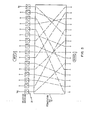
- the inversion stage 38 and the permutation circuit 42 are shown in more detail in FIG. 5 for a 16 bit command code.
- the inversion stage inverts the i-th bit b i if the i-th bit of the first key k 'is a one: in the other case, the stage passes the command code unchanged.
- the permutation circuit 42 permutes the lines that come from the inversion stage in accordance with the second key k. This permutation of the lines is shown by the dashed lines within the circuit 42 of FIG. 5.
- the first key k ' In order to encrypt the code, only the bits after the second key k therefore have to be permuted and then the selective inversion is carried out using the first key k '.
- the first key k ' has 16 bits, while the second key k has 64 bits. The total is then 80 bits.
- the total number of possible decoder circuits using different keys is therefore: If the microprocessor is an 8 bit microprocessor with an 8 bit data bus, then the decoder circuit has only 8 input and output lines. In this case, the first key k l only requires 8 bits, while the second key k contains 32 bits. The total number of bits is then 40. The number of possible 8 bit decoder circuits that use different keys is then:
- the key registers with the decryption keys can be set in the microprocessor by the manufacturer. However, it is also possible to program the keys using special commands. It should be noted that the key registers can only be written to, but cannot be read out. The keys remain in the registers even when a reset command is executed by the microprocessor.
- the microprocessor also has a pair of instructions to place the decoder circuit in either the decryption mode or the non-decryption mode. Typically, when a reset command is executed, the decoder attitude is in the non-decryption mode. The microprocessor begins executing booted codes and subsequent codes in the non-decryption mode. The original codes must therefore be unencrypted codes.
- the number of bytes required for the first two non-encrypted instructions must be less than the size of the code queue.
Landscapes
- Engineering & Computer Science (AREA)
- Software Systems (AREA)
- Theoretical Computer Science (AREA)
- Physics & Mathematics (AREA)
- General Engineering & Computer Science (AREA)
- Computer Hardware Design (AREA)
- Computer Security & Cryptography (AREA)
- General Physics & Mathematics (AREA)
- Multimedia (AREA)
- Technology Law (AREA)
- Remote Sensing (AREA)
- Radar, Positioning & Navigation (AREA)
- Mathematical Physics (AREA)
- Storage Device Security (AREA)
Applications Claiming Priority (2)
| Application Number | Priority Date | Filing Date | Title |
|---|---|---|---|
| US571771 | 1984-01-18 | ||
| US06/571,771 US4633388A (en) | 1984-01-18 | 1984-01-18 | On-chip microprocessor instruction decoder having hardware for selectively bypassing on-chip circuitry used to decipher encrypted instruction codes |
Publications (2)
| Publication Number | Publication Date |
|---|---|
| EP0155399A2 true EP0155399A2 (fr) | 1985-09-25 |
| EP0155399A3 EP0155399A3 (fr) | 1988-08-10 |
Family
ID=24284980
Family Applications (1)
| Application Number | Title | Priority Date | Filing Date |
|---|---|---|---|
| EP84115954A Withdrawn EP0155399A3 (fr) | 1984-01-18 | 1984-12-20 | Circuit de protection contre l'exécution non-autorisée d'un programme |
Country Status (2)
| Country | Link |
|---|---|
| US (1) | US4633388A (fr) |
| EP (1) | EP0155399A3 (fr) |
Cited By (3)
| Publication number | Priority date | Publication date | Assignee | Title |
|---|---|---|---|---|
| GB2203271A (en) * | 1987-04-02 | 1988-10-12 | Ibm | Personal computer with encrypted programs |
| EP0396774A4 (en) * | 1988-10-26 | 1991-10-30 | Hitachi Maxell Ltd. | Method and apparatus for controlling recording medium and recording medium produced under the control thereof |
| EP1966466A4 (fr) * | 2005-12-29 | 2010-11-24 | Lg Chemical Ltd | Appareil pour la séparation d'huile et de gaz perdus dans un moteur |
Families Citing this family (63)
| Publication number | Priority date | Publication date | Assignee | Title |
|---|---|---|---|---|
| JPS58116571A (ja) * | 1981-12-29 | 1983-07-11 | 富士通株式会社 | マイクロコンピユ−タに於ける命令暗号化方式及びその実施に使用されるマイクロコンピユ−タ |
| FR2536880B1 (fr) * | 1982-11-30 | 1987-05-07 | Bull Sa | Microprocesseur concu notamment pour executer les algorithmes de calcul d'un systeme de chiffrement a cle publique |
| DE3483410D1 (de) * | 1983-10-14 | 1990-11-22 | Toshiba Kawasaki Kk | Einchip mikrocomputer mit verschluesselbarer funktion des programmspeichers. |
| US4817140A (en) * | 1986-11-05 | 1989-03-28 | International Business Machines Corp. | Software protection system using a single-key cryptosystem, a hardware-based authorization system and a secure coprocessor |
| US5146575A (en) * | 1986-11-05 | 1992-09-08 | International Business Machines Corp. | Implementing privilege on microprocessor systems for use in software asset protection |
| US5109413A (en) * | 1986-11-05 | 1992-04-28 | International Business Machines Corporation | Manipulating rights-to-execute in connection with a software copy protection mechanism |
| JPH0192833A (ja) * | 1987-10-02 | 1989-04-12 | Satoru Kubota | 暗号翻訳の回路を内蔵することにより、ソフトウェアの違法なコピーを防止するマイクロプロセッサ |
| JPH01320564A (ja) * | 1988-06-23 | 1989-12-26 | Hitachi Ltd | 並列処理装置 |
| US5343524A (en) * | 1991-06-21 | 1994-08-30 | Mu Xiao Chun | Intelligent security device |
| GB9406666D0 (en) * | 1994-04-05 | 1994-05-25 | Communicate Ltd | Computer system |
| FR2719680B1 (fr) * | 1994-05-05 | 1996-07-12 | Gemplus Card Int | Procédé de sécurisation des accès aux cartes amovibles pour ordinateur. |
| US5559884A (en) * | 1994-06-30 | 1996-09-24 | Microsoft Corporation | Method and system for generating and auditing a signature for a computer program |
| FR2723223B1 (fr) * | 1994-07-29 | 1996-08-30 | Sgs Thomson Microelectronics | Procede de brouillage numerique et application a un circuit programmable |
| JP3395863B2 (ja) * | 1994-08-10 | 2003-04-14 | 富士通株式会社 | ソフトウエア管理モジュール、ソフトウエア再生管理装置およびソフトウエア再生管理システム |
| JPH08305558A (ja) * | 1995-04-27 | 1996-11-22 | Casio Comput Co Ltd | 暗号化プログラム演算装置 |
| AU6761996A (en) * | 1995-07-20 | 1997-02-18 | Dallas Semiconductor Corporation | Method and apparatus for encryption key creation |
| US5892826A (en) * | 1996-01-30 | 1999-04-06 | Motorola, Inc. | Data processor with flexible data encryption |
| US5933620A (en) * | 1996-03-28 | 1999-08-03 | Advanced Micro Devices, Inc. | Method and apparatus for serializing microprocessor identification numbers |
| US5790663A (en) * | 1996-03-28 | 1998-08-04 | Advanced Micro Devices, Inc. | Method and apparatus for software access to a microprocessor serial number |
| US5790783A (en) * | 1996-03-28 | 1998-08-04 | Advanced Micro Devices, Inc. | Method and apparatus for upgrading the software lock of microprocessor |
| US5937063A (en) * | 1996-09-30 | 1999-08-10 | Intel Corporation | Secure boot |
| US6381740B1 (en) | 1997-09-16 | 2002-04-30 | Microsoft Corporation | Method and system for incrementally improving a program layout |
| EP0929040A3 (fr) * | 1997-12-25 | 2007-06-27 | Nippon Telegraph and Telephone Corporation | Microprocesseur de brouillage de données |
| KR100357177B1 (ko) * | 1998-01-13 | 2002-12-18 | 주식회사 하이닉스반도체 | 마이크로컴퓨터의명령해석장치 |
| US6675298B1 (en) | 1999-08-18 | 2004-01-06 | Sun Microsystems, Inc. | Execution of instructions using op code lengths longer than standard op code lengths to encode data |
| US6308256B1 (en) * | 1999-08-18 | 2001-10-23 | Sun Microsystems, Inc. | Secure execution of program instructions provided by network interactions with processor |
| US20070288765A1 (en) * | 1999-12-22 | 2007-12-13 | Kean Thomas A | Method and Apparatus for Secure Configuration of a Field Programmable Gate Array |
| GB9930145D0 (en) | 1999-12-22 | 2000-02-09 | Kean Thomas A | Method and apparatus for secure configuration of a field programmable gate array |
| US7240218B2 (en) * | 2000-02-08 | 2007-07-03 | Algotronix, Ltd. | Method of using a mask programmed key to securely configure a field programmable gate array |
| FR2810425A1 (fr) * | 2000-06-20 | 2001-12-21 | Groupe Ecoles Telecomm | Microprocesseur securise |
| US6678833B1 (en) | 2000-06-30 | 2004-01-13 | Intel Corporation | Protection of boot block data and accurate reporting of boot block contents |
| JP4892167B2 (ja) * | 2000-07-18 | 2012-03-07 | シンプレックス メジャー センドリアン ベルハッド | ディジタル・データ保護構成 |
| GB0114317D0 (en) * | 2001-06-13 | 2001-08-01 | Kean Thomas A | Method of protecting intellectual property cores on field programmable gate array |
| CA2364174A1 (fr) * | 2001-11-27 | 2003-05-27 | Bayer Inc. | Composes butyliques elastomeres avec matiere de charge, ayant une meilleure resistance au grillage |
| US7526595B2 (en) * | 2002-07-25 | 2009-04-28 | International Business Machines Corporation | Data path master/slave data processing device apparatus and method |
| US20040064457A1 (en) * | 2002-09-27 | 2004-04-01 | Zimmer Vincent J. | Mechanism for providing both a secure and attested boot |
| US7194627B2 (en) * | 2003-03-14 | 2007-03-20 | Broadcom Corporation | Method and system for data encryption and decryption |
| US7321910B2 (en) * | 2003-04-18 | 2008-01-22 | Ip-First, Llc | Microprocessor apparatus and method for performing block cipher cryptographic functions |
| US7900055B2 (en) * | 2003-04-18 | 2011-03-01 | Via Technologies, Inc. | Microprocessor apparatus and method for employing configurable block cipher cryptographic algorithms |
| US7519833B2 (en) * | 2003-04-18 | 2009-04-14 | Via Technologies, Inc. | Microprocessor apparatus and method for enabling configurable data block size in a cryptographic engine |
| US7844053B2 (en) * | 2003-04-18 | 2010-11-30 | Ip-First, Llc | Microprocessor apparatus and method for performing block cipher cryptographic functions |
| US7529368B2 (en) | 2003-04-18 | 2009-05-05 | Via Technologies, Inc. | Apparatus and method for performing transparent output feedback mode cryptographic functions |
| US7502943B2 (en) * | 2003-04-18 | 2009-03-10 | Via Technologies, Inc. | Microprocessor apparatus and method for providing configurable cryptographic block cipher round results |
| US7532722B2 (en) | 2003-04-18 | 2009-05-12 | Ip-First, Llc | Apparatus and method for performing transparent block cipher cryptographic functions |
| US7539876B2 (en) * | 2003-04-18 | 2009-05-26 | Via Technologies, Inc. | Apparatus and method for generating a cryptographic key schedule in a microprocessor |
| US8060755B2 (en) * | 2003-04-18 | 2011-11-15 | Via Technologies, Inc | Apparatus and method for providing user-generated key schedule in a microprocessor cryptographic engine |
| US7542566B2 (en) * | 2003-04-18 | 2009-06-02 | Ip-First, Llc | Apparatus and method for performing transparent cipher block chaining mode cryptographic functions |
| US7392400B2 (en) * | 2003-04-18 | 2008-06-24 | Via Technologies, Inc. | Microprocessor apparatus and method for optimizing block cipher cryptographic functions |
| US7529367B2 (en) * | 2003-04-18 | 2009-05-05 | Via Technologies, Inc. | Apparatus and method for performing transparent cipher feedback mode cryptographic functions |
| US7536560B2 (en) * | 2003-04-18 | 2009-05-19 | Via Technologies, Inc. | Microprocessor apparatus and method for providing configurable cryptographic key size |
| US7925891B2 (en) * | 2003-04-18 | 2011-04-12 | Via Technologies, Inc. | Apparatus and method for employing cryptographic functions to generate a message digest |
| CN1317649C (zh) * | 2003-09-19 | 2007-05-23 | 联想(北京)有限公司 | 一种基于安全芯片的计算机终端安全系统 |
| US20050071656A1 (en) * | 2003-09-25 | 2005-03-31 | Klein Dean A. | Secure processor-based system and method |
| US7502928B2 (en) * | 2004-11-12 | 2009-03-10 | Sony Computer Entertainment Inc. | Methods and apparatus for secure data processing and transmission |
| EP1849117A1 (fr) * | 2005-02-11 | 2007-10-31 | Universal Data Protection Corporation | Procede et systeme pour securite de donnees de microprocesseur |
| US7395385B2 (en) * | 2005-02-12 | 2008-07-01 | Broadcom Corporation | Memory management for a mobile multimedia processor |
| US20060184803A1 (en) * | 2005-02-12 | 2006-08-17 | Rainer Ulrich | Method and system for digital rights management in a mobile multimedia processor |
| WO2007028241A2 (fr) * | 2005-09-07 | 2007-03-15 | Universal Data Protection Corporation | Procede et systeme de protection des donnees de supports d'enregistrement |
| US7594101B2 (en) * | 2006-02-06 | 2009-09-22 | Stmicroelectronics S.A. | Secure digital processing unit and method for protecting programs |
| DE102007021256A1 (de) * | 2007-05-07 | 2008-11-13 | Giesecke & Devrient Gmbh | Verfahren zum Speichern von Anwendungsdaten in einen Datenträger mit einem verschlüsselnden Speicher-Controller |
| US20090285390A1 (en) * | 2008-05-16 | 2009-11-19 | Ati Technologies Ulc | Integrated circuit with secured software image and method therefor |
| US11593111B2 (en) * | 2020-01-27 | 2023-02-28 | Arm Limited | Apparatus and method for inhibiting instruction manipulation |
| EP3907633B1 (fr) | 2020-05-05 | 2022-12-14 | Nxp B.V. | Système et procédé d'obscurcissement de commandes opcode dans un dispositif à semiconducteur |
Family Cites Families (19)
| Publication number | Priority date | Publication date | Assignee | Title |
|---|---|---|---|---|
| US3368207A (en) * | 1965-05-12 | 1968-02-06 | Ibm | File protection to i/o storage |
| US3377624A (en) * | 1966-01-07 | 1968-04-09 | Ibm | Memory protection system |
| US4120030A (en) * | 1977-03-11 | 1978-10-10 | Kearney & Trecker Corporation | Computer software security system |
| US4278837A (en) * | 1977-10-31 | 1981-07-14 | Best Robert M | Crypto microprocessor for executing enciphered programs |
| US4168396A (en) * | 1977-10-31 | 1979-09-18 | Best Robert M | Microprocessor for executing enciphered programs |
| US4246638A (en) * | 1978-09-14 | 1981-01-20 | Thomas William J | Method and apparatus for controlling usage of a programmable computing machine |
| US4465901A (en) * | 1979-06-04 | 1984-08-14 | Best Robert M | Crypto microprocessor that executes enciphered programs |
| US4319079A (en) * | 1979-09-13 | 1982-03-09 | Best Robert M | Crypto microprocessor using block cipher |
| US4306289A (en) * | 1980-02-04 | 1981-12-15 | Western Electric Company, Inc. | Digital computer having code conversion apparatus for an encrypted program |
| US4543646A (en) * | 1980-06-05 | 1985-09-24 | Western Digital Corporation | Chip topography for MOS Data Encryption Standard circuit |
| US4368357A (en) * | 1980-11-14 | 1983-01-11 | International Telephone And Telegraph Corporation | Bypass apparatus for use in secure communication systems |
| US4513174A (en) * | 1981-03-19 | 1985-04-23 | Standard Microsystems Corporation | Software security method using partial fabrication of proprietary control word decoders and microinstruction memories |
| US4433207A (en) * | 1981-09-10 | 1984-02-21 | Best Robert M | Cryptographic decoder for computer programs |
| US4471163A (en) * | 1981-10-05 | 1984-09-11 | Donald Thomas C | Software protection system |
| US4525599A (en) * | 1982-05-21 | 1985-06-25 | General Computer Corporation | Software protection methods and apparatus |
| US4555591A (en) * | 1982-09-07 | 1985-11-26 | At&T Bell Laboratories | Integrated circuit devices for secure data encryption |
| US4558176A (en) * | 1982-09-20 | 1985-12-10 | Arnold Mark G | Computer systems to inhibit unauthorized copying, unauthorized usage, and automated cracking of protected software |
| US4562305A (en) * | 1982-12-22 | 1985-12-31 | International Business Machines Corporation | Software cryptographic apparatus and method |
| US4591660A (en) * | 1983-10-25 | 1986-05-27 | At&T Bell Laboratories | Common control audio decryptor |
-
1984
- 1984-01-18 US US06/571,771 patent/US4633388A/en not_active Expired - Lifetime
- 1984-12-20 EP EP84115954A patent/EP0155399A3/fr not_active Withdrawn
Cited By (3)
| Publication number | Priority date | Publication date | Assignee | Title |
|---|---|---|---|---|
| GB2203271A (en) * | 1987-04-02 | 1988-10-12 | Ibm | Personal computer with encrypted programs |
| EP0396774A4 (en) * | 1988-10-26 | 1991-10-30 | Hitachi Maxell Ltd. | Method and apparatus for controlling recording medium and recording medium produced under the control thereof |
| EP1966466A4 (fr) * | 2005-12-29 | 2010-11-24 | Lg Chemical Ltd | Appareil pour la séparation d'huile et de gaz perdus dans un moteur |
Also Published As
| Publication number | Publication date |
|---|---|
| EP0155399A3 (fr) | 1988-08-10 |
| US4633388A (en) | 1986-12-30 |
Similar Documents
| Publication | Publication Date | Title |
|---|---|---|
| EP0155399A2 (fr) | Circuit de protection contre l'exécution non-autorisée d'un programme | |
| DE69327206T2 (de) | System zur ununterbrochenen Verarbeitung verschlüsselter und unverschlüsselter Daten und Befehle | |
| DE69120596T2 (de) | Datenverschlüsselungsvorrichtung und Verfahren zur Datenverschlüsselung | |
| DE68927755T2 (de) | System zur sicheren chiffrierschlüsselverarbeitung | |
| DE69729557T2 (de) | Verfahren und gerät zum softwarezugriff auf eine mikroprozessorseriennummer | |
| DE3407642C2 (fr) | ||
| DE69533312T2 (de) | Geschütztes speichersystem und verfahren dafür | |
| DE69433077T2 (de) | Software-Verteilungsschutzverfahren | |
| EP0932867B1 (fr) | Circuit electronique de traitement de donnees | |
| DE3432721C2 (fr) | ||
| WO2005036406A1 (fr) | Decodage ou codage lors d'acces en ecriture a une memoire | |
| DE1499203B1 (de) | Schaltungsanordnung zum Speicherschutz bei Datenverarbeitungsanlagen mit Simultanbetrieb | |
| EP0520228A2 (fr) | Système de traitement de données avec accès protégé | |
| DE602004004079T2 (de) | Befehl zur berechnung eines sicherheits-nachricht-authentifizierungskodes | |
| EP0280035B1 (fr) | Procédé de protection de programmes et de contrôle d'intégrité de programme protégé | |
| DE60100363T2 (de) | Sequenznummerierungsmechanismus zur sicherung der ausführungsordnungs-integrietät von untereinander abhängigen smart-card anwendungen | |
| DE69716722T2 (de) | Verfahren und vorrichtung für den schutz von daten mit verwendung von verriegelungswerten in einem rechnersystem | |
| DE2810421C2 (de) | Speicherschutzeinrichtung | |
| EP0276450A1 (fr) | Circuit de protection de données pour le blocage de la transmission de signaux sur un bus | |
| DE19626972A1 (de) | Verfahren und Vorrichtung zur vorläufigen Freigabe für die Anwendung eines von einer elektronischen Kassette geschützten Programms | |
| EP1636700A1 (fr) | Procede de rechargement d'un logiciel dans le secteur d'amor age d'une memoire morte programmable | |
| DE3853482T2 (de) | Einrichtung zum schützen von speicherzonen eines elektronischen systems mit mikroprozessor. | |
| DE19901829A1 (de) | Schaltungsanordnung zur elektronischen Datenverarbeitung | |
| EP0135888B1 (fr) | Procédé pour éviter l'exécution d'un programme sur un ordinateur n'ayant pas l'autorisation d'exécuter ledit programme | |
| DE3779692T2 (de) | Wahlweises rechnerzugriff-schutzsystem. |
Legal Events
| Date | Code | Title | Description |
|---|---|---|---|
| PUAI | Public reference made under article 153(3) epc to a published international application that has entered the european phase |
Free format text: ORIGINAL CODE: 0009012 |
|
| 17P | Request for examination filed |
Effective date: 19841220 |
|
| AK | Designated contracting states |
Designated state(s): AT CH DE FR GB IT LI NL |
|
| PUAL | Search report despatched |
Free format text: ORIGINAL CODE: 0009013 |
|
| RHK1 | Main classification (correction) |
Ipc: G06F 12/14 |
|
| AK | Designated contracting states |
Kind code of ref document: A3 Designated state(s): AT CH DE FR GB IT LI NL |
|
| STAA | Information on the status of an ep patent application or granted ep patent |
Free format text: STATUS: THE APPLICATION IS DEEMED TO BE WITHDRAWN |
|
| 18D | Application deemed to be withdrawn |
Effective date: 19880811 |
|
| RIN1 | Information on inventor provided before grant (corrected) |
Inventor name: CHIU, MING-YEE |