EP0155409A1 - Système de production automatique d'originaux de musique graphique - Google Patents
Système de production automatique d'originaux de musique graphique Download PDFInfo
- Publication number
- EP0155409A1 EP0155409A1 EP84200384A EP84200384A EP0155409A1 EP 0155409 A1 EP0155409 A1 EP 0155409A1 EP 84200384 A EP84200384 A EP 84200384A EP 84200384 A EP84200384 A EP 84200384A EP 0155409 A1 EP0155409 A1 EP 0155409A1
- Authority
- EP
- European Patent Office
- Prior art keywords
- graphic
- musical
- peripheral
- music
- operative
- Prior art date
- Legal status (The legal status is an assumption and is not a legal conclusion. Google has not performed a legal analysis and makes no representation as to the accuracy of the status listed.)
- Withdrawn
Links
Images

Classifications
-
- B—PERFORMING OPERATIONS; TRANSPORTING
- B41—PRINTING; LINING MACHINES; TYPEWRITERS; STAMPS
- B41J—TYPEWRITERS; SELECTIVE PRINTING MECHANISMS, i.e. MECHANISMS PRINTING OTHERWISE THAN FROM A FORME; CORRECTION OF TYPOGRAPHICAL ERRORS
- B41J3/00—Typewriters or selective printing or marking mechanisms characterised by the purpose for which they are constructed
- B41J3/34—Typewriters or selective printing or marking mechanisms characterised by the purpose for which they are constructed for printing musical scores
-
- G—PHYSICS
- G06—COMPUTING OR CALCULATING; COUNTING
- G06F—ELECTRIC DIGITAL DATA PROCESSING
- G06F3/00—Input arrangements for transferring data to be processed into a form capable of being handled by the computer; Output arrangements for transferring data from processing unit to output unit, e.g. interface arrangements
- G06F3/01—Input arrangements or combined input and output arrangements for interaction between user and computer
- G06F3/03—Arrangements for converting the position or the displacement of a member into a coded form
- G06F3/033—Pointing devices displaced or positioned by the user, e.g. mice, trackballs, pens or joysticks; Accessories therefor
-
- G—PHYSICS
- G10—MUSICAL INSTRUMENTS; ACOUSTICS
- G10G—REPRESENTATION OF MUSIC; RECORDING MUSIC IN NOTATION FORM; ACCESSORIES FOR MUSIC OR MUSICAL INSTRUMENTS NOT OTHERWISE PROVIDED FOR, e.g. SUPPORTS
- G10G1/00—Means for the representation of music
Definitions
- the invention concerns a system for the automatic production of graphic music originals to be used for the printed reproduction of the so called "music scores" in a high number of copies.
- a music original In view of its use a music original must naturally be graphically perfect in each of its own parts, i.e. in musical signs, in special signs and the accompanying alphanumerical indications altogether.
- a first type of semi-automatic system consists in a piano (or organ) keyboard connected to a computer.
- the acoustic signals sent by the organ are analyzed and their physical characteristics (frequency, phase, duration, etc.) are extracted; an alphanumerical keyboard introduces in the computer the complementary information and the instructions needed by the computer.
- the computer processes the memorized information and executes the music original through a peripheral graphic output unit (plotter).
- a second semi-automatic system consists in an electric typewriter including eight vertical spaces which allow the positioning of notes within an octave without having to move the paper sheet. This system acts as a mere help to the previously mentioned manual techniques, as it only permits the writing of the most recurrent signs, without achieving the flexibility needed by an automatic system.
- Such purpose is realized by the present invention through a system for the automatic production of graphic music originals, formed by a microcomputer consisting of a central proces- unit and a memory system for the memorization of data and programs and a set of peripheral input and output units, characterized in that one of said peripheral input units consists of a touch-sensitive organ and of a contact unit physically associable with different areas of said sensitive unit, such sensitive unit including a first area apt to the support of a music sheet for the selection of the co-ordinates of the musical graphic signs to be introduced in the music original, and a second area for the selection of said musical graphic signs and associated instructions.
- the system for the automatic production of originals represented in Fig. 1 consists of an electronic processor (microcomputer) 100 consisting of central processing unit CPU 1, a memory unit RAM 2, a read only memory EPROM 3 and a memory channel 4; to it are connected peripheral units 6 to 12 connected to CPU 1 through an input/output channel 5.
- microcomputer microcomputer
- microcomputer is, in general terms, of the type known in the art of personal computers and, more specifically, the one produced by Mostek Corporation can be employed, described in the manual titled "Z80 Microcomputer Systems FLP-80DOS Flexible Disk Operating System V 2.1 Publication No. MK78557. May 1979". ln said manual are described details of the Operative System, which includes a Monitor and a set of programs.
- Peripheral units 6 to 12 are also known in the art, being employed mainly in the scientific/technical field. They are: a graphic printer 6, a plotter 7, an input graphic tablet 8 (digitizer), a graphic video 9, an alphanumerical keyboard 10, and finally a couple of flexible disk units (floppy-disk) 11 and 12, which constitute the mass memory.
- Peripheral graphic units which can be used for the system, according to the invention are for example:
- the CPU unit 1 together with RAM 2 and EPROM 3, allows the microcomputer's operative system (DOS) to operate the whole system including peripheral units 6 to 12.
- DOS microcomputer's operative system
- the system according to the invention employs a second operative system of musical. type (MELOS) which will be subsequently described.
- the digitizer b (Fig. 2) includes a sensitive surface 21, carrying a number of musical graphic information, and a special sensitive pen 20 (referred to from now on as "stylus"), or other equivalent sensor, capable of converting said graphic information into numerical information representing the co-ordinates (x, y) of the point of sensitive surface 21, which is each time indicated by stylus 20.
- the co-ordinates indicated by stylus 20 can be memorized in numerical form on the magnetic support (floppy-disk) of peripheral units 11-12.
- sensitive surface 21 is divided into two areas:
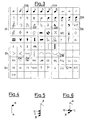
- FIG. 3 A non-limitative example of graphic signs and instructions which can be inserted in area 18 of the graphic tablet 8 is given in Fig. 3 and includes elementary graphic signs 22, complex graphic signs 23 and instructions 24.
- the elementary graphic signs 22 consist of musical symbols of single note 22A, pause symbols 22B, symbols of clef 22C, symbols of alteration 22D and various other special symbols 22E.
- the complex graphic signs 23 consist of musical symbols of trill 23A, of ligature 23B, of crescendo/diminuendo 23C.
- instructions 24 are representative of associated logical functions, identified by the following initials:
- the flexible discs magnetic units 11 and 12 serve the purpose of memorizing the co-ordinates (x, y) and the codes of graphic signs 22, 23 and of instructions 24 introduced by stylus 20.
- the high resolution peripheral graphic unit (plotter) 7 is employed by CPU 1 to control the writing of the music original.
- CPU 1 will employ to this purpose the information introduced in floppy disks 11 and 12 through the digitizer 8.
- plotter 7 can be replaced by an output unit of photographic type.
- Graphic video 9 is employed for the visualization of notes and music signs as they are fed in by the operator. This immediate check of the music introduced allows the correction of errors as soon as they are made, thus simplifying the production process of the originals.
- Alphanumerical keyboard 10 allows the introduction of instructions relevant to the operative system (described in the publication mentioned earlier) and to the musical operative system MELOS; besides it also serves the purpose of answering the messages that bot of these operative systems send to the operator on graphic video 9.
- Graphic printer 6 is employed for the production of proofs of the music originals, as being faster and less accurate than plotter 7, it allows to check rapidly whether the work introduced is correct or requires modifications.
- the system according to the invention employs an operative system of conventional type plus a second musical operative system called MELOS.
- MELOS a second musical operative system
- the operator lays and secures an empty music sheet on area 16 of tablet 21.
- the operator then sets on keyboard 10 the order of start work CR, followed by the order of research LX.
- the recording of a music page can now start, effected through stylus 20 and tablet 21. More precisely, when the operator lays stylus 20 on a certain point of the central area 16 of tablet 21, an electric signal is generated representative of the corresponding co-ordinates of the pentagram, which is received and memorized by the microcomputer 100. When instead the stylus 20 is laid on a sensitive area 19 of peripheral area 18 of the tablet, an electric signal is generated which represents a musical symbol 22, 23, or an instruction 24. Proceeding this way, the various musical notes are recorded one at a time or in groups on the floppy-disk prepared to receive them. Naturally, the sequence of operations executed through stylus 20 and tablet 21 will be different according to whether it is required to record single notes or chords, groups of notes and so on.
- the first note (B) is written by following the procedure explained earlier for the non-standard note, and then the positions of the other notes (C, D) are introduced following to the operation of order ACC. By doing so, all notes result with the same horizontal position. Eventual overlapping of notes is automatically avoided by the operative system MELOS, which takes care of shifting one or more notes to the opposite part of the vertical bar, as illustrated in Fig. 6.
- the position (x, y) is employed to cause the shift of the pen-nib of plotter 7 from the actual position to the starting position of the sign to be drawn.
- the code of the sign is used to have access to the corresponding graphic routine.
Landscapes
- Engineering & Computer Science (AREA)
- Multimedia (AREA)
- Physics & Mathematics (AREA)
- General Engineering & Computer Science (AREA)
- Theoretical Computer Science (AREA)
- Acoustics & Sound (AREA)
- Human Computer Interaction (AREA)
- General Physics & Mathematics (AREA)
- Electrophonic Musical Instruments (AREA)
Priority Applications (1)
| Application Number | Priority Date | Filing Date | Title |
|---|---|---|---|
| EP84200384A EP0155409A1 (fr) | 1984-03-19 | 1984-03-19 | Système de production automatique d'originaux de musique graphique |
Applications Claiming Priority (1)
| Application Number | Priority Date | Filing Date | Title |
|---|---|---|---|
| EP84200384A EP0155409A1 (fr) | 1984-03-19 | 1984-03-19 | Système de production automatique d'originaux de musique graphique |
Publications (1)
| Publication Number | Publication Date |
|---|---|
| EP0155409A1 true EP0155409A1 (fr) | 1985-09-25 |
Family
ID=8192424
Family Applications (1)
| Application Number | Title | Priority Date | Filing Date |
|---|---|---|---|
| EP84200384A Withdrawn EP0155409A1 (fr) | 1984-03-19 | 1984-03-19 | Système de production automatique d'originaux de musique graphique |
Country Status (1)
| Country | Link |
|---|---|
| EP (1) | EP0155409A1 (fr) |
Cited By (1)
| Publication number | Priority date | Publication date | Assignee | Title |
|---|---|---|---|---|
| EP0272070A3 (en) * | 1986-12-15 | 1989-11-29 | Omron Tateisi Electronics Co. | Input apparatus for computer |
Citations (5)
| Publication number | Priority date | Publication date | Assignee | Title |
|---|---|---|---|---|
| GB1268382A (en) * | 1969-03-28 | 1972-03-29 | Nat Res Dev | Improvements in and relating to apparatus for setting printed music |
| US3720948A (en) * | 1971-06-03 | 1973-03-13 | Co Data Corp | Processing of coordinate values of points entered in a graph board or the like |
| FR2409567A1 (fr) * | 1977-11-17 | 1979-06-15 | Fourreau Pierre | Instrument de musique opto-electronique a codage lineaire des notes |
| GB2064851A (en) * | 1979-12-07 | 1981-06-17 | Rowe C C | Automatic music writer |
| EP0087949A2 (fr) * | 1982-02-27 | 1983-09-07 | Fanuc Ltd. | Méthode et appareil de création de données de commande numérique |
-
1984
- 1984-03-19 EP EP84200384A patent/EP0155409A1/fr not_active Withdrawn
Patent Citations (5)
| Publication number | Priority date | Publication date | Assignee | Title |
|---|---|---|---|---|
| GB1268382A (en) * | 1969-03-28 | 1972-03-29 | Nat Res Dev | Improvements in and relating to apparatus for setting printed music |
| US3720948A (en) * | 1971-06-03 | 1973-03-13 | Co Data Corp | Processing of coordinate values of points entered in a graph board or the like |
| FR2409567A1 (fr) * | 1977-11-17 | 1979-06-15 | Fourreau Pierre | Instrument de musique opto-electronique a codage lineaire des notes |
| GB2064851A (en) * | 1979-12-07 | 1981-06-17 | Rowe C C | Automatic music writer |
| EP0087949A2 (fr) * | 1982-02-27 | 1983-09-07 | Fanuc Ltd. | Méthode et appareil de création de données de commande numérique |
Cited By (2)
| Publication number | Priority date | Publication date | Assignee | Title |
|---|---|---|---|---|
| EP0272070A3 (en) * | 1986-12-15 | 1989-11-29 | Omron Tateisi Electronics Co. | Input apparatus for computer |
| US4916740A (en) * | 1986-12-15 | 1990-04-10 | Omron Tateisi Electronics Co. | Input apparatus for computer |
Similar Documents
| Publication | Publication Date | Title |
|---|---|---|
| EP0164009B1 (fr) | Dispositif pour introduire des données | |
| US6348648B1 (en) | System and method for coordinating music display among players in an orchestra | |
| US5847302A (en) | Tone information processing device for an electronic musical instrument for generating sounds | |
| US7985913B2 (en) | Braille music systems and methods | |
| JPH0574078B2 (fr) | ||
| US6053740A (en) | Lyrics display apparatus | |
| GB2070311A (en) | Electronic musical instrument with keyboard | |
| US6727418B2 (en) | Musical score display apparatus and method | |
| US5549029A (en) | Method for operating a musical instrument | |
| US4483231A (en) | Preset apparatus of electronic musical instrument | |
| US6143972A (en) | Device and method for playing music from a score | |
| JPH10240117A (ja) | 楽器練習の支援装置および楽器練習用情報の記録媒体 | |
| US5052265A (en) | Method of recording fingering positions for stringed musical instruments | |
| US4513650A (en) | Electronic musical instrument | |
| JP3244397B2 (ja) | パラメータ編集装置 | |
| JP2000250793A (ja) | データセット選択装置 | |
| Rudolph et al. | Finale: An easy guide to music notation | |
| JP2570214B2 (ja) | 演奏情報入力装置 | |
| Mellor | Technical innovations in braille reading, writing, and production | |
| EP4517735A1 (fr) | Système vidéo-audio et procédé interactif vidéo-audio | |
| JPS585778A (ja) | 楽譜印刷システムにおける楽譜デ−タ入力方式 | |
| Winter | Performing Beethoven's early piano concertos | |
| JPS61212898A (ja) | 自動演奏装置 | |
| JP2746382B2 (ja) | 画像形成装置 | |
| JP3299992B2 (ja) | 演奏データ編集装置 |
Legal Events
| Date | Code | Title | Description |
|---|---|---|---|
| PUAI | Public reference made under article 153(3) epc to a published international application that has entered the european phase |
Free format text: ORIGINAL CODE: 0009012 |
|
| AK | Designated contracting states |
Designated state(s): AT CH DE FR GB IT LI NL |
|
| STAA | Information on the status of an ep patent application or granted ep patent |
Free format text: STATUS: THE APPLICATION IS DEEMED TO BE WITHDRAWN |
|
| 18D | Application deemed to be withdrawn |
Effective date: 19860527 |