EP0155506A2 - Verbessertes Verfahren zur Herstellung von Riboflavin - Google Patents
Verbessertes Verfahren zur Herstellung von Riboflavin Download PDFInfo
- Publication number
- EP0155506A2 EP0155506A2 EP85101665A EP85101665A EP0155506A2 EP 0155506 A2 EP0155506 A2 EP 0155506A2 EP 85101665 A EP85101665 A EP 85101665A EP 85101665 A EP85101665 A EP 85101665A EP 0155506 A2 EP0155506 A2 EP 0155506A2
- Authority
- EP
- European Patent Office
- Prior art keywords
- oder
- steht
- für
- riboflavin
- formula
- Prior art date
- Legal status (The legal status is an assumption and is not a legal conclusion. Google has not performed a legal analysis and makes no representation as to the accuracy of the status listed.)
- Granted
Links
Classifications
-
- C—CHEMISTRY; METALLURGY
- C07—ORGANIC CHEMISTRY
- C07D—HETEROCYCLIC COMPOUNDS
- C07D475/00—Heterocyclic compounds containing pteridine ring systems
- C07D475/12—Heterocyclic compounds containing pteridine ring systems containing pteridine ring systems condensed with carbocyclic rings or ring systems
- C07D475/14—Benz [g] pteridines, e.g. riboflavin
Definitions
- a disadvantage of the reaction of II with III in alkanols is that a partial esterification of the alkanols with acetic acid takes place as a side reaction, which in addition to the reaction-related water of condensation causes water to get into the reaction mixture, which interferes with the further condensation of II with III and a elaborate regeneration of the solvent is necessary.
- the physical properties of the solvent-catalyst system and the reaction and crystallization conditions in the synthesis cause a lower purity of the riboflavin.
- a process for the condensation of II with III in a mixture of a solvent such as ethyl acetate and nitrobenzene or a nitrated alkane is also known from JA-OS 10151.
- the yields are 82-84%.
- Disadvantages of this process are, on the one hand, excessively low space-time yields and the need to use nitrobenzene, etc., which has a very high vapor pressure and is extremely toxic.
- the process is particularly advantageous if the reaction is carried out in ethylene glycol diacetate or in 1-methoxy-2-propanol or in a mixture of these solvents.
- a purity improvement to over 96% is completely unexpected when a mixture of the acetates, alkoxyalkanol acetates or alkoxyalkanols according to the invention is used in the presence of acid catalysts.
- the starting compounds II and their preparation are known. In general, one becomes the cheapest connection in this series, namely the Phe Use a monto derivative. In principle, however, compounds are also suitable in which the ortho or in particular the para position of the azophenyl group are substituted by substituents such as methyl, chlorine or the nitro group.
- the starting compounds do not have to be specially cleaned, but can also be used as raw products. The yield information then relates to II contained in the starting material.
- the inert organic diluents or solvents of the general formula IV according to the invention are, in particular, the acetates of polyhydric aliphatic alcohols, such as ethylene glycol diacetate, butane-1,4-diol diacetate or glycerol triacetate, and alkoxyalkanol acetates, such as 2-ethoxyethyl acetate, and even alkoxyalkanols such as 1 -Methoxy-2-propanol suitable. It is particularly advantageous to use ethylene glycol diacetate or 1-methoxy-2-propanol or a mixture of these two solvents.
- the amount of solvent is generally about 2 to 12 liters per kilo II.
- the acidic condensing agent used is, in principle, all of the acids previously described in the literature for this reaction, preferably weak organic acids such as glacial acetic acid, propionic acid, phenylacetic acid, benzoic acid, trimethylacetic acid (pivalic acid), 2,2-dimethylbutanoic acid, 2,2-dimethyl-pentanoic acid and 1-methyl-cyclopentane carboxylic acid into consideration.
- weak organic acids such as glacial acetic acid, propionic acid, phenylacetic acid, benzoic acid, trimethylacetic acid (pivalic acid), 2,2-dimethylbutanoic acid, 2,2-dimethyl-pentanoic acid and 1-methyl-cyclopentane carboxylic acid into consideration.
- the amount of carboxylic acid is preferably 0.5 to 6 moles per mole II, which corresponds, for example, to approximately 0.83 to 1 kg per kg II for glacial acetic acid and 2.36 kg to 2.85 kg per kg II for Versatic 10 acid .
- the reaction temperatures are 80-120 ° C. Is preferably carried out at temperatures above 100'C, that is at about 100 to 115 ° C and in a correspondingly high-boiling solvent. At 100 ° C the reaction time is about 5 to 15 hours.
- riboflavin from II and III is advantageously obtained in very pure form and very good yields.
Landscapes
- Chemical & Material Sciences (AREA)
- Organic Chemistry (AREA)
- Organic Low-Molecular-Weight Compounds And Preparation Thereof (AREA)
Abstract



- R' für H oder CH3 steht,
- R2 für H oder CH3- steht, oder wenn n für 0 steht, CH3-CO-O-CH2- bedeutet,
- R3 für CH3-, C2H5- oder CH3-CO- steht,
- R4 für CH3-CO- steht
- oderfür H steht wenn R3 CH3- oder C2H5- beduetet und n für 0 oder 2, vorzugsweise 0 steht,
Description
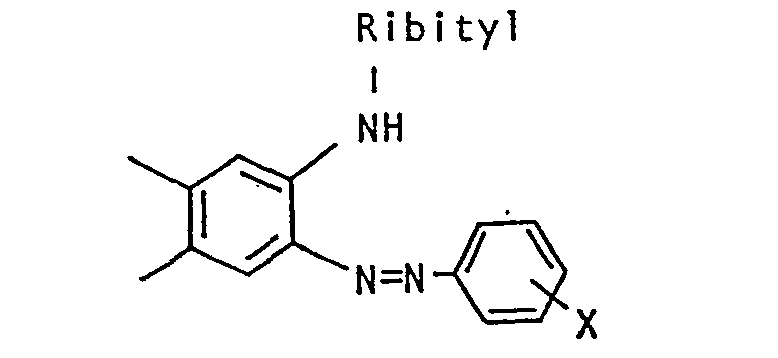
- Die vorliegende Erfindung betrifft ein verbessertes Verfahren zur Herstellung von Riboflavin (I; Vitamin B2) durch Kondensation eines 4,5-Dimethyl-N-(D)-ribityl-2-phenylazo-anilins (II) mit Barbitursäure (III) in Gegenwart eines sauren Kondensationsmittels in einem organischen Lösungsmittel.

- Rib = Ribityl
- X = H; p- oder o-Substituent wie -C1, -NO2 oder -CH3.
- Dieser letzte Schritt der Ribloflavinsynthese ist - sieht man von der erfindungsgemäßen Verbesserung ab - aus mehreren Veröffentlichungen bekannt. Erstmals beschrieben wurde die Umsetzung von II mit III zu I in -J. Am. Chem. Soc. 69 (1947), S. 1487 f. Als Reaktionsmedium wurde hierin insbesondere ein Gemisch aus Eisessig und Dioxan genannt. Da bei diesem Verfahren das relativ teure Lösungsmittel Dioxan in großen Mengen verwendet werden muß und zudem gegen Dioxan Bedenken wegen gesundheitsgefährdender Wirkung bestehen, ist dieses Verfahren für eine Riboflavinherstellung in technischem Maßstab nicht geeignet.
- Eine ausführliche Untersuchung über die Eignung verschiedener organischer Säuren als Katalysator für die Umsetzung von II mit III wurde von Berezowski et al im J. Gen. Chem. USSR 31 (1961), Seiten 3444 f beschrieben. Als Lösungsmittel wurde siedendes Butanol verwendet. Die hierbei erzielten Ausbeuten von maximal ca. 70 % befriedigen bei einem Verfahren im technischen Maßstab nicht, zumal wenn es sich um den letzten Reaktionsschritt eines vielstufigen Verfahrens handelt und da diese Ausbeuten auch nur bei Verwendung von größeren III-Überschüssen erzielt wurden.
- Gemäß der CS-PS 127 303 wird II mit III in Gegenwart von Eisessig in Butanol oder Dioxan umgesetzt. Die erzielten Ausbeuten betragen maximal 78 %.
- Aus der JA-OS 7737/1963 ist die Umsetzung von II mit III in einem Gemisch aus Alkanolen mit Kp = 80 bis 120°C und Eisessig an Al2O3 oder gereinigter Diatomeenerde bekannt. Die Ausbeuten betragen 67-69 % der Theorie.
- Nachteilig bei der Umsetzung von II mit III in Alkanolen ist, daß als Nebenreaktion eine teilweise Veresterung der Alkanole mit der Essigsäure stattfindet, wodurch einerseits zusätzlich zu dem reaktionsbedingten Kondensationswasser Wasser in das Reaktionsgemisch gelangt, welches die weitere Kondensation von II mit III stört und andererseits ein aufwendiges Regenerieren des Lösungsmittels notwendig ist. Außerdem verursachen die physikalischen Eigenschaften des Lösungsmittel-Katalysator-Systems sowie die Reaktions- und Kristallisationsbedingungen bei der Synthese eine geringere Reinheit des Riboflavins.
- Aus der JA-OS 10151 ist weiterhin ein Verfahren zur Kondensation von II mit III in einem Gemisch aus einem Lösungsmittel wie Essigsäureethylester und Nitrobenzol oder einem nitrierten Alkan bekannt. Die Ausbeuten betragen 82-84 %. Nachteilig an diesem Verfahren sind einerseits zu niedrige Raum-Zeit-Ausbeuten sowie die Notwendigkeit der Mitverwendung von Nitrobenzol u.ä., welches einen sehr hohen Dampfdruck aufweist und äußerst giftig ist.
- Aus der CS-PS 195 229 ist ein Verfahren zur Herstellung von I aus II und III in einem Gemisch aus Xylol, einem C3-C5-Alkanol, Eisessig und Essigsäureestern bekannt. Die Ausbeuten betragen 86-87,4 % an einem relativ reinen I. Nachteilig an diesem Verfahren sind die aufwendige Aufarbeitung des eingesetzten Lösungsmittelgemisches, schlechte Raum-Zeit-Ausbeuten und Schwierigkeiten beim Abfiltrieren des Produktes, da I aus diesem Gemisch in relativ kleinen schwer filtrierbaren Kristallen ausfällt.
- Weiterhin ist in der JA-OS 3575/1957 ein Verfahren zur Herstellung von I durch Umsetzen von II mit III in einem Gemisch aus einem organischen Lösungsmittel und Eisessig an einem sauren Salz wie SnC12, ZnCl2, FeCl2, AlCl3 oder BiCl3 als Katalysator bekannt. Man erhält 1-Ausbeuten über 80 % der Theorie. Nachteilig an diesem Verfahren ist, daß die erwähnten guten Ausbeuten nur erzielt werden, wenn man mit einem Barbitursäureüberschuß von 75 bis 110 % arbeitet; daß das erhaltene Riboflavin in jedem Fall einer mit Ausbeuteverlusten verbundenen Nachreinigung unterzogen werden muß und daß die Regeneration der Lösungsmittel und der Metallsalze recht zeit- und kostenaufwendig ist.
- Es war daher die Aufgabe der Erfindung ein Lösungsmittel zu finden, in welchem die säurekatalysierte Kondensation von II und III in guten Ausbeuten sowie in guten Raum-Zeit-Ausbeuten verläuft, aus dem I außerdem in möglichst hoher Reinheit auskristallisiert und das zusätzlich möglichst oft wiederverwendet und/oder auf möglichst einfache Weise regeneriert werden kann.
- Es wurde nun überraschenderweise gefunden, daß bei Verwendung bestimmter aliphatischer Diol- oder Triolderivate als Lösungsmittel die Nachteile des Standes der Technik weitgehend beseitigt sind und daß I in sehr guten Ausbeuten und sehr reiner kristalliner Form erhalten wird.
- Gegenstand der Erfindung ist daher ein verbessertes Verfahren zur Herstellung von Riboflavin der Formel I*


- R1 für H oder CH3 steht,
- R2 für H oder CH3- steht, oder wenn n für 0 steht, CH3-CO-0-CH2- bedeutet,
- R3 für CH3-, C2H5- oder CH3-CO- steht,
- R 4 für CH3-CO- steht oder für H steht wenn R3 CH3- oder C2H5- bedeutet und
- n für 0 oder 2, vorzugsweise 0 steht,
- Mit besonderem Vorteil gestaltet sich das Verfahren, wenn man die Umsetzung in Ethylenglykoldiacetat oder in 1-Methoxy-2-propanol oder in einem Gemisch aus diesen Lösungsmitteln durchführt.
- Bei Verwendung der erfindungsgemäßen Lösungsmittel werden nahezu quantitative Ausbeuten an I erzielt. Die Reinheit von I liegt immer bei mindestens 94 %, meist aber über 95 %.
- Es war überraschend, daß auch hohe Ausbeuten und Reinheiten bei der Bildung von Riboflavin erzielt werden, wenn man einen Alkoxyalkanol, wie das 1-Methoxy-2-propanol, als Lösungsmittel für die Umsetzung verwendet. Bei diesem Reaktionsverlauf zeigt sich, daß ein Gemisch aus beispielsweise Methoxypropanol und Eisessig, (R)Versaticsäure, Propionsäure oder Pivalinsäure kaum zur Veresterung neigt, so daß nur geringe Verluste an Lösungsmittel und Säure entstehen und damit ein kostspieliger Regenerierungsaufwand entfällt.
- Völlig unerwartet ist eine Reinheitsverbesserung auf über 96 % bei Anwendung einer Mischung aus den erfindungsgemäßen Acetaten, Alkoxyalkanolacetaten oder Alkoxyalkanolen in Gegenwart von Säurekatalysatoren.
- Die Ausgangsverbindungen II sowie deren Herstellung sind bekannt. Im allgemeinen wird man die billigste Verbindung dieser Reihe, nämlich das Phenylazoderivat einsetzen. Jedoch eignen sich prinzipiell auch Verbindungen, in denen die ortho- oder insbesondere die para-Stellung der Azophenylgruppe durch Substituenten wie Methyl, Chlor oder die Nitrogruppe substituiert sind. Die Ausgangsverbindungen müssen nicht speziell gereinigt werden, sondern können auch als Rohprodukte eingesetzt werden. Die Ausbeuteangaben beziehen sich dann auf im Ausgangsmaterial enthaltenes II.
- Als inerte organische Verdünnungs- oder Lösungsmittel der allgemeinen Formel IV sind erfindungsgemäß insbesondere die Acetate mehrwertiger aliphatischer Alkohole, wie Ethylenglykoldiacetat, Butan-1,4-diol-diacetat oder Glycerintriacetat sowie Alkoxyalkanolacetate, wie 2-Ethoxy-ethylacetat, und sogar Alkoxyalkanole, wie 1-Methoxy-2-propanol geeignet. Mit ganz besonderem Vorteil verwendet man Ethylenglykoldiacetat oder 1-Methoxy-2-propanol oder ein Gemisch aus diesen beiden Lösungsmitteln. Die Menge des Lösungsmittels beträgt im allgemeinen etwa 2 bis 12 Liter pro Kilo II.
- Als saure Kondensationsmittel kommen im Prinzip alle bisher in der Literatur für diese Umsetzung beschriebenen Säuren, vorzugsweise schwache organische Säuren wie Eisessig, Propionsäure, Phenylessigsäure, Benzoesäure, Trimethylessigsäure (Pivalinsäure), 2,2-Dimethylbutansäure, 2,2-Dimethyl--pentansäure und 1-Methyl-cyclopentancarbonsäure in Betracht.
- Technisch von besonderer Bedeutung sind der besonders billige Eisessig und im Handel erhältliche Gemische synthetischer Säuren, die im wesentlichen gesättigte tertiäre Carbonsäuren enthalten, wie vor allem die sogenannte Versatic(R)-10-Säure, eine synthetische C10-Carbonsäure der Shell Chemie sowie ähnliche Produkte der Firma Esso, die unter dem Namen "Neosäuren" im Handel sind. Genannt seien hiervon beispielsweise die "Neopentansäure", die als Hauptbestandteil Trimethylessigsäure enthält, und die "Neodecansäure", die in ihrer Zusammensetzung der Versatic-10-Säure ähnlich sein dürfte.
- Die Menge der Carbonsäure beträgt vorzugsweise 0,5 bis 6 Mol pro Mol II, was beispielsweise für Eisessig etwa 0,83 bis 1 kg pro kg II und für Versatic-10-Säure 2,36 kg bis 2,85 kg pro kg II entspricht.
- Es ist ein besonderer Vorteil des erfindungsgemäßen Verfahrens, daß man auch bei Einsatz äquimolarer Mengen von II und III deutlich höhere Ausbeuten als bisher erzielt. Diese Ausbeuten betragen etwa 85 %, lassen sich aber noch auf weit über 90 % erhöhen, wenn man III in einem bis zu 0,3-molaren Überschuß verwendet. Höhere Überschüsse stören nicht, erbringen jedoch keine merklichen Ausbeutesteigerungen mehr.
- Die Reaktionstemperaturen liegen bei 80-120°C. Vorzugsweise arbeitet man bei Temperaturen über 100'C, also bei etwa 100 bis 115°C sowie in einem entsprechend hochsiedenden Lösungsmittel. Bei 100°C beträgt die Reaktionszeit etwa 5 bis 15 Stunden.
- Mit Hilfe des erfindungsgemäßen Verfahrens erhält man Riboflavin aus II und III auf vorteilhafter Weise in sehr reiner Form sowie sehr guten Ausbeuten.
- Eine Mischung aus jeweils 40 g 4,5-Dimethyl-N-(D)-ribityl-2-phenylazo- anilin (87 %ig an dem benötigten 2-Phenylazoisomeren; entsprechend 0,0966 mol), 16 g (0,125 mol) Barbitursäure und den aus der folgenden Tabelle ersichtlichen Mengen an Säuren und Lösungsmitteln wurde für die Dauer der angegebenen Reaktionszeit auf die angegebene Reaktionstemperatur erhitzt. Anschließend wurde das Reaktionsgemisch auf 60°C abgekühlt und der ausgeschiedene Niederschlag zunächst abgesaugt, dann mit Methanol, 60°C warmem Wasser und erneut mit Methanol gewaschen und bei 80-90°C im Trockenschrank getrocknet. In der Tabelle sind die erzielten Ausbeuten und Reinheiten angegeben. Die prozentualen Ausbeuten beziehen sich dabei auf eingesetztes 100 %iges 4,5-Dimethyl-N-(D)-ribityl-2-phenyl- azoanilin und 100 Xiges Riboflavin.


Claims (3)


Applications Claiming Priority (2)
| Application Number | Priority Date | Filing Date | Title |
|---|---|---|---|
| DE3406319 | 1984-02-22 | ||
| DE19843406319 DE3406319A1 (de) | 1984-02-22 | 1984-02-22 | Verbessertes verfahren zur herstellung von riboflavin |
Publications (3)
| Publication Number | Publication Date |
|---|---|
| EP0155506A2 true EP0155506A2 (de) | 1985-09-25 |
| EP0155506A3 EP0155506A3 (en) | 1986-06-18 |
| EP0155506B1 EP0155506B1 (de) | 1988-08-24 |
Family
ID=6228446
Family Applications (1)
| Application Number | Title | Priority Date | Filing Date |
|---|---|---|---|
| EP85101665A Expired EP0155506B1 (de) | 1984-02-22 | 1985-02-15 | Verbessertes Verfahren zur Herstellung von Riboflavin |
Country Status (5)
| Country | Link |
|---|---|
| US (1) | US4673742A (de) |
| EP (1) | EP0155506B1 (de) |
| JP (1) | JPS60193988A (de) |
| DE (2) | DE3406319A1 (de) |
| DK (1) | DK162998B (de) |
Families Citing this family (2)
| Publication number | Priority date | Publication date | Assignee | Title |
|---|---|---|---|---|
| DE3542837A1 (de) * | 1985-12-04 | 1987-06-11 | Basf Ag | Verbessertes verfahren zur herstellung von riboflavin |
| DE3615834A1 (de) * | 1986-05-10 | 1987-11-12 | Basf Ag | Verbessertes verfahren zur herstellung von ribitylxylidin |
Family Cites Families (4)
| Publication number | Priority date | Publication date | Assignee | Title |
|---|---|---|---|---|
| US2343254A (en) * | 1940-08-02 | 1944-03-07 | Commercial Solvents Corp | Process for recovering riboflavin from adsorbates |
| US2847413A (en) * | 1953-11-23 | 1958-08-12 | Merck & Co Inc | 5'-desoxyriboflavin and processes for preparing the same |
| DE3247381A1 (de) * | 1982-12-22 | 1984-06-28 | Basf Ag, 6700 Ludwigshafen | Verbessertes verfahren zum reinigen von riboflavin |
| DE3302497A1 (de) * | 1983-01-26 | 1984-07-26 | Basf Ag, 6700 Ludwigshafen | Verbessertes verfahren zur herstellung von riboflavin |
-
1984
- 1984-02-22 DE DE19843406319 patent/DE3406319A1/de not_active Withdrawn
-
1985
- 1985-02-15 EP EP85101665A patent/EP0155506B1/de not_active Expired
- 1985-02-15 DE DE8585101665T patent/DE3564576D1/de not_active Expired
- 1985-02-20 US US06/703,523 patent/US4673742A/en not_active Expired - Fee Related
- 1985-02-21 JP JP60031681A patent/JPS60193988A/ja active Granted
- 1985-02-21 DK DK079685A patent/DK162998B/da unknown
Also Published As
| Publication number | Publication date |
|---|---|
| EP0155506A3 (en) | 1986-06-18 |
| DK79685A (da) | 1985-08-23 |
| EP0155506B1 (de) | 1988-08-24 |
| JPS60193988A (ja) | 1985-10-02 |
| US4673742A (en) | 1987-06-16 |
| DK162998B (da) | 1992-01-06 |
| DE3406319A1 (de) | 1985-08-22 |
| JPH0586395B2 (de) | 1993-12-10 |
| DE3564576D1 (en) | 1988-09-29 |
| DK79685D0 (da) | 1985-02-21 |
Similar Documents
| Publication | Publication Date | Title |
|---|---|---|
| DE3002678C2 (de) | ||
| DE2612577C2 (de) | Verfahren zur Carboxylierung von Ketonen, Estern und Nitroparaffinen | |
| DE2449492A1 (de) | Verfahren zur herstellung von optisch aktivem p-hydroxyphenylglycin | |
| EP0155506B1 (de) | Verbessertes Verfahren zur Herstellung von Riboflavin | |
| EP0002460A1 (de) | Verfahren zur Herstellung von 3,4-Methylendioxymandelsäure | |
| DE2151716C3 (de) | Verfahren zur Herstellung von Estern von 2-Aryl-2-dimethylamino-lalkanolen | |
| EP0395984B1 (de) | Verfahren zur Herstellung von 2-Cyan-3,3-diarylacrylsäureestern | |
| DE2636423B1 (de) | Verfahren zur Herstellung von Anthranilsaeureestern | |
| EP0115295B1 (de) | Verbessertes Verfahren zur Herstellung von Riboflavin | |
| DE2624360A1 (de) | Verfahren zur herstellung von gegebenenfalls substituiertem 3-phenoxybenzaldehyd | |
| EP0498847B1 (de) | Verfahren zur herstellung von 1,4-bis-(4-hydroxybenzoyl)-benzol | |
| EP0089417A1 (de) | Verfahren zur Herstellung von Phthalid | |
| EP0161548B1 (de) | Verbessertes Verfahren zur Herstellung von Riboflavin und neue Zwischenprodukte für dieses Verfahren | |
| EP0154223B1 (de) | Verfahren zur Herstellung von 6-Acetoxy-2-naphthoesäure und von reiner 6-Hydroxy-2-naphthoesäure | |
| DE1670711C3 (de) | Verfahren zur Herstellung von Thionothiolphosphor-(-phosphon-, phosphin-)säuree stern | |
| DE3338547C2 (de) | Verfahren zur Herstellung von 2,2,4-Trimethyl-1,3-pentandioldiisobutyrat | |
| EP0224871A2 (de) | Verbessertes Verfahren zur Herstellung von Riboflavin | |
| DE2735569C2 (de) | ||
| EP0642511B1 (de) | Verfahren zur herstellung von 5-dichloracetyl-3,3,6-trimethyl-9-oxo-1,5-diazabycyclo 4,3,0]nonan | |
| EP0083764A2 (de) | Verfahren zur Herstellung von Carbamaten | |
| DE2162577C3 (de) | Verfahren zur Herstellung von Hydroxybenzoesäurearyle stern | |
| AT212305B (de) | Verfahren zur Herstellung von neuen Carbonsäureestern des 4, 6-Dinitro-2-sek. butylphenols | |
| DE69211788T2 (de) | Verfahren zur Herstellung von 5-(2',4'-Difluorphenyl)-Salizylsäure in reiner Form II | |
| DE19832146B4 (de) | Verfahren zur Herstellung von 3-Methylpyrazol bzw. dessen Salze | |
| EP0059974B1 (de) | Verfahren zur Herstellung von Phenoxyalkancarbonsäureestern von Hydroxyäthyltheophyllin |
Legal Events
| Date | Code | Title | Description |
|---|---|---|---|
| PUAI | Public reference made under article 153(3) epc to a published international application that has entered the european phase |
Free format text: ORIGINAL CODE: 0009012 |
|
| AK | Designated contracting states |
Designated state(s): CH DE FR GB LI NL |
|
| PUAL | Search report despatched |
Free format text: ORIGINAL CODE: 0009013 |
|
| AK | Designated contracting states |
Kind code of ref document: A3 Designated state(s): CH DE FR GB LI NL |
|
| 17P | Request for examination filed |
Effective date: 19860701 |
|
| 17Q | First examination report despatched |
Effective date: 19870817 |
|
| GRAA | (expected) grant |
Free format text: ORIGINAL CODE: 0009210 |
|
| AK | Designated contracting states |
Kind code of ref document: B1 Designated state(s): CH DE FR GB LI NL |
|
| REF | Corresponds to: |
Ref document number: 3564576 Country of ref document: DE Date of ref document: 19880929 |
|
| GBT | Gb: translation of ep patent filed (gb section 77(6)(a)/1977) | ||
| ET | Fr: translation filed | ||
| NLXE | Nl: other communications concerning ep-patents (part 3 heading xe) |
Free format text: ON 890124 NEW PAGE 8 OF THE TRANSLATION OF THE PATENT SPECIFICATION HAVE BEEN RECEIVED IN CONNECTION WITH CORRECTIONS ISSUED BY THE EUROPEAN PATENT OFFICE |
|
| PLBE | No opposition filed within time limit |
Free format text: ORIGINAL CODE: 0009261 |
|
| STAA | Information on the status of an ep patent application or granted ep patent |
Free format text: STATUS: NO OPPOSITION FILED WITHIN TIME LIMIT |
|
| 26N | No opposition filed | ||
| PGFP | Annual fee paid to national office [announced via postgrant information from national office to epo] |
Ref country code: FR Payment date: 19960122 Year of fee payment: 12 |
|
| PGFP | Annual fee paid to national office [announced via postgrant information from national office to epo] |
Ref country code: NL Payment date: 19960129 Year of fee payment: 12 |
|
| PGFP | Annual fee paid to national office [announced via postgrant information from national office to epo] |
Ref country code: GB Payment date: 19960201 Year of fee payment: 12 |
|
| PGFP | Annual fee paid to national office [announced via postgrant information from national office to epo] |
Ref country code: DE Payment date: 19960224 Year of fee payment: 12 |
|
| PGFP | Annual fee paid to national office [announced via postgrant information from national office to epo] |
Ref country code: CH Payment date: 19960513 Year of fee payment: 12 |
|
| PG25 | Lapsed in a contracting state [announced via postgrant information from national office to epo] |
Ref country code: GB Effective date: 19970215 |
|
| PG25 | Lapsed in a contracting state [announced via postgrant information from national office to epo] |
Ref country code: DE Effective date: 19970224 |
|
| PG25 | Lapsed in a contracting state [announced via postgrant information from national office to epo] |
Ref country code: LI Effective date: 19970228 Ref country code: CH Effective date: 19970228 |
|
| PG25 | Lapsed in a contracting state [announced via postgrant information from national office to epo] |
Ref country code: NL Effective date: 19970901 |
|
| GBPC | Gb: european patent ceased through non-payment of renewal fee |
Effective date: 19970215 |
|
| REG | Reference to a national code |
Ref country code: CH Ref legal event code: PL |
|
| PG25 | Lapsed in a contracting state [announced via postgrant information from national office to epo] |
Ref country code: FR Effective date: 19971030 |
|
| NLV4 | Nl: lapsed or anulled due to non-payment of the annual fee |
Effective date: 19970901 |
|
| REG | Reference to a national code |
Ref country code: FR Ref legal event code: ST |