EP0155776A1 - Digital navstar receiver - Google Patents
Digital navstar receiver Download PDFInfo
- Publication number
- EP0155776A1 EP0155776A1 EP85301261A EP85301261A EP0155776A1 EP 0155776 A1 EP0155776 A1 EP 0155776A1 EP 85301261 A EP85301261 A EP 85301261A EP 85301261 A EP85301261 A EP 85301261A EP 0155776 A1 EP0155776 A1 EP 0155776A1
- Authority
- EP
- European Patent Office
- Prior art keywords
- receiver
- digital
- signals
- quadrature signals
- cos
- Prior art date
- Legal status (The legal status is an assumption and is not a legal conclusion. Google has not performed a legal analysis and makes no representation as to the accuracy of the status listed.)
- Withdrawn
Links
- 230000000694 effects Effects 0.000 claims abstract description 10
- 238000009825 accumulation Methods 0.000 claims description 12
- 238000012937 correction Methods 0.000 claims description 9
- 238000006243 chemical reaction Methods 0.000 claims description 6
- 238000012545 processing Methods 0.000 claims description 6
- 230000003321 amplification Effects 0.000 claims description 3
- 230000002596 correlated effect Effects 0.000 claims description 3
- 238000003199 nucleic acid amplification method Methods 0.000 claims description 3
- 238000005259 measurement Methods 0.000 description 6
- 238000002347 injection Methods 0.000 description 4
- 239000007924 injection Substances 0.000 description 4
- 230000005540 biological transmission Effects 0.000 description 3
- 238000001914 filtration Methods 0.000 description 2
- 230000033001 locomotion Effects 0.000 description 2
- 238000000034 method Methods 0.000 description 2
- 239000000243 solution Substances 0.000 description 2
- 230000003044 adaptive effect Effects 0.000 description 1
- 238000004364 calculation method Methods 0.000 description 1
- 239000000969 carrier Substances 0.000 description 1
- 230000001276 controlling effect Effects 0.000 description 1
- 230000001419 dependent effect Effects 0.000 description 1
- 238000011156 evaluation Methods 0.000 description 1
- 238000000605 extraction Methods 0.000 description 1
- 230000002349 favourable effect Effects 0.000 description 1
- 238000012544 monitoring process Methods 0.000 description 1
- 238000012546 transfer Methods 0.000 description 1
- 230000009466 transformation Effects 0.000 description 1
Images



Classifications
-
- G—PHYSICS
- G01—MEASURING; TESTING
- G01S—RADIO DIRECTION-FINDING; RADIO NAVIGATION; DETERMINING DISTANCE OR VELOCITY BY USE OF RADIO WAVES; LOCATING OR PRESENCE-DETECTING BY USE OF THE REFLECTION OR RERADIATION OF RADIO WAVES; ANALOGOUS ARRANGEMENTS USING OTHER WAVES
- G01S19/00—Satellite radio beacon positioning systems; Determining position, velocity or attitude using signals transmitted by such systems
- G01S19/01—Satellite radio beacon positioning systems transmitting time-stamped messages, e.g. GPS [Global Positioning System], GLONASS [Global Orbiting Navigation Satellite System] or GALILEO
- G01S19/13—Receivers
- G01S19/24—Acquisition or tracking or demodulation of signals transmitted by the system
- G01S19/29—Acquisition or tracking or demodulation of signals transmitted by the system carrier including Doppler, related
Definitions
- This invention relates to receivers for the Navstar satellite navigation system.
- Navstar is a satellite navigation system which is planned to give continuous worldwide all-weather coverage, providing highly accurate, three-dimensional position and velocity information.
- the complete Navstar system is planned to consist of 18 satellites arranged in nearly circular orbits with radii of 26,600km, and an inclination to the earth's equatorial plane of 55 degrees. Each satellite transmits two navigation signals, designated Ll and L2 and centred at 1575 and 1228MHz respectively.
- Both signals convey ranging information by means of modulations which are locked in time to atomic standards.
- modulations which are known as pseudorandom codes because they appear random, but are nevertheless well defined.
- a user can calculate the range and range rate to a particular satellite by monitoring four satellites (Fig. 1). By decoding data about their motions which are also modulated on to the transmitted signals, the user may solve equations (Fig. 2) to determine his three-dimensional position and velocity and also apply corrections to his clock, making it conform to satellite time.
- the software controlling the receiver must choose from the satellites in view the subset which gives the most favourable geometry for the navigational calculations.
- C/A Coarse/ Acquisition
- P Precision
- a basic Navstar receiver typically contains a low-noise amplifier and down-converter to a convenient IF, followed by one or more code and carrier tracking channels, each capable of tracking the transmissions from any satellite. There is also associated range and range-rate measurement circuits.
- the purpose of the code tracking loop is to keep a code generator in the receiver in step with a received pseudorandom sequence, and hence provide information on the range to the satellite being tracked.
- a receiver To obtain a position and velocity estimation, a receiver must be locked to the transmissions from a number of satellites.
- Four measurements of "pseudo-range" are made by locking code tracking loops to the received signals and then timing the occurrence of certain states of the code generators within the loops with the aid of the receiver's clock. The measurements are of "pseudo-range" rather than true range because of the (as yet) undetermined receiver clock offset.
- a receiver for a Navstar satellite navigation system including amplification and down conversion to i.f. frequencies to produce quadrature signals, analogue-to-digital converters to digitise separately the quadrature signals, local digital code generating means, means for correlating the digitised quadrature signals separately with the same locally generated digital codes, channel signal processing means to which the outputs of the correlation means are applied, the processing means being arranged to control the code and carrier tracking of the receiver, and correction means responsive to control signals generated in the processing means to effect phase rotation of the baseband signal phasor represented by the digitised quadrature signals to effect Doppler tracking in the receiver loop, characterised in that the correction means includes means for generating digital signals representing sin ⁇ T and cos GJT, where ⁇ T is the required phase rotation angle, means for multiplying each of the quadrature signals by the sin ⁇ T and cos ⁇ T signals separately and means for summing the multiplied signals according to the algorithm where I and Q are the digit
- Fig. 3 shows a generalised Navstar receiver architecture. Signal is taken in at L-band and passed through successive stages of amplification and down-conversion at r.f., i.f. and zero i.f. frequencies. At some point in the chain, the signal will have to go through an analogue to digital interface, to allow information extraction by a digital processor. If the code and carrier loops are closed in software, this processor would also provide the necessary feedback control signals.
- I and Q channels In-phase (I) and Quadrature (Q) channels are necessary with the I and Q channels denoting the real and imaginary components of the phasor. Any Doppler shift will cause the phasor to rotate and so produce a Doppler loss if filtering is implemented by accumulation of successive phasor samples. This effect is shown in Fig. 4. The rotation must therefore be removed or considerably reduced before appreciable accumulation may take place.
- the signal vector may be expressed in exponential form thus.
- A is the signal amplitude
- ⁇ is the Doppler frequency
- T the sample interval
- P is an arbitrary angle.
- the signal vector In order to remove the phase rotation, the signal vector must be multiplied by a counter-rotating unit vector thus.
- the phasor will now appear to be stationary and may be accumulated in time without loss.
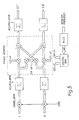
- the transformation is effected by the circuit arrangement shown in Fig. 5.
- the digitised quadrature signals I & Q representing the real and imaginary components of the phasor, are first fed to respective correlators 50a, 50b where they are correlated with locally generated code signals.
- the correlated signals are then subjected to partial accumulation in accumulators 51a, 51b to reduce the data rate before feeding to the phase rotation circuitry.
- the channel processor (not shown) calculates the rotation frequency to be applied to correct the Doppler loss in the received signal.
- This rotation frequency is fed to a numerically controlled oscillator (NCO) 52 which derives a phase rotation angle WT required to effect the necessary phase rotation of the signal vector.
- NCO numerically controlled oscillator
- a clocked shift register 61 acting as an accumulator to which is fed a digital word, say r 21 bits (representing a positive or a negative rotation frequency).
- the accumulator has a feedback summed with the input.
- the phase rotation angle is represented by a shorter M-bit digital word, say 6 bits) taken from an intermediate stage of the accumulator.
- the word length required will be determined by the maximum phase noise that may be tolerated from the rotation operation.
- This value will typically be well below the thermal noise expected in Navstar phase tracking loops.
- the frequency range and resolution of the NCO must be adequate to cover the complete expected Doppler range in steps small enough to prevent significant phase errors accumulating between NCO updates.
- a Doppler range of +10 kHz will be more than adequate as this will encompass the full satellite Doppler range of ⁇ 4 kHz together with a user velocity range of +Mach 3.8.
- the NCO will be updated at an effective rate of approximately twice the loop bandwidth.
- a frequency resolution of 0.01 Hz will permit a worst case phase error of ⁇ 0.06 radians to accrue. This is consistent with the phase noise given above.
- the number of bits required to control the NCO is therefore defined as ⁇ log 2 (20.10 3 /0.01) ⁇ 21 bits.
- the NCO must also be clocked at a sufficiently high rate to prevent jitter on the phase ramp output occurring. This jitter is produced as a consequence of the oscillator only producing a finite number of output samples per output cycle. The problem is therefore worst at the highest output frequency. In order to reduce this effect to the level of the phase quantisation, therefore, approximately 64 output samples per output cycle will be required. This corresponds to a clocking rate of 640 kHz.
- the number of bits required for the I and Q digitisations will be application dependent. If a 2 dB loss can be tolerated then single bit conversion will be adequate. However if 2 bits are used this loss will be reduced to 0.6 dB. These two cases assume that the signal to noise ratio is negative. As progression is made through the accumulation stages this will not always be the case and more bits will become necessary.
- phase rotation is effected therefore will depend on the implementation of the device.
- a 2 bit rotator operating at 20 MHz may be placed directly before or after the correlator.
- a slower but greater word length rotator may be used after a limited amount of post correlation accumulation.
- the phase rotator 53 comprises logic multipliers 54 and summers 55.
- Each of the digitised I & Q signals is separately multiplied by cos ⁇ T and sin ⁇ T, which are themselves derived from a read-only-memory (ROM) 56 to which the NCO output word is applied.
- the multiplier outputs I cos ⁇ T and Q sin ⁇ T are summed to give a corrected vector I 1 , likewise Q cos wT and I sin ⁇ T are summed to give Q 1 .
- I and Q are then subjected to further, post phase rotation accumulation in accumulators 57a, 57b before being input to the channel processor (not shown).
- the primary function of the channel processor is to maintain track of the code and carrier phases.
- Estimates of code position error may be made simply by differencing early and late correlation samples. These are derived by performing I 2 + Q 2 operations on early and late correlation outputs. It may be noted that in a digital implementation channel balance will no longer be a problem.
- the code position error estimates may then be applied to a software loop filter before being used to update the code generator (not shown), hence closing the code tracking loop.
- Carrier phase estimates may be made by using a Costas I.Q. technique on the prompt correlation samples. The carrier loop will then be closed in a similar manner to the code loop. Carrier frequency estimates may also be made by performing an operation on time sequential I,Q pairs as shown below ' This error function may be used to assist initial carrier phase acquisition and may also be employed to give frequency estimates when severe jamming precludes use of the carrier phase tracking loop.
- This configuration allows the addition of more receiver channels simply by the addition of extra code generators, N.C.O's and PROMS.
- the same A/D module and channel processor may be used for the extra channels.
- a separate A/D conversion module will, however, be required if Ll and L2 are to be received simultaneously.
- the adaptive threshold 2 bit A/D converters may be replaced with single bit units.
- the correlator need only be a switched early/late type and so only requiring a single pair of I and Q outputs.
- serial correlation blocks can be used in parallel.
Landscapes
- Engineering & Computer Science (AREA)
- Radar, Positioning & Navigation (AREA)
- Remote Sensing (AREA)
- Computer Networks & Wireless Communication (AREA)
- Physics & Mathematics (AREA)
- General Physics & Mathematics (AREA)
- Position Fixing By Use Of Radio Waves (AREA)
- Radio Relay Systems (AREA)
Applications Claiming Priority (2)
| Application Number | Priority Date | Filing Date | Title |
|---|---|---|---|
| GB08405386A GB2155268B (en) | 1984-03-01 | 1984-03-01 | Digital navstar receiver |
| GB8405386 | 1984-03-01 |
Publications (1)
| Publication Number | Publication Date |
|---|---|
| EP0155776A1 true EP0155776A1 (en) | 1985-09-25 |
Family
ID=10557417
Family Applications (1)
| Application Number | Title | Priority Date | Filing Date |
|---|---|---|---|
| EP85301261A Withdrawn EP0155776A1 (en) | 1984-03-01 | 1985-02-25 | Digital navstar receiver |
Country Status (5)
| Country | Link |
|---|---|
| US (1) | US4651154A (da) |
| EP (1) | EP0155776A1 (da) |
| JP (1) | JPS60210780A (da) |
| DK (1) | DK92985A (da) |
| GB (1) | GB2155268B (da) |
Cited By (13)
| Publication number | Priority date | Publication date | Assignee | Title |
|---|---|---|---|---|
| EP0220005A2 (en) | 1985-10-18 | 1987-04-29 | Nortel Networks Corporation | Phase rotation of signals |
| EP0230130A1 (en) * | 1985-12-23 | 1987-07-29 | Texas Instruments Incorporated | Global position system receiver |
| EP0230923A3 (en) * | 1986-01-21 | 1989-04-19 | Standard Elektrik Lorenz Aktiengesellschaft | Spread spectrum signals receiver |
| EP0242115A3 (en) * | 1986-04-14 | 1990-05-02 | Western Atlas International, Inc. | Method and system for determining position on a moving platform, such as a ship, using signals from gps satellites |
| US5014066A (en) * | 1982-03-01 | 1991-05-07 | Western Atlas International, Inc. | System for simultaneously deriving position information from a plurality of satellite transmissions |
| EP0438199A3 (en) * | 1990-01-19 | 1992-09-09 | Philips Electronics Uk Limited | Radio receiver |
| EP0508405A1 (en) * | 1991-04-12 | 1992-10-14 | Sharp Kabushiki Kaisha | System for measuring position by using global positioning system and receiver for global positioning system |
| US5805200A (en) * | 1982-03-01 | 1998-09-08 | Western Atlas International, Inc. | System for determining position from pseudorandomly modulated radio signals |
| US8364136B2 (en) | 1999-02-01 | 2013-01-29 | Steven M Hoffberg | Mobile system, a method of operating mobile system and a non-transitory computer readable medium for a programmable control of a mobile system |
| US8369967B2 (en) | 1999-02-01 | 2013-02-05 | Hoffberg Steven M | Alarm system controller and a method for controlling an alarm system |
| US8892495B2 (en) | 1991-12-23 | 2014-11-18 | Blanding Hovenweep, Llc | Adaptive pattern recognition based controller apparatus and method and human-interface therefore |
| US9151633B2 (en) | 1998-01-27 | 2015-10-06 | Steven M. Hoffberg | Mobile communication device for delivering targeted advertisements |
| US10361802B1 (en) | 1999-02-01 | 2019-07-23 | Blanding Hovenweep, Llc | Adaptive pattern recognition based control system and method |
Families Citing this family (28)
| Publication number | Priority date | Publication date | Assignee | Title |
|---|---|---|---|---|
| US4797677A (en) * | 1982-10-29 | 1989-01-10 | Istac, Incorporated | Method and apparatus for deriving pseudo range from earth-orbiting satellites |
| US4785463A (en) * | 1985-09-03 | 1988-11-15 | Motorola, Inc. | Digital global positioning system receiver |
| GB2211051B (en) * | 1987-10-10 | 1991-07-10 | Stc Plc | Code correlation arrangement |
| US4959656A (en) * | 1989-10-31 | 1990-09-25 | The United States Of America As Represented By The Administrator Of The National Aeronautics And Space Administration | Efficient detection and signal parameter estimation with application to high dynamic GPS receiver |
| US5101416A (en) * | 1990-11-28 | 1992-03-31 | Novatel Comunications Ltd. | Multi-channel digital receiver for global positioning system |
| US5390207A (en) * | 1990-11-28 | 1995-02-14 | Novatel Communications Ltd. | Pseudorandom noise ranging receiver which compensates for multipath distortion by dynamically adjusting the time delay spacing between early and late correlators |
| US5347284A (en) * | 1991-02-28 | 1994-09-13 | Texas Instruments Incorporated | System and method for a digital navigation satellite receiver |
| US5402450A (en) * | 1992-01-22 | 1995-03-28 | Trimble Navigation | Signal timing synchronizer |
| US5459758A (en) * | 1993-11-02 | 1995-10-17 | Interdigital Technology Corporation | Noise shaping technique for spread spectrum communications |
| US5703597A (en) * | 1995-12-22 | 1997-12-30 | Alliedsignal, Inc. | Adaptive carrier phase lock loop in a GPS receiver |
| US6067328A (en) * | 1996-12-12 | 2000-05-23 | Alliedsignal | High precision hardware carrier frequency and phase aiding in a GPS receiver |
| GB2351864B (en) * | 1999-07-05 | 2004-05-26 | Symmetricom Inc | A receiver for receiving rf pseudo-random encoded signals |
| US7184461B2 (en) * | 2000-03-13 | 2007-02-27 | Pri Research & Development Corp. | High speed precision pseudo random noise shift control for fast multiple channel global positioning system signal re-tracking |
| US7173957B2 (en) * | 2000-03-13 | 2007-02-06 | Pri Research & Development Corp. | Efficient epoch processing in multichannel global positioning system signal receiver |
| US6965631B2 (en) * | 2000-03-13 | 2005-11-15 | Pri Research & Development Corp. | Low power passive correlators for multichannel global positioning system signal receiver |
| US7876807B2 (en) * | 2004-07-05 | 2011-01-25 | Accord Software & Systems Pvt. Ltd. | Asymmetry technique for multipath mitigation in pseudorandom noise ranging receiver |
| US7339524B2 (en) * | 2004-07-30 | 2008-03-04 | Novariant, Inc. | Analog decorrelation of ranging signals |
| US7339526B2 (en) * | 2004-07-30 | 2008-03-04 | Novariant, Inc. | Synchronizing ranging signals in an asynchronous ranging or position system |
| US7532160B1 (en) * | 2004-07-30 | 2009-05-12 | Novariant, Inc. | Distributed radio frequency ranging signal receiver for navigation or position determination |
| US7342538B2 (en) * | 2004-07-30 | 2008-03-11 | Novariant, Inc. | Asynchronous local position determination system and method |
| US7205939B2 (en) * | 2004-07-30 | 2007-04-17 | Novariant, Inc. | Land-based transmitter position determination |
| US7315278B1 (en) * | 2004-07-30 | 2008-01-01 | Novariant, Inc. | Multiple frequency antenna structures and methods for receiving navigation or ranging signals |
| US7339525B2 (en) * | 2004-07-30 | 2008-03-04 | Novariant, Inc. | Land-based local ranging signal methods and systems |
| US7271766B2 (en) * | 2004-07-30 | 2007-09-18 | Novariant, Inc. | Satellite and local system position determination |
| GB0417717D0 (en) * | 2004-08-10 | 2004-09-08 | Koninkl Philips Electronics Nv | Identifying a reference point in a signal |
| US7428259B2 (en) * | 2005-05-06 | 2008-09-23 | Sirf Technology Holdings, Inc. | Efficient and flexible GPS receiver baseband architecture |
| RU2318221C1 (ru) * | 2006-07-04 | 2008-02-27 | Открытое акционерное общество "Российский институт радионавигации и времени" | Способ поиска сигналов спутников в многоканальном приемнике сигналов спутниковых радионавигационных систем |
| US8193968B1 (en) * | 2010-01-15 | 2012-06-05 | Exelis, Inc. | Systems and methods for space situational awareness and space weather |
Citations (3)
| Publication number | Priority date | Publication date | Assignee | Title |
|---|---|---|---|---|
| US3971996A (en) * | 1973-01-18 | 1976-07-27 | Hycom Incorporated | Phase tracking network |
| FR2522413A1 (fr) * | 1982-03-01 | 1983-09-02 | Macrometrics Inc | Procede et systeme pour mesurer des vecteurs sur ligne de base par radio-interferometrie en utilisant des signaux radio-electriques de satellites en orbite et dispositif utilise pour determiner l'emplacement d'un point sur le sol |
| EP0091167A1 (fr) * | 1982-04-09 | 1983-10-12 | Telecommunications Radioelectriques Et Telephoniques T.R.T. | Procédé de correction de fréquence de la porteuse locale dans le récepteur d'un système de transmission de données et récepteur utilisant ce procédé |
Family Cites Families (4)
| Publication number | Priority date | Publication date | Assignee | Title |
|---|---|---|---|---|
| US3755816A (en) * | 1970-05-01 | 1973-08-28 | Aii Syst | Radio navigation system |
| US4457006A (en) * | 1981-11-16 | 1984-06-26 | Sperry Corporation | Global positioning system receiver |
| DE3278915D1 (en) * | 1981-12-31 | 1988-09-22 | Secr Defence Brit | Receivers for navigation satellite systems |
| US4539565A (en) * | 1982-08-16 | 1985-09-03 | The Boeing Company | FM/CW radar linearization network and method therefor |
-
1984
- 1984-03-01 GB GB08405386A patent/GB2155268B/en not_active Expired
-
1985
- 1985-02-25 EP EP85301261A patent/EP0155776A1/en not_active Withdrawn
- 1985-02-27 US US06/706,310 patent/US4651154A/en not_active Expired - Lifetime
- 1985-02-27 JP JP60038622A patent/JPS60210780A/ja active Pending
- 1985-02-28 DK DK92985A patent/DK92985A/da not_active Application Discontinuation
Patent Citations (3)
| Publication number | Priority date | Publication date | Assignee | Title |
|---|---|---|---|---|
| US3971996A (en) * | 1973-01-18 | 1976-07-27 | Hycom Incorporated | Phase tracking network |
| FR2522413A1 (fr) * | 1982-03-01 | 1983-09-02 | Macrometrics Inc | Procede et systeme pour mesurer des vecteurs sur ligne de base par radio-interferometrie en utilisant des signaux radio-electriques de satellites en orbite et dispositif utilise pour determiner l'emplacement d'un point sur le sol |
| EP0091167A1 (fr) * | 1982-04-09 | 1983-10-12 | Telecommunications Radioelectriques Et Telephoniques T.R.T. | Procédé de correction de fréquence de la porteuse locale dans le récepteur d'un système de transmission de données et récepteur utilisant ce procédé |
Non-Patent Citations (2)
| Title |
|---|
| MILITARY MICROWAVES CONFERENCE PROCEEDINGS, October 25-27, 1978, London, GB, pages 61-74, Microwave Exhibitionss and Publishers Ltd., Sevenoaks, Kent, GB; F. PERGAL et al.: "Factors affecting pseudonoise system design in microwave satellite communications" * |
| PROCEEDINGS OF THE IEE part F, vol. 127, no. 2, April 1980, pages 163-167, Stevenage, GB; P.K. BLAIR: "Receivers for the NAVSTAR global positioning system" * |
Cited By (17)
| Publication number | Priority date | Publication date | Assignee | Title |
|---|---|---|---|---|
| US5805200A (en) * | 1982-03-01 | 1998-09-08 | Western Atlas International, Inc. | System for determining position from pseudorandomly modulated radio signals |
| US5014066A (en) * | 1982-03-01 | 1991-05-07 | Western Atlas International, Inc. | System for simultaneously deriving position information from a plurality of satellite transmissions |
| EP0220005A2 (en) | 1985-10-18 | 1987-04-29 | Nortel Networks Corporation | Phase rotation of signals |
| EP0230130A1 (en) * | 1985-12-23 | 1987-07-29 | Texas Instruments Incorporated | Global position system receiver |
| EP0230923A3 (en) * | 1986-01-21 | 1989-04-19 | Standard Elektrik Lorenz Aktiengesellschaft | Spread spectrum signals receiver |
| EP0242115A3 (en) * | 1986-04-14 | 1990-05-02 | Western Atlas International, Inc. | Method and system for determining position on a moving platform, such as a ship, using signals from gps satellites |
| EP0438199A3 (en) * | 1990-01-19 | 1992-09-09 | Philips Electronics Uk Limited | Radio receiver |
| EP0508405A1 (en) * | 1991-04-12 | 1992-10-14 | Sharp Kabushiki Kaisha | System for measuring position by using global positioning system and receiver for global positioning system |
| US5434787A (en) * | 1991-04-12 | 1995-07-18 | Sharp Kabushiki Kaisha | System for measuring position by using global positioning system and receiver for global position system |
| US8892495B2 (en) | 1991-12-23 | 2014-11-18 | Blanding Hovenweep, Llc | Adaptive pattern recognition based controller apparatus and method and human-interface therefore |
| US9551582B2 (en) | 1998-01-27 | 2017-01-24 | Blanding Hovenweep, Llc | Mobile communication device |
| US10127816B2 (en) | 1998-01-27 | 2018-11-13 | Blanding Hovenweep, Llc | Detection and alert of automobile braking event |
| US9151633B2 (en) | 1998-01-27 | 2015-10-06 | Steven M. Hoffberg | Mobile communication device for delivering targeted advertisements |
| US8364136B2 (en) | 1999-02-01 | 2013-01-29 | Steven M Hoffberg | Mobile system, a method of operating mobile system and a non-transitory computer readable medium for a programmable control of a mobile system |
| US9535563B2 (en) | 1999-02-01 | 2017-01-03 | Blanding Hovenweep, Llc | Internet appliance system and method |
| US8369967B2 (en) | 1999-02-01 | 2013-02-05 | Hoffberg Steven M | Alarm system controller and a method for controlling an alarm system |
| US10361802B1 (en) | 1999-02-01 | 2019-07-23 | Blanding Hovenweep, Llc | Adaptive pattern recognition based control system and method |
Also Published As
| Publication number | Publication date |
|---|---|
| JPS60210780A (ja) | 1985-10-23 |
| DK92985A (da) | 1985-09-02 |
| DK92985D0 (da) | 1985-02-28 |
| US4651154A (en) | 1987-03-17 |
| GB2155268A (en) | 1985-09-18 |
| GB2155268B (en) | 1987-08-26 |
Similar Documents
| Publication | Publication Date | Title |
|---|---|---|
| US4651154A (en) | Digital NAVSTAR receiver | |
| US4613977A (en) | Digital Navstar receiver | |
| US5414729A (en) | Pseudorandom noise ranging receiver which compensates for multipath distortion by making use of multiple correlator time delay spacing | |
| US5459473A (en) | GPS receiver | |
| US5192957A (en) | Sequencer for a shared channel global positioning system receiver | |
| US4821294A (en) | Digital signal processor and processing method for GPS receivers | |
| CA2232412C (en) | Receiver for determining a position on the basis of satellite networks | |
| EP1644753B1 (en) | A HARDWARE ARCHITECTURE FOR PROCESSING GALILEO ALTERNATE BINARY OFFSET CARRIER (AltBOC) SIGNALS | |
| EP0242115B1 (en) | Method and system for determining position on a moving platform, such as a ship, using signals from GPS satellites | |
| US4894842A (en) | Precorrelation digital spread spectrum receiver | |
| US5805108A (en) | Apparatus and method for processing multiple frequencies in satellite navigation systems | |
| US4841544A (en) | Digital direct sequence spread spectrum receiver | |
| US4578678A (en) | High dynamic global positioning system receiver | |
| US5576715A (en) | Method and apparatus for digital processing in a global positioning system receiver | |
| US5850420A (en) | Wideband receiver for the measurement of distance by pseudo-random code signals | |
| US4807256A (en) | Global position system receiver | |
| US5040240A (en) | Receiver architecture for use with a global positioning system | |
| CN100585428C (zh) | 用于解调卫星无线电导航信号的方法及装置 | |
| US6184822B1 (en) | Split C/A code receiver | |
| CN101568852A (zh) | 用于接收boc调制无线电导航信号的方法和设备 | |
| JP2006058297A (ja) | 最初に概略位置を知ることなしに無線周波数信号受信器の定位方法とその方法を実行する受信器 | |
| EP1159690B1 (en) | Method and apparatus for digital correlation | |
| DK166468B1 (da) | Digital modtager for satellitnavigationssystem med dopplerjustering | |
| Blair | Receivers for the NAVSTAR global positioning system | |
| WO1996027139A1 (en) | Method and apparatus for digital processing in a global positioning system receiver |
Legal Events
| Date | Code | Title | Description |
|---|---|---|---|
| PUAI | Public reference made under article 153(3) epc to a published international application that has entered the european phase |
Free format text: ORIGINAL CODE: 0009012 |
|
| AK | Designated contracting states |
Designated state(s): AT BE CH DE FR IT LI LU NL SE |
|
| 17P | Request for examination filed |
Effective date: 19850828 |
|
| RAP1 | Party data changed (applicant data changed or rights of an application transferred) |
Owner name: STC PLC |
|
| RAP1 | Party data changed (applicant data changed or rights of an application transferred) |
Owner name: STC PLC |
|
| 17Q | First examination report despatched |
Effective date: 19871216 |
|
| STAA | Information on the status of an ep patent application or granted ep patent |
Free format text: STATUS: THE APPLICATION IS DEEMED TO BE WITHDRAWN |
|
| 18D | Application deemed to be withdrawn |
Effective date: 19880427 |
|
| RIN1 | Information on inventor provided before grant (corrected) |
Inventor name: FEARNHEAD, GRAHAM ROY Inventor name: WONG, ANDREW CHI-CHUNG Inventor name: GALE, SIMON JOHN |