EP0155823A2 - Revêtement de substrats avec des films en résine synthétique - Google Patents
Revêtement de substrats avec des films en résine synthétique Download PDFInfo
- Publication number
- EP0155823A2 EP0155823A2 EP85301777A EP85301777A EP0155823A2 EP 0155823 A2 EP0155823 A2 EP 0155823A2 EP 85301777 A EP85301777 A EP 85301777A EP 85301777 A EP85301777 A EP 85301777A EP 0155823 A2 EP0155823 A2 EP 0155823A2
- Authority
- EP
- European Patent Office
- Prior art keywords
- substrate
- precursor
- synthetic resin
- treatment chamber
- evaporation container
- Prior art date
- Legal status (The legal status is an assumption and is not a legal conclusion. Google has not performed a legal analysis and makes no representation as to the accuracy of the status listed.)
- Granted
Links
Images

Classifications
-
- H—ELECTRICITY
- H10—SEMICONDUCTOR DEVICES; ELECTRIC SOLID-STATE DEVICES NOT OTHERWISE PROVIDED FOR
- H10P—GENERIC PROCESSES OR APPARATUS FOR THE MANUFACTURE OR TREATMENT OF DEVICES COVERED BY CLASS H10
- H10P14/00—Formation of materials, e.g. in the shape of layers or pillars
- H10P14/60—Formation of materials, e.g. in the shape of layers or pillars of insulating materials
- H10P14/68—Organic materials, e.g. photoresists
- H10P14/683—Organic materials, e.g. photoresists carbon-based polymeric organic materials, e.g. polyimides, poly cyclobutene or PVC
-
- B—PERFORMING OPERATIONS; TRANSPORTING
- B05—SPRAYING OR ATOMISING IN GENERAL; APPLYING FLUENT MATERIALS TO SURFACES, IN GENERAL
- B05D—PROCESSES FOR APPLYING FLUENT MATERIALS TO SURFACES, IN GENERAL
- B05D1/00—Processes for applying liquids or other fluent materials
- B05D1/60—Deposition of organic layers from vapour phase
-
- H—ELECTRICITY
- H10—SEMICONDUCTOR DEVICES; ELECTRIC SOLID-STATE DEVICES NOT OTHERWISE PROVIDED FOR
- H10P—GENERIC PROCESSES OR APPARATUS FOR THE MANUFACTURE OR TREATMENT OF DEVICES COVERED BY CLASS H10
- H10P14/00—Formation of materials, e.g. in the shape of layers or pillars
- H10P14/60—Formation of materials, e.g. in the shape of layers or pillars of insulating materials
- H10P14/63—Formation of materials, e.g. in the shape of layers or pillars of insulating materials characterised by the formation processes
- H10P14/6326—Deposition processes
- H10P14/6328—Deposition from the gas or vapour phase
- H10P14/6332—Deposition from the gas or vapour phase using thermal evaporation
-
- H—ELECTRICITY
- H10—SEMICONDUCTOR DEVICES; ELECTRIC SOLID-STATE DEVICES NOT OTHERWISE PROVIDED FOR
- H10P—GENERIC PROCESSES OR APPARATUS FOR THE MANUFACTURE OR TREATMENT OF DEVICES COVERED BY CLASS H10
- H10P14/00—Formation of materials, e.g. in the shape of layers or pillars
- H10P14/60—Formation of materials, e.g. in the shape of layers or pillars of insulating materials
- H10P14/65—Formation of materials, e.g. in the shape of layers or pillars of insulating materials characterised by treatments performed before or after the formation of the materials
- H10P14/6516—Formation of materials, e.g. in the shape of layers or pillars of insulating materials characterised by treatments performed before or after the formation of the materials of treatments performed after formation of the materials
- H10P14/6536—Formation of materials, e.g. in the shape of layers or pillars of insulating materials characterised by treatments performed before or after the formation of the materials of treatments performed after formation of the materials by exposure to radiation, e.g. visible light
-
- H—ELECTRICITY
- H10—SEMICONDUCTOR DEVICES; ELECTRIC SOLID-STATE DEVICES NOT OTHERWISE PROVIDED FOR
- H10P—GENERIC PROCESSES OR APPARATUS FOR THE MANUFACTURE OR TREATMENT OF DEVICES COVERED BY CLASS H10
- H10P14/00—Formation of materials, e.g. in the shape of layers or pillars
- H10P14/60—Formation of materials, e.g. in the shape of layers or pillars of insulating materials
- H10P14/65—Formation of materials, e.g. in the shape of layers or pillars of insulating materials characterised by treatments performed before or after the formation of the materials
- H10P14/6516—Formation of materials, e.g. in the shape of layers or pillars of insulating materials characterised by treatments performed before or after the formation of the materials of treatments performed after formation of the materials
- H10P14/6536—Formation of materials, e.g. in the shape of layers or pillars of insulating materials characterised by treatments performed before or after the formation of the materials of treatments performed after formation of the materials by exposure to radiation, e.g. visible light
- H10P14/6538—Formation of materials, e.g. in the shape of layers or pillars of insulating materials characterised by treatments performed before or after the formation of the materials of treatments performed after formation of the materials by exposure to radiation, e.g. visible light by exposure to UV light
-
- H—ELECTRICITY
- H10—SEMICONDUCTOR DEVICES; ELECTRIC SOLID-STATE DEVICES NOT OTHERWISE PROVIDED FOR
- H10P—GENERIC PROCESSES OR APPARATUS FOR THE MANUFACTURE OR TREATMENT OF DEVICES COVERED BY CLASS H10
- H10P14/00—Formation of materials, e.g. in the shape of layers or pillars
- H10P14/60—Formation of materials, e.g. in the shape of layers or pillars of insulating materials
- H10P14/63—Formation of materials, e.g. in the shape of layers or pillars of insulating materials characterised by the formation processes
- H10P14/6326—Deposition processes
- H10P14/6328—Deposition from the gas or vapour phase
- H10P14/6334—Deposition from the gas or vapour phase using decomposition or reaction of gaseous or vapour phase compounds, i.e. chemical vapour deposition
Definitions
- This invention relates to the covering of substrates with synthetic resin films.
- substrates with films of synthetic resin for various purposes.
- semiconductive elements may be covered with an insulating film, a passivating film, or a soft error preventing film; or a liquid crystal display element may be covered with a liquid crystal orientation film.
- Other substrates may be coated with a separation film for liquid or gas or with a photo resist.
- the wet process is such that it is very difficult to obtain an extremely thin film, and the adhesion of the film to the substrate is not always sufficient. Further it often happens that impurities are liable to be included in the film because the process involves such steps as the addition of solvent, removal of the solvent, recovery of the solvent, etc.
- the polymer vapor deposition process is such that the degree of polymerization of the film is often insufficient because decomposition and depolymerization often occur.
- the plasma polymerization process is such that control of the molecular structure of the synthetic resin is difficult because decomposition of the precursor often takes place and, in addition, the resultant synthetic resin film is comparatively rigid because cross-linking tends to occur.
- one aspect of the present invention provides a process for covering a substrate with a synthetic resin film by contacting the substrate with one or more precursors for the synthetic resin and polymerising the precursor(s) in contact with the substrate characterised in that the or each precursor is evaporated under vacuum to form vapors of the precursor and the substrate is contacted with the vapors.
- the vacuum degree is usually set to be from about 1 x 10- 2 to about 1 x 10 -6 Torr.
- At least one kind of precursor for a predetermined synthetic resin is evaporated under vacuum in order that vapors thereof may be polymerized on a substrate.
- uniform precursor Vapors which do not contain any impurities or decomposed precursor can be deposited on the substrate and be brought into contact with each other thereon.
- a satisfactory polymerization reaction can be effected, and a synthetic resin film which is fine in structure, high in purity and uniform in thickness and which has good adhesion to the substrate can be formed.
- any desired covering film thickness, including extremely thin films, can be obtained.
- the or each precursor may be a monomer or an oligomer and the process is not limited in regard to the nature or number of the monomers or oligomers which may be used. It is possible to make a synthetic resin of desired molecular structure by properly selecting the nature and the number of the monomers or oligomers to be used and any of various polymerisations reactions such as addition polymerization, condensation polymerization, or photopolymerisation can be employed as appropriate.
- a polyimide e.g. using pyromellitic acid anhydride and 4,4'-diaminodiphenyl ether as precursors
- a polyamide e.g. using terephthalic acid dichloride and 4,4'-diaminodiphenyl ether as precursors
- a polyurea e.g. using 4,4'-diphenyl methane diisocyanate and 4,4 1- diamino diphenyl ether as precursors
- a polyurethane e.g. using 4,4'-diphenyl methane diisocyanate and p-hydroquinone as precursors.
- the precursor(s) can be deposited on to a substrate which has been previously heated to a predetermined temperature or the substrate can be heated after the deposition of the precursor(s) thereon at room temperature.
- the precursor(s) polymerise(s) by a photo-polymerization reaction
- this can be achieved by irradiating the precursor(s) on the substrate with actinic light.
- a coating formed of a cinnamic acid derivative polymer may be produced (e.g. using distyryl ketone as precursor).
- An initiator or the like for the polymerization reaction can be evaporated simultaneously with the evaporation of the precursor(s) if the occasion demands.
- an apparatus for covering a substrate with a synthetic resin film by the process as mentioned above characterised in that it comprises a treatment chamber connected to a vacuum supply, an evaporation container located within the chamber for each precursor, a holder for the substrate which holder is located within the chamber and is disposed so that the substrate can be contacted by precursor vapors from the or each evaporation container, a heater for heating the precursor in each evaporation container, and a shutter capable of being interposed between the substrate holder and the evaporation container(s).
- the substrate holder and the evaporation container are so disposed as to face one another and, in a particularly preferred embodiment, the apparatus is designed to effect the polymerisation of the precursor(s) by a thermal reaction.
- a heater for the substrate is provided at that side of the holder which is remote from the evaporation container.
- a part of the, or of one of the, evaporation container(s) is extended to the exterior of the treatment chamber.
- The, or one of the, precursor is placed in this extended part and heated and evaporated therein. In this way the vapor pressure of the precursor can be more easily controlled.
- the apparatus is designed to effect the polymerisation of the precursor by photopolymerisation.
- a light source is provided externally of the treatment chamber for irradiating the substrate holder through a light transmission window in the treatment chamber.
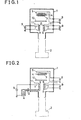
- an apparatus comprising.a treatment chamber connected to a vacuum evacuation system 2 such as an exterior vacuum pump or the like.
- a substrate 3 on which a covering film of synthetic resin is to be formed, is so held by a substrate holder 4 in the treatment chamber 1 as to be directed downwards.
- the substrate 3 is arranged to be heated to a predetermined temperature by a heater 5 provided behind a back surface of the substrate holder 4.
- two glass tubular evaporation containers 6 for evaporating two different synthetic resin precursors a and b are so provided at a lower portion of the interior of the treatment chamber 1 as to be directed towards the substrate 3.
- Each of these evaporation containers 6 is arranged to be heated to a predetermined temperature by a heater 7 coiled around the same.
- numeral 8 denotes an electric power source for the heater 5
- numeral 9 denotes an electic power source for the heater 7
- numeral 10 denotes a moveable shutter interposed between the substrate 3 and the evaporation containers 6.
- Numeral 11 denotes thermo-couples inserted in each of the precursors a and b so that the temperatures thereof can be constantly measured and controlled by a suitable means (not shown) located externally of the treatment chamber.
- a polyimide film was formed on a substrate from its precursors by a condensation polymerization reaction.
- Pyromellitic acid dianhydride (precursor a) was introduced into one of the evaporation containers 6 and 4,4'-diaminodiphenylether (precursor b) was charged into the other evaporation container.
- the total pressure of the atmosphere in the treatment chamber 1 was reduced to 1 x 10 -5 Torr by means of the vacuum evacuation system 2 with the shutter 10 closed i.e. in a position where it is interposed between the evaporation containers 6 and the substrate 3 in the holder 4.
- the pyromellitic acid dianhydride was heated to 175 ⁇ 29C, and the 4,4'-diaminodiphenylether was heated to 170 ⁇ 2°C, by the respective heaters.
- the shutter 10 was opened so that it was no longer shielding the substrate 3 from the evaporation containers 6 whereby vapors of the precursors a and b were deposited on the substate 3 to form a film of predetermined thickness at a deposition rate of 150A/min.
- the shutter 10 was closed again, and the substrate 3 was heated to 250 0 C by the heater 5. This temperature was kept for 40 - 60 minutes to bring about a polycondensation reaction of the precursors on the substrate 3 to form a polyimide covering film on the substrate 3.
- the precursors a and b were caused to evaporate at a mol ratio of 1:1 in stoichiometric terms by adjusting the vapor pressures thereof so that the desired covering film was formed.
- the resultant polyimide covering film was fine in structure, high in purity, and had good adhesion to the substrate.
- the film was by no means inferior to films formed by the conventional wet process in so far as various properties, such as electrical insulating property, chemical resistance, and heat resistance, were concerned.
- a polyamide film was formed on a substrate, from its precursors by a condensation polymerisation reaction.
- Terephthalic acid dichloride (precursor a) and 4,4'-diaminodiphenylether (precursor b) were charged into their respective evaporation containers 6 and the total pressure of the atmosphere in the treatment chamber 1 was set at 1 x 10 -5 Torr by means of the vacuum evacuation system 2 with the shutter 10 closed.
- the terephthalic acid dichloride was heated to 64 ⁇ 2 0 C and the 4,4'-diaminodiphenylether was heated to 165 + 2 0 C by their respective heaters.
- the pressure in the treatment chamber 1 was set at 5 x 10 -3 Torr by the vapor pressure of the terephthalic acid dichloride in order that the respective precursors a and b may be evaporated in a mol ratio of 1:1
- the shutter 10 was opened, and vapors of the precursors a and b were deposited on the substrate o 3 at a deposition rate of 60A/min., and polymerised together at room temperature.
- the shutter was closed when the resultant polymide film reached a predetermined thickness.
- the polymerization reaction on the substrate 3 proceeded as follows. Firstly, vapors of the 4,4' diaminodiphenylether adhered to the substrate 3, and vapors of the simultaneously evaporated terephthalic acid dichloride were then brought into contact therewith so that the desired polymerization reaction took place on the substrate 3. Thereafter the two kinds of vapor were deposited thereon one after another and the polymerization reaction thus progressed.
- the resultant polyamide covering film was fine in structure, high in purity, and had good adhesion to the substrate. In addition, it was by no means inferior to films formed by the conventional wet process in so far as various properties, such a electrical insulating property, chemical resistance, and heat resistance, were concerned.
- 4,4'-diaminodiphenylether diisocyanate (precursor a) and 4,4'-diaminodiphenylether (precursor b) were charged into their respective evaporation containers 6 and the whole pressure of the atmospheric gas in the treatment chamber 1 was set at 1 x 10" Torr with the shutter 10 closed. Thereafter, the 4,4'-diphenylmethane diisocyanate and the 4,4'-diaminodiphenylether were heated, by the heaters 7 to 82 ⁇ 2°C and 140 ⁇ 2°C, respectively. The shutter 10 was then opened and the precursors a and b were deposited on the substrate 3 at a deposition rate of 60A/min.
- the polymerization of the precursors on the substrate progressed at room temperature to form a polyurea covering film of a predetermined thickness.
- the precursors a and b were evaporated in a mol ratio of 1:1 in stoichiometric terms by adjusting the vapor pressures thereof so that the desired covering film was formed.
- the resultant polyurea covering film was fine in structure, high in purity and had good adhesion to the substrate. Further, it had better heat resistance than a comparable film formed in conventional manner.
- the degree of polymerization of the resultant covering film could be adjusted by heating the substrate 3 to a predetermined temperature by means of the heater 5.
- the 4,4'-diphenylmethane diisocyanate and the p-hydroquinone were heated by the heaters 7 to 82 + 2°C and 120 + 2°C, respectively, in almost the same manner as in the foregoing example.
- the shutter 10 was then opened while the pressure was kept at 1 x 10 -5 Torr whereby the precursors a and b were deposited on the substrate 3 at a o deposition rate of 600A/min., while the substrate 3 was being heated to 150°C. In this way, the precursors underwent a polymerization reaction on the substrate 3 to form a polyurethane covering film.
- the polyurethane covering film thus produced in this example was also fine in structure, high in purity, and had good adhesion to the substrate. Its heat resistance was nearly equal to that of a comparable film formed in conventional manner.
- the evaporation container 6 for evaporating the precursor a includes a part which extends to the exterior of the treatment chamber 1 so that a precursor may be introduced, in the form of a vapor thereof, into the treatment chamber 1 after it has been charged and evaporated in the externally extended part. In this way, an adjustment of the gas pressure can be carried out easily.
- Numeral 12 denotes a valve for adjusting the amount of vapor introduced.
- FIG. 3 there is shown a modified apparatus for carrying out the formation of the synthetic resin covering film by means of photopolymerization.
- Parts corresponding to parts of Fig. 1 are denoted by like reference numerals.
- a single tubular evaporation container 6 ii provided in the treatment chamber 1, and the substrate 3 facing the container 6 through the shutter 10 is so held by the substrate holder 4 as to be directed obliquely towards the container 6.
- a light source 13 such as a xenon lamp for irradiating the substrate 3 with light through a quartz window pane 14 provided in a wall la of the treatment chamber 1.
- a precursor c of the desired film is contained in the container 6 and is so arranged as to be heated by the heater 7 coiled around the container 6 while its temperature is being measured by the thermo-couple 11 led out to the exterior of the chamber 1.
- a covering film of a cinnamic acid derivative polymer is formed from its precursor by means of a photo-polymerization reaction using the apparatus shown in Figure 3.
- the interior of the treatment chamber 1 was evacuated to 1 x 10 -5 Torr, and distyryl ketone (precursor c) was charged into the evaporation container 6 and heated to a predetermined temperature with the shutter 10 in its closed position.
- the precursor c was heated to 105 ⁇ 2 0 C by the heater 7, while the temperature thereof was monitored by the thermo-couple 11.
- the light source 13 was then turned on, and the substrate 3 was irradiated with light from the source passing through the window pane 14. Thereafter, the shutter 10 was opened, whereby vapors of the precursor c, from the evaporation container 6, were deposited on the substrate 3.
- the substrate 3 was at a room temperature, the distance between the evaporation container 6 and the substrate 3 was 200 mm, and the deposition rate of the vapors of precursor c on the 0 substrate 3 was about 50 A/min. After the polymer film on the substrate had reached a predetermined thickness, the shutter 10 was closed. Thus by means of this process, a cinnamic acid derivative polymer covering film was formed on the substrate 3.
- the resultant covering film in this Example was also fine in structure, high in purity, and had good adhesion. Also, its heat resistance was nearly equal to that of a comparable film formed in conventional manner.
Landscapes
- Physical Vapour Deposition (AREA)
Applications Claiming Priority (6)
| Application Number | Priority Date | Filing Date | Title |
|---|---|---|---|
| JP52344/84 | 1984-03-21 | ||
| JP5234484A JPS60197730A (ja) | 1984-03-21 | 1984-03-21 | ポリイミド膜の形成方法 |
| JP17929384A JPS6157602A (ja) | 1984-08-30 | 1984-08-30 | 光重合法によるポリマ−被膜の形成法 |
| JP179293/84 | 1984-08-30 | ||
| JP59200257A JPS6178463A (ja) | 1984-09-25 | 1984-09-25 | 合成樹脂被膜の形成方法 |
| JP200257/84 | 1984-09-25 |
Publications (3)
| Publication Number | Publication Date |
|---|---|
| EP0155823A2 true EP0155823A2 (fr) | 1985-09-25 |
| EP0155823A3 EP0155823A3 (en) | 1986-10-01 |
| EP0155823B1 EP0155823B1 (fr) | 1989-07-26 |
Family
ID=27294609
Family Applications (1)
| Application Number | Title | Priority Date | Filing Date |
|---|---|---|---|
| EP85301777A Expired EP0155823B1 (fr) | 1984-03-21 | 1985-03-14 | Revêtement de substrats avec des films en résine synthétique |
Country Status (3)
| Country | Link |
|---|---|
| US (1) | US4624867A (fr) |
| EP (1) | EP0155823B1 (fr) |
| DE (1) | DE3571772D1 (fr) |
Cited By (4)
| Publication number | Priority date | Publication date | Assignee | Title |
|---|---|---|---|---|
| US4737232A (en) * | 1985-01-17 | 1988-04-12 | Jean Flicstein | Process for depositing and crystallizing a thin layer of organic material by means of a beam of energy |
| EP0255037A3 (en) * | 1986-07-30 | 1989-03-15 | Hitachi, Ltd. | A method for forming polyimide film by chemical vapor deposition |
| EP0376333A3 (fr) * | 1988-12-29 | 1991-03-06 | Sharp Kabushiki Kaisha | Méthode et appareillage pour la fabrication de films minces de polyimide |
| EP2135971A4 (fr) * | 2007-04-16 | 2012-08-08 | Ulvac Inc | Film polyurée et son procédé de formation |
Families Citing this family (42)
| Publication number | Priority date | Publication date | Assignee | Title |
|---|---|---|---|---|
| US6224948B1 (en) | 1997-09-29 | 2001-05-01 | Battelle Memorial Institute | Plasma enhanced chemical deposition with low vapor pressure compounds |
| US6045864A (en) * | 1997-12-01 | 2000-04-04 | 3M Innovative Properties Company | Vapor coating method |
| CA2353506A1 (fr) | 1998-11-02 | 2000-05-11 | 3M Innovative Properties Company | Oxydes conducteurs transparents pour ecran plat en plastique |
| US6217947B1 (en) | 1998-12-16 | 2001-04-17 | Battelle Memorial Institute | Plasma enhanced polymer deposition onto fixtures |
| US6268695B1 (en) | 1998-12-16 | 2001-07-31 | Battelle Memorial Institute | Environmental barrier material for organic light emitting device and method of making |
| US6274204B1 (en) | 1998-12-16 | 2001-08-14 | Battelle Memorial Institute | Method of making non-linear optical polymer |
| US6207238B1 (en) * | 1998-12-16 | 2001-03-27 | Battelle Memorial Institute | Plasma enhanced chemical deposition for high and/or low index of refraction polymers |
| US6207239B1 (en) | 1998-12-16 | 2001-03-27 | Battelle Memorial Institute | Plasma enhanced chemical deposition of conjugated polymer |
| US6228434B1 (en) | 1998-12-16 | 2001-05-08 | Battelle Memorial Institute | Method of making a conformal coating of a microtextured surface |
| US6228436B1 (en) * | 1998-12-16 | 2001-05-08 | Battelle Memorial Institute | Method of making light emitting polymer composite material |
| US6358570B1 (en) | 1999-03-31 | 2002-03-19 | Battelle Memorial Institute | Vacuum deposition and curing of oligomers and resins |
| US6506461B2 (en) * | 1999-03-31 | 2003-01-14 | Battelle Memorial Institute | Methods for making polyurethanes as thin films |
| AU5926800A (en) * | 1999-07-08 | 2001-01-30 | Nanocell, Inc. | Semiconductor devices and process for manufacture |
| US6548912B1 (en) | 1999-10-25 | 2003-04-15 | Battelle Memorial Institute | Semicoductor passivation using barrier coatings |
| US6573652B1 (en) | 1999-10-25 | 2003-06-03 | Battelle Memorial Institute | Encapsulated display devices |
| US6866901B2 (en) | 1999-10-25 | 2005-03-15 | Vitex Systems, Inc. | Method for edge sealing barrier films |
| US20100330748A1 (en) | 1999-10-25 | 2010-12-30 | Xi Chu | Method of encapsulating an environmentally sensitive device |
| US7198832B2 (en) * | 1999-10-25 | 2007-04-03 | Vitex Systems, Inc. | Method for edge sealing barrier films |
| US6413645B1 (en) | 2000-04-20 | 2002-07-02 | Battelle Memorial Institute | Ultrabarrier substrates |
| US6623861B2 (en) | 2001-04-16 | 2003-09-23 | Battelle Memorial Institute | Multilayer plastic substrates |
| US6492026B1 (en) | 2000-04-20 | 2002-12-10 | Battelle Memorial Institute | Smoothing and barrier layers on high Tg substrates |
| TW200304955A (en) * | 2002-04-05 | 2003-10-16 | Matsushita Electric Industrial Co Ltd | Method and apparatus for producing resin thin film |
| US8808457B2 (en) | 2002-04-15 | 2014-08-19 | Samsung Display Co., Ltd. | Apparatus for depositing a multilayer coating on discrete sheets |
| US8900366B2 (en) | 2002-04-15 | 2014-12-02 | Samsung Display Co., Ltd. | Apparatus for depositing a multilayer coating on discrete sheets |
| JP2004115777A (ja) * | 2002-09-06 | 2004-04-15 | Ulvac Japan Ltd | 抗菌性高分子及びその製造方法、抗菌性高分子被膜及びその作製方法、並びにこの被膜を表面に有する物品 |
| US7648925B2 (en) | 2003-04-11 | 2010-01-19 | Vitex Systems, Inc. | Multilayer barrier stacks and methods of making multilayer barrier stacks |
| US7510913B2 (en) | 2003-04-11 | 2009-03-31 | Vitex Systems, Inc. | Method of making an encapsulated plasma sensitive device |
| JP2005083792A (ja) * | 2003-09-05 | 2005-03-31 | Konica Minolta Medical & Graphic Inc | 放射線画像変換パネル及びその製造方法 |
| JP4208790B2 (ja) * | 2004-08-10 | 2009-01-14 | キヤノン株式会社 | 放射線検出装置の製造方法 |
| KR101063788B1 (ko) * | 2005-03-24 | 2011-09-08 | 가부시키가이샤 알박 | 진공부품의 제조방법 |
| US7767498B2 (en) | 2005-08-25 | 2010-08-03 | Vitex Systems, Inc. | Encapsulated devices and method of making |
| KR101511799B1 (ko) | 2006-12-28 | 2015-04-13 | 쓰리엠 이노베이티브 프로퍼티즈 컴파니 | 박막 금속 층 형성을 위한 핵형성 층 |
| US8524369B2 (en) * | 2007-10-18 | 2013-09-03 | Ulvac, Inc. | Method for lamination of decorative metal film on resin base material, and resin base material having decorative metal film thereon |
| US8350451B2 (en) | 2008-06-05 | 2013-01-08 | 3M Innovative Properties Company | Ultrathin transparent EMI shielding film comprising a polymer basecoat and crosslinked polymer transparent dielectric layer |
| US9337446B2 (en) | 2008-12-22 | 2016-05-10 | Samsung Display Co., Ltd. | Encapsulated RGB OLEDs having enhanced optical output |
| US9184410B2 (en) | 2008-12-22 | 2015-11-10 | Samsung Display Co., Ltd. | Encapsulated white OLEDs having enhanced optical output |
| US8590338B2 (en) | 2009-12-31 | 2013-11-26 | Samsung Mobile Display Co., Ltd. | Evaporator with internal restriction |
| US8969096B2 (en) * | 2011-09-01 | 2015-03-03 | Toyota Motor Engineering & Manufacturing North America, Inc. | Automotive fogging analyses by xenon UV exposure |
| CN106632942B (zh) * | 2016-09-30 | 2019-04-16 | 中国林业科学研究院林产化学工业研究所 | 一种具有自修复功能的热固性聚氨酯及其制备方法 |
| US11492300B2 (en) | 2016-12-27 | 2022-11-08 | Sabic Global Technologies B.V. | Drying a coating using electromagnetic radiation or heating of drum |
| EP3562596B1 (fr) | 2016-12-28 | 2025-05-07 | Sabic Agri-Nutrients Company | Récupération de solvant de flux de gaz de balayage provenant des procédés de revêtement d'engrais |
| US20240209567A1 (en) * | 2021-04-29 | 2024-06-27 | Soliyarn, Inc. | Producing coated textiles using photo-initiated chemical vapor deposition |
Family Cites Families (20)
| Publication number | Priority date | Publication date | Assignee | Title |
|---|---|---|---|---|
| US3119707A (en) * | 1960-03-31 | 1964-01-28 | Space Technology Lab Inc | Method for the deposition of thin films by electron deposition |
| US3271180A (en) * | 1962-06-19 | 1966-09-06 | Ibm | Photolytic processes for fabricating thin film patterns |
| US3406040A (en) * | 1964-06-24 | 1968-10-15 | Ibm | Vapor deposition method for forming thin polymeric films |
| US3374111A (en) * | 1964-06-30 | 1968-03-19 | Ibm | Method for depositing thin dielectric polymer films |
| US3578425A (en) * | 1967-03-14 | 1971-05-11 | Gen Electric | Diamond and boron nitride particles coated with a polymerized dianhydride |
| US3713874A (en) * | 1967-03-14 | 1973-01-30 | Gen Electric | Photopolymerized polycarboxylic acid anhydride film coating and product,and method of forming |
| US3619259A (en) * | 1967-04-04 | 1971-11-09 | Gen Electric | Photopolymerized film, composite thereof, and method of forming |
| GB1298453A (en) * | 1969-01-02 | 1972-12-06 | Nat Res Dev | Production of polymer films by evaporation |
| US3607365A (en) * | 1969-05-12 | 1971-09-21 | Minnesota Mining & Mfg | Vapor phase method of coating substrates with polymeric coating |
| US3665269A (en) * | 1969-12-29 | 1972-05-23 | Gen Electric | Capacitors having a photopolymerized dielectric film |
| US3829324A (en) * | 1970-03-31 | 1974-08-13 | Canadian Patents Dev | Bonding condensation polymers to polymeric base materials |
| GB1449835A (en) * | 1973-12-07 | 1976-09-15 | Nat Res Dev | Composite metal polymer films |
| JPS573137B2 (fr) * | 1974-03-13 | 1982-01-20 | ||
| US4180614A (en) * | 1975-01-20 | 1979-12-25 | E. I. Du Pont De Nemours And Company | Gas-barrier coated films, sheets or foils and method of preparation |
| US4104438A (en) * | 1975-01-20 | 1978-08-01 | E. I. Du Pont De Nemours And Company | Gas-barrier coated films, sheets or foils and method of preparation |
| US4009153A (en) * | 1975-03-04 | 1977-02-22 | E. I. Du Pont De Nemours And Co. | Vapor-phase preparation of aromatic polyamides |
| US4107349A (en) * | 1977-08-12 | 1978-08-15 | The United States Of America As Represented By The Secretary Of The Army | Method of adjusting the frequency of piezoelectric resonators |
| US4331705A (en) * | 1979-05-11 | 1982-05-25 | Minnesota Mining And Manufacturing Company | Curing of polyamic acids or salts thereof by ultraviolet exposure |
| US4331722A (en) * | 1980-12-11 | 1982-05-25 | Packo Industries, Inc. | Sealing leaks by polymerization of volatilized organosilane monomers |
| US4357364A (en) * | 1981-04-27 | 1982-11-02 | Rockwell International Corporation | High rate resist polymerization method |
-
1985
- 1985-03-14 DE DE8585301777T patent/DE3571772D1/de not_active Expired
- 1985-03-14 EP EP85301777A patent/EP0155823B1/fr not_active Expired
- 1985-03-21 US US06/714,291 patent/US4624867A/en not_active Expired - Lifetime
Cited By (4)
| Publication number | Priority date | Publication date | Assignee | Title |
|---|---|---|---|---|
| US4737232A (en) * | 1985-01-17 | 1988-04-12 | Jean Flicstein | Process for depositing and crystallizing a thin layer of organic material by means of a beam of energy |
| EP0255037A3 (en) * | 1986-07-30 | 1989-03-15 | Hitachi, Ltd. | A method for forming polyimide film by chemical vapor deposition |
| EP0376333A3 (fr) * | 1988-12-29 | 1991-03-06 | Sharp Kabushiki Kaisha | Méthode et appareillage pour la fabrication de films minces de polyimide |
| EP2135971A4 (fr) * | 2007-04-16 | 2012-08-08 | Ulvac Inc | Film polyurée et son procédé de formation |
Also Published As
| Publication number | Publication date |
|---|---|
| US4624867A (en) | 1986-11-25 |
| EP0155823B1 (fr) | 1989-07-26 |
| DE3571772D1 (en) | 1989-08-31 |
| EP0155823A3 (en) | 1986-10-01 |
Similar Documents
| Publication | Publication Date | Title |
|---|---|---|
| EP0155823B1 (fr) | Revêtement de substrats avec des films en résine synthétique | |
| Fortin et al. | Chemical vapor deposition polymerization: the growth and properties of parylene thin films | |
| US5536317A (en) | Parylene deposition apparatus including a quartz crystal thickness/rate controller | |
| Takahashi et al. | Synthesis of aromatic polyimide film by vacuum deposition polymerization | |
| US6107184A (en) | Nano-porous copolymer films having low dielectric constants | |
| US5538758A (en) | Method and apparatus for the deposition of parylene AF4 onto semiconductor wafers | |
| JP3488458B2 (ja) | 物品のための保護フィルム及び方法 | |
| Han et al. | Pulsed plasma polymerization of pentafluorostyrene: synthesis of low dielectric constant films | |
| US5536322A (en) | Parylene deposition apparatus including a heated and cooled support platen and an electrostatic clamping device | |
| Limb et al. | Pulsed plasma‐enhanced chemical vapor deposition from hexafluoropropylene oxide: Film composition study | |
| KR20010052861A (ko) | P-크실리렌과 다중비닐 규소/산소 공단량체의 공중합체의화학 증착 | |
| EP0862664B1 (fr) | Procede et appareil de depot de parylene af4 sur tranches de semi-conducteurs | |
| JPH046791B2 (fr) | ||
| JPH09143681A (ja) | 高分子薄膜の形成方法 | |
| US4588609A (en) | Process for the photochemical vapor deposition of aromatic polymers | |
| US6362115B1 (en) | In-situ generation of p-xylyiene from liquid precursors | |
| JPS61261322A (ja) | 合成樹脂被膜の形成方法 | |
| JP2912756B2 (ja) | 合成樹脂被膜の形成装置及び形成方法 | |
| EP0054189B1 (fr) | Procédé pour le dépôt photochimique en phase vapeur | |
| US9957618B2 (en) | Single-unit reactor design for combined oxidative, initiated, and plasma-enhanced chemical vapor deposition | |
| JPH05171415A (ja) | 合成樹脂被膜の形成装置及び形成方法 | |
| Liberman et al. | Integration of vapor deposited polyimide into a multichip module packaging process | |
| CA1184149A (fr) | Phosphines polymerisees au plasma, comme agents ameliorant l'adherence | |
| JP2002285320A (ja) | 有機高分子薄膜の形成方法 | |
| JPH0762236B2 (ja) | 合成樹脂被膜の形成方法 |
Legal Events
| Date | Code | Title | Description |
|---|---|---|---|
| PUAI | Public reference made under article 153(3) epc to a published international application that has entered the european phase |
Free format text: ORIGINAL CODE: 0009012 |
|
| AK | Designated contracting states |
Designated state(s): CH DE FR GB LI |
|
| PUAL | Search report despatched |
Free format text: ORIGINAL CODE: 0009013 |
|
| AK | Designated contracting states |
Kind code of ref document: A3 Designated state(s): CH DE FR GB LI |
|
| 17P | Request for examination filed |
Effective date: 19861124 |
|
| 17Q | First examination report despatched |
Effective date: 19870914 |
|
| RAP1 | Party data changed (applicant data changed or rights of an application transferred) |
Owner name: NIHON SHINKU GIJUTSU KABUSHIKI KAISHA |
|
| GRAA | (expected) grant |
Free format text: ORIGINAL CODE: 0009210 |
|
| AK | Designated contracting states |
Kind code of ref document: B1 Designated state(s): CH DE FR GB LI |
|
| REF | Corresponds to: |
Ref document number: 3571772 Country of ref document: DE Date of ref document: 19890831 |
|
| ET | Fr: translation filed | ||
| PLBE | No opposition filed within time limit |
Free format text: ORIGINAL CODE: 0009261 |
|
| STAA | Information on the status of an ep patent application or granted ep patent |
Free format text: STATUS: NO OPPOSITION FILED WITHIN TIME LIMIT |
|
| 26N | No opposition filed | ||
| REG | Reference to a national code |
Ref country code: GB Ref legal event code: IF02 |
|
| PGFP | Annual fee paid to national office [announced via postgrant information from national office to epo] |
Ref country code: GB Payment date: 20040310 Year of fee payment: 20 |
|
| PGFP | Annual fee paid to national office [announced via postgrant information from national office to epo] |
Ref country code: FR Payment date: 20040326 Year of fee payment: 20 |
|
| PGFP | Annual fee paid to national office [announced via postgrant information from national office to epo] |
Ref country code: CH Payment date: 20040329 Year of fee payment: 20 |
|
| PGFP | Annual fee paid to national office [announced via postgrant information from national office to epo] |
Ref country code: DE Payment date: 20040527 Year of fee payment: 20 |
|
| PG25 | Lapsed in a contracting state [announced via postgrant information from national office to epo] |
Ref country code: LI Free format text: LAPSE BECAUSE OF EXPIRATION OF PROTECTION Effective date: 20050313 Ref country code: GB Free format text: LAPSE BECAUSE OF EXPIRATION OF PROTECTION Effective date: 20050313 Ref country code: CH Free format text: LAPSE BECAUSE OF EXPIRATION OF PROTECTION Effective date: 20050313 |
|
| REG | Reference to a national code |
Ref country code: GB Ref legal event code: PE20 |
|
| REG | Reference to a national code |
Ref country code: CH Ref legal event code: PL |