EP0155860A1 - Frequenz- und Phasenstabilisierung von Farbvideokodern/Dekodern - Google Patents
Frequenz- und Phasenstabilisierung von Farbvideokodern/Dekodern Download PDFInfo
- Publication number
- EP0155860A1 EP0155860A1 EP85400181A EP85400181A EP0155860A1 EP 0155860 A1 EP0155860 A1 EP 0155860A1 EP 85400181 A EP85400181 A EP 85400181A EP 85400181 A EP85400181 A EP 85400181A EP 0155860 A1 EP0155860 A1 EP 0155860A1
- Authority
- EP
- European Patent Office
- Prior art keywords
- phase
- flop
- flip
- signals
- frequency
- Prior art date
- Legal status (The legal status is an assumption and is not a legal conclusion. Google has not performed a legal analysis and makes no representation as to the accuracy of the status listed.)
- Granted
Links
- 230000006641 stabilisation Effects 0.000 title abstract description 5
- 238000011105 stabilization Methods 0.000 title abstract description 4
- 230000006866 deterioration Effects 0.000 claims description 2
- 238000000034 method Methods 0.000 claims description 2
- 230000001960 triggered effect Effects 0.000 claims description 2
- 230000000087 stabilizing effect Effects 0.000 claims 2
- 230000000295 complement effect Effects 0.000 abstract 1
- 230000010363 phase shift Effects 0.000 description 7
- 230000000903 blocking effect Effects 0.000 description 6
- 241001362574 Decodes Species 0.000 description 5
- 238000010586 diagram Methods 0.000 description 5
- 230000000630 rising effect Effects 0.000 description 4
- 238000011144 upstream manufacturing Methods 0.000 description 4
- VYZAMTAEIAYCRO-UHFFFAOYSA-N Chromium Chemical compound [Cr] VYZAMTAEIAYCRO-UHFFFAOYSA-N 0.000 description 3
- 230000008034 disappearance Effects 0.000 description 3
- 230000003321 amplification Effects 0.000 description 2
- 238000003199 nucleic acid amplification method Methods 0.000 description 2
- 101100420776 Arabidopsis thaliana SYN1 gene Proteins 0.000 description 1
- VUDQSRFCCHQIIU-UHFFFAOYSA-N DIF1 Natural products CCCCCC(=O)C1=C(O)C(Cl)=C(OC)C(Cl)=C1O VUDQSRFCCHQIIU-UHFFFAOYSA-N 0.000 description 1
- 101150001108 DIF1 gene Proteins 0.000 description 1
- 239000003638 chemical reducing agent Substances 0.000 description 1
- 239000000470 constituent Substances 0.000 description 1
- 238000010276 construction Methods 0.000 description 1
- 230000004048 modification Effects 0.000 description 1
- 238000012986 modification Methods 0.000 description 1
- 235000020004 porter Nutrition 0.000 description 1
- 239000010453 quartz Substances 0.000 description 1
- 239000004065 semiconductor Substances 0.000 description 1
- VYPSYNLAJGMNEJ-UHFFFAOYSA-N silicon dioxide Inorganic materials O=[Si]=O VYPSYNLAJGMNEJ-UHFFFAOYSA-N 0.000 description 1
- 239000003381 stabilizer Substances 0.000 description 1
- 238000011282 treatment Methods 0.000 description 1
Images

Classifications
-
- H—ELECTRICITY
- H04—ELECTRIC COMMUNICATION TECHNIQUE
- H04N—PICTORIAL COMMUNICATION, e.g. TELEVISION
- H04N9/00—Details of colour television systems
- H04N9/44—Colour synchronisation
Definitions
- the present invention relates to devices and methods for frequency and phase stabilization of coders / decoders of color video systems. It is well known that in systems such as the SECAM system and the PAL system, the signals differ between lines of different parities, which introduces a frequency half H / 2 of the frequency line H. During the processing of the signals, we will therefore use devices which divide or multiply by 2 the frequency, which can introduce phase shifts of n, that is to say a phase opposition.
- the present invention therefore aims to stabilize coders and / or decoders by using a stabilizer continuously transmitting line synchronization signals even during the passages of frame synchronization signals and during disturbances (shifts, deformations, disappearances, appearances, etc.).
- the device according to the invention therefore essentially aims to provide the coder / decoder with signals linked to the line frequency (essentially H / 2 or H) without introducing errors or causes of errors. It uses devices of the oscillator or equivalent type slaved to the line frequency, associated with a phase lock device of the PLL loop type and at least one device of the flip-flop or equivalent type, the assembly controlling the coder-decoder.
- these devices receive the synchronization signals from a synchronization splitter or equivalent device and transmit stabilized synchronization signals, in frequency and in phase, to an encoder / decoder.
- the phase blocking device is associated with a monostable or equivalent capable of playing the role of line frequency pulse generator.
- This monostable can also be arranged upstream or downstream of the phase blocking device.
- one or more differentiators are used, each followed by a monostable or rocker.
- At least one flip-flop can be used downstream of the phase blocker, one of which can play the role of monostable pulse generator with line frequency.
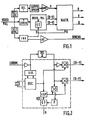
- FIG. 1 there is shown schematically an interface assembly receiving on one side PAL type video signals and processing them, to transmit at the output RGB signals (red, green, blue) as well as the synchronization signals, which allows connection for example to a SECAM device equipped with a socket intended to receive such signals.
- RGB signals red, green, blue
- synchronization signals which allows connection for example to a SECAM device equipped with a socket intended to receive such signals.
- This type of interface therefore makes it possible to connect any PAL coded switchgear (computer, video game, video recorder or other) to SECAM switchgear (display console, television or other).
- PAL video signals are fed first to a synchronization signal separator (SEP.SYNC), secondly to a chrominance signal filter (F.CHROM) followed by a PAL decoder (DECOD. PAL) and thirdly to a chrominance signal rejection circuit (REJ.CHR.)
- a synchronization signal separator SEP.SYNC
- F.CHROM chrominance signal filter
- DECOD. PAL PAL decoder
- REJ.CHR. chrominance signal rejection circuit
- DEL.1 delay line
- SUPPR.SYNCHR. circuit synchronization tops suppressor
- AMPL. amplifier
- the synchro separator SEP.SYNC
- the synchro separator is followed by an assembly (INV.) which will be described in more detail below and which corresponds to the essential part of the present invention.
- This set emits on the one hand the synchronization signals (SYNCHR.) Via an impedance adapter (AD.), Signals which will be found at the output of the interface, and on the other hand the frequency and phase stabilized signals which are brought to the decoder (DECOD.PAL) and to a matrixing circuit (MATR). Note that if this decoder includes a divider by 2 (as shown in Figure 1), to go from line frequency H to half frequency H / 2, it is not necessary to provide a divider. If on the contrary, the decoder (DECOD.PAL) does not provide for this division, it is necessary to ensure it either in the assembly (INV.) According to the invention, or on the connection between the assembly (INV.
- the decoder DECOD.PAL
- the difference signals RY and BY are collected at the output
- the third channel R.CHR., DEL.1, SUPPRE.SYNCHR., AMPL.
- All the signals RY, BY and Y are processed in the matrixing circuit (MATR.) at the output of which the RGB signals are collected which, joined to the synchronization signals mentioned above, constitute elements allowing connection of the interface downstream.
- the PAL decoder circuit can be of any conventional type and can, for example, be organized around suitable integrated circuits as will be seen below.
- the essential functions are illustrated by FIG. 2 which corresponds to the case of FIG. 1, that is to say including the divider by 2 circuit of the frequency.
- the signals from the filter (F.CHROM.) Of FIG. 1 are brought on the one hand to an assembly constituted by a servo device (ASS.) And an oscillator controlled by quartz, on the other hand to a delay line (DEL.2).
- Two analog signal multipliers X1, X2 are connected upstream, the first XI to the delay line (DEL.2) via an amplifier as well as to the OSC / ASS assembly, the second X2 to the delay line DEL .2 and a phase shift device of ⁇ 90 ° connected to the oscillator (OSC.)
- the divider by 2 (: 2) receiving the synchronization signals at frequency H from the device INV. (figure 1).
- a gatekeeper (P) corrects the divider under the control of the X3 circuit itself connected upstream to the phase shifter by ⁇ 90 ° and to the line delay (DEL.2). This porter also ensures the white-black / color passages.
- This circuit can for example be produced on the basis of an integrated circuit of TEA 5620 type (THOMSON-EFCIS). which corresponds to the content of the dotted frame in Figure 2.
- the transistors Q 2 and Q 5 operate as impedance reducers and are followed on the one hand by the transistors Q 3 and Q 4 operating as current generators, which creates the two components, a function of BY and RY, which result therefrom. adding to point P gives VY and, on the other hand, transistors Q 6 and Q 7 also operating as current generators giving respectively B and R.
- the electronic switches C1 and C2 ensuring clamping are controlled at frequency H.
- the transistor Q 12 supplies the current Y which being added at Q to the current VY gives V, the transistor Q 8 ensuring clamping at this same line frequency.
- the signals R, G, B thus obtained are directed via the transistors Qg, Q 10 and Q 11 to the outputs of the interface assembly of FIG. 1.
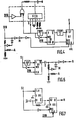
- FIG. 1 As regards the essential part of the invention, namely the INV assembly. in Figure 1, three embodiments will be the subject of Figures 4, 6 and 7.
- Figure 4 there is shown a device according to the invention such as (INV.) in Figure 1. It receives the SYN synchronization signals. of the synchro separator (SEP.SYNC.) of figure 1. These signals are brought to the input of the phase blocking loop constituted by the amplifier, the imperative OR gate, the F filter and the VCO oscillator controlled by voltage. The signals collected at S should theoretically be stabilized in frequency and in phase.
- SEP.SYNC. synchro separator
- the latter is uncertain and is the subject of the subsequent treatments which begin by bringing a flip-flop B1 with type D mounting, on the one hand to the input SET via a differentiator DIF1, on the other hand to RESET input via a reversing door.
- This scale receives at the clock input CLK the synchronization signals, and its outputs Q and Q are respectively connected to a second flip-flop B2 with type D mounting, to the input SET via a second differentiator DIF.2, on the one hand and to l RESET entry on the other hand.
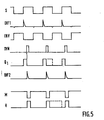
- FIG. 5 illustrates in the form of a timing diagram the processing of these signals.
- the square pulses represented in curve S of FIG. 5 are collected, which at the output of the differentiator gives pulses of the form DIF corresponding to the rising edges of the slots of the curve S, while that the inverting gate puts the signals in phase opposition S.
- the signals from the curve Q 1 are collected. The rising edge of these signals corresponds to the rising edge of the signals S but their falling edge corresponds to the attack of the SYN signals.
- the second pulse of Q I will keep the width of the corresponding S pulse (dotted profile) but the number will not be changed. It would be the same if this second SYN pulse was too late, and came after the falling edge of the corresponding S pulse. If several pulses occur during the same period, only the first one will count.
- the second flip-flop B2 therefore receives in S the signals DIF.2 originating from the differentiator and whose pulses correspond to the falling edges of the pulses Q l .
- the monostable triggered by SYN pulses. emits the signals M.
- the second pulse M is missing, we find in Q 2 a different width (in dotted lines) but without modification of the number of pulses. Maintaining the frequency H is therefore ensured without phase shift since, even if a few different widths appear, the regularity is ensured.
- the first rocker ensures the phasing of the falling edge of the pulse, the second that of the rising edge. It will be noted that, in the circuit of this FIG.
- the monostable can be placed not upstream of the last rocker but downstream, as shown in FIG. 6.
- the associated capacity and resistance form the differentiator D and are themselves associated with the monostable M
- the first rocker as a monostable and a differentiator.
- the signals S coming from the phase blocking loop arrive on the one hand at the clock input CLK of the first flip-flop B10 and, on the other hand via an inverting gate at the RESET input of the second flip-flop B2.
- the output Q of the flip-flop B10 is connected both to the input SI of this same flip-flop and to the input S2 of the second. At this output Q, we obtain not pulses of the DIF.1 type ( Figure 5) but of the Q 1 type ( Figure 5).
- the second flip-flop B20 receives the synchronization signals SYN in CLK and transmits in Q the pulses H 'which are sent to a monostable not shown, as in FIG. 6.
- the flip-flop B20 therefore plays the role of Bl in FIGS. 4 and 6 while the flip-flop B10 plays the role of the differentiator DIF.l. We can also play the first rocker the role of monostable.
- the devices according to the invention such as those which are the subject of FIGS. 4, 6 and 7 can operate with PAL decoders as in FIG. 1 but can also operate with other types of coders or decoders, for example of the SECAM type. .
- these devices can be used to supply any video system with pulses at the line frequency (or at any frequency linked to the line frequency and in particular at the half frequency). stabilized both in frequency and in phase and without interruptions (mainly due to the passage of frame synchronization signals) and without disturbances (due to distortions, disappearances or appearances of pulses).
Landscapes
- Engineering & Computer Science (AREA)
- Multimedia (AREA)
- Signal Processing (AREA)
- Processing Of Color Television Signals (AREA)
- Stabilization Of Oscillater, Synchronisation, Frequency Synthesizers (AREA)
- Manipulation Of Pulses (AREA)
- Color Television Systems (AREA)
Priority Applications (1)
| Application Number | Priority Date | Filing Date | Title |
|---|---|---|---|
| AT85400181T ATE43943T1 (de) | 1984-02-06 | 1985-02-04 | Frequenz- und phasenstabilisierung von farbvideokodern/dekodern. |
Applications Claiming Priority (2)
| Application Number | Priority Date | Filing Date | Title |
|---|---|---|---|
| FR8401888 | 1984-02-06 | ||
| FR8401888A FR2559331B1 (fr) | 1984-02-06 | 1984-02-06 | Procede et circuit pour la production d'impulsions destinees a un codeur ou decodeur pal ou secam |
Publications (2)
| Publication Number | Publication Date |
|---|---|
| EP0155860A1 true EP0155860A1 (de) | 1985-09-25 |
| EP0155860B1 EP0155860B1 (de) | 1989-06-07 |
Family
ID=9300852
Family Applications (1)
| Application Number | Title | Priority Date | Filing Date |
|---|---|---|---|
| EP85400181A Expired EP0155860B1 (de) | 1984-02-06 | 1985-02-04 | Frequenz- und Phasenstabilisierung von Farbvideokodern/Dekodern |
Country Status (4)
| Country | Link |
|---|---|
| EP (1) | EP0155860B1 (de) |
| AT (1) | ATE43943T1 (de) |
| DE (1) | DE3570967D1 (de) |
| FR (1) | FR2559331B1 (de) |
Families Citing this family (1)
| Publication number | Priority date | Publication date | Assignee | Title |
|---|---|---|---|---|
| FR2789257B1 (fr) | 1999-02-02 | 2002-11-15 | Schneider Electric Sa | Dispositif transducteur a circuit oscillant |
Citations (3)
| Publication number | Priority date | Publication date | Assignee | Title |
|---|---|---|---|---|
| FR2055713A1 (de) * | 1969-08-01 | 1971-04-30 | Centre Electronique Fse | |
| DE2514324A1 (de) * | 1974-04-03 | 1975-10-09 | Indesit | Verarbeitungsschaltkreis fuer farbfernsehsignale |
| FR2283612A1 (fr) * | 1974-08-30 | 1976-03-26 | Thomson Csf | Decodeur pour le systeme secam |
-
1984
- 1984-02-06 FR FR8401888A patent/FR2559331B1/fr not_active Expired
-
1985
- 1985-02-04 EP EP85400181A patent/EP0155860B1/de not_active Expired
- 1985-02-04 AT AT85400181T patent/ATE43943T1/de not_active IP Right Cessation
- 1985-02-04 DE DE8585400181T patent/DE3570967D1/de not_active Expired
Patent Citations (3)
| Publication number | Priority date | Publication date | Assignee | Title |
|---|---|---|---|---|
| FR2055713A1 (de) * | 1969-08-01 | 1971-04-30 | Centre Electronique Fse | |
| DE2514324A1 (de) * | 1974-04-03 | 1975-10-09 | Indesit | Verarbeitungsschaltkreis fuer farbfernsehsignale |
| FR2283612A1 (fr) * | 1974-08-30 | 1976-03-26 | Thomson Csf | Decodeur pour le systeme secam |
Also Published As
| Publication number | Publication date |
|---|---|
| ATE43943T1 (de) | 1989-06-15 |
| EP0155860B1 (de) | 1989-06-07 |
| FR2559331A1 (fr) | 1985-08-09 |
| FR2559331B1 (fr) | 1989-05-12 |
| DE3570967D1 (en) | 1989-07-13 |
Similar Documents
| Publication | Publication Date | Title |
|---|---|---|
| CA1252880A (en) | Multi-system television receiver | |
| CA1106057A (en) | Electronic signal processing apparatus | |
| US4179705A (en) | Method and apparatus for separation of chrominance and luminance with adaptive comb filtering in a quadrature modulated color television system | |
| FR2510853A1 (fr) | Systeme de television et moyen transducteur d'image, moyen de visualisation, dispositif pour former un signal video composite et dispositif pour decoder ce signal a y utiliser | |
| FR2482815A1 (fr) | Dispositif de codage et de decodage de signaux d'image et de son | |
| FR2679088A1 (fr) | Circuit d'elimination des bruits pour un recepteur de television. | |
| US3546372A (en) | Vertical and horizontal aperture equalization | |
| JPH06509923A (ja) | テレビジョン受信機のための雑音減少装置及び方法 | |
| US4766484A (en) | NTSC/PAL switchable video color decoder using a digital comb filter and method | |
| US4343017A (en) | Decoding composite PAL television signals | |
| FR2500977A1 (fr) | Dispositif pour ameliorer la lisibilite de caracteres alpha-mosaiques | |
| FR2489064A1 (fr) | Circuit de traitement de signal video | |
| FR2546689A1 (fr) | Convertisseur analogique-numerique comprenant deux sources de signaux de tremblotement | |
| EP0155860B1 (de) | Frequenz- und Phasenstabilisierung von Farbvideokodern/Dekodern | |
| EP0441723B1 (de) | Automatisches Verfahren zur Farbfernsehnormidentifizierung | |
| FR2666952A1 (fr) | Decodeur secam. | |
| FR2460581A1 (fr) | Dispositif de numerisation des signaux videofrequence et equipements transmetteurs comportant un tel dispositif | |
| EP0710038A1 (de) | Detektor zur Empfangsdetektion eines nach dem SECAM-Standard kodierten Farbfernsehsignals | |
| FR2512618A1 (fr) | Filtre sectionneur pal | |
| JPH04230194A (ja) | カラーテレビジョン像のカラーエッジ改善のための方法および装置 | |
| EP0375540A1 (de) | Verfahren zur Verwürfelung von PAL-, SECAM- und NTSC-FBAS-Signalen und Dekoder für Signale, die nach diesem Verfahren verwürfelt sind | |
| JPH0380688A (ja) | Catv用端末装置 | |
| FR2544946A1 (fr) | Oscillateur module en frequence et codeur de television incorporant un tel oscillateur | |
| FR2516331A1 (en) | Colour television system | |
| FR2516734A1 (fr) | Generateur d'impulsions de declenchement de la composante de synchronisation de sous-porteuse de chrominance et de blocage du palier arriere |
Legal Events
| Date | Code | Title | Description |
|---|---|---|---|
| PUAI | Public reference made under article 153(3) epc to a published international application that has entered the european phase |
Free format text: ORIGINAL CODE: 0009012 |
|
| AK | Designated contracting states |
Designated state(s): AT BE CH DE FR GB IT LI LU NL SE |
|
| ITCL | It: translation for ep claims filed |
Representative=s name: STUDIO BREVETTI EUROPA S.R.L. |
|
| TCAT | At: translation of patent claims filed | ||
| TCNL | Nl: translation of patent claims filed | ||
| 17P | Request for examination filed |
Effective date: 19860222 |
|
| 17Q | First examination report despatched |
Effective date: 19871209 |
|
| GRAA | (expected) grant |
Free format text: ORIGINAL CODE: 0009210 |
|
| AK | Designated contracting states |
Kind code of ref document: B1 Designated state(s): AT BE CH DE FR GB IT LI LU NL SE |
|
| PG25 | Lapsed in a contracting state [announced via postgrant information from national office to epo] |
Ref country code: IT Free format text: LAPSE BECAUSE OF FAILURE TO SUBMIT A TRANSLATION OF THE DESCRIPTION OR TO PAY THE FEE WITHIN THE PRESCRIBED TIME-LIMIT;WARNING: LAPSES OF ITALIAN PATENTS WITH EFFECTIVE DATE BEFORE 2007 MAY HAVE OCCURRED AT ANY TIME BEFORE 2007. THE CORRECT EFFECTIVE DATE MAY BE DIFFERENT FROM THE ONE RECORDED. Effective date: 19890607 Ref country code: GB Effective date: 19890607 Ref country code: NL Effective date: 19890607 Ref country code: AT Effective date: 19890607 Ref country code: SE Effective date: 19890607 |
|
| REF | Corresponds to: |
Ref document number: 43943 Country of ref document: AT Date of ref document: 19890615 Kind code of ref document: T |
|
| REF | Corresponds to: |
Ref document number: 3570967 Country of ref document: DE Date of ref document: 19890713 |
|
| NLV1 | Nl: lapsed or annulled due to failure to fulfill the requirements of art. 29p and 29m of the patents act | ||
| PG25 | Lapsed in a contracting state [announced via postgrant information from national office to epo] |
Ref country code: DE Effective date: 19891121 |
|
| GBV | Gb: ep patent (uk) treated as always having been void in accordance with gb section 77(7)/1977 [no translation filed] | ||
| PG25 | Lapsed in a contracting state [announced via postgrant information from national office to epo] |
Ref country code: CH Effective date: 19900228 Ref country code: LU Free format text: LAPSE BECAUSE OF NON-PAYMENT OF DUE FEES Effective date: 19900228 Ref country code: LI Effective date: 19900228 Ref country code: BE Effective date: 19900228 |
|
| PLBE | No opposition filed within time limit |
Free format text: ORIGINAL CODE: 0009261 |
|
| STAA | Information on the status of an ep patent application or granted ep patent |
Free format text: STATUS: NO OPPOSITION FILED WITHIN TIME LIMIT |
|
| 26N | No opposition filed | ||
| BERE | Be: lapsed |
Owner name: CGV CIE GENERALE DE VIDEOTECHNIQUE Effective date: 19900228 |
|
| REG | Reference to a national code |
Ref country code: CH Ref legal event code: PL |
|
| PGFP | Annual fee paid to national office [announced via postgrant information from national office to epo] |
Ref country code: FR Payment date: 19960703 Year of fee payment: 12 |
|
| PG25 | Lapsed in a contracting state [announced via postgrant information from national office to epo] |
Ref country code: FR Effective date: 19971030 |
|
| REG | Reference to a national code |
Ref country code: FR Ref legal event code: ST |