EP0155930A2 - Verfahren und Einrichtung zur Vergasung von kohlenstoffhältigen Materialien - Google Patents
Verfahren und Einrichtung zur Vergasung von kohlenstoffhältigen Materialien Download PDFInfo
- Publication number
- EP0155930A2 EP0155930A2 EP85890063A EP85890063A EP0155930A2 EP 0155930 A2 EP0155930 A2 EP 0155930A2 EP 85890063 A EP85890063 A EP 85890063A EP 85890063 A EP85890063 A EP 85890063A EP 0155930 A2 EP0155930 A2 EP 0155930A2
- Authority
- EP
- European Patent Office
- Prior art keywords
- gasified
- heat
- gasification
- reactor
- fiber
- Prior art date
- Legal status (The legal status is an assumption and is not a legal conclusion. Google has not performed a legal analysis and makes no representation as to the accuracy of the status listed.)
- Withdrawn
Links
Images
Classifications
-
- C—CHEMISTRY; METALLURGY
- C10—PETROLEUM, GAS OR COKE INDUSTRIES; TECHNICAL GASES CONTAINING CARBON MONOXIDE; FUELS; LUBRICANTS; PEAT
- C10J—PRODUCTION OF PRODUCER GAS, WATER-GAS, SYNTHESIS GAS FROM SOLID CARBONACEOUS MATERIAL, OR MIXTURES CONTAINING THESE GASES; CARBURETTING AIR OR OTHER GASES
- C10J3/00—Production of combustible gases containing carbon monoxide from solid carbonaceous fuels
- C10J3/02—Fixed-bed gasification of lump fuel
- C10J3/06—Continuous processes
- C10J3/12—Continuous processes using solid heat-carriers
-
- C—CHEMISTRY; METALLURGY
- C10—PETROLEUM, GAS OR COKE INDUSTRIES; TECHNICAL GASES CONTAINING CARBON MONOXIDE; FUELS; LUBRICANTS; PEAT
- C10J—PRODUCTION OF PRODUCER GAS, WATER-GAS, SYNTHESIS GAS FROM SOLID CARBONACEOUS MATERIAL, OR MIXTURES CONTAINING THESE GASES; CARBURETTING AIR OR OTHER GASES
- C10J3/00—Production of combustible gases containing carbon monoxide from solid carbonaceous fuels
- C10J3/02—Fixed-bed gasification of lump fuel
-
- C—CHEMISTRY; METALLURGY
- C10—PETROLEUM, GAS OR COKE INDUSTRIES; TECHNICAL GASES CONTAINING CARBON MONOXIDE; FUELS; LUBRICANTS; PEAT
- C10J—PRODUCTION OF PRODUCER GAS, WATER-GAS, SYNTHESIS GAS FROM SOLID CARBONACEOUS MATERIAL, OR MIXTURES CONTAINING THESE GASES; CARBURETTING AIR OR OTHER GASES
- C10J3/00—Production of combustible gases containing carbon monoxide from solid carbonaceous fuels
- C10J3/58—Production of combustible gases containing carbon monoxide from solid carbonaceous fuels combined with pre-distillation of the fuel
-
- C—CHEMISTRY; METALLURGY
- C10—PETROLEUM, GAS OR COKE INDUSTRIES; TECHNICAL GASES CONTAINING CARBON MONOXIDE; FUELS; LUBRICANTS; PEAT
- C10J—PRODUCTION OF PRODUCER GAS, WATER-GAS, SYNTHESIS GAS FROM SOLID CARBONACEOUS MATERIAL, OR MIXTURES CONTAINING THESE GASES; CARBURETTING AIR OR OTHER GASES
- C10J2300/00—Details of gasification processes
- C10J2300/09—Details of the feed, e.g. feeding of spent catalyst, inert gas or halogens
- C10J2300/0983—Additives
-
- C—CHEMISTRY; METALLURGY
- C10—PETROLEUM, GAS OR COKE INDUSTRIES; TECHNICAL GASES CONTAINING CARBON MONOXIDE; FUELS; LUBRICANTS; PEAT
- C10J—PRODUCTION OF PRODUCER GAS, WATER-GAS, SYNTHESIS GAS FROM SOLID CARBONACEOUS MATERIAL, OR MIXTURES CONTAINING THESE GASES; CARBURETTING AIR OR OTHER GASES
- C10J2300/00—Details of gasification processes
- C10J2300/18—Details of the gasification process, e.g. loops, autothermal operation
- C10J2300/1807—Recycle loops, e.g. gas, solids, heating medium, water
Definitions
- the invention relates to a process for the gasification of carbon-containing fine-grained or sludge-like materials, such as e.g. Lignite dust or biomass in fixed bed reactors, in which the material to be gasified is preheated and, in particular, dried before entering the fixed bed reactor and the vapors formed are mixed with the gasification medium, coarse-grained fibers being added to the material to be gasified in or before the fixed bed reactor to improve the gas permeability .
- carbon-containing fine-grained or sludge-like materials such as e.g. Lignite dust or biomass in fixed bed reactors
- the material to be gasified must be introduced into the fixed bed reactor designed as a gasification reactor in a predetermined minimum grain size. If the grain size is less than this, there is a lack of gassing, as a result of which the efficiency of the system drops sharply. Furthermore, the substances to be gasified should have a Minoestas content so that after the gasification zone there is still a substance for gas distribution and also for gas heating. For the reasons mentioned, dusts, sawdust and sewage sludge can only be gasified to a very limited extent and can be recycled for thermal purposes. However, because of their changing low carbon content, washing piles that occur in coal mining are unsuitable for gasification and can practically only be deposited.
- the object of the invention is to overcome these disadvantages even further and to provide the fixed bed reactor designed as a gasification reactor with a broader range of fuels by including the fine-grained or sludge-like materials.
- the process according to the invention is characterized in that washing piles or limestone with a grain size of more than 10 mm are used as dietary fibers, which after separation from the ashes in the granular state are fed to a separate utilization and that ashes from the fixed bed reactor with the abrasion of the dietary fibers is applied to the moist material to be gasified and reacted, the Mg and Ca oxides contained in the ash being hydrated by the moisture of the materials introduced, and the material to be gasified being preheated and partially dried by the heat of reaction.
- Essential embodiments of the invention are specified in the subclaims.
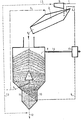
- the invention is shown, for example and schematically, in the attached figure. That too gasifying material is fed via the feed line 1 via a mixing container 2 to a dryer 3, which is designed, for example, as a heated vibrating trough in which the material to be dried is dried and preheated by supplying heat. With the material to be gasified, the coarse-grained ballast material, such as preheated iron balls, limestone or washing piles, is also fed to the dryer via the line 4 and intimately mixed with the material to be gasified in the vibration channel of the dryer 3. Since the coarse grain load material has a higher temperature than the material to be gasified, additional heat is introduced, which results in a drying effect.
- a dryer 3 which is designed, for example, as a heated vibrating trough in which the material to be dried is dried and preheated by supplying heat.
- the coarse-grained ballast material such as preheated iron balls, limestone or washing piles
- the vapors produced in the dryer are discharged via the steam line 5 and mixed with the gasification agent, which is fed via the feed line 6 to the gas distributor 7 in the actual gasification reactor.
- the predried material is transferred from the dryer 3 into the solid-state reactor 8 according to arrow 9 and deposited there in layers, the temperature of the layers increasing from top to bottom to the actual gasification zone and after the gasification zone up to approximately the supply temperature of the gasification agent in the area of the gas distributor 7 drops again.
- the degassed material now comes into a separation zone 10, in which a sieve 11 is provided, which separates the coarse-grained fiber from the ashes produced.
- the ballast is fed to line 4, while the ash is discharged via the ash removal line 12 or recirculated via line 13, in particular if it contains a large amount of CaO or MgO, and is introduced into the mixing container 2, where the MgO or Ca0 reacts with the moisture of the material to be gasified, which causes the material to be dried to heat up in the mixing container, whereby the CaO or MgO is hydrated.
- the hot generated in the fixed bed reactor 8 Fuel gas is discharged via line 14 and cooled in a heat exchanger 15, heat transfer being provided to the coarser-grained fiber, whereby part of the heat is used in the process for preheating the material to be gasified or for drying it.
- Artificial fiber such as e.g. Iron body, ceramic or expanded clay body in spherical form or as zylpebbs.
- natural fiber such as Wash mountains or limestone can be used.
- washing mountains there is an additional introduction of material to be gasified in the form of carbon inclusions, whereby the material not to be gasified, insofar as it contains lime or magnesite, is also partially used.
- limestone is used, the limestone can burn in the solid-fuel reactor 8 in this process, so that burnt lime is formed as coarse-grained fiber, which is fed to a separate recycling process, whereby the recirculation line shown in the drawing is interrupted and only the fresh lime via the heat exchanger 15 is supplied.
- the gas permeability in the solid-state reactor can be improved, as a result of which a uniform temperature distribution is achieved in this reactor, which is expressed in better gasification efficiency.
- the method according to the invention also enables the gasification of extremely low-ash fuels, which are obtained, for example, in biotechnology, as a result of which, for example, dewatered bagasse can be gasified.
- the tar droplets which are discharged from the solid reactor 8 by the hot gas, partly in the heat exchanger 15 to the relatively cold dietary fibers are released, where they condense on their surface. This measure makes the fiber sticky, so that dust to be gasified sticks to the fiber.
- the recirculated tar is then reintroduced into the solid-state reactor and can be converted into fuel gas or can be used directly as fuel by contacting the gasification medium, whereby the tar level in the circuit keeps itself at a certain level.
- the dryer 3 is also possible to design the dryer 3 as a shaft dryer and to place it on the carburetor 8 after reducing the cross-section, which results in a retort in tower construction.
- the line 14 for the hot fuel gas connects to the upper end of the retort, which in particular is still enlarged, as a result of which gas re-suction from the gasification chamber 8 into the dryer 3 and explosions in the dryer appear to be avoidable.
- the dryer 3 thus forms a bulk material feed for the carburetor 8, from which, according to the volume reduction during gasification and the ash and fiber removal, dried or pre-dried bulk material flows.
- a heat pipe system can also be provided, the heat absorption side of which is arranged in the wall of the gasifier 8 in the region of the gasification zone or just below it, and the heat emission side of which is arranged on the ceiling of the collecting chamber for the raw gas generated and rising from the gasification zone.
- This part of the heat pipe system thus acts as a radiator and heats the respective free bulk material surface, which causes the gasification temperature of the Bulk goods and the ash discharge temperature is reached more quickly. This causes a reduction in the size of the gasifier or an increase in the specific gasification capacity of the gasifier.
Landscapes
- Chemical & Material Sciences (AREA)
- Engineering & Computer Science (AREA)
- Combustion & Propulsion (AREA)
- Oil, Petroleum & Natural Gas (AREA)
- Organic Chemistry (AREA)
- Processing Of Solid Wastes (AREA)
- Treatment Of Sludge (AREA)
Abstract
Description
- Die Erfindung betrifft ein Verfahren zur Vergasung von kohlenstoffhaltigen feinkörnigen oder schlammartigen Materialien, wie z.B. Braunkchlenstaub oder Biomasse in Festbettreaktoren, bei dem das zu vergasende Material vorgewärmt und insbesondere vor dem Eintritt in den Festbettreaktor getrocknet wird und die entstehenden Dämpfe dem Vergasungsmedium beigemischt werden, wobei dem zu vergasenden Material im oder vor dem Festbettreaktor zur Verbesserung der Gasdurchlässigkeit grobkörnige Ballaststoffe beigemischt werden.
- Es ist bekannt, kohlenstoffhältige Materialien zu verschwelen und/oder zu vergasen. Das zu vergasende Material muß dabei in einer vorgegebenen Mindestkorngröße in den als Vergasungsreaktor ausgebildeten Festbettreaktor eingebracht werden. Liegt die Korngröße darunter, kommt es zur mangelnden Durchgasung, wodurch der Wirkungsgrad der Anlage stark abfällt. Ferner sollen die zu vergasenden Stoffe einen Minoestaschegehalt aufweisen, damit nach der Vergasungszone noch ein Stoff zur Gasverteilung und auch zur Gaserwärmung vorhanden ist. Aus den genannten Gründen können Stäube, Sägespäne bzw. Klärschlamm nur in sehr begrenztem Umfang vergast und einer wärmewirtschaftilchen Verwertung zugeführt werden. Aber auch Waschberge, die im Kohlenbergbau anfallen, sind auf Grund ihres wechselnden geringen Kohlenstoffgehaltes zur Vergasung ungeeignet und können praktisch nur deponiert werden. Zur Begegnung dieser Nachteile ist es bekannt, staubförmige Brennstoffe zu brikettieren und den Brikett eine gasdurchlässige (rohrförmige) Form (DE-OS 22 56 383; zu geben oder abwechselnd (DE-PS 168.873, AT-PS 64.423) feinkörniges und grobkörniges Material in die Vergasungsretorte aufzugeben und so die Gasdurchlässigkeit zu verbesseren.
- Die Erfindung hat es sich zur Aufgabe gestellt, diesen Nachteilen noch weiter zu begegnen und dem als Vergasungsreaktor ausgebildeten Festbettreaktor eine breitere Brennstoffpalette durch Einbeziehung der feinkörnigen oder schlammartigen Materialien zur Verfügung zu stellen. Das erfindungsgemäße Verfahren ist dadurch gekennzeichnet, daß als Ballaststoffe Waschberge oder Kalkstein mit einer Körnung von mehr als 10 mm verwendet werden,die nach der Abtrennung von der Asche im körnigen Zustand einer getrennten Verwertung zugeführt werden und daß Asche aus dem Festbettreaktor mit dem Abrieb der Ballaststoffe auf das feuchte zu vergasende Material aufgebracht und zur Reaktion gebracht wird, wobei die in der Asche enthaltenen Mg- und Ca-Oxide durch die Feuchtigkeit der eingebrachten Materialien hydratisiert werden, und durch die Reaktionswärme das zu vergasende Material vorgewärmt und teilweise getrocknet wird. Wesentliche Ausgestaltungen der Erfindung sind in den Unteransprüchen angegeben.
- Bei der erfindungsgemäßen Lösung der Aufgabe hat es sich überraschend herausgestellt, daß durch die Erfindung auch das Teerproblem des erzeugten Gases einer wirtschaftlichen Lösung zugeführt werden konnte, indem bei der Erhitzung der zugeführten Ballaststoffe durch das erzeugte Gas die Teertröpfchen an den Ballaststoffen kondensieren und so erneut dem Vergaser zugeführt werden, in welchem sie zum Teil verbrannt bzw. vergast werden.
- Die Erfindung ist in der angeschlossenen Figur beispielsweise und schematisch dargestellt. Das zu vergasende Material wird über die Zuführungsleitung 1 über einen Mischbehälter 2 einem Trockner 3 zugeführt, der beispielsweise als beheizte Vibrationsrinne ausgebildet ist, in dem das zu trocknende Material durch Wärmezufuhr getrocknet und vorerwärmt wird. Mit dem zu vergasenden Material wird dem Trockner über.die Leitung 4 auch grobkörnigeres Ballastmaterial wie z.B. vorerhitzte Eisenkugeln, Kalkstein oder auch Waschberge zugeführt und in der Vibrationsrinne des Trockners 3 mit dem zu vergasenden Material innig durchmischt. Da das grobkörnige Eallastmaterial eine höhere Temperatur als das zu vergasende Material aufweist, wird zusätzliche Wärme eingebracht, wodurch ein Trocknungseffekt eintritt. Die im Trockner entstehenden Dämpfe werden über die Dampfleitung 5 abgeführt und dem Vergasungsmittel beigemischt, welches über die Zuführungsleitung 6 dem Gasverteiler 7 im eigentlichen Vergasungsreaktor zugeführt wird. Das vorgetrocknete Material wird gemäß Pfeil 9 aus dem Trockner 3 in den Feststoffreaktor 8 übergeführt und dort schichtenweise abgelagert, wobei die Temperatur der Schichten von oben nach unten bis zur eigentlichen Vergasungszone zunimmt und nach der Vergasungszone bis etwa zur Zuführungstemperatur des Vergasungsmittels im Bereich des Gasverteilers 7 wieder absinkt. Das entgaste Material kommt nun in eine Trennzone 10, in der ein Sieb 11 vorgesehen ist, welches die grobkörnigen Ballaststoffe von der erzeugten Asche trennt. Die Ballaststcffe werden der Leitung 4 zugeführt,während die Asche über die Entaschungsleitung 12 abgeführt bzw. insbesondere dann, wenn sie stark CaO- oder MgO-hältig ist, über die Leitung 13 rezirkuliert und in den Mischbehälter 2 eingegeben wird, wo das MgO bzw. Ca0 mit der Feuchte des zu vergasenden Materials reagiert,wodurch es bereits im Mischbehälter zu einer Erwärmung des zu trocknenden Gutes kommt, wobei das CaO bzw. das MgO hydratisiert wird. Das im Festbettreaktor 8 erzeugte heiße Brenngas wird über die Leitung 14 abgeführt und in einem Wärmetauscher 15 abgekühlt, wobei ein Wärmeübergang an die grobkörnigeren Ballaststoffe vorgesehen ist, wodurch ein Teil der Wärme in den Prozeß zur Vorerwärmung des zu vergasenden Materials bzw. zu dessen Trocknung verwendet wird.
- Als Ballaststoffe eignen sich besonders künstliche Ballaststoffe wie z.B. Eisenkörper, Keramik oder Blähtonkörper in Kugelform oder auch als Zylpebbs. Anstelle der künstlichen Ballaststoffe können auch natürliche Ballaststoffe wie z.B. Waschberge oder Kalkstein verwendet werden. Bei der Verwendung von Waschbergen ergibt sich eine zusätzliche Einbringung von zu vergasendem Material in Form von Kohleeinschlüssen, wobei auch das nicht zu vergasende Material, soweit es kalk- oder magnesithältig ist, zum Teil verwertet wird. Wird hingegen Kalkstein verwendet, so läßt sich bei diesem Verfahren der Kalkstein im Feststoffreaktor 8 brennen, so daß als grobkörniger Ballaststoff Brandkalk entsteht, der einer getrennten Verwertung zugeführt wird, wodurch die in der Zeichnung cargestellte Rezirkulationsleitung sinngemäß unterbrochen wird und nur der Frischkalk über den Wärmetauscher 15 zugeführt wird.
- Durch die Zuführung von grobkörnigem Ballastmaterial läßt sich die Gasdurchlässigkeit im Feststoffreaktor verbessern, wodurch eine gleichmäßige Temperaturverteilung in diesem erreicht wird, welche sich in einem besseren Vergasungswirkungsgrad ausdrückt. Das erfindungsgemäße Verfahren ermöglicht aber auch die Vergasung von extrem aschearmen Brennstoffen, welche beispielsweise in der Biotechnik anfallen, wodurch beispielsweise entwässerte Bagasse vergasungsfähig wird. Bei der Durchführung des Verfahrens zeigt es sich ferner, daß die Teertröpfchen, die durch das heiße Gas aus dem Feststoffreaktor 8 ausgetragen werden, zum Teil im Wärmetauscher 15 an die relativ kalten Ballaststoffe abgegeben werden, wobei sie an deren Oberfläche kondensieren. Durch diese Maßnahme werden die Ballaststoffe klebrig, so daß sich zu vergasender Staub an die Ballaststoffe klebt. Dies bewirkt eine Verringerung der Staubfraktion, so daß im zu vergasenden Material die Staubfraktion erhöht werden kann. Der rezirkulierte Teer wird dadurch erneut in den Feststoffreaktor eingebracht und kann darin durch Kontaktnahme mit dem Vergasungsmedium zum Teil in Brenngas umgewandelt bzw. auch als Brennstoff direkt verwendet werden kann, wodurch sich der Teerspiegel im Kreislauf von selbst auf einer gewissen Höhe hält.
- Im Rahmen der Erfindung ist es auch möglich, den Trockner 3 als Schachttrockner auszubilden und auf den Vergaser 8 nach einer Querschnittverminderung aufzusetzen, wodurch eine Retorte in Turmbauweise entsteht. Die Leitung 14 für das heiße Brenngas schließt am oberen Ende der insbesondere noch erweiterten Retorte an, wodurch Gasrücksaugungen aus dem Vergaserraum 8 in den Trockner 3 und Explosionen im Trockner vermeidbar erscheinen. Der Trockner 3 bildet somit eine Schüttgutvorlage für den Vergaser 8 aus der entsprechend der Volumenverminderung bei der Vergasung und der Aschen- und Ballaststoffentnahme getrocknetes bzw. vorgetrocknetes Schüttgut nachfließt. Zur Intensivierung des Prozesses kann ferner ein Wärmerohrsystem vorgesehen sein, dessen Wärmeaufnahmeseite in der Wandung des Vergasers 8 im Bereich der Vergasungszone oder knapp darunter und dessen Wärmeabgabeseite an der Decke der Sammelkammer für das erzeugte und aus der Vergasungszone aufsteigende Rohgas angeordnet ist. Dieser Teil des Wärmerohrsystems wirkt somit als Strahler und beheizt die jeweilige freie Schüttgutoberfläche, wodurch die Vergasungstemperatur des Schüttgutes und die Aschenaustragstemperatur rascher erreicht wird. Dies bewirkt eine Verkleinerung des Vergasers oder Vergrößerung des spezifischen Vergasungsvermögens des Vergasers.
Claims (7)
Applications Claiming Priority (2)
| Application Number | Priority Date | Filing Date | Title |
|---|---|---|---|
| AT962/84 | 1984-03-22 | ||
| AT0096284A AT387786B (de) | 1984-03-22 | 1984-03-22 | Verfahren zur vergasung von kohlenstoffhaeltigen materialien |
Publications (2)
| Publication Number | Publication Date |
|---|---|
| EP0155930A2 true EP0155930A2 (de) | 1985-09-25 |
| EP0155930A3 EP0155930A3 (de) | 1986-08-13 |
Family
ID=3503820
Family Applications (1)
| Application Number | Title | Priority Date | Filing Date |
|---|---|---|---|
| EP85890063A Withdrawn EP0155930A3 (de) | 1984-03-22 | 1985-03-15 | Verfahren und Einrichtung zur Vergasung von kohlenstoffhältigen Materialien |
Country Status (3)
| Country | Link |
|---|---|
| US (1) | US4758248A (de) |
| EP (1) | EP0155930A3 (de) |
| AT (1) | AT387786B (de) |
Cited By (2)
| Publication number | Priority date | Publication date | Assignee | Title |
|---|---|---|---|---|
| WO2010015316A3 (de) * | 2008-08-05 | 2010-11-25 | Krones Ag | Verfahren und vorrichtung zur herstellung von synthesegas aus biomasse |
| EP2333033A2 (de) | 2009-10-06 | 2011-06-15 | Politechnika Lubelska | Verfahren zur Herstellung von Brennstoff aus Klärschlamm |
Families Citing this family (5)
| Publication number | Priority date | Publication date | Assignee | Title |
|---|---|---|---|---|
| DE19961437C2 (de) * | 1999-12-20 | 2002-04-18 | Kopf Ag | Verfahren und Anlage zur Gewinnung von brennbarem Gas aus Klärschlamm |
| US20060180459A1 (en) * | 2005-02-16 | 2006-08-17 | Carl Bielenberg | Gasifier |
| DE102007062414B4 (de) * | 2007-12-20 | 2009-12-24 | Ecoloop Gmbh | Autothermes Verfahren zur kontinuierlichen Vergasung von kohlenstoffreichen Substanzen |
| DE102011121508A1 (de) | 2011-12-16 | 2013-06-20 | Ecoloop Gmbh | Gegenstromvergasung mit Synthesegas als Arbeitsmedium |
| DE102012014161A1 (de) | 2012-07-18 | 2014-02-20 | Ecoloop Gmbh | Gegenstrom-/Gleichstrom-Vergasung von kohlenstoffreichen Substanzen |
Family Cites Families (18)
| Publication number | Priority date | Publication date | Assignee | Title |
|---|---|---|---|---|
| US538908A (en) * | 1895-05-07 | Emile gobbe | ||
| US189576A (en) * | 1877-04-17 | Improvement in processes and apparatus for manufacturing gas | ||
| DE168873C (de) * | 1903-07-03 | |||
| US795874A (en) * | 1905-01-17 | 1905-08-01 | Charles Whitfield | Apparatus for the manufacture of combustible gas from peat. |
| US906793A (en) * | 1908-02-28 | 1908-12-15 | Charles J Greenstreet | Process of producing gas. |
| AT64423B (de) * | 1912-05-23 | 1914-04-10 | Arthur Graham Glasgow | Verfahren und Vorrichtung zum Destillieren von bituminöser Kohle oder sonstigem kohlenstoffhaltigen Material. |
| US1977684A (en) * | 1927-10-01 | 1934-10-23 | Babcock & Wilcox Co | Process of producing water gas |
| US2175613A (en) * | 1936-03-10 | 1939-10-10 | Koppers Co Inc | Process for the production of gases |
| GB620029A (en) * | 1945-01-16 | 1949-03-18 | Edvin Andreas Johansson | Improvements in methods for dry distillation |
| US2682455A (en) * | 1949-06-16 | 1954-06-29 | Consolidation Coal Co | Gasification of carbonaceous solid fuels |
| US2591595A (en) * | 1949-09-29 | 1952-04-01 | Standard Oil Dev Co | Method for controlling the temperature of exothermic reactions such as the gasification of carbonaceous solids |
| GB1435089A (en) * | 1972-11-09 | 1976-05-12 | Gen Electric | Fixed bed coal gasification |
| DE2264924A1 (de) * | 1972-11-17 | 1975-08-28 | Gen Electric | Verfahren zur erzeugung eines gasgemisches |
| US3920417A (en) * | 1973-06-29 | 1975-11-18 | Combustion Eng | Method of gasifying carbonaceous material |
| DE2943309C2 (de) * | 1979-10-26 | 1984-06-20 | Hölter, Heinz, Dipl.-Ing., 4390 Gladbeck | Verfahren zur gemeinsamen Pyrolyse von Ballastkohle und Müll mit anschließender Vergasung und Anlage zur Durchführung der Pyrolyse |
| DE3102819A1 (de) * | 1980-01-29 | 1982-02-18 | Babcock-Hitachi K.K., Tokyo | Verfahren fuer die rueckgwinnung von waerme bei der kohlevergasung und vorrichtung dafuer |
| US4353713A (en) * | 1980-07-28 | 1982-10-12 | Cheng Shang I | Integrated gasification process |
| DE3220126A1 (de) * | 1982-05-28 | 1983-12-01 | Eisenmann KG Maschinenbau-Gesellschaft mbH & Co, 7030 Böblingen | Verfahren und anlage zur gewinnung von generatorgas aus fossilen brennstoffen |
-
1984
- 1984-03-22 AT AT0096284A patent/AT387786B/de not_active IP Right Cessation
-
1985
- 1985-03-15 EP EP85890063A patent/EP0155930A3/de not_active Withdrawn
-
1986
- 1986-11-18 US US06/931,992 patent/US4758248A/en not_active Expired - Fee Related
Cited By (2)
| Publication number | Priority date | Publication date | Assignee | Title |
|---|---|---|---|---|
| WO2010015316A3 (de) * | 2008-08-05 | 2010-11-25 | Krones Ag | Verfahren und vorrichtung zur herstellung von synthesegas aus biomasse |
| EP2333033A2 (de) | 2009-10-06 | 2011-06-15 | Politechnika Lubelska | Verfahren zur Herstellung von Brennstoff aus Klärschlamm |
Also Published As
| Publication number | Publication date |
|---|---|
| EP0155930A3 (de) | 1986-08-13 |
| AT387786B (de) | 1989-03-10 |
| ATA96284A (de) | 1988-08-15 |
| US4758248A (en) | 1988-07-19 |
Similar Documents
| Publication | Publication Date | Title |
|---|---|---|
| EP1226222B1 (de) | Verfahren zur vergasung von organischen stoffen und stoffgemischen | |
| US4069024A (en) | Two-stage gasification system | |
| DE19930071C2 (de) | Verfahren und Vorrichtung zur Pyrolyse und Vergasung von organischen Stoffen und Stoffgemischen | |
| JP2024531100A (ja) | バイオマス熱分解液体から炭素を再捕捉するためのプロセス及びシステム | |
| DE3347554C2 (de) | Verfahren zur Gewinnung von verwertbarem Gas aus Müll durch Pyrolyse und Vorrichtung zum Durchführen des Verfahrens | |
| DE3603054C2 (de) | Verfahren zur Vergasung von Klärschlamm | |
| DE10033453B4 (de) | Verfahren und Vorrichtung zur Verwertung von Stoffen und Stoffgemischen, die organische Bestandteile enthalten | |
| CA2209578C (en) | Sewage sludge disposal process and product | |
| DE3344847C2 (de) | Schnell-Pyrolyse von Braunkohlen und Anordnung zur Durchführung dieses Verfahrens | |
| DE2242012A1 (de) | Verfahren und vorrichtung zur gemeinsamen entsorgung von industrie- haushaltsmuell und klaerschlamm | |
| US3185635A (en) | Method for producing metallurgical coke and metal-coke from both coking and non-coking coals | |
| AT510136A1 (de) | Verfahren zur herstellung von kohlepartikeln enthaltenden presslingen | |
| EP1337607B1 (de) | Verfahren zur vergasung von flüssigen bis pastösen organischen stoffen und stoffgemischen | |
| US4309190A (en) | Process of producing coal briquettes for gasification or devolatilization | |
| EP3024912B1 (de) | Verfahren zur reinigung und gewinnung von energiehaltigen gasen | |
| WO2010081620A1 (de) | Verfahren zur herstellung von kohlepartikel enthaltenden presslingen | |
| EP0155930A2 (de) | Verfahren und Einrichtung zur Vergasung von kohlenstoffhältigen Materialien | |
| EP0208881A1 (de) | Pyrolyseanlage | |
| DE112007003339T5 (de) | Verfahren und Vorrichtung zur Vergasung von Vergasungsbrennstoff | |
| DE2834717C2 (de) | Verfahren und Vorrichtung zur kombinierten Müllverwertung und Abwasseraufbereitung | |
| DE3439600C2 (de) | ||
| DE3228532A1 (de) | Verfahren zur verschwelung und vergasung von kohlenstoffhaltigen feststoffen | |
| DE4226015C1 (de) | Verfahren zur Entsorgung von festen und flüssigen Abfallstoffen im Vergasungsprozeß bei der Festbettdruckvergasung | |
| EP2593536B1 (de) | Verfahren zur herstellung von kohlepartikel enthaltenden presslingen | |
| DE3202161A1 (de) | Verfahren zur verkokung von kaltgepressten briketts und vorrichtung zu seiner durchfuehrung |
Legal Events
| Date | Code | Title | Description |
|---|---|---|---|
| PUAI | Public reference made under article 153(3) epc to a published international application that has entered the european phase |
Free format text: ORIGINAL CODE: 0009012 |
|
| AK | Designated contracting states |
Designated state(s): BE CH DE FR GB IT LI LU NL SE |
|
| PUAL | Search report despatched |
Free format text: ORIGINAL CODE: 0009013 |
|
| AK | Designated contracting states |
Kind code of ref document: A3 Designated state(s): BE CH DE FR GB IT LI LU NL SE |
|
| 17P | Request for examination filed |
Effective date: 19870203 |
|
| STAA | Information on the status of an ep patent application or granted ep patent |
Free format text: STATUS: THE APPLICATION IS DEEMED TO BE WITHDRAWN |
|
| 18D | Application deemed to be withdrawn |
Effective date: 19891003 |
|
| RIN1 | Information on inventor provided before grant (corrected) |
Inventor name: BECKMANN, GEORG, DR. DIPL.-ING. Inventor name: HILLINGER, BRUNO, DR. DIPL.-ING. |