EP0156227A2 - Formteil sowie Verfahren zu seiner Herstellung - Google Patents
Formteil sowie Verfahren zu seiner Herstellung Download PDFInfo
- Publication number
- EP0156227A2 EP0156227A2 EP85102741A EP85102741A EP0156227A2 EP 0156227 A2 EP0156227 A2 EP 0156227A2 EP 85102741 A EP85102741 A EP 85102741A EP 85102741 A EP85102741 A EP 85102741A EP 0156227 A2 EP0156227 A2 EP 0156227A2
- Authority
- EP
- European Patent Office
- Prior art keywords
- layer
- molded part
- fleece
- bitumen
- stabilizing
- Prior art date
- Legal status (The legal status is an assumption and is not a legal conclusion. Google has not performed a legal analysis and makes no representation as to the accuracy of the status listed.)
- Withdrawn
Links
- 238000000034 method Methods 0.000 title claims description 8
- 238000000465 moulding Methods 0.000 title claims 2
- 239000000463 material Substances 0.000 claims abstract description 22
- 239000010426 asphalt Substances 0.000 claims abstract description 15
- 230000000087 stabilizing effect Effects 0.000 claims abstract description 13
- 230000006641 stabilisation Effects 0.000 claims description 12
- 238000011105 stabilization Methods 0.000 claims description 12
- 238000004519 manufacturing process Methods 0.000 claims description 10
- 239000000843 powder Substances 0.000 claims description 5
- 239000004033 plastic Substances 0.000 claims description 4
- 229920003023 plastic Polymers 0.000 claims description 4
- 229920001169 thermoplastic Polymers 0.000 claims description 4
- 239000004416 thermosoftening plastic Substances 0.000 claims description 4
- 239000000203 mixture Substances 0.000 claims description 3
- 229920001187 thermosetting polymer Polymers 0.000 claims description 2
- 238000013007 heat curing Methods 0.000 claims 1
- 239000010410 layer Substances 0.000 description 51
- 238000009413 insulation Methods 0.000 description 9
- 239000002184 metal Substances 0.000 description 7
- KXGFMDJXCMQABM-UHFFFAOYSA-N 2-methoxy-6-methylphenol Chemical compound [CH]OC1=CC=CC([CH])=C1O KXGFMDJXCMQABM-UHFFFAOYSA-N 0.000 description 4
- 239000005011 phenolic resin Substances 0.000 description 4
- 229920001568 phenolic resin Polymers 0.000 description 4
- 229920000742 Cotton Polymers 0.000 description 3
- 238000004132 cross linking Methods 0.000 description 3
- 238000010438 heat treatment Methods 0.000 description 3
- 230000002349 favourable effect Effects 0.000 description 2
- -1 polyethylene Polymers 0.000 description 2
- 238000004080 punching Methods 0.000 description 2
- 229920005989 resin Polymers 0.000 description 2
- 239000011347 resin Substances 0.000 description 2
- 210000002268 wool Anatomy 0.000 description 2
- 239000004698 Polyethylene Substances 0.000 description 1
- 239000004743 Polypropylene Substances 0.000 description 1
- 239000012790 adhesive layer Substances 0.000 description 1
- 230000015572 biosynthetic process Effects 0.000 description 1
- 229920002678 cellulose Polymers 0.000 description 1
- 239000001913 cellulose Substances 0.000 description 1
- 238000000576 coating method Methods 0.000 description 1
- 239000002131 composite material Substances 0.000 description 1
- 239000000428 dust Substances 0.000 description 1
- 239000000835 fiber Substances 0.000 description 1
- 238000005554 pickling Methods 0.000 description 1
- 229920000728 polyester Polymers 0.000 description 1
- 229920000573 polyethylene Polymers 0.000 description 1
- 229920001155 polypropylene Polymers 0.000 description 1
- 238000007493 shaping process Methods 0.000 description 1
Images
Classifications
-
- B—PERFORMING OPERATIONS; TRANSPORTING
- B32—LAYERED PRODUCTS
- B32B—LAYERED PRODUCTS, i.e. PRODUCTS BUILT-UP OF STRATA OF FLAT OR NON-FLAT, e.g. CELLULAR OR HONEYCOMB, FORM
- B32B11/00—Layered products comprising a layer of bituminous or tarry substances
- B32B11/10—Layered products comprising a layer of bituminous or tarry substances next to a fibrous or filamentary layer
-
- B—PERFORMING OPERATIONS; TRANSPORTING
- B32—LAYERED PRODUCTS
- B32B—LAYERED PRODUCTS, i.e. PRODUCTS BUILT-UP OF STRATA OF FLAT OR NON-FLAT, e.g. CELLULAR OR HONEYCOMB, FORM
- B32B5/00—Layered products characterised by the non- homogeneity or physical structure, i.e. comprising a fibrous, filamentary, particulate or foam layer; Layered products characterised by having a layer differing constitutionally or physically in different parts
- B32B5/02—Layered products characterised by the non- homogeneity or physical structure, i.e. comprising a fibrous, filamentary, particulate or foam layer; Layered products characterised by having a layer differing constitutionally or physically in different parts characterised by structural features of a fibrous or filamentary layer
- B32B5/022—Non-woven fabric
-
- B—PERFORMING OPERATIONS; TRANSPORTING
- B32—LAYERED PRODUCTS
- B32B—LAYERED PRODUCTS, i.e. PRODUCTS BUILT-UP OF STRATA OF FLAT OR NON-FLAT, e.g. CELLULAR OR HONEYCOMB, FORM
- B32B7/00—Layered products characterised by the relation between layers; Layered products characterised by the relative orientation of features between layers, or by the relative values of a measurable parameter between layers, i.e. products comprising layers having different physical, chemical or physicochemical properties; Layered products characterised by the interconnection of layers
- B32B7/04—Interconnection of layers
- B32B7/12—Interconnection of layers using interposed adhesives or interposed materials with bonding properties
-
- G—PHYSICS
- G10—MUSICAL INSTRUMENTS; ACOUSTICS
- G10K—SOUND-PRODUCING DEVICES; METHODS OR DEVICES FOR PROTECTING AGAINST, OR FOR DAMPING, NOISE OR OTHER ACOUSTIC WAVES IN GENERAL; ACOUSTICS NOT OTHERWISE PROVIDED FOR
- G10K11/00—Methods or devices for transmitting, conducting or directing sound in general; Methods or devices for protecting against, or for damping, noise or other acoustic waves in general
- G10K11/16—Methods or devices for protecting against, or for damping, noise or other acoustic waves in general
- G10K11/162—Selection of materials
- G10K11/168—Plural layers of different materials, e.g. sandwiches
-
- B—PERFORMING OPERATIONS; TRANSPORTING
- B32—LAYERED PRODUCTS
- B32B—LAYERED PRODUCTS, i.e. PRODUCTS BUILT-UP OF STRATA OF FLAT OR NON-FLAT, e.g. CELLULAR OR HONEYCOMB, FORM
- B32B2307/00—Properties of the layers or laminate
- B32B2307/10—Properties of the layers or laminate having particular acoustical properties
Definitions
- the invention relates to a molded part which comprises a first layer of nonwoven material and a second layer of bitumen or a bitumen-plastic mixture, and to a method for producing this molded part.
- molded parts used here consist of two layers, namely a first layer of pressed cotton fleece and a second bitumen layer.
- a molded part is produced in such a way that a raw fleece impregnated with phenolic resin (approx. 20 to 40 7) is first pressed under high pressure to form a molded part and e.g. at the same time the phenolic resin is cured by a sufficiently long heat treatment in order to achieve crosslinking of the nonwoven components - preferably cotton. Then e.g. the bitumen layer is applied by deep drawing.
- the cured fleece has, inter alia, the function of serving as a carrier for the relatively soft bitumen layer.
- the requirement of sufficient stiffness or stability made on such molded parts is met, which is necessary in order to be able to transport the molded part without the risk of deformation and to be able to apply it in a simple manner during the motor vehicle manufacturing process.
- the hardened nonwoven layer on the one hand, due to its stiffness, no longer contributes much to increasing the insulation dimension of the molded part; on the other hand, due to manufacturing tolerances or deformations that are not entirely avoidable during transport, there is a risk that the overall very stiff molded part of the sheet metal contour will not be in full contact, so that there are air gaps between the sheet metal and the molded part, which considerably impair the insulation dimensions.
- the present invention is therefore based on the object of creating or producing a molded part of the type mentioned at the outset which is sufficiently stable and yet has better insulating properties.
- a stabilizing layer is provided between the still relatively soft nonwoven material layer and the bitumen or bitumen / plastic layer.
- the additional stabilization or stiffening layer takes on the task of ensuring stability that facilitates transport and handling, so that the layer consisting of nonwoven material no longer has to make a significant contribution to the stability of the system. It can therefore remain in a relatively soft 7u position so that it can adapt or conform to the sheet metal part to be equipped with the molded part. There is no longer any danger of air gaps worsening the insulation dimensions.
- the relatively soft non-woven layer itself has much better insulation properties than the fully compressed non-woven layer (according to the prior art).
- An increase in the dam dimension can therefore be achieved both by the molded part according to the invention and by its improved application.
- Another advantage is that the molded part does not lose its shape even after exposure to heat. The full-surface contact with the sheet metal part is therefore also then guaranteed if partial areas of the molded part are applied overhead, which is necessary, for example, in the footwell of a vehicle.
- the layer causing the stabilization can be designed in a variety of ways. It can consist of a material which cures in the case of light, air and / or heat and is applied, for example, only in critical areas which are to be protected from deformations.
- the manner in which the molded part according to the invention is produced can also be different.
- the fleece can first be deformed, equipped with the stabilizing layer and then provided with the layer containing bitumen.
- Another possibility is to first deform the bitumen layer, stiffen it with the stabilizing layer and then laminate the fleece layer on top. It is essential that the nonwoven layer can remain relatively soft, so that its free surface can adapt to the sheet metal part to be equipped with the molded part without the formation of air gaps and thus an optimally favorable insulation behavior can be achieved.
- a particularly advantageous method for producing the molded part is characterized in that an originally flat nonwoven is first deformed in such a way that it does not lose its relatively soft state, is equipped with the stabilizing layer and then the layer containing bitumen is laminated on.
- the way in which the stabilization layer is formed depends on the material used.
- thermosetting product is applied to the flat nonwoven before the deformation, then the deformation, the crosslinking of the nonwoven material and the curing of the stabilization layer can be carried out in one manufacturing step by working with a mold and a heatable stamp.
- the deformation itself takes place at a distance, so that the fleece remains relatively soft and does not lose its sound insulation properties.
- thermoplastic used as the material for the stabilization layer, which is applied to the fleece before it is deformed, then there is the possibility of pickling the fleece directly into the form, for example with infrared lamps, so that the technically complex heatable stamp is used superfluous.
- the stabilization cools during the subsequent deformation step layer and hardens, so that a one-sided soft but stable molded part is formed, which can then be easily equipped with the layer containing bitumen. It is particularly expedient in this method if the material forming the stabilization layer is sprinkled onto the still flat nonwoven in the form of a powder. For dust and fiber insulation, covering with a thin cellulose layer (approx. 20 g / m 2 ) is advantageous. Polyester, polyethylene and also polypropylene powder can be used.
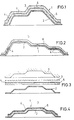
- Figure 1 shows a molded part 1, which still rests on its shape designated 2.
- the molded part 1 comprises the bituminous layer (3), preferably made of a bitumen-plastic mixture. Niese has been stabilized according to the process of the invention after it has been deformed in that the rapidly, preferably light-curing, resin in the form of strips 4 is applied in critical areas which tend to deform easily. This gives the molded part a kind of support corset.
- the layer 5 consisting of nonwoven material is laminated onto the bituminous layer 3 in a manner not shown in detail.
- the molded part 1 shown in Figure 2 includes the deep-drawn or punched bituminous layer 3, the is also stabilized with strip-shaped coatings 4.
- the strips have a semi-oval shape, the broad side of which faces layer 3.
- a correspondingly designed nozzle is used for the cross-sectional shaping of these strips 4, by means of which the resin which, for example, hardens light in a few seconds is applied to the layer 3.
- the bituminous layer 3 is laminated with a wool fleece 5, which is connected to the layer 3 by means of the adhesive layer 6.
- a wool fleece 5 When the wool fleece 5 is applied, deformations of the layer 3 no longer occur, since it is stabilized by the strips 4.
- the manufacturing method explained with reference to FIGS. 1 and 2 has the advantage that the nonwoven is not pressed together by a punching tool and thus largely retains its full volume.
- the material 4 forming the stabilizing layer is applied to the still flat fleece 5, for example in the form of a Sprinkled powder. Then the punch is moved to form 2 at a distance so that the desired deformation is achieved. Simultaneous heating of the stamp causes the stabilization layer 4 to harden and - if not yet done - a reaction of the phenolic resin contained in the fleece for the purpose of crosslinking the fleece material.
- a heatable stamp 7 is unnecessary if a thermoplastic is used as the material for the stabilizing layer and if the fleece 5 and the material forming the stabilizing layer 4 are heated immediately before being introduced into the mold 2, 7.
- the stabilization layer cools down and hardens, so that a stable molded structure is made of non-woven cotton.
- the layer 3 containing bitumen, shown in broken lines in FIG. 3, is applied, so that the inherently rigid molded part 1 shown in FIG. 4 is produced.
- the exemplary embodiments each show a raised shape 2.
- the invention can also be used for trough-like shapes.
- the nonwoven material remains so soft during the deformation step that it retains optimal sound insulation properties. This is the case if, for example, a raw fleece with a thickness of 100 mm is deformed (at a distance) and heat treatment to a layer of about 20 - 30 mm is deformed.
- the application of heat is required for the reaction of the phenolic resin in the raw fleece and can also serve to harden a stabilization layer applied on one side.
Landscapes
- Engineering & Computer Science (AREA)
- Textile Engineering (AREA)
- Physics & Mathematics (AREA)
- Acoustics & Sound (AREA)
- Multimedia (AREA)
- Laminated Bodies (AREA)
- Moulding By Coating Moulds (AREA)
- Woven Fabrics (AREA)
Abstract
Description
- Die Erfindung bezieht sich auf ein Formteil, das eine erste Schicht aus Vliesmaterial und eire zweite Schicht aus Bitumen oder einem Bitumen-Kunststoff-Gemisch umfaßt sowie auf ein Verfahren zur Herstellung dieses Formteiles.
- Bei der Kraftfahrzeug-Herstellung werden einzelne Blechteile, - Abschnitte oder - Bereiche - z.B. das den Fahrgastraum vom Motorraum trennende Blech - mit einem Formteil ausgerüstet, um insbesondere eine wirksame Schalldämmung zu erzielen. Bekannte dabei verwendete Formteile bestehen aus zwei Schichten, und zwar einer ersten Schicht aus verpreßterm Baumwollvlies und einer zweiten Bitumenschicht. Die Herstellung eines solchen Formteiles erfolgt in der Weise, daß zunächst ein mit Phenolharz (zu ca. 20 bis 40 7) getränktes Rohvlies unter hohem Druck zu einem Formteil gepreßt und z.B. gleichzeitig durch ausreichend lange Wärmebehandlung das Phenolharz ausgehärtet wird, um eine Vernetzung der Vliesbestandteile - vorzugsweise Baumwolle - zu erzielen. Danach wird z.B. durch Tiefziehen die Bitumenschicht aufgebracht.
- Bei einem in dieser Art und Weise hergestellten Formteil hat das ausgehärtete Vlies u.a. die Funktion, als Träger der relativ weichen Bitumenschicht zu dienen. Dadurch wird die an solche Formteile gestellte Forderung ausreichender Steifheit oder Stabilität erfüllt, die notwendig ist, um das Formteil ohne die Gefahr von Deformationen transportieren und während des Kfz-Herstellungsprozesses in einfacher Weise applizieren zu können. Nachteilig ist jedoch, daß die ausgehärtete Vliesschicht zum einen aufgrund ihrer Steifheit zur Erhöhung des Dämm-Maßes des Formteiles nicht mehr viel beiträgt; zum anderen besteht aufgrund von Herstellungstoleranzen oder nicht ganz vermeidharer Deformationen während des Transportes die Gefahr, daß das insgesamt sehr steife Formteil der Blechkontur nicht vollflächig anliegt, so daß Luftspalte zwischen Blech und Formteil bestehen, die die Dämm-Maße erheblich verschlechtern.
- Der vorliegenden Erfindung liegt deshalb die Aufgabe zugrunde, ein Formteil der eingangs erwähnten Art zu schaffen bzw. herzustellen, welches ausreichend stabil ist und dennoch bessere Dämmeigenschaften hat.
- Diese Aufgabe wird erfindungsgemäß dadurch gelöst, daß zwischen der noch relativ weichen Vliesmaterialschicht und der Bitumen- oder Bitumen/Kunststoff-Schicht eine Stabilisierungsschicht vorgesehen ist. Bei einem Formteil dieser Art übernimmt die zusätzliche Stabiliserungs- oder Versteifungsschicht die Aufgabe, für eine den Transport und das Handling erleichternde Stabilität zu sorgen, so daß die aus Vliesmaterial bestehende Schicht einen wesentlichen Beitrag zur Stabilität des Systems nicht mehr zu leisten hat. Sie kann deshalb in einem relativ weichen 7u-stand verbleiben, so daß sie sich dem mit dem Formteil auszurüstenden Blechteil anpassen bzw. anschmiegen kann. Die Gefahr der Entstehung von die Dämm-Maße verschlechternden Luftspalten besteht nicht mehr. Außerdem hat die relativ weiche Vliesschicht selbst wesentlich bessere Dämm-Eigenschaften als die vollständig verpreßte Vliesschicht (nach dem Stand der Technik). Sowohl durch das erfindungsgemäße Formteil selbst als auch durch seine verbesserte Applizierung läßt sich deshalb eine Erhöhung des Damm-Maßes erzielen. Ein weiterer Vorteil liegt darin, daß das Formteil seine Form auch bei späterer Wärmeeinwirkung nicht verliert. Der vollflächige Kontakt mit dem Blechteil ist deshalb auch dann gewährleistet, wenn Teilbereiche des Formteiles überkopf appliziert sind, was z.B. im Fußraum eines Fahrzeuges nötig ist.
- Die die Stabilisierung bewirkende Schicht kann vielfältig gestaltet sein. Sie kann aus einem bei Licht, Luft und/ oder Wärme aushärtendem "aterial bestehen, das z.B. nur in kritischen, vor Deformationen zu schützenden Bereichen aufgebracht ist.
- Auch die Art und Weise der Herstellung des erfindungsgemäßen Formteiles kann unterschiedlich sein. Z.B. kann zuerst das Vlies verformt, mit der Stabilisierungsschicht ausgerüstet und dann mit der Bitumen enthaltenden Schicht versehen werden. Eine andere Möglichkeit besteht darin, zunächst die Bitumenschicht zu verformen, mit der Stabilisierungsschicht zu versteifen und darauf die VliesSchicht aufzukaschieren. Wesentlich ist dabei, daß die Vliesschicht relativ weich bleiben kann, so daß sich ihre freie Oberfläche dem mit dem Formteil auszurüstenden Blechteil ohne Bildung von Luftspalten anzupassen vermag und damit ein optimal günstiges Dämmverhalten erzielt werden kann.
- Ein besonders vorteilhaftes Verfahren zur Herstellung des Formteiles ist dadurch gekennzeichnet, daß zunächst ein ursprünglich ebenes Vlies derart verformt wird, daß es seinen relativ weichen Zustand nicht verliert, mit t der Stabilisierungsschicht ausgerüstet wird und danach die Bitumen enthaltende Schicht aufkaschiert wird. Die Art und Weise der Ausbildung der Stabilisierungsschicht hängt dabei von dem verwendeten Material ab.
- Wird z.B. als die Stabilisierungsschicht bildendes Material ein bei Wärme aushärtendes Produkt vor der Verformung auf das ebene Vlies aufgebracht, dann kann die Verformung, die Vernetzung des Vliesmaterials und die Aushärtung der Stabilisierungsschicht in einem Verfabrensschritt durchgeführt werden, indem mit einer Form und einem heizbaren Stempel gearbeitet wird. Die Verformung selbst erfolgt auf Abstand, so daß das Vlies relativ weich bleibt und seine Schalldämmeigenschaften nicht verliert.
- Wird als Material für die Stabilisierungsschicht ein Thermoplast verwendet, das vor der Verformung des Vlieses auf dieses aufgebracht ist, dann besteht die Möglichkeit, das Vlies unmittelbar vor dem Finbringen in die Form z.R. mit Infrarot-Lampen aufzubeizen, so daß sich der technisch aufwendige beheizbare Stempel erübrigt. Während des sich anschließenden Verformungsschrittes kühlt die Stabilisierungsschicht ab und härtet aus, so daß ein einseitin weiches und dennoch stabiles Formteil entsteht, das anschließend in einfacher Weise mit der Bitumen enthaltenden Schicht ausgerüstet werden kann. Besonders zweckmäßig ist es bei diesem Verfahren, wenn das die Stabilisierungsschicht bildende Material auf das noch ebene Vlies in Form eines Pulvers aufgestreut wird. Zur Staub- und Faserisolierung ist danach die Abdeckung mit einer dünnen Zellstoffschicht (ca. 20 g/m2) vorteilhaft. Polyester-, Polyäthylen- und auch Polypropylen-Pulver kann verwendet werden.
- Weitere Vorteile und Einzelheiten sollen anhand der Figuren 1 bis 4 erläutert werden.
- Figur 1 zeigt ein Formteil 1, das noch auf seiner mit 2 bezeichneten Form ruht. Das Formteil 1 umfaßt die bitumenhaltige Schicht (3), vorzugsweise aus einem Bitumen- Kunststoff-Gemisch. niese ist nach dem erfindungsgemäßen Verfahren nach seiner Verformung dadurch stabilisiert worden, daß in kritischen, leicht zu Deformationen neigenden Bereichen das schnell, vorzugsweise an Licht aushärtende Harz in Form von Streifen 4 aufgebracht ist. Dadurch erhält das Formteil eine Art Stützkorsett. Auf die bitumenhaltige Schicht 3 ist die aus Vliesmaterial bestehende Schicht 5 in nicht näher dargestellter Weise aufkaschiert.
- Das in Figur 2 dargestellte Formteil 1 umfaßt die tiefgezogene oder gestanzte bitumenhaltige Schicht 3, die ebenfalls mit streifenförmigen Beschichtungen 4 stabilisiert ist. Die Streifen haben eine halbovale Form, deren breite Seite der Schicht 3 zugewandt ist. Zur Ouerschnittsformung dieser Streifen 4 dient eine entsprechend gestaltete Düse, mit der das z.P. an Licht in wenigen Sekunden aushärtende Harz auf die Schicht 3 aufgebracht wird.
- Die bitumenhaltige Schicht 3 ist mit einem Wollvlies 5 kaschiert, das mittels der Kleberschicht 6 mit der Schicht 3 verbunden ist. Beim Aufbringen des Wollvlieses 5 treten Deformationen der Schicht 3 nicht mehr auf, da sie durch die Streifen 4 stabilisiert ist. Gegenüber dem Verfahren der Herstellung eines aus einer bitumenhaltigen Schicht und einem Vlies bestehenden Verbundformteiles durch Stanzen hat das anhand der Figuren 1 und 2 erläuterte Herstellungsverfahren den Vorteil, daß das Vlies nicht durch ein Stanzwerkzeug zusammengepreßt ist und damit sein volles Volumen weitestgehend beibehält.
- Anhand der Figuren 3 und 4 soll ein besonders günstiges Herstellungsverfahren erläutert werden. Auf das noch ebene Vlies 5 wird vor der Verformung das die Stabilisierungsschicht bildende Material4aufgebracht, z.B. in Form eines Pulvers aufgestreut. Danach wird der Stempel auf Abstand auf die Form 2 gefahren, so daß die gewünschte Verformung erzielt wird. Eine gleichzeitige Beheizung des Stempels bewirkt das Aushärten der Stabilisierungsschicht 4 und - falls noch nicht geschehen - eine Reaktion des im Vlies enthaltenen Phenolharzes zum Zwecke der Vernetzung des Vliesmaterials. Ein heizbarer Stempel 7 erübrigt sich, wenn als Material für die Stabilisierungsschicht ein Thermoplast verwendet wird und wenn das Vlies 5 und das die Stabilisierungsschicht 4 bildende Material unmittelbar vor dem Einbringen in die Form 2, 7 erwärmt werden. Während der Verformung - vorzugsweise mit gekühlter Oberform - kühlt die Stabilisierungsschicht aus und wird hart, so daß ein stabiles Formgebilde aus Baum- ;ollvlies entsteht.
- Kach der Verformung des Vlieses 5 und der Aushärtung der Schicht 4 wird die in Figur 3 gestrichelt dargestellte, Bitumen enthaltende Schicht 3 aufgebracht, so daß das in Figur 4 dargestellte, eigensteife Formteil 1 entsteht.
- Die Ausführungsbeispiele zeigen jeweils eine erhabene Form 2. Natürlich ist die Frfindung auch bei muldenartigen Formen anwendbar.
- Wesentlich ist, daß das Vliesmaterial während des Verformungsschrittes so weich bleibt, daß es optimale Schalldämmeigenschaften behält. Dies ist der Fall, wenn.z.B. ein Rohvlies mit einer Stärke von 100 mm durch Verformen (auf Abstand) und Wärmebehandlung zu einer Schicht von ca. 20 - 30 mm verformt wird. Die Wärmeanwendung ist zur Reaktion des im Rohvlies befindlichen Phenolharzes erforderlich und kann gleichzeitig der Aushärtung einer einseitig aufgebrachten Stabilisierungsschicht dienen.
Claims (11)
Applications Claiming Priority (4)
| Application Number | Priority Date | Filing Date | Title |
|---|---|---|---|
| DE3410274 | 1984-03-21 | ||
| DE3410274 | 1984-03-21 | ||
| DE3500597 | 1985-01-10 | ||
| DE19853500597 DE3500597A1 (de) | 1984-03-21 | 1985-01-10 | Formteil sowie verfahren zu seiner herstellung |
Publications (2)
| Publication Number | Publication Date |
|---|---|
| EP0156227A2 true EP0156227A2 (de) | 1985-10-02 |
| EP0156227A3 EP0156227A3 (de) | 1987-04-29 |
Family
ID=25819548
Family Applications (1)
| Application Number | Title | Priority Date | Filing Date |
|---|---|---|---|
| EP85102741A Withdrawn EP0156227A3 (de) | 1984-03-21 | 1985-03-11 | Formteil sowie Verfahren zu seiner Herstellung |
Country Status (4)
| Country | Link |
|---|---|
| EP (1) | EP0156227A3 (de) |
| JP (1) | JPS612550A (de) |
| DE (1) | DE3500597A1 (de) |
| PT (1) | PT80143B (de) |
Families Citing this family (2)
| Publication number | Priority date | Publication date | Assignee | Title |
|---|---|---|---|---|
| US7222464B2 (en) | 2002-12-18 | 2007-05-29 | Suehiro-System Co., Ltd. | Anchor bolt and installing method thereof |
| RU2360078C2 (ru) | 2004-06-30 | 2009-06-27 | Суехиро-Систем Ко., Лтд. | Составной анкерный болт (варианты) и способ монтажа анкерного болта |
Family Cites Families (4)
| Publication number | Priority date | Publication date | Assignee | Title |
|---|---|---|---|---|
| GB1228592A (de) * | 1968-03-27 | 1971-04-15 | ||
| GB1451707A (en) * | 1974-07-26 | 1976-10-06 | British Uralite Ltd | Noise control materials |
| DE2629029A1 (de) * | 1976-06-29 | 1978-01-12 | Gundernhausen Chemie | Verfahren zur herstellung mehrschichtiger formteile |
| DE3300298A1 (de) * | 1983-01-07 | 1984-07-19 | Chemie-Werk Weinsheim Gmbh, 6520 Worms | Plattenfoermiges teil mit koerperschalldaempfender und versteifender wirkung |
-
1985
- 1985-01-10 DE DE19853500597 patent/DE3500597A1/de not_active Withdrawn
- 1985-03-11 EP EP85102741A patent/EP0156227A3/de not_active Withdrawn
- 1985-03-21 PT PT80143A patent/PT80143B/de unknown
- 1985-03-22 JP JP60055717A patent/JPS612550A/ja active Pending
Also Published As
| Publication number | Publication date |
|---|---|
| DE3500597A1 (de) | 1985-10-10 |
| PT80143A (de) | 1985-04-01 |
| PT80143B (de) | 1987-02-11 |
| EP0156227A3 (de) | 1987-04-29 |
| JPS612550A (ja) | 1986-01-08 |
Similar Documents
| Publication | Publication Date | Title |
|---|---|---|
| DE4305847C2 (de) | Verfahren zur Herstellung einer Verkleidung für einen Innenbereich eines Baukörpers sowie entsprechend hergestellte Verkleidung | |
| DE3784836T2 (de) | Verfahren zum herstellen von schichtstoffteilen. | |
| DE69721503T2 (de) | Verfahren zur herstellung eines wiederverwendbaren dachhimmelmaterials | |
| EP1646492B1 (de) | Innenausstattungskomponenten von kraftfahrzeugen mit einem definierten oberflächenprofil | |
| DE102012104534A1 (de) | Innenverkleidung für ein Kraftfahrzeug, die einen Dachhimmel und einen Versteifungsrahmen aufweist, und Verfahren zu ihrer Herstellung | |
| DE3317138A1 (de) | Verfahren zum verbinden von pressteilen mit grossporigen koerpern | |
| DE2915474C2 (de) | Biegesteifer Verbundschichtstoff, Verfahren zu seiner Herstellung, sowie Verwendung als Fertighimmel für Automobile | |
| EP0657265A1 (de) | Verfahren zur Herstellung flächiger kaschierter Teile unter Verwendung von Gitterförmigen Vorformlingen | |
| DE3117137C2 (de) | Vorgeformtes, selbsttragendes Fahrzeugteil, insbesondere Fahrzeughimmel | |
| DE3215244A1 (de) | Schalldaemmende auskleidung, insbesondere fuer kraftfahrzeuge, sowie verfahren zu deren herstellung | |
| DE2615793C2 (de) | Formteil und Verfahren zu seiner Herstellung | |
| DE3301682A1 (de) | Verfahren zur herstellung von schalldaemmkoerpern | |
| DE3428128A1 (de) | Verfahren zum herstellen von aussenhautteilen fuer fahrzeuge sowie nach dem verfahren hergestelltes aussenhautteil | |
| DE3220768C2 (de) | Verfahren zum Herstellen von mit einer strukturierten Dekorschicht versehenen Formteilen aus Faservliesen | |
| EP1861241A1 (de) | Verfahren und werkzeug zur herstellung eines verbund-karosserieteils für ein fahrzeug | |
| WO2001026878A1 (de) | Verfahren zur herstellung einer dachversteifung für fahrzeuge und dachversteifung | |
| DE2941949C2 (de) | Verfahren zur Herstellung eines Kunststoff-Ski | |
| WO1994007708A1 (de) | Dachauskleidung | |
| EP3504046B1 (de) | Faserverstärkter schaumstoff | |
| DE3500597A1 (de) | Formteil sowie verfahren zu seiner herstellung | |
| DE10147527A1 (de) | Kraftfahrzeuginnenteile und Verfahren zu deren Herstellung | |
| EP3398761A1 (de) | Verfahren zur erhöhung der steifigkeit von vliesformteilen mittels additiver fertigung | |
| WO2012089354A1 (de) | Herstellungsverfahren für formteile mit unterschiedlichen oberflächenmaterialien | |
| DE4423551A1 (de) | Preß-Formgebungsverfahren sowie Vorrichtung zur Durchführung des Verfahrens | |
| DE2606325A1 (de) | Verfahren zum bleibenden verformen von schalldaemmplatten |
Legal Events
| Date | Code | Title | Description |
|---|---|---|---|
| PUAI | Public reference made under article 153(3) epc to a published international application that has entered the european phase |
Free format text: ORIGINAL CODE: 0009012 |
|
| AK | Designated contracting states |
Designated state(s): BE DE FR GB IT NL SE |
|
| 17P | Request for examination filed |
Effective date: 19860326 |
|
| PUAL | Search report despatched |
Free format text: ORIGINAL CODE: 0009013 |
|
| AK | Designated contracting states |
Kind code of ref document: A3 Designated state(s): BE DE FR GB IT NL SE |
|
| STAA | Information on the status of an ep patent application or granted ep patent |
Free format text: STATUS: THE APPLICATION IS DEEMED TO BE WITHDRAWN |
|
| 18D | Application deemed to be withdrawn |
Effective date: 19870401 |
|
| RIN1 | Information on inventor provided before grant (corrected) |
Inventor name: HENSCHKE, SIEGFRIED Inventor name: POLAK, JOSEF, DR. Inventor name: PROBST, WERNER Inventor name: SCHEWE, HERMANN Inventor name: PLATE, RUDOLF |