EP0156312A2 - Composition céramique piézoélectrique pour résonateur dans un filtre à ondes électrique - Google Patents
Composition céramique piézoélectrique pour résonateur dans un filtre à ondes électrique Download PDFInfo
- Publication number
- EP0156312A2 EP0156312A2 EP85103314A EP85103314A EP0156312A2 EP 0156312 A2 EP0156312 A2 EP 0156312A2 EP 85103314 A EP85103314 A EP 85103314A EP 85103314 A EP85103314 A EP 85103314A EP 0156312 A2 EP0156312 A2 EP 0156312A2
- Authority
- EP
- European Patent Office
- Prior art keywords
- piezo
- weight
- lead zirconate
- composition
- zirconate titanate
- Prior art date
- Legal status (The legal status is an assumption and is not a legal conclusion. Google has not performed a legal analysis and makes no representation as to the accuracy of the status listed.)
- Withdrawn
Links
- 239000000203 mixture Substances 0.000 title claims abstract description 60
- 239000000919 ceramic Substances 0.000 title claims abstract description 43
- HFGPZNIAWCZYJU-UHFFFAOYSA-N lead zirconate titanate Chemical class [O-2].[O-2].[O-2].[O-2].[O-2].[Ti+4].[Zr+4].[Pb+2] HFGPZNIAWCZYJU-UHFFFAOYSA-N 0.000 claims abstract description 35
- QDOXWKRWXJOMAK-UHFFFAOYSA-N dichromium trioxide Chemical compound O=[Cr]O[Cr]=O QDOXWKRWXJOMAK-UHFFFAOYSA-N 0.000 claims abstract description 11
- 239000000654 additive Substances 0.000 claims abstract description 10
- QGLKJKCYBOYXKC-UHFFFAOYSA-N nonaoxidotritungsten Chemical compound O=[W]1(=O)O[W](=O)(=O)O[W](=O)(=O)O1 QGLKJKCYBOYXKC-UHFFFAOYSA-N 0.000 claims description 38
- WGLPBDUCMAPZCE-UHFFFAOYSA-N Trioxochromium Chemical compound O=[Cr](=O)=O WGLPBDUCMAPZCE-UHFFFAOYSA-N 0.000 claims description 33
- 229910010293 ceramic material Inorganic materials 0.000 claims description 32
- 229910001930 tungsten oxide Inorganic materials 0.000 claims description 27
- 229910052451 lead zirconate titanate Inorganic materials 0.000 claims description 22
- 239000004615 ingredient Substances 0.000 claims description 20
- 230000000996 additive effect Effects 0.000 claims description 8
- 239000011575 calcium Substances 0.000 claims description 8
- CIOAGBVUUVVLOB-UHFFFAOYSA-N strontium atom Chemical compound [Sr] CIOAGBVUUVVLOB-UHFFFAOYSA-N 0.000 claims description 8
- OYPRJOBELJOOCE-UHFFFAOYSA-N Calcium Chemical compound [Ca] OYPRJOBELJOOCE-UHFFFAOYSA-N 0.000 claims description 7
- 229910052712 strontium Inorganic materials 0.000 claims description 7
- 229910052784 alkaline earth metal Inorganic materials 0.000 claims description 6
- 150000001342 alkaline earth metals Chemical class 0.000 claims description 6
- 229910052788 barium Inorganic materials 0.000 claims description 6
- DSAJWYNOEDNPEQ-UHFFFAOYSA-N barium atom Chemical compound [Ba] DSAJWYNOEDNPEQ-UHFFFAOYSA-N 0.000 claims description 6
- 229910052791 calcium Inorganic materials 0.000 claims description 6
- 230000008878 coupling Effects 0.000 abstract description 8
- 238000010168 coupling process Methods 0.000 abstract description 8
- 238000005859 coupling reaction Methods 0.000 abstract description 8
- ZNOKGRXACCSDPY-UHFFFAOYSA-N tungsten trioxide Chemical compound O=[W](=O)=O ZNOKGRXACCSDPY-UHFFFAOYSA-N 0.000 abstract description 2
- 239000000463 material Substances 0.000 description 11
- 230000008859 change Effects 0.000 description 7
- 238000012360 testing method Methods 0.000 description 7
- 230000007423 decrease Effects 0.000 description 6
- 238000005259 measurement Methods 0.000 description 6
- 238000009472 formulation Methods 0.000 description 5
- 238000000034 method Methods 0.000 description 5
- 230000000694 effects Effects 0.000 description 4
- 239000000126 substance Substances 0.000 description 4
- GWEVSGVZZGPLCZ-UHFFFAOYSA-N Titan oxide Chemical compound O=[Ti]=O GWEVSGVZZGPLCZ-UHFFFAOYSA-N 0.000 description 3
- MCMNRKCIXSYSNV-UHFFFAOYSA-N Zirconium dioxide Chemical compound O=[Zr]=O MCMNRKCIXSYSNV-UHFFFAOYSA-N 0.000 description 3
- 230000001747 exhibiting effect Effects 0.000 description 3
- 239000002245 particle Substances 0.000 description 3
- 238000005245 sintering Methods 0.000 description 3
- 229910003781 PbTiO3 Inorganic materials 0.000 description 2
- AYJRCSIUFZENHW-UHFFFAOYSA-L barium carbonate Chemical compound [Ba+2].[O-]C([O-])=O AYJRCSIUFZENHW-UHFFFAOYSA-L 0.000 description 2
- 229910000423 chromium oxide Inorganic materials 0.000 description 2
- 230000000052 comparative effect Effects 0.000 description 2
- 230000003247 decreasing effect Effects 0.000 description 2
- NKZSPGSOXYXWQA-UHFFFAOYSA-N dioxido(oxo)titanium;lead(2+) Chemical compound [Pb+2].[O-][Ti]([O-])=O NKZSPGSOXYXWQA-UHFFFAOYSA-N 0.000 description 2
- 238000002156 mixing Methods 0.000 description 2
- 230000000704 physical effect Effects 0.000 description 2
- 238000011160 research Methods 0.000 description 2
- 239000006104 solid solution Substances 0.000 description 2
- BQCADISMDOOEFD-UHFFFAOYSA-N Silver Chemical compound [Ag] BQCADISMDOOEFD-UHFFFAOYSA-N 0.000 description 1
- WZECUPJJEIXUKY-UHFFFAOYSA-N [O-2].[O-2].[O-2].[U+6] Chemical compound [O-2].[O-2].[O-2].[U+6] WZECUPJJEIXUKY-UHFFFAOYSA-N 0.000 description 1
- 230000002411 adverse Effects 0.000 description 1
- 238000001354 calcination Methods 0.000 description 1
- 229910000019 calcium carbonate Inorganic materials 0.000 description 1
- 238000006243 chemical reaction Methods 0.000 description 1
- 239000011651 chromium Substances 0.000 description 1
- 238000004891 communication Methods 0.000 description 1
- 238000010276 construction Methods 0.000 description 1
- 238000007796 conventional method Methods 0.000 description 1
- 239000013078 crystal Substances 0.000 description 1
- 230000002542 deteriorative effect Effects 0.000 description 1
- 238000010586 diagram Methods 0.000 description 1
- 230000005686 electrostatic field Effects 0.000 description 1
- 238000002474 experimental method Methods 0.000 description 1
- 230000002349 favourable effect Effects 0.000 description 1
- 238000001914 filtration Methods 0.000 description 1
- 230000006872 improvement Effects 0.000 description 1
- 238000003780 insertion Methods 0.000 description 1
- 230000037431 insertion Effects 0.000 description 1
- 238000009413 insulation Methods 0.000 description 1
- 238000003801 milling Methods 0.000 description 1
- YEXPOXQUZXUXJW-UHFFFAOYSA-N oxolead Chemical compound [Pb]=O YEXPOXQUZXUXJW-UHFFFAOYSA-N 0.000 description 1
- 230000010287 polarization Effects 0.000 description 1
- 239000000843 powder Substances 0.000 description 1
- 230000009467 reduction Effects 0.000 description 1
- 238000009877 rendering Methods 0.000 description 1
- 239000011369 resultant mixture Substances 0.000 description 1
- 238000005476 soldering Methods 0.000 description 1
- 229910000018 strontium carbonate Inorganic materials 0.000 description 1
- OGIDPMRJRNCKJF-UHFFFAOYSA-N titanium oxide Inorganic materials [Ti]=O OGIDPMRJRNCKJF-UHFFFAOYSA-N 0.000 description 1
- 230000009466 transformation Effects 0.000 description 1
- 229910000439 uranium oxide Inorganic materials 0.000 description 1
Images
Classifications
-
- H—ELECTRICITY
- H10—SEMICONDUCTOR DEVICES; ELECTRIC SOLID-STATE DEVICES NOT OTHERWISE PROVIDED FOR
- H10N—ELECTRIC SOLID-STATE DEVICES NOT OTHERWISE PROVIDED FOR
- H10N30/00—Piezoelectric or electrostrictive devices
- H10N30/80—Constructional details
- H10N30/85—Piezoelectric or electrostrictive active materials
- H10N30/853—Ceramic compositions
Definitions
- This invention relates to a new lead zirconate titanate based piezo-electric ceramic composition for producing ceramic resonator in the electrical wave-filters. More particularly, this invention relates to a new piezo-electric ceramic composition comprising a modified or unmodified lead zirconate titanate together with tungsten oxide (W0 3 ) and chromium oxide (Cr 2 0 3 ) as additives and well suited for use as the wave-filter resonator exhibiting improved group-delay-time characteristics for the filters.
- W0 3 tungsten oxide
- Cr 2 0 3 chromium oxide
- the electrical and physical properties of the piezo-electric ceramics comprising lead zirconate titanate can be modified by admixing with a proportion of chromium oxide or uranium oxide or another oxides, and/or by replacing a part of the lead component in the lead zirconate titanate by an alkaline earth metal selected from strontium (Sr), calcium (Ca) and barium (Ba) (see, e.g., U.S. Patent Nos. 3,006,857; 3,117,094 and 3,194,765).
- the piezo-electric ceramic material consisting essentially of electrostatically prepolarized lead zirconate titanate can be modified so as to improve the group-delay-time characteristics of the filter as produced therefrom, by admixing the ceramic material with an amount of 1.5 to 4.5% by weight of tungsten oxide (W0 3 ) as well as an amount of 0.1 to 0.5% by weight of chromic oxide (Cr 2 0 3 ) based on the total weight of the resultant mixture.
- the piezo-electric ceramic material comprising lead zirconate titanate is admixed with an amount of 1.5 to 4.5% by weight of tungsten oxide
- the mechanical quality factor (Qm) of said ceramic material is advantageously decreased while the electro- '.mechanical coupling coefficient (hereinafter abbreviated as Kr) and the di-electric constant (hereinafter abbreviated as e) of said ceramic material are advantageously increased due to the addition of tungsten oxide, although this addition of tungsten oxide can deteriorate much or less the temperature and time stabilities of the resonant frequency (hereinafter abbreviated as Fr) of the resonator produced from the ceramic material.
- Fr resonant frequency
- the meritable effects of the tungsten oxide and chromic oxide added are obtainable also when the chemical composition of the lead zirconate titanate is so further modified in a known manner that the atomic ratio of Zr to Ti in the lead zirconate titanate is changed from a value of 0.5:0.5 (for Pb(Zr 0 ⁇ 5 ⁇ Ti 0 ⁇ 5 )O 3 , namely the solid solution of equi-molar proportions of lead zirconate PbZr0 3 and lead titanate PbTi0 3 ) to a value of ranging from 0.48:0.52 to 0.52:0.48.
- the lead zirconate titanates effectively available for the purposes of this invention include such one of the formula Pb(Zr a -Ti 1-a ) 0 3 wherein the value of a is ranging from 0.48 to 0.52 and which is able to provide a lead zirconate titanate of such chemical composition in which the crystal phase change (usually called the morphotropic transformation) can occur with exhibiting a very much enhanced piezo-electric electric distortion effect but with giving only a low value of not more than 0.20% for the temperature coefficient of the resonant frequency (in a temperature range of -20°C to 60°C).
- a piezo-electric ceramic composition for producing resonators in wave-filters which comprises as the principal ingredient a lead zirconate titanate of empirical formula Pb(Zr a Ti 1-a )O 3 wherein not more than 10 molar % of the Pb component is replaced by an equivalent quantity of at least one alkaline earth metal selected from strontium, calcium and barium and a is a value of 0.48 to 0.52, and as the additive ingredients 1.5 to 4.5% by weight of tungsten oxide (W0 3 ) and 0.1 to 0.5% by weight of chromic oxide (Cr 2 0 3 ) based on the total weight of the composition.
- tungsten oxide W0 3
- Cr 2 0 3 chromic oxide
- the piezo-electric ceramic composition of this invention essentially consists of a.mixture of the principal lead zirconate titanate ingredient with tungsten oxide (W0 3 ) and chromic oxide (Cr 2 O 3 ) as the additive ingredients.
- the first additive, tungsten oxide (W0 3 ) is effective not only to decrease the mechanical quality factor (Qm) of the ceramic material but also to increase the electromechanical coupling coefficient (Kr) and the di-electric constant (e) of the ceramic material.
- the amount or proportion of tungsten oxide added is less than 1.5% by weight based on the total weight of the material composition, the electric and physical properties of the resulting piezo-electric ceramic material do not reach the satisfactory levels (which are desirable to show an e value of not less than 1300, a Kr value of not less than 50%, and a Qm value of not more than 300).
- the second additive, chromic oxide (Cr 2 0 3 ) is effective to reduce the change in the resonant frequency (Fr) with temperature and with time, and hence to enhance the temperature and time stabilities for the resonant frequency (Fr).
- This advantageous effect of chromic oxide can be developed already by addition of a small amount, 0.1% by weight of chromic oxide, but addition of a further increased amount of chromic oxide is likely to result in a reduction in the Kr value and an increase in the Qm value of the resulting piezo-electric ceramic material.
- the upper limit for the amount of chromic oxide added is necessary to be set at the value of 0.5% by weight of chromic oxide (Cr 2 0 3 ) based on the total weight of the ceramic composition of this invention.
- a part of up to 10 molar % of the lead (Pb) component of the lead zirconate titanate can be replaced by an equivalent quantity of at least one of strontium, calcium and barium, as be known in the art, e.g. as disclosed in U.S. Patent No. 3,006,857, with a view to improve the sintering properties of the resulting ceramic material but without deteriorating unduly the di-electric constant and the electromechanical coupling coefficient of the ceramic material.
- Replacement of a part of more than 10 molar % of the lead component by the alkaline-earth metals could deteriorate the electric and electromechanical properties of the ceramic material.
- lead zirconate titanate of empirical formula Pb(Zr a -Ti 1-a )O 3 present in the ceramic composition of - this invention is that the lead zirconate titanates having the values of a in the stipulated range are of the formulation which is near the morphotropic phase boundary (see U.S. Patent Nos.
- the ceramic composition according to this invention may be prepared in accordance with different ceramic procedures which are well known in the art and are described, for example, in the specification of U.S. Patent Nos. 3,006,857 and 3,194,765.
- a preferred method of preparing the ceramic composition comprises mixing lead oxide (PbO), zirconia oxide (Zr0 2 ) and titania (Ti0 2 ) each of a chemical pure grade with each other, optionally together with appropriate amounts of strontium, calcium or barium carbonate when a part of the lead component in the lead zirconate titanate product is to be replaced by the alkaline earth metal, so that a mixture of-the combined ingredients is obtained.
- This mixture is then wet or dry milled to achieve thorough mixing and comparatively uniform particle size of the ingredient particles. After this first milling, the mixture is dried (when wet milled) and reground to make the mixture homogeneous as much as possible. The reground mixture is then sintered for reaction to produce the modified or unmodified lead zirconate titanate. The sintered material is then again ground and milled. At this stage, pre-determined suitable proportions of tungsten oxide (W0 3 ) and chromic oxide (Cr 2 o 3 ) are thoroughly admixed. After the addition of tungsten oxide and chromic oxide, the mixture obtained is pre-reacted by calcining or sintering at a high temperature for a suitable time.
- W0 3 tungsten oxide
- Cr 2 o 3 chromic oxide
- the pre-reacted material is then cooled and crushed and milled to an average particle size of e.g., 1 microns or more or less, followed by being hot-pressed into desired shapes in accordance with conventional ceramic procedures.
- the shapes so formed are then ultimately fired until the material gains the ceramic quality or maturity.
- the fired shapes may then be cooled and polarized in a manner well known in the art, for example, by applying a pair of electrodes to opposite sides of the ceramic bodies and applying an electrostatic field to the electrodes so that the ceramic material of the shapes is electrostatically polarized, to exhibit the piezo-electric properties.
- the formulation of the ceramic sample compositions so prepared is thus represented by the following formula:- where X denotes the proportion of tungsten oxide in % by weight and Y denotes the proportion of chromic oxide in % by weight as indicated in Table 1 on the weight basis of the whole mixture of all the ingredients.
- the ceramic samples to be tested were prepared by the following procedure:- All the finely divided ingredient materials, namely the strontium-modified lead zirconate titanate, tungsten oxide and chromic oxide were weighed and mixed together in such proportions that the formulations of the resulting mixtures were corresponding to the respective values of X and Y as indicated in Table 1. The mixture was milled in ball mill, dried and thereafter once pre-calcined at 730-780°C.
- the pre-calcined material was wet reground in ball mill for 16 hours and dried.
- the so dried powder was hot-pressed into discs of 20 mm diameter and 1 mm thickness.
- the discs were sintered at 1100-1200°C for 2 hours so that the whole material of the discs gained the ceramic quality or maturity.
- the sintered discs were polished at the front and rear sides thereof to give the precisely planar surfaces to which were then bonded two electrodes of silver metal by soldering.
- the disc material was then polarized by applying a D.C. voltage of 30 to 50 KV/cm for 30 minutes while the discs were kept in a bath of insulation oil.
- the discs so polarized and showing a conventional electromechanical resonator construction were used as the test samples and tested for measurement of their electric and electromechanical properties. The test results obtained are shown in the following Table 1.
- di-electric constant (e) shown in Table 1 was made at a frequency of 1 KHz, and the measurements of the electromechanical coupling coefficient (Kr) and the mechanical quality factor (Qm) were conducted according to the method of standard circuit of I.R.E. (The Institute of Radio Engineers). Besides, the measurement of the rate (in percent) of change in the resonant frequency (Fr) with time was conducted by estimating the change in the central frequency (455 KHz) which occurred in 10,000 hours of service after the polarization, with using the specimen plates of 4.8 mm square which were cut out of the aforesaid sintered discs.
- Kr electromechanical coupling coefficient
- Qm mechanical quality factor
- test results similar to those of Tables 1 and 2 were obtained when testing in the same manner as above some additional piezo-ceramic material samples having the same formulations as mentioned above except that the strontium component in the modified lead zirconate titanate was replaced by calcium or barium.
- the piezo-electric ceramic composition of this invention should exhibit a di- electric constant (e) of not less than 1300, an electromechanical coupling coefficient (Kr) of not less than 50% and a mechanical quality factor (Qm) of not more than 300 in combination.
- each resonator (S) in parallel comprising a square plate-shaped resonator element which was similarly made of the piezo-electric ceramic material of Sample No. 16 set out in Table 1, had external dimensions of 4.8 mm square and 0.35 mm thickness and exhibited a central frequency of 455 KHz-and an electrostatic capacity of 800 to 1000 pF.
- the Qm value may desirably be in a range of 80 to 300 because of that the flattness of the curve of the group-delay-time characteristics is much enhanced as the Qm value decreases, provided that the insertion loss of the resonator can be increased unduly and the selective filtering characteristics of the filter can be deteriorated if the Qm value is lowered excessively.
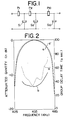
- the piezo-electric ceramic compositions consisting essentially of a modified or unmodified lead zirconate titanate admixed simultaneously with 1.5-4.5% by weight of tungsten oxide and 0.1-0.5% by weight of chromic oxide according to this invention exhibit the desired values in terms of the di-electric constant (e) of not less than 1300, electromechanical coupling co- efficient (Kr) of not less than 50% and mechanical quality factor (Qm) of not more than 300 (see Tables 1 and 2); and also exhibit a low rate of change in the resonant frequency with time of not more than 0.10% (see Tables 1 and 2) as well as a favorable flattness in respect of the group-delay-time characteristics curve for the filter, with a lesser phase distortion of the output signals (see Figure 2 of the accompanying drawings).
- the di-electric constant e
- Kr electromechanical coupling co- efficient
- Qm mechanical quality factor
- the piezo-electric ceramic composition of this invention shows in practice important advantages that this composition gives greatly improved group-delay-time . characteristics for the filter and displays high electric and electromechanical performances with reasonable stability even after long time service.
- a piezo-electric ceramic composition for use as ceramic resonator in electrical wave filters which comprises as the principal ingredient a strontium-modified lead zirconate titanate of empirical formula Pb 0.95 Sr 0.05 (Zr a -Ti 1-a )O 3 wherein a is a value of 0.48 to 0.52, preferably a value of 0.5, and as the additive ingredients 1.5 to 4.5% by weight of tungsten oxide (W0 3 ) and 0.1 to 0.5% by weight of chromic oxide (Cr 2 0 3 ) based on the total weight of the composition.
- a strontium-modified lead zirconate titanate of empirical formula Pb 0.95 Sr 0.05 (Zr a -Ti 1-a )O 3 wherein a is a value of 0.48 to 0.52, preferably a value of 0.5, and as the additive ingredients 1.5 to 4.5% by weight of tungsten oxide (W0 3 ) and 0.1 to 0.5% by weight of chromic oxide (Cr 2 0
- a piezo-electric ceramic composition consisting essentially of a strontium-modified lead zirconate titanate of empirical formula admixed with 1.5 to 4.5% by weight of tungsten oxide (W0 3 ) and 0.1 to 0.5% by weight of chromic oxide (Cr 2 0 3 ) based on the total weight of the composition.
- a wave-filter resonator formed from a piezo-electric ceramic material consisting essentially of a strontium-modified lead zirconate titanate of empirical formula wherein a is a value of 0.48 to 0.52, preferably a value of 0.5, admixed with 1.5 to 4.5% by weight of tungsten oxide (WO 3 ) and 0.1 to 0.5% by weight of chromic oxide (Cr 2 0 3 ) based on the total weight of the composition.
- a is a value of 0.48 to 0.52, preferably a value of 0.5, admixed with 1.5 to 4.5% by weight of tungsten oxide (WO 3 ) and 0.1 to 0.5% by weight of chromic oxide (Cr 2 0 3 ) based on the total weight of the composition.
Landscapes
- Chemical & Material Sciences (AREA)
- Engineering & Computer Science (AREA)
- Ceramic Engineering (AREA)
- Compositions Of Oxide Ceramics (AREA)
Applications Claiming Priority (2)
| Application Number | Priority Date | Filing Date | Title |
|---|---|---|---|
| JP53837/84 | 1984-03-21 | ||
| JP59053837A JPS60196983A (ja) | 1984-03-21 | 1984-03-21 | セラミツクフイルタ素子用圧電磁器組成物 |
Publications (1)
| Publication Number | Publication Date |
|---|---|
| EP0156312A2 true EP0156312A2 (fr) | 1985-10-02 |
Family
ID=12953895
Family Applications (1)
| Application Number | Title | Priority Date | Filing Date |
|---|---|---|---|
| EP85103314A Withdrawn EP0156312A2 (fr) | 1984-03-21 | 1985-03-21 | Composition céramique piézoélectrique pour résonateur dans un filtre à ondes électrique |
Country Status (2)
| Country | Link |
|---|---|
| EP (1) | EP0156312A2 (fr) |
| JP (1) | JPS60196983A (fr) |
Cited By (3)
| Publication number | Priority date | Publication date | Assignee | Title |
|---|---|---|---|---|
| EP0379390A3 (fr) * | 1989-01-20 | 1991-02-20 | MITSUI TOATSU CHEMICALS, Inc. | Elément piézoélectrique à effet électrostrictif géant et composition céramique pour sa fabrication |
| US7564176B2 (en) * | 2006-03-22 | 2009-07-21 | Tdk Corporation | Laminated piezoelectric element and production method of the same |
| CN101717251B (zh) * | 2009-12-04 | 2012-05-23 | 北京工业大学 | 一种改性钛酸铅压电陶瓷材料及其制备方法 |
Family Cites Families (1)
| Publication number | Priority date | Publication date | Assignee | Title |
|---|---|---|---|---|
| JPS5227359A (en) * | 1975-08-27 | 1977-03-01 | Hitachi Ltd | Face down bonding method |
-
1984
- 1984-03-21 JP JP59053837A patent/JPS60196983A/ja active Pending
-
1985
- 1985-03-21 EP EP85103314A patent/EP0156312A2/fr not_active Withdrawn
Cited By (3)
| Publication number | Priority date | Publication date | Assignee | Title |
|---|---|---|---|---|
| EP0379390A3 (fr) * | 1989-01-20 | 1991-02-20 | MITSUI TOATSU CHEMICALS, Inc. | Elément piézoélectrique à effet électrostrictif géant et composition céramique pour sa fabrication |
| US7564176B2 (en) * | 2006-03-22 | 2009-07-21 | Tdk Corporation | Laminated piezoelectric element and production method of the same |
| CN101717251B (zh) * | 2009-12-04 | 2012-05-23 | 北京工业大学 | 一种改性钛酸铅压电陶瓷材料及其制备方法 |
Also Published As
| Publication number | Publication date |
|---|---|
| JPS60196983A (ja) | 1985-10-05 |
Similar Documents
| Publication | Publication Date | Title |
|---|---|---|
| US4568848A (en) | Acoustic surface wave devices containing piezoelectric ceramics | |
| KR100282598B1 (ko) | 압전 세라믹 조성물 | |
| JPH11228227A (ja) | 圧電磁器組成物 | |
| JP3259678B2 (ja) | 圧電磁器組成物 | |
| KR100282599B1 (ko) | 압전 세라믹 조성물 | |
| JP3282576B2 (ja) | 圧電磁器組成物 | |
| EP0722918B1 (fr) | Composition céramique piézoélectrique | |
| JPH0782024A (ja) | 圧電磁器組成物 | |
| JPH11228225A (ja) | 圧電磁器組成物 | |
| US6123867A (en) | Piezoelectric ceramic composition and piezoelectric device using the same | |
| US6383408B1 (en) | Piezoelectric ceramic and surface wave device using the same | |
| US2960411A (en) | Dielectric ceramic compositions | |
| JP2002255641A (ja) | 圧電磁器および圧電素子 | |
| US3671765A (en) | Electromechanical resonator employing piezoelectric ceramic consisting of lead zirconate-titanate containing manganese monoxide | |
| EP0156312A2 (fr) | Composition céramique piézoélectrique pour résonateur dans un filtre à ondes électrique | |
| EP0423822A1 (fr) | Matériau céramique ferroélectrique | |
| JPH11349380A (ja) | 圧電磁器組成物及びこれを用いた圧電素子 | |
| JP3125624B2 (ja) | 圧電磁器 | |
| JP3384044B2 (ja) | 圧電磁器 | |
| JP2001130961A (ja) | 圧電磁器組成物およびそれを用いた圧電セラミック素子 | |
| JPS63151667A (ja) | 圧電磁器組成物 | |
| JP4467168B2 (ja) | 圧電磁器および圧電素子 | |
| JPH0745882A (ja) | 圧電素子 | |
| JP3266483B2 (ja) | 圧電磁器組成物 | |
| JP2001130960A (ja) | 圧電磁器組成物およびそれを用いた圧電セラミック素子 |
Legal Events
| Date | Code | Title | Description |
|---|---|---|---|
| PUAI | Public reference made under article 153(3) epc to a published international application that has entered the european phase |
Free format text: ORIGINAL CODE: 0009012 |
|
| AK | Designated contracting states |
Designated state(s): DE FR GB NL |
|
| STAA | Information on the status of an ep patent application or granted ep patent |
Free format text: STATUS: THE APPLICATION IS DEEMED TO BE WITHDRAWN |
|
| 18D | Application deemed to be withdrawn |
Effective date: 19870401 |
|
| RIN1 | Information on inventor provided before grant (corrected) |
Inventor name: FUJIMOTO, NAOYUKI Inventor name: SOBUE, HIDEO |