EP0156372A2 - Verfahren und Harzzusammensetzung zur Herstellung von Informationsaufzeichnungsträgern - Google Patents
Verfahren und Harzzusammensetzung zur Herstellung von Informationsaufzeichnungsträgern Download PDFInfo
- Publication number
- EP0156372A2 EP0156372A2 EP85103642A EP85103642A EP0156372A2 EP 0156372 A2 EP0156372 A2 EP 0156372A2 EP 85103642 A EP85103642 A EP 85103642A EP 85103642 A EP85103642 A EP 85103642A EP 0156372 A2 EP0156372 A2 EP 0156372A2
- Authority
- EP
- European Patent Office
- Prior art keywords
- compound
- iii
- moles
- mole
- reaction product
- Prior art date
- Legal status (The legal status is an assumption and is not a legal conclusion. Google has not performed a legal analysis and makes no representation as to the accuracy of the status listed.)
- Granted
Links
Images
Classifications
-
- G—PHYSICS
- G11—INFORMATION STORAGE
- G11B—INFORMATION STORAGE BASED ON RELATIVE MOVEMENT BETWEEN RECORD CARRIER AND TRANSDUCER
- G11B7/00—Recording or reproducing by optical means, e.g. recording using a thermal beam of optical radiation by modifying optical properties or the physical structure, reproducing using an optical beam at lower power by sensing optical properties; Record carriers therefor
- G11B7/24—Record carriers characterised by shape, structure or physical properties, or by the selection of the material
- G11B7/26—Apparatus or processes specially adapted for the manufacture of record carriers
- G11B7/263—Preparing and using a stamper, e.g. pressing or injection molding substrates
-
- B—PERFORMING OPERATIONS; TRANSPORTING
- B29—WORKING OF PLASTICS; WORKING OF SUBSTANCES IN A PLASTIC STATE IN GENERAL
- B29C—SHAPING OR JOINING OF PLASTICS; SHAPING OF MATERIAL IN A PLASTIC STATE, NOT OTHERWISE PROVIDED FOR; AFTER-TREATMENT OF THE SHAPED PRODUCTS, e.g. REPAIRING
- B29C39/00—Shaping by casting, i.e. introducing the moulding material into a mould or between confining surfaces without significant moulding pressure; Apparatus therefor
- B29C39/02—Shaping by casting, i.e. introducing the moulding material into a mould or between confining surfaces without significant moulding pressure; Apparatus therefor for making articles of definite length, i.e. discrete articles
- B29C39/026—Shaping by casting, i.e. introducing the moulding material into a mould or between confining surfaces without significant moulding pressure; Apparatus therefor for making articles of definite length, i.e. discrete articles characterised by the shape of the surface
-
- G—PHYSICS
- G11—INFORMATION STORAGE
- G11B—INFORMATION STORAGE BASED ON RELATIVE MOVEMENT BETWEEN RECORD CARRIER AND TRANSDUCER
- G11B23/00—Record carriers not specific to the method of recording or reproducing; Accessories, e.g. containers, specially adapted for co-operation with the recording or reproducing apparatus ; Intermediate mediums; Apparatus or processes specially adapted for their manufacture
- G11B23/0057—Intermediate mediums, i.e. mediums provided with an information structure not specific to the method of reproducing or duplication such as matrixes for mechanical pressing of an information structure ; record carriers having a relief information structure provided with or included in layers not specific for a single reproducing method; apparatus or processes specially adapted for their manufacture
-
- B—PERFORMING OPERATIONS; TRANSPORTING
- B29—WORKING OF PLASTICS; WORKING OF SUBSTANCES IN A PLASTIC STATE IN GENERAL
- B29C—SHAPING OR JOINING OF PLASTICS; SHAPING OF MATERIAL IN A PLASTIC STATE, NOT OTHERWISE PROVIDED FOR; AFTER-TREATMENT OF THE SHAPED PRODUCTS, e.g. REPAIRING
- B29C35/00—Heating, cooling or curing, e.g. crosslinking or vulcanising; Apparatus therefor
- B29C35/02—Heating or curing, e.g. crosslinking or vulcanizing during moulding, e.g. in a mould
- B29C35/08—Heating or curing, e.g. crosslinking or vulcanizing during moulding, e.g. in a mould by wave energy or particle radiation
-
- B—PERFORMING OPERATIONS; TRANSPORTING
- B29—WORKING OF PLASTICS; WORKING OF SUBSTANCES IN A PLASTIC STATE IN GENERAL
- B29K—INDEXING SCHEME ASSOCIATED WITH SUBCLASSES B29B, B29C OR B29D, RELATING TO MOULDING MATERIALS OR TO MATERIALS FOR MOULDS, REINFORCEMENTS, FILLERS OR PREFORMED PARTS, e.g. INSERTS
- B29K2033/00—Use of polymers of unsaturated acids or derivatives thereof as moulding material
- B29K2033/04—Polymers of esters
Definitions
- This invention relates to a process for producing a plastic information-recording medium, the plastic information-recording medium thus produced and a light-or radiation-curable resin composition used therefor.
- Plastic information-recording mediums used for digital audio discs, video discs, optical discs, magnetic optical discs, etc. bear information patterns by means cf grooves and/or pits on surfaces of transparent plastic substrates.
- Such plastic information-recording mediums are produced by casting a radiation-curable resin composition into a cavity formed by a stamper having an information pattern forming surface theon and a transparent plastic plate, curing the resin composition by irradiation with a radiation through the transparent plastic plate, and taking off the stamper and the transparent plastic plate.
- a radiation-curable resin composition comprising an acrylate or methacrylate oligomer having 1 to 4 acrylate or methacrylate groups per molecule such as an alkylene-bis(phenoxyalkylacrylate) represented by the formula: or an alkylene-bis (phenoxyalkylmethacrylate) represented by the formula: and 0.1 tc 0.5% by weight of a photcpolymerization initiator, the viscosity of the resin composition being 1000 to 15000 cps.
- the molding conditions should be selected severely and the resulting molded article is insufficient in mechanical strength, heat resistance, moisture resistance and rather large in oprical anisotropy.
- This invention provides a process for producing a plastic information-recording medium which comprises
- a light- or radiation-curable resin composition into a cavity formed by a stamper having an information pattern forming surface thereon and a releasable plate having a smooth surface thereon, at least one of the stamper and the releasable plate being transparent,
- This invention also provides a plastic information-recording medium thus produced.
- This invention further provides a light- or radiation-curable resin composition usable for producing a plastic information-recording medium comprising
- the light- or radiation-curable resin composition usable for producing a plastic information-recording medium comprises compounds (I), (II) and (III) and a photopolymerization initiator.
- the compound (I) has 4 or more, preferably 5 or more, more preferably 5 to 6, acryl or methacryl groups in one molecule and a viscosity of 3000 cps or less, preferably 3000 to 10 cps, more preferably 3000 to 100 cps, at 25°C.
- Examples of the compound (I) are pentaerythritol tetracrylate, pentaerythritol tetramethacrylate, dipentaerythritol hexaacrylate, dipentaerythritol hexamethacrylate, a dipentaerythritol derivative hexacrylate or hexamethacrylate represented by the formula: wherein R 1 is hydrogen or a methyl group; m is an integer of 1 or more; a is an integer of 1 or more; and b is zero or an integer of 1 or more.
- the dipentaerythritol derivative hexaacrylates or hexamethacrylates are available commercially under the tradename of DPCA-20, 30, 60, or 120 manufactured by Nippon Kayaku Co., Ltd. as follows:
- the compound (II) is represented by the formula: wherein R 1 is hydrogen or a methyl group; R 2 is hydrogen, an alkyl group having 1 to 5 carbon atoms, or a group of the formula: or ( ⁇ CH 2 ) ⁇ m in which m is an integer of 3 to 10.
- R 3 the following groups are more preferable:
- the compound (III) is represented by the formula: wherein R i is as defined above; and R 4 is a hydrocarbon group having 6 to 16 carbon atoms.
- R 4 are n-CH 3 (CH 2 ) 9 - , CH 3 (CH 2 ) 11 -, and CH 3 (CH 2 ) 12 -. More preferable examples of R 4 are
- These compounds
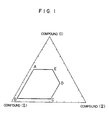
- the compounds (I), (II) and (III) are used in amounts in the closed area of lines A-B-C-D-E-A (including the values on the lines) in the triangular diagram of Fig. 1, wherein individual points A, B, C, D, and E have the following values in percents by weight:
- the compound (I) is used in an amount of 5 to 50% by weight.
- the amount of the compound (I) is less than 5% by weight, the viscosity of the resin composition becomes high so as to make the casting operation difficult, the resulting cured product, i.e., plastic information-recording medium, shows a warp when used at high temperatures (e.g. 70°C or higher), and is lowered in elastic modulus and in surface hardness.
- the amount of the compound (I) is more than 50% by weight, the resulting cured product is lowered in mechanical strength (e.g., tensile strength, elastic modulus) and undesirably increases in optical strain so as to lose practical use.
- Particularly preferable range of the amount of the compound (I) is 10 to 40% by weight.
- the compound (II) is used in an amount of 20 to 90% by weight.
- the amount of the compound (II) is less than 20% by weight, the resulting cured product (plastic information-recording medium) is lowered in mechanical strength (e.g. tensile strength, elastic modulus).
- the amount of the compound (II) is more than 90% by weight, the resulting cured product undesirably shows a warp when used at high temperatures (e.g. 70°C or higher).
- Particularly preferable range of the amount of the compound (II) is 83 to 30% by weight.
- the compound (III) is used in an amount of 5 to 50% by weight.
- the amount of the compound (III) is less than 5% by weight, the resulting cured product (plastic information-recording medium) is worsened in optical strain and shows a larger warp due to larger moisture absorption.
- the amount of the compound (III) is larger than 50% by weight, the resulting cured product is undesirably lowered in mechanical strength (e.g. tensile strength, elastic modulus).
- Particularly preferable range of the amount of the compound (III) is 7 to 40% by weight.
- benzyls such as benzyl, etc.; benzoins such as benzoin, benzoin ethyl ether, benzoin isopropyl ether, benzoin isobutyl ether, etc.; benzophenones such as benzophenone, 4-methoxybenzophenone, etc.; acetophenones such as acetophenone, 2,2-diethoxyacetophenone, etc.; thioxanthones such as 2-chlorothioxanthone, 2-methyl- thioxanthone, etc.; anthraquinones such as 2-ethylanthraquinone, 2-methylanthraquinone, etc.; benzyl dimethyl ketal, 1-hydroxycyclohexylphenyl ketone, 2-hydroxy-2-methyl-l-phenylpropane-l-on, 1-(4-isopropylphenyl)-2-hydroxy-2
- benzoin isopropyl ether benzoin isobutyl ether, 1-hydroxycyclohexylphenyl ketone, and 1-(4-isopropylphenyl)-2-hydroxy-2-methylpropane-l-on are more preferable.
- the photopolymerization initiator is used in an amount of 0.5 to 10 parts by weight, preferably 0.5 to 5 parts by weight, more preferably 0.7 to 3 parts by weight, based on 100 parts by weight of the total of the compounds (I), (II) and (III).
- amount is less than 0.5 part by weight, curing by light or radiation becomes insufficient, whereas when the amount is more than 10 parts by weight, the resulting cured article is lowered in mechanical strength.
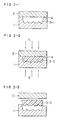
- numeral 1 denotes a stamper
- numeral 2 a releasable plate
- numeral 3-1 a cavity
- numeral 4 an inlet of a resin composition.
- the thickness of the cavity formed between the releasable plate and the stamper is preferably 0.8 to 2.0 mm, more preferably 0.8 to 1.5 mm.
- the thickness of the cavity is less than 0.8 mm, the resulting plastic information-recording medium having grooves and/or holes (pits) for carrying information pattern produced from the light- or radiation-curable resin composition is too thin to show desirable mechanical strength and has a tendency to increase noises at the time of reading information due to foreign particles adhered to surfaces having no information.
- the thickness of the cavity is more than 2.0 mm, the resulting plastic information-recording medium becomes too thick and too heavy, and undesirably has uncured portions therein.
- the stamper which has an information pattern forming surface thereon in contact with the cavity can be made from the following materials:
- the stamper made from the material (a) or (c) it is preferable to treat the information pattern forming surface with a releasing agent such as dimethylpolysiloxane, methylhydrogenpolysiloxane, or the like before use.
- a releasing agent such as dimethylpolysiloxane, methylhydrogenpolysiloxane, or the like.
- the use of the material (d) is preferable.
- the releasable plate which has a smooth surface in contact with the cavity can be made from the following materials:
- a light- or radiation-curable resin composition is cast into the cavity 3-1 through the inlet 4 and is subjected to irradiation with a light or radiation 5 as shown in Fig. 2-2.
- numeral 3-2 is the resin composition.
- the releasable plate When the stamper is made from the non-transparent material (a) or (b), the releasable plate should be made from the transparent material (g) or (h). When the releasable plate is made from the non-transparent material (e) or (f), the stamper should be made from the transparent material (c) or (d). In such cases, the resin composition is irradiated by a light or radiation through the transparent releasable plate or the transparent stamper and should have the components (I), (II) and (III) in amounts as defined above together with the photo- pclymerization initiator.
- the stamper When the stamper is made from the transparent material (c) or (d) and the releasable plate is made from the transparent material (g) or (h), the light or radiation 5 can be irradiated either through one of the stamper and the releasable plate or through both the stamper and the releasable plate as shown in Fig. 2-2.
- a conventional light- or radiation-curable resin composition can be used, but the use of the special resin composition comprising the compounds (I), (II) and (III) together with the photopolymerization initiator is more preferable.
- the special resin composition as mentioned above should be used.
- the special resin composition comprising the compounds (I), (II) and (III) and the photopolymerization initiator is irradiated with a light or radiation 5 from the both sides as shown in Fig. 2-2
- the resulting cured plastic information-recording medium shows unexpected excellent properties in preventing warp even after subjected to a heat treatment at 100°C for 1 hour. Therefore, the irradiation from both sides, i.e., both the transparent releasable plate and the transparent stamper, is more preferable.
- actinic light such as visible light, ultraviolet light, X-rays, electron beams, etc.
- actinic light is better from the viewpoint of practical use.
- Typical sources of actinic radiation include a highpressure mercury lamp, a low-pressure mercury lamp, a xencn lamp, a metal halide lamp, etc., in the case of ultraviolet light.
- Suitable irradiation amounts are 10 to 500 mW/cm 2 in the wave lengths of 320 to 400 nm.
- the releasable plate 2 and the stamper 1 are removed to give the desired plastic information-recording medium 3-3 as shown in Fig. 2-3.
- the plastic information-recording medium thus produced is small in optical strain, transparent and has good moisture resistance which prevents the medium from warpage due to moisture absorption, good heat resistance which prevents the medium from warpage due to the use at high temperatures such as 70°C or higher, and good mechanical strength which prevents the medium from breakdown due to impact.
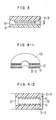
- optical disc recording mediums as shown in Figs. 3 and 4-1 and 4-2 can be constructed by a conventional method including the formation of recording fil- cf Te-Sn, Te-Se, or the like by, e.g., vacuum evaporation, and the like on the information pattern forming surface of the plastic information-recording medium.
- Transparent plates having grooves and pits thereon are preferable when they are good in curing characteristics, and have the retardation of 10 mm or less, the heat resistance of 70°C or higher and the tensile strength of 500 kg/cm 2 or more.
- optical disc recording mediums are increased in signal noises, and suffered from the warpage under high temperatures or breakdown during operation.
- a light- or radiation-curable resin composition (Sample No. 1) was prepared by mixing 40.8 parts of dipentaerythritol derivative hexacrylate (DPCA 30, a trade name, mfg. by Nippon Kayaku Co., Ltd.) as the compound (I), 30.6 parts of a reaction product of isophorone diisocyanate (1 mole) and 2-hydroxyethyl methacrylate (2 moles) as the compound (II), 28.6 parts of isobornyl methacrylate as the compound (III) and 2 parts of benzoin isopropyl ether as the photopolymerization initiator.
- DPCA 30 dipentaerythritol derivative hexacrylate
- a stamper 1 was made of nickel as shown in Fig. 2-1 sc as to have grooves (depth 0.09 ⁇ m, width 0.40 ⁇ m) and pits (or holes) (depth 0.16 ⁇ m, width 0.60 ⁇ m) and an outer diameter of 300 mm.
- a releasable plate having a smooth surface was prepared by baking a dimethylpolysiloxane releasing agent on a surface of glass circular plate having an outer diameter of 300 mm with a thickness of 10 mm.
- a cavity 3-1 with 1.3 mm thick was made by combining the stamper 1 and the releasable plate 2 with the smooth surface in contact with the cavity as shown in Fig. 2-1.
- the resin composition (Sample Nc. 1) was cast through an inlet 4 under vacuum.
- Ultraviolet light of wavelength of 320 to 400 nm was irradiated from a high pressure mercury lamp with an intensity cf 400 mW/cm 2 through the releasable plate 2 for 4: seconds to cure the resin composition.
- the releasable plate 2 and the stamper 1 were removed to give a plastic information-recording medium 3-3 as shown in Fig. 2-3.
- the plastic information-recording medium thus produced had a thickness of 1.2 mm and precise replicas of the grooves and pits of the stamper.
- the optical retardation at a wavelentth of 830 nm was 0.5 nm
- the heat distotion temperature was 110°C
- the tensile strength was 550 kg/cm 2
- the light transmittance at a wavelength of 830 nm was 99%
- the warpage of the plate was 0.1 mm/300 mr in diameter or less.
- a light- or radiation-curable resin composition (Sampel No. 2) was prepared by mixing 40.8 parts of dipentaerythritol derivative hexaacrylate (DPCA 60, a trade name, mfd. by Nippon Kayaku Co., Ltd.) as the compound (I), 30.6 parts of a reaction product of 1,3-bis-(isocyanatomethyl)cyclohexane (1 mole) and 2-hydroxyethyl methacrylate (2 moles) as the compound (II), 28.6 parts of cyclohexyl methacrylate as the compound (III) and 2 parts of benzoin isobutyl ether as the photopolymerization initiator.
- DPCA 60 dipentaerythritol derivative hexaacrylate
- 2-hydroxyethyl methacrylate 2 moles
- a stamper 1 was made from a transparent resin as shown in Fig. 2-1 so as to have grooves (depth 0.09 ⁇ m, width 0.40 ⁇ m) and pits (depth 0.16 ⁇ m, width 0.60 ⁇ m) and an outer diameter of 300 mm.
- the transparent stamper was obtained by adhering a cured light-curable resin composition (comprising 50% of polypropylene glycol dimethacrylate, 48% of neopentyl glycol dimethacrylate and 2% of benzoin isopropyl ether as a photopolymerization initiator) having grooves and pits with about 80 ⁇ m thick to a polymethyl methacrylate plate with 10 mm thick.
- a releasable plate 2 having a smooth surface was prepared by baking a dimethylsilicone releasing agent on a surface of nickel circular plate having an outer diameter of 300 mm with a thickness of 5 mm.
- a cavity 3-1 with 1.3 mm thick was made by combining the stamper 1 and the releasable plate 2 with the smooth surface in contact with the cavity as shown in Fig. 2-1.
- the resin composition (Sample Nc. 2) was cast through an inlet 4 under vacuum.
- Ultraviolet light of wavelength of 320 to 400 nm was irradiated from a high pressure mercury lamp with an intensity of 400 mW/cm 2 through the stamper 1 for 40 seconds to cure the resin composition.
- the reles- able plate 2 and the stamper 1 were removed to give a plastic information-recording medium 3-3 as shown in Fig. 2-3.
- the plastic information-recording medium thus produced had a thickness of 1.2 mm and precise replicas of the greaves and pits of the stamper.
- the optical retardation at a wavelength of 830 nm was 0.4 nm
- the heat distortion temperature was 100°C
- the tensile strength was 500 kg/cm 2
- the light transmittance at a wavelength of 830 nm was 95%
- the warpage of the plate was 0.1 mm/300 mm in diameter or less.
- Plastic information-recording mediums were produced in the same manner as described in Example 1 by using the compounds (I), (II) and (III) and photopolymerization initiatcr as listed in Table 2.
- Sample Nos. 3 to 12 show better results in the curing characteristics, retardation, heat resistance and tensile strength than the required ones tc be sufficient for practical use.
- Sample Nos. 13 to 24 do not satisfy the required values in all the items, and thus not suitable for practical use.
- Plastic information-recording mediums were produced in the same manner as described in Example 1 by using the compounds (I), (II) and (III) or known compounds in place of the compounds (I), (II) and (III), and photopolymerization initiator as listed in Table 3.
- Sample Nos. 25 to 30 show better results in the curing characteristics, retardation, heat resistance and tensile strength than the required ones to be sufficient for practical use.
- Sample Nos. 31 and 32 are insufficient in the retardation, heat resistance and tensile strength and not suitable for practical use.
- Optical disc recording mediums as shown in Fig. 3 were prepared by using the plastic information-recording mediums obtained in Examples 1 to 4 as substrates 3-3 for optical discs as follows.
- a Te-Sn phase transformation type recording film 6 of 30 nm thick was formed on an information pattern forming surface of the substrate by vacuum deposition, followed by vacuum deposition of Si0 2 film 7 thereon in 10 nm thick as a protective coating.
- polymethyl methacrylate plate 9 or polycarbonate plate 9 of 1 mm thick was laminated thereon tightly using an epoxy resin 8.
- a light- or radiation-curable resin composition was prepared by mixing 30 parts of hexaacrylic acid ester of dipentaerythritol derivative (DPCA 60), 60 parts of a reaction product of isophorone diisocyanate (1 mole) and 2-hydroxyethyl acrylate (2 moles), 10 parts of isobornyl methacrylate, and 1 part of 1-hydroxycyclohexylphenyl ketone as a photopolymerization initiator.
- a stamper 1 was made from a transparent resin as shown in Fig. 2-1 so as to have grooves (depth 0.16 ⁇ m, width 0.60 ⁇ m) and pits (depth 0.16 ⁇ m, width 0.60 ⁇ m) and an outer diameter of 130 mm.
- the transparent stamper was obtained by adhering a cured light-curable resin composition (comprising 50% of polyethylene glycol dimethacrylate, 48% of hexanediol dimethacrylate and 2% of benzoin isopropyl ether as a photopolymerization initiator) having grooves and pits with about 80 ⁇ m thick to a polymethyl methacrylate plate with 10 mm thick.
- a releasable plate 2 having a smooth surface was prepared by baking a dimethylsilicone releasing agent on a surface of glass circular plate having an outer diameter of 130 mm with a thickness of 10 mm.
- a cavity 3-1 with 1.3 mm thick was made by combining the stamper 1 and the releasable plate 2 with the smooth surface in contact with the cavity as shown in Fig. 2-1.
- the resin composition 3-2 was cast through an inlet 4 under vacuum.
- High pressure mercury lamps were placed on both sides of the transparent resin- made stamper 1 and the glass circular plate so as to irradiate ultraviolet light of a wavelength of 365 nm with an intensity of 100 mW/cm 2 .
- the resin composition in the cavity was cured by the following three irradiating methods:
- the transparent plastic information-recording mediums (substrates) thus produced are exposed to a high-temperature atmosphere of about 100°C for about 1 hour during the crystallization treatment after vacuum deposition of recording film or during the construction of air sandwich-type disc.
- the plastic information-recording mediums (substrates) produced in Example 6 by irradiating the ultraviolet light from both sides simultaneously (method c) for 30 seconds were subjected to vacuum deposition of Te-Se alloy to form each hole-punched type recording film on the information pattern forming surface in a thickness of 30 nm.
- An optical disc recording medium of air sandwich structure as shown in Figs. 4-1 and 4-2 was prepared by bonding two substrates (3-3) thus obtained with inner and outer ring spacers 12 made from an epoxy resin with 2 mm thick using an epoxy resin adhesive, and curing the epoxy resin adhesive by heating at 100°C for 1 hour.
Landscapes
- Engineering & Computer Science (AREA)
- Manufacturing & Machinery (AREA)
- Macromonomer-Based Addition Polymer (AREA)
- Manufacturing Optical Record Carriers (AREA)
Applications Claiming Priority (2)
| Application Number | Priority Date | Filing Date | Title |
|---|---|---|---|
| JP5832184A JPS60202557A (ja) | 1984-03-28 | 1984-03-28 | 光デイスク用基板の製造方法 |
| JP58321/84 | 1984-03-28 |
Publications (3)
| Publication Number | Publication Date |
|---|---|
| EP0156372A2 true EP0156372A2 (de) | 1985-10-02 |
| EP0156372A3 EP0156372A3 (en) | 1988-01-07 |
| EP0156372B1 EP0156372B1 (de) | 1989-11-08 |
Family
ID=13081010
Family Applications (1)
| Application Number | Title | Priority Date | Filing Date |
|---|---|---|---|
| EP19850103642 Expired EP0156372B1 (de) | 1984-03-28 | 1985-03-27 | Verfahren und Harzzusammensetzung zur Herstellung von Informationsaufzeichnungsträgern |
Country Status (2)
| Country | Link |
|---|---|
| EP (1) | EP0156372B1 (de) |
| JP (1) | JPS60202557A (de) |
Cited By (8)
| Publication number | Priority date | Publication date | Assignee | Title |
|---|---|---|---|---|
| GB2176794A (en) * | 1985-05-28 | 1987-01-07 | Nippon Sheet Glass Co Ltd | Copolymer having high refractive index |
| US4734477A (en) * | 1985-07-16 | 1988-03-29 | Mitsubishi Petrochemical Co., Ltd. | Method for cast molding plastic substrate |
| EP0226123A3 (de) * | 1985-12-03 | 1988-08-10 | Matsushita Electric Industrial Co., Ltd. | Verfahren zum Herstellen eines Gegenstandes aus organischem Glas |
| EP0323225A3 (de) * | 1987-12-28 | 1990-04-25 | Canon Kabushiki Kaisha | Giessform und Verfahren für damit hergestellte Informationsaufnahmemittel |
| EP0501569A1 (de) * | 1991-02-28 | 1992-09-02 | Koninklijke Philips Electronics N.V. | Verfaren zur Herstellung eines Objekts mit strukturierten Oberflächen und Gerät zur Durchführung des Verfahrens |
| US5234633A (en) * | 1987-12-28 | 1993-08-10 | Canon Kabushiki Kaisha | Cast molding die and process for producing information recording medium using the same |
| WO2001044875A3 (en) * | 1999-12-15 | 2002-06-27 | Nanogen Inc | Micromolds fabricated using mems technology and methods of use therefor |
| CN116554391A (zh) * | 2023-06-15 | 2023-08-08 | 之江实验室 | 飞秒激光直写光刻胶成膜树脂、负性飞秒激光直写光刻胶及其图案化方法 |
Families Citing this family (3)
| Publication number | Priority date | Publication date | Assignee | Title |
|---|---|---|---|---|
| US6326173B1 (en) | 1999-04-12 | 2001-12-04 | Nanogen/Becton Dickinson Partnership | Electronically mediated nucleic acid amplification in NASBA |
| US6238868B1 (en) | 1999-04-12 | 2001-05-29 | Nanogen/Becton Dickinson Partnership | Multiplex amplification and separation of nucleic acid sequences using ligation-dependant strand displacement amplification and bioelectronic chip technology |
| US6458908B1 (en) | 1999-06-01 | 2002-10-01 | Mitsui Chemicals, Inc. | Sulfur-containing unsaturated carboxylate compound and its cured products |
Family Cites Families (2)
| Publication number | Priority date | Publication date | Assignee | Title |
|---|---|---|---|---|
| NL7904113A (nl) * | 1979-05-25 | 1980-11-27 | Philips Nv | Optisch uitleesbare informatieschijf, werkwijze voor de vervaardiging ervan alsmede een inrichting voor het uitvoeren van deze werkwijze. |
| NL8101515A (nl) * | 1981-03-27 | 1982-10-18 | Philips Nv | Optisch uitleesbare informatieschijf en werkwijze voor de vervaardiging ervan. |
-
1984
- 1984-03-28 JP JP5832184A patent/JPS60202557A/ja active Pending
-
1985
- 1985-03-27 EP EP19850103642 patent/EP0156372B1/de not_active Expired
Cited By (10)
| Publication number | Priority date | Publication date | Assignee | Title |
|---|---|---|---|---|
| GB2176794A (en) * | 1985-05-28 | 1987-01-07 | Nippon Sheet Glass Co Ltd | Copolymer having high refractive index |
| GB2176794B (en) * | 1985-05-28 | 1989-10-25 | Nippon Sheet Glass Co Ltd | Copolymer having high refractive index |
| US4734477A (en) * | 1985-07-16 | 1988-03-29 | Mitsubishi Petrochemical Co., Ltd. | Method for cast molding plastic substrate |
| EP0226123A3 (de) * | 1985-12-03 | 1988-08-10 | Matsushita Electric Industrial Co., Ltd. | Verfahren zum Herstellen eines Gegenstandes aus organischem Glas |
| EP0323225A3 (de) * | 1987-12-28 | 1990-04-25 | Canon Kabushiki Kaisha | Giessform und Verfahren für damit hergestellte Informationsaufnahmemittel |
| US5234633A (en) * | 1987-12-28 | 1993-08-10 | Canon Kabushiki Kaisha | Cast molding die and process for producing information recording medium using the same |
| US5389313A (en) * | 1987-12-28 | 1995-02-14 | Canon Kabushiki Kaisha | Method of producing a molding die for an information recording medium |
| EP0501569A1 (de) * | 1991-02-28 | 1992-09-02 | Koninklijke Philips Electronics N.V. | Verfaren zur Herstellung eines Objekts mit strukturierten Oberflächen und Gerät zur Durchführung des Verfahrens |
| WO2001044875A3 (en) * | 1999-12-15 | 2002-06-27 | Nanogen Inc | Micromolds fabricated using mems technology and methods of use therefor |
| CN116554391A (zh) * | 2023-06-15 | 2023-08-08 | 之江实验室 | 飞秒激光直写光刻胶成膜树脂、负性飞秒激光直写光刻胶及其图案化方法 |
Also Published As
| Publication number | Publication date |
|---|---|
| EP0156372A3 (en) | 1988-01-07 |
| EP0156372B1 (de) | 1989-11-08 |
| JPS60202557A (ja) | 1985-10-14 |
Similar Documents
| Publication | Publication Date | Title |
|---|---|---|
| US4729938A (en) | Optical disc base plate having a primer layer formed of an ultraviolet-cured resin composition | |
| KR0170096B1 (ko) | 미세 구조의 복합 플라스틱 제품 | |
| US5281371A (en) | Method and apparatus for forming substrate sheet for optical recording medium | |
| US5171392A (en) | Method of producing an optical information record carrier | |
| EP0156372B1 (de) | Verfahren und Harzzusammensetzung zur Herstellung von Informationsaufzeichnungsträgern | |
| EP0224312B1 (de) | Matrize | |
| US4668550A (en) | Optical disc | |
| EP2290649B1 (de) | Optisches aufzeichnungsmedium und zusammensetzung eines reaktiven vernetzbaren harzes zur verwendung bei seiner herstellung | |
| EP0239130B1 (de) | Optische Platte | |
| EP0402334B1 (de) | Ultraviolettlicht empfindliche Komposition und Trägerplatte für optische Platte mit dieser Zusammensetzung | |
| JP4078678B2 (ja) | 光ディスクの製造方法 | |
| EP0211330B1 (de) | Substrat für eine optische Platte und Verfahren zu dessen Herstellung | |
| JPWO1998002875A1 (ja) | 光ディスク及びその製造方法、シート材料の製造方法 | |
| JPH0827996B2 (ja) | 光学的記録のための直効マスター/スタンパー | |
| JP4150514B2 (ja) | 光情報媒体 | |
| CN101681653B (zh) | 光信息记录介质的制造方法及光信息记录介质 | |
| US20040184397A1 (en) | Optical recording medium, method of producing the same and protective film-forming resin | |
| EP2259264A2 (de) | Medium zur aufzeichnung optischer informationen und verfahren zu seiner herstellung | |
| US6887547B2 (en) | Optical information recording medium | |
| JPH0644354B2 (ja) | プラスチック情報記録媒体 | |
| JPS63197612A (ja) | 注型成形用型 | |
| JPS60177064A (ja) | 光学式情報記録体 | |
| WO2003012784A1 (en) | Optical recording medium, method of producing the same and protective film-forming resin | |
| EP1204108A2 (de) | Optisches Aufzeichnungsmedium und Herstellungsverfahren | |
| JPS63503018A (ja) | 基板に平滑面を付与する方法 |
Legal Events
| Date | Code | Title | Description |
|---|---|---|---|
| PUAI | Public reference made under article 153(3) epc to a published international application that has entered the european phase |
Free format text: ORIGINAL CODE: 0009012 |
|
| AK | Designated contracting states |
Designated state(s): FR NL |
|
| PUAL | Search report despatched |
Free format text: ORIGINAL CODE: 0009013 |
|
| AK | Designated contracting states |
Kind code of ref document: A3 Designated state(s): FR NL |
|
| 17P | Request for examination filed |
Effective date: 19880113 |
|
| 17Q | First examination report despatched |
Effective date: 19880317 |
|
| GRAA | (expected) grant |
Free format text: ORIGINAL CODE: 0009210 |
|
| AK | Designated contracting states |
Kind code of ref document: B1 Designated state(s): FR NL |
|
| ET | Fr: translation filed | ||
| PLBE | No opposition filed within time limit |
Free format text: ORIGINAL CODE: 0009261 |
|
| STAA | Information on the status of an ep patent application or granted ep patent |
Free format text: STATUS: NO OPPOSITION FILED WITHIN TIME LIMIT |
|
| 26N | No opposition filed | ||
| PGFP | Annual fee paid to national office [announced via postgrant information from national office to epo] |
Ref country code: FR Payment date: 19920122 Year of fee payment: 8 |
|
| PGFP | Annual fee paid to national office [announced via postgrant information from national office to epo] |
Ref country code: NL Payment date: 19920331 Year of fee payment: 8 |
|
| PG25 | Lapsed in a contracting state [announced via postgrant information from national office to epo] |
Ref country code: NL Effective date: 19931001 |
|
| NLV4 | Nl: lapsed or anulled due to non-payment of the annual fee | ||
| PG25 | Lapsed in a contracting state [announced via postgrant information from national office to epo] |
Ref country code: FR Effective date: 19931130 |
|
| REG | Reference to a national code |
Ref country code: FR Ref legal event code: ST |