EP0156974A2 - Régulateur de débit à trois conditions de fonctionnement pour fluides corporels - Google Patents
Régulateur de débit à trois conditions de fonctionnement pour fluides corporels Download PDFInfo
- Publication number
- EP0156974A2 EP0156974A2 EP84114913A EP84114913A EP0156974A2 EP 0156974 A2 EP0156974 A2 EP 0156974A2 EP 84114913 A EP84114913 A EP 84114913A EP 84114913 A EP84114913 A EP 84114913A EP 0156974 A2 EP0156974 A2 EP 0156974A2
- Authority
- EP
- European Patent Office
- Prior art keywords
- valve
- location
- fluid
- pressure
- chambers
- Prior art date
- Legal status (The legal status is an assumption and is not a legal conclusion. Google has not performed a legal analysis and makes no representation as to the accuracy of the status listed.)
- Granted
Links
Images


Classifications
-
- A—HUMAN NECESSITIES
- A61—MEDICAL OR VETERINARY SCIENCE; HYGIENE
- A61M—DEVICES FOR INTRODUCING MEDIA INTO, OR ONTO, THE BODY; DEVICES FOR TRANSDUCING BODY MEDIA OR FOR TAKING MEDIA FROM THE BODY; DEVICES FOR PRODUCING OR ENDING SLEEP OR STUPOR
- A61M27/00—Drainage appliance for wounds or the like, i.e. wound drains, implanted drains
- A61M27/002—Implant devices for drainage of body fluids from one part of the body to another
- A61M27/006—Cerebrospinal drainage; Accessories therefor, e.g. valves
Definitions
- the present invention relates to an intracranial pressure relief valve and, more particularly, to a three stage valve which provides either constant pressure or constant flow characteristics in accordance with a fluid pressure differential applied across the valve.
- Hydrocephalus is a condition in which the body, for any one of a variety of reasons, is unable to relieve itself of excess cerebrospinal fluid (CSF) collected in the ventricles of the brain.
- CSF cerebrospinal fluid
- the excessive collection of CSF in the ventricular spaces results in an increase in both . epidural and intradural pressures. This in turn causes a number of adverse physiological effects including compression of brain tissue, impairment of blood flow in the brain tissue and impairment of the brain's normal metabolism.
- CSF pressure regulator valves and methods of controlling CSF pressure have been developed which include various forms of check valves, servo valves or combinations thereof.
- Such valves serve to divert CSF from the ventricles of the brain through a discharge line to some suitable drainage area of the body such as the venous system or the peritoneal cavity.
- Check valves operate by opening when the difference between CSF pressure and pressure in the discharge line exceeds a predetermined value.
- the present invention is directed to a pressure relief valve which prevents the excessive flow of CSF in the event of sudden increases in differential pressure.
- the differential pressure between CSF and fluid in the drainage location acts to displace a movable area of a diaphragm.
- Such movement of the diaphragm actuates a valve regulating the passage of CSF to the drainage area.
- the valve allows the passage of fluid at a flow rate sufficient to maintain a desired ventricular CSF pressure.
- a sudden increase in differential pressure causes the valve to operate essentially as a constant flow device in which passage of fluid is maintained at a relatively constant desired flow rate.
- a very high differential pressure causes the valve to once again operate in a constant pressure mode this time at a higher pressure, thereby preventing CSF pressure from building above a predetermined maximum safe value.
- a valve for controlling the passage of body fluids from one location in the body to another location includes a housing having first and second interior chambers.
- An inlet port establishes fluid communication between the first chamber and the one location while an outlet port establishes fluid communication between the second chamber and the other location.
- a valve mechanism between the first chamber and the second chamber regulates the passage of fluid between the chambers. The valve may be actuated to any one of four conditions. In the first of these conditions, fluid communication between the first and second chambers is prevented. In the second condition fluid communication is provided between the first and second chambers at a flow rate sufficient to maintain a desired constant first pressure differential between the first and second chambers.
- valve In the third condition, fluid communication is provided between the first and second chambers sufficient to maintain a desired relatively constant flow rate of fluid between the chambers while in the fourth condition fluid communication between the chambers is provided at a fluid flow rate sufficient to maintain a constant desired second pressure differential between the first and second chambers.
- the valve includes partition means in the housing which include a movable member separating the first and second chambers and which moves in response to the pressure differential therebetween.
- the movable member is associated with the valve mechanism such that motion of the member in response to an increasing.pressure differential between fluids in the first and second chambers sequentially conditions the valve mechanism from the first condition through the second and third conditions to the fourth condition. Accordingly, the valve mechanism will be sequentially conditioned to one of the four conditions in response to an increasing pressure differential between fluid at the one location of the body and fluid at the other location of the body.
- a hydrocephalus system 10 for maintaining a desired predetermined intracranial pressure in a patient 11 is illustrated.
- the system shown includes a three stage pressure relief valve 12 constructed in accordance with the present invention for maintaining the desired intracranial pressure.
- Cerebrospinal fluid (CSF) 14 is drained from a ventricle 15 of the brain 16 by means of a ventricular catheter 17.
- the catheter is radio-opaque in order to facilitate its accurate placement within the brain.
- the distal end 18 of the catheter is provided with a plurality of apertures 20 allowing the passage of CSF therethrough and is positioned in a suitable brain ventricle as illustrated.
- the other end of the catheter is coupled to the inlet port 21 of the valve thereby establishing fluid communication between the valve and the ventricle.
- the outlet port 22 of the valve is attached to one end of a drain catheter 23, the opposite end of which discharges into an appropriate location of the patient's body.
- the drain catheter is threaded through an appropriate vein 24 to terminate within the right atrium of the heart 25.
- Another drainage location for example, the peritoneal cavity, could also be selected.
- the valve allows passage of CSF from the brain ventricles to the selected discharge location thereby relieving CSF pressure caused by excessive accumulation of CSF.
- valve 12 Normally, a pressure differential exists between CSF within the ventricle and fluid in the selected drainage location. Accordingly, a differential pressure will exist between fluids applied to the inlet and outlet ports of the valve.
- the valve illustrated is of the type which opens when the pressure differential exceeds a predetermined threshold value.
- the valve 12 includes means foradjusting the differential pressure threshold at which it opens so that the hydrocephalus system may be adjusted to suit the specific requirements of an individual patient.
- the differential pressure While an increased differential pressure may result from the excessive accumulation of CSF in the brain ventricles, such an increase may be a perfectly normal response to ordinary physical activity of the patient. For example, when a patient stands after lying for some time in a recumbent position as illustrated in phantom in fig. 1, the differential pressure will suddenly increase by reason of the sudden increase in vertical height H of the fluid column existing between the distal end of the ventricular catheter 17 and the drainage location. If the relief valve were to open and permit unrestrained fluid flow during this period, hyperdrainage of the ventricle, and a brain hematoma, are possible results. Accordingly, the valve includes means for preventing such unrestricted fluid flow to the drainage location in the event of a sudden increase in the differential pressure.
- the valve includes a disc-shaped inner housing 26 fashioned from a durable, biologically compatible material, such as thermoplastic polymers of polyethersulfone or polycarbonates.
- the inner housing 26 is received within an outer housing comprising two members 27 and 28 formed of silicone rubber or similar material bonded together over the inner housing.
- the dimensions of the inner and outer housings are selected so as to be compatible with subcutaneous implantation of the valve over the cranium 29.
- the inner housing includes two circular cup-shaped members 30 and 31, each including a single port 32 and 33 respectively, by means of which fluid can pass to or from the interior region of the housing.
- outer housing members 27 and 28 are provided with internal conduits 35 and 36 respectively, which allow fluid communication between the inlet and outlet ports and the housing 26.
- Upper housing member 30 is provided with an aperture 37 through the upper surface thereof. As illustrated, the aperture 37 includes a region of relatively larger diameter 38 coaxially aligned above a region of relatively smaller diameter 40. Both the relatively larger diameter and smaller diameter regions of the aperture are internally threaded as illustrated.
- the upper housing member 30 also includes a removable cap 41 having a domed upper surface 42 and an externally threaded cylindrical lower portion 43 dimensioned as to engage the threads of the relatively larger diameter segment 38 of the aperture 37.
- the upper housingmember includes a raised annular seat 44 adjacent the periphery of the aperture against which the cap bears as it is screwed into the upper housing member.
- the valve includes partition means in the form of a movable member or diaphragm 45 extending laterally across the interior region of the inner housing thereby dividing that region into first and second interior chambers 46 and 47, respectively.
- the diaphragm 45 is fashioned from a flexible biocompatible material, such as silicone rubber, and, as best seen in fig. 3, comprises a disc-shaped member having an aperture 48 provided centrally therethrough.
- the operative surface 50 of the diaphragm is provided with an annular groove 51 concentrically aligned with the center aperture which allows the operative surface to travel vertically in response to differential pressure across the diaphragm such as might result from a difference in pressures in the first and second interior chambers.
- the thickness of the diaphragm is increased to form a raised area 52, while both the upper and lower surfaces of the raised area, 53 and 54 respectively, are undercut to form a circular, rectangular cross-sectioned channel 55 therebetween as is best seen in fig. 6.
- the diaphragm 45 also includes an integrally formed raised circular edge 56 projecting both above and below the operative surface 50 along its outer circumference. This edge, in a manner to be developed, facilitates installation of the diaphragm within the housing.
- the lower edge of the upper housing member is provided with a rectangular cross section channel 57 thereby forming inner and outer sleeves 58 and 60 respectively.
- the vertical dimension of the inner sleeve 58 is less than that of the outer sleeve 60 while the channel 57 is dimensioned to receive the outer raised edge 56 of the diaphragm.
- the upper edge surface of the lower housing member is provided with a pair of raised steps 61 and 62 thereby forming concentric annular ledges 64, 65 and 66 thereon.
- the lower edge of the outer sleeve 60 contacts the first ledge 64, while the second ledge 65 is dimensioned so as to contact the lower edge 56 of the diaphragm when the diaphragm is in place.
- the inner ledge 64 is dimensioned as to allow the diaphragm to be received in the space formed between the upper edge thereof and the lower edge of the interior sleeve 60.
- the valve includes valving means for regulating fluid communication between the first and second chambers.
- valving means take the form of a valve seat 67 mounted for movement between valve closure means and fluid restrictor means.
- valve closure means take the form of a sphere 6S, fashioned from ruby, sapphire or similar hard, biocompatible material
- the fluid restrictor means take the form of a generally cylindrical restrictor 70 also fashioned from ruby, sapphire or similar such material.
- the valve seat 67 formed of the same material selected for the sphere and the restrictor, comprises a disrhaving flat, parallel, upper and lower faces 71 and 72.
- the valve seat is received within the channel 55 formed in the raised segment 52 of the diaphragm adjacent the aperture provided centrally therethrough whereby the valve seat travels with movement of the diaphragm.
- the ruby valve closure sphere 68 is positioned directly above the valve seat and is held in position by means of a cylindrical collar 74 externally threaded and dimensioned to engage the threads of the relatively narrow diameter segment 40 of the aperture provided in the upper surface of upper housing member 30 directly beneath the cap 41.
- the cylindrical collar 74 includes a central hollow region 75 dimensioned to receive the ruby sphere 68 and may be engagingly or disengagingly rotated relative to the upper housing member whereby the vertical position of the sphere relative to the valve seat 67 may be adjusted.
- the valve seat 67 includes an orifice 76 extending centrally therethrough which provides fluid communication between the first and second chambers.
- the orifice 76 is located directly beneath the sphere 68 so that when the sphere contacts the upper surface of the valve seat 67, as would occur when the diaphragm 45 is deflected upwardly, it totally occludes the orifice thereby precluding the passage of fluid between the first and second chambers.
- the restrictor extends perpendicularly upward from the lower interior surface of the inner housing and is positioned directly beneath the valve seat orifice so that downward travel of the diaphragm and the valve seat results in the introduction of the restrictor 70 into the orifice thereby partially occluding the passage between the first and second chambers.
- the orifice 76 provided in the valve seat is not a simple cylindrical aperture but rather is tapered so that the orifice 76 is narrowest at the upper surface 71 of the valve seat 67 and widest at its lower surface 72.
- the restrictor 70 is generally cylindrical in form and includes a segment of relatively larger diameter 77 above and coaxially aligned with a segment of relatively narrower diameter 78 the lower edge of which is received in a suitable recess 80 provided in the lower interior surface of housing member 31 thereby affixing the restrictor perpendicularly relative to that surface.
- the dimension of the restrictor is selected so that it will barely pass through the orifice at its narrowest point.
- the valve seat orifice had a diameter of .040 inches at its narrowest point and the clearance between the restrictor and the orifice at the narrowest point was on the order of .001 inches.
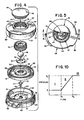
- Fig. 10 is a graphical depiction of pressure versus flow characteristics of a valve constructed in accordance with the invention. Briefly, the valve operates to maintain a desired differential pressure P 1 between fluids in the brain ventricles and at the selected discharge location of the body. The valve accomplishes this by adjusting the fluid flow rate Q so that the desired pressure PI is maintained. Such operation of the valve occurs within the region designated I on the graph of fig. 10.
- a flow rate greater than a pre-selected rate Q 1 will be necessary to maintain the desired first pressure P 1 .
- a flow rate may create risks of undesirable hyperdrainage of the brain ventricles.
- the valve automatically serves to maintain a relatively constant desired rate of fluid flow despite changes in differential pressure.
- the flow rate will not be entirely independent of the applied differential pressure but rather will increase from a lower flow rate Q 1 to a higher flow rate Q 2 as differential pressure increases between first pressure P 1 and a second pressure P 2 as indicated by the solid line in fig. 10.
- a valve operating in this condition is operating in region II of fig. 10.
- Flow rates Q1 and Q 2 are sufficiently low so that during a temporary rapid increase in differential pressure, pressure will return to normal before a quantity of CSF sufficient to cause adverse side effects may flow through the valve.
- Q 1 and Q 2 might be 0.4 ml./min and 0.8 ml./min. respectively, while first and second pressures, P 1 and P 2 may have values of 80 and 350 millimeters of water respectively. While it is desirable to avoid high flow rates through the valve in order to avoid hyperdrainage of the ventricles, it may, under certain emergency conditions, be desirable to allow rapid shunting of CSF in order to avoid possible brain damage.
- increases in differential pressure tend to close the valve between the first and second interior chambers.
- the valve is constructed so that when differential pressure exceeds a second pressure P 2 substantially higher than first pressure P 1 , the valve once again operates to allow a fluid flow rate sufficient to maintain a differential pressure no higher than second pressure P 2 .
- Such operation is that which would occur in region III of fig. 10.
- FIGS 6 - 9 illustrate operation of the valve in each of the regions previously described.
- CSF applied to the inlet port 21 of the valve completely fills the first chamber 46 and exerts a downwardly directed force on the diaphragm 45 by reason of the CSF pressure within the brain ventricle.
- the second chamber 47 is in fluid communication with the selected drainage location in the body, the pressure of the CSF therein exerts an upwardly directed force on the lower surface of the diaphragm. Accordingly, the differential pressure between CSF in the brain ventricle and fluid at the drainage location results in verticle deflection of both the diaphragm and the valve seat 67 rigidly attached thereto. As shown in fig.
- valve seat 67 contacts sphere 68
- the orifice 76 is totally occluded, thereby preventing fluid flow between chambers 46 and 47.
- differential pressure is relatively low, such as when the valve is operating in region I fig. 10
- the resulting slight downward displacement of the diaphragm is sufficient to displace the valve seat 67 relative to the sphere 68 thereby allowing fluid to pass through the orifice 76 from the first interior chamber 46 to the second interior chamber 47.
- the valving means in this condition are illustrated in fig. 7. As shown, downward deflection of the diaphragm is sufficient to allow the passage of fluid through the orifice, yet the upper surface of the restrictor 70 is sufficiently removed from the orifice so as not to interfere with the flow of fluid between the chambers.
- the valve acts primarily as a constant pressure device whereby a constant pressure differential is maintained between the fluids in the first and second chambers.
- a slight increase in differential pressure results in slight downward deflection of the diaphragm thereby further opening the valving means to allowgreaterfluid flow between the chambers with the results that the increased pressure in the first chamber is rapidly relieved.
- a decrease in the pressure of fluid in the first chamber allows the diaphragm to move toward the sphere, thereby restricting the fluid flow between the chambers, thus allowing pressure in the first chamber to increase.
- Fig. 8 illustrates the condition of the valve when a sudden increase in differential pressure is applied to the valve.
- the pressure differential exceeds the first desired pressure P 1 and consequently the valve operates in region II of fig. 10.
- the downward displacement of the diaphragm 45 is sufficient to cause the valve seat 67 to descend over the restrictor 70 thereby causing the restrictor to partially occlude the orifice 76 therein. Because the orifice is tapered, additional downward travel of the valve seat results in a further occlusion of the orifice.
- the orifice is shaped such that the additional occlusion occurring orifice by reason of increasing differential pressure is sufficient to offset the higher flow rate ordinarily resulting from increased pressure thereby resulting in a relatively uniform rate fluid flow between the chambers despite increase in differential pressure. Accordingly, in this condition, the valve acts primarily as a constant flow device permitting the passage of fluid from the first to the second chamber at a relatively constant desired rate despite changes in applied differertial pressure.
- Fig. 9 illustrates operation of the valve in region III of fig. 10 such as would occur when differential pressure exceeds the desired second pressure P 2 .
- differential pressure displaces the diaphragm to a degree sufficient to cause the large diameter end 77 of the restrictor 70 to protrude past the upper surface of the valve seat thereby allowing fluid to easily flow past the restrictor and through the orifice 76.
- the orifice is not nearly as restricted as it was in fig. 8 when the large diameter end of the restrictor 70 was received within the tapered region of the valve seat 67.
- valve seat When the valve is operating in this manner, increases in differential pressure cause the valve seat to be further displaced away from the restrictor, thereby further opening the orifice, and allowing a greater fluid flow rate.
- the valve once again operates essentially as a constant pressure device whereby differential pressure greater than a desired maximum pressure P 2 is prevented.
- a further advantage of this construction is that as the restrictor passes through the orifice, it tends to remove foreign materials which may tend to clog the valve. Thus, should clogging occur, the resulting increased differential pressure will eventually cause the restrictor to pass through the orifice thereby providing the valve with a self-cleaning feature.
Landscapes
- Health & Medical Sciences (AREA)
- Engineering & Computer Science (AREA)
- Biomedical Technology (AREA)
- Neurology (AREA)
- Ophthalmology & Optometry (AREA)
- Otolaryngology (AREA)
- Anesthesiology (AREA)
- Heart & Thoracic Surgery (AREA)
- Hematology (AREA)
- Life Sciences & Earth Sciences (AREA)
- Animal Behavior & Ethology (AREA)
- General Health & Medical Sciences (AREA)
- Public Health (AREA)
- Veterinary Medicine (AREA)
- External Artificial Organs (AREA)
- Infusion, Injection, And Reservoir Apparatuses (AREA)
- Check Valves (AREA)
- Safety Valves (AREA)
Applications Claiming Priority (2)
| Application Number | Priority Date | Filing Date | Title |
|---|---|---|---|
| US55939283A | 1983-12-08 | 1983-12-08 | |
| US559392 | 1983-12-08 |
Publications (3)
| Publication Number | Publication Date |
|---|---|
| EP0156974A2 true EP0156974A2 (fr) | 1985-10-09 |
| EP0156974A3 EP0156974A3 (en) | 1986-06-11 |
| EP0156974B1 EP0156974B1 (fr) | 1989-08-30 |
Family
ID=24233437
Family Applications (1)
| Application Number | Title | Priority Date | Filing Date |
|---|---|---|---|
| EP84114913A Expired EP0156974B1 (fr) | 1983-12-08 | 1984-12-07 | Régulateur de débit à trois conditions de fonctionnement pour fluides corporels |
Country Status (4)
| Country | Link |
|---|---|
| EP (1) | EP0156974B1 (fr) |
| JP (1) | JPS60139257A (fr) |
| CA (1) | CA1236749A (fr) |
| DE (1) | DE3479565D1 (fr) |
Cited By (7)
| Publication number | Priority date | Publication date | Assignee | Title |
|---|---|---|---|---|
| EP0233325A1 (fr) * | 1985-12-23 | 1987-08-26 | Cordis Corporation | Soupape implantable à trois étages pour limiter la pression avec membres ajustables de tige de soupape |
| EP0233324A3 (en) * | 1985-12-23 | 1987-09-02 | Cordis Corporation | Three stage intracranial pressure control valve |
| EP0163897B1 (fr) * | 1984-05-08 | 1988-07-13 | Cordis Corporation | Valve à trois étages avec tige à une seule partie pour limiter la pression intercrânienne |
| WO1993018802A1 (fr) * | 1992-03-20 | 1993-09-30 | Alcon Surgical, Inc. | Systeme de regulation de debit et de pression de liquide |
| US9072865B2 (en) | 2008-03-14 | 2015-07-07 | Sophysa | Method of regulating CSF drainage |
| US9867935B2 (en) | 2010-02-12 | 2018-01-16 | Debiotech S.A. | Micromechanic passive flow regulator |
| US9971358B2 (en) | 2013-01-10 | 2018-05-15 | Debiotech S.A. | Adjustable passive flow regulator |
Families Citing this family (4)
| Publication number | Priority date | Publication date | Assignee | Title |
|---|---|---|---|---|
| JPS63151149U (fr) * | 1987-03-24 | 1988-10-04 | ||
| EP2153855A1 (fr) * | 2008-08-16 | 2010-02-17 | Debiotech S.A. | Régulateur d'écoulement de fluides passifs pour l'administration de médicaments à débit constant et dispositif de perfusion de médicaments correspondant |
| JP5511486B2 (ja) * | 2010-04-26 | 2014-06-04 | 康雄 藍原 | 水頭症治療用シャントバルブ |
| WO2014055015A1 (fr) * | 2012-10-01 | 2014-04-10 | Roxhed Niclas | Dérivation de liquide céphalorachidien destinée au traitement de l'hydrocéphalie |
Family Cites Families (5)
| Publication number | Priority date | Publication date | Assignee | Title |
|---|---|---|---|---|
| US3270771A (en) * | 1963-06-11 | 1966-09-06 | Robertshaw Controls Co | Resilient disc check valve |
| US3769982A (en) * | 1971-09-24 | 1973-11-06 | R Schulte | Physiological drainage system with closure means responsive to downstream suction |
| US3768508A (en) * | 1972-01-24 | 1973-10-30 | R Schulte | Valve for controllable release of entrapped body fluids |
| US3910283A (en) * | 1973-10-09 | 1975-10-07 | Harry H Leveen | Process for treatment of ascites and device to accomplish same |
| CA1248425A (fr) * | 1983-02-17 | 1989-01-10 | Michael D. Hooven | Soupape de regulation de la pression intracranienne |
-
1984
- 1984-12-07 EP EP84114913A patent/EP0156974B1/fr not_active Expired
- 1984-12-07 JP JP59259872A patent/JPS60139257A/ja active Granted
- 1984-12-07 CA CA000469536A patent/CA1236749A/fr not_active Expired
- 1984-12-07 DE DE8484114913T patent/DE3479565D1/de not_active Expired
Cited By (7)
| Publication number | Priority date | Publication date | Assignee | Title |
|---|---|---|---|---|
| EP0163897B1 (fr) * | 1984-05-08 | 1988-07-13 | Cordis Corporation | Valve à trois étages avec tige à une seule partie pour limiter la pression intercrânienne |
| EP0233325A1 (fr) * | 1985-12-23 | 1987-08-26 | Cordis Corporation | Soupape implantable à trois étages pour limiter la pression avec membres ajustables de tige de soupape |
| EP0233324A3 (en) * | 1985-12-23 | 1987-09-02 | Cordis Corporation | Three stage intracranial pressure control valve |
| WO1993018802A1 (fr) * | 1992-03-20 | 1993-09-30 | Alcon Surgical, Inc. | Systeme de regulation de debit et de pression de liquide |
| US9072865B2 (en) | 2008-03-14 | 2015-07-07 | Sophysa | Method of regulating CSF drainage |
| US9867935B2 (en) | 2010-02-12 | 2018-01-16 | Debiotech S.A. | Micromechanic passive flow regulator |
| US9971358B2 (en) | 2013-01-10 | 2018-05-15 | Debiotech S.A. | Adjustable passive flow regulator |
Also Published As
| Publication number | Publication date |
|---|---|
| CA1236749A (fr) | 1988-05-17 |
| EP0156974B1 (fr) | 1989-08-30 |
| EP0156974A3 (en) | 1986-06-11 |
| DE3479565D1 (en) | 1989-10-05 |
| JPH0519422B2 (fr) | 1993-03-16 |
| JPS60139257A (ja) | 1985-07-24 |
Similar Documents
| Publication | Publication Date | Title |
|---|---|---|
| US4776838A (en) | Three stage valve | |
| EP0163897B1 (fr) | Valve à trois étages avec tige à une seule partie pour limiter la pression intercrânienne | |
| US4675003A (en) | Three stage pressure regulator valve | |
| EP0233325B1 (fr) | Soupape implantable à trois étages pour limiter la pression avec membres ajustables de tige de soupape | |
| US4781672A (en) | Three stage implantable flow control valve with improved valve closure member | |
| US4681559A (en) | Plural valve three stage pressure relief system | |
| US4714458A (en) | Three stage valve with flexible valve seat | |
| US4557721A (en) | Servo valve | |
| EP0233324B1 (fr) | Soupape de régulation de pression intracrânienne à trois étages | |
| US4705499A (en) | Implantable servo valve having integral pressure sensor | |
| US4776839A (en) | Three stage implantable pressure relief valve with improved valve stem member | |
| US4540400A (en) | Non-invasively adjustable valve | |
| US4551128A (en) | Cerebrospinal fluid shunt valve | |
| US5437627A (en) | Implantable valve for the treatment of hydrocephaly | |
| US5368556A (en) | Implantable drainage valve for the treatment of hydrocephalus | |
| US4741730A (en) | Hydrocephalus shunt with in-line filter | |
| JP5511486B2 (ja) | 水頭症治療用シャントバルブ | |
| EP0156974B1 (fr) | Régulateur de débit à trois conditions de fonctionnement pour fluides corporels | |
| US4769002A (en) | Intercranial pressure regulator valve | |
| US20080132823A1 (en) | Self adjusting hydrocephalus valve | |
| EP0117050B1 (fr) | Valve pour régler la pression intra-crânienne | |
| US9731102B2 (en) | Adjustable resistance, gravitationally activated, anti-siphon valve | |
| US5810761A (en) | Intraventricular pressure control device | |
| US12390624B2 (en) | Valve for permanent implantation, in particular for treatment of normal pressure hydrocephalus |
Legal Events
| Date | Code | Title | Description |
|---|---|---|---|
| PUAI | Public reference made under article 153(3) epc to a published international application that has entered the european phase |
Free format text: ORIGINAL CODE: 0009012 |
|
| AK | Designated contracting states |
Designated state(s): DE FR GB IT NL |
|
| PUAL | Search report despatched |
Free format text: ORIGINAL CODE: 0009013 |
|
| AK | Designated contracting states |
Kind code of ref document: A3 Designated state(s): DE FR GB IT NL |
|
| 17P | Request for examination filed |
Effective date: 19861210 |
|
| 17Q | First examination report despatched |
Effective date: 19880209 |
|
| GRAA | (expected) grant |
Free format text: ORIGINAL CODE: 0009210 |
|
| AK | Designated contracting states |
Kind code of ref document: B1 Designated state(s): DE FR GB IT NL |
|
| ITF | It: translation for a ep patent filed | ||
| REF | Corresponds to: |
Ref document number: 3479565 Country of ref document: DE Date of ref document: 19891005 |
|
| ET | Fr: translation filed | ||
| PLBE | No opposition filed within time limit |
Free format text: ORIGINAL CODE: 0009261 |
|
| STAA | Information on the status of an ep patent application or granted ep patent |
Free format text: STATUS: NO OPPOSITION FILED WITHIN TIME LIMIT |
|
| 26N | No opposition filed | ||
| ITTA | It: last paid annual fee | ||
| PGFP | Annual fee paid to national office [announced via postgrant information from national office to epo] |
Ref country code: NL Payment date: 19960924 Year of fee payment: 13 |
|
| PGFP | Annual fee paid to national office [announced via postgrant information from national office to epo] |
Ref country code: GB Payment date: 19961108 Year of fee payment: 13 |
|
| PG25 | Lapsed in a contracting state [announced via postgrant information from national office to epo] |
Ref country code: GB Free format text: LAPSE BECAUSE OF NON-PAYMENT OF DUE FEES Effective date: 19971207 |
|
| PG25 | Lapsed in a contracting state [announced via postgrant information from national office to epo] |
Ref country code: NL Free format text: LAPSE BECAUSE OF NON-PAYMENT OF DUE FEES Effective date: 19980701 |
|
| GBPC | Gb: european patent ceased through non-payment of renewal fee |
Effective date: 19971207 |
|
| NLV4 | Nl: lapsed or anulled due to non-payment of the annual fee |
Effective date: 19980701 |
|
| REG | Reference to a national code |
Ref country code: FR Ref legal event code: ST |
|
| PGFP | Annual fee paid to national office [announced via postgrant information from national office to epo] |
Ref country code: DE Payment date: 20001214 Year of fee payment: 17 |
|
| PGFP | Annual fee paid to national office [announced via postgrant information from national office to epo] |
Ref country code: FR Payment date: 20001215 Year of fee payment: 17 |
|
| PG25 | Lapsed in a contracting state [announced via postgrant information from national office to epo] |
Ref country code: FR Free format text: THE PATENT HAS BEEN ANNULLED BY A DECISION OF A NATIONAL AUTHORITY Effective date: 20011231 |
|
| PG25 | Lapsed in a contracting state [announced via postgrant information from national office to epo] |
Ref country code: DE Free format text: LAPSE BECAUSE OF NON-PAYMENT OF DUE FEES Effective date: 20020702 |
|
| PG25 | Lapsed in a contracting state [announced via postgrant information from national office to epo] |
Ref country code: FR Free format text: THE PATENT HAS BEEN ANNULLED BY A DECISION OF A NATIONAL AUTHORITY Effective date: 20001231 |