EP0157329A2 - PrCo5 enthaltende Magnete - Google Patents
PrCo5 enthaltende Magnete Download PDFInfo
- Publication number
- EP0157329A2 EP0157329A2 EP85103515A EP85103515A EP0157329A2 EP 0157329 A2 EP0157329 A2 EP 0157329A2 EP 85103515 A EP85103515 A EP 85103515A EP 85103515 A EP85103515 A EP 85103515A EP 0157329 A2 EP0157329 A2 EP 0157329A2
- Authority
- EP
- European Patent Office
- Prior art keywords
- rare earth
- alloy
- sintering aid
- ferromagnetic metal
- sintering
- Prior art date
- Legal status (The legal status is an assumption and is not a legal conclusion. Google has not performed a legal analysis and makes no representation as to the accuracy of the status listed.)
- Withdrawn
Links
Images


Classifications
-
- H—ELECTRICITY
- H01—ELECTRIC ELEMENTS
- H01F—MAGNETS; INDUCTANCES; TRANSFORMERS; SELECTION OF MATERIALS FOR THEIR MAGNETIC PROPERTIES
- H01F1/00—Magnets or magnetic bodies characterised by the magnetic materials therefor; Selection of materials for their magnetic properties
- H01F1/01—Magnets or magnetic bodies characterised by the magnetic materials therefor; Selection of materials for their magnetic properties of inorganic materials
- H01F1/03—Magnets or magnetic bodies characterised by the magnetic materials therefor; Selection of materials for their magnetic properties of inorganic materials characterised by their coercivity
- H01F1/032—Magnets or magnetic bodies characterised by the magnetic materials therefor; Selection of materials for their magnetic properties of inorganic materials characterised by their coercivity of hard-magnetic materials
- H01F1/04—Magnets or magnetic bodies characterised by the magnetic materials therefor; Selection of materials for their magnetic properties of inorganic materials characterised by their coercivity of hard-magnetic materials metals or alloys
- H01F1/047—Alloys characterised by their composition
- H01F1/053—Alloys characterised by their composition containing rare earth metals
- H01F1/055—Alloys characterised by their composition containing rare earth metals and magnetic transition metals, e.g. SmCo5
- H01F1/0555—Alloys characterised by their composition containing rare earth metals and magnetic transition metals, e.g. SmCo5 pressed, sintered or bonded together
- H01F1/0557—Alloys characterised by their composition containing rare earth metals and magnetic transition metals, e.g. SmCo5 pressed, sintered or bonded together sintered
Definitions
- This invention relates to methods for producing rare earth-containing permanent magnets, and to compositions for use in the methods.
- Permanent magnets defined as materials which exhibit permanent ferromagnetism (the ability to maintain magnetism following removal from a magnetizing field), have long been useful industrial materials, finding extensive applications in such devices as meters, loudspeakers, motors, and generators.
- a typical commercial samarium-cobalt magnet has the nominal empirical composition SmCo 5' prepared by mixing powdered SmCo 5 with a minor amount of samarium-cobalt alloy sintering aid which is richer in samarium than SmCo 5' aligning the mixture in a magnetic field, pressing the mixture into a desired shape, and sintering the shape. During sintering, the sintering aid becomes at least partially liquid, permitting a large density increase in the shape.
- This general method is described in U.S. Patent 3,655,464 to Benz.
- Cech in U.S. Patent 3,625,779, mixes rare earth oxide and calcium hydride, then heats to reduce the oxide and form rare earth metal, which is melted with cobalt. The resulting alloy is then subjected to extensive treatments to remove even traces of formed calcium oxide, and used to produce magnets.
- Clegg in U.S. Patent 4,290,826, discloses a process for producing cobalt-rare earth alloys by mixing cobalt powder and refractory oxide powder, adding rare earth metal powder, and heating to form the alloy, without significant sintering.
- the avoidance of sintering is said to preserve the original small particle sizes, which improves the properties of magnets formed from the product powdered alloy.
- Unsintered powders must be bound together in resins, etc., to be useful as permanent magnets.
- the resulting low density of such magnets is reflected in the comparatively low magnetic strengths obtained.
- the binders contribute to disadvantages such as the inability to use the magnets at elevated temperatures.
- sintered magnets have significantly greater mechanical strength.
- compositions for the production of rare earth-ferromagnetic metal permanent magnets comprise:
- a method for preparing permanent magnets comprises: (1) mixing the rare earth-ferromagnetic alloy with the sintering aid; (2) adding to this mixture the additive material; (3) aligning the magnetic domains of the mixture in a magnetic field; (4) compacting the aligned mixture to form a shape; and (5) sintering the compacted shape.
- rare earth means the lanthanide elements having atomic numbers from 57 to 71, inclusive, and the element yttrium, atomic number 39, which is commonly found in rare earth concentrates and is chemically similar to the rare earths.
- Ferromagnetic metals for purposes of this invention, are iron, nickel, cobalt, and numerous alloys containing one or more of these metals. Ferromagnetic metals exhibit the characteristic of magnetic hysteresis, wherein the plots of induction versus applied field strengths (from zero to a high positive value, and then to a high negative value and returning to zero) are hysteresis loops.
- a figure of merit for a particular magnet shape is the energy product, obtained by multiplying values of B and H for a given point on the demagnetization curve and expressed in Gauss-Oersteds (GOe).
- Ge Gauss-Oersteds
- K indicates multiplication by 10 3
- M indicates multiplication by 10 6 .
- iH Intrinsic coercivity
- the present invention is, in part, directed to the preparation of rare earth-ferromagnetic metal compositions, which can be used to fabricate high strength permanent magnets.
- These compositions comprise mixtures of rare earth-ferromagnetic metal alloy powder, usually, but not always, a powdered second-phase sintering aid, and up to about 2 percent by weight of a refractory oxide, carbide, or nitride additive.
- Rare earth-ferromagnetic metal alloys which are useful in the present invention are those which possess ferromagnetic properties. Suitable alloys have been identified in the literature; the presently preferred alloys have an empirical formula approximating RM,, wherein R is rare earth metal and M is ferromagnetic metal, as defined herein. Useful magnetic properties are also found in certain RM 2 , R 2 M 7' R 2 M 17 , and other alloys. The invention is exemplified herein by compositions based upon PrCo 5 alloys, but it is to be understood that no limitation is intended thereby.
- Sintering aids are also rare earth-ferromagnetic metal alloys, either containing the same metals as do the major phase alloys or different metals. Proportions of the component metals, however, are chosen such that the sintering aid will be at least partially liquid at the chosen sintering temperatures for the magnet.
- Presently preferred sintering aids are rare earth-ferromagnetic metal alloys which contain an excess of rare earth over that required for the formation of RM 5 compositions.
- Sintering aid alloys are present in the mixed magnet compositions in lesser amounts than the major rare earth-ferromagnetic metal alloy phase, about 1 up to about 15 (normally about 10 to about 15) percent by weight of the major phase. Thus, sintering aid is considered to be present in a minor amount, as a second phase.
- magnet base alloys will not require a separately added sintering aid for the practice of the invention.
- some compositions do not consist of a single phase, but contain a major phase having good ferromagnetic properties, and minor amounts of one or more lower melting phases.
- the magnet alloy can be considered to have its own internal sintering aid, and no external sintering aid phases need be added.
- any system having an internal, or externally added, lower melting phase, in addition to the magnet base alloy can benefit from the use of the present invention.
- Additive materials are particulate refractory oxides, carbides, and nitrides, which have melting points higher than the magnet sintering temperatures, used in amounts about 0.1 percent to about 2 percent by weight of the magnet composition.
- Suitable oxides include, without limitation, zinc oxide, magnetite, chromic oxide, aluminum oxide, calcium oxide, magnesium oxide, zirconium oxide, cupric oxide, and hydrated oxides such as tungstic acid.
- Metals of certain of these oxides, such as chromium and copper, have shown some effectiveness as additives, but iron does not appear to benefit the tested magnet compositions to a large extent.
- oxides such as boric oxide, palladium oxide, tantalum oxide, titanium oxide, and barium oxide, at concentrations which have been tested, either do not significantly improve magnet alloy compositions or degrade properties of the magnets.
- oxide additives are chromic oxide, aluminum oxide, and magnesium oxide.
- Carbides and nitrides which are effective in the invention include tungsten carbide and titanium nitride. However, chromium carbide does not appear to be suitable.
- All rare earth-containing alloys for the present invention can be prepared by simply melting together particles of rare earth metal and ferromagnetic metal, using equipment and techniques known in the art.
- co-reduction methods can be used, wherein, for example, rare earth oxide, ferromagnetic metal oxide, or a mixture thereof, is reduced at high temperature with an active metal, such as calcium.
- An exemplary procedure is mixing rare earth oxide, cobalt metal, and calcium, then heating in an inert atmosphere to produce a rare earth-cobalt alloy and calcium oxide.
- the co-reduction product is subjected to treatment for removal of the calcium oxide (see Cech et al., U.S. Patent 3,625,779, described previously); certain alloy and oxide mixtures can be utilized in the present invention without separation treatment, thereby reducing the number of steps needed for producing magnets.
- the rare earth-ferromagnetic alloy powder preferably having particle sizes up to about 10 microns, is intimately mixed with sintering aid, having a similar or smaller particle size range and distribution.
- Additive material preferably having approximately the same particle sizes as alloy and sintering aid, or smaller, is added and thoroughly mixed with the other components.
- Magnetic domains of the mixture are aligned in a magnetic field, preferably simultaneously with a compacting step, in which a shape is formed from the powder. The shape is then sintered to form a magnet having good mechanical integrity, under conditions of vacuum or an inert atmosphere (such as argon).
- sintering temperatures about 950° C. to about 1250° C. are used.
- magnets using this embodiment of the invention, a praseodymium-cobalt alloy powder, preferably having particle sizes up to about 10 microns, is intimately mixed with sintering aid, having a similar or smaller particle size range and distribution. Magnetic domains of the mixture are aligned in a magnetic field, preferably simultaneously with a compacting step, in which a shape is formed from the powder. The shape is then sintered to form a magnet having good mechanical integrity, under an inert atmosphere (such as argon).
- an inert atmosphere such as argon
- sintering temperatures about 1020° C. to about 1090° C. are used. Sintering temperatures should be adjusted, depending upon the particular sintering aid utilized in the mixture. For praseodymium-cobalt sintering aid, temperatures about 1020° C. to about 1050° C. are preferred; for samarium-cobalt sintering aid, the preferred temperatures are about 1070° C. to about 1090° C.
- Permanent magnets are prepared, using the following procedure:
- the praseodymium-cobalt alloy contains 34% Pr and 66% Co, using an impure praseodymium containing 1.6% Fe, 0.37% Ni, and 1.9% rare earths other than praseodymium.
- the magnets are formed from a mixture containing 88% Pr-Co and 12% of a sintering aid, which is 60% Sm and 40% Co.
- the ends of these prepared magnets are ground, using 180 and 600 grit silicon carbide grinding papers, followed by polishing on a diamond wheel and, finally, on a cloth wheel, using submicron alumina dispersed in water as a polishing medium. After etching for a few seconds in a 1% nitol solution, the polished ends are examined under a microscope.
- Example 2 Using the procedure of Example 1, a purified praseodymium is used to produce magnets having the properties summarized in Table III.
- a 6.00 gram portion of the praseodymium-cobalt alloy of Example 1 is mixed with varying amounts of a sintering aid which contains 60% praseodymium and 40% cobalt. Magnets produced, using the procedure of the preceding examples, have properties summarized in Table IV.
- magnets having properties summarized in Table VI are prepared. These preparations show the effect of samarium-cobalt sintering aid upon magnetic properties of praseodymium-cobalt magnets.
- Magnet 1F is a samarium-cobalt composition, for comparison, sintered at 1120° C. All other magnets are sintered at 1080° C.
- Magnets are prepared with additives to increase coercivity. Results are summarized in Table VII, demonstrating improved magnetic properties when additives are used.
- Magnet 2I is a comparative samarium-cobalt composition containing 36.5% Sm and no added praseodymium, sintered at 1120° C. All other magnets have a rare earth content of 37.5% (30.0% Pr and 7.5% Sm).
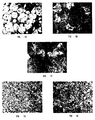
- Two magnets from Table VII, designated 2H and 2T, are selected for metallographic examination.
- the ends of these magnets are ground, using 180 and 600 grit silicon carbide grinding papers, followed by polishing on a diamond wheel and, finally, on a cloth wheel, using submicron alumina particles, dispersed in water, as a polishing medium. After etching for a few seconds in a 1% nitol solution, the polished ends are examined under a microscope.
- Figure 3A is a photomicrograph at 500X magnification of Magnet 2T.
- Figure 3B is a photomicrograph, under similar magnification, of Magnet 2H, showing the relatively greater phase dispersion obtained by using an additive.
- Figure 4 shows certain magnetic properties of the two magnets.
- broken lines represent data for Magnet 2T, while solid lines are for Magnet 2H.
- These demagnetization curves indicate the improvement in coercivity obtained with the additives. Also significant is the dramatic improvement in "squareness" of the curves, indicating the resistance of the magnet to domain reversal in a demagnetizing field.
- Example 6 Using the procedure of Example 6, an alloy containing 34% Pr and 66% Co is mixed with a sintering aid containing 60% Pr and 40% Co to form a mixture which contains 38% Pr, and is used to produce permanent magnets. Sintering is at a temperature of 1040° C., yielding the results summarized in Table IX.
Landscapes
- Chemical & Material Sciences (AREA)
- Crystallography & Structural Chemistry (AREA)
- Inorganic Chemistry (AREA)
- Engineering & Computer Science (AREA)
- Power Engineering (AREA)
- Hard Magnetic Materials (AREA)
Applications Claiming Priority (4)
| Application Number | Priority Date | Filing Date | Title |
|---|---|---|---|
| US59527784A | 1984-03-30 | 1984-03-30 | |
| US06/595,290 US4601754A (en) | 1984-03-30 | 1984-03-30 | Rare earth-containing magnets |
| US595290 | 1984-03-30 | ||
| US595277 | 1996-02-01 |
Publications (2)
| Publication Number | Publication Date |
|---|---|
| EP0157329A2 true EP0157329A2 (de) | 1985-10-09 |
| EP0157329A3 EP0157329A3 (de) | 1987-06-16 |
Family
ID=27082214
Family Applications (1)
| Application Number | Title | Priority Date | Filing Date |
|---|---|---|---|
| EP85103515A Withdrawn EP0157329A3 (de) | 1984-03-30 | 1985-03-25 | PrCo5 enthaltende Magnete |
Country Status (1)
| Country | Link |
|---|---|
| EP (1) | EP0157329A3 (de) |
Cited By (2)
| Publication number | Priority date | Publication date | Assignee | Title |
|---|---|---|---|---|
| AU608309B2 (en) * | 1987-04-06 | 1991-03-28 | Ford Motor Company Of Canada Limited | Multiphase permanent magnet of the fe-b-mm type |
| CN104700972A (zh) * | 2013-12-06 | 2015-06-10 | 绥中鑫源科技有限公司 | 一种高性能低成本各向异性粘接磁粉及制备方法 |
-
1985
- 1985-03-25 EP EP85103515A patent/EP0157329A3/de not_active Withdrawn
Cited By (2)
| Publication number | Priority date | Publication date | Assignee | Title |
|---|---|---|---|---|
| AU608309B2 (en) * | 1987-04-06 | 1991-03-28 | Ford Motor Company Of Canada Limited | Multiphase permanent magnet of the fe-b-mm type |
| CN104700972A (zh) * | 2013-12-06 | 2015-06-10 | 绥中鑫源科技有限公司 | 一种高性能低成本各向异性粘接磁粉及制备方法 |
Also Published As
| Publication number | Publication date |
|---|---|
| EP0157329A3 (de) | 1987-06-16 |
Similar Documents
| Publication | Publication Date | Title |
|---|---|---|
| CA1315571C (en) | Magnetic materials and permanent magnets | |
| EP0261579B1 (de) | Verfahren zur Herstellung eines Seltenerd-Eisen-Bor-Dauermagneten mit Hilfe eines abgeschreckten Legierungspuders | |
| EP0126802B2 (de) | Verfahren zur Herstellung eines Permanentmagneten | |
| EP1884574B1 (de) | R-T-B-System-Seltenerd-Dauermagnet | |
| EP0101552B2 (de) | Magnetische Materialien, permanente Magnete und Verfahren zu deren Herstellung | |
| US5645651A (en) | Magnetic materials and permanent magnets | |
| EP0208807B1 (de) | Seltene Erden-Eisen-Bor-Dauermagnete | |
| EP0344018B1 (de) | Seltene Erden-Dauermagnet | |
| JP2751109B2 (ja) | 熱安定性の良好な焼結型永久磁石 | |
| EP0242187A1 (de) | Dauermagnet und Verfahren zu seiner Herstellung | |
| US3421889A (en) | Magnetic rare earth-cobalt alloys | |
| US4891078A (en) | Rare earth-containing magnets | |
| JPH07105289B2 (ja) | 希土類永久磁石の製造方法 | |
| US4601754A (en) | Rare earth-containing magnets | |
| US4776902A (en) | Method for making rare earth-containing magnets | |
| EP0029071A1 (de) | Verfahren zur herstellung einer dauermagnetlegierung | |
| Burzo et al. | Magnetic properties of Nd2Fe14− x− yCoxAlyB alloys | |
| JPH11251125A (ja) | 希土類元素・鉄・ボロン系焼結磁石およびその製造方法 | |
| US4954186A (en) | Rear earth-iron-boron permanent magnets containing aluminum | |
| US5055129A (en) | Rare earth-iron-boron sintered magnets | |
| EP0157329A2 (de) | PrCo5 enthaltende Magnete | |
| JPH0678582B2 (ja) | 永久磁石材料 | |
| JP3645312B2 (ja) | 磁性材料と製造法 | |
| JP2966169B2 (ja) | 希土類磁石並びに希土類磁石用合金粉末とその製造方法 | |
| JP3086334B2 (ja) | 永久磁石用異方性希土類合金粉末 |
Legal Events
| Date | Code | Title | Description |
|---|---|---|---|
| PUAI | Public reference made under article 153(3) epc to a published international application that has entered the european phase |
Free format text: ORIGINAL CODE: 0009012 |
|
| AK | Designated contracting states |
Designated state(s): AT BE CH DE FR GB IT LI LU NL SE |
|
| PUAL | Search report despatched |
Free format text: ORIGINAL CODE: 0009013 |
|
| RHK1 | Main classification (correction) |
Ipc: H01F 1/08 |
|
| AK | Designated contracting states |
Kind code of ref document: A3 Designated state(s): AT BE CH DE FR GB IT LI LU NL SE |
|
| 17P | Request for examination filed |
Effective date: 19871208 |
|
| 17Q | First examination report despatched |
Effective date: 19900201 |
|
| STAA | Information on the status of an ep patent application or granted ep patent |
Free format text: STATUS: THE APPLICATION IS DEEMED TO BE WITHDRAWN |
|
| 18D | Application deemed to be withdrawn |
Effective date: 19911007 |
|
| RIN1 | Information on inventor provided before grant (corrected) |
Inventor name: GHANDEHARI, MOHAMMAD H. |