EP0157537A2 - Herstellen von Kolbenringen - Google Patents
Herstellen von Kolbenringen Download PDFInfo
- Publication number
- EP0157537A2 EP0157537A2 EP85301909A EP85301909A EP0157537A2 EP 0157537 A2 EP0157537 A2 EP 0157537A2 EP 85301909 A EP85301909 A EP 85301909A EP 85301909 A EP85301909 A EP 85301909A EP 0157537 A2 EP0157537 A2 EP 0157537A2
- Authority
- EP
- European Patent Office
- Prior art keywords
- profile
- strip
- piston ring
- guide
- metal strip
- Prior art date
- Legal status (The legal status is an assumption and is not a legal conclusion. Google has not performed a legal analysis and makes no representation as to the accuracy of the status listed.)
- Granted
Links
Images



Classifications
-
- F—MECHANICAL ENGINEERING; LIGHTING; HEATING; WEAPONS; BLASTING
- F16—ENGINEERING ELEMENTS AND UNITS; GENERAL MEASURES FOR PRODUCING AND MAINTAINING EFFECTIVE FUNCTIONING OF MACHINES OR INSTALLATIONS; THERMAL INSULATION IN GENERAL
- F16J—PISTONS; CYLINDERS; SEALINGS
- F16J9/00—Piston-rings, e.g. non-metallic piston-rings, seats therefor; Ring sealings of similar construction
- F16J9/12—Details
-
- B—PERFORMING OPERATIONS; TRANSPORTING
- B21—MECHANICAL METAL-WORKING WITHOUT ESSENTIALLY REMOVING MATERIAL; PUNCHING METAL
- B21D—WORKING OR PROCESSING OF SHEET METAL OR METAL TUBES, RODS OR PROFILES WITHOUT ESSENTIALLY REMOVING MATERIAL; PUNCHING METAL
- B21D7/00—Bending rods, profiles, or tubes
- B21D7/08—Bending rods, profiles, or tubes by passing between rollers or through a curved die
-
- B—PERFORMING OPERATIONS; TRANSPORTING
- B21—MECHANICAL METAL-WORKING WITHOUT ESSENTIALLY REMOVING MATERIAL; PUNCHING METAL
- B21D—WORKING OR PROCESSING OF SHEET METAL OR METAL TUBES, RODS OR PROFILES WITHOUT ESSENTIALLY REMOVING MATERIAL; PUNCHING METAL
- B21D7/00—Bending rods, profiles, or tubes
- B21D7/12—Bending rods, profiles, or tubes with program control
Definitions
- the invention relates to the manufacture of piston rings and, in particular, piston rings for internal combustion engines.
- Piston rings for internal combustion engines are commonly formed of metal in a generally circular profile with two free ends closely adjacent one another (but not touching). Each piston ring is received in an associated groove provided in a piston for the internal combustion engine, where the purpose of the ring is to provide a seal between the piston and an associated cylinder or liner.
- the piston ring should seal against the associated cylinder or liner with an even pressure all round the piston ring, the outward pressing force being provided either by natural resilience of the piston ring and/or by an independent spring, possibly assisted by gas pressure behind the piston ring.
- the piston ring is required to provide this even pressure when at an elevated operating temperature.
- the profile of the piston ring at room temperature will not be the same as the shape of the piston ring at these operating temperatures since the expansion of the piston ring will not be uniform around its circumference because of the presence of the free ends.
- a piston will have two or more piston rings arranged at axially spaced positions and so there will be a difference between the temperatures at which the various rings operate, and consequently the amount of expansion will differ between these various piston rings.
- each piston ring must, when cold, have a predetermined non-circular profile which is such as to ensure that, on expansion, the piston ring gives the required even outward pressure at its particular operating temperature.
- this profile is an oval shape with the maximum diameter in a direction normal to the plane containing the gap and the piston ring axis and with the ends of the piston ring directed inwardly towards one another. If a certain "mean" such profile is assumed, piston rings operating in a hotter environment will generally have the ends directed further in towards one another, so-called “negative ovality", and piston rings operating in a cooler environment will have their ends directed inwardly less than the mean, a so-called "positive ovality".
- Piston rings can be produced by a number of methods.
- One such method is by bending a metal strip into a required profile, by the use of cam-controlled rollers, and then separating the profile so produced to form piston rings.
- a machine for performing such a method is described in French Patent Specification No.2517226 where the profile of the piston ring is determined by a cam whose shape is transferred to the steel strip by a cam-follower and a pair of rollers whose position adjusts to vary the curvature imparted to the steel strip.
- Cams have the advantage that they can allow very high rates of production of piston rings. For example, the production of piston rings using cams is much quicker than other conventional methods of production of piston rings such as casting a cylinder of material, cutting the cylinder in planes normal to the axis thereof and then finish machining the rings so produced. Thus the use of cams to bend strips has found wide application in the production of piston rings.
- cams have, however, a number of disadvantages.
- a different cam is required for each profile of piston ring and, as explained above, many different profiles of piston ring are needed.
- cams are subject to wear and so there can be a loss of accuracy due to such wear and a need to replace cams at regular intervals.
- a fresh cam must be produced each time a new profile of piston ring is required and these cams must be machined to a very high accuracy. Thus it is not possible to vary the profile of a piston ring quickly and easily.
- a machine for producing from a metal strip, piston rings of a predetermined profile for internal combustion engines comprising at least two guides for guiding the metal strip in a path in which the strip is formed by the guides into a generally circular profile, which is then separated from the remainder of the strip to form a piston ring, characterised in that at least one of said guides is movable relatively to the other guide or guides during said formation of a piston ring to vary the profile of the strip around the piston ring, and a control system for producing digital signals corresponding to a required piston ring profile, the digital signals controlling the movement of said at least one movable guide during formation of a piston ring from said metal strip to produce a piston ring having the required profile therearound.
- the piston rings are produced from a flat strip of a suitable metal.
- a steel strip may be used having a composition which is 1% chromium, 1% molybdenum, 0.55% nickel and 0.1% vanadium (all by weight), remainder iron and having a hardness of 500-550 on the Vickers scale.
- a second material for the strip is a low alloy steel or plain eutectoid carbon steel treated by a patenting process in which a strip of the steel is transformed from an austenitic structure to a finely and uniformly dispersed ferrite-cementite structure in a molten lead or salt bath and then hard drawn through dies.
- the strip It is required to form the strip into a piston ring of generally circular profile having two free ends separated by a gap.
- the precise profile of the ring will vary from ring to ring but in general it will be oval with the longer ax,is normal to the plane including the gap and the piston ring axis.
- the ends of the ring will be directed inwardly by a required amount, in order to produce a ring which, when at its individual operating temperature, and under the particular imposed loads encountered by such a piston ring, applies a uniform pressure to the associated cylinder or liner.
- a piston ring having this shape can be produced from a steel strip by bending the steel strip into a ring, with the curvature imparted to the strip being varied around the ring in such a way as to produce the required ring profile.
- These variations are very small; for example, the difference between the major and minor axes of the shape may only be 1 or 2 mm.
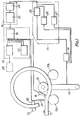
- a pair of fixed driven rollers 10.a, 10b which engage the same side of the strip 11 at spaced positions therealong.
- the strip 11 is pulled past the rollers 10 by drive rollers 55.
- a movable roller 12 engages the strip 11 on the opposite side thereof to the fixed rollers 10 and intermediate the fixed driver rollers 10.
- the rollers 10 impart a constant curvature to the strip 11.
- the movable roller 12 has its axis parallel to the axes of the fixed rollers 10 and is mounted at one end of an arm 13, whose other end is mounted for pivotal movement about an axis parallel to the roller axes. As seen in Figure 1, the movable roller 12 is positioned so that the strip 11 is bent by the roller 12, the degree of curvature being determined by the position of the movable roller 12 in relation to the fixed rollers 10.
- the position of the movable roller 12 is controlled by pivoting of the arm 13 by an actuator 14 which is fed with signals by a control system.
- the actuator 14 may take any convenient form such as linear motor, a solenoid, a low-inertia high-torque motor or a device operating on magnetostrictive effects or any transducer device for converting electrical signals into movement of the arm 13.
- the control system is a digital control system and can take a number of forms.
- it could be a conventional numerical control or computer numerical control device in which information defining required roller positions at various points around the circumference of a piston ring is fed into a computer store and is read in real time to provide electric signals for the actuator 14 which cause the actuator 14 to move the arm 13 to the required positions.
- feedback may be provided.
- the control system comprises a computer 15, a signal processor 16 and an arm control system 17.
- An end detector 18 feeds to the computer a signal when an end of the strip is detected at a datum point and a strip velocity detector 21 feeds the computer a signal representative of the strip velocity (and thus representative of the position of the strip 11 relative to the datum).
- input profile data is prepared which defines the required curvature of the piston ring at a succession of spaced positions around the ring.
- This data does not give all the positions of the movable roller 12 around the ring, but gives only, for example, points at which the curvature changes or points at which the curvature changes non-linearly.
- the profile may, for example, be defined at intervals around the piston ring as drops or decreases from a nominal maximum curvature.
- the piston ring is to be symmetrical about one or more planes including the axis of the piston ring, it is only necessary to define the input data for the initial symmetrical portion.
- the piston ring is to be generally oval with a longer axis normal to the plane including the piston ring axis and the gap and is to have inwardly directed ends, only input data for the first half of the piston ring need be defined, because the other half of the piston ring is the same.
- the profile data is fed to an input device 18 of the computer 15 and passes from the input device 18 to a store 19 of the computer 15.
- the computer 15 may be a microprocessor.
- the strip 11 is set in movement and the end detector 20 and the strip velocity transducer 21 feed to the store 19 in real time a digital signal when the end of the strip passes a datum point, and a signal representative of the position of the strip 11 relative to the datum (and thus relative to the movable roller 12).
- the computer 15 On receipt of these signals, the computer 15 produces a group of bits corresponding to the required roller position at the point on the strip 11 contacted by the roller 12 at that moment in time; the required position being the roller position necessaryy to produce the required piston ring profile at that point.
- the computer 15 does this in the following way. If the strip is defined by 2000 bits of information and is moving at 0.3 metres per second, then, for a piston ring of 100 mm "diameter", and if the position could be required to be changed every 10 minutes of arc, the computer must produce a group of bits every 500 microseconds. Of course, at high speeds and more complex profiles, this time interval may be less than that, for example, it may be 100 microseconds.
- a calculating unit 22 of the computer calculates, before the commencement of strip movement, a few initial groups of bits from the input data held in the store 19 and passes these initial groups to the store 19, from which the initial groups are outputted to the signal processor 16, described in more detail below. During the remainder of the 500 microsecond intervals between the groups, the calculating unit 22 produces groups of bits for subsequent future roller positions. The number of groups so produced depends on the time available within each interval and the capacity of the store 19 to hold such groups.
- the production of these groups from the input data will involve interpolation between the input data, because the groups may be required at intervals which are smaller than the intervals at which the input data is given.
- the interpolation is preferably a linear interpolation, although it will be appreciated that the computer could be programmed to produce any other required interpolation.
- the computer 15 will be programmed to produce groups for the whole circumferential profile of the piston ring, even where the input data defines only a portion of a symmetrical profile.
- the output from the computer 15 is thus a succession of groups of bits defining successive roller positions and produced in real time at time intervals determined by signals from the transducer 21.
- This succession of groups of bits is received by a digital-to-analogue converter 23 of the signal processor 16 which converts each of the succession of groups into a roller arm position signal of constant amplitude corresponding to the value of the associated group of bits.
- the duration of each such signal is the same as the interval between successive groups.
- This output which is effectively a series of consecutive steps, is fed to a step converter 24 of the signal processor 16.
- the step converter 24 the amplitude of each signal is stored until the next succeeding signal is received.
- the step converter 24 outputs a continuous signal which has an initial value equal to the value of the first received signal and has a final value equal to the value of the next successive signal.
- the continuous signal will rise or fall progressively between these initial and final values. This rise or fall may be linear but need not necessarily be so.
- the output of the step converter 24 is thus a continuous signal which so changes progressively that at successive time intervals equal to the time intervals of the digital signals, the amplitude of the signal is related to the successive values of the digital signals.
- This continuous signal can thus be regarded as an analogue of the succession of roller arm position signals representing the required position of the roller at a succession of points around the piston ring.
- This continuous signal is fed as an input signal to a feedback control device 25 of the closed-loop continuous arm control system 17.
- the output of the feedback control device 25 is fed to the actuator 14 which moves the arm 13 in accordance with the output signal.
- the output of the actuator 14 is monitored by an arm position transducer 26 and an arm speed transducer 27 which provide feedback arm position and arm velocity signals to the feedback control device 25 which uses these feedback signals to modify the continuous signal from the signal processor 16 in accordance with the feedback signals.
- the computer 15 does not have to deal with the feedback control of the arm positioning signal. This is done in a purely analogue fashion in a closed-loop control system. This is another factor which allows the computer to be a microprocessor which maintains high strip speeds and allows complex changes of arm position.
- step converter 24 produces a time delay in the system. A further time delay is introduced by the inertia of the roller 12 and the associated arm 13 (although this will be kept to a minimum).
- the computer 15 may be programmed so that the datum position from which the roller position signals are calculated, is offset by a distance equal to the time lag in the system. This will bring the profile into the required spatial orientation.
- the computer 15 can be quickly and simply programmed to produce any required workpiece profile. Indeed, by the provision of a keyboard, shown in chain dotted line at 28, it is possible to alter the profiles of the piston rings during production.
- the first two rollers, 10a and 11 could be the fixed driven rollers and the third roller 10.b, could be the movable roller.
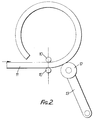
- a pair of fixed driven rollers 10 which engage on opposite sides of the strip 11 and serve to drive and guide the strip 11 towards a movable roller 12. These two rollers 10 do not impart any curvature to the strip 11; they simply form fixed guides.
- the movable roller 12 is aranged as described above with reference to Figure 1 and is connected to a control system of any of the kinds described above with reference to Figure 1.
- the machine of Figure 3 is a variation of the machine of Figure 2 in which there are two movable rollers 12a and 12b. These rollers engage on either side of the strip and have their centres arranged on a line which intersects the line passing through the axes of the fixed rollers 10, the point of intersection defining the centre about which the strip is curved by the movable rollers 12a, 12b, so that pivoting of the arm 13 increases or decreases this curvature.
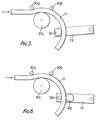
- rollers 30a, 30b, 30c, 30d there are four rollers 30a, 30b, 30c, 30d, with fixed axes before the movable roller 12 mounted on the arm 13.
- These fixed rollers are arranged in an initial group of three; two of which, 30a, 30b of smaller diameter, contact the strip 11 on one side at spaced positions therealong and the other of which 30c, of larger diameter, contacts the strip 11 on the other side thereof, at a point intermediate the points of contact of the two smaller diameter rollers 30a, 30b.
- the arrangement of these three rollers is such that the strip is given an initial curvature which is the minimum required curvature.
- the driven roller 12 only needs to apply to the strip, variations in curvature relative to this maximum curvature.
- the three initial rollers 30.a, 30b, 30c may be driven to advance the steel strip.
- the fourth roller 30d is arranged. It has the same diameter as the smaller diameter initial rollers 30a, 30h, and contacts the strip on the side thereof opposite to the side contacted by the movable roller 12 to guide the strip 11 onto the movable roller 12.
- the fourth fixed roller 30d is omitted and -a single movable roller 12 is provided which contacts the strip on the opposite side to the side contacted by the movable roller of the embodiment of Figure 4.
- the initial rollers 30a, 30b, 30c are arranged to give the strip a maximum curvature with the movable roller 12 imparting to the strip a variable increase in this curvature.
- FIG. 6 The variation shown in Figure 6 is generally the same as that of Figure 5 except that there are two movable rollers 12.a, 12b arranged similarly to the movable rollers in the embodiment of Figure 3.
- the initial rollers will give the strip 11 a fixed curvature that is intermediate the maximum and minimum required curvatures, the movable rollers 12a, 12h imparting to the strip a variable increase in this curvature.
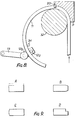
- the strip 11 is initially fed through a curved passage formed between a fixed member 31 and a roller 32 whose axis is fixed.
- the passage is a similar cross-section to the cross-section of the strip 11 and at the outlet a die 33 is provided, whose purpose will be described in more detail below.
- a further roller 34 having a fixed axis is provided just before the movable roller 12 which is mounted on an arm 13 in the manner described above.
- two such movable rollers may be provided, as in the embodiments of Figures 2 and 4.
- the die 33 in the embodiments of both Figure 7 and Figure 8, is arranged such as to alter the cross-section of the strip to a required piston ring cross-section.
- Some possible cross-sections are shown in Figure 9.
- section A the width of the piston ring is reduced by the die.
- section B the inner edges of the piston ring are tapered - although both edges are shown tapered, only one of the edges may be so tapered.
- section C the outer edge of the ring is barrelled in order to provide improved lubrication over the ring edge during operation.
- a rebate is formed around one inner edge of the piston ring.
- the strip 11 is fed by two rollers, one of which is shown at 40.
- the strip 11 then engages two fixed guides 41, 42 arranged on opposite sides of the strip 11 and at spaced positions therealong. These guides 41, 42 impart no curvature to the strip 11.
- an adjustable guide 43 which imparts a fixed curvature to the strip 11 during operation of the machine, but which can be adjusted between operations to alter this imparted curvature. This curvature is the maximum curvature that is required.
- the strip 11 next contacts the strip length encoder 44 which, similarly to the strip velocity detector 21 in the Figure 1 embodiment, produces a signal representative of the length of the strip 11 which has passed the encoder.
- a solenoid indenter 45 is then provided for marking the strip 11 at a predetermined point therealong.
- a movable roller 46 then contacts the strip 11 on the opposite side of the strip 11 to the adjustable guide 43.
- the roller 46 is mounted eccentrically on a shaft 47 which is rotated by an actuator (not shown) controlled by a control system which may be of the kind described above with reference to Figure 1.
- the rotation of the shaft 47 causes the roller 46 to vary the curvature already imparted by the adjustable guide 43 in accordance with the required piston ring profile data fed to the control system.
- a sensor 48 acts in the same way as the arm position transducer 26 of the Figure 1 embodiment, to provide a feedback signal representative of the position of the roller 46.
- rollers may, where appropriate, be replaced by suitable guides, or the guides may, where appropriate, be replaced by suitable rollers.
- the piston rings may be separated from the strip in a number of ways.
- One possibility is to halt the feed of the strip 11 when the ring has been formed and then cut the ring from the remaining strip using, for example, a grinding wheel.
- a number of rings may be formed in succession in a helical coil which is then cut along its length to form the individual rings and to form the gaps between the ends of the rings.
- the rings can be treated, for example, by nitro-carburising before being used.
Landscapes
- Engineering & Computer Science (AREA)
- Mechanical Engineering (AREA)
- General Engineering & Computer Science (AREA)
- Pistons, Piston Rings, And Cylinders (AREA)
- Shearing Machines (AREA)
- Bending Of Plates, Rods, And Pipes (AREA)
- Shaping Metal By Deep-Drawing, Or The Like (AREA)
Applications Claiming Priority (2)
| Application Number | Priority Date | Filing Date | Title |
|---|---|---|---|
| GB848407712A GB8407712D0 (en) | 1984-03-24 | 1984-03-24 | Piston rings for ic engines |
| GB8407712 | 1984-03-24 |
Publications (4)
| Publication Number | Publication Date |
|---|---|
| EP0157537A2 true EP0157537A2 (de) | 1985-10-09 |
| EP0157537A3 EP0157537A3 (en) | 1986-10-29 |
| EP0157537B1 EP0157537B1 (de) | 1989-02-08 |
| EP0157537B2 EP0157537B2 (de) | 1992-03-11 |
Family
ID=10558642
Family Applications (1)
| Application Number | Title | Priority Date | Filing Date |
|---|---|---|---|
| EP85301909A Expired - Lifetime EP0157537B2 (de) | 1984-03-24 | 1985-03-19 | Herstellen von Kolbenringen |
Country Status (6)
| Country | Link |
|---|---|
| EP (1) | EP0157537B2 (de) |
| JP (1) | JP2568997B2 (de) |
| KR (1) | KR920008668B1 (de) |
| CA (1) | CA1259172A (de) |
| DE (1) | DE3568144D1 (de) |
| GB (2) | GB8407712D0 (de) |
Cited By (14)
| Publication number | Priority date | Publication date | Assignee | Title |
|---|---|---|---|---|
| WO1990006459A1 (en) * | 1988-12-01 | 1990-06-14 | Hepworth & Grandage Limited | Piston rings |
| EP0360115A3 (de) * | 1988-09-19 | 1990-08-22 | T&N TECHNOLOGY LIMITED | Kolbenringe |
| EP0348837A3 (en) * | 1988-06-30 | 1990-09-05 | T&N Technology Limited | Method for the manufacture of piston rings |
| EP0405600A1 (de) * | 1989-06-30 | 1991-01-02 | Hashimoto Forming Industry Co., Ltd. | Verfahren und Vorrichtung zur Biegebearbeitung langgestreckter Werkstücke |
| FR2652290A1 (fr) * | 1989-09-25 | 1991-03-29 | Riken Kk | Assemblage de segment racleur d'huile et son procede de fabrication et d'usinage. |
| FR2678853A1 (fr) * | 1991-07-09 | 1993-01-15 | Lorraine Laminage | Procede et dispositif de commande d'une operation de cintrage de produits metallurgiques longs. |
| GB2264886A (en) * | 1992-03-11 | 1993-09-15 | T & N Technology Ltd | Manufacture of piston rings |
| DE4225878A1 (de) * | 1992-08-05 | 1994-02-10 | Bayer Isolierglasfab Kg | Verfahren und Vorrichtung zum Biegen eines im wesentlichen teilkreisförmigen Bogens an einem Abstandhalterprofil |
| DE4416258A1 (de) * | 1994-05-07 | 1995-11-16 | Ae Goetze Gmbh | Vorrichtung zur Herstellung von unrunden Kolbenringen |
| US5752705A (en) * | 1988-12-01 | 1998-05-19 | Ae Piston Products Limited | Piston rings |
| CN100344405C (zh) * | 2004-09-20 | 2007-10-24 | 南京飞燕活塞环股份有限公司 | 用仿形棒定型加工钢质活塞环的方法 |
| CN100500365C (zh) * | 2001-07-03 | 2009-06-17 | 金井宏彰 | 管接头用箍环的制造方法、制造装置及管接头用的箍环 |
| CN111957865A (zh) * | 2020-08-08 | 2020-11-20 | 宁波东艾密封科技有限公司 | 一种大型密封垫金属骨架无焊接技术制造工艺及应用 |
| JP2024049816A (ja) * | 2022-09-29 | 2024-04-10 | 日本ピストンリング株式会社 | 螺旋状線材製造装置、ピストンリング製造装置、螺旋状線材製造方法、ピストンリング製造方法 |
Families Citing this family (6)
| Publication number | Priority date | Publication date | Assignee | Title |
|---|---|---|---|---|
| GB2283555A (en) * | 1993-11-04 | 1995-05-10 | Ford Motor Co | Piston ring seal |
| US5946961A (en) * | 1998-05-01 | 1999-09-07 | Buhrke Industries, Inc. | Web bowing apparatus |
| DE102005041408A1 (de) * | 2005-09-01 | 2007-03-08 | Mahle International Gmbh | Verfahren zur Herstellung eines Kolbenrings für Verbrennungsmotoren sowie einen derartigen Kolbenring |
| JP4981081B2 (ja) * | 2009-03-11 | 2012-07-18 | 株式会社栗本鐵工所 | ベンディングロール装置 |
| ITRM20090430A1 (it) * | 2009-08-06 | 2011-02-07 | Cml Int Spa | Metodo di misurazione di linghezza di tratti di curva di estradosso o intradosso di un pezzo allungato e relativo strumento di misura |
| CN112222850B (zh) * | 2020-09-23 | 2021-08-03 | 常州汉诺车圈有限公司 | 一种自动定长切割成型机 |
Family Cites Families (16)
| Publication number | Priority date | Publication date | Assignee | Title |
|---|---|---|---|---|
| FR1145975A (fr) * | 1955-08-12 | 1957-11-05 | Segment d'étanchéité, procédé pour sa fabrication et installation pour la mise en oeuvre de ce procédé | |
| GB856254A (en) * | 1956-03-14 | 1960-12-14 | Bochumer Ges Fur Grubenausbau | A new or improved method and apparatus for the production of supporting segments |
| CH354651A (de) * | 1956-12-06 | 1961-05-31 | H Dr Ing Berg Heinz | Maschine zur automatischen Herstellung von unrunden Kolbenringen |
| GB1138860A (en) * | 1966-04-16 | 1969-01-01 | Ralph Gordon Smith | Improvements in the bending of structural members |
| AU429691B2 (en) * | 1968-09-26 | 1972-10-31 | Improvements in or relating tothe manufacture of ring gear andother ring blanks | |
| JPS5217818B2 (de) * | 1973-04-19 | 1977-05-18 | ||
| US3854215A (en) * | 1973-07-27 | 1974-12-17 | Boeing Co | Multiplanar sensor and control system for use in roll forming machines |
| DE2551944A1 (de) * | 1974-11-20 | 1976-05-26 | Boeing Co | Numerisch gesteuerte formgebungsmaschine |
| US4080815A (en) * | 1975-06-09 | 1978-03-28 | The Boeing Company | Pinch and forming roll assembly for numerically controlled contour forming machines |
| JPS522717A (en) * | 1975-06-24 | 1977-01-10 | Nec Corp | Method of manufacturing magnetic head |
| DE2838128C3 (de) * | 1978-09-01 | 1981-10-22 | Goetze Ag, 5093 Burscheid | Vorrichtung zum Herstellen von unrunden Kolbenringen aus Metalldraht oder -band |
| JPS5659532A (en) * | 1979-10-23 | 1981-05-23 | Nippon Steel Corp | Method and apparatus for manufacturing spiral pipe |
| JPS5725233A (en) * | 1980-07-18 | 1982-02-10 | Nhk Spring Co Ltd | Formation of coil spring |
| FR2517226A1 (fr) * | 1981-11-30 | 1983-06-03 | Floquet Monopole | Perfectionnements aux procedes et dispositifs de fabrication des segments d'etancheite pour pistons |
| GB2119299A (en) * | 1982-03-04 | 1983-11-16 | Pa Management Consult | Making cutting tools |
| JP5823812B2 (ja) | 2011-10-19 | 2015-11-25 | 大倉工業株式会社 | ウエブ継ぎ合わせ用接合テープ、継ぎ合わせ用治具およびウエブの継ぎ合わせ方法 |
-
1984
- 1984-03-24 GB GB848407712A patent/GB8407712D0/en active Pending
-
1985
- 1985-03-19 GB GB08507025A patent/GB2155828A/en not_active Withdrawn
- 1985-03-19 DE DE8585301909T patent/DE3568144D1/de not_active Expired
- 1985-03-19 EP EP85301909A patent/EP0157537B2/de not_active Expired - Lifetime
- 1985-03-23 KR KR1019850001908A patent/KR920008668B1/ko not_active Expired
- 1985-03-25 CA CA000477407A patent/CA1259172A/en not_active Expired
- 1985-03-25 JP JP60058656A patent/JP2568997B2/ja not_active Expired - Lifetime
Cited By (18)
| Publication number | Priority date | Publication date | Assignee | Title |
|---|---|---|---|---|
| EP0348837A3 (en) * | 1988-06-30 | 1990-09-05 | T&N Technology Limited | Method for the manufacture of piston rings |
| EP0360115A3 (de) * | 1988-09-19 | 1990-08-22 | T&N TECHNOLOGY LIMITED | Kolbenringe |
| WO1990006459A1 (en) * | 1988-12-01 | 1990-06-14 | Hepworth & Grandage Limited | Piston rings |
| US5752705A (en) * | 1988-12-01 | 1998-05-19 | Ae Piston Products Limited | Piston rings |
| US5425257A (en) * | 1989-06-30 | 1995-06-20 | Hashimoto Forming Industry Co., Ltd. | Method and apparatus for bending an elongate workpiece |
| EP0405600A1 (de) * | 1989-06-30 | 1991-01-02 | Hashimoto Forming Industry Co., Ltd. | Verfahren und Vorrichtung zur Biegebearbeitung langgestreckter Werkstücke |
| FR2652290A1 (fr) * | 1989-09-25 | 1991-03-29 | Riken Kk | Assemblage de segment racleur d'huile et son procede de fabrication et d'usinage. |
| FR2678853A1 (fr) * | 1991-07-09 | 1993-01-15 | Lorraine Laminage | Procede et dispositif de commande d'une operation de cintrage de produits metallurgiques longs. |
| GB2264886B (en) * | 1992-03-11 | 1995-05-03 | T & N Technology Ltd | Manufacture of piston rings |
| GB2264886A (en) * | 1992-03-11 | 1993-09-15 | T & N Technology Ltd | Manufacture of piston rings |
| US5502880A (en) * | 1992-03-11 | 1996-04-02 | T&N Technology Limited | Manufacture of piston rings |
| DE4225878A1 (de) * | 1992-08-05 | 1994-02-10 | Bayer Isolierglasfab Kg | Verfahren und Vorrichtung zum Biegen eines im wesentlichen teilkreisförmigen Bogens an einem Abstandhalterprofil |
| DE4416258A1 (de) * | 1994-05-07 | 1995-11-16 | Ae Goetze Gmbh | Vorrichtung zur Herstellung von unrunden Kolbenringen |
| CN100500365C (zh) * | 2001-07-03 | 2009-06-17 | 金井宏彰 | 管接头用箍环的制造方法、制造装置及管接头用的箍环 |
| CN100344405C (zh) * | 2004-09-20 | 2007-10-24 | 南京飞燕活塞环股份有限公司 | 用仿形棒定型加工钢质活塞环的方法 |
| CN111957865A (zh) * | 2020-08-08 | 2020-11-20 | 宁波东艾密封科技有限公司 | 一种大型密封垫金属骨架无焊接技术制造工艺及应用 |
| CN111957865B (zh) * | 2020-08-08 | 2022-07-01 | 宁波东艾密封科技有限公司 | 一种大型密封垫金属骨架无焊接技术制造工艺及应用 |
| JP2024049816A (ja) * | 2022-09-29 | 2024-04-10 | 日本ピストンリング株式会社 | 螺旋状線材製造装置、ピストンリング製造装置、螺旋状線材製造方法、ピストンリング製造方法 |
Also Published As
| Publication number | Publication date |
|---|---|
| GB2155828A (en) | 1985-10-02 |
| DE3568144D1 (en) | 1989-03-16 |
| JPS60216926A (ja) | 1985-10-30 |
| KR920008668B1 (ko) | 1992-10-08 |
| EP0157537B2 (de) | 1992-03-11 |
| JP2568997B2 (ja) | 1997-01-08 |
| GB8507025D0 (en) | 1985-04-24 |
| KR850007008A (ko) | 1985-10-30 |
| CA1259172A (en) | 1989-09-12 |
| GB8407712D0 (en) | 1984-05-02 |
| EP0157537A3 (en) | 1986-10-29 |
| EP0157537B1 (de) | 1989-02-08 |
Similar Documents
| Publication | Publication Date | Title |
|---|---|---|
| CA1259172A (en) | Manufacture of piston rings | |
| US4080815A (en) | Pinch and forming roll assembly for numerically controlled contour forming machines | |
| US4558577A (en) | Roll-forming machine for making articles having cross-sectional configurations varying lengthwise | |
| EP2144720B1 (de) | Verfahren und vorrichtung zum profilbiegen | |
| CA1219662A (en) | Machine tool control | |
| SU651673A3 (ru) | Способ обработки наружных и внутренних поверхностей деталей многоугольной формы | |
| US4416130A (en) | Pulsing impact straightener | |
| US10525515B2 (en) | Roll-bending processing method and processing device | |
| US3842635A (en) | Tube rolling mill for producing tubing with various external configurations | |
| JP2553447B2 (ja) | スエージングマシンにおける加工方法及び装置 | |
| GB1260695A (en) | Apparatus and method for winding coil springs | |
| US5068963A (en) | Piston rings | |
| KR100538897B1 (ko) | 재료를제거하지않고박판을기계가공하는방법및장치 | |
| US7334446B1 (en) | Method for producing a striplike pre-material made of metal, especially a pre-material which has been profiled into regularly reoccurring sections, and device therefor | |
| JP2002066678A (ja) | 螺旋形波状線材の製造方法 | |
| US3726117A (en) | Device and method for controlling the movement of a deformation roll | |
| SU1532120A1 (ru) | Способ правки нежестких валов | |
| US20190348895A1 (en) | Roll bending machine | |
| SU891220A1 (ru) | Способ размерной подналадки двух резцов | |
| SU995921A1 (ru) | Способ прокатки клиновидных профилей | |
| SU1454533A1 (ru) | Волока | |
| SU1560353A1 (ru) | Устройство дл правки проволоки | |
| RU2030931C1 (ru) | Способ настройки трехвалкового стана винтовой прокатки | |
| SU603519A1 (ru) | Машина дл огневой зачистки гор чего металла в потоке прокатного стана | |
| SU834159A1 (ru) | Способ поверхностного упрочнени МЕТАлличЕСКиХ издЕлий |
Legal Events
| Date | Code | Title | Description |
|---|---|---|---|
| PUAI | Public reference made under article 153(3) epc to a published international application that has entered the european phase |
Free format text: ORIGINAL CODE: 0009012 |
|
| AK | Designated contracting states |
Designated state(s): DE FR IT SE |
|
| PUAL | Search report despatched |
Free format text: ORIGINAL CODE: 0009013 |
|
| AK | Designated contracting states |
Kind code of ref document: A3 Designated state(s): DE FR IT SE |
|
| 17P | Request for examination filed |
Effective date: 19870313 |
|
| 17Q | First examination report despatched |
Effective date: 19880114 |
|
| GRAA | (expected) grant |
Free format text: ORIGINAL CODE: 0009210 |
|
| AK | Designated contracting states |
Kind code of ref document: B1 Designated state(s): DE FR IT SE |
|
| REF | Corresponds to: |
Ref document number: 3568144 Country of ref document: DE Date of ref document: 19890316 |
|
| ET | Fr: translation filed | ||
| ITF | It: translation for a ep patent filed | ||
| PLBI | Opposition filed |
Free format text: ORIGINAL CODE: 0009260 |
|
| 26 | Opposition filed |
Opponent name: GOETZE AG Effective date: 19891103 |
|
| PUAH | Patent maintained in amended form |
Free format text: ORIGINAL CODE: 0009272 |
|
| STAA | Information on the status of an ep patent application or granted ep patent |
Free format text: STATUS: PATENT MAINTAINED AS AMENDED |
|
| 27A | Patent maintained in amended form |
Effective date: 19920311 |
|
| AK | Designated contracting states |
Kind code of ref document: B2 Designated state(s): DE FR IT SE |
|
| ET3 | Fr: translation filed ** decision concerning opposition | ||
| ITF | It: translation for a ep patent filed | ||
| ITTA | It: last paid annual fee | ||
| EAL | Se: european patent in force in sweden |
Ref document number: 85301909.9 |
|
| PGFP | Annual fee paid to national office [announced via postgrant information from national office to epo] |
Ref country code: FR Payment date: 20010208 Year of fee payment: 17 |
|
| PGFP | Annual fee paid to national office [announced via postgrant information from national office to epo] |
Ref country code: DE Payment date: 20010222 Year of fee payment: 17 |
|
| PGFP | Annual fee paid to national office [announced via postgrant information from national office to epo] |
Ref country code: SE Payment date: 20010223 Year of fee payment: 17 |
|
| PG25 | Lapsed in a contracting state [announced via postgrant information from national office to epo] |
Ref country code: SE Free format text: LAPSE BECAUSE OF NON-PAYMENT OF DUE FEES Effective date: 20020320 |
|
| PG25 | Lapsed in a contracting state [announced via postgrant information from national office to epo] |
Ref country code: DE Free format text: LAPSE BECAUSE OF NON-PAYMENT OF DUE FEES Effective date: 20021001 |
|
| EUG | Se: european patent has lapsed |
Ref document number: 85301909.9 |
|
| PG25 | Lapsed in a contracting state [announced via postgrant information from national office to epo] |
Ref country code: FR Free format text: LAPSE BECAUSE OF NON-PAYMENT OF DUE FEES Effective date: 20021129 |
|
| REG | Reference to a national code |
Ref country code: FR Ref legal event code: ST |