EP0158110B1 - Colorants triphénodioxazine - Google Patents
Colorants triphénodioxazine Download PDFInfo
- Publication number
- EP0158110B1 EP0158110B1 EP85102448A EP85102448A EP0158110B1 EP 0158110 B1 EP0158110 B1 EP 0158110B1 EP 85102448 A EP85102448 A EP 85102448A EP 85102448 A EP85102448 A EP 85102448A EP 0158110 B1 EP0158110 B1 EP 0158110B1
- Authority
- EP
- European Patent Office
- Prior art keywords
- alkyl
- optionally substituted
- phenyl
- fluoro
- pyrimidinyl
- Prior art date
- Legal status (The legal status is an assumption and is not a legal conclusion. Google has not performed a legal analysis and makes no representation as to the accuracy of the status listed.)
- Expired
Links
- 239000000975 dye Substances 0.000 title description 19
- 125000003178 carboxy group Chemical group [H]OC(*)=O 0.000 claims description 12
- 125000001997 phenyl group Chemical group [H]C1=C([H])C([H])=C(*)C([H])=C1[H] 0.000 claims description 11
- 125000004178 (C1-C4) alkyl group Chemical group 0.000 claims description 8
- 125000004169 (C1-C6) alkyl group Chemical group 0.000 claims description 7
- 229910052794 bromium Inorganic materials 0.000 claims description 7
- 238000004043 dyeing Methods 0.000 claims description 7
- 125000001624 naphthyl group Chemical group 0.000 claims description 7
- 125000003368 amide group Chemical group 0.000 claims description 6
- 229910052801 chlorine Inorganic materials 0.000 claims description 6
- 125000002887 hydroxy group Chemical group [H]O* 0.000 claims description 6
- 125000004442 acylamino group Chemical group 0.000 claims description 5
- 229910052739 hydrogen Inorganic materials 0.000 claims description 5
- 125000000951 phenoxy group Chemical group [H]C1=C([H])C([H])=C(O*)C([H])=C1[H] 0.000 claims description 5
- 125000003107 substituted aryl group Chemical group 0.000 claims description 5
- 125000000229 (C1-C4)alkoxy group Chemical group 0.000 claims description 4
- 125000000623 heterocyclic group Chemical group 0.000 claims description 4
- 125000002496 methyl group Chemical group [H]C([H])([H])* 0.000 claims description 4
- 229910052757 nitrogen Inorganic materials 0.000 claims description 4
- 150000001732 carboxylic acid derivatives Chemical class 0.000 claims description 3
- 125000000956 methoxy group Chemical group [H]C([H])([H])O* 0.000 claims description 3
- 229910004727 OSO3H Inorganic materials 0.000 claims description 2
- 229910006069 SO3H Inorganic materials 0.000 claims description 2
- 125000004956 cyclohexylene group Chemical group 0.000 claims description 2
- 229920002994 synthetic fiber Polymers 0.000 claims 2
- 150000003857 carboxamides Chemical class 0.000 claims 1
- BDHFUVZGWQCTTF-UHFFFAOYSA-N sulfonic acid Chemical compound OS(=O)=O BDHFUVZGWQCTTF-UHFFFAOYSA-N 0.000 claims 1
- -1 alkyl radicals Chemical class 0.000 description 62
- 150000003254 radicals Chemical class 0.000 description 10
- HEMHJVSKTPXQMS-UHFFFAOYSA-M Sodium hydroxide Chemical compound [OH-].[Na+] HEMHJVSKTPXQMS-UHFFFAOYSA-M 0.000 description 9
- 239000000243 solution Substances 0.000 description 9
- 238000009833 condensation Methods 0.000 description 8
- 230000005494 condensation Effects 0.000 description 8
- 125000001424 substituent group Chemical group 0.000 description 8
- 125000000217 alkyl group Chemical group 0.000 description 7
- 150000001875 compounds Chemical class 0.000 description 7
- JUJWROOIHBZHMG-UHFFFAOYSA-N Pyridine Chemical compound C1=CC=NC=C1 JUJWROOIHBZHMG-UHFFFAOYSA-N 0.000 description 6
- 229910052736 halogen Inorganic materials 0.000 description 6
- 239000000463 material Substances 0.000 description 6
- 238000000034 method Methods 0.000 description 6
- 239000000460 chlorine Substances 0.000 description 5
- 229910052731 fluorine Inorganic materials 0.000 description 5
- 150000002367 halogens Chemical class 0.000 description 5
- 239000000985 reactive dye Substances 0.000 description 5
- JYEUMXHLPRZUAT-UHFFFAOYSA-N 1,2,3-triazine Chemical compound C1=CN=NN=C1 JYEUMXHLPRZUAT-UHFFFAOYSA-N 0.000 description 4
- CDBYLPFSWZWCQE-UHFFFAOYSA-L Sodium Carbonate Chemical compound [Na+].[Na+].[O-]C([O-])=O CDBYLPFSWZWCQE-UHFFFAOYSA-L 0.000 description 4
- FAPWRFPIFSIZLT-UHFFFAOYSA-M Sodium chloride Chemical compound [Na+].[Cl-] FAPWRFPIFSIZLT-UHFFFAOYSA-M 0.000 description 4
- 125000003118 aryl group Chemical group 0.000 description 4
- 229910052799 carbon Inorganic materials 0.000 description 4
- 239000003795 chemical substances by application Substances 0.000 description 4
- 239000011737 fluorine Substances 0.000 description 4
- 125000005146 naphthylsulfonyl group Chemical group C1(=CC=CC2=CC=CC=C12)S(=O)(=O)* 0.000 description 4
- 238000006798 ring closing metathesis reaction Methods 0.000 description 4
- 125000000020 sulfo group Chemical group O=S(=O)([*])O[H] 0.000 description 4
- RHUYHJGZWVXEHW-UHFFFAOYSA-N 1,1-Dimethyhydrazine Chemical compound CN(C)N RHUYHJGZWVXEHW-UHFFFAOYSA-N 0.000 description 3
- AZQWKYJCGOJGHM-UHFFFAOYSA-N 1,4-benzoquinone Chemical compound O=C1C=CC(=O)C=C1 AZQWKYJCGOJGHM-UHFFFAOYSA-N 0.000 description 3
- KXDAEFPNCMNJSK-UHFFFAOYSA-N Benzamide Chemical class NC(=O)C1=CC=CC=C1 KXDAEFPNCMNJSK-UHFFFAOYSA-N 0.000 description 3
- PXGOKWXKJXAPGV-UHFFFAOYSA-N Fluorine Chemical compound FF PXGOKWXKJXAPGV-UHFFFAOYSA-N 0.000 description 3
- ZMXDDKWLCZADIW-UHFFFAOYSA-N N,N-Dimethylformamide Chemical compound CN(C)C=O ZMXDDKWLCZADIW-UHFFFAOYSA-N 0.000 description 3
- QAOWNCQODCNURD-UHFFFAOYSA-N Sulfuric acid Chemical compound OS(O)(=O)=O QAOWNCQODCNURD-UHFFFAOYSA-N 0.000 description 3
- YXFVVABEGXRONW-UHFFFAOYSA-N Toluene Chemical compound CC1=CC=CC=C1 YXFVVABEGXRONW-UHFFFAOYSA-N 0.000 description 3
- ZMANZCXQSJIPKH-UHFFFAOYSA-N Triethylamine Chemical compound CCN(CC)CC ZMANZCXQSJIPKH-UHFFFAOYSA-N 0.000 description 3
- 125000003545 alkoxy group Chemical group 0.000 description 3
- XSCHRSMBECNVNS-UHFFFAOYSA-N benzopyrazine Natural products N1=CC=NC2=CC=CC=C21 XSCHRSMBECNVNS-UHFFFAOYSA-N 0.000 description 3
- 125000005521 carbonamide group Chemical group 0.000 description 3
- 239000007859 condensation product Substances 0.000 description 3
- 125000000843 phenylene group Chemical group C1(=C(C=CC=C1)*)* 0.000 description 3
- UMJSCPRVCHMLSP-UHFFFAOYSA-N pyridine Natural products COC1=CC=CN=C1 UMJSCPRVCHMLSP-UHFFFAOYSA-N 0.000 description 3
- 125000000472 sulfonyl group Chemical group *S(*)(=O)=O 0.000 description 3
- XLYOFNOQVPJJNP-UHFFFAOYSA-N water Substances O XLYOFNOQVPJJNP-UHFFFAOYSA-N 0.000 description 3
- 150000004057 1,4-benzoquinones Chemical class 0.000 description 2
- 125000002373 5 membered heterocyclic group Chemical group 0.000 description 2
- 125000004070 6 membered heterocyclic group Chemical group 0.000 description 2
- QGZKDVFQNNGYKY-UHFFFAOYSA-N Ammonia Chemical compound N QGZKDVFQNNGYKY-UHFFFAOYSA-N 0.000 description 2
- QGZKDVFQNNGYKY-UHFFFAOYSA-O Ammonium Chemical compound [NH4+] QGZKDVFQNNGYKY-UHFFFAOYSA-O 0.000 description 2
- 239000005711 Benzoic acid Substances 0.000 description 2
- LSNNMFCWUKXFEE-UHFFFAOYSA-M Bisulfite Chemical compound OS([O-])=O LSNNMFCWUKXFEE-UHFFFAOYSA-M 0.000 description 2
- RTZKZFJDLAIYFH-UHFFFAOYSA-N Diethyl ether Chemical compound CCOCC RTZKZFJDLAIYFH-UHFFFAOYSA-N 0.000 description 2
- IAZDPXIOMUYVGZ-UHFFFAOYSA-N Dimethylsulphoxide Chemical group CS(C)=O IAZDPXIOMUYVGZ-UHFFFAOYSA-N 0.000 description 2
- DGAQECJNVWCQMB-PUAWFVPOSA-M Ilexoside XXIX Chemical compound C[C@@H]1CC[C@@]2(CC[C@@]3(C(=CC[C@H]4[C@]3(CC[C@@H]5[C@@]4(CC[C@@H](C5(C)C)OS(=O)(=O)[O-])C)C)[C@@H]2[C@]1(C)O)C)C(=O)O[C@H]6[C@@H]([C@H]([C@@H]([C@H](O6)CO)O)O)O.[Na+] DGAQECJNVWCQMB-PUAWFVPOSA-M 0.000 description 2
- PVNIIMVLHYAWGP-UHFFFAOYSA-N Niacin Chemical compound OC(=O)C1=CC=CN=C1 PVNIIMVLHYAWGP-UHFFFAOYSA-N 0.000 description 2
- PCNDJXKNXGMECE-UHFFFAOYSA-N Phenazine Natural products C1=CC=CC2=NC3=CC=CC=C3N=C21 PCNDJXKNXGMECE-UHFFFAOYSA-N 0.000 description 2
- KYQCOXFCLRTKLS-UHFFFAOYSA-N Pyrazine Chemical compound C1=CN=CC=N1 KYQCOXFCLRTKLS-UHFFFAOYSA-N 0.000 description 2
- SMWDFEZZVXVKRB-UHFFFAOYSA-N Quinoline Chemical compound N1=CC=CC2=CC=CC=C21 SMWDFEZZVXVKRB-UHFFFAOYSA-N 0.000 description 2
- UIIMBOGNXHQVGW-UHFFFAOYSA-M Sodium bicarbonate Chemical compound [Na+].OC([O-])=O UIIMBOGNXHQVGW-UHFFFAOYSA-M 0.000 description 2
- 239000002253 acid Substances 0.000 description 2
- DZBUGLKDJFMEHC-UHFFFAOYSA-N acridine Chemical compound C1=CC=CC2=CC3=CC=CC=C3N=C21 DZBUGLKDJFMEHC-UHFFFAOYSA-N 0.000 description 2
- 229910052783 alkali metal Inorganic materials 0.000 description 2
- 125000003282 alkyl amino group Chemical group 0.000 description 2
- 125000003277 amino group Chemical group 0.000 description 2
- 150000005840 aryl radicals Chemical class 0.000 description 2
- VMKJWLXVLHBJNK-UHFFFAOYSA-N cyanuric fluoride Chemical compound FC1=NC(F)=NC(F)=N1 VMKJWLXVLHBJNK-UHFFFAOYSA-N 0.000 description 2
- 229960001760 dimethyl sulfoxide Drugs 0.000 description 2
- PPSZHCXTGRHULJ-UHFFFAOYSA-N dioxazine Chemical compound O1ON=CC=C1 PPSZHCXTGRHULJ-UHFFFAOYSA-N 0.000 description 2
- 150000005125 dioxazines Chemical class 0.000 description 2
- 125000005843 halogen group Chemical group 0.000 description 2
- TWBYWOBDOCUKOW-UHFFFAOYSA-N isonicotinic acid Chemical compound OC(=O)C1=CC=NC=C1 TWBYWOBDOCUKOW-UHFFFAOYSA-N 0.000 description 2
- LQNUZADURLCDLV-UHFFFAOYSA-N nitrobenzene Chemical compound [O-][N+](=O)C1=CC=CC=C1 LQNUZADURLCDLV-UHFFFAOYSA-N 0.000 description 2
- TVMXDCGIABBOFY-UHFFFAOYSA-N octane Chemical compound CCCCCCCC TVMXDCGIABBOFY-UHFFFAOYSA-N 0.000 description 2
- SCVFZCLFOSHCOH-UHFFFAOYSA-M potassium acetate Chemical compound [K+].CC([O-])=O SCVFZCLFOSHCOH-UHFFFAOYSA-M 0.000 description 2
- 239000000047 product Substances 0.000 description 2
- 229910052708 sodium Inorganic materials 0.000 description 2
- 229910000029 sodium carbonate Inorganic materials 0.000 description 2
- 239000011780 sodium chloride Substances 0.000 description 2
- GETQZCLCWQTVFV-UHFFFAOYSA-N trimethylamine Chemical compound CN(C)C GETQZCLCWQTVFV-UHFFFAOYSA-N 0.000 description 2
- 125000003161 (C1-C6) alkylene group Chemical group 0.000 description 1
- 125000004955 1,4-cyclohexylene group Chemical group [H]C1([H])C([H])([H])C([H])([*:1])C([H])([H])C([H])([H])C1([H])[*:2] 0.000 description 1
- 125000004825 2,2-dimethylpropylene group Chemical group [H]C([H])([H])C(C([H])([H])[H])(C([H])([H])[*:1])C([H])([H])[*:2] 0.000 description 1
- VEPOHXYIFQMVHW-XOZOLZJESA-N 2,3-dihydroxybutanedioic acid (2S,3S)-3,4-dimethyl-2-phenylmorpholine Chemical compound OC(C(O)C(O)=O)C(O)=O.C[C@H]1[C@@H](OCCN1C)c1ccccc1 VEPOHXYIFQMVHW-XOZOLZJESA-N 0.000 description 1
- PXBFMLJZNCDSMP-UHFFFAOYSA-N 2-Aminobenzamide Chemical class NC(=O)C1=CC=CC=C1N PXBFMLJZNCDSMP-UHFFFAOYSA-N 0.000 description 1
- LDCCBULMAFILCT-UHFFFAOYSA-N 2-aminobenzene-1,4-disulfonic acid Chemical compound NC1=CC(S(O)(=O)=O)=CC=C1S(O)(=O)=O LDCCBULMAFILCT-UHFFFAOYSA-N 0.000 description 1
- ZMCHBSMFKQYNKA-UHFFFAOYSA-N 2-aminobenzenesulfonic acid Chemical compound NC1=CC=CC=C1S(O)(=O)=O ZMCHBSMFKQYNKA-UHFFFAOYSA-N 0.000 description 1
- OGLKKYALUKXVPQ-UHFFFAOYSA-N 2-chloro-5-nitrobenzoyl chloride Chemical compound [O-][N+](=O)C1=CC=C(Cl)C(C(Cl)=O)=C1 OGLKKYALUKXVPQ-UHFFFAOYSA-N 0.000 description 1
- BCHZICNRHXRCHY-UHFFFAOYSA-N 2h-oxazine Chemical compound N1OC=CC=C1 BCHZICNRHXRCHY-UHFFFAOYSA-N 0.000 description 1
- AGIJRRREJXSQJR-UHFFFAOYSA-N 2h-thiazine Chemical compound N1SC=CC=C1 AGIJRRREJXSQJR-UHFFFAOYSA-N 0.000 description 1
- LHYQAEFVHIZFLR-UHFFFAOYSA-L 4-(4-diazonio-3-methoxyphenyl)-2-methoxybenzenediazonium;dichloride Chemical compound [Cl-].[Cl-].C1=C([N+]#N)C(OC)=CC(C=2C=C(OC)C([N+]#N)=CC=2)=C1 LHYQAEFVHIZFLR-UHFFFAOYSA-L 0.000 description 1
- 125000004172 4-methoxyphenyl group Chemical group [H]C1=C([H])C(OC([H])([H])[H])=C([H])C([H])=C1* 0.000 description 1
- 125000000590 4-methylphenyl group Chemical group [H]C1=C([H])C(=C([H])C([H])=C1*)C([H])([H])[H] 0.000 description 1
- 125000004008 6 membered carbocyclic group Chemical group 0.000 description 1
- UHOVQNZJYSORNB-UHFFFAOYSA-N Benzene Chemical group C1=CC=CC=C1 UHOVQNZJYSORNB-UHFFFAOYSA-N 0.000 description 1
- WKBOTKDWSSQWDR-UHFFFAOYSA-N Bromine atom Chemical compound [Br] WKBOTKDWSSQWDR-UHFFFAOYSA-N 0.000 description 1
- 125000002853 C1-C4 hydroxyalkyl group Chemical group 0.000 description 1
- 229920003043 Cellulose fiber Polymers 0.000 description 1
- ZAMOUSCENKQFHK-UHFFFAOYSA-N Chlorine atom Chemical compound [Cl] ZAMOUSCENKQFHK-UHFFFAOYSA-N 0.000 description 1
- 229920000742 Cotton Polymers 0.000 description 1
- MYMOFIZGZYHOMD-UHFFFAOYSA-N Dioxygen Chemical compound O=O MYMOFIZGZYHOMD-UHFFFAOYSA-N 0.000 description 1
- VGGSQFUCUMXWEO-UHFFFAOYSA-N Ethene Chemical compound C=C VGGSQFUCUMXWEO-UHFFFAOYSA-N 0.000 description 1
- 239000005977 Ethylene Substances 0.000 description 1
- GOLZVLAYHIEUEM-UHFFFAOYSA-N FC=1C(=C(C(=C(C1)S(=O)(=O)O)NC1=NN=NC=C1)F)S(=O)(=O)O Chemical compound FC=1C(=C(C(=C(C1)S(=O)(=O)O)NC1=NN=NC=C1)F)S(=O)(=O)O GOLZVLAYHIEUEM-UHFFFAOYSA-N 0.000 description 1
- SECXISVLQFMRJM-UHFFFAOYSA-N N-Methylpyrrolidone Chemical compound CN1CCCC1=O SECXISVLQFMRJM-UHFFFAOYSA-N 0.000 description 1
- UEEJHVSXFDXPFK-UHFFFAOYSA-N N-dimethylaminoethanol Chemical compound CN(C)CCO UEEJHVSXFDXPFK-UHFFFAOYSA-N 0.000 description 1
- 150000001204 N-oxides Chemical class 0.000 description 1
- 229910019142 PO4 Inorganic materials 0.000 description 1
- 239000004952 Polyamide Substances 0.000 description 1
- ZLMJMSJWJFRBEC-UHFFFAOYSA-N Potassium Chemical compound [K] ZLMJMSJWJFRBEC-UHFFFAOYSA-N 0.000 description 1
- KWYUFKZDYYNOTN-UHFFFAOYSA-M Potassium hydroxide Chemical compound [OH-].[K+] KWYUFKZDYYNOTN-UHFFFAOYSA-M 0.000 description 1
- CZPWVGJYEJSRLH-UHFFFAOYSA-N Pyrimidine Chemical compound C1=CN=CN=C1 CZPWVGJYEJSRLH-UHFFFAOYSA-N 0.000 description 1
- GSEJCLTVZPLZKY-UHFFFAOYSA-N Triethanolamine Chemical compound OCCN(CCO)CCO GSEJCLTVZPLZKY-UHFFFAOYSA-N 0.000 description 1
- HCHKCACWOHOZIP-UHFFFAOYSA-N Zinc Chemical compound [Zn] HCHKCACWOHOZIP-UHFFFAOYSA-N 0.000 description 1
- 150000007513 acids Chemical class 0.000 description 1
- 229910000288 alkali metal carbonate Inorganic materials 0.000 description 1
- 150000008041 alkali metal carbonates Chemical class 0.000 description 1
- 125000002947 alkylene group Chemical group 0.000 description 1
- 229910021529 ammonia Inorganic materials 0.000 description 1
- ROOXNKNUYICQNP-UHFFFAOYSA-N ammonium persulfate Chemical compound [NH4+].[NH4+].[O-]S(=O)(=O)OOS([O-])(=O)=O ROOXNKNUYICQNP-UHFFFAOYSA-N 0.000 description 1
- 150000004982 aromatic amines Chemical class 0.000 description 1
- 125000001691 aryl alkyl amino group Chemical group 0.000 description 1
- 125000003710 aryl alkyl group Chemical group 0.000 description 1
- 125000001769 aryl amino group Chemical group 0.000 description 1
- 125000004104 aryloxy group Chemical group 0.000 description 1
- 125000000852 azido group Chemical group *N=[N+]=[N-] 0.000 description 1
- 239000002585 base Substances 0.000 description 1
- 239000011230 binding agent Substances 0.000 description 1
- 229910021538 borax Inorganic materials 0.000 description 1
- GDTBXPJZTBHREO-UHFFFAOYSA-N bromine Substances BrBr GDTBXPJZTBHREO-UHFFFAOYSA-N 0.000 description 1
- 239000000872 buffer Substances 0.000 description 1
- 239000008366 buffered solution Substances 0.000 description 1
- 238000010531 catalytic reduction reaction Methods 0.000 description 1
- 229920002678 cellulose Polymers 0.000 description 1
- 239000001913 cellulose Substances 0.000 description 1
- 238000006243 chemical reaction Methods 0.000 description 1
- 238000004040 coloring Methods 0.000 description 1
- 125000004122 cyclic group Chemical group 0.000 description 1
- 238000001035 drying Methods 0.000 description 1
- 125000001301 ethoxy group Chemical group [H]C([H])([H])C([H])([H])O* 0.000 description 1
- 125000001495 ethyl group Chemical group [H]C([H])([H])C([H])([H])* 0.000 description 1
- 125000000031 ethylamino group Chemical group [H]C([H])([H])C([H])([H])N([H])[*] 0.000 description 1
- 239000000835 fiber Substances 0.000 description 1
- 239000012065 filter cake Substances 0.000 description 1
- 150000005171 halobenzenes Chemical class 0.000 description 1
- OAKJQQAXSVQMHS-UHFFFAOYSA-O hydrazinium(1+) Chemical compound [NH3+]N OAKJQQAXSVQMHS-UHFFFAOYSA-O 0.000 description 1
- 125000004170 methylsulfonyl group Chemical group [H]C([H])([H])S(*)(=O)=O 0.000 description 1
- 239000000203 mixture Substances 0.000 description 1
- 235000001968 nicotinic acid Nutrition 0.000 description 1
- 229960003512 nicotinic acid Drugs 0.000 description 1
- 239000011664 nicotinic acid Substances 0.000 description 1
- 125000000449 nitro group Chemical group [O-][N+](*)=O 0.000 description 1
- IJGRMHOSHXDMSA-UHFFFAOYSA-N nitrogen Substances N#N IJGRMHOSHXDMSA-UHFFFAOYSA-N 0.000 description 1
- 125000004433 nitrogen atom Chemical group N* 0.000 description 1
- 150000007530 organic bases Chemical class 0.000 description 1
- 150000001451 organic peroxides Chemical class 0.000 description 1
- 239000003960 organic solvent Substances 0.000 description 1
- 239000007800 oxidant agent Substances 0.000 description 1
- 230000003647 oxidation Effects 0.000 description 1
- 238000007254 oxidation reaction Methods 0.000 description 1
- 230000001590 oxidative effect Effects 0.000 description 1
- 125000004430 oxygen atom Chemical group O* 0.000 description 1
- 125000003854 p-chlorophenyl group Chemical group [H]C1=C([H])C(*)=C([H])C([H])=C1Cl 0.000 description 1
- RDOWQLZANAYVLL-UHFFFAOYSA-N phenanthridine Chemical group C1=CC=C2C3=CC=CC=C3C=NC2=C1 RDOWQLZANAYVLL-UHFFFAOYSA-N 0.000 description 1
- 125000003170 phenylsulfonyl group Chemical group C1(=CC=CC=C1)S(=O)(=O)* 0.000 description 1
- 235000021317 phosphate Nutrition 0.000 description 1
- 239000008363 phosphate buffer Substances 0.000 description 1
- 150000003013 phosphoric acid derivatives Chemical class 0.000 description 1
- LFSXCDWNBUNEEM-UHFFFAOYSA-N phthalazine Chemical compound C1=NN=CC2=CC=CC=C21 LFSXCDWNBUNEEM-UHFFFAOYSA-N 0.000 description 1
- 229920002647 polyamide Polymers 0.000 description 1
- 229920006306 polyurethane fiber Polymers 0.000 description 1
- 229910052700 potassium Inorganic materials 0.000 description 1
- 239000011591 potassium Substances 0.000 description 1
- 235000011056 potassium acetate Nutrition 0.000 description 1
- 159000000001 potassium salts Chemical class 0.000 description 1
- 239000002244 precipitate Substances 0.000 description 1
- 238000001556 precipitation Methods 0.000 description 1
- 238000002360 preparation method Methods 0.000 description 1
- 125000002924 primary amino group Chemical group [H]N([H])* 0.000 description 1
- PBMFSQRYOILNGV-UHFFFAOYSA-N pyridazine Chemical compound C1=CC=NN=C1 PBMFSQRYOILNGV-UHFFFAOYSA-N 0.000 description 1
- 125000000714 pyrimidinyl group Chemical group 0.000 description 1
- JWVCLYRUEFBMGU-UHFFFAOYSA-N quinazoline Chemical compound N1=CN=CC2=CC=CC=C21 JWVCLYRUEFBMGU-UHFFFAOYSA-N 0.000 description 1
- 239000004627 regenerated cellulose Substances 0.000 description 1
- 150000003839 salts Chemical group 0.000 description 1
- 239000011734 sodium Substances 0.000 description 1
- 239000001632 sodium acetate Substances 0.000 description 1
- 235000017281 sodium acetate Nutrition 0.000 description 1
- 229910000030 sodium bicarbonate Inorganic materials 0.000 description 1
- 235000017557 sodium bicarbonate Nutrition 0.000 description 1
- 235000017550 sodium carbonate Nutrition 0.000 description 1
- 235000011121 sodium hydroxide Nutrition 0.000 description 1
- 239000001488 sodium phosphate Substances 0.000 description 1
- 235000011008 sodium phosphates Nutrition 0.000 description 1
- 159000000000 sodium salts Chemical class 0.000 description 1
- 235000010339 sodium tetraborate Nutrition 0.000 description 1
- 238000003756 stirring Methods 0.000 description 1
- 239000000126 substance Substances 0.000 description 1
- SEEPANYCNGTZFQ-UHFFFAOYSA-N sulfadiazine Chemical compound C1=CC(N)=CC=C1S(=O)(=O)NC1=NC=CC=N1 SEEPANYCNGTZFQ-UHFFFAOYSA-N 0.000 description 1
- 125000000446 sulfanediyl group Chemical group *S* 0.000 description 1
- BUUPQKDIAURBJP-UHFFFAOYSA-N sulfinic acid Chemical compound OS=O BUUPQKDIAURBJP-UHFFFAOYSA-N 0.000 description 1
- HXJUTPCZVOIRIF-UHFFFAOYSA-N sulfolane Chemical compound O=S1(=O)CCCC1 HXJUTPCZVOIRIF-UHFFFAOYSA-N 0.000 description 1
- 125000000565 sulfonamide group Chemical group 0.000 description 1
- 125000000542 sulfonic acid group Chemical group 0.000 description 1
- RWSOTUBLDIXVET-UHFFFAOYSA-O sulfonium Chemical compound [SH3+] RWSOTUBLDIXVET-UHFFFAOYSA-O 0.000 description 1
- 229910052717 sulfur Inorganic materials 0.000 description 1
- 239000000725 suspension Substances 0.000 description 1
- UGNWTBMOAKPKBL-UHFFFAOYSA-N tetrachloro-1,4-benzoquinone Chemical compound ClC1=C(Cl)C(=O)C(Cl)=C(Cl)C1=O UGNWTBMOAKPKBL-UHFFFAOYSA-N 0.000 description 1
- 239000004753 textile Substances 0.000 description 1
- 150000003573 thiols Chemical class 0.000 description 1
- 125000005270 trialkylamine group Chemical group 0.000 description 1
- BSVBQGMMJUBVOD-UHFFFAOYSA-N trisodium borate Chemical compound [Na+].[Na+].[Na+].[O-]B([O-])[O-] BSVBQGMMJUBVOD-UHFFFAOYSA-N 0.000 description 1
- RYFMWSXOAZQYPI-UHFFFAOYSA-K trisodium phosphate Chemical class [Na+].[Na+].[Na+].[O-]P([O-])([O-])=O RYFMWSXOAZQYPI-UHFFFAOYSA-K 0.000 description 1
- 210000002268 wool Anatomy 0.000 description 1
- 238000010626 work up procedure Methods 0.000 description 1
Classifications
-
- C—CHEMISTRY; METALLURGY
- C09—DYES; PAINTS; POLISHES; NATURAL RESINS; ADHESIVES; COMPOSITIONS NOT OTHERWISE PROVIDED FOR; APPLICATIONS OF MATERIALS NOT OTHERWISE PROVIDED FOR
- C09B—ORGANIC DYES OR CLOSELY-RELATED COMPOUNDS FOR PRODUCING DYES, e.g. PIGMENTS; MORDANTS; LAKES
- C09B62/00—Reactive dyes, i.e. dyes which form covalent bonds with the substrates or which polymerise with themselves
- C09B62/002—Reactive dyes, i.e. dyes which form covalent bonds with the substrates or which polymerise with themselves with the linkage of the reactive group being alternatively specified
- C09B62/0025—Specific dyes not provided for in groups C09B62/004 - C09B62/018
-
- C—CHEMISTRY; METALLURGY
- C09—DYES; PAINTS; POLISHES; NATURAL RESINS; ADHESIVES; COMPOSITIONS NOT OTHERWISE PROVIDED FOR; APPLICATIONS OF MATERIALS NOT OTHERWISE PROVIDED FOR
- C09B—ORGANIC DYES OR CLOSELY-RELATED COMPOUNDS FOR PRODUCING DYES, e.g. PIGMENTS; MORDANTS; LAKES
- C09B62/00—Reactive dyes, i.e. dyes which form covalent bonds with the substrates or which polymerise with themselves
- C09B62/44—Reactive dyes, i.e. dyes which form covalent bonds with the substrates or which polymerise with themselves with the reactive group not directly attached to a heterocyclic ring
- C09B62/4401—Reactive dyes, i.e. dyes which form covalent bonds with the substrates or which polymerise with themselves with the reactive group not directly attached to a heterocyclic ring with two or more reactive groups at least one of them being directly attached to a heterocyclic system and at least one of them being directly attached to a non-heterocyclic system
Definitions
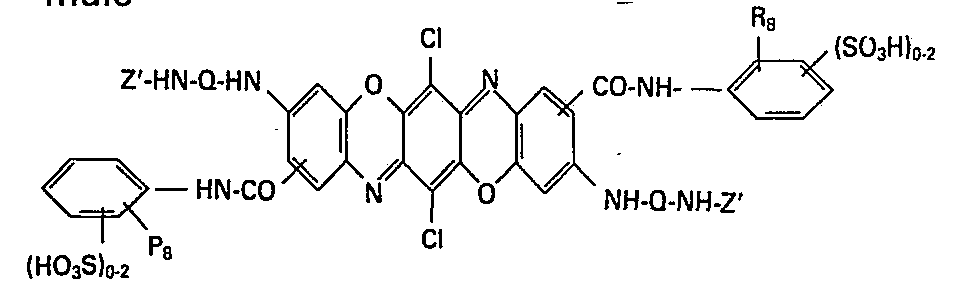
- the invention furthermore relates to the use of the dyes of the formulas I-III for dyeing natural and synthetic hydroxyl- or amide group-containing materials and the natural or synthetic hydroxyl- or amide group-containing materials dyed with these dyes.
- Dyes are preferred which have at least two water-solubilizing groups, in particular sulfo, sulfato or carboxy groups.
- Possible substituents for the alkyl radicals R 5 and R 6 are in particular: water-solubilizing groups or hydrophilic groups such as: -S0 3 H, -OSO 3 H, -COOH, -OH, C 1 -C 4 alkoxy, optionally substituted, for example, by C 1 -C 4 hydroxyalkyl or C 1 -C 4 alkoxy-C 1 -C 4 alkyl.
- Suitable substituents for the aryl radicals in particular the phenyl radicals: -S0 3 H, -COOH furthermore C 1 -C 4 -alkyl, halogen, C 1 -C 4 -alkoxy and functionally modified sulfo and carboxy groups.
- bridge members Y 2 are alkylene radicals such as C 2 -C 6 alkylene, optionally interrupted by 0, S or N, optionally substituted, for example ethylene, 1,2- and 1,3-propylene, 1,2-, 1,3 -, 1,4- and 2,3-butylene, 2-methyl-1,3-propylene, 2,2-dimethylpropylene, 2-methyl-2,4-pentylene, 1-phenylethylene, 2,5-hexylene, 1 , 5-pentylene, 1,6-hexylene, 1,3-cyclohexylene, 1,4-cyclohexylene, 4-methyl-1,3-cyclohexylene, 2-hydroxy-1,3-propylene, 2-sulfato-1,3 -propylene, -CH2CH2-O-CH2CH2-, CH 2 CH 2 -S-CH 2 CH 2 -, Alkylene residues such as
- Arylene radicals such as optionally substituted phenylene, in particular phenylene and phenylene substituted by alkyl, alkoxy, sulfo, carboxy or halogen, such as 1,2-, 1,3-, 1,4-phenylene, 3-methyl-1,2-phenylene, 4- Methyl-1,2-phenylene, 2-methyl-1,3-phenylene, 4-methyl-1,3-phenylene, 5-methyl-1,3-phenylene, 2-methyl-1,4-phenylene, 2, 4,6-trimethyl-1,3-phenylene, 2,3,5,6-tetramethyl-1,4-phenylene, 2,6-dimethyl-1,3-phenylene, 2-methyl-6-ethyl-1, 3-phenylene, 2-methyl-4,6-diethyl-1,3-phenylene, 2,6-diethyl-4-methyl-1,3-phenylene, 2-methoxy-1,3-phenylene, 4-methoxy 1,3-phenylene, 6-methoxy-1,3
- 1,4-phenylene 2-methyl-5-sulfo-1,3-phenylene, 2-methyl-4-sulfo-1,3-phenylene, 2,4,6-trimethyl-5-sulfo-1,3- phenylene, 2,6-dimethyl-4- and -5-sulfo-1,3-phenylene, 2-methyl-6-sulfo-1,3-phenylene, 4-methyl-6-sulfo-1,3-phenylene, 6-methyl-4-sulfo-1,3-phenylene, 3-methyl-6-sulfo-1,4-phenylene, 6-methoxy-4-sulfo-1,3-phenylene, 4-methoxy-6-sulfo 1,3-phenylene.
- Suitable radicals R, and R 2 are, for example, Cl, Br, C, -C 4 -alkyl, C, -C 4 -alkoxy, aryloxy, in particular optionally substituted phenoxy, acylamino, carboxy, optionally further substituted carbonamide.
- Suitable radicals R 3 are, for example, C i -C 4 alkyl, C 1 -C 4 alkoxy, halogen, in particular CI.
- Suitable radicals R 4 are the radicals R 6 .
- the residues are preferably Position to
- R 1 and R 2 are preferably CI and R 3 are H.
- Suitable fiber-reactive radicals Z ' that is to say those which react under dyeing conditions with materials containing hydroxyl groups or amide groups to form a covalent bond, are, for example, those which contain at least one detachable substituent bonded to a heterocyclic or to an aliphatic radical, in particular those which contain at least contain a reactive substituent attached to a 5- or 6-membered heterocyclic ring, such as to a monazine, diazine, triazine, e.g. B.
- pyridine pyrimidine, pyridazine, pyrazine, thiazine, oxazine or asymmetrical or symmetrical triazine ring, or to such a ring system which has one or more fused aromatic rings, such as a quinoline, phthalazine, quinazoline , Quinoxaline, acridine, phenazine and phenanthridine ring system; the 5-membered or 6-membered heterocyclic rings which have at least one reactive substituent are accordingly preferably those which contain one or more nitrogen atoms and which may contain fused-on or preferably 6-membered carbocyclic rings.
- reactive substituents on the heterocycle include:
- Halogen including hydrazinium, sulfonium, sulfonyl, azido (N 3 ), rhodanido, thio, thiol ether, oxyether, sulfinic acid and sulfonic acid.
- Mono- or dihalo-symmetrical-triazinyl residues e.g. B. 2,4-dichlorotriazinyl-6-, 2-amino-4-chlorotriazinyl-6-, 2-alkylamino-4-chlorotriazinyl-6-, such as 2-methylamino-4-chlorotriazinyl-6-, 2-ethylamino or 2-propylamino-4-chlorotriazinyl-6-, 2-ß-ox-ethylamino-4-chlorotriazinyl-6-, 2-di-ß-oxethylamino-4-chlorotriazinyl-6- and the corresponding sulfuric acid semiesters, 2 -Diethylamino-4-chloro- triazinyl-6-, 2-morpholino- or 2-piperidino-4-chlorotriazinyl-6-, 2-cyclohexylamino-4-chlorotriazinyl-6-, 2-
- halotriazinyl radicals can also be linked to a second halotriazinyl radical.
- residues are the following:
- the reactive halogen atoms in the above-mentioned 2-halogen-4-substituted-triazinyl radicals can form quaternary salts against tertiary bases such as trimethylamine, triethylamine, dimethyl- ⁇ -hydroxyethylamine, triethanolamine, N, N-dimethylhydrazine, pyridine, a , y-picoline, nicotinic acid or isonicotinic acid can be exchanged.
- tertiary bases such as trimethylamine, triethylamine, dimethyl- ⁇ -hydroxyethylamine, triethanolamine, N, N-dimethylhydrazine, pyridine, a , y-picoline, nicotinic acid or isonicotinic acid can be exchanged.
- Mono-, di- or trihalopyrimidinyl residues such as 2,4-dichloropyrimidinyl-6-, 2,4,5-trichloropyrimidinyl-6-, 2,4-dichloro-5-nitro- or -5-methyl- or -5 -carboxymethyl- or -5-carboxy- or -5-cyano- or -5-vinyl- or -5-sulfo- or -5-mono - di- or -trichloromethyl- or -5-carboalkoxy-pyrimidinyl-6- , 2,6-dichloropyrimidine-4-carbonyl-, 2,4-dichloropyrimidine-5-carbonyl-, 2-chloro-4-methyl-pyrimidine-5-carbonyl-, 2-methyl-4-chloropyrimidine-5-carbonyl- , 2-methyl-5-chloro-2-fluoro-4-pyrimidinyl, 6-trifluoromethyl-2-fluoro-4-pyrimidinyl
- dyes according to the invention particular preference is given to those having a fluorine or chloro-s-triazinyl radical which, as further substituents, has an amino group which is optionally substituted by alkyl or aryl radicals, in particular optionally substituted phenyl radicals, or those which contain a fluorine or chloropyrimidinyl radical .
- the condensation of the dioxazine compounds with the reactive component is carried out either in aqueous or aqueous-organic medium, depending on the reactive component used, at temperatures of 0-80 ° C. and pH values of 3-9 in the presence of alkaline condensing agents such as aqueous alkali metal bicarbonate, alkali metal carbonate -, Alkalihydroxid-, Alkalihydrogenphosphat-, Dialkaliahydrogen-Phosphat- or Trialkaliphosphat- solution, or the condensation is carried out in aprotic organic solvents such as toluene, halobenzenes, nitrobenzene, dimethylformamide, N-methylpyrrolidone, tetramethylene sulfone, optionally dimethyl methyl sulfoxide, dimethyl methyl sulfoxide In the presence of aprotic organic bases such as trialkylamines, N, N-dialkylanilines, pyridine or alkylpyridines at temperatures of 0-80
- the substituted carbonamide group in the dioxazines in the benzine rings of the dioxazine system can occur either in the o- or in the p-positions to the ring oxygen atoms of the dioxazine system.
- the compounds (IV) are prepared analogously.
- the condensation of the benzoquinone (V) with (VI) is best carried out in an aqueous or aqueous organic medium with the addition of alkaline condensing agents at pH values of 3-11, preferably 4-8, and temperatures of 20-90 ° C., preferably 40-70 ° C or in buffered solutions containing the above alkaline condensing agents. You can also work in a purely organic environment with the addition of acid-binding agents.
- Alkaline condensing agents are, for example, sodium hydrogen carbonate, sodium carbonate, sodium or potassium acetate, sodium hydroxide solution, potassium hydroxide solution, sodium phosphates, sodium borate.
- condensation products turn out to be poorly soluble, brown products.
- the benzene carboxamides (VI) used can be obtained by stepwise condensation of 2-chloro-5-nitrobenzene carboxylic acid chloride with ammonia or alkyl or arylamines and subsequent catalytic reduction of the nitro group.
- a variant for the preparation of compounds (VII) consists in the addition of aminobenzene carboxamides (VI) to 1,4-benzoquinones of the formula wherein R, and R 2 have the meaning given above, and the oxidation of the primary adducts formed.
- the ring closure of the quinone condensation products can be carried out according to methods known per se, as are mentioned in German Offenlegungsschriften 2122262, 2124080, 2302382, 2344781, 2503611, 2823828 and in British Patent 2019872, especially in concentrated sulfuric acid and especially in oleum with S0 3 - Held from 1-50% at temperatures of 10-80 ° C, if necessary with the addition of oxidizing agents such as potassium or ammonium peroxi disulfate or organic peroxides can be made.
- oxidizing agents such as potassium or ammonium peroxi disulfate or organic peroxides
- the new dyes in the shades of blue are valuable products that are characterized by high color strengths. They are suitable in dispersed or dissolved form for a wide variety of applications.
- water-soluble compounds find preferred interest for dyeing textile materials containing hydroxyl and amide groups, in particular materials made from native and regenerated cellulose and synthetic polyamide and polyurethane fibers, wool and silk.
- the temperature information in the examples is ° C.
- the formulas of the water-soluble dyes in the description and in the examples are those of the free acids. If the dyes are reactive, they are generally isolated and used in the form of their alkali metal salts, in particular the sodium or potassium salts.
- EP-A-0053743 describes triphendioxazine reactive dyes which have the substituent combination of sulfonamide group containing reactive groups and optionally non-reactively substituted amino groups.
- the dyes according to the invention are not suggested by this.
- a dioxazine carbonamide component of the formula prepared by condensation of 5-amino-2- (ß-aminoethylamino) -benzoic acid (ß-sulfoethyl-amide) with chloranil and subsequent oxidative ring closure in oleum are dissolved in 200 ml of water by adding 2N sodium hydroxide solution at pH 12.
- the solution of the color component is then introduced as rapidly as possible into the suspension of the reactive component prepared above at 0-5 ° C. in such a way that a pH of 8.5-9.0 is established and this pH is maintained by dropping 1n sodium hydroxide solution. Stirring is continued at 0-5 ° C.
- the color component which initially failed in part, will soon be completely resolved as the implementation progresses.
- the temperature is allowed to rise to 20 ° C. overnight under constant pH control, the pH is adjusted to 7.5-8.0 and the reactive dye obtained is salted out with 15-20% sodium chloride.
- the precipitate obtained is suction filtered, the filter cake is washed with sodium chloride solution and, after the addition of phosphates as a buffer, it is dried at 50 ° C. in a vacuum cabinet.
- An alternative work-up method is to evaporate the dye solution to dryness after adding phosphate buffers in a rotary evaporator. In any case, a blue powder is obtained, the coloring substance of which is the sodium salt of the dye of the following formula
Landscapes
- Chemical & Material Sciences (AREA)
- Organic Chemistry (AREA)
- Coloring (AREA)
Claims (6)



Applications Claiming Priority (2)
| Application Number | Priority Date | Filing Date | Title |
|---|---|---|---|
| DE19843409439 DE3409439A1 (de) | 1984-03-15 | 1984-03-15 | Triphendioxazinfarbstoffe |
| DE3409439 | 1984-03-15 |
Publications (3)
| Publication Number | Publication Date |
|---|---|
| EP0158110A2 EP0158110A2 (fr) | 1985-10-16 |
| EP0158110A3 EP0158110A3 (en) | 1986-03-12 |
| EP0158110B1 true EP0158110B1 (fr) | 1988-06-01 |
Family
ID=6230532
Family Applications (1)
| Application Number | Title | Priority Date | Filing Date |
|---|---|---|---|
| EP85102448A Expired EP0158110B1 (fr) | 1984-03-15 | 1985-03-05 | Colorants triphénodioxazine |
Country Status (4)
| Country | Link |
|---|---|
| US (1) | US4622396A (fr) |
| EP (1) | EP0158110B1 (fr) |
| JP (1) | JPS60212464A (fr) |
| DE (2) | DE3409439A1 (fr) |
Families Citing this family (4)
| Publication number | Priority date | Publication date | Assignee | Title |
|---|---|---|---|---|
| US5171852A (en) * | 1987-01-20 | 1992-12-15 | Imperial Chemical Industries Plc | Triphenodioxazine reactive dyes having sulphonate ester groups |
| DE3833864A1 (de) * | 1988-10-05 | 1990-04-12 | Hoechst Ag | Verfahren zum einphasigen bedrucken von cellulosefasern mit triphendioxazin-reaktivfarbstoffen |
| EP0365478B1 (fr) * | 1988-10-18 | 1993-12-08 | Ciba-Geigy Ag | Colorants reactifs, leur préparation et leur emploi |
| CN103408965A (zh) * | 2013-08-08 | 2013-11-27 | 大连理工大学 | 一类含有酰亚胺和三苯二噁嗪结构的染料及其制备方法 |
Family Cites Families (7)
| Publication number | Priority date | Publication date | Assignee | Title |
|---|---|---|---|---|
| US2355497A (en) * | 1943-02-20 | 1944-08-08 | Du Pont | Dioxazine coloring matters and process for preparing the same |
| GB1450746A (en) * | 1974-01-31 | 1976-09-29 | Ici Ltd | Tripendioxazine dyestuffs |
| AU497288B2 (en) * | 1975-04-15 | 1978-12-07 | Imperial Chemical Industries Limited | Dyestuffs |
| US4336377A (en) * | 1979-02-02 | 1982-06-22 | Ciba-Geigy Corporation | Basic dioxazine compounds |
| JPS5733380A (en) * | 1980-08-07 | 1982-02-23 | Seiko Epson Corp | Wrist watch with alarm device |
| DE3045471A1 (de) * | 1980-12-02 | 1982-07-08 | Bayer Ag, 5090 Leverkusen | Dioxazin-reaktivfarbstoffe, verfahren zu ihrer herstellung und ihre verwendung zum faerben und bedrucken von hydroxyl- oder amidgruppenhaltigen fasermaterialien |
| EP0084718B1 (fr) * | 1982-01-27 | 1986-04-16 | Imperial Chemical Industries Plc | Colorants triphènedioxaziniques |
-
1984
- 1984-03-15 DE DE19843409439 patent/DE3409439A1/de not_active Withdrawn
-
1985
- 1985-02-22 US US06/704,441 patent/US4622396A/en not_active Expired - Fee Related
- 1985-03-05 DE DE8585102448T patent/DE3563059D1/de not_active Expired
- 1985-03-05 EP EP85102448A patent/EP0158110B1/fr not_active Expired
- 1985-03-13 JP JP60048448A patent/JPS60212464A/ja active Granted
Also Published As
| Publication number | Publication date |
|---|---|
| JPH0517942B2 (fr) | 1993-03-10 |
| DE3563059D1 (de) | 1988-07-07 |
| JPS60212464A (ja) | 1985-10-24 |
| US4622396A (en) | 1986-11-11 |
| EP0158110A2 (fr) | 1985-10-16 |
| DE3409439A1 (de) | 1985-09-26 |
| EP0158110A3 (en) | 1986-03-12 |
Similar Documents
| Publication | Publication Date | Title |
|---|---|---|
| EP0053743B1 (fr) | Colorants dioxazines réactifs, procédé pour leur préparation et leur utilisation pour la teinture et l'impression de matières fibreuses contenant des groupes hydroxyles ou amides | |
| EP0199036B1 (fr) | Colorants triphénodioxazines | |
| EP0144580B1 (fr) | Colorants triphénodioxazine | |
| EP0158857A2 (fr) | Colorants réactifsde la serie de dichlorotriphinyldioxazines | |
| EP0299328B1 (fr) | Colorants réactifs | |
| EP0134033B1 (fr) | Colorants benzothiazinophénoxazines | |
| EP0158882B1 (fr) | Colorants triphénodioxazine | |
| EP0652262A1 (fr) | Colorants réactifs, leur procédé de préparation et leur utilisation | |
| EP0204245B1 (fr) | Colorants réactifs | |
| EP0271656B1 (fr) | Colorants réactifs amino alcoxy-triphène dioxazine | |
| EP0158110A2 (fr) | Colorants triphénodioxazine | |
| EP0153480A2 (fr) | Colorants réactifs de la série des diarylaminoxanthènes, leur préparation et leur utilisation | |
| EP0190603B1 (fr) | Colorants aminoalkylène sulfone-triphénodioxazine | |
| EP0349848A2 (fr) | Colorants triphène dioxazine | |
| EP0414068B1 (fr) | Colorants réactifs | |
| EP0432542B1 (fr) | Colorants azoiques et produits intermédiaires de leur synthèse | |
| EP0205080B1 (fr) | Colorants réactifs triphénodioxazine-disulfimide | |
| EP0685532A1 (fr) | Colorants réactifs nouveaux, leur préparation et leur utilisation | |
| EP0338310B1 (fr) | Colorants réactifs | |
| EP0379905A1 (fr) | Colorants réactifs |
Legal Events
| Date | Code | Title | Description |
|---|---|---|---|
| PUAI | Public reference made under article 153(3) epc to a published international application that has entered the european phase |
Free format text: ORIGINAL CODE: 0009012 |
|
| 17P | Request for examination filed |
Effective date: 19850305 |
|
| AK | Designated contracting states |
Designated state(s): CH DE FR GB LI |
|
| PUAL | Search report despatched |
Free format text: ORIGINAL CODE: 0009013 |
|
| AK | Designated contracting states |
Kind code of ref document: A3 Designated state(s): CH DE FR GB LI |
|
| 17Q | First examination report despatched |
Effective date: 19861024 |
|
| R17C | First examination report despatched (corrected) |
Effective date: 19870331 |
|
| GRAA | (expected) grant |
Free format text: ORIGINAL CODE: 0009210 |
|
| AK | Designated contracting states |
Kind code of ref document: B1 Designated state(s): CH DE FR GB LI |
|
| REF | Corresponds to: |
Ref document number: 3563059 Country of ref document: DE Date of ref document: 19880707 |
|
| GBT | Gb: translation of ep patent filed (gb section 77(6)(a)/1977) | ||
| ET | Fr: translation filed | ||
| PLBE | No opposition filed within time limit |
Free format text: ORIGINAL CODE: 0009261 |
|
| STAA | Information on the status of an ep patent application or granted ep patent |
Free format text: STATUS: NO OPPOSITION FILED WITHIN TIME LIMIT |
|
| 26N | No opposition filed | ||
| PGFP | Annual fee paid to national office [announced via postgrant information from national office to epo] |
Ref country code: DE Payment date: 19950214 Year of fee payment: 11 |
|
| PGFP | Annual fee paid to national office [announced via postgrant information from national office to epo] |
Ref country code: CH Payment date: 19950216 Year of fee payment: 11 |
|
| PGFP | Annual fee paid to national office [announced via postgrant information from national office to epo] |
Ref country code: GB Payment date: 19950223 Year of fee payment: 11 |
|
| PGFP | Annual fee paid to national office [announced via postgrant information from national office to epo] |
Ref country code: FR Payment date: 19950227 Year of fee payment: 11 |
|
| PG25 | Lapsed in a contracting state [announced via postgrant information from national office to epo] |
Ref country code: GB Effective date: 19960305 |
|
| PG25 | Lapsed in a contracting state [announced via postgrant information from national office to epo] |
Ref country code: LI Effective date: 19960331 Ref country code: CH Effective date: 19960331 |
|
| GBPC | Gb: european patent ceased through non-payment of renewal fee |
Effective date: 19960305 |
|
| REG | Reference to a national code |
Ref country code: CH Ref legal event code: PL |
|
| PG25 | Lapsed in a contracting state [announced via postgrant information from national office to epo] |
Ref country code: FR Effective date: 19961129 |
|
| PG25 | Lapsed in a contracting state [announced via postgrant information from national office to epo] |
Ref country code: DE Effective date: 19961203 |
|
| REG | Reference to a national code |
Ref country code: FR Ref legal event code: ST |