EP0158111A1 - Récipient pour le stockage ou le transport d'objets ou matériaux comme conteneurs, palettes etc. - Google Patents
Récipient pour le stockage ou le transport d'objets ou matériaux comme conteneurs, palettes etc. Download PDFInfo
- Publication number
- EP0158111A1 EP0158111A1 EP85102454A EP85102454A EP0158111A1 EP 0158111 A1 EP0158111 A1 EP 0158111A1 EP 85102454 A EP85102454 A EP 85102454A EP 85102454 A EP85102454 A EP 85102454A EP 0158111 A1 EP0158111 A1 EP 0158111A1
- Authority
- EP
- European Patent Office
- Prior art keywords
- corner
- profiles
- container
- receptacle
- arms
- Prior art date
- Legal status (The legal status is an assumption and is not a legal conclusion. Google has not performed a legal analysis and makes no representation as to the accuracy of the status listed.)
- Withdrawn
Links
- 239000004033 plastic Substances 0.000 claims abstract description 7
- 229920003023 plastic Polymers 0.000 claims abstract description 7
- 229920000571 Nylon 11 Polymers 0.000 claims description 6
- 238000010276 construction Methods 0.000 claims description 6
- 239000000463 material Substances 0.000 claims description 5
- 239000004952 Polyamide Substances 0.000 claims description 3
- 229920002647 polyamide Polymers 0.000 claims description 3
- 229910052782 aluminium Inorganic materials 0.000 description 10
- XAGFODPZIPBFFR-UHFFFAOYSA-N aluminium Chemical compound [Al] XAGFODPZIPBFFR-UHFFFAOYSA-N 0.000 description 10
- 238000004519 manufacturing process Methods 0.000 description 6
- 230000006378 damage Effects 0.000 description 4
- 230000008901 benefit Effects 0.000 description 3
- 230000008439 repair process Effects 0.000 description 3
- 230000007704 transition Effects 0.000 description 3
- 238000003780 insertion Methods 0.000 description 2
- 230000037431 insertion Effects 0.000 description 2
- 239000013585 weight reducing agent Substances 0.000 description 2
- 208000027418 Wounds and injury Diseases 0.000 description 1
- 230000004308 accommodation Effects 0.000 description 1
- 238000005452 bending Methods 0.000 description 1
- 230000015572 biosynthetic process Effects 0.000 description 1
- 239000004566 building material Substances 0.000 description 1
- 238000005520 cutting process Methods 0.000 description 1
- 238000013461 design Methods 0.000 description 1
- 238000011161 development Methods 0.000 description 1
- 238000000855 fermentation Methods 0.000 description 1
- 230000004151 fermentation Effects 0.000 description 1
- 230000006872 improvement Effects 0.000 description 1
- 208000014674 injury Diseases 0.000 description 1
- 238000005304 joining Methods 0.000 description 1
- 238000012423 maintenance Methods 0.000 description 1
- 229910052751 metal Inorganic materials 0.000 description 1
- 239000002184 metal Substances 0.000 description 1
- 238000000034 method Methods 0.000 description 1
- 239000002991 molded plastic Substances 0.000 description 1
- 230000008569 process Effects 0.000 description 1
- 230000035945 sensitivity Effects 0.000 description 1
- 230000035939 shock Effects 0.000 description 1
- 230000000087 stabilizing effect Effects 0.000 description 1
- 230000001988 toxicity Effects 0.000 description 1
- 231100000419 toxicity Toxicity 0.000 description 1
- 238000003466 welding Methods 0.000 description 1
Images


Classifications
-
- B—PERFORMING OPERATIONS; TRANSPORTING
- B65—CONVEYING; PACKING; STORING; HANDLING THIN OR FILAMENTARY MATERIAL
- B65D—CONTAINERS FOR STORAGE OR TRANSPORT OF ARTICLES OR MATERIALS, e.g. BAGS, BARRELS, BOTTLES, BOXES, CANS, CARTONS, CRATES, DRUMS, JARS, TANKS, HOPPERS, FORWARDING CONTAINERS; ACCESSORIES, CLOSURES, OR FITTINGS THEREFOR; PACKAGING ELEMENTS; PACKAGES
- B65D88/00—Large containers
- B65D88/02—Large containers rigid
- B65D88/12—Large containers rigid specially adapted for transport
- B65D88/14—Large containers rigid specially adapted for transport by air
Definitions
- the invention relates to a container for storing or transporting objects or materials such as containers, pallets, etc., in particular for air freight, in a frame construction from profiles connected to one another at the corners and from the plates between the profiles which close and fasten to the profiles.
- the invention relates primarily, but by no means exclusively, to flight containers and flight pallets, that is to say containers and pallets for air freight which are as light as possible, the term “container” or “pallet” is always used below for simplification, which always means the flight container or flight pallet is.
- the invention is also readily applicable to containers, pallets and other containers for ship, truck or rail freight and consequently includes this area.
- the requirements placed on a container which also apply to pallets, are diverse. It should be as light as possible with optimal use of space. Strength requirements must be met. Loading and unloading the container must be as easy as handling it on the airfield and in the aircraft itself. Because of the inevitable lightweight design, damage due to relatively rough handling is not uncommon, and damaged parts must therefore be replaced within a very short time.
- the building material for containers must comply with strict regulations regarding flammability, toxicity etc., and finally the material and manufacturing costs should be as low as possible.
- the manufacturing effort for the frame construction is relatively high because the profile ends, no matter which profile shape is used, have to be cut very precisely so that perfect transitions can be produced in the corners of the container.
- a precise joint of three or even four converging profile parts requires very precise and correspondingly complicated miter cuts.
- the profiles made of aluminum must be welded to one another very precisely and additionally connected to each other with angles or connecting bars screwed inwards so that the corners have the required strength.
- the task is to create a container such as a container and / or a pallet, which allow a simple and reliable connection of the profiles and largely meet the requirements mentioned at the beginning.
- the profiles end at a distance from the corner and are each provided at the end with a receptacle into which an arm of a corner connector engages, which consists of a corner piece with arms extending therefrom.
- the corner connector preferably consists of plastic, in particular of polyamide, if possible of polyamide 11, and is produced as a molded plastic part.
- the openings between the profiles can be closed by attaching conventional aluminum sheet plates. This gives the container its Rigidity in addition to the high strength of the corner connections according to the invention.
- the frame as a whole has a much higher strength than has previously been possible by welding in connection with stiffening angles, etc.
- a substantial improvement in strength could not actually be expected from pure plug connections, as made possible by the invention.
- the frame gets a firm additional cohesion by attaching the plates, so that the corner connectors can not detach themselves from the profiles or can be pulled out.
- a pure plug connection even gives the frame a previously unattainable very advantageous basic elasticity, so that within certain limits an elastic twisting of the frame is possible in the event of extraordinary stresses. This ability also prevents possible damage, such as that which occurs with rigid containers.
- corner pieces serve as corner protection. The risk of injury from pronounced aluminum corners is avoided.
- the container like the pallet, has a much better appearance due to the slightly rounded corners.
- Stabilizing the frame with plastic corners also opens up the possibility of using other, especially lighter materials, such as polyamide sheets, instead of the sheets made of aluminum sheet, which are used exclusively today to use.
- each profile should grip around the arm assigned to it. It should be expressly pointed out at this point that the invention is not only applicable to hollow profiles, but that, for example in the case of L profiles, corresponding receptacles can be formed or attached at the ends thereof, each for mutual engagement with the arms of the Corner connector are determined. Whichever type of profile is chosen, it is essential that the receptacles for the arms grip the latter tightly in the sense of a press fit that can still be released, for example for repairs.
- the profiles adjacent to the actual corner piece or their receptacles should each be designed so that the wall of the receptacle is flush with the corner piece, which in turn projects correspondingly over the arms. This gives a smooth transition from the aluminum profiles to the corner pieces, which is advantageous for both technical and formal reasons.
- the paragraph between the arms and the corner piece forms the stop for inserting the arms into the respective receptacle of the profile.
- corner pieces provided for the floor are each designed as sliding cheeks.
- the corner connectors provided on the container or pallet floor have a multiple task.
- the shape of the corner pieces naturally differs accordingly from the corner pieces, that only form the immediate corner area of a container.
- the sliding cheeks are of considerable importance when introducing containers and pallets into the aircraft or into the ground transport equipment.
- the slide cheeks which were previously made of aluminum, have a relatively high friction resistance and a high sensitivity to impact.
- sliding cheeks deformed by impacts can represent a considerable obstacle when loading the container.
- the receptacles on the arms can be positively fixed or locked, beyond the bond achieved by attaching the panels.
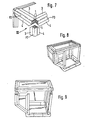
- the essential corners II, III, IV, V and VI each have the corner connector E2, E3, E4, E5, which are designed as one-piece plastic injection-molded parts. or E6, which each consist of polyamide 11 and in the figures Fig. 2-. 6 are shown.
- corner connector E2 is used.
- a corner piece ES2 One could also say corner filling piece, with three arms A1, A2 and A3 extending at right angles from this.
- Fig. 2 shows schematically the assembly of the corner II from the upper profiles P1 and P4 and the vertical profile P5. It can be seen that the arm A2 is inserted into a receptacle 1 located at the end of the profile P1 and the arm A3 is inserted into a corresponding receptacle 1 on the profile P5 up to the stop on the projecting corner piece ES2. A corresponding measure is also taken with respect to the arm A1 and the corresponding accommodation of the profile P4 (not shown). It is a pure plug-in connection with a relatively tight fit, which, however, enables the parts that have been plugged in to be released for repairs.
- the flange strips 3, 4 visible on the profile P1 and cut for fermentation allow a positive connection of the plates B2 and B3 adjacent to the profile P1 in addition to riveting.
- the corner pieces ES2 form the correspondingly rounded plastic corners of the container with a flush, stepless transition from the adjacent profiles such as P1, P4 and P5 to the corner piece ES2.
- Fig. 3 illustrates that the corner piece ES3 of the corner connector E3, not only the function as a core corner piece, from which in this case four arms A1 - A4 can assume, but also that of a sliding cheek 5, for which the shape shown in the drawing two flanges 6, 7 which meet one another essentially at right angles and which have a certain radius and also a certain lead-in chamfer, as required by the IATA.
- strips 8, 9 running at right angles to the flanges 6, 7 are available for bringing about further connections.
- the arm A4 which runs at an oblique angle to the floor, illustrates that even obliquely converging profiles can be easily connected to one another in the manner according to the invention.
- the corner connectors E4 and E6 according to FIGS. 4 and 6 correspond to each other, due to the position of the corners IV and VI assigned to them at the bottom of the container.
- the slide cheek 5 is formed with the flanges 6, 7, and three arms A1, A2 and A3 are available for insertion into the corresponding receptacles of the adjacent profiles. Bars 7, 8 are also available here for further connection options.
- Fig. 7 illustrates the creation of the container frame from the profiles and the associated corner connectors.
- the corner II is only given as an example that the receptacles 1 on the profiles P2, P3 and P7 are produced by cutting them off substantially perpendicular to the profile direction and a miter cut is only necessary on the adjacent flange strips 3, 4.
- Fig. 9 illustrates that the top of the container can be easily removed as a whole, including the associated corner connector, after loosening the corresponding plate fastening, for example for repair or other maintenance purposes. It was pointed out at the beginning that in the simple dismantled. speed to correct damage is a particular advantage of the invention.
- sample container which is only produced to explain the invention and is shown in the drawings, can be produced in all customary container shapes and sizes.
- a profile P14 made of aluminum used for the frame construction partially designed as a hollow profile and shown here in dash-dotted lines, has a receptacle 1 at its end located at a distance from the corner of the pallet.
- the arms A5 and A6 press-fit into the receptacles 1 of the adjacent profiles such as P14 in the assembled state, so that a firm corner connection of the profile frame of the pallet is created.
- the bottom 2a of the pallet which in the present case consists of sheet metal, is fastened to an inner flange 2 of the all-round profiles, of which only the profile P14 is partially shown in the drawing, by riveting.
- a corresponding fastening of the floor corner is made with an inner flange 4a of the corner piece ES7.
- the wall of the receptacle 1 is flush with the surface of the corner piece ES7, the arms A5, A6 of which accordingly spring back inwards for fitting into the receptacle 1.
- the corner piece ES7 which runs over a corner is in turn preferably shaped as a sliding cheek 5.
Landscapes
- Engineering & Computer Science (AREA)
- Mechanical Engineering (AREA)
- Pallets (AREA)
- Lubricants (AREA)
Applications Claiming Priority (4)
| Application Number | Priority Date | Filing Date | Title |
|---|---|---|---|
| DE3409683 | 1984-03-16 | ||
| DE19843409683 DE3409683A1 (de) | 1984-03-16 | 1984-03-16 | Frachtcontainer |
| DE8435273U | 1984-12-01 | ||
| DE19848435273 DE8435273U1 (de) | 1984-12-01 | 1984-12-01 | Palette insbesondere fuer Luftfracht |
Publications (1)
| Publication Number | Publication Date |
|---|---|
| EP0158111A1 true EP0158111A1 (fr) | 1985-10-16 |
Family
ID=25819402
Family Applications (1)
| Application Number | Title | Priority Date | Filing Date |
|---|---|---|---|
| EP85102454A Withdrawn EP0158111A1 (fr) | 1984-03-16 | 1985-03-05 | Récipient pour le stockage ou le transport d'objets ou matériaux comme conteneurs, palettes etc. |
Country Status (3)
| Country | Link |
|---|---|
| EP (1) | EP0158111A1 (fr) |
| AU (1) | AU4000485A (fr) |
| NO (1) | NO851033L (fr) |
Cited By (2)
| Publication number | Priority date | Publication date | Assignee | Title |
|---|---|---|---|---|
| WO1988008821A1 (fr) * | 1987-05-13 | 1988-11-17 | Schweizerische Aluminium Ag | Conteneur de fret pour transports aeriens |
| WO1993022223A1 (fr) * | 1992-04-29 | 1993-11-11 | Royal Ordnance Plc | Ameliorations relatives a des conteneurs amortissant le souffle d'une explosion |
Families Citing this family (1)
| Publication number | Priority date | Publication date | Assignee | Title |
|---|---|---|---|---|
| DE3428109C1 (de) * | 1984-07-30 | 1985-09-19 | Aluminium-Walzwerke Singen Gmbh, 7700 Singen | Frachtbehaelter,insbesondere fuer Lufttransporte |
Citations (2)
| Publication number | Priority date | Publication date | Assignee | Title |
|---|---|---|---|---|
| GB1267809A (en) * | 1968-12-04 | 1972-03-22 | Wilmot Packaging Ltd | Improvements relating to containers |
| GB2026985A (en) * | 1978-08-04 | 1980-02-13 | Alusuisse | Containers for air freight |
-
1985
- 1985-03-05 EP EP85102454A patent/EP0158111A1/fr not_active Withdrawn
- 1985-03-15 NO NO851033A patent/NO851033L/no unknown
- 1985-03-15 AU AU40004/85A patent/AU4000485A/en not_active Abandoned
Patent Citations (2)
| Publication number | Priority date | Publication date | Assignee | Title |
|---|---|---|---|---|
| GB1267809A (en) * | 1968-12-04 | 1972-03-22 | Wilmot Packaging Ltd | Improvements relating to containers |
| GB2026985A (en) * | 1978-08-04 | 1980-02-13 | Alusuisse | Containers for air freight |
Cited By (2)
| Publication number | Priority date | Publication date | Assignee | Title |
|---|---|---|---|---|
| WO1988008821A1 (fr) * | 1987-05-13 | 1988-11-17 | Schweizerische Aluminium Ag | Conteneur de fret pour transports aeriens |
| WO1993022223A1 (fr) * | 1992-04-29 | 1993-11-11 | Royal Ordnance Plc | Ameliorations relatives a des conteneurs amortissant le souffle d'une explosion |
Also Published As
| Publication number | Publication date |
|---|---|
| NO851033L (no) | 1985-09-17 |
| AU4000485A (en) | 1985-09-19 |
Similar Documents
| Publication | Publication Date | Title |
|---|---|---|
| EP2230186B1 (fr) | Palette, notamment euro-palette | |
| DE69206498T2 (de) | Frachtbehälter für Luftfracht. | |
| EP0517755B1 (fr) | Palette de fret aerien | |
| EP0680442B1 (fr) | Systeme de transport et de stockage | |
| WO2012168305A1 (fr) | Contenant de fret destiné en particulier au chargement des avions, et procédé de fabrication d'un tel contenant de fret | |
| DE102012023653A1 (de) | Kraftfahrzeugkarosserie mit Leichtbauteil | |
| EP2637942B1 (fr) | Dispositif auxiliaire de transport notamment pour palettes | |
| DE4317376A1 (de) | Bausatz für Kofferaufbauten | |
| DE102019105689B3 (de) | Untergestell eines Schienenfahrzeuges | |
| EP0158111A1 (fr) | Récipient pour le stockage ou le transport d'objets ou matériaux comme conteneurs, palettes etc. | |
| DE3409683A1 (de) | Frachtcontainer | |
| DE2855564A1 (de) | Werkstueckpalette | |
| EP2524855B1 (fr) | Structure pour un véhicule utilitaire | |
| EP0455875B1 (fr) | Récipient pliable | |
| EP2409934B1 (fr) | Conteneur de fret aérien | |
| DE69621531T2 (de) | Regal, insbesondere für Metallregaleinheiten | |
| DE3875086T2 (de) | Mehrzweck-container. | |
| DE8435273U1 (de) | Palette insbesondere fuer Luftfracht | |
| EP3388317B1 (fr) | Construction de véhicule frigorifique | |
| WO2017182038A2 (fr) | Entretoise de palette en grande partie protégée contre un endommagement | |
| EP3395611A1 (fr) | Rail d'arrimage, espace de chargement, véhicule | |
| EP3753857A1 (fr) | Élément de paroi d'un cadre de rehausse de palette et cadre de rehausse de palette | |
| DE3102146A1 (de) | "umlenkanordnung fuer frachtpaletten" | |
| DE202007001329U1 (de) | Ladungssicherungslattensystem für eine Fahrzeug-, anhänger- oder -aufliegerwand | |
| DE102014109323B4 (de) | Mehrweg-Transportbox |
Legal Events
| Date | Code | Title | Description |
|---|---|---|---|
| PUAI | Public reference made under article 153(3) epc to a published international application that has entered the european phase |
Free format text: ORIGINAL CODE: 0009012 |
|
| AK | Designated contracting states |
Designated state(s): AT BE CH DE FR GB IT LI LU NL SE |
|
| 17P | Request for examination filed |
Effective date: 19860311 |
|
| 17Q | First examination report despatched |
Effective date: 19861006 |
|
| STAA | Information on the status of an ep patent application or granted ep patent |
Free format text: STATUS: THE APPLICATION IS DEEMED TO BE WITHDRAWN |
|
| 18D | Application deemed to be withdrawn |
Effective date: 19870217 |
|
| RIN1 | Information on inventor provided before grant (corrected) |
Inventor name: RUST, HARALD, DIPL.-ING. |