EP0158341A2 - Appareil pour le formage en continu des embouts de tubes en matière thermoplastique extrudés - Google Patents
Appareil pour le formage en continu des embouts de tubes en matière thermoplastique extrudés Download PDFInfo
- Publication number
- EP0158341A2 EP0158341A2 EP85104347A EP85104347A EP0158341A2 EP 0158341 A2 EP0158341 A2 EP 0158341A2 EP 85104347 A EP85104347 A EP 85104347A EP 85104347 A EP85104347 A EP 85104347A EP 0158341 A2 EP0158341 A2 EP 0158341A2
- Authority
- EP
- European Patent Office
- Prior art keywords
- workpiece carrier
- push rods
- shaft
- auf
- der
- Prior art date
- Legal status (The legal status is an assumption and is not a legal conclusion. Google has not performed a legal analysis and makes no representation as to the accuracy of the status listed.)
- Granted
Links
Images

Classifications
-
- B—PERFORMING OPERATIONS; TRANSPORTING
- B29—WORKING OF PLASTICS; WORKING OF SUBSTANCES IN A PLASTIC STATE IN GENERAL
- B29C—SHAPING OR JOINING OF PLASTICS; SHAPING OF MATERIAL IN A PLASTIC STATE, NOT OTHERWISE PROVIDED FOR; AFTER-TREATMENT OF THE SHAPED PRODUCTS, e.g. REPAIRING
- B29C57/00—Shaping of tube ends, e.g. flanging, belling or closing; Apparatus therefor, e.g. collapsible mandrels
- B29C57/10—Closing
-
- B—PERFORMING OPERATIONS; TRANSPORTING
- B29—WORKING OF PLASTICS; WORKING OF SUBSTANCES IN A PLASTIC STATE IN GENERAL
- B29B—PREPARATION OR PRETREATMENT OF THE MATERIAL TO BE SHAPED; MAKING GRANULES OR PREFORMS; RECOVERY OF PLASTICS OR OTHER CONSTITUENTS OF WASTE MATERIAL CONTAINING PLASTICS
- B29B13/00—Conditioning or physical treatment of the material to be shaped
- B29B13/02—Conditioning or physical treatment of the material to be shaped by heating
- B29B13/023—Half-products, e.g. films, plates
- B29B13/024—Hollow bodies, e.g. tubes or profiles
- B29B13/025—Tube ends
-
- B—PERFORMING OPERATIONS; TRANSPORTING
- B29—WORKING OF PLASTICS; WORKING OF SUBSTANCES IN A PLASTIC STATE IN GENERAL
- B29C—SHAPING OR JOINING OF PLASTICS; SHAPING OF MATERIAL IN A PLASTIC STATE, NOT OTHERWISE PROVIDED FOR; AFTER-TREATMENT OF THE SHAPED PRODUCTS, e.g. REPAIRING
- B29C31/00—Handling, e.g. feeding of the material to be shaped, storage of plastics material before moulding; Automation, i.e. automated handling lines in plastics processing plants, e.g. using manipulators or robots
- B29C31/002—Handling tubes, e.g. transferring between shaping stations, loading on mandrels
-
- B—PERFORMING OPERATIONS; TRANSPORTING
- B29—WORKING OF PLASTICS; WORKING OF SUBSTANCES IN A PLASTIC STATE IN GENERAL
- B29C—SHAPING OR JOINING OF PLASTICS; SHAPING OF MATERIAL IN A PLASTIC STATE, NOT OTHERWISE PROVIDED FOR; AFTER-TREATMENT OF THE SHAPED PRODUCTS, e.g. REPAIRING
- B29C57/00—Shaping of tube ends, e.g. flanging, belling or closing; Apparatus therefor, e.g. collapsible mandrels
-
- B—PERFORMING OPERATIONS; TRANSPORTING
- B29—WORKING OF PLASTICS; WORKING OF SUBSTANCES IN A PLASTIC STATE IN GENERAL
- B29L—INDEXING SCHEME ASSOCIATED WITH SUBCLASS B29C, RELATING TO PARTICULAR ARTICLES
- B29L2023/00—Tubular articles
- B29L2023/22—Tubes or pipes, i.e. rigid
Definitions
- the present invention relates to a device for molding one end of extruded pipe sections or sleeves made of thermoplastic material.
- Extruded pipe sections made of thermoplastic material can be formed using heat and pressure to produce shafts for the production of writing utensils such as felt pens, ballpoint pens, mechanical pencils, but also for pipettes, toothpaste dispensers etc.
- a basic possibility for the production of such workpieces is that a The mandrel or core is inserted into the extruded tube section to be formed and at the same time one end is inserted into a molding tool, the workpiece being given the desired shape under the action of heat and pressure.
- DE-OS 18 08 037 is a generic machine. described for forming socket ends on thermoplastic pipes; it consists of a rotating workpiece carrier which is formed from disks provided with recesses. The disks are attached to a shaft that is supported and driven in side parts. Heating devices for heating the plastic pipe ends and molding tools for molding the pipe ends are arranged in the machine so as to be displaceable parallel to the drive shaft. The heating devices can rotate on turret wheels, it being possible for either the entire turret wheels or the individual heating devices on the turret wheels to be axially displaceable. This machine works intermittently, which is mainly due to the independent heating and molding devices.
- a mandrel provided with a stop collar penetrates into the pipe end to be swaged in the pipe held in a multi-part die.
- a die part in the form of an upsetting sleeve is movable with the mandrel and slides over the pipe end in such a way that the material of the pipe wall presses between the sleeve and the mandrel during the upsetting process.
- DE-AS 17 04 124 describes and shows a method and a device for molding a base at the end of a thermoplastic plastic tube.
- the device consists of a mandrel carrying or receiving the tube and a first preform and a second finished form die. Matrices and mandrel are axially movable relative to each other.
- an end of the tube protruding from the mandrel is heated and pressed into the preforming die in this deformable state.
- the preformed tube end is then pressed into the finished form die under high pressure and cooled in the process.
- the die of the preform can also be cooled, it has a cooling channel. The cooling is used here to prevent the molded part from melting on the molding tool.
- DE-PS 927 063 describes a device for upsetting pipe ends and partially. shown; it shows a compression mandrel with a (compression) sleeve serving as a molding tool.
- the tube to be upset is held in a die, the front tube end being exposed in a recess in the die.
- the mandrel moves into the pipe end, with the sleeve reaching over the pipe.
- Mandrel and sleeve are movable relative to each other. If the sleeve comes to a stop with the die, the material of the pipe end between the sleeve and the mandrel is pressed as the mandrel moves.
- the invention enables time-saving continuous production of such shaped plastic tube sections, since the special design of the device enables rapid successive heating and pressure application with subsequent holding and cooling, as will be described in more detail below.
- the centerpiece of the device according to the invention is a disc-shaped workpiece carrier provided on a continuously driven central shaft, on the cylindrical periphery of which a number of recesses or grooves running in the direction of the shaft and having a semicircular cross section are provided for receiving individual workpieces, for example plastic pipe sections here.
- Each such groove (machining station) are axially on it aligned machining tools assigned, i.e.
- a core or mandrel that can be moved axially in the direction of the workpiece and on the other side a forming tool (nest) that can also be moved axially in the direction of the workpiece with an associated heating element, which in turn is provided by the Nest can be axially moved away in order to be able to directly expose the latter to the action of cooling water.
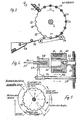
- F ig. 1 shows a basic illustration of a central shaft 4 mounted in a frame or frame 2, which is continuously driven by an electric motor 6 by means of a chain drive 8 - for example at a speed of approximately 2 rpm.
- a disk-shaped workpiece carrier 10 is provided, which has on its cylindrical outer circumference a series of recesses 12 or grooves which run in the direction of the shaft and have an approximately semicircular cross section and which are provided for receiving individual plastic pipe sections 14 to be machined .
- 16 such recesses can be provided on the circumference for receiving the individual workpieces.
- these recesses 12 are referred to as processing stations.
- two disks 16, 18 rigidly connected to the central axis are provided on the central shaft at a distance from one another, which disks serve for axially parallel guidance of cam-controlled push rods 20, which are axially aligned with the individual processing stations 12 in the disk-shaped workpiece carrier 10.
- These push rods are acted upon by springs 22 in one direction away from the disk-shaped workpiece carrier and are displaced against this spring force by providing rollers 24 on the end of the individual push rods remote from the disk-shaped workpiece carrier, said rollers being arranged on a circular one arranged on the side part 26 of the frame of the device Roll the cam track 28 with a variable height in the axial direction of the central shaft 4.
- a mandrel or core 30 is provided, which can be inserted into the workpieces (ie the plastic tube sections).
- two guide disks 32, 34 are likewise rigidly arranged on the central shaft 4 at a distance from one another. Similar to those described above, these guide disks are used for axially parallel guidance of two groups of push rods 36, 38, which are arranged concentrically with the central axis 4 and acted upon by springs 40 away from the workpiece carrier.
- Each pushing station 12 (in FIG. 1 on the right side) is assigned two push rods 36, 38, ie in the concrete off guidance example a total of 16 inner and 16 outer push rods, which in turn are each controlled by curved tracks 42, 44.
- the inner push rod 38 assigned to a specific machining station has a cantilever 64 on the end facing the disk-shaped workpiece carrier, on which the molding tool or nest 48 is arranged such that it is axially aligned with the associated machining station.
- the corresponding outer push rod 36 is provided on its side facing the disk-shaped workpiece carrier with a heating element 50, which can tightly grip around the nest 48, so that good heat transfer from the heating element to the nest or molding tool 48 is possible.
- the circular curved tracks 42, 44 which are assigned to the inner and the outer push rods 36, 38, the latter are reciprocated in a time sequence to be described in the axial direction moved to form the plastic pipe sections 14 in the interaction between the respective dies 48 and cores 30 in the desired manner.
- the disc-shaped workpiece carrier 10 is shown in a view from the right (in Figure 1), the di Direction of rotation is indicated by the arrow in the clockwise direction.
- the plastic pipe sections 14 to be machined are brought to the cylindrical periphery of the disk-shaped workpiece carrier by a separating device (not shown in more detail) via an approximately radial chute 52 in an axis-parallel orientation to the shaft 4, where the foremost pipe section falls into a machining station in the form of the groove-shaped recess 12 .
- each plastic tube section initially remains in the groove-shaped recess of each processing station as a result of gravity.
- the core 30 belonging to the respective processing station begins to move into the plastic pipe section due to the shape of the curved path 28 and moves this in the direction of this movement on the nest 48 ready for recording, which has already been preheated by the radiator 50.
- the core is just the length of the finished plastic sleeve and is closed off from the associated push rod 20 by a collar 21 which bears at one end when the core is inserted into the tube section.
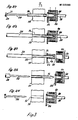
- Figure 3 shows five different working positions 3/1 to 3/5 of the aforementioned tools, in the order of the work steps for forming the workpiece.
- Figure 3/1 shows the relative position of the tools mentioned when applying the workpiece to the workpiece carrier; this is the starting position.
- Figure 3/2 shows the relative position of the core 30, the workpiece carrier 10, the nest 48 and the radiator 50 in their working position. The core 30 is advanced so far that it has moved into the nest 48 with the workpiece 14; the front part of the workpiece is formed here under the influence of pressure and heat.
- the radiator is pulled off the nest (molding tool), the radiator being retracted in a controlled manner by the outer cam track 42 so that the nest is exposed which is then sprayed with cooling water.
- the relative position of the core or mandrel and nest in relation to the workpiece carrier is unchanged compared to Fig. 3/2.
- This phase of the processing of the plastic tube serves to "hold", ie to apply pressure and to cool the previously heated thermoplastic material so that it changes back into a solid physical state.
- This "hold” lasts until the one under consideration Processing station with the workpiece 14 held therein comes into the area of the conveyor belt 54, which is arranged in FIG. 2 in the lower area of the disk-shaped workpiece carrier (on both sides of the bottom dead center UT).
- This conveyor belt lies with its upper run on the workpiece carrier or on the workpieces and serves to clamp or hold the finished workpieces between the workpiece carrier and the conveyor belt so that the core / mandrel and the nest can be moved away from the finished workpiece , so that the latter is exposed - compare Figure 3/4.
- the workpiece is thus clamped between the cylindrical workpiece carrier and the conveyor belt 54 and the nest and the core move away from the workpiece.
- the finished workpiece falls down due to gravity via a chute 56 into a simple collecting container 58 which has to be emptied from time to time.
- the nest 48 and the heating element 50 are started by the pushrods controlled by the cam tracks 42, 44 to move back towards the workpiece carrier 10 in order to assume the starting position in the vicinity of the workpiece carrier and thus be prepared for the next machining cycle.
- This State is shown in Figure 3/5.
- the processing cycle shown begins anew.
- the radiator can be moved in the axial direction independently of the nest. As shown in Figure 3/3, the nest is exposed briefly during the machining cycle, so that a rapid change in temperature of the nest and thus of the workpiece can be achieved using cooling water. As soon as sufficient cooling and thus solidification of the thermoplastic material has been achieved, the then cooled nest is moved back into the corresponding recess 66 in the radiator which has already been axially moved away, so that the nest can be heated again (as shown in Fig. 3/4) to gradually bring the nest back to the necessary forming temperature for the next machining cycle.
- the push rod-controlled axial movements of the core, mold or heating element can be described as follows.
- “Forward” means towards the workpiece carrier, while “backward” or “back” means away from the workpiece carrier.
- the core 30 begins to move about 20 ° to 30 ° before top dead center (FIG. 2) into the workpiece inserted into the workpiece carrier and has reached the frontmost position about 45 ° after top dead center, which is shown, for example, in FIG. 3/2.
- the collar 21 on the core 30 simultaneously presses the workpiece into the nest heated by the radiator.
- the core remains in this position up to approx. 160 ° from top dead center, i.e. until after reaching the conveyor belt 54, then moves back to the completely retracted starting position and remains in this position up to approx. 340 °, ie approx. 20 ° before top dead center.
- Each molding tool is located from a rotary position shortly after passing the conveyor belt 54 (at approx. 210 ° from top dead center) until shortly after passing the start of the conveyor belt arrangement in the foremost position directly on the workpiece carrier 10. Only in the area of the conveyor belt is the nest in the retracted position, as shown in Fig. 3/4. This position of the nest is necessary in order to release the finished workpiece and to let it fall freely out of the workpiece carrier at the end of the conveyor belt arrangement.
- the radiators 50 which are preferably continuously heated by means of electrical resistors 60, are in direct contact with the workpiece carrier for most of a revolution the nest to warm it up or keep it at the necessary forming temperature. Only in the area from about 90 ° from top dead center, where the cooling of the nest with cooling water begins, up to about 180 ° from top dead center, the radiator and nest are separated from one another, ie in this rotational angle position of the device, the nest 48 controlled by the cam track 44 moves in the already retracted radiator back (Fig. 3/4), followed drive (from about 210 °) nest and radiator together forwardly in the direction of the workpiece carrier to the required for the new machining cycle forward initial position take (F ig. 3 / 5 or Fig. 3/1).
- the heating of the molds by the radiator takes place approximately from the bottom dead center to approximately 90 ° after the top dead center, i.e. over a total of approximately three quarters of the rotary movement, and at approximately 90 ° the radiator is moved away from the mold to the rear in order to access the cooling water to provide for the nest, which acts on the nest in the rotation angle range of approximately 90 ° to 180 °.
- the basic machining cycle of a workpiece illustrated above with reference to a machining station runs continuously and at the same time slightly out of phase at all machining stations, the The number of existing processing stations is determined only by the A b dimensions of the device.
- a specific exemplary embodiment of this device has, for example, 16 processing stations, the processing speed of the device being approximately 2 rpm.
- radiator 50 is electrically heated. However, this is only one way of generating the necessary heat of fusion in the pipe section made of thermoplastic material. Other types of heating are easily conceivable. So it is among other things conceivable to heat the plastic directly using ultrasound, as is known in the prior art.
- the push rods 36 and 38 - but also 20 - are provided with a surface 62, so that the rollers 24 of the push rods bearing on the cam tracks 28, 42 and 44 (FIG. 1) during the rotational movement of the shaft 4 and thus all tools are always directed tangentially to the cam track.
Landscapes
- Engineering & Computer Science (AREA)
- Mechanical Engineering (AREA)
- Robotics (AREA)
- Physics & Mathematics (AREA)
- Thermal Sciences (AREA)
- Shaping Of Tube Ends By Bending Or Straightening (AREA)
- Extrusion Moulding Of Plastics Or The Like (AREA)
Priority Applications (1)
| Application Number | Priority Date | Filing Date | Title |
|---|---|---|---|
| AT85104347T ATE35522T1 (de) | 1984-04-10 | 1985-04-10 | Kontinuierlich arbeitende vorrichtung zum formen eines endes von aus thermoplastischem kunststoff extrudierten rohrabschnitten. |
Applications Claiming Priority (2)
| Application Number | Priority Date | Filing Date | Title |
|---|---|---|---|
| DE19843413532 DE3413532A1 (de) | 1984-04-10 | 1984-04-10 | Kontinuierlich arbeitende vorrichtung zum umformen eines endes von extrudierten rohrabschnitten aus thermoplastischem kunststoff |
| DE3413532 | 1984-04-10 |
Publications (3)
| Publication Number | Publication Date |
|---|---|
| EP0158341A2 true EP0158341A2 (fr) | 1985-10-16 |
| EP0158341A3 EP0158341A3 (en) | 1986-04-09 |
| EP0158341B1 EP0158341B1 (fr) | 1988-07-06 |
Family
ID=6233201
Family Applications (1)
| Application Number | Title | Priority Date | Filing Date |
|---|---|---|---|
| EP85104347A Expired EP0158341B1 (fr) | 1984-04-10 | 1985-04-10 | Appareil pour le formage en continu des embouts de tubes en matière thermoplastique extrudés |
Country Status (3)
| Country | Link |
|---|---|
| EP (1) | EP0158341B1 (fr) |
| AT (1) | ATE35522T1 (fr) |
| DE (2) | DE3413532A1 (fr) |
Cited By (4)
| Publication number | Priority date | Publication date | Assignee | Title |
|---|---|---|---|---|
| WO1988009262A1 (fr) * | 1987-05-27 | 1988-12-01 | Mb Group Plc | Procedes et appareil servant a rabattre les bords d'articles polymeres tubulaires |
| FR2719249A1 (fr) * | 1994-05-02 | 1995-11-03 | Cagnon Sa | Procédé d'implantation d'inserts métalliques dans une pièce en matière plastique et dispositif. |
| CN110239068A (zh) * | 2019-07-15 | 2019-09-17 | 浙江甬源塑业有限公司 | 一种塑料管弯管设备的弯管装置 |
| CN110239067A (zh) * | 2019-07-15 | 2019-09-17 | 浙江甬源塑业有限公司 | 一种立式塑料管弯管设备 |
Families Citing this family (1)
| Publication number | Priority date | Publication date | Assignee | Title |
|---|---|---|---|---|
| BE1016664A3 (nl) * | 2005-06-30 | 2007-04-03 | Indurub Nv | Werkwijze en inrichting voor het vervaardigen van kurken uit kunststof. |
Family Cites Families (15)
| Publication number | Priority date | Publication date | Assignee | Title |
|---|---|---|---|---|
| DE927063C (de) * | 1952-11-22 | 1955-04-28 | Rheinische Roehrenwerke Ag | Vorrichtung zum Anstauchen von Rohrenden |
| FR1083422A (fr) * | 1954-01-18 | 1955-01-10 | Tubophane S A R L | Procédé et installation pour fabriquer des fonds de tubesten matière plastique |
| FR1192934A (fr) * | 1957-06-07 | 1959-10-29 | Pechiney | Manchonnage des tubes en matières plastiques |
| NL293317A (fr) * | 1962-05-28 | |||
| FR1491328A (fr) * | 1966-05-24 | 1967-08-11 | Isotube | Procédé de soudure par matriçage de fond de tube en matière thermoplastique |
| DE1284079C2 (de) * | 1966-08-16 | 1973-11-22 | Nordrohr Werke Kg | Maschine zum Formen von Muffenenden an Rohren aus thermoplastischem Kunststoff |
| US3493998A (en) * | 1967-06-02 | 1970-02-10 | Flexible Plastic Straw Corp | Machine for forming a flexible area in tubular plastic resinous drinking straws |
| US4035463A (en) * | 1968-01-16 | 1977-07-12 | Heidenreich & Harbeck | Method of making hollow articles, especially bottles, of thermoplastics |
| US3641884A (en) * | 1969-07-07 | 1972-02-15 | Anton Jivoin | Manufacturing flexible drinking straws |
| GB1276337A (en) * | 1969-09-25 | 1972-06-01 | Lev Nikolaevich Koshkin | Automatic continuous machine |
| JPS5839870Y2 (ja) * | 1976-09-14 | 1983-09-08 | 花王株式会社 | 棒状樹脂の先端加工装置 |
| DE2855298A1 (de) * | 1977-12-27 | 1979-07-05 | Bassan & Cie | Verfahren und vorrichtung zur herstellung von rohrfoermigen duebeln aus thermoplastischem material |
| US4285904A (en) * | 1978-06-05 | 1981-08-25 | Beckman Instruments, Inc. | Method and apparatus for sealing centrifuge tubes |
| US4302174A (en) * | 1979-11-13 | 1981-11-24 | Hauni-Richmond, Inc. | Arrangement for closing the barrels of tampon inserters |
| US4404159A (en) * | 1981-03-16 | 1983-09-13 | Mcfarlane Richard H | Apparatus and process for forming a tapered tip end on a plastic tube |
-
1984
- 1984-04-10 DE DE19843413532 patent/DE3413532A1/de not_active Withdrawn
-
1985
- 1985-04-10 DE DE8585104347T patent/DE3563598D1/de not_active Expired
- 1985-04-10 EP EP85104347A patent/EP0158341B1/fr not_active Expired
- 1985-04-10 AT AT85104347T patent/ATE35522T1/de not_active IP Right Cessation
Cited By (5)
| Publication number | Priority date | Publication date | Assignee | Title |
|---|---|---|---|---|
| WO1988009262A1 (fr) * | 1987-05-27 | 1988-12-01 | Mb Group Plc | Procedes et appareil servant a rabattre les bords d'articles polymeres tubulaires |
| EP0293162B1 (fr) * | 1987-05-27 | 1991-09-11 | CMB Foodcan plc | Procédé et dispositif pour le bordage d'objets tubulaires en matière polymère |
| FR2719249A1 (fr) * | 1994-05-02 | 1995-11-03 | Cagnon Sa | Procédé d'implantation d'inserts métalliques dans une pièce en matière plastique et dispositif. |
| CN110239068A (zh) * | 2019-07-15 | 2019-09-17 | 浙江甬源塑业有限公司 | 一种塑料管弯管设备的弯管装置 |
| CN110239067A (zh) * | 2019-07-15 | 2019-09-17 | 浙江甬源塑业有限公司 | 一种立式塑料管弯管设备 |
Also Published As
| Publication number | Publication date |
|---|---|
| EP0158341B1 (fr) | 1988-07-06 |
| EP0158341A3 (en) | 1986-04-09 |
| ATE35522T1 (de) | 1988-07-15 |
| DE3413532A1 (de) | 1985-10-17 |
| DE3563598D1 (en) | 1988-08-11 |
Similar Documents
| Publication | Publication Date | Title |
|---|---|---|
| DE1604702C3 (de) | Vorrichtung zum Herstellen von Ver packungsbehaltern aus zwei Hohlkörpern | |
| DE19914974A1 (de) | Wechselcorrugator | |
| DE1602291C3 (de) | Dornwechselvorrichtung an einer Metallstrangpresse | |
| EP0158341B1 (fr) | Appareil pour le formage en continu des embouts de tubes en matière thermoplastique extrudés | |
| DE69020038T2 (de) | Verfahren und Vorrichtung zur Formgebung eines vorgefertigten Kunststoffbehälters. | |
| EP0111687B1 (fr) | Méthode de fabrication d'une bague de segments de commutateur | |
| DE2555697B2 (de) | Verfahren zum Herstellen von Doppelkontaktnieten | |
| DE2038681A1 (de) | Maschine zur Herstellung von geschweissten Lagern u.dgl. | |
| WO2016083086A1 (fr) | Dispositif et procédé de fluotournage de pièces | |
| DE534390C (de) | Maschine mit umlaufenden Schlagbacken zum Umformen von Metallrohren | |
| DE2154912C3 (de) | Automatische Schnellpresse | |
| DE531266C (de) | Selbsttaetige Maschine zum Herstellen von Ampullen aus abgepassten Glasrohren | |
| DE19716383C2 (de) | Verfahren zur Herstellung von rotationssymmetrischen Hohlkörpern | |
| DE69419206T2 (de) | Verfahren und Vorrichtung zum Herstellen eines metallischen Teils | |
| WO2015135084A1 (fr) | Dispositif et procédé de fabrication d'un arbre fonctionnel | |
| EP0279014A1 (fr) | Procédé pour la fabrication de tiges comportant au moins un épaississement à une extrémité | |
| DE877689C (de) | Rohrbearbeitungsmaschine | |
| CH469520A (de) | Drehautomat | |
| DE2709572A1 (de) | Vorrichtung zur kontinuierlichen herstellung orientierter hohlkoerper aus thermoplastischem material | |
| DE3704946A1 (de) | Verfahren zur herstellung von stangenfoermigen koerpern mit mindestens einer einseitigen endverdickung sowie einrichtung hierzu | |
| DE2323590C3 (de) | Vorrichtung zum Umbiegen der Enden von thermoplastischen Nutisolierungen bei Statoren elektrischer Maschinen | |
| DE2519521A1 (de) | Ziehverfahren und ziehpresse zur verfahrensdurchfuehrung zur herstellung von gezogenen hohlkoerpern | |
| DE963954C (de) | Einrichtung zum Zu- und Abfuehren von Werkstuecken in einer zum Herstellen von Stiftschrauben bestimmten Aufbaueinheit | |
| DE1167003B (de) | Vorrichtung zur vollautomatischen Tubenherstellung aus thermoplastischen Kunststoffen | |
| DE1808037A1 (de) | Maschine zur Formung von Muffenenden an thermoplastischen Kunststoffrohren |
Legal Events
| Date | Code | Title | Description |
|---|---|---|---|
| PUAI | Public reference made under article 153(3) epc to a published international application that has entered the european phase |
Free format text: ORIGINAL CODE: 0009012 |
|
| AK | Designated contracting states |
Designated state(s): AT BE CH DE FR GB IT LI LU NL SE |
|
| PUAL | Search report despatched |
Free format text: ORIGINAL CODE: 0009013 |
|
| AK | Designated contracting states |
Kind code of ref document: A3 Designated state(s): AT BE CH DE FR GB IT LI LU NL SE |
|
| 17P | Request for examination filed |
Effective date: 19860509 |
|
| 17Q | First examination report despatched |
Effective date: 19870626 |
|
| GRAA | (expected) grant |
Free format text: ORIGINAL CODE: 0009210 |
|
| AK | Designated contracting states |
Kind code of ref document: B1 Designated state(s): AT BE CH DE FR GB IT LI LU NL SE |
|
| ITF | It: translation for a ep patent filed | ||
| PG25 | Lapsed in a contracting state [announced via postgrant information from national office to epo] |
Ref country code: SE Effective date: 19880706 Ref country code: NL Effective date: 19880706 |
|
| REF | Corresponds to: |
Ref document number: 35522 Country of ref document: AT Date of ref document: 19880715 Kind code of ref document: T |
|
| GBT | Gb: translation of ep patent filed (gb section 77(6)(a)/1977) | ||
| REF | Corresponds to: |
Ref document number: 3563598 Country of ref document: DE Date of ref document: 19880811 |
|
| ET | Fr: translation filed | ||
| NLV1 | Nl: lapsed or annulled due to failure to fulfill the requirements of art. 29p and 29m of the patents act | ||
| PGFP | Annual fee paid to national office [announced via postgrant information from national office to epo] |
Ref country code: GB Payment date: 19890331 Year of fee payment: 5 |
|
| PG25 | Lapsed in a contracting state [announced via postgrant information from national office to epo] |
Ref country code: AT Effective date: 19890410 |
|
| PGFP | Annual fee paid to national office [announced via postgrant information from national office to epo] |
Ref country code: FR Payment date: 19890413 Year of fee payment: 5 |
|
| ITTA | It: last paid annual fee | ||
| PG25 | Lapsed in a contracting state [announced via postgrant information from national office to epo] |
Ref country code: LU Free format text: LAPSE BECAUSE OF NON-PAYMENT OF DUE FEES Effective date: 19890430 |
|
| PLBE | No opposition filed within time limit |
Free format text: ORIGINAL CODE: 0009261 |
|
| STAA | Information on the status of an ep patent application or granted ep patent |
Free format text: STATUS: NO OPPOSITION FILED WITHIN TIME LIMIT |
|
| PGFP | Annual fee paid to national office [announced via postgrant information from national office to epo] |
Ref country code: BE Payment date: 19890523 Year of fee payment: 5 |
|
| PGFP | Annual fee paid to national office [announced via postgrant information from national office to epo] |
Ref country code: DE Payment date: 19890626 Year of fee payment: 5 |
|
| 26N | No opposition filed | ||
| PGFP | Annual fee paid to national office [announced via postgrant information from national office to epo] |
Ref country code: CH Payment date: 19890717 Year of fee payment: 5 |
|
| PG25 | Lapsed in a contracting state [announced via postgrant information from national office to epo] |
Ref country code: GB Effective date: 19900410 |
|
| PG25 | Lapsed in a contracting state [announced via postgrant information from national office to epo] |
Ref country code: LI Effective date: 19900430 Ref country code: CH Effective date: 19900430 Ref country code: BE Effective date: 19900430 |
|
| BERE | Be: lapsed |
Owner name: GEH-KUNSTSTOFFWERK K.G. Effective date: 19900430 |
|
| GBPC | Gb: european patent ceased through non-payment of renewal fee | ||
| PG25 | Lapsed in a contracting state [announced via postgrant information from national office to epo] |
Ref country code: FR Effective date: 19901228 |
|
| REG | Reference to a national code |
Ref country code: CH Ref legal event code: PL |
|
| PG25 | Lapsed in a contracting state [announced via postgrant information from national office to epo] |
Ref country code: DE Effective date: 19910101 |
|
| REG | Reference to a national code |
Ref country code: FR Ref legal event code: ST |