EP0158536A2 - Verfahren und Einrichtung zur Herstellung von leitenden Mustern auf einem Substrat - Google Patents
Verfahren und Einrichtung zur Herstellung von leitenden Mustern auf einem Substrat Download PDFInfo
- Publication number
- EP0158536A2 EP0158536A2 EP85302477A EP85302477A EP0158536A2 EP 0158536 A2 EP0158536 A2 EP 0158536A2 EP 85302477 A EP85302477 A EP 85302477A EP 85302477 A EP85302477 A EP 85302477A EP 0158536 A2 EP0158536 A2 EP 0158536A2
- Authority
- EP
- European Patent Office
- Prior art keywords
- electrically conductive
- conductive material
- gold
- layer
- silver
- Prior art date
- Legal status (The legal status is an assumption and is not a legal conclusion. Google has not performed a legal analysis and makes no representation as to the accuracy of the status listed.)
- Granted
Links
Images


Classifications
-
- C—CHEMISTRY; METALLURGY
- C23—COATING METALLIC MATERIAL; COATING MATERIAL WITH METALLIC MATERIAL; CHEMICAL SURFACE TREATMENT; DIFFUSION TREATMENT OF METALLIC MATERIAL; COATING BY VACUUM EVAPORATION, BY SPUTTERING, BY ION IMPLANTATION OR BY CHEMICAL VAPOUR DEPOSITION, IN GENERAL; INHIBITING CORROSION OF METALLIC MATERIAL OR INCRUSTATION IN GENERAL
- C23F—NON-MECHANICAL REMOVAL OF METALLIC MATERIAL FROM SURFACE; INHIBITING CORROSION OF METALLIC MATERIAL OR INCRUSTATION IN GENERAL; MULTI-STEP PROCESSES FOR SURFACE TREATMENT OF METALLIC MATERIAL INVOLVING AT LEAST ONE PROCESS PROVIDED FOR IN CLASS C23 AND AT LEAST ONE PROCESS COVERED BY SUBCLASS C21D OR C22F OR CLASS C25
- C23F4/00—Processes for removing metallic material from surfaces, not provided for in group C23F1/00 or C23F3/00
- C23F4/04—Processes for removing metallic material from surfaces, not provided for in group C23F1/00 or C23F3/00 by physical dissolution
-
- C—CHEMISTRY; METALLURGY
- C23—COATING METALLIC MATERIAL; COATING MATERIAL WITH METALLIC MATERIAL; CHEMICAL SURFACE TREATMENT; DIFFUSION TREATMENT OF METALLIC MATERIAL; COATING BY VACUUM EVAPORATION, BY SPUTTERING, BY ION IMPLANTATION OR BY CHEMICAL VAPOUR DEPOSITION, IN GENERAL; INHIBITING CORROSION OF METALLIC MATERIAL OR INCRUSTATION IN GENERAL
- C23C—COATING METALLIC MATERIAL; COATING MATERIAL WITH METALLIC MATERIAL; SURFACE TREATMENT OF METALLIC MATERIAL BY DIFFUSION INTO THE SURFACE, BY CHEMICAL CONVERSION OR SUBSTITUTION; COATING BY VACUUM EVAPORATION, BY SPUTTERING, BY ION IMPLANTATION OR BY CHEMICAL VAPOUR DEPOSITION, IN GENERAL
- C23C2/00—Hot-dipping or immersion processes for applying the coating material in the molten state without affecting the shape; Apparatus therefor
- C23C2/02—Pretreatment of the material to be coated, e.g. for coating on selected surface areas
-
- H—ELECTRICITY
- H05—ELECTRIC TECHNIQUES NOT OTHERWISE PROVIDED FOR
- H05K—PRINTED CIRCUITS; CASINGS OR CONSTRUCTIONAL DETAILS OF ELECTRIC APPARATUS; MANUFACTURE OF ASSEMBLAGES OF ELECTRICAL COMPONENTS
- H05K3/00—Apparatus or processes for manufacturing printed circuits
- H05K3/10—Apparatus or processes for manufacturing printed circuits in which conductive material is applied to the insulating support in such a manner as to form the desired conductive pattern
- H05K3/108—Apparatus or processes for manufacturing printed circuits in which conductive material is applied to the insulating support in such a manner as to form the desired conductive pattern by semi-additive methods; masks therefor
-
- H—ELECTRICITY
- H05—ELECTRIC TECHNIQUES NOT OTHERWISE PROVIDED FOR
- H05K—PRINTED CIRCUITS; CASINGS OR CONSTRUCTIONAL DETAILS OF ELECTRIC APPARATUS; MANUFACTURE OF ASSEMBLAGES OF ELECTRICAL COMPONENTS
- H05K3/00—Apparatus or processes for manufacturing printed circuits
- H05K3/30—Assembling printed circuits with electric components, e.g. with resistors
- H05K3/32—Assembling printed circuits with electric components, e.g. with resistors electrically connecting electric components or wires to printed circuits
- H05K3/34—Assembling printed circuits with electric components, e.g. with resistors electrically connecting electric components or wires to printed circuits by soldering
- H05K3/3465—Application of solder
- H05K3/3468—Application of molten solder, e.g. dip soldering
-
- H—ELECTRICITY
- H05—ELECTRIC TECHNIQUES NOT OTHERWISE PROVIDED FOR
- H05K—PRINTED CIRCUITS; CASINGS OR CONSTRUCTIONAL DETAILS OF ELECTRIC APPARATUS; MANUFACTURE OF ASSEMBLAGES OF ELECTRICAL COMPONENTS
- H05K2201/00—Indexing scheme relating to printed circuits covered by H05K1/00
- H05K2201/03—Conductive materials
- H05K2201/0302—Properties and characteristics in general
- H05K2201/0305—Solder used for other purposes than connections between PCB or components, e.g. for filling vias or for programmable patterns
-
- H—ELECTRICITY
- H05—ELECTRIC TECHNIQUES NOT OTHERWISE PROVIDED FOR
- H05K—PRINTED CIRCUITS; CASINGS OR CONSTRUCTIONAL DETAILS OF ELECTRIC APPARATUS; MANUFACTURE OF ASSEMBLAGES OF ELECTRICAL COMPONENTS
- H05K2203/00—Indexing scheme relating to apparatus or processes for manufacturing printed circuits covered by H05K3/00
- H05K2203/04—Soldering or other types of metallurgic bonding
- H05K2203/044—Solder dip coating, i.e. coating printed conductors, e.g. pads by dipping in molten solder or by wave soldering
-
- H—ELECTRICITY
- H05—ELECTRIC TECHNIQUES NOT OTHERWISE PROVIDED FOR
- H05K—PRINTED CIRCUITS; CASINGS OR CONSTRUCTIONAL DETAILS OF ELECTRIC APPARATUS; MANUFACTURE OF ASSEMBLAGES OF ELECTRICAL COMPONENTS
- H05K2203/00—Indexing scheme relating to apparatus or processes for manufacturing printed circuits covered by H05K3/00
- H05K2203/07—Treatments involving liquids, e.g. plating, rinsing
- H05K2203/0703—Plating
- H05K2203/0723—Electroplating, e.g. finish plating
-
- H—ELECTRICITY
- H05—ELECTRIC TECHNIQUES NOT OTHERWISE PROVIDED FOR
- H05K—PRINTED CIRCUITS; CASINGS OR CONSTRUCTIONAL DETAILS OF ELECTRIC APPARATUS; MANUFACTURE OF ASSEMBLAGES OF ELECTRICAL COMPONENTS
- H05K3/00—Apparatus or processes for manufacturing printed circuits
- H05K3/02—Apparatus or processes for manufacturing printed circuits in which the conductive material is applied to the surface of the insulating support and is thereafter removed from such areas of the surface which are not intended for current conducting or shielding
- H05K3/06—Apparatus or processes for manufacturing printed circuits in which the conductive material is applied to the surface of the insulating support and is thereafter removed from such areas of the surface which are not intended for current conducting or shielding the conductive material being removed chemically or electrolytically, e.g. by photo-etch process
- H05K3/067—Etchants
-
- Y—GENERAL TAGGING OF NEW TECHNOLOGICAL DEVELOPMENTS; GENERAL TAGGING OF CROSS-SECTIONAL TECHNOLOGIES SPANNING OVER SEVERAL SECTIONS OF THE IPC; TECHNICAL SUBJECTS COVERED BY FORMER USPC CROSS-REFERENCE ART COLLECTIONS [XRACs] AND DIGESTS
- Y10—TECHNICAL SUBJECTS COVERED BY FORMER USPC
- Y10S—TECHNICAL SUBJECTS COVERED BY FORMER USPC CROSS-REFERENCE ART COLLECTIONS [XRACs] AND DIGESTS
- Y10S428/00—Stock material or miscellaneous articles
- Y10S428/901—Printed circuit
-
- Y—GENERAL TAGGING OF NEW TECHNOLOGICAL DEVELOPMENTS; GENERAL TAGGING OF CROSS-SECTIONAL TECHNOLOGIES SPANNING OVER SEVERAL SECTIONS OF THE IPC; TECHNICAL SUBJECTS COVERED BY FORMER USPC CROSS-REFERENCE ART COLLECTIONS [XRACs] AND DIGESTS
- Y10—TECHNICAL SUBJECTS COVERED BY FORMER USPC
- Y10T—TECHNICAL SUBJECTS COVERED BY FORMER US CLASSIFICATION
- Y10T29/00—Metal working
- Y10T29/49—Method of mechanical manufacture
- Y10T29/49002—Electrical device making
- Y10T29/49117—Conductor or circuit manufacturing
- Y10T29/49124—On flat or curved insulated base, e.g., printed circuit, etc.
- Y10T29/49155—Manufacturing circuit on or in base
-
- Y—GENERAL TAGGING OF NEW TECHNOLOGICAL DEVELOPMENTS; GENERAL TAGGING OF CROSS-SECTIONAL TECHNOLOGIES SPANNING OVER SEVERAL SECTIONS OF THE IPC; TECHNICAL SUBJECTS COVERED BY FORMER USPC CROSS-REFERENCE ART COLLECTIONS [XRACs] AND DIGESTS
- Y10—TECHNICAL SUBJECTS COVERED BY FORMER USPC
- Y10T—TECHNICAL SUBJECTS COVERED BY FORMER US CLASSIFICATION
- Y10T428/00—Stock material or miscellaneous articles
- Y10T428/12—All metal or with adjacent metals
- Y10T428/12389—All metal or with adjacent metals having variation in thickness
- Y10T428/12396—Discontinuous surface component
-
- Y—GENERAL TAGGING OF NEW TECHNOLOGICAL DEVELOPMENTS; GENERAL TAGGING OF CROSS-SECTIONAL TECHNOLOGIES SPANNING OVER SEVERAL SECTIONS OF THE IPC; TECHNICAL SUBJECTS COVERED BY FORMER USPC CROSS-REFERENCE ART COLLECTIONS [XRACs] AND DIGESTS
- Y10—TECHNICAL SUBJECTS COVERED BY FORMER USPC
- Y10T—TECHNICAL SUBJECTS COVERED BY FORMER US CLASSIFICATION
- Y10T428/00—Stock material or miscellaneous articles
- Y10T428/12—All metal or with adjacent metals
- Y10T428/12493—Composite; i.e., plural, adjacent, spatially distinct metal components [e.g., layers, joint, etc.]
Definitions
- the present invention relates to methods of and apparatus for forming conductive patterns on a substrate.
- conductive strips are of low cost metals such as copper and tin and are formed on a ceramic substrate or a multi-layered substrate including glass or glass-ceramic materials.
- One process for forming such conductors is to etch a solid film of conductor formed on a substrate. With such etching techniques, however, the etching fluid tends to undercut the conductors and so there is a limit to the width to which such conductors can in practice be formed. Also etching techniques are wasteful of materials and disposal of the waste products can be difficult.
- Another method of forming conductors is to screen print the conductors on the substrate.
- the resolution of screen printing is limited and so again this places a limit on the width of and spacing between the conductors which can be formed on a substrate.
- a still further method of forming conductors on a substrate is by means of an additive method using a plating or lift-off evaporation process. Again in practice such techniques either require the extensive use of aqueous processes, which is undesirable, or require high cost equipment to achieve high accuracy.
- a method of forming a conductive pattern on a substrate comprising the steps of coating the substrate with a first electrically conductive material to form a first layer, forming a resist pattern on the first layer, depositing a second electrically conductive material on the parts of the first layer not covered by the resist pattern, removing the resist pattern and temporarily subjecting the now exposed parts of the first layer and the deposits of said second conductive material, with a third electrically conductive material in its molten state, the third electrically conductive material being such that when in its molten state it acts simultaneously to dissolve the first conductive material and to provide a coating on said second electrically conductive material.
- a method of forming an electrically conductive pattern on a substrate comprising the steps of forming a layer of gold on an electrically insulating substrate, coating said gold layer with a photo-resist, exposing the photo-resist to light through a photo mask, selectively removing the exposed portions of the photo-resist, coating the now exposed parts of the gold layer with a second electrically conductive material other than gold, removing the remaining photo-resist and subjecting the exposed parts of the gold layer and the said second electrically conductive material to a third electrically conductive material in molten form, the third electrically conductive material being such that it simultaneously acts to dissolve the exposed parts of the gold layer and form an electrically conductive coating on the second electrically conductive material.
- apparatus for treating a substrate carrying an electrically conductive pattern comprising a container for containing an oxidation inhibiting vapourisable liquid, heating means for heating the container to a level at which the liquid therein vapourises, a vessel for holding a molten electrically conductive material, means supporting the vessel in the container to be above the liquid phase of the vapourisable liquid and means for displacing said substrate along a predetermined path through the container to the vessel, whereby when the heater is operative it will cause the vapourisable liquid to vapourise and the vapour to heat the material in the vessel to its molten state, and to form a preheating oxidation inhibiting environment around the said path.
- an inorganic substrate 2 of a ceramic, glass, glass-ceramic material is coated with 0.2 micron thick layer 6 of gold.
- This gold layer 6 is formed by screen printing a mixture of a gold metallorganic material (an organic material having gold radicals) and a base metal metall-organic material (which forms a metal oxide on heating) to coat the whole surface of this substrate. The assembly is then fired in an oven to release the organic materials and leave the gold deposited as a layer 6 on the substrate. The adherence of the gold layer 6 to the substrate is effected by the aforesaid metal oxide.
- a photo-resist is then deposited as a layer to cover the gold layer 6.
- the photo-resist layer can be formed by laminating a dry film resist on to the layer 6 or coating the layer 6 with a wet film resist and then drying.
- the photo-resist layer is then selectively exposed to light through a photo mask (not shown) defining a desired pattern and etched to leave the pattern 8 (see Figure 2).
- the pattern is in the form of a plurality of parallel strips 10.
- the assembly is then plated with copper. Since the resist strips 10 are electrically insulating and the exposed gold layer 6 is electrically conductive, electro-plating or electroless plating with copper will only deposit a copper layer on the exposed parts of the gold layer. Accordingly, a series of copper strips 12 are formed between the strips 10 of the etched resist layer 8 (see Figure 3).
- a solvent is used to remove the strips 10 of the resist material so as to leave (as shown in Figure 4) a gold layer 6 carrying a conductive pattern of copper.
- the assembly is then dipped for a period of a few seconds in molten tin which will dissolve the exposed parts of the gold layer and simultaneously coat the strips 12 of copper with a layer of tin 14.
- the resultant board with its tin plated copper conductors or tracks is ready for soldering to integrated circuits and the like.
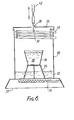
- Figure 6 shows the apparatus used for simultaneously dissolving the exposed parts of the gold layer and coating the copper conductors or tracks with tin.
- a stainless steel container 20 is supported on a heater 22 incorporating a heating element 24.
- the container 20 is covered by lid 26 having a slotted opening 28 through which an assembly 30 can be introduced in the container and then subsequently withdrawn.
- the container 20 is partly filled with a fluorinated hydrocarbon 32, such as for example Fluorinert FC 71 manufactured by 3M's.
- a fluorinated hydrocarbon 32 such as for example Fluorinert FC 71 manufactured by 3M's. This hydrocarbon has a boiling point of approximately 250°C.
- a stand 34 supports a ceramic vessel containing pure tin 38, above the level of the liquid hydrocarbon 32.
- a cooling coil 40 is located in the upper region of the container 20.
- the heating coil 24 of the heater is energised to heat the container to a temperature of at least 250°C. At this temperature the fluorinated hydrocarbon boils to fill the volume of the container above the level of the liquid with hot vapour. This hot vapour heats the vessel 36 and the tin therein (which has a melting point of about 230°C), to cause the tin to melt and so provide a bath of molten tin. Any vapour reaching the upper extremity of the container is condensed by the cooling coil 40 and returned to the liquid at the bottom of the container.
- the assembly 28 held by a pair of tongs 42 or other support members, is lowered through the opening 28. As it passes into the container 20, it is initially heated by the vapourised hydrocarbon which also acts to inhibit oxidation. Eventually the assembly 30 is immersed in the molten tin for a period sufficient to dissolve the gold and coat the copper conductors with tin. The board is then withdrawn from the bath of molten tin and up through the opening in the lid 26 of the container and left to cool.
- the pre- heating and pre-cooling action effected by the vapour is conducive to the formation of a thin layer of tin, thereby reducing the risk of the tin bridging the conductors, and reduces the risk of thermal shock to the assembly and therefore damage to the conductors.
- a tin based compound can be used, for example a tin/lead or tin/silver alloy, tin/lead/silver alloy.
- the alloys can also include the elements of Bismuth, Antimony or Indium.
- a fluid such as Arklone P (Registered Trade Mark of ICI) or Freon TF (Registered Trade Mark of DuPont) is added to the fluorinated hydrocarbon so that when heated a vapour layer of this material floats on top of the vapourised fluorinated hydrocarbon. This acts to reduce the loss of the fluorinated hydrocarbon from the system.
- Arklone P Registered Trade Mark of ICI
- Freon TF Registered Trade Mark of DuPont
- the use of metallorganic materials to produce a gold layer eliminates the need for either aqueous processing or expensive thin film processing to produce a seed layer.
- the oxide-glass forming adhesive mechanism between the gold and multilayer gives a high adhesion, even to glass surfaces.
- the use of molten tin to dissolve the exposed gold portions eliminates the need for removing a seed layer with ionic aqueous fluids. The use of such fluids generally introduces a reliability hazard.
- the tinned copper conductors produced by the described method avoid the need for subsequent preparatory operations such as would be needed when reflowing chip carriers and performing similar operations.
- gold silver can be used to provide the layer 6.
- the gold or silver may be alloyed with up to 25% platinum or other material to reduce metal migration or the solubility in the tin.
- tne processes may be used to form the top conductive layer of the structure. This is more clearly shown in Figures 7 to 11.
- an inorganic substrate 12 of a ceramic, glass, glass-ceramic material supports a multilayer structure.
- the structure includes a conductive pattern 15 (which may have been formed by thick film plating or cofired ceramic methods for example).
- the conductive pattern 15 is coated with an insulated layer 14 which is then fired. Through holes 17 are provided in the insulating layer 14 to expose the underlying conductor.
- the structure is coated with a 0.2 micron thick layer 16 of gold.
- This gold layer 16 is formed by screen printing a mixture of a gold metallorganic material (an organic material having gold radicals) and a base metal metall-organic material (which forms a metal oxide on heating) to coat the whole surface of the layer 14 and the through holes 17.
- the assembly is then fired in an oven to release the organic materials and leave the gold deposited as a layer 16 on the layer 14 of multilayer structure-The adherence of the gold layer 16 to the layer 14 is effected by the aforesaid metal oxide.
- a photo-resist is then deposited as a layer to cover the gold layer 16.
- the photo-resist layer can be formed by laminating a dry film resist on to the layer 16 or coating the layer 16 with a wet film resist and then drying.
- the photo-resist layer is then selectively exposed to light through a photo mask (not shown) defining a desired pattern and etched to leave the pattern 18 (see Figure 8).
- the pattern is in the form of a plurality of parallel strips 110.
- the assembly is then plated with copper. Since the resist strips 110 are electrically insulating and the exposed gold layer 16 is electrically conductive, electro-plating or electroless plating with copper will only deposit a copper layer on the exposed parts of the gold layer. Accordingly, a series of copper strips 112 are formed between the strips 110 of the etched resist layer 18 (see Figure 9).
- a solvent is used to remove the strips 110 of the resist material so as to leave (as shown in Figure 11) a gold layer 16 carrying a conductive pattern of copper.
- the assembly is then dipped in molten tin which will dissolve the exposed parts of the gold layer and simultaneously coat the strips 112 of copper with a layer of tin 114.
- the resultant multilayer board with its tin plated copper conductors or tracks on the top surface is ready for soldering to integrated circuits and the like.
Landscapes
- Engineering & Computer Science (AREA)
- Chemical & Material Sciences (AREA)
- Metallurgy (AREA)
- Microelectronics & Electronic Packaging (AREA)
- Materials Engineering (AREA)
- Mechanical Engineering (AREA)
- Manufacturing & Machinery (AREA)
- Organic Chemistry (AREA)
- Chemical Kinetics & Catalysis (AREA)
- Manufacturing Of Printed Wiring (AREA)
- Internal Circuitry In Semiconductor Integrated Circuit Devices (AREA)
- Manufacturing Of Printed Circuit Boards (AREA)
- Manufacturing Of Electric Cables (AREA)
Priority Applications (1)
| Application Number | Priority Date | Filing Date | Title |
|---|---|---|---|
| AT85302477T ATE68931T1 (de) | 1984-04-12 | 1985-04-09 | Verfahren und einrichtung zur herstellung von leitenden mustern auf einem substrat. |
Applications Claiming Priority (2)
| Application Number | Priority Date | Filing Date | Title |
|---|---|---|---|
| GB8409504 | 1984-04-12 | ||
| GB8409504 | 1984-04-12 |
Publications (3)
| Publication Number | Publication Date |
|---|---|
| EP0158536A2 true EP0158536A2 (de) | 1985-10-16 |
| EP0158536A3 EP0158536A3 (en) | 1987-09-23 |
| EP0158536B1 EP0158536B1 (de) | 1991-10-23 |
Family
ID=10559572
Family Applications (1)
| Application Number | Title | Priority Date | Filing Date |
|---|---|---|---|
| EP85302477A Expired - Lifetime EP0158536B1 (de) | 1984-04-12 | 1985-04-09 | Verfahren und Einrichtung zur Herstellung von leitenden Mustern auf einem Substrat |
Country Status (4)
| Country | Link |
|---|---|
| US (1) | US4606788A (de) |
| EP (1) | EP0158536B1 (de) |
| AT (1) | ATE68931T1 (de) |
| DE (1) | DE3584461D1 (de) |
Cited By (6)
| Publication number | Priority date | Publication date | Assignee | Title |
|---|---|---|---|---|
| EP0195223A3 (en) * | 1985-03-22 | 1987-06-03 | Schering Aktiengesellschaft Berlin Und Bergkamen | Production of metallic structures on a non-conductive substrate |
| WO1988005990A1 (en) * | 1987-02-05 | 1988-08-11 | Hughes Aircraft Company | Cladding of substrates with thick metal circuit patterns |
| GB2228372A (en) * | 1988-12-09 | 1990-08-22 | Minnesota Mining & Mfg | Making printed circuits |
| EP0298422A3 (en) * | 1987-07-08 | 1990-10-31 | Hitachi, Ltd. | Wiring method |
| US5139923A (en) * | 1987-07-08 | 1992-08-18 | Hitachi, Ltd. | Method for improving adhesion of a resist layer to a metallic layer and electrolessly plating a wiring pattern thereon |
| DE102007032856A1 (de) | 2007-07-12 | 2009-01-15 | Joachim Brudermüller-Reimann | Im Ohr-Lautsprechersystem mit Signalübertragung per Funk |
Families Citing this family (28)
| Publication number | Priority date | Publication date | Assignee | Title |
|---|---|---|---|---|
| US4657778A (en) * | 1984-08-01 | 1987-04-14 | Moran Peter L | Multilayer systems and their method of production |
| US5064681A (en) * | 1986-08-21 | 1991-11-12 | International Business Machines Corporation | Selective deposition process for physical vapor deposition |
| US4847446A (en) * | 1986-10-21 | 1989-07-11 | Westinghouse Electric Corp. | Printed circuit boards and method for manufacturing printed circuit boards |
| US4887762A (en) * | 1987-03-12 | 1989-12-19 | British Aerospace Public Limted Company | Solder coating processes |
| US4816616A (en) * | 1987-12-10 | 1989-03-28 | Microelectronics Center Of North Carolina | Structure and method for isolated voltage referenced transmission lines of substrates with isolated reference planes |
| US5162191A (en) * | 1988-01-05 | 1992-11-10 | Max Levy Autograph, Inc. | High-density circuit and method of its manufacture |
| US5488394A (en) * | 1988-01-05 | 1996-01-30 | Max Levy Autograph, Inc. | Print head and method of making same |
| US4897676A (en) * | 1988-01-05 | 1990-01-30 | Max Levy Autograph, Inc. | High-density circuit and method of its manufacture |
| US4994349A (en) * | 1988-06-27 | 1991-02-19 | At&T Bell Laboratories | Printed wiring board fabrication method |
| US5100501A (en) * | 1989-06-30 | 1992-03-31 | Texas Instruments Incorporated | Process for selectively depositing a metal in vias and contacts by using a sacrificial layer |
| US5418039A (en) * | 1991-04-01 | 1995-05-23 | Ppg Industries, Inc. | Reflective patterned glass product and coating method |
| WO1992019786A1 (en) * | 1991-05-08 | 1992-11-12 | Superconductor Technologies, Inc. | Fabrication process for low loss metallizations on superconducting thin film devices |
| US5196087A (en) * | 1991-06-18 | 1993-03-23 | Multimedia Design, Inc. | Method for making multi-layer printed circuit board |
| US5260517A (en) * | 1992-09-09 | 1993-11-09 | Micron Technology, Inc. | Interconnect lead with stress joint |
| US5242535A (en) * | 1992-09-29 | 1993-09-07 | The Boc Group, Inc. | Method of forming a copper circuit pattern |
| US5820769A (en) * | 1995-05-24 | 1998-10-13 | Regents Of The University Of Minnesota | Method for making magnetic storage having discrete elements with quantized magnetic moments |
| US6309580B1 (en) * | 1995-11-15 | 2001-10-30 | Regents Of The University Of Minnesota | Release surfaces, particularly for use in nanoimprint lithography |
| US7758794B2 (en) * | 2001-10-29 | 2010-07-20 | Princeton University | Method of making an article comprising nanoscale patterns with reduced edge roughness |
| US5772905A (en) * | 1995-11-15 | 1998-06-30 | Regents Of The University Of Minnesota | Nanoimprint lithography |
| US20040137734A1 (en) * | 1995-11-15 | 2004-07-15 | Princeton University | Compositions and processes for nanoimprinting |
| US5630948A (en) * | 1995-11-21 | 1997-05-20 | Magnecomp Corp. | Method for the fabrication of integrated conductor suspensions and product |
| US5875070A (en) * | 1996-09-26 | 1999-02-23 | Magnecomp Corp. | Suspension flexure with primary and secondary stiffness control |
| US5912787A (en) * | 1996-10-07 | 1999-06-15 | Magnecomp Corp. | Disk drive suspension with minimum wire-induced bias |
| US6787706B2 (en) * | 2001-02-21 | 2004-09-07 | Kyocera Corporation | Ceramic circuit board |
| CN1314544C (zh) * | 2002-08-28 | 2007-05-09 | 中国科学院长春应用化学研究所 | 一种热模塑高分子薄膜微图案化的制作方法 |
| DE112010005201B4 (de) * | 2010-01-28 | 2025-10-16 | Tohoku University | Herstellungsverfahren für metallische Teile und das metallische Teil |
| CN102320554B (zh) * | 2011-07-11 | 2014-05-28 | 西安交通大学 | 一种纳米缝的模板对准压印制备工艺 |
| JP6311200B2 (ja) * | 2014-06-26 | 2018-04-18 | 住友電工プリントサーキット株式会社 | プリント配線板、電子部品及びプリント配線板の製造方法 |
Family Cites Families (8)
| Publication number | Priority date | Publication date | Assignee | Title |
|---|---|---|---|---|
| US3615465A (en) * | 1969-06-13 | 1971-10-26 | Nasa | Photoetching of metal-oxide layers |
| US3883947A (en) * | 1971-11-05 | 1975-05-20 | Bosch Gmbh Robert | Method of making a thin film electronic circuit unit |
| US3837944A (en) * | 1972-09-01 | 1974-09-24 | Nat Starch Chem Corp | Selective etching of metal oxides of tin or indium |
| US3832176A (en) * | 1973-04-06 | 1974-08-27 | Eastman Kodak Co | Novel photoresist article and process for its use |
| US3881884A (en) * | 1973-10-12 | 1975-05-06 | Ibm | Method for the formation of corrosion resistant electronic interconnections |
| CS215588B1 (cs) * | 1980-03-26 | 1982-08-27 | Bedrich Rous | Způsob úpravy zlacených přívodů elektronických součástek |
| US4357202A (en) * | 1981-06-12 | 1982-11-02 | International Business Machines Corporation | Refractory oxide fabrication |
| DE3145721A1 (de) * | 1981-11-19 | 1983-05-26 | Helmuth 2058 Lauenburg Schmoock | Verfahren zum herstellen von gedruckten schaltungen |
-
1985
- 1985-04-03 US US06/719,375 patent/US4606788A/en not_active Expired - Fee Related
- 1985-04-09 AT AT85302477T patent/ATE68931T1/de not_active IP Right Cessation
- 1985-04-09 DE DE8585302477T patent/DE3584461D1/de not_active Expired - Lifetime
- 1985-04-09 EP EP85302477A patent/EP0158536B1/de not_active Expired - Lifetime
Cited By (9)
| Publication number | Priority date | Publication date | Assignee | Title |
|---|---|---|---|---|
| EP0195223A3 (en) * | 1985-03-22 | 1987-06-03 | Schering Aktiengesellschaft Berlin Und Bergkamen | Production of metallic structures on a non-conductive substrate |
| AT397328B (de) * | 1985-03-22 | 1994-03-25 | Schering Ag | Verfahren zur herstellung von elektrisch leitenden strukturen auf nichtleitern |
| WO1988005990A1 (en) * | 1987-02-05 | 1988-08-11 | Hughes Aircraft Company | Cladding of substrates with thick metal circuit patterns |
| EP0298422A3 (en) * | 1987-07-08 | 1990-10-31 | Hitachi, Ltd. | Wiring method |
| US5139923A (en) * | 1987-07-08 | 1992-08-18 | Hitachi, Ltd. | Method for improving adhesion of a resist layer to a metallic layer and electrolessly plating a wiring pattern thereon |
| GB2228372A (en) * | 1988-12-09 | 1990-08-22 | Minnesota Mining & Mfg | Making printed circuits |
| GB2228372B (en) * | 1988-12-09 | 1993-06-23 | Minnesota Mining & Mfg | Patterning process and product |
| US5294476A (en) * | 1988-12-09 | 1994-03-15 | Minnesota Mining And Manufacturing Company | Patterning process and microparticles of substantially the same geometry and shape |
| DE102007032856A1 (de) | 2007-07-12 | 2009-01-15 | Joachim Brudermüller-Reimann | Im Ohr-Lautsprechersystem mit Signalübertragung per Funk |
Also Published As
| Publication number | Publication date |
|---|---|
| US4606788A (en) | 1986-08-19 |
| ATE68931T1 (de) | 1991-11-15 |
| EP0158536B1 (de) | 1991-10-23 |
| EP0158536A3 (en) | 1987-09-23 |
| DE3584461D1 (de) | 1991-11-28 |
Similar Documents
| Publication | Publication Date | Title |
|---|---|---|
| US4606788A (en) | Methods of and apparatus for forming conductive patterns on a substrate | |
| US4032033A (en) | Methods and apparatus for heating articles | |
| US3742597A (en) | Method for making a coated printed circuit board | |
| US4325780A (en) | Method of making a printed circuit board | |
| US3625837A (en) | Electroplating solder-bump connectors on microcircuits | |
| SE429914B (sv) | Forfarande for framstellning av tryckta kretskort | |
| US4088545A (en) | Method of fabricating mask-over-copper printed circuit boards | |
| US4874124A (en) | Process for carrying out the soldering of electronic components on a support | |
| US2803216A (en) | Apparatus for printed-circuit solder coating | |
| EP0068276B1 (de) | Verfahren zur Herstellung von Metallschichten auf Substraten mittels stromloser Plattiertechniken | |
| CA1258717A (en) | Method for manufacture of printed circuit boards | |
| JPS6289398A (ja) | 基板上に導体パタ−ンを形成する方法及び装置 | |
| JP2556971B2 (ja) | 半田転写キャリア.フィルムと、半田転写キャリア、フィルムの再生方法 | |
| US3666639A (en) | Method for coating metals or insulating substrates having a vitreous binder | |
| JP2596754B2 (ja) | プリント配線板の半田層の形成方法 | |
| JP3279677B2 (ja) | はんだめっきプリント配線板のヒュージング前処理方法 | |
| JPS55122666A (en) | Solder fusion-connecting method | |
| Duckworth | High reliability Ta/Al thin-film hybrid circuits | |
| JPH03173195A (ja) | 窒化アルミニウム基板における導体回路の形成方法 | |
| NO860985L (no) | Elektrisk kretsanordning og fremgangsmaate for dens fremstilling. | |
| EP0232026A2 (de) | Mehrschicht-Schaltungen und Herstellungsverfahren dafür | |
| JPS6419794A (en) | Method of soldering electronic component | |
| Wooldridge et al. | Accelerated ageing and solderability testing of printed wiring boards | |
| JPH11284316A (ja) | 配線基板の導体パタ―ン形成方法 | |
| JPH0946025A (ja) | プリント配線板の製造方法 |
Legal Events
| Date | Code | Title | Description |
|---|---|---|---|
| PUAI | Public reference made under article 153(3) epc to a published international application that has entered the european phase |
Free format text: ORIGINAL CODE: 0009012 |
|
| AK | Designated contracting states |
Designated state(s): AT BE CH DE FR GB IT LI LU NL SE |
|
| 17P | Request for examination filed |
Effective date: 19860421 |
|
| PUAL | Search report despatched |
Free format text: ORIGINAL CODE: 0009013 |
|
| AK | Designated contracting states |
Kind code of ref document: A3 Designated state(s): AT BE CH DE FR GB IT LI LU NL SE |
|
| 17Q | First examination report despatched |
Effective date: 19891018 |
|
| GRAA | (expected) grant |
Free format text: ORIGINAL CODE: 0009210 |
|
| AK | Designated contracting states |
Kind code of ref document: B1 Designated state(s): AT BE CH DE FR GB IT LI LU NL SE |
|
| PG25 | Lapsed in a contracting state [announced via postgrant information from national office to epo] |
Ref country code: SE Effective date: 19911023 Ref country code: NL Effective date: 19911023 Ref country code: LI Effective date: 19911023 Ref country code: IT Free format text: LAPSE BECAUSE OF FAILURE TO SUBMIT A TRANSLATION OF THE DESCRIPTION OR TO PAY THE FEE WITHIN THE PRESCRIBED TIME-LIMIT;WARNING: LAPSES OF ITALIAN PATENTS WITH EFFECTIVE DATE BEFORE 2007 MAY HAVE OCCURRED AT ANY TIME BEFORE 2007. THE CORRECT EFFECTIVE DATE MAY BE DIFFERENT FROM THE ONE RECORDED. Effective date: 19911023 Ref country code: CH Effective date: 19911023 Ref country code: BE Effective date: 19911023 Ref country code: AT Effective date: 19911023 |
|
| REF | Corresponds to: |
Ref document number: 68931 Country of ref document: AT Date of ref document: 19911115 Kind code of ref document: T |
|
| REF | Corresponds to: |
Ref document number: 3584461 Country of ref document: DE Date of ref document: 19911128 |
|
| REG | Reference to a national code |
Ref country code: CH Ref legal event code: PL |
|
| EN | Fr: translation not filed | ||
| PG25 | Lapsed in a contracting state [announced via postgrant information from national office to epo] |
Ref country code: FR Effective date: 19920313 |
|
| NLV1 | Nl: lapsed or annulled due to failure to fulfill the requirements of art. 29p and 29m of the patents act | ||
| PGFP | Annual fee paid to national office [announced via postgrant information from national office to epo] |
Ref country code: GB Payment date: 19920406 Year of fee payment: 8 |
|
| PG25 | Lapsed in a contracting state [announced via postgrant information from national office to epo] |
Ref country code: LU Free format text: LAPSE BECAUSE OF NON-PAYMENT OF DUE FEES Effective date: 19920430 |
|
| PLBE | No opposition filed within time limit |
Free format text: ORIGINAL CODE: 0009261 |
|
| STAA | Information on the status of an ep patent application or granted ep patent |
Free format text: STATUS: NO OPPOSITION FILED WITHIN TIME LIMIT |
|
| 26N | No opposition filed | ||
| PG25 | Lapsed in a contracting state [announced via postgrant information from national office to epo] |
Ref country code: DE Effective date: 19930101 |
|
| REG | Reference to a national code |
Ref country code: FR Ref legal event code: ST |
|
| PG25 | Lapsed in a contracting state [announced via postgrant information from national office to epo] |
Ref country code: GB Effective date: 19930409 |
|
| GBPC | Gb: european patent ceased through non-payment of renewal fee |
Effective date: 19930409 |