EP0158861A2 - Schlagwiderstandsfähige Blase mit hoher Luftundurchlässigkeit - Google Patents
Schlagwiderstandsfähige Blase mit hoher Luftundurchlässigkeit Download PDFInfo
- Publication number
- EP0158861A2 EP0158861A2 EP85103399A EP85103399A EP0158861A2 EP 0158861 A2 EP0158861 A2 EP 0158861A2 EP 85103399 A EP85103399 A EP 85103399A EP 85103399 A EP85103399 A EP 85103399A EP 0158861 A2 EP0158861 A2 EP 0158861A2
- Authority
- EP
- European Patent Office
- Prior art keywords
- bladders
- solvent
- coating
- film
- resin
- Prior art date
- Legal status (The legal status is an assumption and is not a legal conclusion. Google has not performed a legal analysis and makes no representation as to the accuracy of the status listed.)
- Withdrawn
Links
Images
Classifications
-
- B—PERFORMING OPERATIONS; TRANSPORTING
- B29—WORKING OF PLASTICS; WORKING OF SUBSTANCES IN A PLASTIC STATE IN GENERAL
- B29D—PRODUCING PARTICULAR ARTICLES FROM PLASTICS OR FROM SUBSTANCES IN A PLASTIC STATE
- B29D22/00—Producing hollow articles
- B29D22/02—Inflatable articles
-
- A—HUMAN NECESSITIES
- A63—SPORTS; GAMES; AMUSEMENTS
- A63B—APPARATUS FOR PHYSICAL TRAINING, GYMNASTICS, SWIMMING, CLIMBING, OR FENCING; BALL GAMES; TRAINING EQUIPMENT
- A63B41/00—Hollow inflatable balls
- A63B41/02—Bladders
-
- A—HUMAN NECESSITIES
- A63—SPORTS; GAMES; AMUSEMENTS
- A63B—APPARATUS FOR PHYSICAL TRAINING, GYMNASTICS, SWIMMING, CLIMBING, OR FENCING; BALL GAMES; TRAINING EQUIPMENT
- A63B45/00—Apparatus or methods for manufacturing balls
-
- B—PERFORMING OPERATIONS; TRANSPORTING
- B29—WORKING OF PLASTICS; WORKING OF SUBSTANCES IN A PLASTIC STATE IN GENERAL
- B29D—PRODUCING PARTICULAR ARTICLES FROM PLASTICS OR FROM SUBSTANCES IN A PLASTIC STATE
- B29D22/00—Producing hollow articles
- B29D22/04—Spherical articles, e.g. balls
-
- C—CHEMISTRY; METALLURGY
- C08—ORGANIC MACROMOLECULAR COMPOUNDS; THEIR PREPARATION OR CHEMICAL WORKING-UP; COMPOSITIONS BASED THEREON
- C08J—WORKING-UP; GENERAL PROCESSES OF COMPOUNDING; AFTER-TREATMENT NOT COVERED BY SUBCLASSES C08B, C08C, C08F, C08G or C08H
- C08J7/00—Chemical treatment or coating of shaped articles made of macromolecular substances
- C08J7/04—Coating
- C08J7/0427—Coating with only one layer of a composition containing a polymer binder
-
- A—HUMAN NECESSITIES
- A63—SPORTS; GAMES; AMUSEMENTS
- A63B—APPARATUS FOR PHYSICAL TRAINING, GYMNASTICS, SWIMMING, CLIMBING, OR FENCING; BALL GAMES; TRAINING EQUIPMENT
- A63B2209/00—Characteristics of used materials
-
- C—CHEMISTRY; METALLURGY
- C08—ORGANIC MACROMOLECULAR COMPOUNDS; THEIR PREPARATION OR CHEMICAL WORKING-UP; COMPOSITIONS BASED THEREON
- C08J—WORKING-UP; GENERAL PROCESSES OF COMPOUNDING; AFTER-TREATMENT NOT COVERED BY SUBCLASSES C08B, C08C, C08F, C08G or C08H
- C08J2375/00—Characterised by the use of polyureas or polyurethanes; Derivatives of such polymers
- C08J2375/04—Polyurethanes
-
- Y—GENERAL TAGGING OF NEW TECHNOLOGICAL DEVELOPMENTS; GENERAL TAGGING OF CROSS-SECTIONAL TECHNOLOGIES SPANNING OVER SEVERAL SECTIONS OF THE IPC; TECHNICAL SUBJECTS COVERED BY FORMER USPC CROSS-REFERENCE ART COLLECTIONS [XRACs] AND DIGESTS
- Y10—TECHNICAL SUBJECTS COVERED BY FORMER USPC
- Y10T—TECHNICAL SUBJECTS COVERED BY FORMER US CLASSIFICATION
- Y10T428/00—Stock material or miscellaneous articles
- Y10T428/26—Web or sheet containing structurally defined element or component, the element or component having a specified physical dimension
- Y10T428/263—Coating layer not in excess of 5 mils thick or equivalent
- Y10T428/264—Up to 3 mils
- Y10T428/265—1 mil or less
-
- Y—GENERAL TAGGING OF NEW TECHNOLOGICAL DEVELOPMENTS; GENERAL TAGGING OF CROSS-SECTIONAL TECHNOLOGIES SPANNING OVER SEVERAL SECTIONS OF THE IPC; TECHNICAL SUBJECTS COVERED BY FORMER USPC CROSS-REFERENCE ART COLLECTIONS [XRACs] AND DIGESTS
- Y10—TECHNICAL SUBJECTS COVERED BY FORMER USPC
- Y10T—TECHNICAL SUBJECTS COVERED BY FORMER US CLASSIFICATION
- Y10T428/00—Stock material or miscellaneous articles
- Y10T428/31504—Composite [nonstructural laminate]
- Y10T428/31551—Of polyamidoester [polyurethane, polyisocyanate, polycarbamate, etc.]
- Y10T428/31562—Next to polyamide [nylon, etc.]
-
- Y—GENERAL TAGGING OF NEW TECHNOLOGICAL DEVELOPMENTS; GENERAL TAGGING OF CROSS-SECTIONAL TECHNOLOGIES SPANNING OVER SEVERAL SECTIONS OF THE IPC; TECHNICAL SUBJECTS COVERED BY FORMER USPC CROSS-REFERENCE ART COLLECTIONS [XRACs] AND DIGESTS
- Y10—TECHNICAL SUBJECTS COVERED BY FORMER USPC
- Y10T—TECHNICAL SUBJECTS COVERED BY FORMER US CLASSIFICATION
- Y10T428/00—Stock material or miscellaneous articles
- Y10T428/31504—Composite [nonstructural laminate]
- Y10T428/31551—Of polyamidoester [polyurethane, polyisocyanate, polycarbamate, etc.]
- Y10T428/31573—Next to addition polymer of ethylenically unsaturated monomer
- Y10T428/31587—Hydrocarbon polymer [polyethylene, polybutadiene, etc.]
Definitions
- the field of this invention is bladders for footballs and_.other sport balls or bags which are subjected to repeated impacts in use. More specifically, the invention is concerned with an improvement in inflatible polyurethane bladders for footballs and the like.
- Laminates of polyurethane with other resin polymers have been tested experimentally for football bladders. It was found, however, that the durability of the bladders was not acceptable for commercial use, the bladders-delaminating within a short time when the balls are subjected to impacts, as occurs with the kicking of footballs. Prior to the present invention, no method has been known of manufacturing polyurethane bladders for footballs and the like which provides high air retention and which are highly impact resistant.
- the present invention involves a coating procedure for polyurethane film to be used in making inflatible bladders.
- a coating solution is used containing a resin polymer which when applied.to the polyurethane film is capable of decreasing the air (0 2 /N 2 ) permeability.
- the coating polymer is dissolved in an organic carrier solvent which does not dissolve or react with the polyurethane film.
- the coating solution also contains a small percent of an attack solvent which is capable of dissolving the polyurethane film.
- the process permits the use of polyurethane film in relatively thin guages, such as 5 mil film, with the application of an air retention coating of a thickness of less than 1 mil.
- the resulting composites have a very uniform thickness without significant thin or weak spots, providing both high air retention and high impact resistance. Bladders made from such coated films overcome the problem of delamination referred to above.
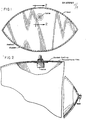
- FIG. 1 is a plan view of the football bladder
- Fig. 2 is a partial fragmentary sectional view taken on line 2-2 of Fig. 1.
- the components of the bladder are identified by descriptive labels.
- This invention relates to a method of manufacturing bladders for sports balls or bags which are subjected to repeated impacts in use.
- An important use of the bladders of this invention is in footballs, but the bladders are also well adapted for use in other impact type balls and bags, such as soccer balls, punching bags, etc.
- the term "footballs or the like" is intended to refer to-such balls and bags generically.
- the starting material for preparing the inflatible bladders-pf the present invention is polyurethane film.
- the film is selected for the properties which make it capable of being formed into high performance bladders.
- the film may have a thickness of from about 3 to 12 mils, such as,-typically, a 5 mil or 10 mil film.
- the thinner guages are preferred, such as polyurethane film of from 3 to 8 mils.
- polyurethane film is readily available commercially. Suitable commercial sources include Deerfield Urethane Co., South Deerfield, Mass., and Elra Industries, Cincinnati, Ohio.
- polyurethanes are made by reaction of diisocyanates with polyhydric alcohols or polyethers.
- Hydrocyal-terminated polyurethane tri- polymers are the most common thermoplastic material. This invention, however, is not limited to specific polyurethane film compositions, but is generally applicable to polyurethane films capable of being formed into bladders for footballs and the like.
- a thin layer of a coating solution is applied to one side of the polyurethane film.
- the coating solution comprises a selected coating resin dissolved in an organic carrier solvent, which also contains a small proportion of an attack solvent.
- the carrier solvent is selected tor its ability to dissolve the coating resin and its inability to dissolve or react with the polyurethane film.
- the polyurethane film is essentially inert to the carrier solvent.
- the attack solvent which is present in a controlled, limited amount is capable of dissolving the polyurethane.
- the general class of coating resins are those which are known to provide decreased air permeability when used as a layer of composites or laminates.
- the preferred coating resins are polyvinylidene polymers and copolymers of vinylidene chloride with other vinyl monomers, and particularly such copolymers formed from vinylidene chloride with a minor proportion of vinyl chloride, sometimes referred to as "Saran" polymers.
- Other vinyl monomers which may be copolymerized with vinylidene chloride include isobutyl vinyl monomers, and methyl methacrylate.
- Another vinyl-type polymers which may be used is ethylene vinyl alcohol polymers (referred to as "EVAL" resins), and also polyamide polymers, a preferred subclass of which is referred to as "Nylon" polymers.
- the carrier solvent for the coating resin is an organic solvent in which the coating resin is soluble and which is miscible with the attack solvent.
- the carrier solvent nay. therefore be varied with the particular coating resin.
- ketone carrier solvents may be used for polyvinylidene polymers and copolymers, such as vinylidine chloride and vinyl chloride copolymers.
- ketone solvents include acetone, methylethyl ketone, methylisobutyl ketone, etc.
- a ketone solvent may also be employed.
- a particularly desirable solvent mixture is pyrrolidine and acetone.
- alcohol solvents may be used, such as isopropyl or butyl alcohols.
- the attack solvent is selected from the class of solvents known to be capable of dissolving or solubilizing polyurethane resins. These include particularly tetrahydrofuran, dimethyl formamide, and dimethyl sulfoxide. It should be understood, however, that this list is not intended to be exhaustive. Another characteristic of the attack solvent is that it should be miscible with the carrier solvent. In this case, only a minor proportion of the attack solvent is utilized ⁇ Based on the coating solution, containing the carrier-solvent, the coating resin, and the attack solvent, the weight percent of the attack solvent should be within the range from about 3 to 18% by weight. A preferred range is from-about 5 to 15% by weight based on the coating solution. By limiting the concentration of the attack solvent, a fusion-type attachment can be obtained between the coated layer and the polyurethane film without at the same time producing thin or mechanically weak spots in the polyurethane film. The resulting composite will therefore be of relatively uniform thickness.
- the applied coating layer may have an average thickness within the range from about 0.3 to 1.2 mils.
- a preferred range is from about 0.3 to 0.8 mils, such as approximately 0.5 mil coating on a polyurethane film of 5 mil thickness.
- the concentration of the resin in the coating solution is highly critical, but may range from about 25 to 45 weight percent. For example, a preferred concentration range is from about 30 to 40 wt. %.
- the concentration of the carrier solvent may vary over a considerable range, such as from about 50 to 70 wt. % of the coating solution. In preferred embodiments, the carrier solvent will usually range from about 50 to 60 wt. %.
- the coating solution is applied to one side of the polyurethane film by an applicator apparatus capable of producing a thin uniform coating.
- an applicator apparatus capable of producing a thin uniform coating.
- the coating solution will usually be applied at normal room temperature, both the polyurethane film and the coating solution being at the ambient temperature.
- a dryer such as a convection air dryer in which the temperature can be controlled to rapidly evaporate the carrier solvent and the attack solvent, leaving the applied resin in a thin layer on the film.
- the temperature should be limited to temperatures at which the polyurethane film is not appreciably softened. For example, drying temperatures in the range from about 180 to 200°F can be used.
- the desired thickness of the applied coating is generally within the range from about 0.3 to 1.2 mils, preferred thickness using a sequence of two coating and drying steps being in the range from about 0.3 to 0.8 mils.
- the polyurethane film After the polyurethane film has been coated on one side, as described, it is then formed into the inflatible bladders by standard manufacturing procedures.
- the assembley of the bladder is carried out so that the coated side of the film is on the outside of the bladder.
- the film may be cut in sheets of the approximate size for forming individual bladders. A valve hole is punched in each sheet, the valve is inserted and the sheet is folded with the uncoated side inwardly. The folded sheet is then die cut to the shape of the final bladder, and heat seal is made around the periphery of the bladder.
- the inside flange of the valve is sealed to the inner surface of the bladder by an adhesive or heat seal, this step being carried out either on insertion of the valve or at the time of bonding the film.
- FIG. 1 and 2 of the accompanying drawing A completed bladder of the type described is illustrated in Figs. 1 and 2 of the accompanying drawing.
- the football bladder is shown in a partially inflated condition.
- the components of the bladder have been given descriptive labels.
- the following examples further illustrate the invention with respect to football bladders.
- the starting material for preparing football bladders is a polyester-based urethane film, such as polyurethane film No. X-1043, Deerfield Industries, South Deerfield, Massachusetts.
- the film has a thickness of 5 mils with a tolerance of +1 mil.
- This film is formed by a blow molding extrusion process. It has an air permeability rating of 130 to 140 cc of oxygen per meter 2 per 24 hours.
- a coating solution is prepared by mixing the following ingredients in the indicated proportions.
- the coating resin is a "Saran"-type resin, being a copolymer containing 85% by weight of vinylidine chloride and 15% vinyl chloride.
- the resin may'be Saran F310, Dow Chemical Company, Midland, Michigan.
- the MEK carrier solvent designates methylethyl ketone
- the attack solvent THF designates tetrahydrofuran.
- the coating solution is applied at room temperature using a knife-over-roll coating apparatus to one side of the polyurethane film.
- the coated film moves continuously from the coating station into a dryer where it is subjected to air convection drying at a temperature of 180-200°F.
- the drying flashes off the solvents, leaving a dry coating of the resin on the film.
- the coated-side of the film is recoated, using the same kind of equipment and the same coating solution.
- the film moves continuously from the second coating station to a dryer of the same kind previously employed, using the same temperature conditions- Solvents are again flashed off to leave a dried layer of the resin having an approximate thickness of 0.5 mils ⁇ 0.1 mils.
- the coated film has an air permeability rating of 1.5 to 4.5 cc of oxygen per meter 2 per 24 hours.
- the coated film is then used to manufacture the football bladders.
- the coated film is drawn off the roll, cut into rectangles, and one side of the rectangle is punched to allow the attachment of the valve.
- a snap-in type valve is inserted, which has a large flange bearing against the inside, uncoated surface of the polyurethane film.
- the valve flange is sealed to the surrounding film using a thermal or sonic sealing procedure.
- the superimposed sides of the bladder are then heat-sealed to each other around their periphery. Radio frequency-type sealing is preferred.
- the bladder assembley is then die- cut to the final shape of the bladder, the line of the die- cut being spaced outwardly by a small margin from the line of the seal. Following inspection, the completed bladders are then ready for insertion in footballs.
- Coated bladders manufactured as described in Example I were compared for air retention with bladders manufactured from uncoated 5 mil polyurethane film, using the same film and manufacturing procedure.
- the average air retention rate of the coated polyurethane bladders had an average air transmission rate of 1.9 cc/24 hours for oxy g er) compares with 140 cc/24 hours for oxygen for the uncoated bladders.
- the air transmission rates are in terms of cubic centimeters per 24 hours period.
- Saran-coated polyurethane football bladders prepared as described in Example I were subjected to duration tests.
- the method of test used was to flex the football in a jig that compressed the ball by 1/3 of its volume (to 2/3 of the volume) and then release it to normal. This constitutes one cycle.
- the balls (bladders) were tested for 100,000 cycles after aging as follows:
- the bladders made from saran coated urethane did not fail; whereas the saran-laminated urethane did fail.
- the laminated saran/urethane was made by heat laminating a 0.005" urethane film to a 0.00075" saran film by the use of heat and pressure.
- the amount of testing to deleninate and fail the laminated film was about 25,000 cycles or 5 kicks (in the kicking test.) This result compares with that obtained with a co-extruded laminate of Saran and polyurethane.
Landscapes
- Health & Medical Sciences (AREA)
- Chemical & Material Sciences (AREA)
- General Health & Medical Sciences (AREA)
- Physical Education & Sports Medicine (AREA)
- Medicinal Chemistry (AREA)
- Organic Chemistry (AREA)
- Engineering & Computer Science (AREA)
- Mechanical Engineering (AREA)
- Polymers & Plastics (AREA)
- Chemical Kinetics & Catalysis (AREA)
- Laminated Bodies (AREA)
- Application Of Or Painting With Fluid Materials (AREA)
- Supplying Of Containers To The Packaging Station (AREA)
- Air Bags (AREA)
Applications Claiming Priority (2)
| Application Number | Priority Date | Filing Date | Title |
|---|---|---|---|
| US06/601,297 US4513058A (en) | 1984-04-17 | 1984-04-17 | Impact resistant high air retention bladders |
| US601297 | 1984-04-17 |
Publications (2)
| Publication Number | Publication Date |
|---|---|
| EP0158861A2 true EP0158861A2 (de) | 1985-10-23 |
| EP0158861A3 EP0158861A3 (en) | 1987-02-04 |
Family
ID=24406980
Family Applications (1)
| Application Number | Title | Priority Date | Filing Date |
|---|---|---|---|
| EP85103399A Withdrawn EP0158861A3 (en) | 1984-04-17 | 1985-03-22 | Impact resistant high air retention bladders |
Country Status (12)
| Country | Link |
|---|---|
| US (1) | US4513058A (de) |
| EP (1) | EP0158861A3 (de) |
| JP (1) | JPS60232179A (de) |
| KR (1) | KR880002329B1 (de) |
| AR (1) | AR245029A1 (de) |
| AU (1) | AU574771B2 (de) |
| BR (1) | BR8500907A (de) |
| CA (1) | CA1222682A (de) |
| GB (1) | GB2157575B (de) |
| MX (1) | MX166957B (de) |
| PH (1) | PH20881A (de) |
| ZA (1) | ZA85570B (de) |
Families Citing this family (34)
| Publication number | Priority date | Publication date | Assignee | Title |
|---|---|---|---|---|
| US5096756A (en) * | 1990-04-02 | 1992-03-17 | Wilson Sporting Goods Co. | Composite bladder for game balls |
| US5328724A (en) * | 1993-09-02 | 1994-07-12 | E. I. Du Pont De Nemours And Company | Solution coating process for packaging film |
| EP1214897A3 (de) * | 1994-08-31 | 2004-03-03 | Nike International Ltd | Verbesserte flexible Membranbarriere |
| TW399014B (en) * | 1994-08-31 | 2000-07-21 | Nike Inc | Laminated resilient flexible barrier membranes |
| US5952065A (en) * | 1994-08-31 | 1999-09-14 | Nike, Inc. | Cushioning device with improved flexible barrier membrane |
| US6599597B1 (en) * | 1995-06-07 | 2003-07-29 | Nike, Inc. | Barrier membranes including a barrier layer employing aliphatic thermoplastic urethanes |
| JP4210328B2 (ja) * | 1995-06-07 | 2009-01-14 | ナイキ,インコーポレイテッド | ポリエステルポリオールを含有するポリウレタンをベースとした物質からなる膜 |
| US6013340A (en) * | 1995-06-07 | 2000-01-11 | Nike, Inc. | Membranes of polyurethane based materials including polyester polyols |
| US5756145A (en) * | 1995-11-08 | 1998-05-26 | Baylor College Of Medicine | Durable, Resilient and effective antimicrobial coating for medical devices and method of coating therefor |
| US6558686B1 (en) | 1995-11-08 | 2003-05-06 | Baylor College Of Medicine | Method of coating medical devices with a combination of antiseptics and antiseptic coating therefor |
| US6261400B1 (en) | 1997-04-09 | 2001-07-17 | Spalding Sports Worldwide, Inc. | Method of manufacturing multi-layer game ball |
| HK1040595B (zh) | 1998-09-11 | 2006-02-17 | 耐克国际有限公司 | 柔韧性膜 |
| US6082025A (en) * | 1998-09-11 | 2000-07-04 | Nike, Inc. | Flexible membranes |
| CN105147342B (zh) | 2004-06-23 | 2018-04-17 | 直空间有限公司 | 用于组织移除或分离的设备系统和方法 |
| US20060148601A1 (en) * | 2004-12-31 | 2006-07-06 | Ou Tsung M | Sportsball |
| AU2008224435B2 (en) | 2007-03-15 | 2014-01-09 | Ortho-Space Ltd. | Prosthetic devices and methods for using same |
| WO2008139473A2 (en) | 2007-05-14 | 2008-11-20 | Bioprotect Ltd. | Delivery device for delivering bioactive agents to internal tissue in a body |
| US8210973B2 (en) | 2008-06-27 | 2012-07-03 | Nike, Inc. | Sport ball bladder |
| US8708847B2 (en) | 2008-06-27 | 2014-04-29 | Nike, Inc. | Sport ball casing and methods of manufacturing the casing |
| US8852039B2 (en) * | 2011-06-28 | 2014-10-07 | Nike, Inc. | Sport ball casing with integrated bladder material |
| US8182379B2 (en) * | 2008-06-27 | 2012-05-22 | Nike, Inc. | Sport balls and methods of manufacturing the sport balls |
| TW201021881A (en) * | 2008-12-05 | 2010-06-16 | geng-xian Lin | Sporting goods with seamless bonding and manufacturing method thereof |
| US8702542B2 (en) * | 2009-12-08 | 2014-04-22 | Pete Parenti | Total control batting ball |
| US10201325B2 (en) | 2010-01-07 | 2019-02-12 | Bioprotect Ltd. | Controlled tissue dissection systems and methods |
| US20130116794A1 (en) | 2010-08-04 | 2013-05-09 | Shaul Shohat | Shoulder implant |
| CN202015459U (zh) * | 2011-03-25 | 2011-10-26 | 福建元吉体育用品有限公司(外资企业) | 一种新型的二层防漏球 |
| US8771115B2 (en) * | 2011-05-04 | 2014-07-08 | Nike, Inc. | Sport ball with an inflation-retention bladder |
| US8672784B2 (en) * | 2011-05-04 | 2014-03-18 | Nike, Inc. | Sport ball with an inflation-retention bladder |
| WO2013030849A1 (en) * | 2011-08-29 | 2013-03-07 | Prem Nath Magon | A carboxylated acrylonitrile butadiene latex seamless bladder having improved adhesion for valve body and a process for manufacturing thereof |
| US9289307B2 (en) | 2011-10-18 | 2016-03-22 | Ortho-Space Ltd. | Prosthetic devices and methods for using same |
| US8926459B2 (en) | 2012-03-30 | 2015-01-06 | Nike, Inc. | Sport balls and methods of manufacturing the sport balls |
| DE212014000054U1 (de) * | 2013-02-22 | 2015-12-10 | Nsi International, Inc. | Ventilanordnung für aufblasbare Blase |
| WO2020112624A1 (en) * | 2018-11-29 | 2020-06-04 | Nike Innovate C.V. | Sports ball and method of manufacture |
| JP7142176B2 (ja) * | 2019-06-17 | 2022-09-26 | ディーディースポーツ,インコーポレイテッド | 衝撃吸収キャリアに収容された電子装置を有するスポーツボール |
Family Cites Families (7)
| Publication number | Priority date | Publication date | Assignee | Title |
|---|---|---|---|---|
| DD77807A (de) * | ||||
| US3625876A (en) * | 1968-07-02 | 1971-12-07 | Continental Can Co | Vinylidene chloride polymer coating composition for thermoplastic films |
| FR2324325A1 (fr) * | 1975-10-30 | 1977-04-15 | Piraud Jean Daniel | Ballon de sport |
| US4119592A (en) * | 1977-02-25 | 1978-10-10 | The B. F. Goodrich Company | Rubbery bladders from epoxy compositions |
| AU553648B2 (en) * | 1981-06-03 | 1986-07-24 | Toyo Seikan Kaisha Ltd. | Ethylene vinyl alcohol vessel |
| ES8503704A1 (es) * | 1982-07-01 | 1985-03-01 | Du Pont | Un procedimiento para la preparacion de una composicion elastomerica termoplastica, procesable por fusion |
| EP0134523A1 (de) * | 1983-08-04 | 1985-03-20 | General Electric Company | Absorption von Additiven aus Lösungen in Polymeroberflächen |
-
1984
- 1984-04-17 US US06/601,297 patent/US4513058A/en not_active Expired - Lifetime
-
1985
- 1985-01-24 ZA ZA85570A patent/ZA85570B/xx unknown
- 1985-02-01 PH PH31804A patent/PH20881A/en unknown
- 1985-02-15 GB GB08503952A patent/GB2157575B/en not_active Expired
- 1985-02-19 CA CA000474623A patent/CA1222682A/en not_active Expired
- 1985-02-28 BR BR8500907A patent/BR8500907A/pt unknown
- 1985-03-01 MX MX204480A patent/MX166957B/es unknown
- 1985-03-22 EP EP85103399A patent/EP0158861A3/en not_active Withdrawn
- 1985-04-04 AU AU40837/85A patent/AU574771B2/en not_active Ceased
- 1985-04-10 KR KR1019850002398A patent/KR880002329B1/ko not_active Expired
- 1985-04-17 JP JP60080441A patent/JPS60232179A/ja active Granted
- 1985-04-17 AR AR85300115A patent/AR245029A1/es active
Also Published As
| Publication number | Publication date |
|---|---|
| CA1222682A (en) | 1987-06-09 |
| AU4083785A (en) | 1985-10-24 |
| GB2157575A (en) | 1985-10-30 |
| KR880002329B1 (ko) | 1988-10-26 |
| GB8503952D0 (en) | 1985-03-20 |
| KR850007214A (ko) | 1985-12-02 |
| BR8500907A (pt) | 1985-12-03 |
| PH20881A (en) | 1987-05-27 |
| MX166957B (es) | 1993-02-15 |
| EP0158861A3 (en) | 1987-02-04 |
| GB2157575B (en) | 1988-03-02 |
| JPH0376153B2 (de) | 1991-12-04 |
| AU574771B2 (en) | 1988-07-14 |
| JPS60232179A (ja) | 1985-11-18 |
| ZA85570B (en) | 1985-09-25 |
| AR245029A1 (es) | 1993-12-30 |
| US4513058A (en) | 1985-04-23 |
Similar Documents
| Publication | Publication Date | Title |
|---|---|---|
| US4513058A (en) | Impact resistant high air retention bladders | |
| US5527616A (en) | Laminate for flexible packaging and a process for preparing the same | |
| US6106950A (en) | Waterborne primer and oxygen barrier coating with improved adhesion | |
| US5279873A (en) | Composite material for balloon and balloon made thereof | |
| CA1341518C (en) | Amorphous nylon copolymer and copolyamide films and blends | |
| US4177099A (en) | Method of bonding polyurethane sheeting to acrylic or polyurethane sheeting in production of transparent windows | |
| EP2216173B1 (de) | Methode zur Herstellung eines mit einer Vinylidenchlorid-Copolymer-Mischung beschichteten Polyamidfilms | |
| AU638845B2 (en) | Deodorized multilayer film with vinylidene chloride copolymer barrier | |
| US4565739A (en) | Oriented multi-layer heat sealable film | |
| US5059486A (en) | Self-healing rubber article and method | |
| EP1681156B1 (de) | Gereckte, mehrlagige folie und verfahren zur herstellung einer gereckten mehrlagigen folie | |
| KR900000242B1 (ko) | 열수축성 적층상 포장재료 | |
| JP2760203B2 (ja) | 積層体 | |
| US3549482A (en) | Printing material and process for producing the same | |
| JPH10306264A (ja) | 接着剤及びそれを用いた積層体 | |
| JP3255893B2 (ja) | カバーフィルム | |
| JPH0623890A (ja) | ラベルの製造方法 | |
| JP2002352779A (ja) | リチウムイオン電池用外装材 | |
| JP3730742B2 (ja) | 液体薬品用包装材料及びその製造方法 | |
| US3984492A (en) | Coating composition for polyester resin | |
| JPH0596620A (ja) | 積層フイルムから成るラベルの製造方法 | |
| US11798438B2 (en) | Haptic adhesive article and a method of forming the same | |
| JP2574017B2 (ja) | フツ素樹脂系フイルム被覆発泡積層体 | |
| JPH1158655A (ja) | 易接着性フィルム及びその製造方法 | |
| KR100824577B1 (ko) | 점착테이프 및 점착테이프의 제조방법 |
Legal Events
| Date | Code | Title | Description |
|---|---|---|---|
| PUAI | Public reference made under article 153(3) epc to a published international application that has entered the european phase |
Free format text: ORIGINAL CODE: 0009012 |
|
| AK | Designated contracting states |
Designated state(s): DE FR SE |
|
| PUAL | Search report despatched |
Free format text: ORIGINAL CODE: 0009013 |
|
| AK | Designated contracting states |
Kind code of ref document: A3 Designated state(s): DE FR SE |
|
| 17P | Request for examination filed |
Effective date: 19870409 |
|
| 17Q | First examination report despatched |
Effective date: 19871201 |
|
| 18D | Application deemed to be withdrawn |
Effective date: 19890923 |
|
| RIN1 | Information on inventor provided before grant (corrected) |
Inventor name: MARTIN, ROBIN ALAN |