EP0158927A2 - Verfahren zur Behandlung der Herzinsuffizienz - Google Patents
Verfahren zur Behandlung der Herzinsuffizienz Download PDFInfo
- Publication number
- EP0158927A2 EP0158927A2 EP85104028A EP85104028A EP0158927A2 EP 0158927 A2 EP0158927 A2 EP 0158927A2 EP 85104028 A EP85104028 A EP 85104028A EP 85104028 A EP85104028 A EP 85104028A EP 0158927 A2 EP0158927 A2 EP 0158927A2
- Authority
- EP
- European Patent Office
- Prior art keywords
- alkyl
- carbethoxy
- propyl
- atoms
- aryl
- Prior art date
- Legal status (The legal status is an assumption and is not a legal conclusion. Google has not performed a legal analysis and makes no representation as to the accuracy of the status listed.)
- Granted
Links
Classifications
-
- A—HUMAN NECESSITIES
- A61—MEDICAL OR VETERINARY SCIENCE; HYGIENE
- A61K—PREPARATIONS FOR MEDICAL, DENTAL OR TOILETRY PURPOSES
- A61K38/00—Medicinal preparations containing peptides
- A61K38/16—Peptides having more than 20 amino acids; Gastrins; Somatostatins; Melanotropins; Derivatives thereof
- A61K38/55—Protease inhibitors
- A61K38/556—Angiotensin converting enzyme inhibitors
-
- A—HUMAN NECESSITIES
- A61—MEDICAL OR VETERINARY SCIENCE; HYGIENE
- A61P—SPECIFIC THERAPEUTIC ACTIVITY OF CHEMICAL COMPOUNDS OR MEDICINAL PREPARATIONS
- A61P43/00—Drugs for specific purposes, not provided for in groups A61P1/00-A61P41/00
-
- A—HUMAN NECESSITIES
- A61—MEDICAL OR VETERINARY SCIENCE; HYGIENE
- A61P—SPECIFIC THERAPEUTIC ACTIVITY OF CHEMICAL COMPOUNDS OR MEDICINAL PREPARATIONS
- A61P9/00—Drugs for disorders of the cardiovascular system
-
- A—HUMAN NECESSITIES
- A61—MEDICAL OR VETERINARY SCIENCE; HYGIENE
- A61P—SPECIFIC THERAPEUTIC ACTIVITY OF CHEMICAL COMPOUNDS OR MEDICINAL PREPARATIONS
- A61P9/00—Drugs for disorders of the cardiovascular system
- A61P9/12—Antihypertensives
-
- C—CHEMISTRY; METALLURGY
- C07—ORGANIC CHEMISTRY
- C07K—PEPTIDES
- C07K5/00—Peptides containing up to four amino acids in a fully defined sequence; Derivatives thereof
- C07K5/02—Peptides containing up to four amino acids in a fully defined sequence; Derivatives thereof containing at least one abnormal peptide link
- C07K5/022—Peptides containing up to four amino acids in a fully defined sequence; Derivatives thereof containing at least one abnormal peptide link containing the structure -X-C(=O)-(C)n-N-C-C(=O)-Y-; X and Y being heteroatoms; n being 1 or 2
- C07K5/0222—Peptides containing up to four amino acids in a fully defined sequence; Derivatives thereof containing at least one abnormal peptide link containing the structure -X-C(=O)-(C)n-N-C-C(=O)-Y-; X and Y being heteroatoms; n being 1 or 2 with the first amino acid being heterocyclic, e.g. Pro, Trp
Definitions
- Aryl as in the following, is preferably to be understood as meaning optionally substituted phenyl, biphenylyl or naphthyl. The same applies to residues derived from aryl such as aryloxy, arylthio. Aroyl is understood to mean in particular benzoyl. Aliphatic radicals can be straight-chain or branched.
- thienyl Under a mono- or bicyclic heterocycle radical having 5 to 7 or 8 to 10 ring atoms, of which 1 to 2 ring atoms are sulfur or oxygen atoms and / or of which 1 to 4 ring atoms are nitrogen atoms, for example thienyl, benzo [b] thienyl, Furyl, pyranyl, benzofuryl, pyrrolyl, imidazolyl, pyrazolyl, pyridyl, pyrimidinyl, pyridazinyl, indazolyl, isoindolyl, indolyl, purinyl, quinolizinyl, isoquinolinyl, phthalazinyl, naphthyridinyl, quinoxalinyl, quinazolyl, cylolylololylolylolylolylolylolylolylolylolylolylololy
- Naturally occurring a-amino acids are e.g. in Houben-Weyl, Methods of Organic Chemistry, Vol. XV / 1 and XV / 2.
- R 1 stands for a side chain of a protected naturally occurring a-amino acid, such as, for example, protected Ser, Thr, Asp, Asn, Glu, Gln, Arg, Lys, Hyl, Cys, Orn, Cit, Tyr, Trp, His or Hyp, are preferred as protective groups in peptide chemistry customary groups (see Houben-Weyl, Vol. XV / 1 and XV / 2).
- the known amino protecting groups but in particular Z, Boc or (C 1 -C 6 ) alkanoyl, are preferred.
- Preferred 0-protecting groups for tyrosine are (C 1 -C 6 ) alkyl, in particular methyl or ethyl.
- the compounds of formula I are angiotensin converting enzyme (ACE) inhibitors or intermediates in the production of such inhibitors and can also be used to combat high blood pressure of various origins.
- ACE angiotensin converting enzyme
- the compounds of formula I are known from DE-OS 3211397, DE-OS 3227055, EP A -46953, E-PA-79022, E-PA-84164, E-PA89637, E-PA-90362. They are also the subject of German patent applications P 32 42 151.6, P 32 46 503.3, P 32 46 757.5, P 33 00 774.8 and P 33 24 263.1.
- the angiotensin converting enzyme inhibitors described above can be used on mammals such as monkeys, dogs, cats, rats, humans, etc.
- the compounds suitable for the use according to the invention are expediently incorporated into pharmaceutical preparations in a customary manner. They can be brought into the usual forms of administration, such as capsules, tablets, dragées, solutions, ointments, emulsions and also in depot form.
- the active ingredient can optionally also be in microencapsulated form.
- the preparations can contain compatible, organic or inorganic accompanying substances, for example granulating substances, adhesives and binders, lubricants, suspending agents, solvents, antibacterial agents, wetting agents and preservatives. Oral and parenteral use forms are preferred.
- the compounds of formula I can be administered in doses of 0.1-50 mg per dose one to three times a day.
- Chronic oral treatment of spontaneously hypertensive rats for two weeks with 1 mg / kg of the compound of the formula II leads to a 55% inhibition of ACE in the heart at the end of the treatment, with 30 mg / kg enalapril per os, however, under otherwise identical conditions no inhibition observed.
- the systemic reduction in blood pressure which is caused by compounds of the formula I, leads to a reduction in afterload and thus to relief of the inadequate heart.
- Postganglionic sympathetic stimulation on the isolated heart leads to increased heart rate, contraction force and a decrease in coronary flow through increased catecholamine release.
- Oral pretreatment with 1 mg / kg per os of the compound of the formula I in rabbits significantly reduces the influence on the heart frequency and coronary flow, but leaves the contraction force unaffected. These effects work together to protect the insufficient heart.
- Angiotensin I decreased, bradykinin, on the other hand, increased the coronary flow in the isolated heart of rabbits, guinea pigs and rats. Oral pretreatment of the animals with 1 mg / kg of the compound of the formula I orally reduces the effect of angiotensin I and significantly increases the action of bradykinin. The same effect can only be achieved with 30 mg / kg enalapril.
- N- (1-S-Carbethoxy-3-phenyl-propyl) -S-alanyl-1S, 3S-5S, -2-azabicyclo [3.3.0] octane-3-carboxylic acid and corn starch are mixed with an aqueous gelatin solution .
- the mixture is dried and ground into granules.
- Microcrystalline cellulose and magnesium stearate are mixed with the granulate.
- the resulting granules are pressed into 1000 tablets, each tablet containing 10 mg of the ACE inhibitor.
- These tablets can be used to treat heart failure.
- Example 2 Analogously to Example 1, 1000 tablets are produced, each containing 10 mg of N- (1-S-carbethox Y -3-phenyl-propyl) -S-alanyl- (2S, 3aR, 7aS) -octahydroindole-2-carboxylic acid hydrochloride.
- Gelatin capsules each containing 10 mg of N- (1-S-carbethoxy-3-phenylpropyl) -S-alanyl-IS, 3S, 5S-2-azabicyclo [3.3.0] octane-3-carboxylic acid, are mixed with the filled the following mixture:
- These capsules can be used to treat heart failure.
- N- (1-S-Carboxy-3-phenyl-propyl) -S-alanyl-1S, 3S, 5S-2-azabicyclo [3.3.0] octane-3-carboxylic acid, the preservatives and sodium chloride are dissolved in 3 1 Dissolved water for injection and made up to 5 1 with water for injection.
- the solution is sterile filtered and filled aseptically into pre-sterilized bottles, which are sealed with sterilized rubber caps. Each bottle contains 5 ml of solution.
- Tablets that can be used to treat heart failure are made as described in Example 1, except that instead of N- (1-S-carbethoxy-3-phenyl-propyl) -S-alanyl-1S, 3S, 5S-2-azabicyclo [3.3.0] octane-3S-carboxylic acid N- (1-S-carboxy-3-phenyl-propyl) -S-alanyl-1S, 3S, 5S-2-azabicyclo [3.3.0 ] octane-3-carboxylic acid or N- (1-S-carboxy-3-phenyl-propyl) -S-alanyl-2S, 3aR, 7aS- octahydroindole-2-carboxylic acid or N- (1-S-carbethoxy-3phenyl- propyl) -S-alanyl-cis-2,3,3a, -4,5,7a-hexahydro [1 H] indole-2-
Landscapes
- Health & Medical Sciences (AREA)
- Chemical & Material Sciences (AREA)
- Life Sciences & Earth Sciences (AREA)
- General Health & Medical Sciences (AREA)
- Medicinal Chemistry (AREA)
- Organic Chemistry (AREA)
- Bioinformatics & Cheminformatics (AREA)
- Veterinary Medicine (AREA)
- Public Health (AREA)
- Animal Behavior & Ethology (AREA)
- Pharmacology & Pharmacy (AREA)
- Engineering & Computer Science (AREA)
- Proteomics, Peptides & Aminoacids (AREA)
- General Chemical & Material Sciences (AREA)
- Nuclear Medicine, Radiotherapy & Molecular Imaging (AREA)
- Chemical Kinetics & Catalysis (AREA)
- Epidemiology (AREA)
- Heart & Thoracic Surgery (AREA)
- Molecular Biology (AREA)
- Genetics & Genomics (AREA)
- Biophysics (AREA)
- Biochemistry (AREA)
- Vascular Medicine (AREA)
- Gastroenterology & Hepatology (AREA)
- Immunology (AREA)
- Cardiology (AREA)
- Medicines That Contain Protein Lipid Enzymes And Other Medicines (AREA)
- Peptides Or Proteins (AREA)
- External Artificial Organs (AREA)
- Crystals, And After-Treatments Of Crystals (AREA)
- Pharmaceuticals Containing Other Organic And Inorganic Compounds (AREA)
- Removal Of Specific Substances (AREA)
- Electrotherapy Devices (AREA)
- Steroid Compounds (AREA)
- Medicines Containing Plant Substances (AREA)
- Iron Core Of Rotating Electric Machines (AREA)
- Transplanting Machines (AREA)
Abstract

Description
- Die Erfindung betrifft ein Verfahren zur Behandlung der Herzinsuffizienz durch perorale oder parenterale Anwendung von Angiotensin-Converting-Enzym-Inhibitoren der Formel I

- n= 1 oder 2 ist,
- R= Wasserstoff,
- einen gegebenenfalls substituierten aliphatischen Rest mit 1 - 8 C-Atomen,
- einen gegebenenfalls substituierten alicyclischen Rest mit 3 - 9 C-Atomen,
- einen gegebenenfalls substituierten aromatischen Rest mit 6 - 12 C-Atomen,
- einen gegebenenfalls substituierten araliphatischen Rest mit 7 - 14 C-Atomen,
- einen gegebenenfalls substituierten alicyclisch-aliphatischen Rest mit 7 - 14 C-Atomen,
- einen Rest ORa oder SRa, worin
- Ra für einen gegebenenfalls substituierten aliphatischen Rest mit 1 - 4 C-Atomen, für einen gegebenenfalls substituierten aromatischen Rest mit 6 - 12 C-Atomen oder einen gegebenenfalls substituierten heteroaromatischen Rest mit 5 - 12 Ringatomen steht,
- R 1 Wasserstoff,
- einen gegebenenfalls substituierten aliphatischen Rest mit 1 - 6 C-Atomen,
- einen gegebenenfalls substituierten alicyclischen Rest mit 3 - 9 C-Atomen,
- einen gegebenenfalls substituierten alicyclisch-aliphatischen Rest mit 4 - 13 C-Atomen,
- einen gegebenenfalls substituierten aromatischen Rest mit 6 - 12 C-Atomen,
- einen gegebenenfalls substituierten araliphatischen Rest mit 7 - 16 C-Atomen,
- einen gegebenenfalls substituierten heteroaromatischen Rest mit 5 - 12 Ringatomen oder
- die erforderlichenfalls geschützte Seitenkette einer natürlich vorkommenden a-Aminosäure bedeuten,
- R 2 und R3 gleich oder verschieden sind und Wasserstoff,
- einen gegebenenfalls substituierten aliphatischen Rest mit 1 - 6 C-Atomen,
- einen gegebenenfalls substituierten alicyclischen Rest mit 3 - 9 C-Atomen,
- einen gegebenenfalls substituierten aromatischen Rest mit 6 - 12 C-Atomen,
- einen gegebenenfalls substituierten araliphatischen Rest mit 7 - 16 C-Atomen bedeuten und
- R4 und R5 zusammen mit den sie tragenden Atomen ein heterocyclisches, mono-, bi-, oder tricyclisches Ringsystem mit 5 bis 15 C-Atomen bilden.
- Als solche Ringsysteme kommen insbesondere jene aus der folgenden Gruppe in Betracht:
- Tetrahydroisochinolin (A); Decahydroisochinolin (B); Octahydroindol (C); Octahydrocyclopenta [b]pyrrol (D); 2-Azaspiro[4.5]decan (E); 2-Azaspiro[4.4]nonan (F); Spiro[(bicyclo[2.2.1]heptan)-2,3-pyrrolidin] (G); Spiro-[(bicyclo[2.2.2]octan)-2,3-pyrrolidin] (J); 2-Azatri- cyclo[4,3,0,16,9]decan (I); Decahydrocyclohepta[b]pyrrol (J); Octahydroisoindol (K); Octahydrocyclopenta[c]pyrrol (L); 2,3,3a,4,5,7a-Hexahydroindol (M); 2-Azabicyclo[3.1.0]-hexan (N); die alle gegebenenfalls substituiert sein können. Bevorzugt sind jedoch die unsubstituierten Systeme.
- Bei den Verbindungen, die mehrere chirale Atome besitzen, kommen alle möglichen Diastereomere als Racemate oder Enantiomere, oder Gemische verschiedener Diastereomere in Betracht.
- Die in Betracht kommenden cyclischen Aminosäureester weisen die folgenden Strukturformeln auf.


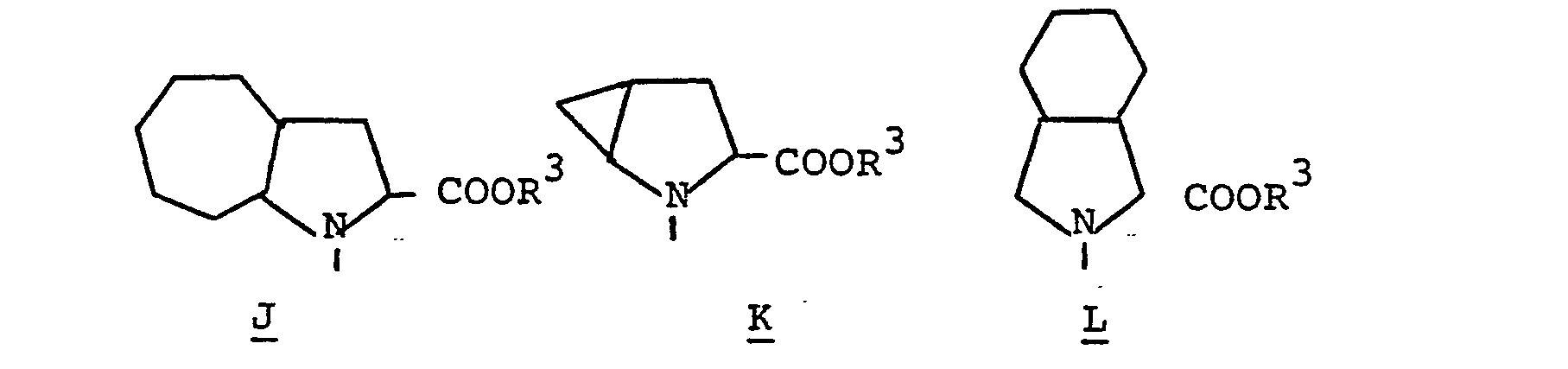

- n= 1 oder 2 ist
- R Wasserstoff,
- Alkyl mit 1 - 8 C-Atomen,
- Alkenyl mit 2 - 6 C-Atomen,
- Cycloalkyl mit 3 - 9 C-Atomen,
- Aryl mit 6 - 12 C-Atomen, das durch (CI-C4)-Alkyl, (CI-C4)-Alkoxy, Hydroxy, Halogen, Nitro, Amino, Aminomethyl, (C1-C4)-Alkyl- amino, Di-(C1-C4)-alkylamino, (C1-C4)-Alkanoyl- amino, Methylendioxy, Carboxy, Cyano und/oder Sulfamoyl, mono-, di- oder trisubstituiert sein kann,
- Alkoxy mit 1 - 4 C-Atomen,
- Aryloxy mit 6 - 12 C-Atomen, das wie oben bei Aryl beschrieben substituiert sein kann,
- Amino-(C1-C4)-alkyl, (C1-C4)-Alkanoylamino-(C1-C4)alkyl, (C7-C13 )-Aroylamino-(C1-C4)-alkyl, (C1-C4)-Alkoxy-carbonylamino-(C1-C4)-alkyl, (C6-C12)-Aryl-(C1-C4)-alkoxycarbonylamino-(C1-C4)-alkyl, (C6-C12)-Aryl-(C1-C4)-alkylamino-(C1-C4)-alkyl, (C1-C4)-Alkylamino-(C1-C4)-alkyl, Di-(C1-C4)-alkylamino-(C1-C4)-alkyl, Guanidino-(C1-C4)-alkyl, Imidazolyl, Indolyl, (C1-C4)-Alkylthio, (C1-C4)-Alkylthio-(C1-C4)-alkyl, (C6-C12)-Arylthio-(C1-C4-alkyl, das im Arylteil wie oben bei Aryl beschrieben, substituiert sein kann, (C 6-C 12)-Aryl-(C1-C4)-alkylthio, das im Arylteil wie oben bei Aryl beschrieben substituiert sein kann, Carboxy-(C1-C4)-alkyl, Carboxy, Carbamoyl, Carbamoyl-(C1-C4)-alkyl, (C1-C4)-Alkoxy-carbonyl-(C1-C4)-alkyl, (C6-C12)-Aryloxy-(C1-C4)-alkyl, das im Arylteil wie oben bei Aryl beschrieben substituiert sein kann oder (C6-C12)-Aryl-(C1-C4)-alkoxy, das im Arylteil wie oben bei Aryl beschrieben substituiert sein kann,
- R1 Wasserstoff, Alkyl mit 1 - 6 C-Atomen, Alkenyl mit 2 - 6 C-Atomen, Alkinyl mit 2 - 6 C-Atomen, Cycloalkyl mit 3 - 9 C-Atomen, Cycloalkenyl mit 5 - 9 C-Atomen, (C3-C9)-Cycloalkyl-(C1-C4)-alkyl, (C5-C9)-Cycloalkenyl-(C1-C4)-alkyl, gegebenenfalls teilhydriertes Aryl mit 6 - 12 C-Atomen, das wie oben bei R beschrieben substituiert sein kann, (C6-C12)-Aryl-(C1-C4)-alkyl oder (C7-C13)-Aroyl-(C 1 oder C2)alkyl die beide wie das vorstehende Aryl substituiert sein können mono- bzw. bicyclisches, gegebenenfalls teilhydriertes Heteroaryl mit 5 - 7 bzw. 8 - 10 Ringatomen, wovon 1 bis 2 Ringatome Schwefel- oder Sauerstoffatome und/oder 1 bis 4 Ringatome Stickstoffatome darstellen, das wie das vorstehende Aryl substituiert sein kann oder die gegebenenfalls geschützte Seitenkette einer natürlich vorkommenden a-Aminosäure R1-CH(NH2)-COOH bedeuten,
- R 2 und R3 gleich oder verschieden sind und Wasserstoffe Alkyl mit 1 - 6 C-Atomen, Alkenyl mit 2 - 6 C-Atomen, Di-(C1-C4)-alkylamino-(C1-C4)-alkyl, (C1-C5)-Alkanoyloxy-(C1-C4)-alkyl, (C1-G6)-Alkoxy-carbonyloxy-(C1-C4)-alkyl, (C7-C13)-Aroyloxy-(C1-C4)-alkyl, (C6-C12)-Aryloxycarbonyloxy(C1-C4)-alkyl, Aryl mit 6 - 12 C-Atomen, (C6-C12)-Aryl-(C1-C4)-alkyl, (C3-C9)-Cycloalkyl oder (C3-C9)-Cycloalkyl-(C1-C4)-alkyl bedeuten und
- R 4 und R5 die oben angegebene Bedeutung haben.
- Besonders bevorzugt ist eine Ausführungsform, die dadurch gekennzeichnet ist, daß Verbindungen der Formel I angewendet werden, in der
- n= 1 oder 2 ist,
- R (C1-C6)-Alkyl, (C2-C6)-Alkenyl, (C3-c9)-Cycloalkyl, Amino-(C1-C4)-alkyl, (C2-C5)-Acylamino-(C1-C4)-alkyl, (C7 C13)-Aroylamino-(C1-C4)-alkyl, (C1-C4)-Alkoxy- carbonylamino-(C1-C4)-alkyl, (C6-C12)-Aryl-(C1-C4)-alkoxycarbonylamino-(C1-C4)-alkyl, (C6-C12)-Aryl, das durch (C1-C4)-Alkyl, (C1-C4)-Alkoxy, Hydroxy, Halogen, Nitro, Amino, (Cl-C4)-Alkylamino, Di-(C1-C4)-alkylamino und/oder Methylendioxy mono-, di- oder trisubstituiert sein kann, oder 3-Indolyl, insbesondere Methyl, Ethyl, Cyclohexyl, tert. Butoxycarbonylamino-(Cl-C4)-alkyl, Benzoyloxycarbonylamino-(C1-C4)-alkyl oder Phenyl, das durch Phenyl, (C1-C2)-Alkyl, (C1 oder C2)-Alkoxy, Hydroxy, Fluor, Chlor, Brom, Amino, (C1-C4)-Alkylamino, Di-(C1-C4)alkylamino, Nitro und/oder Methylendioxy mono- oder disubstituiert oder im Falle von Methoxy, trisubstituiert sein kann, bedeutet,
- R 1 Wasserstoff oder (C1-C6)-Alkyl, das gegebenenfalls durch Amino, (C1-C6)-Acylamino oder Benzoylamino substituiert sein kann, (C2-C6)-Alkenyl, (C3-C 9)-Cycloalkyl, (C5-C9)-Cycloalkenyl, (C3-C 7)-Cycloalkyl-(C1-C4)-alkyl, (C6-C12)-Aryl oder teilhydriertes Aryl, das jeweils durch (C1-C4)-Alkyl, (C1 oder C2)-Alkoxy oder Halogen substituiert sein kann, (C6-C12)-Aryl-(C1 bis C4)-alkyl oder (C7-C13)-Aroyl-(C1-C2)-alkyl, die beide wie vorstehend definiert im Arylrest substituiert sein können, ein mono- bzw. bicyclischer Heterocyclen-Rest mit 5 bis 7 bzw. 8 bis 10 Ringatomen, wovon 1 bis 2 Ringatome Schwefel- oder Sauerstoffatome und/oder 1 bis 4 Ringatome Stickstoffatome darstellen, oder eine Seitenkette einer natürlich vorkommenden, gegebenenfalls geschützten a-Aminosäure, insbesondere aber Wasserstoff, (C1-C3)-Alkyl, (C2 oder C3)-Alkenyl, die gegebenenfalls geschützte Seitenkette von Lysin, Benzyl, 4-Methoxybenzyl, 4-Ethoxybenzyl, Phenethyl, 4-Amino-butyl oder Benzoylmethyl bedeutet,
- R 2 und R3 gleiche oder verschiedene Reste Wasserstoff, (C 1-C6)-Alkyl, (C2-C6)-Alkenyl oder (C6-C12)-Aryl-(C1-C4)-alkyl, insbesondere aber Wasserstoff, (C1-C4)-Alkyl oder Benzyl bedeuten und
- R 4 und R5 die oben angegebene Bedeutung haben.
- Insbesondere bevorzugt ist die Anwendung von Verbindungen der Formel I, in welcher n= 2 ist, R= Phenyl, R 1= Methyl, R2 und R 3 gleiche oder verschiedene (CI-C6)-Alkylreste oder (C7-C10)-Aralkylreste wie Benzyl oder Nitrobenzyl bedeuten und R4 und R5 zusammen für einen Rest der Formel steht,

- Unter Aryl ist hier wie im folgenden vorzugsweise gegebenenfalls substituiertes Phenyl, Biphenylyl oder Naphthyl zu verstehen. Entsprechendes gilt für von Aryl abgeleitete Reste wie Aryloxy, Arylthio. Unter Aroyl wird insbesondere Benzoyl verstanden. Aliphatische Reste können geradkettig oder verzweigt sein.
- Unter einem mono- bzw. bicyclischen Heterocyclen-Rest mit 5 bis 7 bzw. 8 bis 10 Ringatomen, wovon 1 bis 2 Ringatome Schwefel oder Sauerstoffatome und/oder wovon 1 bis 4 Ringatome Stickstoffatome darstellen, wird beispielsweise Thienyl, Benzo[b]thienyl, Furyl, Pyranyl, Benzofuryl, Pyrrolyl, Imidazolyl, Pyrazolyl, Pyridyl, Pyrimidinyl, Pyridazinyl, Indazolyl, Isoindolyl, Indolyl, Purinyl, Chinolizinyl, Isochinolinyl, Phthalazinyl, Naphthyridinyl, Chinoxalinyl, Chinazolyl, Cinnolinyl, Pteridinyl, Oxyzolyl, Isoxazolyl, Thiazolyl oder Isothiazolyl verstanden. Diese Reste können auch teilweise oder vollständig hydriert sein.
- Natürlich vorkommende a-Aminosäuren sind z.B. in Houben-Weyl, Methoden der Organischen Chemie, Bd. XV/1 und XV/2 beschrieben.
- Falls R1 für eine Seitenkette einer geschützten natürlich vorkommenden a-Aminosäure steht, wie z.B. geschütztes Ser, Thr, Asp, Asn, Glu, Gln, Arg, Lys, Hyl, Cys, Orn, Cit, Tyr, Trp, His oder Hyp, sind als Schutzgruppen in der Peptidchemie üblichen Grupppen bevorzugt (vgl. Houben-Weyl, Bd. XV/1 und XV/2). Im Falle, daß R1 die geschützte Lysin-Seitenkette bedeutet, werden die bekannten AminoSchutzgruppen, insbesondere aber Z, Boc oder (C1-C6)-Alkanoyl bevorzugt. Als 0-Schutzgruppen für Tyrosin kommen bevorzugt (C1-C6)-Alkyl, insbesondere Methyl oder Ethyl in Frage.
- Besonders vorteilhaft können die folgenden Verbindungen nach der erfindungsgemäßen Methode angewendet werden:
- N-(1-S-Carbethoxy-3-phenyl-propyl)-S-alanyl-S-1,2,3,4-tetrahydroisochinolin-3-carbonsäure
- N-(1-S-Carbethoxy-3-cyclohexyl-propyl)-S-alanyl-S-1,2,3,4-tetrahydroisochinolin-3-carbonsäure
- N-(1-S-Carbethoxy-3-phenyl-propyl)-S-lysyl-S-1,2,3,4-tetrahydroisochinolin-3-carbonsäure
- N-(1-S-Carbethoxy-3-phenyl-propyl)-0-ethyl-S-tyrosyl-S-1,2,3,4-tetrahydroisochinolin-3-carbonsäure
- N-(1-S-CarbethoxY-3-phenyl-propyl)-S-alanyl-3S-decahydroisochinolin-3-carbonsäure
- N-(1-S-CarbethoxY-3-phenyl-propyl)-S-alanyl-(2S,3aS,7aS)-octahydroindol-2-carbonsäure
- N-(1-S-Carbethoxy-3-cyclohexyl-propyl)-S-alanyl-(2S,3aS, 7aS)-octahydroindol-2-carbonsäure
- N-(1-S-Carbethoxy-3-phenyl-propyl)-S-lysyl-(2S,3aS,7aS)-octahydroindol-2-carbonsäure
- N-(1-S-Carbethoxy-3-cyclohexyl-propyl)-S-lysyl-(2S,3aS, 7aS)-octahydroindol-2-carbonsäure
- N-(1-S-Carbethoxy-3-cyclohexyl-propyl)-S-lysyl-(2S,3aS, 7aS)-octahydroindol-2-carbonsäure
- N-(l-S-Carbethoxy-3-phenyl-propyl)-0-methyl-S-tyrosyl-(2S, 3aS,7aS)-octahydroindol-2-carbonsäure
- N-(1-S-Carbethoxy-3-Phenyl-propyl)-O-ethyl-S-tyrosyl-(2S,3aS,7aS)-octahydroindol-2-carbonsäure
- N-(1-S-Carbethoxy-3-(3,4-dimethylphenyl-propyl)-S-alanyl-(2S,3aS,7aS)-octahydroindol-2-carbonsäure
- N-[1-S-Carbethoxy-3-(4-fluorphenyl)-propyl]-S-alanyl-(2S,3aS,7aS)-octahydroindol-2-carbonsäure
- N-[1-S-Carbethoxy-3-(4-methoxyphenyl)-propyl]-S-alanyl-(2S,3aS,7aS)-octahydroindol-2-carbonsäure
- N-[1-S-Carbethoxy-3-(3,4-dimethoxyphenyl)-propyl]-S-alanyl-(2S,3aS,7aS)-octahydroindol-2-carbonsäure
- N-(1-S-Carbethoxy-3-cyclopentylpropyl)-S-alanyl-(2S,3aS, 7aS)-octahydroindol-2-carbonsäure
- N-(1-S-Carbethoxy-3-phenyl-propyl}-S-alanyl-(2S,3aR,7aS)-octahydroindol-2-carbonsäure
- N-(1-S-Carbethoxy-3-cyclohexyl-propyl)-S-alanyl-(2S,3aR,7aS)-octahydroindol-carbonsäure
- N-(1-S-Carbethoxy-3-phenyl-propyl)-S-lysyl-(2S,3aR,7aS)-octahydroindol-2-carbonsäure
- N-(1-S-Carbethoxy-3-cyclohexyl-propyl)-S-lysyl-(2S,3aR, 7aS)-octahydroindol-2-carbonsäure
- N-(1-S-Carbethoxy-3-phenyl-propyl)-O-ethyl-S-tyrosyl-(2S,3aS,7aR)-octahydroindol-2-carbonsäure
- N-(1-S-Carbethoxy-3-phenyl-propyl)-S-alanyl-(2S,3aR,7aR)-octahydroindol-2-carbonsäure
- N-(1-S-CarbethoxY-3-phenyl-propyl)-S-lysyl-(2S,3aR,7aS)-octahydroindol-2-carbonsäure
- N-(1-S-Carbethoxy-3-cyclohexyl-propyl)-S-alanyl-(2S,3aR, 7aR)-octahydrolndol-2-carbonsäure
- N-(1-S-Carbethoxy-3-cyclohexyl-propyl)-O-ethyl-S-tyrosyl-(2S,3aR,7aR)-octahydroindol-2-carbonsäure
- N-(1-S-Carbethoxy-3-phenyl-propyl)-S-alanyl-(2S,3aS,7aR)-octahydroindol-2-carbonsäure
- N-(1-S-Carbethoxy-3-phenyl-propyl)-O-ethyl-S-tyrosyl-(2S,3aS,7aS)-octahydroindol-2-carbonsäure
- N-(1-S-Carbethoxy-3,4-dimethylphenyl-propyl)-S-alanyl-(2S,3aS,7aS)-octahydroindol-2-carbonsäure
- N-[1-S-CarbethoxY-3-(4-fluorphenyl)-propyl]-S-alanyl-(2S,3aS,7aS)-octahydroindol-2-carbonsäure
- N-[1-S-Carbethoxy-3-(4-methoxyphenyl)-propyl]-S-alanyl-(2S,3aS,7aS)-octahydroindol-2-carbonsäure
- N-[1-S-Carbethoxy-3-(3,4-dimethoxyphenyl)-propyl]-S-alanyl-(2S,3aS,7aS)-octahydroindol-2-carbonsäure
- N-(1-S-Carbethoxy-3-cyclopentylpropyl)-S-alanyl-(2S,3aS, 7aS)-octahydroindol-2-carbonsäure
- N-(1-S-Carbethoxy-3-phenyl-propyl)-S-alanyl-cis-endo-2-azabicyclo[3.3.0]octan-3-S-carbonsäure
- N-(1-S-Carbethoxy-3-phenyl-propyl)-S-lysyl-cis-endo-2-azabicyclo[3.3.0]octan-3-S-carbonsäure
- N-(1-S-Carbethoxy-3-cyclohexyl-propyl)-S-alanyl-cis-endo-2-azabicyclo[3.3.0]octan-3-S-carbonsäure
- N-(1-S-Carboxy-3-cyclohexyl-propyl)-S-alanyl-cis-endo-2-azabicyclo[3.3.0]octan-3-S-carbonsäure
- N-(1-S-Carbethoxy-butyl)-S-alanyl-cis-endo-2-azabicyclo-[3.3.0]octan-3-S-carbonsäure
- N-(1-S-Carbethoxy-3-(3,4-dimethoxyphenylpropyl)-S-alanyl- cis-endo-2-azabicyclo[3.3.0]octan-3-S-carbonsäure
- N-(1-S-Carbethoxy-3-cyclopentyl-propyl)-S-alanyl-cis-endo- azabicyclo-[3.3.0]octan-3-S-carbonsäure
- N-(1-S-Carbethoxy-3-phenyl-propyl)-O-methyl-S-tyrosyl- cis-endo-2-azabicyclo[3.3.0]octan-3-S-carbonsäure
- N-(1-S-Carbethoxy-3-phenyl-propyl)-O-ethyl-S-tyrosyl- cis-endo-2-azabicyclo[3.3.0]octan-3-S-carbonsäure
- N-(1-S-Carbethoxy-3-(4-fluorphenyl-propyl)-S-alanyl- cis-endo-azabicyclo[3.3.0]octan-3-S-carbonsäure
- N-(1-S-Carbethoxy-3-(4-methoxyphenyl-propyl)-S-alanyl- cis-endo-2-azabicyclo[3.3.0]octan-3-S-carbonsäure
- N-(1-S-Carbethoxy-3-phenyl-propyl)-S-lysyl-(2S,3aR,6aS)-octahydrocyclopenta[b]pyrrol-2-carbonsäure
- N-(1-S-CarbethoxY-3-cyclohexylpropyl)-lysyl-(2s,3a,6aS)-octahydrocyclopenta[b]pyrrol-2-carbonsäure
- N-(1-S-Carbethoxy-3-phenyl-propyl)-O-ethyl-S-tyrosyl-(2S, 3aR,6aS)-octahydrocyclopenta[b]pyrrol-2-carbonsäure
- N-(1-S-Carbethoxy-3-phenyl-propyl)-S-alanyl-2-(2S,3aR,6aS)-octahydrocyclopenta[b]pyrrol-2-carbonsäure
- N-(1-S-Carbethoxy-3-phenyl-propyl)-S-alanyl-2-azaspiro-[4,5]decan-3-S-carbonsäure
- N-(1-S-Carbethoxy-3-phenyl-propyl)-O-ethyl-2-tyrosyl- azaspiro-[4,5]decan-3-S-carbonsäure
- N-(1-S-Carbethoxy-3-phenyl-propyl)-S-lysyl-2-azaspiro-[4,5 Jdecan-3-S-carbonsäure
- N-(l-S-Carbethoxy-3-cyclohexylpropyl)-S-alanyl-2-azaspiro [4,5]decan-3-S-carbonsäure
- N-(1-S-Carbethoxy-3-cyclohexylpropyl)-S-lysyl-2-azaspiro-[4,5]decan-3-S-carbonsäure
- N-(1-S-Carbethoxy-3-phenyl-propyl)-S-alanyl-2-azaspiro-[4,4]nonan-3-S-carbonsäure
- N-(l-S-Carbethoxy-3-phenyl-propyl)-0-ethyl-S-tyrosyl-2- azaspiro[4,4]nonan-3-S-carbonsäure
- N-(1-S-Carbethoxy-3-phenyl-propyl)-S-lysyl-2-azaspiro-[4,4]nonan-3-S-carbonsäure
- N-(1-S-Carbethoxy-3-cyclohexyl-propyl)-S-alanyl-2-aza- spiro[4,4]nonan-3-S-carbonsäure
- N-(1-S-Carbethoxy-3-cyclopentyl-propyl)-S-alanyl-2-aza- spiro[4,4]nonan-3-S-carbonsäure
- N-(1-S-Carbethoxy-3-cyclopentyl-propyl)-S-lysyl-2-aza- spiro[4,4]nonan-3-S-carbonsäure
- N-(1-S-Carbethoxy-3-phenyl-propyl)-S-alanyl-splro[bicyclo-[2.2.1]heptan-2,3'-pyrrolid1n]-S'-3-carbonsäure
- N-(1-S-Carbethoxy-3-phenyl-propyl)-0-ethyl-S-tyrosyl- spiro[bicyclo[2.2.1]heptan-2,3'-pyrrolidin]-5'-S-carbonsäure
- N-(1-S-Carbethoxy-3-phenyl-propyl)-S-lysyl-spiro(bicyclo-[2.2. 1]heptan-2,3'-pyrrolidin]-5'-S-carbonsäure
- N-(1-S-Carbethoxy-3-cyclohexyl-propyl)-S-alanyl-spiro-[bicyclo[2.2.1]heptan-2,3'-pyrrolidin]5'-S-carbonsäure N-(1-S-Carbethoxy-3-cyclohexyl-propyl)-S-lysyl-spiro-[bicyclo[2.2.1]heptan-2,3'-pyrrolidin]-5'-S-carbonsäure N-(1-S-Carbethoxy-3-phenyl-propyl)-S-alanyl-spiro-[bicyclo[2.2.2]octan-2,3'-pyrrolidin]-5'-S-carbonsäure
- N-(1-S-Carbethoxy-3-phenyl-propyl)-0-ethyl-tyrosyl-spiro-[bicyclo[2.2.2]octan-2,3'-pyrrolidin]-5'-S-carbonsäure N-(1-S-Carbethoxy-3-phenyl-propyl)-S-lysyl-spiro[bicyclo-[2.2.2]octan-2,3'-pyrrolidin]-5'-S-carbonsäure
- N-(l-S-Carbethoxy-3-cyclohexyl-propyl)-S-alanyl-spiro-[bicyclo[2.2.2]octan-2,3'-pyrrolidin]-5'-S-carbonsäure N-(1-S-Carbethoxy-3-phenyl-propyl)-S-alanyl-2-azatricyclo-(4,3,0,16,9]decan-3-S-carbonsäure
- N-(1-S-Carbethoxy-3-phenyl-propyl)-O-ethyl-S-tyrosyl-2- azatricyclo[4,3,0,16,9]decan-3-S-carbonsäure
- N-(1-S-Carbethoxy-3-phenyl-propyl)-S-lysyl-2-azatricyclo-[4,3,0,1 6,9]decan-3-S-carbonsäure
- N-(1-S-Carbethoxy-3-cyclohexyl-propyl)-S-alanyl-2-azatri- cyclo[4,3,0,16,9]decan-3-S-carbonsäure
- N-(1-S-Carbethoxy-3-cyclohexyl-propyl)-S-lysyl-2-azatricyclo-[4,3,0,16,9]decan-3-S-carbonsäure
- N-(1-S-Carbethoxy-3-phenyl-propyl)-S-alanyl-decahydro- cyclohepta[b]pyrrol-2-S-carbonsäure
- N-(1-S-Carbethoxy-3-phenyl-propyl)-0-ethyl-S-tyrosyl- decahydrocyclophepta[b]pyrrol-2-S-carbonsäure
- N-(1-S-Carbethoxy-3-phenyl-propyl)-S-lysyl-decahydro- cyclohepta[b]pyrrol-2-S-carbonsäure
- N-(1-S-Carbethoxy-3-cyclohexyl-propyl)-S-alanyl-deca- hydrocyclohepta[b]pyrrol-2-S-carbonsäure
- N-(1-S-Carbethoxy-3-cyclohexyl-propyl)-S-lysyl-decahydro- cyclohepta[b]pyrrol-2-S-carbonsäure
- N-(1-S-Carbethoxy-3-phenyl-propyl)-S-alanyl-trans-octahydroisoindol-1-S-carbonsäure
- N-(1-S-Carbethoxy-3-phenyl-propyl)-S-alanyl-cis-octahydroisoindol-l-S-carbonsäure
- N-(1-S-Carbethoxy-3-cyclohexyl-propyl)-S-alanyl-trans- octahydroisoindol-1-S-carbonsäure
- N-(l-S-Carbethoxy-3-cyclohexyl-propyl)-S-alanyl-cis-octa- hydroisoindol-l-S-carbonsäure
- N-(1-S-Carbethoxy-3-phenyl-propyl)-S-alanyl-cis-octahydrocyclopenta[c]pyrrol-1-S-carbonsäure
- N-(1-S-Carbethoxy-3-cyclohexyl-propyl)-S-alanyl-cis-octahydrocyclopenta[c]pyrrol-1-S-carbonsSure-benzylester
- N-(1-S-Carbethoxy-3-cyclohexyl-propyl)-S-lysyl-cis-octahydrocyclopenta[c]pyrrol-l-S-carbonsäure
- N-(1-S-Carbethoxy-3-phenyl-propyl)-S-alanyl-2,3,3a,4,5,7a-hexahydroindol-cis-endo-2-S-carbonsäure
- N-(1-S-Carbethoxy-3-phenyl-propyl)-S-lysyl-2,3,3a,4,5,7a-hexahydroindol-cis-endo-2-S-carbonsäure
- N-(1-S-Carbethoxy-3-cyclohexyl-propyl)-S-lysyl-2-azabi- cyclo[3.1.0Jhexan-3-S-carbonsäure
- N-(1-S-Carboxy-3-phenyl-propyl)-S-lysyl-2-azabicyclo-[3.1.0]hexan-eis-endo-3-S-carbonsäure
- N-(l-S-Carbethoxy-3-cyclopentylpropyl)-S-alanyl-2-aza- bicylco[3.1.0]hexan-3-carbonsäure
- N-(1-S-Carbethoxy-3-phenyl-propyl)-S-alanyl-cis-endo-2-azabicyclo[3.l.0]hexan-3-S-carbonsäure
- N-(1-S- Garbethoxy-3-cyclohexyl-propyl)-S-alanyl-cis-endo-2-azabicyclo[3.1.0]hexan-3-S-carbonsäure
- Diese Verbindungen lassen sich z.B. nach dem in der deutschen Patentanmeldung P 33 33 455.2 beschriebenen Verfahren herstellen, in dem die in der Anmeldung beschriebenen tert. Butyl- oder Benzylreste in bekannter Weise durch saure oder alkalische Hydrolyse oder durch Edelmetall-katalysierte Hydrogenolyse in die Monocarbonsäurederivate überführt werden. Die Nε-Benzyloxycarbonylschutzgruppe der Lysinderivate wird durch Edelmetall-katalysierte Hydrogenolyse entfernt. Die oben aufgeführten Verbindungen lassen sich leicht mit physiologisch verträglichen Säuren oder Basen (im Falle von Mono- oder Dicarbonsäuren) in die entsprechenden Salze (z.B. Hydrochloride, Maleinate, Fumarate, etc.) überführen und als Salze die erfindungsgemäße Verwendung finden.
- Die Verbindungen der Formel I sind Hemmstoffe des Angiotensin Converting Enzymes (ACE) beziehungsweise Zwischenprodukte bei der Herstellung von solchen Hemmstoffen und können auch zur Bekämpfung des Bluthochdrucks verschiedener Genese eingesetzt werden. Die Verbindungen der Formel I sind bekannt aus DE-OS 3211397, DE-OS 3227055, E-PA-46953, E-PA-79022, E-PA-84164, E-PA89637, E-PA-90362. Sie sind weiterhin Gegenstand der deutschen Patentanmeldungen P 32 42 151.6, P 32 46 503.3, P 32 46 757.5, P 33 00 774.8 und P 33 24 263.1.
- In Ausübung der erfindungsgemäßen Methode können die oben beschriebenen Angiotensin Converting Enzyme-Inhibitoren an Säugern wie Affen, Hunden, Katzen, Ratten, Menschen etc. angewendet werden. Die für die erfindungsgemäße Verwendung geeigneten Verbindungen werden zweckmäßig in üblicher Weise in pharmazeutische Präparate eingearbeitet. Sie können in die üblichen Verabreichungsformen, wie Kapseln, Tabletten, Dragees, Lösungen, Salben, Emulsionen und auch in Depot-Form gebracht werden. Der Wirkstoff kann gegebenenfalls auch in mikroverkapselter Form vorliegen. Die Präparate können verträgliche, organische bzw. anorganische Begleitstoffe, beispielsweise Granulierstoffe, Klebe- und Bindemittel, Gleitmittel, Suspendiermittel, Lösungsmittel, antibakterielle Mittel, Netzmittel und Konservierungsmittel enthalten. Orale und parenterale Anwendungsformen werden bevorzugt. Die Verbindungen der Formel I können in Dosierungen von 0,1 - 50 mg pro Dosis ein- bis dreimal täglich verabreicht werden.
- Die Wirksamkeit der Verbindungen der Formel I bei verschiedenen Formen der Herzinsuffizienz kann aus ihrer Wirkung in verschiedenen Testmodellen abgeleitet werden. Als Beispiele sollen im folgenden jeweils die Ergebnisse mit N-(1-S-Carbethoxy-3-phenyl-propyl)-S-alanyl-cis-endo-2-azabicyclo[3,3,0]octan-3-S-carbonsäure (Formel II) dienen.

- Orale Behandlung an spontan hypertonen Ratten mit einer einmaligen Dosis von 1 mg/kg hemmt das ACE im Herzen länger als 24 Stunden signifikant. Dagegen wird mit 30 mg/kg N-(1-Carbethoxy-3-phenyl-propyl)-S-alanyl-S-prolin (Enalapril) per os bereits nach mehr als 6 Stunden keine signifikante Hemmung mehr beobachtet. Chronische orale Behandlung von spontan hypertensiven Ratten über zwei Wochen mit 1 mg/kg der Verbindung der Formel II führt am Ende der Behandlung zu einer 55 %igen Hemmung des ACE im Herzen, mit 30 mg/kg Enalapril per os wird dagegen unter sonst gleichen Bedingungen keine Hemmung beobachtet. Zusätzlich führt die systemische Blutdrucksenkung, die durch Verbindungen der Formel I hervorgerufen wird, zu einer Nachlastsenkung und damit zu einer Entlastung des insuffizienten Herzens.
- Postganglionäre sympathische Stimulation am isolierten Herzen führt über gesteigerte Catecholamin-Freisetzung zum Anstieg von Herzfrequenz, Kontraktionskraft und zu einem Abfall der Coronardurchströmung. Orale Vorbehandlung mit 1 mg/kg per os der Verbindung der Formel I an Kaninchen vermindert signifikant den Einfluß auf Herzfrequenz und Coronardurchströmung, läßt jedoch die Kontraktionskraft unbeeinflußt. Diese Effekte wirken zum Schutz des insuffizienten Herzens zusammen.
- Angiotensin I vermindert, Bradykinin dagegen verstärkt die Coronardurchströmung am isolierten Herzen von Kaninchen, Meerschweinchen und Ratten. Orale Vorbehandlung der Tiere mit 1 mg/kg der Verbindung der Formel I peroral vermindert den Effekt von Angiotensin I und steigert die Wirkung von Bradykinin signifikant. Ein gleicher Effekt kann erst mit 30 mg/kg Enalapril erreicht werden.
- Die folgenden Beispiele geben die Anwendungsformen zur Behandlung der Herzinsuffizienz nach der erfindungsgemäßen Methode an. Die Verbindungen der Formel I können analog den Beispielen in die entsprechenden Anwendungsformen gebracht werden.
- Herstellung des erfindungsgemäß verwendeten Mittels zur oralen Anwendung in der Behandlung der Herzinsuffizenz.
- 1000 Tabletten, die je 10 mg 1-N-(1-S-Carbethoxy-3-phenyl-propyl)-S-alanyl-lS,3S,5S-2-azabicyclo[3.3.0]-octan-3-carbonsäure enthalten, werden mit den folgenden Hilfsmitteln hergestellt:

- N-(1-S-Carbethoxy-3-phenyl-propyl)-S-alanyl-1S,3S-5S,-2-azabicyclo[3.3.0]octan-3-carbonsäure und Maisstärke werden mit einer wäßrigen Gelatine-Lösung gemischt. Die Mischung wird getrocknet und zu einem Granulat vermahlen. Mikrokristalline Cellulose und Magnesiumstearat werden mit dem Granulat vermischt. Das entstandene Granulat wird zu 1000 Tabletten gepreßt, wobei jede Tablette 10 mg des ACE-Hemmers enthält.
- Diese Tabletten können zur Behandlung der Herzinsuffizenz verwendet werden.
- Analog Beispiel 1 werden 1000 Tabletten hergestellt, die je 10 mg N-(1-S-CarbethoxY-3-phenyl-propyl)-S-alanyl-(2S,3aR,7aS)-octahydroindol-2-carbonsäure-hydrochlorid enthalten.
- Gelatine-Kapseln, die je 10 mg N-(1-S-Carbethoxy-3-Phenylpropyl)-S-alanyl-lS,3S,5S-2-azabicyclo[3.3.0]octan-3-carbonsäure enthalten, werden mit der folgenden Mischung gefüllt:

- Diese Kapseln können zur Behandlung der Herzinsuffizienz verwendet werden.
- Die Herstellung einer Injektionslösung zur Behandlung der Herzinfuffizenz wird im folgenden beschrieben:

- N-(1-S-Carboxy-3-phenyl-propyl)-S-alanyl-1S,3S,5S-2-aza- bicyclo[3.3.0]octan-3-carbonsäure, die Konservierungsstoffe und Natriumchlorid werden in 3 1 Wasser für Injektion gelöst und auf 5 1 mit Wasser für Injektion aufgefüllt. Die Lösung wird steril gefiltert und aseptisch in vorsterilisierte Flaschen gefüllt, die mit sterilisierten Gummikappen verschlossen werden. Jede Flasche enthält 5 ml Lösung.
- Tabletten, die zur Behandlung der Herzinsuffizenz verwendet werden können, werden wie in Beispiel 1 beschrieben hergestellt, mit der Ausnahme, daß anstelle von N-(1-S-Carbethoxy-3-phenyl-propyl)-S-alanyl-1S,3S,5S-2-azabi- cyclo[3.3.0]octan-3S-carbonsaure N-(1-S-Carboxy-3-phenyl-propyl)-S-alanyl-1S,3S,5S-2-azabicyclo[3.3.0]octan-3-carbonsäure oder N-(1-S-Carboxy-3-phenyl-propyl)-S-alanyl-2S,3aR,7aS- octahydroindol-2-carbonsäure oder N-(1-S-Carbethoxy-3phenyl-propyl)-S-alanyl-cis-2,3,3a,-4,5,7a-hexahydro[lH]indol-2-S-endo-carbonsäure oder N-(1-S-Carboxy-3-phenyl-propyl)-S-alanyl-cis-2,3,4a,4, 5,7a-hexahydro[1H]indol-2S-endo-carbonsäure oder N-(1-S-Carboxy-3-phenyl-propyl)-S-lysyl-1S,3S,5S-2-aza- bicyclo[3.3.0]octan-3-carbonsäure oder N-(1-S-Carbethoxy-3-cyclohexyl-propyl)-S-alanyl-1S,3S,5S-2-azabieyclo[3.3.0]oetan-3-carbonsäure oder N-(1-S-Carboxy-3-cyclohexyl-propyl)-S-lysyl-1S-3S,5S-2-azabicylco[3.3.0]octan-3-carbonsäure angewendet werden.
- Eine Injektionslösung wird analog der in Beispiel 4 beschriebenen Vorschrift hergestellt, mit der Ausnahme, daß anstelle von N-(1-S-Carbethoxy-3-phenyl-propyl)-S-alanyl-1S,3S,5S-2-azabicyclo[3.3.0]octan-3-carbonsäure N-(1-S-Carboxy-3-phenyl-propyl)-S-alanyl-lS,3S,5S-2-azabicyclo[3.3.0]octan-3-carbonsäure oder N-(1-S-Carbethoxy-3-phenyl-propyl)-S-alanyl-2S,3aR,7aS- octahydroindol-2-carbonsäurehydrochlorid oder N-(1-S-Carboxy-3-phenyl-propyl)-S-alanyl-2S,3aR,7aS-octa- hydroindol-2-carbonsäure oder N-(1-S-Carbethoxy-3-cyclohexyl-propyl)-S-alanyl-cis-2,3,3a,4,5,7a-hexahydro[lH]indol-2-S-endo-carbonsäure oder N-(1-S-Carboxy-3-phenyl-propyl}-S-alanyl-cis-2,3,3a,4,5,7a-hexahydro[lH]indol-2-S-endo-carbonsäure oder N-(l-Carboxy-3-phenyl-propyl)-S-lysyl-lS,3S,5S-2-azabi- cyclo[3.3.0]octan-3-carbonsäure oder N-(1-S-Carbethoxy-3-cyclohexyl}-S-alanyl-1S,3S,5S-2-aza- blcyclo[3.3.0]octan-3-carbonsäure oder N-(1-S-Carboxy-3-cyclohexyl-propyl)-S-lysyl-lS,3S,5S-2-azabicyclo[3.3.0]oetan-3-carbonsäure angewendet werden.
Claims (10)

Priority Applications (2)
| Application Number | Priority Date | Filing Date | Title |
|---|---|---|---|
| EP93102949A EP0551927B1 (de) | 1984-04-12 | 1985-04-03 | Verfahren zur Behandlung der Herzinsuffizienz |
| AT85104028T ATE98128T1 (de) | 1984-04-12 | 1985-04-03 | Verfahren zur behandlung der herzinsuffizienz. |
Applications Claiming Priority (2)
| Application Number | Priority Date | Filing Date | Title |
|---|---|---|---|
| DE19843413710 DE3413710A1 (de) | 1984-04-12 | 1984-04-12 | Verfahren zur behandlung der herzinsuffizienz |
| DE3413710 | 1984-04-12 |
Related Child Applications (2)
| Application Number | Title | Priority Date | Filing Date |
|---|---|---|---|
| EP93102949A Division EP0551927B1 (de) | 1984-04-12 | 1985-04-03 | Verfahren zur Behandlung der Herzinsuffizienz |
| EP93102949.0 Division-Into | 1993-02-25 |
Publications (3)
| Publication Number | Publication Date |
|---|---|
| EP0158927A2 true EP0158927A2 (de) | 1985-10-23 |
| EP0158927A3 EP0158927A3 (en) | 1989-03-22 |
| EP0158927B1 EP0158927B1 (de) | 1993-12-08 |
Family
ID=6233316
Family Applications (2)
| Application Number | Title | Priority Date | Filing Date |
|---|---|---|---|
| EP93102949A Expired - Lifetime EP0551927B1 (de) | 1984-04-12 | 1985-04-03 | Verfahren zur Behandlung der Herzinsuffizienz |
| EP85104028A Expired - Lifetime EP0158927B1 (de) | 1984-04-12 | 1985-04-03 | Verfahren zur Behandlung der Herzinsuffizienz |
Family Applications Before (1)
| Application Number | Title | Priority Date | Filing Date |
|---|---|---|---|
| EP93102949A Expired - Lifetime EP0551927B1 (de) | 1984-04-12 | 1985-04-03 | Verfahren zur Behandlung der Herzinsuffizienz |
Country Status (9)
| Country | Link |
|---|---|
| US (2) | US5403856A (de) |
| EP (2) | EP0551927B1 (de) |
| JP (1) | JPH0745410B2 (de) |
| AT (2) | ATE98128T1 (de) |
| AU (1) | AU585502B2 (de) |
| CA (1) | CA1246457A (de) |
| CY (1) | CY2163B1 (de) |
| DE (3) | DE3413710A1 (de) |
| ZA (1) | ZA852685B (de) |
Cited By (5)
| Publication number | Priority date | Publication date | Assignee | Title |
|---|---|---|---|---|
| EP0317878A1 (de) * | 1987-11-24 | 1989-05-31 | Hoechst Aktiengesellschaft | Stabilisierte Arzneistoffe, Verfahren zu ihrer Herstellung sowie stabile Arzneizubereitungen |
| EP0214570A3 (de) * | 1985-09-09 | 1989-11-15 | Hoechst Aktiengesellschaft | Neue N-alkylierte Tripeptide, Verfahren zu ihrer Herstellung, sie enthaltende Medikamente und deren Verwendung |
| EP0325160A3 (de) * | 1988-01-21 | 1990-08-22 | Hoechst Aktiengesellschaft | Neue Aminosäureglyceride, Verfahren zu ihrer Herstellung, sie enthaltende Arzneimittel und deren Verwendung |
| US6086919A (en) * | 1994-09-02 | 2000-07-11 | Astra Aktiebolag | Pharmaceutical composition containing the ace inhibitor ramipril and a dihydropyridine compound |
| EP1925303A2 (de) | 1999-08-27 | 2008-05-28 | Sanofi-Aventis Deutschland GmbH | Verwendung von Angiotensin II Typ 1 Rezeptor-Antagonisten zur Prophylaxe von Schlaganfall, Diabetes und kongestivem Herzversagen |
Families Citing this family (8)
| Publication number | Priority date | Publication date | Assignee | Title |
|---|---|---|---|---|
| DE3633496A1 (de) * | 1986-10-02 | 1988-04-14 | Hoechst Ag | Kombination von angiotensin-converting-enzyme-hemmern mit calciumantagonisten sowie deren verwendung in arzneimitteln |
| HUP0203326A3 (en) * | 1999-08-30 | 2003-04-28 | Sanofi Aventis Deutschland | Use of inhibitors of the renin-angiotensin system in the prevention of cardiovascular events |
| US20050032784A1 (en) * | 2003-04-01 | 2005-02-10 | University Of Florida Research Foundation, Inc. | Combination drug therapy for treating hypertension |
| WO2006052968A2 (en) * | 2004-11-05 | 2006-05-18 | King Pharmaceuticals Research & Development, Inc. | Stabilized ramipril compositions and methods of making |
| AU2007291602B2 (en) * | 2006-08-28 | 2012-09-06 | Sanofi-Aventis Deutschland Gmbh | Methods of lowering glucose levels |
| GB0624090D0 (en) * | 2006-12-01 | 2007-01-10 | Selamine Ltd | Ramipril amine salts |
| GB0624084D0 (en) * | 2006-12-01 | 2007-01-10 | Selamine Ltd | Ramipril amino acid salts |
| GB0624087D0 (en) * | 2006-12-01 | 2007-01-10 | Selamine Ltd | Ramipril combination salt |
Family Cites Families (55)
| Publication number | Priority date | Publication date | Assignee | Title |
|---|---|---|---|---|
| JPS5572169A (en) * | 1978-11-27 | 1980-05-30 | Tanabe Seiyaku Co Ltd | Isoquinoline derivative and its preparation |
| IL58849A (en) * | 1978-12-11 | 1983-03-31 | Merck & Co Inc | Carboxyalkyl dipeptides and derivatives thereof,their preparation and pharmaceutical compositions containing them |
| US4294832A (en) * | 1979-04-28 | 1981-10-13 | Tanabe Seiyaku Co., Ltd. | Tetrahydroisoquinoline compounds and a pharmaceutical composition thereof |
| FR2491469A1 (fr) * | 1980-10-02 | 1982-04-09 | Science Union & Cie | Nouveaux imino diacides substitues, leurs procedes de preparation et leur emploi comme inhibiteur d'enzyme |
| FR2503155A2 (fr) * | 1980-10-02 | 1982-10-08 | Science Union & Cie | Nouveaux imino diacides substitues, leurs procedes de preparation et leur emploi comme inhibiteur d'enzyme |
| US4508729A (en) * | 1979-12-07 | 1985-04-02 | Adir | Substituted iminodiacids, their preparation and pharmaceutical compositions containing them |
| FR2487829A2 (fr) * | 1979-12-07 | 1982-02-05 | Science Union & Cie | Nouveaux imino acides substitues, leurs procedes de preparation et leur emploi comme inhibiteur d'enzyme |
| US4350704A (en) * | 1980-10-06 | 1982-09-21 | Warner-Lambert Company | Substituted acyl derivatives of octahydro-1H-indole-2-carboxylic acids |
| IE52663B1 (en) * | 1980-04-02 | 1988-01-20 | Warner Lambert Co | Substituted acyl derivatives of octahydro-1h-indole-2-carboxylic acids |
| DE3032709A1 (de) * | 1980-08-30 | 1982-04-29 | Hoechst Ag, 6000 Frankfurt | Aminosaeurederivate, verfahren zu ihrer herstellung, diese enthaltende mittel und deren verwendung |
| DE3177130D1 (de) * | 1980-08-30 | 1990-01-11 | Hoechst Ag | Aminosaeurederivate, verfahren zu ihrer herstellung, diese enthaltende mittel und deren verwendung. |
| IL63813A0 (en) * | 1980-09-17 | 1981-12-31 | Univ Miami | Carboxyalkyl peptides and thioethers and ethers of peptides,antihypertensive compositions and methods for their use |
| EP0048159A3 (de) * | 1980-09-17 | 1982-05-12 | University Of Miami | Carboxyalkyl-Peptide und Thioäther und Äther von Peptiden als antihypertensive Mittel |
| US4344949A (en) * | 1980-10-03 | 1982-08-17 | Warner-Lambert Company | Substituted acyl derivatives of 1,2,3,4-tetrahydroisoquinoline-3-carboxylic acids |
| ZA817261B (en) * | 1980-10-23 | 1982-09-29 | Schering Corp | Carboxyalkyl dipeptides,processes for their production and pharmaceutical compositions containing them |
| EP0050800B2 (de) * | 1980-10-23 | 1995-06-07 | Schering Corporation | Carboxyalkyl-Dipeptide, Verfahren zu ihrer Herstellung und diese enthaltende Arzneimittel |
| US4374847A (en) * | 1980-10-27 | 1983-02-22 | Ciba-Geigy Corporation | 1-Carboxyalkanoylindoline-2-carboxylic acids |
| GB2086390B (en) * | 1980-11-03 | 1984-06-06 | Ciba Geigy Ag | 1-carboxy-azaalkanoylindoline-2-carboxylic acids process for their manufacture pharmaceutical preparations containing these compounds and their therapeutic application |
| US4462943A (en) * | 1980-11-24 | 1984-07-31 | E. R. Squibb & Sons, Inc. | Carboxyalkyl amino acid derivatives of various substituted prolines |
| US4425355A (en) * | 1981-02-17 | 1984-01-10 | Warner-Lambert Company | Substituted acyl derivatives of chair form of octahydro-1H-indole-2-carboxylic acids |
| US4820729A (en) * | 1981-03-30 | 1989-04-11 | Rorer Pharmaceutical Corporation | N-substituted-amido-amino acids |
| EP0065301A1 (de) * | 1981-05-18 | 1982-11-24 | Merck & Co. Inc. | Derivate der Isochinolin-Carbonsäuren, Verfahren zu ihrer Herstellung und diese enthaltendes Arzneimittel |
| DE3134933A1 (de) * | 1981-09-03 | 1983-03-31 | Hoechst Ag, 6230 Frankfurt | "harnstoffderivate, verfahren zu ihrer herstellung und diese enthaltende medikamente sowie deren verwendung" |
| DE3226768A1 (de) * | 1981-11-05 | 1983-05-26 | Hoechst Ag, 6230 Frankfurt | Derivate der cis, endo-2-azabicyclo-(3.3.0)-octan-3-carbonsaeure, verfahren zu ihrer herstellung, diese enthaltende mittel und deren verwendung |
| SU1327787A3 (ru) * | 1981-11-05 | 1987-07-30 | Хехст Аг (Фирма) | Способ получени цис,эндо-2-азабицикло-/3,3,0/-октан-3-карбоновых кислот или их кислотно-аддитивных солей |
| EP0079521A1 (de) * | 1981-11-09 | 1983-05-25 | Merck & Co. Inc. | Verfahren zur Herstellung von Carboxyalkyldipeptidderivaten |
| EP0080822A1 (de) * | 1981-11-27 | 1983-06-08 | Beecham Group Plc | Antihypertensive auf Prolin basierende Peptide |
| NZ202903A (en) * | 1981-12-29 | 1988-01-08 | Hoechst Ag | 1-- pe pyrrol-2-yl-carboxylic acid derivatives and pharmaceutical compositions |
| US4431644A (en) * | 1982-03-08 | 1984-02-14 | Schering Corporation | Antihypertensive agents |
| DE3210496A1 (de) * | 1982-03-23 | 1983-10-06 | Hoechst Ag | Neue derivate bicyclischer aminsaeuren, verfahren zu ihrer herstellung, diese enthaltende mittel und deren verwendung sowie neue bicyclische aminosaeuren als zwischenstufen und verfahren zu deren herstellung |
| DE3211397A1 (de) * | 1982-03-27 | 1983-11-10 | Hoechst Ag, 6230 Frankfurt | Spiro (4.(3+n))-2-aza-3-carbonsaeure-derivate, verfahren zu ihrer herstellung, diese enthaltende mittel und ihre verwendung |
| DE3211676A1 (de) * | 1982-03-30 | 1983-10-06 | Hoechst Ag | Neue derivate von cycloalka (c) pyrrol-carbonsaeuren, verfahren zu ihrer herstellung, diese enthaltende mittel und deren verwendung sowie neue cycloalka (c) pyrrol-carbonsaeuren als zwischenstufen und verfahren zu deren herstellung |
| US4442089A (en) * | 1982-07-06 | 1984-04-10 | E. R. Squibb & Sons, Inc. | Method for treating glaucoma with topical or systemic ACE inhibitor compositions |
| DE3242151A1 (de) * | 1982-11-13 | 1984-05-17 | Hoechst Ag, 6230 Frankfurt | Neue derivate tricyclischer aminosaeuren, verfahren zu ihrer herstellung, diese enthaltende mittel und deren verwendung, sowie neue bicyclische aminosaeuren als zwischenstufen und verfahren zu deren herstellung |
| DE3246503A1 (de) * | 1982-12-16 | 1984-06-20 | Hoechst Ag, 6230 Frankfurt | Derivate der cis, endo-2-azabicyclo-(5.3.0)-decan-3-carbonsaeure, verfahren zu ihrer herstellung, diese enthaltende mittel und deren verwendung |
| DE3300316A1 (de) * | 1983-01-07 | 1984-07-12 | Hoechst Ag, 6230 Frankfurt | Disubstituierte prolinderivate, verfahren zu ihrer herstellung und ihre verwendung |
| DE3300774A1 (de) * | 1983-01-12 | 1984-07-12 | Hoechst Ag, 6230 Frankfurt | Neue spirocyclische aminosaeuren, verfahren zu ihrer herstellung, diese enthaltende mittel und deren verwendung sowie neue spirocyclische aminosaeuren als zwischenprodukte und verfahren zu deren herstellung |
| EP0115091A1 (de) * | 1983-01-27 | 1984-08-08 | ENI-Ente Nazionale Idrocarburi | N-Carboxyacyl-Derivate von cyclischen Aminosäuren als Antihypertensive nutzbar |
| DE3303112A1 (de) * | 1983-01-31 | 1984-08-09 | Hoechst Ag, 6230 Frankfurt | Verfahren zur racemattrennung optisch aktiver bicyclischer imino-(alpha)-carbonsaeuren |
| DE3315464A1 (de) * | 1983-04-28 | 1984-10-31 | Hoechst Ag, 6230 Frankfurt | Verfahren zur herstellung von n-alkylierten dipeptiden und deren estern |
| US4584285A (en) * | 1983-06-02 | 1986-04-22 | Schering Corporation | Antihypertensive agents |
| DE3322530A1 (de) * | 1983-06-23 | 1985-01-10 | Hoechst Ag, 6230 Frankfurt | Verfahren zur herstellung von mono-, bi- und tricyclischen aminosaeuren |
| DE3324263A1 (de) * | 1983-07-06 | 1985-01-17 | Hoechst Ag, 6230 Frankfurt | Derivate der 2-azabicyclo(3.1.0)hexan-3-carbonsaeure, verfahren zu ihrer herstellung, diese enthaltende mittel und deren verwendung sowie 2-azabicyclo(3.1.0)hexan-derivate als zwischenprodukte und verfahren zu deren herstellung |
| DE3345355A1 (de) * | 1983-12-15 | 1985-06-27 | Hoechst Ag, 6230 Frankfurt | Verfahren zur racematspaltung bicyclischer imino-(alpha)-carbonsaeureester |
| DE3410732A1 (de) * | 1984-03-23 | 1985-09-26 | Hoechst Ag, 6230 Frankfurt | Methode zur behandlung des glaukoms |
| US4678800A (en) * | 1984-06-15 | 1987-07-07 | Ciba-Geigy Corporation | Gamma-r-glutamoyl derivatives |
| DE3431541A1 (de) * | 1984-08-28 | 1986-03-06 | Hoechst Ag, 6230 Frankfurt | Cis,endo-2-azabicycloalkan-3-carbonsaeure-derivate, verfahren zu deren herstellung, deren verwendung sowie zwischenprodukte bei deren herstellung |
| CN86101850A (zh) * | 1985-03-22 | 1987-02-04 | 森得克斯(美国)有限公司 | N,n′-二烷基胍基二肽的制造方法与用途 |
| DE3518514A1 (de) * | 1985-05-23 | 1986-11-27 | Hoechst Ag, 6230 Frankfurt | Neue derivate bicyclischer aminosaeuren, verfahren zu ihrer herstellung, diese enthaltende mittel und deren verwendung |
| DE3633496A1 (de) * | 1986-10-02 | 1988-04-14 | Hoechst Ag | Kombination von angiotensin-converting-enzyme-hemmern mit calciumantagonisten sowie deren verwendung in arzneimitteln |
| DE3639879A1 (de) * | 1986-11-21 | 1988-06-01 | Hoechst Ag | Verfahren zur herstellung von mono-, bi- und tricyclischen aminosaeuren, zwischenprodukte dieses verfahrens sowie ein verfahren zu deren herstellung |
| DE3641451A1 (de) * | 1986-12-04 | 1988-06-16 | Hoechst Ag | Derivate bicyclischer aminocarbonsaeuren, verfahren und zwischenprodukte zu deren herstellung sowie deren verwendung |
| DE3742431A1 (de) * | 1987-12-15 | 1989-07-13 | Hoechst Ag | Neue derivate cyclischer aminosaeuren, verfahren zu ihrer herstellung, sie enthaltende mittel und deren verwendung |
| DE3801587A1 (de) * | 1988-01-21 | 1989-08-03 | Hoechst Ag | Neue aminosaeureglyceride, verfahren zu ihrer herstellung, sie enthaltende arzneimittel und deren verwendung |
| US4997260A (en) * | 1988-12-28 | 1991-03-05 | Makoto Honjo | Optical fiber having a protective coating |
-
1984
- 1984-04-12 DE DE19843413710 patent/DE3413710A1/de not_active Withdrawn
-
1985
- 1985-04-03 EP EP93102949A patent/EP0551927B1/de not_active Expired - Lifetime
- 1985-04-03 AT AT85104028T patent/ATE98128T1/de not_active IP Right Cessation
- 1985-04-03 AT AT93102949T patent/ATE171376T1/de not_active IP Right Cessation
- 1985-04-03 EP EP85104028A patent/EP0158927B1/de not_active Expired - Lifetime
- 1985-04-03 DE DE85104028T patent/DE3587675D1/de not_active Expired - Lifetime
- 1985-04-03 DE DE3588198T patent/DE3588198D1/de not_active Expired - Lifetime
- 1985-04-10 CA CA000478724A patent/CA1246457A/en not_active Expired
- 1985-04-11 ZA ZA852685A patent/ZA852685B/xx unknown
- 1985-04-11 JP JP60075489A patent/JPH0745410B2/ja not_active Expired - Lifetime
- 1985-04-11 AU AU41048/85A patent/AU585502B2/en not_active Expired
-
1994
- 1994-01-31 US US08/188,745 patent/US5403856A/en not_active Expired - Lifetime
- 1994-12-20 US US08/359,860 patent/US5744496A/en not_active Expired - Lifetime
-
2000
- 2000-03-21 CY CY0000007A patent/CY2163B1/xx unknown
Cited By (7)
| Publication number | Priority date | Publication date | Assignee | Title |
|---|---|---|---|---|
| EP0214570A3 (de) * | 1985-09-09 | 1989-11-15 | Hoechst Aktiengesellschaft | Neue N-alkylierte Tripeptide, Verfahren zu ihrer Herstellung, sie enthaltende Medikamente und deren Verwendung |
| EP0317878A1 (de) * | 1987-11-24 | 1989-05-31 | Hoechst Aktiengesellschaft | Stabilisierte Arzneistoffe, Verfahren zu ihrer Herstellung sowie stabile Arzneizubereitungen |
| US5442008A (en) * | 1987-11-24 | 1995-08-15 | Hoechst Aktiengesellschaft | Stabilized polymer film coated compounds and stabilized formulations in compressed from using same |
| EP0325160A3 (de) * | 1988-01-21 | 1990-08-22 | Hoechst Aktiengesellschaft | Neue Aminosäureglyceride, Verfahren zu ihrer Herstellung, sie enthaltende Arzneimittel und deren Verwendung |
| US6086919A (en) * | 1994-09-02 | 2000-07-11 | Astra Aktiebolag | Pharmaceutical composition containing the ace inhibitor ramipril and a dihydropyridine compound |
| EP1925303A2 (de) | 1999-08-27 | 2008-05-28 | Sanofi-Aventis Deutschland GmbH | Verwendung von Angiotensin II Typ 1 Rezeptor-Antagonisten zur Prophylaxe von Schlaganfall, Diabetes und kongestivem Herzversagen |
| EP2277519A2 (de) | 1999-08-27 | 2011-01-26 | Sanofi-Aventis Deutschland GmbH | Verwendung von Angiotensin II Typ 1 Rezeptor-Antagonisten zur Prophylaxe von Schlaganfall, Diabetes und kongestivem Herzversagen |
Also Published As
| Publication number | Publication date |
|---|---|
| DE3587675D1 (de) | 1994-01-20 |
| CA1246457A (en) | 1988-12-13 |
| EP0158927A3 (en) | 1989-03-22 |
| DE3588198D1 (de) | 1998-10-29 |
| AU4104885A (en) | 1985-10-17 |
| AU585502B2 (en) | 1989-06-22 |
| JPH0745410B2 (ja) | 1995-05-17 |
| EP0551927B1 (de) | 1998-09-23 |
| ATE98128T1 (de) | 1993-12-15 |
| JPS60231696A (ja) | 1985-11-18 |
| ZA852685B (en) | 1985-11-27 |
| DE3413710A1 (de) | 1985-10-24 |
| EP0158927B1 (de) | 1993-12-08 |
| CY2163B1 (en) | 2002-08-23 |
| HK1006003A1 (en) | 1999-02-05 |
| US5403856A (en) | 1995-04-04 |
| HK1012008A1 (en) | 1999-07-23 |
| US5744496A (en) | 1998-04-28 |
| ATE171376T1 (de) | 1998-10-15 |
| EP0551927A1 (de) | 1993-07-21 |
Similar Documents
| Publication | Publication Date | Title |
|---|---|---|
| EP0265685B1 (de) | Kombination von Angiotensin- Converting-Enzyme-Hemmern mit Calciumantagonisten sowie deren Verwendung in Arzneimitteln | |
| EP0219782B1 (de) | Verwendung von Angiotensin-Converting-Enzym-Inhibitoren zur Behandlung von Atherosklerose, Thrombose und der peripheren Gefässkrankheit | |
| US5256687A (en) | Pharmaceutical composition for the treatment of high blood pressure | |
| EP0417473B1 (de) | Verfahren zur Behandlung der cardialen sowie der vasculären Hypertrophie und Hyperplasie | |
| EP0551927A1 (de) | Verfahren zur Behandlung der Herzinsuffizienz | |
| DE3610391A1 (de) | Verbindungen mit nootroper wirkung, diese enthaltende mittel und deren verwendung bei der behandlung und prophylaxe cognitiver dysfunktionen | |
| US5231080A (en) | Method for the treatment of atherosclerosis, thrombosis, and peripheral vessel disease | |
| US5747504A (en) | Method of treating cardiac insufficiency using angiotensin-converting enzyme inhibitors | |
| EP0135181B1 (de) | Verfahren zur Herstellung N-alkylierter Dipeptide und deren Estern | |
| EP0135182B1 (de) | Verfahren zur Herstellung von N-alkylierten Dipeptiden und deren Estern | |
| EP0488059B1 (de) | Verwendung einer Kombination aus Angiotensin-Converting-Enzyme-Hemmer und Calciumantagonist zur Behandlung einer Proteinurie | |
| DE3818245A1 (de) | Kombination von angiotensin-converting-enzyme-hemmern mit kaliumkanal-modulatoren sowie deren verwendung in arzneimitteln | |
| EP0158157A1 (de) | Methode zur Behandlung des Glaukoms | |
| DE3803225A1 (de) | Aminosaeureamide mit psychotroper wirkung, verfahren zu ihrer herstellung, sie enthaltende mittel und deren verwendung | |
| EP0331609A2 (de) | Angiotensin-Converting-Enzym-Hemmstoffe mit psychotroper Wirkung | |
| EP0215357A2 (de) | Pharmazeutische Zubereitung zur Behandlung des Bluthochdrucks | |
| DE3532035A1 (de) | Neue n-alkylierte tripeptide, verfahren zu ihrer herstellung, sie enthaltende medikamente und deren verwendung | |
| DE3901291A1 (de) | Verbindungen mit psychotroper wirkung, diese enthaltende mittel und deren verwendung bei der behandlung und prophylaxe von stoerungen des zentralen nervensystems |
Legal Events
| Date | Code | Title | Description |
|---|---|---|---|
| PUAI | Public reference made under article 153(3) epc to a published international application that has entered the european phase |
Free format text: ORIGINAL CODE: 0009012 |
|
| AK | Designated contracting states |
Designated state(s): AT BE CH DE FR GB IT LI LU NL SE |
|
| PUAL | Search report despatched |
Free format text: ORIGINAL CODE: 0009013 |
|
| AK | Designated contracting states |
Kind code of ref document: A3 Designated state(s): AT BE CH DE FR GB IT LI LU NL SE |
|
| 17P | Request for examination filed |
Effective date: 19890729 |
|
| 17Q | First examination report despatched |
Effective date: 19900924 |
|
| GRAA | (expected) grant |
Free format text: ORIGINAL CODE: 0009210 |
|
| AK | Designated contracting states |
Kind code of ref document: B1 Designated state(s): AT BE CH DE FR GB IT LI LU NL SE |
|
| REF | Corresponds to: |
Ref document number: 98128 Country of ref document: AT Date of ref document: 19931215 Kind code of ref document: T |
|
| XX | Miscellaneous (additional remarks) |
Free format text: TEILANMELDUNG 93102949.0 EINGEREICHT AM 03/04/85. |
|
| REF | Corresponds to: |
Ref document number: 3587675 Country of ref document: DE Date of ref document: 19940120 |
|
| ITF | It: translation for a ep patent filed | ||
| ET | Fr: translation filed | ||
| GBT | Gb: translation of ep patent filed (gb section 77(6)(a)/1977) |
Effective date: 19940211 |
|
| EPTA | Lu: last paid annual fee | ||
| PLBE | No opposition filed within time limit |
Free format text: ORIGINAL CODE: 0009261 |
|
| STAA | Information on the status of an ep patent application or granted ep patent |
Free format text: STATUS: NO OPPOSITION FILED WITHIN TIME LIMIT |
|
| 26N | No opposition filed | ||
| EAL | Se: european patent in force in sweden |
Ref document number: 85104028.7 |
|
| REG | Reference to a national code |
Ref country code: CH Ref legal event code: PUE Owner name: HOECHST AKTIENGESELLSCHAFT TRANSFER- AVENTIS PHARM |
|
| REG | Reference to a national code |
Ref country code: GB Ref legal event code: IF02 |
|
| NLS | Nl: assignments of ep-patents |
Owner name: AVENTIS PHARMA DEUTSCHLAND GMBH |
|
| REG | Reference to a national code |
Ref country code: FR Ref legal event code: TP |
|
| REG | Reference to a national code |
Ref country code: GB Ref legal event code: 732E |
|
| PGFP | Annual fee paid to national office [announced via postgrant information from national office to epo] |
Ref country code: NL Payment date: 20040218 Year of fee payment: 20 Ref country code: AT Payment date: 20040218 Year of fee payment: 20 |
|
| PGFP | Annual fee paid to national office [announced via postgrant information from national office to epo] |
Ref country code: SE Payment date: 20040219 Year of fee payment: 20 Ref country code: GB Payment date: 20040219 Year of fee payment: 20 Ref country code: FR Payment date: 20040219 Year of fee payment: 20 |
|
| PGFP | Annual fee paid to national office [announced via postgrant information from national office to epo] |
Ref country code: CH Payment date: 20040220 Year of fee payment: 20 |
|
| PGFP | Annual fee paid to national office [announced via postgrant information from national office to epo] |
Ref country code: LU Payment date: 20040305 Year of fee payment: 20 |
|
| PGFP | Annual fee paid to national office [announced via postgrant information from national office to epo] |
Ref country code: BE Payment date: 20040401 Year of fee payment: 20 |
|
| PGFP | Annual fee paid to national office [announced via postgrant information from national office to epo] |
Ref country code: DE Payment date: 20040430 Year of fee payment: 20 |
|
| PG25 | Lapsed in a contracting state [announced via postgrant information from national office to epo] |
Ref country code: GB Free format text: LAPSE BECAUSE OF EXPIRATION OF PROTECTION Effective date: 20050402 |
|
| PG25 | Lapsed in a contracting state [announced via postgrant information from national office to epo] |
Ref country code: NL Free format text: LAPSE BECAUSE OF EXPIRATION OF PROTECTION Effective date: 20050403 |
|
| REG | Reference to a national code |
Ref country code: GB Ref legal event code: PE20 |
|
| REG | Reference to a national code |
Ref country code: CH Ref legal event code: PL |
|
| BE20 | Be: patent expired |
Owner name: *AVENTIS PHARMA DEUTSCHLAND G.M.B.H. Effective date: 20050403 |
|
| EUG | Se: european patent has lapsed | ||
| NLV7 | Nl: ceased due to reaching the maximum lifetime of a patent |
Effective date: 20050403 |
|
| BE20 | Be: patent expired |
Owner name: *AVENTIS PHARMA DEUTSCHLAND G.M.B.H. Effective date: 20050403 |