EP0159082A1 - Verfahren zur Behandlung von Wolle - Google Patents
Verfahren zur Behandlung von Wolle Download PDFInfo
- Publication number
- EP0159082A1 EP0159082A1 EP85200497A EP85200497A EP0159082A1 EP 0159082 A1 EP0159082 A1 EP 0159082A1 EP 85200497 A EP85200497 A EP 85200497A EP 85200497 A EP85200497 A EP 85200497A EP 0159082 A1 EP0159082 A1 EP 0159082A1
- Authority
- EP
- European Patent Office
- Prior art keywords
- section
- acidification
- prewash
- solvent
- carried out
- Prior art date
- Legal status (The legal status is an assumption and is not a legal conclusion. Google has not performed a legal analysis and makes no representation as to the accuracy of the status listed.)
- Granted
Links
- 238000000034 method Methods 0.000 title claims abstract description 32
- 210000002268 wool Anatomy 0.000 title abstract description 29
- 239000002904 solvent Substances 0.000 claims abstract description 48
- 239000002253 acid Substances 0.000 claims abstract description 34
- 238000003763 carbonization Methods 0.000 claims abstract description 22
- 230000001476 alcoholic effect Effects 0.000 claims abstract description 19
- 239000007864 aqueous solution Substances 0.000 claims abstract description 9
- 238000005406 washing Methods 0.000 claims abstract description 5
- 230000020477 pH reduction Effects 0.000 claims description 32
- 239000004215 Carbon black (E152) Substances 0.000 claims description 24
- 229930195733 hydrocarbon Natural products 0.000 claims description 24
- 150000002430 hydrocarbons Chemical class 0.000 claims description 24
- 239000000463 material Substances 0.000 claims description 18
- 239000000243 solution Substances 0.000 claims description 15
- 230000008030 elimination Effects 0.000 claims description 13
- 238000003379 elimination reaction Methods 0.000 claims description 13
- 238000009434 installation Methods 0.000 claims description 8
- 239000010802 sludge Substances 0.000 claims description 8
- VLKZOEOYAKHREP-UHFFFAOYSA-N n-Hexane Chemical compound CCCCCC VLKZOEOYAKHREP-UHFFFAOYSA-N 0.000 claims description 6
- LFQSCWFLJHTTHZ-UHFFFAOYSA-N Ethanol Chemical compound CCO LFQSCWFLJHTTHZ-UHFFFAOYSA-N 0.000 claims description 5
- QAOWNCQODCNURD-UHFFFAOYSA-N Sulfuric acid Chemical compound OS(O)(=O)=O QAOWNCQODCNURD-UHFFFAOYSA-N 0.000 claims description 5
- 239000002657 fibrous material Substances 0.000 claims description 4
- 239000011261 inert gas Substances 0.000 claims description 4
- 238000010000 carbonizing Methods 0.000 claims description 2
- 238000004821 distillation Methods 0.000 claims description 2
- 239000000203 mixture Substances 0.000 claims description 2
- 239000007788 liquid Substances 0.000 claims 1
- 239000012535 impurity Substances 0.000 description 6
- 239000007789 gas Substances 0.000 description 5
- 239000002609 medium Substances 0.000 description 5
- 235000019388 lanolin Nutrition 0.000 description 4
- 238000006386 neutralization reaction Methods 0.000 description 4
- XLYOFNOQVPJJNP-UHFFFAOYSA-N water Substances O XLYOFNOQVPJJNP-UHFFFAOYSA-N 0.000 description 4
- 206010016807 Fluid retention Diseases 0.000 description 3
- KFZMGEQAYNKOFK-UHFFFAOYSA-N Isopropanol Chemical group CC(C)O KFZMGEQAYNKOFK-UHFFFAOYSA-N 0.000 description 3
- 239000006227 byproduct Substances 0.000 description 3
- 238000000605 extraction Methods 0.000 description 3
- 239000000835 fiber Substances 0.000 description 3
- 235000013311 vegetables Nutrition 0.000 description 3
- 230000000295 complement effect Effects 0.000 description 2
- 230000006835 compression Effects 0.000 description 2
- 238000007906 compression Methods 0.000 description 2
- 238000005238 degreasing Methods 0.000 description 2
- 238000001035 drying Methods 0.000 description 2
- 238000009950 felting Methods 0.000 description 2
- 238000011084 recovery Methods 0.000 description 2
- 238000007670 refining Methods 0.000 description 2
- 238000009987 spinning Methods 0.000 description 2
- 239000004166 Lanolin Substances 0.000 description 1
- 239000012736 aqueous medium Substances 0.000 description 1
- QVGXLLKOCUKJST-UHFFFAOYSA-N atomic oxygen Chemical compound [O] QVGXLLKOCUKJST-UHFFFAOYSA-N 0.000 description 1
- 238000007664 blowing Methods 0.000 description 1
- 238000009960 carding Methods 0.000 description 1
- 238000002485 combustion reaction Methods 0.000 description 1
- 238000010410 dusting Methods 0.000 description 1
- 230000000694 effects Effects 0.000 description 1
- 239000003337 fertilizer Substances 0.000 description 1
- 239000004519 grease Substances 0.000 description 1
- 238000000227 grinding Methods 0.000 description 1
- 229940039717 lanolin Drugs 0.000 description 1
- 230000014759 maintenance of location Effects 0.000 description 1
- 238000010907 mechanical stirring Methods 0.000 description 1
- 238000012986 modification Methods 0.000 description 1
- 230000004048 modification Effects 0.000 description 1
- 239000001301 oxygen Substances 0.000 description 1
- 229910052760 oxygen Inorganic materials 0.000 description 1
- 239000004576 sand Substances 0.000 description 1
- 239000002689 soil Substances 0.000 description 1
- 239000007787 solid Substances 0.000 description 1
- 238000011144 upstream manufacturing Methods 0.000 description 1
Images
Classifications
-
- D—TEXTILES; PAPER
- D01—NATURAL OR MAN-MADE THREADS OR FIBRES; SPINNING
- D01C—CHEMICAL OR BIOLOGICAL TREATMENT OF NATURAL FILAMENTARY OR FIBROUS MATERIAL TO OBTAIN FILAMENTS OR FIBRES FOR SPINNING; CARBONISING RAGS TO RECOVER ANIMAL FIBRES
- D01C1/00—Treatment of vegetable material
-
- D—TEXTILES; PAPER
- D01—NATURAL OR MAN-MADE THREADS OR FIBRES; SPINNING
- D01C—CHEMICAL OR BIOLOGICAL TREATMENT OF NATURAL FILAMENTARY OR FIBROUS MATERIAL TO OBTAIN FILAMENTS OR FIBRES FOR SPINNING; CARBONISING RAGS TO RECOVER ANIMAL FIBRES
- D01C3/00—Treatment of animal material, e.g. chemical scouring of wool
Definitions
- Such methods are in particular applied to the treatment of wool.
- the carbonization is therefore of a fairly long duration; it can alter wool fibers and cause felting.
- the object of the invention is to remedy these drawbacks and to provide a rapid and economical treatment process giving a treated material of improved quality.
- Carbonization takes place at a higher temperature and can therefore have a short duration, even less than two minutes.
- the prewash, the acidification, the said elimination of the excess acid and the carbonization of the material to be treated are carried out while the latter is moving with the same perforated conveyor belt.
- carbonization is carried out by circulating the material with a conveyor belt in several compartments and by circulating uri - inert gas at a temperature of the order of 120 ° C to 140 ° C. against the current through these compartments.
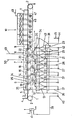
- the figure is a schematic view of an installation for the treatment of fibrous material according to the invention.
- the installation according to the figure comprises a perforated endless conveyor belt 1 supported by two drums 2, one drum of which drives the belt.
- the direction of movement of the upper strand of the conveyor 1 is indicated by the arrow 3.
- Wool is admitted in 4 in a layer on the upper strand of carpet 1.
- This wool successively passes through an entry airlock 5, a prewash part 6 where it is treated with a hydrocarbon solvent, an acidification part 7, where it is treated with an alcoholic solvent in acidified aqueous solution, an elimination part excess acid 8 where it is treated again with a hydrocarbon solvent, a transfer airlock 9, a carbonizer 10 and an evacuation airlock 11.
- the prewash part 6 comprises three sections 12-13, 14-15 and 16-17, the acidification part 7 comprises two sections 18-19 and 20-21 and the excess acid removal part 8 includes a section 22-23.
- Each section includes a watering chamber 12, 14, 16, 18, 20 or 22, through which a part of the upper strand of the carpet 1 passes and the funnel bottom of which is provided with a discharge opening 24 leading to a decanter 13, 15, 17, 19, 21 or 23.
- Each section also includes a sprinkler device consisting of a number of sprinkler heads 25, a supply line 26 connecting the sprinkler device ⁇ of the section to the upper part of its decanter. And a pump 27 mounted in line 26. From the discharge side of each chamber 12, 14, 16, 18, 20 and 22 are mounted two compression rollers 28 between which pass the upper strand of the carpet 1 and the layer of wool which it carries.
- the sprinkler heads 25 are mounted above the wool layer but the chambers 14, 20 and 22 also include a sprinkler head directed towards the underside of the upper strand of the carpet 1.
- the pumps 27 discharge a hydrocarbon solvent under pressure to the sprinklers of the chambers 12, 14 and 16 of the prewash part 6, an alcoholic solvent in acidified aqueous solution under low pressure to the sprinklers of the chambers 18 and 20 of the acidification part 7 and a hydrocarbon solvent under adjustable pressure to the sprinklers of the chamber 22 of the excess acid elimination part 8.
- Hyacocarbonated solvent 49 is introduced into chamber 22 of the excess acid elimination part 8.
- the upper phase of the decanter 23, comprising the hydrocarbon solvent, is allowed to overflow towards the part upper part of the settling tank 17, as indicated by the arrow 30 in the figure.
- the decanter 17 is allowed to overflow towards the decanter 15 and the latter towards the decanter 13, as indicated by the arrows 31 in the figure.
- the hydrocarbon solvent therefore goes upstream against the prewash part 6, taking charge progressively with grease.
- Watering with a hydrocarbon solvent in the excess acid removal part 8 has in particular the effect of spinning the wool after acidification in traditional methods, but takes only a few seconds and requires no manipulation. complementary to wool.
- hydrocarbon solvent hexane can be used efficiently and advantageously.
- An aqueous alcoholic solution is introduced at 50 into the watering chamber 20 of the last section of the acidification part 7 and sulfuric acid is added thereto separately by automatic dosing. Preferably 5 to 10% of concentrated sulfuric acid is added relative to the added amount of alcoholic solution.
- As alcohol isopropyl alcohol is used, for example.
- the settler 21 of the last section of the acidification part 7 is made to project towards the upper part of the decanter 19 of the first section of this part, as indicated by the arrow 32 in the figure.
- the acidification of the vegetable matter contained in the wool takes place very quickly, thanks to the very high wettability of the latter by the acid solution, due to the presence of alcohol at medium concentrations.
- the overflow of the decanter 19 feeds the upper part of the decanter 13 of the first section of the prewash part 6, as indicated by the arrow 33 in the figure.
- this decanter 13 the alcoholic solution is mixed with the miscella watering the wool in chamber 12.
- Is added to the upper phase of the decanter 13 also a portion of alcoholic solution supplied by a line 34 which is supplied by the overflow of a complementary decanter 35 described below.
- the prewash is therefore done with the same hydrocarbon solvent as the removal of the excess acid and only using recycled hydrocarbon solvent.
- This prewash is done in two stages, first using miscella and alcoholic solution in chamber 12 of the first section and using miscella alone in chambers 14 and 16 of the other two sections of the part pre-wash 6. During this pre-wash the wool grease is dissolved and the insoluble impurities, soil and sand, are mechanically entrained.
- Insoluble impurities are deposited in the decanters 13, 15, 17, 19 and 21. They are eliminated towards a degreasing device 37 mounted below the decanters. These insoluble impurities are transported using a transport screw to the end of the device located on the side of the excess acid removal part 8 and these impurities are washed against the current by the same hydrocarbon solvent with which the excess acid elimination part 8 is fed. This solvent is introduced. hydrocarbon through line 38 in device 37.
- the miscella obtained after degreasing the insoluble impurities in the device 37 and the fat solution overflowing from the first settling tank 13 and comprising from 15 to 20% of fat, are pumped by a circulation pump 40 through the pipe 39 to a unit 41 where the solution is deacidified by washing with an aqueous alcoholic solution.
- the deacidified solution is sent, possibly after refining in a refining unit, to a distillation unit not shown in the figure where it is recovered wool grease.
- the alcoholic solution can be returned after extraction of the acid to the acidification part 7.
- the sludge drained from the decanters 13, 15, 17, 19 and 21, collected and degreased in the device 37, are sent by the pump 42 through the pipe 43 to the additional decanter 35.
- the sludge from this decanter 35 is collected which has a solid matter concentration close to 30% and it is pumped using the circulation pump 44 through line 45 to a neutralization unit not shown in the figure. After neutralization, this sludge can be distilled in order to recover the alcohol.
- the sludge is then found in a concentrated aqueous solution at 60%, with a minimum consumption of steam. This sludge has a fertilizing value and can be used as fertilizer, either as it is or after drying.
- the wool still deposited on the conveyor belt 1 is made to penetrate via the transfer airlock 9 into the carbonizer 10.
- This carbonizer 10 is divided into a series of sections 46 in which fans 47 blowing an inert gas heated to 120 e C and 140 ° C through the wool layer to carbonize the vegetable matter is impregnated with acid.
- This gas is introduced via line 48 in the last section 46. This gas rises up the carbonizer against the current while taking charge of solvents. The acid contained in plants is thus concentrated.
- the gas from the first section 46 is removed and this gas is treated in an annex unit, not shown in the figure, or the solvents are recovered.
- Carbonization can be completed in less than two minutes, at temperatures between 120 ° and 140 ° C and the solvents can simultaneously be recovered by methodical extraction against the current with an inert gas.
- the number of sections of the carbonizer depends on the desired capacity and the plant content of the wool.
- the conveyor belt 1 is discharged from the wool leaving the carbonizer 10 via the evacuation airlock 11.
- This wool is sent to conventional grinding and dusting installations. Then the wool can be deacidified, either with water on a conventional line with four or five baths, or using aqueous alcoholic rinsing and neutralization solutions on a line with a perforated conveyor belt.
- a final rinsing with hydrocarbon solvent added with a slight amount of wool grease from the prewash is added to the neutralization.
- the purpose of this additional treatment is to improve the dedusting of carbonized wool, to reduce the water and alcoholic solvent content before drying and to reload the wool fiber with a content in sufficient fat to facilitate the following operations, such as carding.
- Prewash, acidification and carbonization are carried out together on a single treatment line in less than three minutes.
- the exceptional speed of the process is due to the very high efficiency of the extraction of fat and soluble impurities, to the very rapid acidification of plant materials thanks to the presence of alcohol at medium concentrations, to the elimination of the excess acid using a sprinkling of a hydrocarbon solvent, and the speed of carbonization thanks to the water retention of the very reduced wool.
- the wool fibers are much less altered after carbonization and the felting is reduced. This results in a higher carded ribbon yield. This is due to the fact that the prewash is carried out cold without the intervention of water, that the acidification is carried out in an alcohol medium for a limited period and at acid concentrations lower than the concentrations normally used in known processes, than removal of the excess acid is done in a simple and effective way, that the carbonization is done in an extremely fast way and that during the whole process no mechanical stirring of the wool takes place.
- More than 95% of the fat extracted can be recovered, either as it is, or in the form of anhydrous refined lanolin or its derivatives.
- the length of the processing line is less than the lines used to carry out the known methods.
- the prewash part does not necessarily have to include three sections.
- the number of sections depends on the washed performance of the wool and in particular on its fat content.
- the acidification part does not necessarily have to have two sections.
- the number of sections in this part depends on the plant content of the wool.
Landscapes
- Engineering & Computer Science (AREA)
- General Chemical & Material Sciences (AREA)
- Life Sciences & Earth Sciences (AREA)
- Chemical & Material Sciences (AREA)
- Molecular Biology (AREA)
- Chemical Kinetics & Catalysis (AREA)
- Health & Medical Sciences (AREA)
- Wood Science & Technology (AREA)
- Zoology (AREA)
- Textile Engineering (AREA)
- Animal Husbandry (AREA)
- Inorganic Fibers (AREA)
- Chemical Or Physical Treatment Of Fibers (AREA)
- Treatments For Attaching Organic Compounds To Fibrous Goods (AREA)
Applications Claiming Priority (2)
| Application Number | Priority Date | Filing Date | Title |
|---|---|---|---|
| FR8405650 | 1984-04-10 | ||
| FR8405650A FR2562564B1 (fr) | 1984-04-10 | 1984-04-10 | Traitement de matiere fibreuse, en particulier de la laine, et installation pour la mise en oeuvre de ce procede |
Publications (2)
| Publication Number | Publication Date |
|---|---|
| EP0159082A1 true EP0159082A1 (de) | 1985-10-23 |
| EP0159082B1 EP0159082B1 (de) | 1987-11-11 |
Family
ID=9303022
Family Applications (1)
| Application Number | Title | Priority Date | Filing Date |
|---|---|---|---|
| EP85200497A Expired EP0159082B1 (de) | 1984-04-10 | 1985-04-01 | Verfahren zur Behandlung von Wolle |
Country Status (6)
| Country | Link |
|---|---|
| EP (1) | EP0159082B1 (de) |
| JP (1) | JPS60239506A (de) |
| AU (1) | AU572636B2 (de) |
| DE (1) | DE3560954D1 (de) |
| FR (1) | FR2562564B1 (de) |
| ZA (1) | ZA852247B (de) |
Cited By (1)
| Publication number | Priority date | Publication date | Assignee | Title |
|---|---|---|---|---|
| EP0277372A3 (en) * | 1986-10-31 | 1990-03-21 | Sperotto Rimar S.P.A. | Process and plant for carbonizing wool textile articles |
Families Citing this family (2)
| Publication number | Priority date | Publication date | Assignee | Title |
|---|---|---|---|---|
| NZ214369A (en) * | 1985-11-28 | 1988-01-08 | Nz Government | Wool scouring apparatus with laminar plate settler |
| CN105088592B (zh) * | 2015-07-22 | 2016-07-06 | 泰安康平纳机械有限公司 | 一种碳化机提升装置 |
Citations (3)
| Publication number | Priority date | Publication date | Assignee | Title |
|---|---|---|---|---|
| GB431367A (en) * | 1933-04-19 | 1935-07-05 | Deutsche Hydrierwerke Ag | Improvements in or relating to the treatment of raw wool |
| FR1307865A (fr) * | 1960-12-15 | 1962-10-26 | Extraction Continue De Smet | Procédé de traitement de la laine et installation pour la mise en oeuvre de ce procédé |
| US3685322A (en) * | 1965-04-14 | 1972-08-22 | Fur Patentdienst Anstalt | Device for the carbonization of wool |
-
1984
- 1984-04-10 FR FR8405650A patent/FR2562564B1/fr not_active Expired
-
1985
- 1985-03-26 ZA ZA852247A patent/ZA852247B/xx unknown
- 1985-03-26 AU AU40379/85A patent/AU572636B2/en not_active Ceased
- 1985-04-01 EP EP85200497A patent/EP0159082B1/de not_active Expired
- 1985-04-01 DE DE8585200497T patent/DE3560954D1/de not_active Expired
- 1985-04-10 JP JP60076320A patent/JPS60239506A/ja active Pending
Patent Citations (3)
| Publication number | Priority date | Publication date | Assignee | Title |
|---|---|---|---|---|
| GB431367A (en) * | 1933-04-19 | 1935-07-05 | Deutsche Hydrierwerke Ag | Improvements in or relating to the treatment of raw wool |
| FR1307865A (fr) * | 1960-12-15 | 1962-10-26 | Extraction Continue De Smet | Procédé de traitement de la laine et installation pour la mise en oeuvre de ce procédé |
| US3685322A (en) * | 1965-04-14 | 1972-08-22 | Fur Patentdienst Anstalt | Device for the carbonization of wool |
Cited By (1)
| Publication number | Priority date | Publication date | Assignee | Title |
|---|---|---|---|---|
| EP0277372A3 (en) * | 1986-10-31 | 1990-03-21 | Sperotto Rimar S.P.A. | Process and plant for carbonizing wool textile articles |
Also Published As
| Publication number | Publication date |
|---|---|
| AU572636B2 (en) | 1988-05-12 |
| DE3560954D1 (en) | 1987-12-17 |
| AU4037985A (en) | 1985-10-17 |
| ZA852247B (en) | 1985-11-27 |
| FR2562564B1 (fr) | 1986-07-25 |
| FR2562564A1 (fr) | 1985-10-11 |
| EP0159082B1 (de) | 1987-11-11 |
| JPS60239506A (ja) | 1985-11-28 |
Similar Documents
| Publication | Publication Date | Title |
|---|---|---|
| EP0033323B1 (de) | Verbesserungen an verfahren und vorrichtungen zum herstellen von furfural aus pflanzlichen materialien | |
| EP0243220B1 (de) | Verfahren und Vorrichtung zur Ultraschallextraktion von ölhaltigen Stoffen aus ölhaltigen Saaten | |
| FR2472016A1 (fr) | Procede de saccharification continue de la cellulose de plantes | |
| FR2649017A1 (fr) | Procede et dispositif de traitement d'un melange liquide-matiere fibreuse, en particulier de cellulose | |
| FR2744140A1 (fr) | Procede et dispositif pour la production ou le traitement de fibres et de produits a base de fibres | |
| EP0159082B1 (de) | Verfahren zur Behandlung von Wolle | |
| FR2522277A1 (fr) | Dispositif pour rehumecter le gateau de filtration dans une machine de deshydratation | |
| EP0136325B1 (de) | Verfahren zur behandlung von lignocellulose-materialien für die erlangung von cellulose | |
| EP0000110A1 (de) | Verfahren zur Herstellung von Acrylsäure aus deren Lösungen in Tri-n-butylphosphat | |
| EP0052541B1 (de) | Verfahren zur Herstellung kristallisierter Laktose und Vorrichtung zur Durchführung dieses Verfahrens | |
| WO2020126918A1 (fr) | Procede de nettoyage d'un reacteur de traitement d'une biomasse lignocellulosique | |
| WO2020126917A1 (fr) | Procede de traitement de biomasse lignocellulosique | |
| CH653365A5 (fr) | Procede pour hydrolyser de la cellulose en sucres reducteurs. | |
| FR2486556A1 (fr) | Procede de fabrication de pate de bois rape provenant de matieres lignocellulosiques | |
| EP0202999B1 (de) | Verfahren und Vorrichtung zur Herstellung von kristalliner wasserfreier Dextrose | |
| EP1022342B1 (de) | Verfahren und Einheit zur Extraktion von Zuckersaft aus Rüben oder Zichorie | |
| BE1001794A6 (fr) | Procede de recuperation de farine et d'huile a partir de dechets de poissons. | |
| FR2619514A1 (fr) | Procede pour recuperer des substances utiles a partir de produits naturels et l'utilisation d'un appareillage pour la mise en oeuvre dudit procede | |
| FR2504151A1 (fr) | Installation pour l'extraction du jus sucre de la bagasse de canne a sucre ou produit analogue | |
| BE567021A (fr) | Traitement de la laine | |
| BE550874A (de) | ||
| BE655177A (de) | ||
| BE462660A (de) | ||
| FR2650604A1 (fr) | Procede et equipement pour le pretraitement de matiere cellulosique brute | |
| BE462537A (de) |
Legal Events
| Date | Code | Title | Description |
|---|---|---|---|
| PUAI | Public reference made under article 153(3) epc to a published international application that has entered the european phase |
Free format text: ORIGINAL CODE: 0009012 |
|
| AK | Designated contracting states |
Designated state(s): BE DE GB IT |
|
| 17P | Request for examination filed |
Effective date: 19850924 |
|
| 17Q | First examination report despatched |
Effective date: 19860603 |
|
| GRAA | (expected) grant |
Free format text: ORIGINAL CODE: 0009210 |
|
| AK | Designated contracting states |
Kind code of ref document: B1 Designated state(s): BE DE GB IT |
|
| REF | Corresponds to: |
Ref document number: 3560954 Country of ref document: DE Date of ref document: 19871217 |
|
| ITF | It: translation for a ep patent filed | ||
| GBV | Gb: ep patent (uk) treated as always having been void in accordance with gb section 77(7)/1977 [no translation filed] | ||
| PLBE | No opposition filed within time limit |
Free format text: ORIGINAL CODE: 0009261 |
|
| STAA | Information on the status of an ep patent application or granted ep patent |
Free format text: STATUS: NO OPPOSITION FILED WITHIN TIME LIMIT |
|
| 26N | No opposition filed | ||
| PG25 | Lapsed in a contracting state [announced via postgrant information from national office to epo] |
Ref country code: GB Free format text: LAPSE BECAUSE OF NON-PAYMENT OF DUE FEES Effective date: 19881124 |
|
| ITTA | It: last paid annual fee | ||
| PGFP | Annual fee paid to national office [announced via postgrant information from national office to epo] |
Ref country code: DE Payment date: 19890526 Year of fee payment: 5 |
|
| PG25 | Lapsed in a contracting state [announced via postgrant information from national office to epo] |
Ref country code: DE Effective date: 19910101 |
|
| PGFP | Annual fee paid to national office [announced via postgrant information from national office to epo] |
Ref country code: BE Payment date: 19940117 Year of fee payment: 10 |
|
| PG25 | Lapsed in a contracting state [announced via postgrant information from national office to epo] |
Ref country code: BE Effective date: 19950430 |
|
| BERE | Be: lapsed |
Owner name: S.A. EXTRACTION DE SMET Effective date: 19950430 |