EP0159173A2 - Composition de verre - Google Patents
Composition de verre Download PDFInfo
- Publication number
- EP0159173A2 EP0159173A2 EP85302463A EP85302463A EP0159173A2 EP 0159173 A2 EP0159173 A2 EP 0159173A2 EP 85302463 A EP85302463 A EP 85302463A EP 85302463 A EP85302463 A EP 85302463A EP 0159173 A2 EP0159173 A2 EP 0159173A2
- Authority
- EP
- European Patent Office
- Prior art keywords
- percent
- glass
- oxide
- composition
- slag
- Prior art date
- Legal status (The legal status is an assumption and is not a legal conclusion. Google has not performed a legal analysis and makes no representation as to the accuracy of the status listed.)
- Withdrawn
Links
Images
Classifications
-
- C—CHEMISTRY; METALLURGY
- C03—GLASS; MINERAL OR SLAG WOOL
- C03C—CHEMICAL COMPOSITION OF GLASSES, GLAZES OR VITREOUS ENAMELS; SURFACE TREATMENT OF GLASS; SURFACE TREATMENT OF FIBRES OR FILAMENTS MADE FROM GLASS, MINERALS OR SLAGS; JOINING GLASS TO GLASS OR OTHER MATERIALS
- C03C3/00—Glass compositions
- C03C3/04—Glass compositions containing silica
- C03C3/062—Glass compositions containing silica with less than 40% silica by weight
-
- C—CHEMISTRY; METALLURGY
- C03—GLASS; MINERAL OR SLAG WOOL
- C03C—CHEMICAL COMPOSITION OF GLASSES, GLAZES OR VITREOUS ENAMELS; SURFACE TREATMENT OF GLASS; SURFACE TREATMENT OF FIBRES OR FILAMENTS MADE FROM GLASS, MINERALS OR SLAGS; JOINING GLASS TO GLASS OR OTHER MATERIALS
- C03C1/00—Ingredients generally applicable to manufacture of glasses, glazes, or vitreous enamels
- C03C1/002—Use of waste materials, e.g. slags
-
- C—CHEMISTRY; METALLURGY
- C03—GLASS; MINERAL OR SLAG WOOL
- C03C—CHEMICAL COMPOSITION OF GLASSES, GLAZES OR VITREOUS ENAMELS; SURFACE TREATMENT OF GLASS; SURFACE TREATMENT OF FIBRES OR FILAMENTS MADE FROM GLASS, MINERALS OR SLAGS; JOINING GLASS TO GLASS OR OTHER MATERIALS
- C03C13/00—Fibre or filament compositions
- C03C13/001—Alkali-resistant fibres
-
- C—CHEMISTRY; METALLURGY
- C03—GLASS; MINERAL OR SLAG WOOL
- C03C—CHEMICAL COMPOSITION OF GLASSES, GLAZES OR VITREOUS ENAMELS; SURFACE TREATMENT OF GLASS; SURFACE TREATMENT OF FIBRES OR FILAMENTS MADE FROM GLASS, MINERALS OR SLAGS; JOINING GLASS TO GLASS OR OTHER MATERIALS
- C03C13/00—Fibre or filament compositions
- C03C13/06—Mineral fibres, e.g. slag wool, mineral wool, rock wool
Definitions
- This invention relates generally to glass, and, more particularly, to a glass which is resistant to alkaline corrosion.
- zirconium oxide A glass having about 20 percent by weight zirconium oxide (ZrO 2 ) is marketed under the name Cemfil by Pilkington Glass Co. for use as a reinforcing fiber in cement. While fibers with a high zirconium oxide content have .improved resistance to alkaline corrosion as compared with conventional glass fibers, they are very expensive to produce. Moreover, even the expensive zirconium oxide-containing glasses experience some corrosion damage in an alkaline cement medium. Many other applications of glass are similarly limited by corrosion damage of the glass in an alkaline medium, such as, for example, the use of glass in marine applications and certain chemical reactors.
- the present invention provides an improved glass composition and products having excellent resistance to corrosion in an alkaline environment.
- Fibers made from the composition of the invention may be incorporated into wet cement as reinforcements or into other alkaline media.
- the degradation of the fibers in the cement is at least generally less than observed for prior alkaline-resistant, zirconium-containinc j glass fibers, which are also far more costly than fibers made in accordance with the present invention.
- the glass of the present invention may be prepared from the slag produced by municipal solid waste disposal plants or similar facilities, thereby lowering the cost of the final product as well as providing an economical means for disposal of the slag.
- a glass may be prepared by mixing the slag from a municipal solid waste disposal plant or similar facility together with a source of a chemical selected from the group consisting of calcium carbonate, magnesium carbonate, and mixtures thereof, in an amount of from about 30 to about 80 percent of the weight of the total of slag plus calcium carbonate or magnesium carbonate, and then forming the glass (by melting the mixture).
- a source of a chemical selected from the group consisting of calcium carbonate, magnesium carbonate, and mixtures thereof, in an amount of from about 30 to about 80 percent of the weight of the total of slag plus calcium carbonate or magnesium carbonate, and then forming the glass (by melting the mixture).
- a reference to the amount or percentage of a "source” of a chemical refers to the amount or percentage of the chemical added, not including any impurities or other components included in the "source.”
- the source of the calcium carbonate or magnesium carbonate may be pure chemicals, but is preferably a relatively inexpensive mineral such as limestone or dolomite.
- slag nor the final glass composition requires the presence of expensive additives such as the zirconium oxide found in prior alkaline-resistant glasses.
- composition of slag produced by a municipal solid waste plant can vary depending upon the input to the plant, it has been found that glasses having the improved properties can be made from a range of compositions of such slags.
- a glass composition which consists essentially of from about 35 to about 10 percent silicon oxide (SiO 2 ), from about 24 to about 10 percent oxides of iron (Fe 2 0 3 and Fe 3 O 4 ); from about 26 to about 70 percent calcium oxide (CaO), magnesium oxide (MgO), or mixtures thereof; from about 5 to about 18 percent aluminum oxide (Al 2 O 3 ); and up to about 6 percent sodium oxide (Na 2 0), the amounts of the constituents totalling 100 percent.
- the glass composition consists essentially of from about 25 to about 20 percent silicon oxide; from about 24 to about 18 percent oxides of iron; from about 39 to about 51 percent calcium oxide, magnesium oxide, or mixtures thereof; from about 6 to about 8 percent aluminum oxide; and from about 2 to about 3 percent sodium oxide.
- the glass composition consists essentially of about 22 percent silicon oxide; about 21 percent oxides of iron; about 46 percent calcium oxide, magnesium oxide, or mixtures thereof; about 7 percent aluminum oxide; and about 2 percent sodium oxide.
- the total of the percentages of the listed constituents in the most preferred embodiment is slightly less than 100, due to the presence of minor components.
- the constituents used to prepare the glass are placed into a refractory container in the proper proportions and melted. Typically, after the melt is homogenized, the temperature is adjusted to a level for glass forming, typically about 13000C.
- the final glass products may then be formed by any desired technique, for example fiber drawing or extrusion. If the glass is prepared as a fiber, it may be coated wth a sizing and stranded or left as single fibers.
- Glass fibers having a composition in accordance with the invention are advantageously incorporated into wet cement either singly or in strands to strengthen the final cement product, wherein the glass fibers are highly resistant to the corrosive effects of the alkaline environment of the wet or dry cement.
- the fibers are first coated with sizing to protect the fibers and improve their bonding with the environment, before incorporation into the cement.
- the present invention represents a significant advance in the field of the economical preparation of glasses, particularly for use in an alkaline environment such as cement.
- Glass fibers highly resistant to alkaline corrosion may be prepared and coated with sizing to improve their bonding to the cement.
- such fibers may be produced utilizing inexpensive raw materials, such as the slag of a municipal solid waste disposal plant and commonly available minerals such as limestone or dolomite.
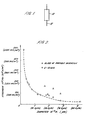
- FIGURE 1 is a schematic illustration of a test arrangement for comparatively testing strengths of glass fibers embedded in cement.
- FIGURE 2 is a graph of the strength of glass fibers as a function of their diameters, illustrating the values for glass fibers prepared in accordance with the present invention and prior glass fibers.
- a glass is prepared from a mixture of from about 70 to about 20 percent by weight of slag produced by a municipal solid waste disposal plant and from about 30 to about 80 percent by weight of a source of calcium or magnesium carbonate, or a mixture thereof.
- the calcium or magnesium carbonate is supplied from a mineral source such as limestone or dolomite, and most preferably is in an amount of from about 50 to about 60 percent.
- Limestone and dolomite are readily obtainable minerals having nominal compositions of CaCO and CaMg(C0 3 ) 2 , respectively, although other minerals are often mixed into the limestone and dolomite.
- the carbon content of the limestone or dolomite is removed as carbon monoxide or carbon dioxide, leaving the calcium oxide or magnesium oxide components.
- Municipal waste disposal is an increasingly critical problem in many areas. Historically, waste was disposed of in landfills and/or by burning. Increased . use of these methods is now undesirable due to land use and pollution restrictions, and unavailability of land.
- An alternative approach to disposal is a solid waste disposal plant wherein waste is heated in a furnace to drive off volatile components into a gas stream and reduce the remaining components to a slag. The slag is more compact than the solid waste, but large amounts of slag are produced and must be disposed of.
- the process of the present invention provides a use for the slag in manufacturing a useful glass, and allows the economical production of the glass.
- composition of the slag produced by a municipal solid waste disposal plant varies with the input waste, it is found in practice that a typical slag consists generally of from about 35 to about 45 percent silicon oxide; from about 10 to about 15 percent aluminum oxide; from about 20 to about 35 percent oxides of iron; from about 5 to about 10 percent calcium oxide; and from about 3 to about 8 percent sodium oxide. Minor amounts of other constituents normally present in slags are tolerated in the slag used in the process of the present invention, as long as their presence does not substantially reduce the alkaline resistance of the final glass product.
- the slag has a composition consisting essentially of about 37 percent silicon oxide, about 35 percent oxides of iron, about 8 percent calcium oxide, about 11 percent aluminum oxide, about 4 percent sodium oxide, and less than about 5 percent of other constituents, the sum of all constituents totalling 100 percent.
- the following slag was utilized in the preparation of samples for Examples 1-5 discussed below: FeO, 28.5; Si0 2 , 36.8; Al 2 O 3 , 11.4; CaO, 8.3; MgO, 0.56; Fe203, 6.9; Na 2 0, 4.0; Ti0 2 , 0.50; MnO, 0.16; K 2 0; 0.53; GuO, 1.80; ZnO, 0.13; and Cr203, 0.19.
- Those skilled in the art will recognise that the precise composition of the slag may vary depending upon the input stream to the municipal solid waste disposal plant.
- the present invention includes a method for making glass in which a material having a composition as defined above in respect of the slag is mixed together with calcium and/or magnesium carbonate in an amount of from 30 to 80 percent by weight of the total and forming the glass.
- the acceptable range of variations may be determined by varying the proportions of these ingredients.
- limestone or dolomite addi- ions of less than about 30 percent oy weight
- the molten mixture of slag and limestone or dolomite is found to be too viscous to allow the preparation of glasses at an acceptable temperature of 1300°C.
- the degradation of the refractory furnace lining is so rapid that the glass-making process may not be feasible.
- limestone or dolomite additions of greater than about 80 percent the resulting glassy mixture is too fluid to form a glass and also damages the refractory furnace linings by dissolution.
- the preferred limestone or dolomite addition within the acceptable range is from about 50 to about 60 percent. This preferred range results from a determination during the glass making operation that glass forming is most readily accomplished in this range, at an acceptable temperature of 1300°C.
- glass fibers are individually extracted from the melt by contacting a cold instrument to the surface of the melt and then withdrawing a stream of glassy fibers which rapidly cools to a solid form.
- the fibers may also be extruded or formed by any other method known to those skilled in the art, for example.
- Increasing amounts of limestone or dolomite lower the glass forming temperature, but increase the likelihood of crystallization of the glass. Lesser amounts of limestone or dolomite increase the glass forming temperature, with the consequent damage to the refractories indicated previously.
- the presently preferred limestone or dolomite range of from about 50 to about 60 percent represents a preferred compromise in these two effects.
- glass wool may be made by impinging a gas stream on a liquid stream, or by forcing a stream of liquid glass against a drum having holes therethrough so that the wool emerges through the holes as a plurality of fine strands.
- a higher limestone or dolomite composition would be possible, and the preferred composition would shift to such compositions.
- a glass consists essentially of from about 35 to about 10 percent silicon oxide; from about 24 to about 10 percent oxides of iron; from about 26 to about 70 percent calcium oxide, magnesium oxide, or mixtures thereof; from about 5 to about 18 percent aluminum oxide; and up to about 6 percent sodium oxide, all percentages by weight and the sum of all constituents totalling 100 percent.
- the glass composition consists essentially of from about 25 to about 20 percent silicon oxide; from about 24 to about 18 percent oxides of iron; from about 39 to about 51 percent calcium oxide, magnesium oxide, or mixtures thereof; from about 6 to about 8 percent aluminum oxide; and from about 2 to about 3 percent sodium oxide.
- a most preferred glass composition consists essentially of about 22 percent silicon oxide; about 21 percent oxides of iron; about 46 percent calcium oxide, magnesium oxide, or mixtures thereof; about 7 percent aluminum oxide; and about 2 percent sodium oxide.
- the high level of iron oxides is believed to be important, as iron forms a hydroxide having very low solubility in alkaline solutions. It is therefore believed that the iron compounds form a protective layer that resists rapid alkaline attack, although applicant does not wish to be bound by this possible explanation.
- the low level of silicon oxide is also believed to be important, as alkali resistance is observed to improve with decreasing amounts of silicon oxide.
- the constituents of the glass are mixed together in a crucible or other refractory container such as alumina and, preferably, heated to a temperature of about 1500 C. The heating may be done in air, as the constituents are used in their oxidized states. At this temperature, the constituents melt together into a fluid mass and are homogenized. The temperature of the melt is adjusted to the glass forming temperature, if necessary. The preferred glass forming temperature is about 1300°C.
- the glass products are then formed by any suitable technique. In the presently preferred approach, glass fibers are up-drawn from the surface of the melt by touching a cold instrument to the surface of the melt and drawing a glass fiber therefrom.
- compositions were prepared by mixing together the indicated proportions of slag from a municipal waste disposal plant and calcium carbonate in the form of limestone.
- the composition of the slag from the municipal waste disposal plant was about 37 percent silicon oxide, about 35 percent oxides of iron, about 8 percent calcium oxide, about 11 percent aluminum oxide, about 4 percent sodium oxide, and minor amounts of other constituents as listed previously, the sum of all constituents totalling 100 percent.
- the samples were prepared by mixing together the proper proportions of slag and limestone in an alumina crucible and melting at a temperature of 1500°C in a gas fired furnace in air. Compositions were prepared in accordance with the following Table I (minor constituent percentages are omitted):
- Glasses could be formed and fibers drawn from the melt at 1300°C for the compositions 1-1 to 1-7.
- Compositions of preliminary samples having less than about 30 percent limestone were too viscous for glass forming at 1300° C , and were excessively corrosive to the refractory linings at greater temperatures.
- a glass could not be formed in preliminary samples having compositions of greater than about 80 percent limestone, because of excessively high fluidity leading to crystallization, so that a glass could not be formed.
- compositions were prepared by mixing together the indicated proportions of slag from a municipal solid waste disposal plant and calcium-magnesium carbonate in the form of dolomite.
- the composition of the slag from the municipal waste disposal plant was about 37 percent silicon oxide, about 35 percent oxides of iron, about 8 percent calcium oxide, about 11 percent aluminum oxide, about 4 percent sodium oxide, and minor amounts of other constituents as listed previously, the sum of all constituents totalling 100 percent.
- the samples were prepared by mixing together the proper proportions of slag and dolomite in an alumina crucible and melting at a temperature of 1500°C in a gas fired furnace in air. Compositions were prepared in accordance with the following Table II (minor constituent percentages are omitted):
- Glass fibers prepared from a composition in accordance with the present invention were tested for their resistance to strength loss when embedded in concrete.
- a glass melt was prepared by melting together a mixture of 45 weight percent of a slag and 55 weight percent dolomite in an alumina crucible in air at 1500°C.
- the composition of the slag was about 37 weight percent silicon oxide, about 35 percent oxides of iron, about 8 percent calcium oxide, about 11 percent aluminum oxide; about 4 percent sodium oxide, and minor amounts of other constituents, the sum of all constituents totalling 100 percent.
- Fibers of about 52 microns diameter were prepared by up-drawing from the melt at 1300° C . One group of fibers was left uncoated and the other group was coated with a sizing prepared by dissolving 3 volume percent vinyl acetate and 1 volume percent silane in 96 volume percent distilled water.
- Fiber samples of each type were enclosed in cement blocks for testing, as illustrated in FIGURE 1.
- a block of cement 10 having dimensions of about 5 cm long and 1 cm by 1 cm in cross section was cast over the fiber 12 and allowed to harden in air for 24 hours at 80°c.
- the blocks 10 and embedded fibers 12 were then placed into a water bath at 80 0 C, and samples were removed for testing after various periods of time. After removal from the bath, the blocks 10 were carefully cracked open and the fiber 12 extracted for testing.
- the fiber 12 was placed on a piece of paper and fixed in place at each end with epoxy. The paper was then cut away.
- the coated fibers are slightly stronger than the uncoated fibers, and both experience comparable strength losses with increased exposure.
- Fibers prepared as in Example 3 and E-glass fibers as described in Example 5 were placed in a cement paste, which was then placed in an autoclave operating at 205°C in steam for 2 hours. After 2 hours the blocks were removed from the autoclave and carefully broken open to extract the fibers. This severe test caused disintegration of conventional E-glass fibers.
- the surfaces of the coated and uncoated fibers of the present invention were inspected at magnifications as high as 266x, and were found to be virtually unattacked and unaltered.
- the tensile strength of fibers made from a prior glass and from a glass in accordance with the invention were determined by measuring the strengths as a function of fiber diameter.
- the prior E-glass had a composition of about 55.2 percent silicon oxide, 14.8 percent aluminum oxide, 7.3 percent boron oxide, 3.3 percent magnesium oxide, 18.7 percent calcium oxide, and minor amounts of other constituents.
- the glass in accordance with the invention was prepared by melting together a mixture of 25 weight percent of a slag and 75 weight percent dolomite in an alumina crucible at 1500°C in air.
- the composition of the slag was about 37 weight percent silicon oxide; about 35 percent oxides of iron; about 8 percent calcium oxide; about 11 percent aluminum oxide; about 4 percent sodium oxide; and minor amounts of other constituents totalling 100 percent. Fibers of various diameters were prepared by up-drawing from the melt at 1300°C, as previously described.
- a 10 centimeter long length of each sample was gripped between the jaws of an Instron testing machine by the technique described in Example 3 and loaded by the technique described in Example 3.
- Figure 2 illustrates the strength of the prior E glass fibers as a function of diameter of the fiber.
- three data points for the fibers prepared in accordance with the invention are shown on the graph.
- the strengths of the fibers in accordance with the present invention are significantly greater than those of the prior glass, and follow the same trend of increasing strength with decreasing fiber diameter.
- a series of glasses was prepared from mixtures of a slag and limestone (CaCO 3 ) having various proportions.
- the compositions of the slag and the glasses are shown in Table IV.
- sample 6-1 was prepared by placing pieces of slag and mixtures of crushed slag and limestone in the appropriate percentages into an alumina cricible, in air in an electric furnace.
- the melt of sample 6-1 was too viscous to cast, and fibers could not be drawn.
- the mixtures (Samples 6-2 to 6-4) were castable and could be drawn into fibers.
- Sample 6-2 was melted into glass after 30 minutes at 1450 ° C . This melt was castable and could be drawn into fibers, but with some difficulty.
- Sample 6-4 was melted into glass after 30 minutes at 1350°C. This melt was castable and readily drawn- into fibers.
- Tests were run to determine the resistance of various prior glasses and the glasses of Example 6 to the corrosive effects of an alkaline environment. To perform the tests, 1 gram of glass was pulverized and placed into 100 ml of an aqueous 5 percent sodium hydroxide solution at 90 0 C for 72 hours, stirring constantly. The remaining solid particles were separated from the liquid by filtration, dried and weighed. A weight loss percentage was then determined.
- Tests were conducted to determine the weight loss of various prior glasses and the glasses of Example 6 in a hot water environment. To perform the tests, 1 gram of glass was pulverized and placed into water at 90°C for 72 hours. The remaining solid particles were separated from the liquid by filtration, dried and weighed. A weight loss percentage was then determined.
- the weight loss properties in water of samples 6-2 to 6-4 are superior to window glass and Cemfil glass.
- the weight loss properties in sodium hydroxide solution of samples 6-3 and 6-4 are superior to the high-zirconia Cemfil glass, which is more expensive and must be fiber drawn at a much higher temperature.
- glass having excellent strength and corrosion resistance properties in an alkaline environment may be readily and economically prepared, preferably from the byproducts of a municipal waste disposal plant and readily available minerals. It is estimated that the glass of the invention may be prepared at a cost per unit weight of about 1/3 that of high-zirconia alkali-resistant glass.
- the glass may be prepared in the form of fibers which can be used to strengthen materials such as cement, organic plastics and textiles, as well as other forms.
Landscapes
- Chemical & Material Sciences (AREA)
- Life Sciences & Earth Sciences (AREA)
- Engineering & Computer Science (AREA)
- Chemical Kinetics & Catalysis (AREA)
- General Chemical & Material Sciences (AREA)
- Geochemistry & Mineralogy (AREA)
- Materials Engineering (AREA)
- Organic Chemistry (AREA)
- General Life Sciences & Earth Sciences (AREA)
- Glass Compositions (AREA)
- Processing Of Solid Wastes (AREA)
Applications Claiming Priority (2)
| Application Number | Priority Date | Filing Date | Title |
|---|---|---|---|
| US59885084A | 1984-04-10 | 1984-04-10 | |
| US598850 | 1984-04-10 |
Publications (2)
| Publication Number | Publication Date |
|---|---|
| EP0159173A2 true EP0159173A2 (fr) | 1985-10-23 |
| EP0159173A3 EP0159173A3 (fr) | 1986-10-08 |
Family
ID=24397175
Family Applications (1)
| Application Number | Title | Priority Date | Filing Date |
|---|---|---|---|
| EP85302463A Withdrawn EP0159173A3 (fr) | 1984-04-10 | 1985-04-09 | Composition de verre |
Country Status (2)
| Country | Link |
|---|---|
| EP (1) | EP0159173A3 (fr) |
| JP (1) | JPS60231440A (fr) |
Cited By (22)
| Publication number | Priority date | Publication date | Assignee | Title |
|---|---|---|---|---|
| EP0752394A3 (fr) * | 1995-07-04 | 1997-05-28 | Hamamatsu Photonics Kk | Verre et plaque de fibres optiques avec celui-ci |
| US7651563B2 (en) | 2002-08-23 | 2010-01-26 | James Hardie Technology Limited | Synthetic microspheres and methods of making same |
| US7727329B2 (en) | 2000-03-14 | 2010-06-01 | James Hardie Technology Limited | Fiber cement building materials with low density additives |
| US7897534B2 (en) | 2003-10-29 | 2011-03-01 | James Hardie Technology Limited | Manufacture and use of engineered carbide and nitride composites |
| US7993570B2 (en) | 2002-10-07 | 2011-08-09 | James Hardie Technology Limited | Durable medium-density fibre cement composite |
| US7998571B2 (en) | 2004-07-09 | 2011-08-16 | James Hardie Technology Limited | Composite cement article incorporating a powder coating and methods of making same |
| CN102807325A (zh) * | 2012-08-21 | 2012-12-05 | 何德开 | 一种翡翠色微晶玻璃及其制备方法 |
| CN102807323A (zh) * | 2012-09-12 | 2012-12-05 | 济南大学 | 一种固体废弃物的回收再利用方法及以该固体废弃物为原料制得的玻璃 |
| CN102815867A (zh) * | 2012-09-05 | 2012-12-12 | 北京盛康宁科技开发有限公司 | 一种彩色微晶玻璃板材及其制备方法 |
| US20140000089A1 (en) * | 2005-06-30 | 2014-01-02 | Unifrax I Llc | Inorganic Fiber |
| CN104341107A (zh) * | 2013-07-30 | 2015-02-11 | 神华集团有限责任公司 | 一种玻璃配合料及其制备方法以及一种玻璃及其制备方法 |
| US8993462B2 (en) | 2006-04-12 | 2015-03-31 | James Hardie Technology Limited | Surface sealed reinforced building element |
| CN105236746A (zh) * | 2015-09-01 | 2016-01-13 | 广西南宁智翠科技咨询有限公司 | 一种生物活性玻璃陶瓷及其制备方法 |
| CN109399938A (zh) * | 2018-11-07 | 2019-03-01 | 东莞理工学院 | 一种城市生活垃圾焚烧飞灰微波熔融制备的建筑装饰用微晶玻璃及应用 |
| CN111533451A (zh) * | 2020-05-12 | 2020-08-14 | 广州鑫泓设备设计有限公司 | 一种新型玻璃工艺品加工工艺 |
| US10882779B2 (en) | 2018-05-25 | 2021-01-05 | Unifrax I Llc | Inorganic fiber |
| US20220177350A1 (en) * | 2019-04-25 | 2022-06-09 | Nippon Fiber Corporation | Radiation-resistant inorganic material and fiber thereof |
| CN115368021A (zh) * | 2022-01-21 | 2022-11-22 | 汇尔杰新材料科技股份有限公司 | 耐腐蚀玻璃纤维及其生产方法与应用 |
| US20230057024A1 (en) * | 2019-12-11 | 2023-02-23 | Saint-Gobain Isover | Method for producing mineral wool |
| AU2021400610B2 (en) * | 2020-12-15 | 2023-10-05 | Nippon Sheet Glass Company, Limited | Reinforcing glass fiber, chopped strand, fiber sheet, and rod |
| CN117279870A (zh) * | 2021-04-06 | 2023-12-22 | 新日本繊维株式会社 | 耐碱性非晶质无机组合物及其纤维 |
| AU2020262012B2 (en) * | 2019-04-25 | 2025-07-31 | Nippon Fiber Corporation | Radiation-resistant inorganic material and fiber thereof |
Families Citing this family (3)
| Publication number | Priority date | Publication date | Assignee | Title |
|---|---|---|---|---|
| EP1856003A2 (fr) | 2005-02-24 | 2007-11-21 | James Hardie International Finance B.V. | Compositions vitreuses alcalino-resistantes |
| CA2632760C (fr) | 2005-12-08 | 2017-11-28 | James Hardie International Finance B.V. | Microparticules heterogenes de faible densite modifiees et procedes et formulations servant a produire les microparticules |
| KR102926809B1 (ko) * | 2020-10-06 | 2026-02-13 | 닛폰 파이버 코포레이션 | 내방사선 열화성 무기 산화물 플레이크 |
Family Cites Families (4)
| Publication number | Priority date | Publication date | Assignee | Title |
|---|---|---|---|---|
| DE1796213B2 (de) * | 1967-09-26 | 1976-01-02 | Ceskoslovenska Akademie Ved., Prag | Faserverstärkter Zement |
| FR2463756A1 (fr) * | 1979-08-20 | 1981-02-27 | Santt Rene | Materiaux et procedes de construction dans les zones menacees par les tremblements de terre |
| DE3002346A1 (de) * | 1980-01-23 | 1981-08-13 | Licencia Találmányokat Ertékesítö Vállalat, Budapest | Verfahren zur herstellung von geschmolzenen silikatmaterialien |
| WO1983001947A1 (fr) * | 1981-12-04 | 1983-06-09 | Us Commerce | Fibres de verre resistantes aux alkalis |
-
1985
- 1985-04-09 EP EP85302463A patent/EP0159173A3/fr not_active Withdrawn
- 1985-04-09 JP JP7364085A patent/JPS60231440A/ja active Pending
Cited By (30)
| Publication number | Priority date | Publication date | Assignee | Title |
|---|---|---|---|---|
| US5696039A (en) * | 1995-07-04 | 1997-12-09 | Hamamatsu Photonics K.K. | Glass and fiber optic plate using the same |
| US5815625A (en) * | 1995-07-04 | 1998-09-29 | Hamamatsu Photonics K.K. | Glass and fiber optic plate using the same |
| EP0752394A3 (fr) * | 1995-07-04 | 1997-05-28 | Hamamatsu Photonics Kk | Verre et plaque de fibres optiques avec celui-ci |
| US8182606B2 (en) | 2000-03-14 | 2012-05-22 | James Hardie Technology Limited | Fiber cement building materials with low density additives |
| US7727329B2 (en) | 2000-03-14 | 2010-06-01 | James Hardie Technology Limited | Fiber cement building materials with low density additives |
| US7651563B2 (en) | 2002-08-23 | 2010-01-26 | James Hardie Technology Limited | Synthetic microspheres and methods of making same |
| US7878026B2 (en) | 2002-08-23 | 2011-02-01 | James Hardie Technology Limited | Synthetic microspheres and methods of making same |
| US7993570B2 (en) | 2002-10-07 | 2011-08-09 | James Hardie Technology Limited | Durable medium-density fibre cement composite |
| US7897534B2 (en) | 2003-10-29 | 2011-03-01 | James Hardie Technology Limited | Manufacture and use of engineered carbide and nitride composites |
| US7998571B2 (en) | 2004-07-09 | 2011-08-16 | James Hardie Technology Limited | Composite cement article incorporating a powder coating and methods of making same |
| US20140000089A1 (en) * | 2005-06-30 | 2014-01-02 | Unifrax I Llc | Inorganic Fiber |
| US8993462B2 (en) | 2006-04-12 | 2015-03-31 | James Hardie Technology Limited | Surface sealed reinforced building element |
| CN102807325A (zh) * | 2012-08-21 | 2012-12-05 | 何德开 | 一种翡翠色微晶玻璃及其制备方法 |
| CN102815867A (zh) * | 2012-09-05 | 2012-12-12 | 北京盛康宁科技开发有限公司 | 一种彩色微晶玻璃板材及其制备方法 |
| CN102807323B (zh) * | 2012-09-12 | 2015-01-21 | 济南大学 | 一种固体废弃物的回收再利用方法及以该固体废弃物为原料制得的玻璃 |
| CN102807323A (zh) * | 2012-09-12 | 2012-12-05 | 济南大学 | 一种固体废弃物的回收再利用方法及以该固体废弃物为原料制得的玻璃 |
| CN104341107A (zh) * | 2013-07-30 | 2015-02-11 | 神华集团有限责任公司 | 一种玻璃配合料及其制备方法以及一种玻璃及其制备方法 |
| CN105236746A (zh) * | 2015-09-01 | 2016-01-13 | 广西南宁智翠科技咨询有限公司 | 一种生物活性玻璃陶瓷及其制备方法 |
| US10882779B2 (en) | 2018-05-25 | 2021-01-05 | Unifrax I Llc | Inorganic fiber |
| CN109399938A (zh) * | 2018-11-07 | 2019-03-01 | 东莞理工学院 | 一种城市生活垃圾焚烧飞灰微波熔融制备的建筑装饰用微晶玻璃及应用 |
| US20220177350A1 (en) * | 2019-04-25 | 2022-06-09 | Nippon Fiber Corporation | Radiation-resistant inorganic material and fiber thereof |
| EP3960715A4 (fr) * | 2019-04-25 | 2023-07-26 | Nippon Fiber Corporation | Matériau inorganique résistant aux rayonnements et fibre associée |
| AU2020262012B2 (en) * | 2019-04-25 | 2025-07-31 | Nippon Fiber Corporation | Radiation-resistant inorganic material and fiber thereof |
| US20230057024A1 (en) * | 2019-12-11 | 2023-02-23 | Saint-Gobain Isover | Method for producing mineral wool |
| CN111533451A (zh) * | 2020-05-12 | 2020-08-14 | 广州鑫泓设备设计有限公司 | 一种新型玻璃工艺品加工工艺 |
| AU2021400610B2 (en) * | 2020-12-15 | 2023-10-05 | Nippon Sheet Glass Company, Limited | Reinforcing glass fiber, chopped strand, fiber sheet, and rod |
| AU2021400610A9 (en) * | 2020-12-15 | 2024-05-30 | Nippon Sheet Glass Company, Limited | Reinforcing glass fiber, chopped strand, fiber sheet, and rod |
| CN117279870A (zh) * | 2021-04-06 | 2023-12-22 | 新日本繊维株式会社 | 耐碱性非晶质无机组合物及其纤维 |
| EP4321492A4 (fr) * | 2021-04-06 | 2025-07-02 | Nippon Fiber Corp | Composition inorganique non cristalline résistante aux alcalis et fibre de celle-ci |
| CN115368021A (zh) * | 2022-01-21 | 2022-11-22 | 汇尔杰新材料科技股份有限公司 | 耐腐蚀玻璃纤维及其生产方法与应用 |
Also Published As
| Publication number | Publication date |
|---|---|
| JPS60231440A (ja) | 1985-11-18 |
| EP0159173A3 (fr) | 1986-10-08 |
Similar Documents
| Publication | Publication Date | Title |
|---|---|---|
| US4363878A (en) | Alkali- and heat-resistant inorganic fiber | |
| JPS60231440A (ja) | アルカリ耐性ガラス、その製造方法、その物質組成並びにアルカリ耐性ガラスを用いた強化セメント | |
| RU2302392C2 (ru) | Стойкое к воздействию высокой температуры стекловидное неорганическое волокно | |
| CA1338340C (fr) | Fibre inorganique | |
| RU2385846C2 (ru) | Стойкое к воздействию высоких температур стекловидное неорганическое волокно | |
| JP5295775B2 (ja) | ガラス組成 | |
| JPH05263319A (ja) | セメント質製品強化用耐アルカリ性高温耐火性繊維及びその強化製品 | |
| EP1036044B1 (fr) | Production de fibres vitreuses | |
| PL165859B1 (pl) | Wlókno szklane ulegajace rozkladowi w srodowisku fizjologicznym PL | |
| KR20120052366A (ko) | 향상된 모듈러스의 리튬프리 유리 | |
| JP2000515480A (ja) | 生物溶解性、高温鉱物ウール | |
| HRP20000008A2 (en) | Mineral wool composition having a biodegradable quality | |
| EP1189846A1 (fr) | Composition de fibre de verre | |
| US3928049A (en) | Alkali-resistant mineral fibers useful for the reinforcement of various moulded articles | |
| EP1038846B1 (fr) | Composition de laine minerale présentant une biosolubilité et une thermostabilité ameliorées | |
| EP0095490A1 (fr) | Fibres de verre resistantes aux alkalis | |
| US3360386A (en) | Glass fiber composition | |
| US2079715A (en) | Process and batch for making ceramic bodies | |
| JPS58167444A (ja) | 耐アルカリ性ガラス繊維 | |
| CN116947320B (zh) | 铬铁硅灰石微晶玻璃及其制备方法 | |
| JPH0645472B2 (ja) | 耐熱性、耐アルカリ性、低pH性に優れた無機質繊維の製造方法 | |
| KR900001372B1 (ko) | 고로슬래그(Slag)를 이용한 내열성 장섬유 제조방법 | |
| WANG | CANMET | |
| RU1768535C (ru) | Состав дл получени непрерывного стекловолокна | |
| JP2538812B2 (ja) | フッ素金雲母ガラスセラミックスの製造方法 |
Legal Events
| Date | Code | Title | Description |
|---|---|---|---|
| PUAI | Public reference made under article 153(3) epc to a published international application that has entered the european phase |
Free format text: ORIGINAL CODE: 0009012 |
|
| AK | Designated contracting states |
Designated state(s): DE FR GB |
|
| PUAL | Search report despatched |
Free format text: ORIGINAL CODE: 0009013 |
|
| AK | Designated contracting states |
Kind code of ref document: A3 Designated state(s): DE FR GB |
|
| STAA | Information on the status of an ep patent application or granted ep patent |
Free format text: STATUS: THE APPLICATION IS DEEMED TO BE WITHDRAWN |
|
| 18D | Application deemed to be withdrawn |
Effective date: 19870409 |
|
| RIN1 | Information on inventor provided before grant (corrected) |
Inventor name: MACKENZIE, JOHN D. |