EP0159266A2 - Verfahren zur Herstellung negativer legierter Elektroden und diese Elektroden verwendende Vorrichtungen - Google Patents
Verfahren zur Herstellung negativer legierter Elektroden und diese Elektroden verwendende Vorrichtungen Download PDFInfo
- Publication number
- EP0159266A2 EP0159266A2 EP85400691A EP85400691A EP0159266A2 EP 0159266 A2 EP0159266 A2 EP 0159266A2 EP 85400691 A EP85400691 A EP 85400691A EP 85400691 A EP85400691 A EP 85400691A EP 0159266 A2 EP0159266 A2 EP 0159266A2
- Authority
- EP
- European Patent Office
- Prior art keywords
- metal
- host
- lithium
- alkali
- organic solution
- Prior art date
- Legal status (The legal status is an assumption and is not a legal conclusion. Google has not performed a legal analysis and makes no representation as to the accuracy of the status listed.)
- Granted
Links
Images



Classifications
-
- H—ELECTRICITY
- H01—ELECTRIC ELEMENTS
- H01M—PROCESSES OR MEANS, e.g. BATTERIES, FOR THE DIRECT CONVERSION OF CHEMICAL ENERGY INTO ELECTRICAL ENERGY
- H01M4/00—Electrodes
- H01M4/02—Electrodes composed of, or comprising, active material
- H01M4/13—Electrodes for accumulators with non-aqueous electrolyte, e.g. for lithium-accumulators; Processes of manufacture thereof
- H01M4/134—Electrodes based on metals, Si or alloys
-
- C—CHEMISTRY; METALLURGY
- C23—COATING METALLIC MATERIAL; COATING MATERIAL WITH METALLIC MATERIAL; CHEMICAL SURFACE TREATMENT; DIFFUSION TREATMENT OF METALLIC MATERIAL; COATING BY VACUUM EVAPORATION, BY SPUTTERING, BY ION IMPLANTATION OR BY CHEMICAL VAPOUR DEPOSITION, IN GENERAL; INHIBITING CORROSION OF METALLIC MATERIAL OR INCRUSTATION IN GENERAL
- C23C—COATING METALLIC MATERIAL; COATING MATERIAL WITH METALLIC MATERIAL; SURFACE TREATMENT OF METALLIC MATERIAL BY DIFFUSION INTO THE SURFACE, BY CHEMICAL CONVERSION OR SUBSTITUTION; COATING BY VACUUM EVAPORATION, BY SPUTTERING, BY ION IMPLANTATION OR BY CHEMICAL VAPOUR DEPOSITION, IN GENERAL
- C23C28/00—Coating for obtaining at least two superposed coatings either by methods not provided for in a single one of groups C23C2/00 - C23C26/00 or by combinations of methods provided for in subclasses C23C and C25C or C25D
-
- H—ELECTRICITY
- H01—ELECTRIC ELEMENTS
- H01M—PROCESSES OR MEANS, e.g. BATTERIES, FOR THE DIRECT CONVERSION OF CHEMICAL ENERGY INTO ELECTRICAL ENERGY
- H01M10/00—Secondary cells; Manufacture thereof
- H01M10/36—Accumulators not provided for in groups H01M10/05-H01M10/34
-
- H—ELECTRICITY
- H01—ELECTRIC ELEMENTS
- H01M—PROCESSES OR MEANS, e.g. BATTERIES, FOR THE DIRECT CONVERSION OF CHEMICAL ENERGY INTO ELECTRICAL ENERGY
- H01M4/00—Electrodes
- H01M4/02—Electrodes composed of, or comprising, active material
- H01M4/36—Selection of substances as active materials, active masses, active liquids
- H01M4/38—Selection of substances as active materials, active masses, active liquids of elements or alloys
- H01M4/40—Alloys based on alkali metals
-
- H—ELECTRICITY
- H01—ELECTRIC ELEMENTS
- H01M—PROCESSES OR MEANS, e.g. BATTERIES, FOR THE DIRECT CONVERSION OF CHEMICAL ENERGY INTO ELECTRICAL ENERGY
- H01M4/00—Electrodes
- H01M4/02—Electrodes composed of, or comprising, active material
- H01M2004/026—Electrodes composed of, or comprising, active material characterised by the polarity
- H01M2004/027—Negative electrodes
-
- H—ELECTRICITY
- H01—ELECTRIC ELEMENTS
- H01M—PROCESSES OR MEANS, e.g. BATTERIES, FOR THE DIRECT CONVERSION OF CHEMICAL ENERGY INTO ELECTRICAL ENERGY
- H01M2300/00—Electrolytes
- H01M2300/0017—Non-aqueous electrolytes
- H01M2300/002—Inorganic electrolyte
- H01M2300/0022—Room temperature molten salts
-
- H—ELECTRICITY
- H01—ELECTRIC ELEMENTS
- H01M—PROCESSES OR MEANS, e.g. BATTERIES, FOR THE DIRECT CONVERSION OF CHEMICAL ENERGY INTO ELECTRICAL ENERGY
- H01M2300/00—Electrolytes
- H01M2300/0017—Non-aqueous electrolytes
- H01M2300/0025—Organic electrolyte
-
- H—ELECTRICITY
- H01—ELECTRIC ELEMENTS
- H01M—PROCESSES OR MEANS, e.g. BATTERIES, FOR THE DIRECT CONVERSION OF CHEMICAL ENERGY INTO ELECTRICAL ENERGY
- H01M2300/00—Electrolytes
- H01M2300/0017—Non-aqueous electrolytes
- H01M2300/0048—Molten electrolytes used at high temperature
-
- H—ELECTRICITY
- H01—ELECTRIC ELEMENTS
- H01M—PROCESSES OR MEANS, e.g. BATTERIES, FOR THE DIRECT CONVERSION OF CHEMICAL ENERGY INTO ELECTRICAL ENERGY
- H01M2300/00—Electrolytes
- H01M2300/0017—Non-aqueous electrolytes
- H01M2300/0065—Solid electrolytes
- H01M2300/0082—Organic polymers
-
- H—ELECTRICITY
- H01—ELECTRIC ELEMENTS
- H01M—PROCESSES OR MEANS, e.g. BATTERIES, FOR THE DIRECT CONVERSION OF CHEMICAL ENERGY INTO ELECTRICAL ENERGY
- H01M4/00—Electrodes
- H01M4/02—Electrodes composed of, or comprising, active material
- H01M4/04—Processes of manufacture in general
- H01M4/049—Manufacturing of an active layer by chemical means
- H01M4/0495—Chemical alloying
-
- H—ELECTRICITY
- H01—ELECTRIC ELEMENTS
- H01M—PROCESSES OR MEANS, e.g. BATTERIES, FOR THE DIRECT CONVERSION OF CHEMICAL ENERGY INTO ELECTRICAL ENERGY
- H01M4/00—Electrodes
- H01M4/02—Electrodes composed of, or comprising, active material
- H01M4/36—Selection of substances as active materials, active masses, active liquids
- H01M4/38—Selection of substances as active materials, active masses, active liquids of elements or alloys
- H01M4/40—Alloys based on alkali metals
- H01M4/405—Alloys based on lithium
-
- H—ELECTRICITY
- H01—ELECTRIC ELEMENTS
- H01M—PROCESSES OR MEANS, e.g. BATTERIES, FOR THE DIRECT CONVERSION OF CHEMICAL ENERGY INTO ELECTRICAL ENERGY
- H01M4/00—Electrodes
- H01M4/02—Electrodes composed of, or comprising, active material
- H01M4/64—Carriers or collectors
- H01M4/66—Selection of materials
- H01M4/661—Metal or alloys, e.g. alloy coatings
-
- H—ELECTRICITY
- H01—ELECTRIC ELEMENTS
- H01M—PROCESSES OR MEANS, e.g. BATTERIES, FOR THE DIRECT CONVERSION OF CHEMICAL ENERGY INTO ELECTRICAL ENERGY
- H01M8/00—Fuel cells; Manufacture thereof
- H01M8/04—Auxiliary arrangements, e.g. for control of pressure or for circulation of fluids
- H01M8/04007—Auxiliary arrangements, e.g. for control of pressure or for circulation of fluids related to heat exchange
- H01M8/04067—Heat exchange or temperature measuring elements, thermal insulation, e.g. heat pipes, heat pumps, fins
- H01M8/04074—Heat exchange unit structures specially adapted for fuel cell
-
- Y—GENERAL TAGGING OF NEW TECHNOLOGICAL DEVELOPMENTS; GENERAL TAGGING OF CROSS-SECTIONAL TECHNOLOGIES SPANNING OVER SEVERAL SECTIONS OF THE IPC; TECHNICAL SUBJECTS COVERED BY FORMER USPC CROSS-REFERENCE ART COLLECTIONS [XRACs] AND DIGESTS
- Y02—TECHNOLOGIES OR APPLICATIONS FOR MITIGATION OR ADAPTATION AGAINST CLIMATE CHANGE
- Y02E—REDUCTION OF GREENHOUSE GAS [GHG] EMISSIONS, RELATED TO ENERGY GENERATION, TRANSMISSION OR DISTRIBUTION
- Y02E60/00—Enabling technologies; Technologies with a potential or indirect contribution to GHG emissions mitigation
- Y02E60/10—Energy storage using batteries
-
- Y—GENERAL TAGGING OF NEW TECHNOLOGICAL DEVELOPMENTS; GENERAL TAGGING OF CROSS-SECTIONAL TECHNOLOGIES SPANNING OVER SEVERAL SECTIONS OF THE IPC; TECHNICAL SUBJECTS COVERED BY FORMER USPC CROSS-REFERENCE ART COLLECTIONS [XRACs] AND DIGESTS
- Y02—TECHNOLOGIES OR APPLICATIONS FOR MITIGATION OR ADAPTATION AGAINST CLIMATE CHANGE
- Y02E—REDUCTION OF GREENHOUSE GAS [GHG] EMISSIONS, RELATED TO ENERGY GENERATION, TRANSMISSION OR DISTRIBUTION
- Y02E60/00—Enabling technologies; Technologies with a potential or indirect contribution to GHG emissions mitigation
- Y02E60/30—Hydrogen technology
- Y02E60/50—Fuel cells
Definitions
- the present invention relates to a process or method for the preparation of alloys and optionally negative alloyed electrodes.
- the invention also relates, as new industrial products, to the alloys and the negative alloyed electrodes thus obtained, as well as to a device involving the use of such negative electrodes.
- the present invention relates to electrochemical generators with high energy densities, generally lithium, and more particularly relates to negative alloyed electrodes, that is to say where lithium is present in a host structure, generally metallic, with an activity lower than that of metallic lithium.
- lithium has been found to tend to form passivation films.
- the formation of such films discussed in detail in JP GABANO, "Lithium Batteries", A cad. Press, NY 1983, generally does not prevent ion exchange at the electrodes because these films are generally thin and ionic conductors. This is particularly the case for non-rechargeable batteries.
- it has been found that such films can electronically isolate a large fraction of the lithium when the latter is present in particulate form or electrochemically redeposited. There is then a significant drop in the rate of use of the negative electrode, this drop then having to be compensated for by an excess of capacity of the negative electrode.
- these alloys are generally hard and fragile intermetallic compounds generally prepared by pyrometallurgical route and therefore difficult to produce in thin forms by rolling, for example. They are therefore most often used in particulate forms pressed with a binder, or sintered or else prepared electrochemically, for example in the form of accumulators assembled in the discharged state.
- These various processes developed for liquid electrolytes are poorly suited to polymer electrolytes using large areas and thicknesses of the order of a few tens of microns.
- An object of the invention is to develop a process for the preparation of alloys one of the constituents of which is an alkali or alkaline earth metal.
- An object of the invention aims at the development of an economical process, easy to implement for producing alloyed electrodes of large surfaces and particularly well suited, as regards electrochemical properties, in particular cycling, to electrochemical generators thin films, in particular with polymer electrolytes.
- Another subject of the invention consists in the development of a process for using alloys of a host metal with an alkali or alkaline earth metal of alloyed negative electrodes produced from these alloys and preferably solid electrolytes based on polymer and devices using the electrodes thus produced in electrochemical generators q generally but not necessarily lithium.
- Another subject of the invention consists of the preparation of alloys of a host metal, in particular chosen from aluminum, magnesium, silicon, zinc, boron, mercury, silver, their alloys and others with an alkali and alkaline earth metal, such as lithium, intended to obtain thin electrodes and large surfaces.
- a host metal in particular chosen from aluminum, magnesium, silicon, zinc, boron, mercury, silver, their alloys and others with an alkali and alkaline earth metal, such as lithium, intended to obtain thin electrodes and large surfaces.
- Another object of the invention lies in the production of thin negative electrodes and large surfaces which are particularly well suited to polymer electrolytes in thin films.
- Another object of the present invention lies in the formation preferably near room temperature of special alloys of alkali or alkaline earth metals with metals capable of reacting to form intermetallics, alloys or even solid solutions.
- Another object of the invention is to control the composition of the alloys formed according to the invention as well as their final form.
- Another object of the invention is to carry out more or less superficial treatments after the shaping of a host structure, such as for example the formation of solid solutions of lithium in aluminum Li ⁇ Al where ⁇ less than a few percent of Li relative to Al.
- these alloys are obtained by reacting a host element of the final alloy having a favorable shape and structure with an organic solution of an alkali or alkaline-earth metal, preferably of metallic lithium, generally in radical form also in contact with a source of said metal, in particular of lithium, so as to form alloys whose morphology is fixed by the starting host element.
- the activity in alkali or alkaline earth metal, in particular in lithium can be controlled by the choice of the host element and by the chemical composition of the solution, in particular whose radical activity is generally less than 600 mVNsLi ° in the case of the preparation of negative electrodes.
- the invention in its broad sense, relates to a method of preparation preferably at room temperature, of metal alloys containing an alkali or alkaline earth metal as well as a host metal, characterized in that one on the one hand prepares an active organic solution of said alkali or alkaline earth metal, as well as a source of said alkali or alkaline earth metal, which is brought into contact with one another, on the other hand , a metal structure containing said host metal is prepared, the metal structure is brought into contact with the organic solution which is kept in contact with the metal source, until an alloy of the host metal and the alkali or alkali metal is formed - earthy with the metallic structure, and that the alloy has an activity determined by that of the organic solution, said organic solution then serving as an agent for transferring the alkali or alkaline-earth metal to the host metallic structure.
- the invention also relates to a method for preparing alloyed metal electrodes, characterized in that the alloys the preparation of which has been described above is brought into contact with an electrolyte, in particular a polymer electrolyte such as those described in the French patent applications of Michel Armand and Michel Duclot. 78.32976, 78.32977 and 78.32978, now published under numbers 2442512, 2442514 and 2442513.
- an electrolyte in particular a polymer electrolyte such as those described in the French patent applications of Michel Armand and Michel Duclot. 78.32976, 78.32977 and 78.32978, now published under numbers 2442512, 2442514 and 2442513.
- the organic solution of alkali or alkaline earth metal comprises in particular a mixture of liquids including at least one polar aprotic solvent compatible with the alkali or alkaline earth metal and solvating ions of this metal.
- solvents there may be mentioned ethereal solvents in particular THF, dioxolane, glymes, crown ethers, as well as solvents based on substituted amines in particular N, N, N'-tetramethyl 1,2- ethane diamine N, N, N'-tetramethyl 1,3-propane diamine TMPD and N, N, N ", N" -pentamethyl diethylene triamine PMDET.
- the organic solution also generally includes a compound with conjugated double bonds, in particular naphthalene, biphenyl, anthracene and benzophenone, which can delocalize the electrons of the metal, and a liquid organic diluent, for example benzene, toluene, alkanes , or mixtures thereof.
- the organic solution must be capable of controlling the activity of the alkali or alkaline-earth metal, preferably at values below 600 mV / vsLi °.
- the molar ratios of the constituents of the organic solution si are the polar solvent, the compound with conjugated double bonds and the liquid organic diluent are preferably the following: More particularly, these reports could be as follows:
- the molar ratio could be as follows:
- the source of alkali or alkaline earth metal it is generally constituted by pure metal intended to ally with the host metal.
- the metal electrode obtained has a predetermined morphology, and to do this, the starting structure is constituted so that it is a precursor of the final morphology of the metal electrode.
- the organic solution is rich in benzene but poor in aromatic compounds and in polar solvents solvating lithium ions and compatible with lithium, which makes it possible to obtain electrodes that are not very passively electrochemically passivated.
- the host metal is usually but not necessarily made up of aluminum.
- other host metals could be used which can form alloys or intermetals with said alkali metals or alkaline earth metals, in particular magnesium, silicon, zinc, boron, mercury, silver, their alloys and others.
- the host structure can obviously be arbitrary but it is understood that its configuration and its constitution, and therefore its morphology must be adapted to the alloy and if necessary to the negative electrode that it is desired to obtain. Several possibilities can be envisaged, some examples of which will be discussed below.
- the host structure consists of a metal strip, in particular copper, molybdenum or nickel, which comprises a planar layer of host metal, in particular aluminum, on at least one and preferably on both sides of the strip. metallic.
- the thickness of the metal strip can preferably vary between 1 ⁇ and 20 ⁇ while the thickness of the layer of host metal can vary between 5 ⁇ and 50 ⁇ , preferably around 25 M.
- the formation of the alloy will be carried out by transfer of the alkali or alkaline-earth metal, preferably lithium to the host metal, thus obtaining a more or less deep penetration of the layer of host metal, depending on the conditions. of operation.
- the layer or layers of host metal have a dritic appearance.
- the total thickness of the host metal on the metal strip varies between 5 and 50 ⁇ , and is preferably around 25 ⁇ .
- the host structure essentially consists of a strip of the host metal.
- the host structure may be the formation of an alloy layer on one or two faces of the metal strip.
- the so-called penetration of the alloy onto the metal strip stops at a certain level, leaving the host metal intact.
- the host structure may consist of a metallic strip, in particular of aluminum, the thickness of which usually varies between 1 ⁇ and 200 ⁇ in one case, and between 5 ⁇ and 500 ⁇ , preferably between 50 u and 300 ⁇ in the other case.
- This choice of thickness makes it possible to obtain, after formation of the alloy, in the first case, alloyed electrodes fully converted on either side or if necessary in the second case having two faces alloyed with an aluminum zone not reacted to the center.
- the latter case has the advantage of improving the mechanical properties of the alloy in addition to ensuring the control of the activity of lithium in the alloy (approximately 380 mVvsLi) as a result of the coexistence of unreacted aluminum and alloy.
- the alloy is allowed to form in depth, the metal strip becomes completely alloyed.
- This integral alloy formation can even go so far as to modify the volume and mechanical properties of the resulting product to the point that the strip disintegrates into alloy particles which can be used for the manufacture of electrodes.
- these particles could be used to develop the flexible anodes described in Canadian patent application No. 406.358 of June 30, 1982.
- the host structure may consist of particles of Al, Mg, Si, Zn, in the form of spheres, flakes or fibers of particle size previously chosen so as to form lithium alloys with stoichiometries close to LiAl, Li O , 9Mg, Li 3.5 Si, LiZn from a radical solution of this metal.
- the organic solution is based on benzene and contains naphthalene or biphenyl, N, N, N ', N'-tetramethyl 1,2-ethane diamine or THF saturated in lithium in radical form and contains an excess of metallic lithium.
- the organic solution is based on benzene and contains a limited amount of metallic lithium so as to control the activity and the proportion of alloy formed.
- the host structure is a strip formed by an aluminum matrix containing fibers or flakes of Al 3 Ni or Al 2 Cu.
- the organic solution contains lithium
- the latter is obviously in contact with a lithium source. It can be based on naphthalene and N, N, N ', N'-tetramethyl 1,2-ethane diamine and the activity of metallic lithium is then between 200 and 400 MvsLi °.
- the solution is based on biphenyl and THF the activity of metallic lithium is stable and is situated at 380 mVvsLi °. If the organic lithium solution is based on biphenyl and N, N, N'N'-tetramethyl 1,2-ethane diamine, the activity of lithium is between ⁇ 50 and 200 mVvsLi o .
- the method according to the invention is interesting since it allows a continuous process where the organic solution has a controlled lithium activity.
- the organic solution acts as a lithium transfer agent (reversible reaction, excellent homogeneity of the composition of the final alloy is ensured.
- the process is economical and determined mainly by the cost of lithium and the other constituent of the alloy. This process also eliminates the steps ordinary thermal synthesis, grinding, sieving and final shaping of the alloyed electrodes presently used as described, for example, in Canadian patent application No. 406.358.
- the invention also relates to a metal electrode constituted by a structure of a host metal, preferably aluminum, magnesium, zinc, silicon, boron, mercury, their alloys, which are alloyed with an alkali or alkaline metal. - earthy.
- a metal electrode constituted by a structure of a host metal, preferably aluminum, magnesium, zinc, silicon, boron, mercury, their alloys, which are alloyed with an alkali or alkaline metal. - earthy.
- the fact that the structure of the alloy produced according to the invention is continuous, on the contrary, provides the composite electrodes with the electronic conduction necessary for electrochemical reactions and prevents deep penetration of the alloy by the electrolyte when contacting alloy with electrolyte.
- the host metal structure of the electrode consists of an electronically conductive metallic strip, in particular of Cu, Ni, Al, Zn, Mo, etc., on which appears a dentritic or planar deposit of a host metal such as Al, Zn, etc.
- the thickness of the alloyed metal on the metal strip is approximately 54 ⁇ to 50 ⁇ .
- the structure of the host metal of the electrode consists of a strip of the host metal alloyed with lithium and whose thickness varies between approximately 5 ⁇ and 500 ⁇ , preferably between approximately 20 ⁇ and 300 u.
- the structure of the host metal of the electrode consists of an aluminum matrix which contains fibers such as the intermetallic Al 3 Ni or Al 2 Cu.
- This host structure is alloyed with lithium and because of the presence of intermetallics, it retains its mechanical properties, even when the activity of lithium in the organic solution is less than 200 mVvsLi ° and the rich ⁇ phase of the alloy lithium aluminum is formed.
- the structure of the host metal of the electrode consists of particles of Al, Mg, Si, Zn, B, Ag allied with lithium with stoichiometries close to LiAl, Li 0.9 Mg, Li 3.5 Si, LiZn.
- the host structure corresponds to particles of Al, Mg, Zn, Si previously classified according to size or shape (spheres, flakes, fibers) for example at 20 + 5 ⁇ , so as to allow the development after reaction with the lithium composite electrodes according to Hydro-Québec's patent application filed on June 30, 1982 under No. 406.358.
- the manufacturing cost of said electrodes is then substantially reduced and the performance improved by precise control of the size and shape of the alloy particles prepared according to the present invention.
- the stoichiometries obtained can be close to Li 0.9 Mg, Li 3.5 Si, LiZn, LiAl from a biphenyl solution; excess lithium, and N, N, N ', N'-tetramethyl 1,2-ethane diamine; or Li 1- ⁇ Al + Al from a solution of naphthalene, excess lithium, and THF.
- the advantage of allowing the alloy formed with a little host metal to coexist with the alloy is to thermodynamically promote the control of the lithium activity during successive recharge cycles.
- Another important advantage of the present invention relates to the remarkable electrochemical properties observed with the electrodes and the devices produced with polymer electrolytes according to the present invention.
- the claimed process allows the preparation of generally continuous structural alloys whose mechanical properties are sufficient after insertion with lithium so that once brought into contact with the polymer electrolyte all the parts of the alloy remain in electronic contact. This has the pure effect of eliminating the need for electronic conduction additives in the electrode, in particular carbon, and of improving the volumetric and mass energy densities.
- the control of the morphology of the alloy before the insertion of lithium makes it possible to locate in the electrode zones of more or less dense alloys and to measure the ion exchange surfaces between the zones of alloy and polymer electrolyte.
- the choice from dendritic structures (Al, Zn or others) or thin strips (Al, Mg or others) will allow obtaining in the first case of the electrodes being able to support high current densities and in the second case, of the thin electrodes of great surfaces and great densities of volumic and mass energy.
- the alloys formed can contain, if necessary, zones of the unreacted host metal, for example aluminum or aluminum ⁇ in the presence of l electrochemically active alloy LiAl. This favors the control of the activity of the alloy near 380 mVvsLi o and turns out as illustrated in the examples below very favorable for the preservation of the structure of the electrode and the maintenance of the cycling properties. .
- An inherent advantage of the process according to the invention is that it allows the significant volume variations occurring in the host structure during the formation of the alloy to occur before the alloy is brought into contact with the electrolyte and assembled. in a complete generator.
- This advantage becomes obvious if, for example, a large-area generator is made from an aluminum strip and a positive electrode placed in the discharged state. first charge, such a device rapidly short-circuits as a result of significant dimensional variations greater than 30% of the strip during the insertion of the lithium.
- These variations in the size of the strip inevitably cause short circuits in the electrolyte, especially when the latter consists of a thin film of polymer (100-10 ⁇ ).
- compositions can be obtained with controlled lithium activities similar to metallic lithium, for example 200-400 mVvsLi ° for solutions based on naphthalene and N, N, N'N'-tetramethyl-1,2-ethane diamine ; for solutions based on biphenyl and THF the activity is stable at 380 mVvsLi °, finally for solutions based on biphenyl and N, N, N'N'-tetramethyl-1,2-ethane diamine, l ' lithium activity is between 200 and less than 50 mVvsLi °.
- controlled lithium activities similar to metallic lithium for example 200-400 mVvsLi ° for solutions based on naphthalene and N, N, N'N'-tetramethyl-1,2-ethane diamine ; for solutions based on biphenyl and THF the activity is stable at 380 mVvsLi °, finally for solutions based on biphenyl and N, N, N'N'
- the invention is not limited to the metals mentioned, to the aromatic compounds or to polar solvents mentioned, which can in certain cases combine the functions of Li ° solvator, of delocalizing electrons of the metal or of diluent in so far as the organic solution of lithium acts as a transporter of Li °, that it is reversible so as to allow the homogenization of the alloy and that it allows the control of the activity of dissolved lithium, preferably at values at 600 mVvsLi °.
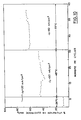
- This example illustrates the dependence of the lithium activity of radical solutions on the nature and the concentration of its constituent elements.
- the radical solution consists of 0.03 M of naphthalene, 0.06 M of tetramethyl ethane diamine and benzene, in the presence of a source of excess metallic lithium.
- the positive electrode consists of MoO 2 particles of approximately 15 £ and acetylene black bound by the polymer of the electrolyte in volume ratios of (, 30-, 10-, 60) and has a capacity of '' about 3.5 C / cm 2 .
- the ratio 0 / 4Li between the oxygen of the metal monomer of the polymer and the lithium salt LiC10 4 is approximately 12/1 for the whole of the generator and the total surface of the generator, of 3.9 cm 2 .
- FIGURE 3 illustrates the appearance of the discharge plates obtained at 27 ° C and 60 uA and the maintenance of the appearance of the discharge plates obtained at 27 ° C and 60 ⁇ A and the maintenance of the capacity observed in coulombs to the discharge cycles identified D2, D5 and D15.
- the dendritic shape of the negative electrode makes it possible to obtain relatively high currents at 27 ° C. as a result of the large exchange surface between the alloy and the polymer electrolyte while the good resistance to cycling confirms the good maintenance of electronic contact between the various parts of the alloy and the absence of the phenomenon of electrical isolation of the alloy by the formation of passivation films.
- the negative electrode is obtained from an aluminum strip approximately 300 ⁇ thick which is immersed for approximately 6 hours in a 1.4 ⁇ 10 ⁇ 1 molar solution of tetramethyl ethane diamine and 6 ⁇ 10 -2 molar in naphthalene in benzene.
- the control of the lithium activity in the solution and of the reaction time allows the preservation of the initial form of the strip since the activity of the solution does not allow the formation of the ⁇ -rich phase and that of the pure aluminum or unreacted phase remains present in the center of the structure (FIGURE 6).
- the capacity of the alloy formed on the surface under these conditions is approximately 70 / cm.
- the electrode is completed by applying to the alloy of the polymer electrolyte dissolved in a solvent such as benzene and allowing to evaporate.
- the thickness of the electrolyte is ⁇ 110 ⁇ and the surface is 5.6 cm 2 .
- the cycling properties at 26, 48 and 55 ° C of the generator are shown in FIGURE 10 and appear excellent over more than 60 successive cycles at rates varying from C / 70 to ⁇ C / 20.
- this example shows how the electrode thus produced so as to allow the coexistence of the alloy formed with a second phase, here the unreacted aluminum, proves favorable to the cycling properties by thermodynamically promoting the control of the activity of the lithium of the electrolyte close to 380 mVvsLi ° which disadvantages the formation of the ⁇ -rich phase during recharging and thus ensures the physical integrity of the electrode.
- the starting structure is a thin strip of aluminum of 25 u and the organic solution is of composition: 9.0 ⁇ 10 -2 molar in biphenyl and approximately 1 molar in THF in benzene.
- the reaction is continued over approximately 100 hours and the transformation of the initial strip into an alloy is observed, the final thickness of which is approximately 40 ⁇ after complete conversion, the lithium activity of the alloy measured according to Example 1 is approximately 380 mVvsLi ° substantially the same value as that observed for the solution.
- This example therefore shows how the control of the activity of the activity of the organic solution allows the conservation of the shape of the original strip as long as the activity does not allow the formation of ⁇ phase aluminum.
- the starting structure is an aluminum strip of approximately 300 ⁇ which is brought into contact with a 1.5 ⁇ 10 -2 molar solution of tetramethyl ethane diamine and 6.5 ⁇ 10 -3 molar naphthalene for 12 hours after which the lithium is first removed and then 1 hour later the alloy is also removed and washed.
- This treatment makes it possible to control the amount of alloy formed ( ⁇ 20C / cm 2 ) on the surface and its homogeneity.
- the generator is then assembled using an electrolyte based on polyoxyethylene of molecular mass 5M which is first fused on the alloy around 90 ° C and then brought into contact on the other side with a positive composite electrode formed of V 6 O 13 ( ⁇ 38 ⁇ ⁇ 2C / cm 2 ), acetylene black and the electrolyte polymer in volume ratios of (, 40 -, 14 -, 45) and its stainless steel manifold.
- the surface area of the generator is 3.9 cm 2 , the 0/4 Li ratio is ⁇ 9/1 for LiClO 4 and the discharge and charge currents of approximately 100 ⁇ A / cm 2 .
- FIGURE 11 The discharge plates of this generator obtained at 100 ° C are illustrated in FIGURE 11 for the tests Dl, D2, D15, D105. Except for the first discharge, the shape of which is typical of V 6 O 13 behaviors and whose capacity is lower than expected as a result of a partial discharge during assembly, the following plates are remarkably stable over more than 100 discharge cycles deep ( ⁇ 60%) and appear to be controlled by the positive electrode. This example clearly illustrates the advantages of the electrodes produced according to the invention under relatively high temperature conditions.
- a known weight of aluminum in the form of a strip 25 u thick by ⁇ 1 cm 2 of surface is immersed in the solution.
- the reaction takes place at room temperature for about 20 hours.
- the product obtained, when the reaction is supplemented is a powder of an alloy of lithium and aluminum composed of grains of cubic shape whose average dimensions are approximately 20 ⁇ X 10 ⁇ X 10 u. This powder is filtered from the dried solution and then weighed. The weight gain due to the formation of the alloy relative to the initial weight of the aluminum allows us to evaluate the stoichiometry of the alloy at around Li 0.5 Al 0.5 .
- the lithium chemical activity of the alloy measured according to the method described in Example 1 is: 188 mVvsLi °, which corresponds to the lithium activity of the beta phase (FIGURE 2) at the stoichiometry of Li 0.56 Al 0.44 according to the composition activity diagram published by TR Jow and CC Liang (Journal of the Electrochemical Society 129, 7, p (1982) 1429-1434).
- Obtaining a high-activity lithium alloy, rich phase ⁇ , is accompanied by an increase in volume which, for the case described here, leads to a disintegration of the initial strip.
- Powders of predetermined particle size by sieving, particle diameter ⁇ 38 ⁇ , of Zn, Si and Ag are successively immersed in the radical solution. After approximately 24 hours of reaction time, the powders produced are filtered from the solution, dried and then weighed.
- We determine the stoichiometry of the synthesized alloys which are: Li 0.55 - Ag 0.45 ' , Li 0.51 Zn 0.49 and Li 0.76 Si 0.24 .
- the chemical activity of these alloys is measured and we obtain: 114 mV, 180 mV and 144 mV respectively.
- the powders of the alloys Li 0.56 Al 0.044 ' , Li 0.55 Ag 0.45 and Li 0.51 Zn 0.49 described in Example 6, are used to make composite negative electrodes according to the procedure described in Canadian patent application N ° 406.358.
- Example 6 having an activity of less than 200 mV is used in the presence of an aluminum structure containing a low rate of Al3Ni intermetals in the form of fibers present in aluminum. In this case, despite a high lithium activity, the formation of LiAI of rich beta phase does not lead to the disintegration of the structure thanks to the presence of fibers.
- a generator test similar to that of Example 2 leads to equivalent performance except for the first discharge voltage which is higher by about 175 mV.
Landscapes
- Chemical & Material Sciences (AREA)
- Chemical Kinetics & Catalysis (AREA)
- Electrochemistry (AREA)
- General Chemical & Material Sciences (AREA)
- Engineering & Computer Science (AREA)
- Materials Engineering (AREA)
- Manufacturing & Machinery (AREA)
- Mechanical Engineering (AREA)
- Metallurgy (AREA)
- Organic Chemistry (AREA)
- Battery Electrode And Active Subsutance (AREA)
- Secondary Cells (AREA)
- Electrolytic Production Of Metals (AREA)
- Manufacture And Refinement Of Metals (AREA)
- Pharmaceuticals Containing Other Organic And Inorganic Compounds (AREA)
Applications Claiming Priority (2)
| Application Number | Priority Date | Filing Date | Title |
|---|---|---|---|
| CA451782 | 1984-04-11 | ||
| CA000451782A CA1244301A (fr) | 1984-04-11 | 1984-04-11 | Procede pour preparer des electrodes negatives alliees et dispositifs utilisant ces electrodes |
Publications (3)
| Publication Number | Publication Date |
|---|---|
| EP0159266A2 true EP0159266A2 (de) | 1985-10-23 |
| EP0159266A3 EP0159266A3 (en) | 1987-10-14 |
| EP0159266B1 EP0159266B1 (de) | 1990-07-04 |
Family
ID=4127631
Family Applications (1)
| Application Number | Title | Priority Date | Filing Date |
|---|---|---|---|
| EP85400691A Expired - Lifetime EP0159266B1 (de) | 1984-04-11 | 1985-04-05 | Verfahren zur Herstellung negativer legierter Elektroden und diese Elektroden verwendende Vorrichtungen |
Country Status (18)
| Country | Link |
|---|---|
| US (1) | US4690840A (de) |
| EP (1) | EP0159266B1 (de) |
| JP (2) | JPH07107861B2 (de) |
| KR (1) | KR850007818A (de) |
| CN (1) | CN85101583A (de) |
| AT (1) | ATE54342T1 (de) |
| AU (1) | AU4048585A (de) |
| BR (1) | BR8501689A (de) |
| CA (1) | CA1244301A (de) |
| DE (1) | DE3578510D1 (de) |
| DK (1) | DK161385A (de) |
| ES (2) | ES8702741A1 (de) |
| FR (1) | FR2569058A1 (de) |
| GR (1) | GR850876B (de) |
| MA (1) | MA20398A1 (de) |
| NO (1) | NO851419L (de) |
| OA (1) | OA07989A (de) |
| ZA (1) | ZA852262B (de) |
Cited By (5)
| Publication number | Priority date | Publication date | Assignee | Title |
|---|---|---|---|---|
| FR2615328A1 (fr) * | 1987-05-12 | 1988-11-18 | Bridgestone Corp | Pile electrique et procede de fabrication |
| EP0323888A3 (de) * | 1988-01-05 | 1992-05-27 | Alcan International Limited | Batterie |
| EP0690517A1 (de) * | 1994-05-30 | 1996-01-03 | Canon Kabushiki Kaisha | Wiederaufladbare Lithiumbatterie |
| EP0692669A1 (de) * | 1993-07-02 | 1996-01-17 | Hydro-Quebec | Beim Auswalzen von Lithiumbändern zu dünnen Folien zu verwendende Schmiermittelzusätze |
| EP0717120A3 (de) * | 1994-12-15 | 1997-06-25 | Sumitomo Electric Industries | Poröser metallischer Körper, dessen Herstellungsverfahren und Batterieplatte daraus |
Families Citing this family (27)
| Publication number | Priority date | Publication date | Assignee | Title |
|---|---|---|---|---|
| JPS63285865A (ja) * | 1987-05-18 | 1988-11-22 | Sanyo Electric Co Ltd | 非水電解液二次電池 |
| SE463536B (sv) * | 1988-04-19 | 1990-12-03 | Inclusion Ab | Saett att framstaella ett aggregat av anodenheter samt aemne foer genomfoerande av saettet |
| US5274493A (en) * | 1989-07-13 | 1993-12-28 | Elf Atochem North America, Inc. | Electrochromic element, materials for use in such element, processes for making such element and such materials and use of such element in an electrochromic glass device |
| US5086351A (en) * | 1989-07-13 | 1992-02-04 | M&T Chemicals, Inc. | Electrochromic elements, materials for use in such element, processes for making such elements and such materials and use of such element in an electrochromic glass device |
| DE4030205C3 (de) * | 1989-09-25 | 1994-10-06 | Ricoh Kk | Negative Elektrode für Sekundärbatterie und ein Verfahren zur Herstellung dieser Elektrode |
| US5133931A (en) * | 1990-08-28 | 1992-07-28 | Reynolds Metals Company | Lithium aluminum alloy system |
| US5227264A (en) * | 1991-02-14 | 1993-07-13 | Hydro-Quebec | Device for packaging a lithium battery |
| US5198045A (en) * | 1991-05-14 | 1993-03-30 | Reynolds Metals Company | Low density high strength al-li alloy |
| US5278005A (en) * | 1992-04-06 | 1994-01-11 | Advanced Energy Technologies Inc. | Electrochemical cell comprising dispersion alloy anode |
| US6019801A (en) * | 1994-07-12 | 2000-02-01 | Hydro-Quebec | Additives for lubricating agents used in the lamination of lithium sheets into thin films |
| US5932375A (en) * | 1997-02-18 | 1999-08-03 | Aluminum Company Of America | Form charging aluminum-lithium battery cells |
| CA2202604C (fr) * | 1997-04-14 | 2000-12-26 | Hydro-Quebec | Feuillard d'anode alliee et dense a relaxation locale de stress |
| DE29823366U1 (de) * | 1998-08-06 | 1999-07-08 | Patent-Treuhand-Gesellschaft für elektrische Glühlampen mbH, 81543 München | Elektrode für eine Hochdruckentladungslampe mit langer Lebensdauer |
| KR20010041259A (ko) | 1998-12-25 | 2001-05-15 | 마츠시타 덴끼 산교 가부시키가이샤 | 리튬 2차 전지 |
| CA2420104C (en) * | 2000-09-01 | 2012-10-30 | Sanyo Electric Co., Ltd. | Negative electrode for lithium secondary cell and method for producing the same |
| US10629947B2 (en) | 2008-08-05 | 2020-04-21 | Sion Power Corporation | Electrochemical cell |
| US20050287441A1 (en) * | 2004-06-23 | 2005-12-29 | Stefano Passerini | Lithium polymer electrolyte batteries and methods of making |
| JP4867212B2 (ja) * | 2005-06-20 | 2012-02-01 | トヨタ自動車株式会社 | リチウム二次電池の製造方法 |
| ATE452418T1 (de) * | 2006-09-12 | 2010-01-15 | Koninkl Philips Electronics Nv | Leuchte mit einem in die quarzglashülle der leuchte integrierten leiter |
| US20080318128A1 (en) * | 2007-06-22 | 2008-12-25 | Sion Power Corporation | Lithium alloy/sulfur batteries |
| EP2721665B1 (de) | 2011-06-17 | 2021-10-27 | Sion Power Corporation | Verfahren zur plattierung einer elektrode |
| CN103947027B (zh) | 2011-10-13 | 2016-12-21 | 赛昂能源有限公司 | 电极结构及其制造方法 |
| CN103722920B (zh) * | 2012-10-11 | 2016-01-06 | 黄瑜贞 | 一种立体印刷的方法及其所制的装饰板与灯箱 |
| JP2018170251A (ja) * | 2017-03-30 | 2018-11-01 | 三井化学株式会社 | 非水電解質二次電池用負極の製造方法、非水電解質二次電池の製造方法、および非水電解質二次電池用負極活物質の製造方法 |
| KR101950465B1 (ko) | 2017-08-11 | 2019-05-02 | 주식회사 엘지화학 | 전해용 전극 및 이의 제조방법 |
| US20190169447A1 (en) * | 2017-12-01 | 2019-06-06 | Flosfia Inc. | Solvent and method of forming organic film using solvent |
| US20240297347A1 (en) | 2020-12-25 | 2024-09-05 | Panasonic Intellectual Property Management Co., Ltd. | Lithium secondary battery |
Family Cites Families (3)
| Publication number | Priority date | Publication date | Assignee | Title |
|---|---|---|---|---|
| US4002492A (en) * | 1975-07-01 | 1977-01-11 | Exxon Research And Engineering Company | Rechargeable lithium-aluminum anode |
| US4056885A (en) * | 1976-12-15 | 1977-11-08 | Exxon Research & Engineering Co. | Method of preparing lithium-aluminum alloy electrodes |
| JPS551058A (en) * | 1978-06-19 | 1980-01-07 | Sanyo Electric Co Ltd | Manufacture of negative-polar active substance for nonaqueous electrolyte cell |
-
1984
- 1984-04-11 CA CA000451782A patent/CA1244301A/fr not_active Expired
-
1985
- 1985-03-26 ZA ZA852262A patent/ZA852262B/xx unknown
- 1985-03-28 AU AU40485/85A patent/AU4048585A/en not_active Abandoned
- 1985-04-01 CN CN85101583A patent/CN85101583A/zh active Pending
- 1985-04-02 MA MA20620A patent/MA20398A1/fr unknown
- 1985-04-04 US US06/719,978 patent/US4690840A/en not_active Expired - Lifetime
- 1985-04-05 FR FR8505293A patent/FR2569058A1/fr active Granted
- 1985-04-05 AT AT85400691T patent/ATE54342T1/de not_active IP Right Cessation
- 1985-04-05 EP EP85400691A patent/EP0159266B1/de not_active Expired - Lifetime
- 1985-04-05 DE DE8585400691T patent/DE3578510D1/de not_active Expired - Lifetime
- 1985-04-08 GR GR850876A patent/GR850876B/el unknown
- 1985-04-10 ES ES542094A patent/ES8702741A1/es not_active Expired
- 1985-04-10 DK DK161385A patent/DK161385A/da not_active IP Right Cessation
- 1985-04-10 BR BR8501689A patent/BR8501689A/pt unknown
- 1985-04-10 NO NO851419A patent/NO851419L/no unknown
- 1985-04-10 KR KR1019850002414A patent/KR850007818A/ko not_active Withdrawn
- 1985-04-11 OA OA58565A patent/OA07989A/xx unknown
- 1985-04-11 JP JP60077518A patent/JPH07107861B2/ja not_active Expired - Lifetime
-
1986
- 1986-07-16 ES ES557030A patent/ES8707309A1/es not_active Expired
-
1995
- 1995-06-22 JP JP15576795A patent/JP3165003B2/ja not_active Expired - Lifetime
Cited By (6)
| Publication number | Priority date | Publication date | Assignee | Title |
|---|---|---|---|---|
| FR2615328A1 (fr) * | 1987-05-12 | 1988-11-18 | Bridgestone Corp | Pile electrique et procede de fabrication |
| EP0323888A3 (de) * | 1988-01-05 | 1992-05-27 | Alcan International Limited | Batterie |
| EP0692669A1 (de) * | 1993-07-02 | 1996-01-17 | Hydro-Quebec | Beim Auswalzen von Lithiumbändern zu dünnen Folien zu verwendende Schmiermittelzusätze |
| EP0690517A1 (de) * | 1994-05-30 | 1996-01-03 | Canon Kabushiki Kaisha | Wiederaufladbare Lithiumbatterie |
| EP1339116A3 (de) * | 1994-05-30 | 2005-03-23 | Canon Kabushiki Kaisha | Wiederaufladbare Lithiumbatterie |
| EP0717120A3 (de) * | 1994-12-15 | 1997-06-25 | Sumitomo Electric Industries | Poröser metallischer Körper, dessen Herstellungsverfahren und Batterieplatte daraus |
Also Published As
| Publication number | Publication date |
|---|---|
| ZA852262B (en) | 1985-11-27 |
| JPS618849A (ja) | 1986-01-16 |
| GR850876B (de) | 1985-11-25 |
| EP0159266B1 (de) | 1990-07-04 |
| JPH08102334A (ja) | 1996-04-16 |
| CA1244301A (fr) | 1988-11-08 |
| CN85101583A (zh) | 1987-01-31 |
| ES8702741A1 (es) | 1987-01-16 |
| FR2569058A1 (fr) | 1986-02-14 |
| ES8707309A1 (es) | 1987-08-01 |
| ES557030A0 (es) | 1987-08-01 |
| MA20398A1 (fr) | 1985-12-31 |
| ATE54342T1 (de) | 1990-07-15 |
| DE3578510D1 (de) | 1990-08-09 |
| ES542094A0 (es) | 1987-01-16 |
| BR8501689A (pt) | 1985-12-10 |
| JP3165003B2 (ja) | 2001-05-14 |
| KR850007818A (ko) | 1985-12-09 |
| DK161385A (da) | 1985-10-12 |
| NO851419L (no) | 1985-10-14 |
| EP0159266A3 (en) | 1987-10-14 |
| OA07989A (fr) | 1986-03-31 |
| DK161385D0 (da) | 1985-04-10 |
| US4690840A (en) | 1987-09-01 |
| AU4048585A (en) | 1985-10-17 |
| FR2569058B1 (de) | 1995-01-27 |
| JPH07107861B2 (ja) | 1995-11-15 |
Similar Documents
| Publication | Publication Date | Title |
|---|---|---|
| EP0159266B1 (de) | Verfahren zur Herstellung negativer legierter Elektroden und diese Elektroden verwendende Vorrichtungen | |
| EP0098772B1 (de) | Zusammengesetzte und biegsame Anoden für nichtwässrige Lithiumzelle | |
| EP0013199B1 (de) | Elektrochemische Stromgeneratoren und Materialien zu ihrer Herstellung | |
| EP0159937B1 (de) | Dichte Anoden aus Lithiumlegierungen für feste Batterien | |
| EP3011071B1 (de) | Verfahren zur herstellung eines amorphen films aus lithiiertem metallsulfid oder oxysulfid | |
| EP3659193B1 (de) | Nanostrukturierter werkstoff und sein herstellungsverfahren | |
| EP1649530A2 (de) | Verfahren zur herstellung einer elektrode aus einem porrösen material, resultierende elektrode und entsprechendes elektrochemisches system | |
| CA2534243A1 (fr) | Particules d'oxyde metallique enrobees a faible taux de dissolution, procedes de preparation et utilisation dans les systemes electrochimiques | |
| FR3063180A1 (fr) | Utilisation d'un compose hybride a matrice mixte organique-inorganique, dit mof, comme materiau actif d'electrode. | |
| FR2724490A1 (fr) | Electrode composite carbone/polymere pour generateur electrochimique rechargeable au lithium | |
| CA3120989A1 (fr) | Materiaux d'enrobage a base d'hydrocarbures aliphatiques insatures et leurs utilisations dans des applications electrochimiques | |
| EP3049471B1 (de) | Polymerzusammensetzungen zur leitung von lithiumionen an elektrochemischen lithiumgenerator | |
| EP3108524A1 (de) | Positive elektrode für elektrochemischen lithium-schwefel-akkumulatir mit einer spezifischen struktur | |
| EP0464117B1 (de) | Elektrodenmaterial auf der basis von lithium enthaltendem vanadiumoxyd, verfahren zur herstellung und anwendung in einem elektrochemischen generator | |
| FR3108793A1 (fr) | Electrode nanoporeuse | |
| WO2024126799A1 (fr) | Électrodes négatives à base de silicium et d'additif fluoré | |
| EP3629400B1 (de) | Herstellungsverfahren von lithiumübergangsmetalloxiden | |
| FR3134396A1 (fr) | Procédé de fluoration d’une surface de lithium métallique | |
| WO2021260175A1 (fr) | Electrode négative hybride graphite/lithium | |
| EP3281244A1 (de) | Verfahren zur herstellung eines materials mit nanoelementen | |
| FR3112029A1 (fr) | Electrode traitee en surface, les elements, modules et batteries la comprenant | |
| CA2199446A1 (fr) | Generateurs a electrolyte polymere possedant un sel de potassium permettant de stabiliser les performances et la vie utile de la batterie | |
| EP4452867A1 (de) | Elektrodenmaterial beschichtet mit einer spezifischen verbindung | |
| FR3137217A1 (fr) | Membrane pour cellule electrochimique comprenant une couche lithiophile | |
| EP4264722A1 (de) | Elektrochemisches festkörper-lithium-schwefel-element |
Legal Events
| Date | Code | Title | Description |
|---|---|---|---|
| PUAI | Public reference made under article 153(3) epc to a published international application that has entered the european phase |
Free format text: ORIGINAL CODE: 0009012 |
|
| 17P | Request for examination filed |
Effective date: 19850427 |
|
| AK | Designated contracting states |
Designated state(s): AT BE CH DE GB IT LI LU NL SE |
|
| PUAL | Search report despatched |
Free format text: ORIGINAL CODE: 0009013 |
|
| AK | Designated contracting states |
Kind code of ref document: A3 Designated state(s): AT BE CH DE GB IT LI LU NL SE |
|
| 17Q | First examination report despatched |
Effective date: 19881007 |
|
| RAP1 | Party data changed (applicant data changed or rights of an application transferred) |
Owner name: SOCIETE NATIONALE ELF AQUITAINE |
|
| GRAA | (expected) grant |
Free format text: ORIGINAL CODE: 0009210 |
|
| AK | Designated contracting states |
Kind code of ref document: B1 Designated state(s): AT BE CH DE GB IT LI LU NL SE |
|
| REF | Corresponds to: |
Ref document number: 54342 Country of ref document: AT Date of ref document: 19900715 Kind code of ref document: T |
|
| REF | Corresponds to: |
Ref document number: 3578510 Country of ref document: DE Date of ref document: 19900809 |
|
| ITF | It: translation for a ep patent filed | ||
| GBT | Gb: translation of ep patent filed (gb section 77(6)(a)/1977) | ||
| ITTA | It: last paid annual fee | ||
| PLBE | No opposition filed within time limit |
Free format text: ORIGINAL CODE: 0009261 |
|
| STAA | Information on the status of an ep patent application or granted ep patent |
Free format text: STATUS: NO OPPOSITION FILED WITHIN TIME LIMIT |
|
| 26N | No opposition filed | ||
| PGFP | Annual fee paid to national office [announced via postgrant information from national office to epo] |
Ref country code: SE Payment date: 19940421 Year of fee payment: 10 |
|
| PGFP | Annual fee paid to national office [announced via postgrant information from national office to epo] |
Ref country code: CH Payment date: 19940425 Year of fee payment: 10 |
|
| PGFP | Annual fee paid to national office [announced via postgrant information from national office to epo] |
Ref country code: BE Payment date: 19940427 Year of fee payment: 10 Ref country code: AT Payment date: 19940427 Year of fee payment: 10 |
|
| PGFP | Annual fee paid to national office [announced via postgrant information from national office to epo] |
Ref country code: NL Payment date: 19940430 Year of fee payment: 10 Ref country code: LU Payment date: 19940430 Year of fee payment: 10 |
|
| EPTA | Lu: last paid annual fee | ||
| EAL | Se: european patent in force in sweden |
Ref document number: 85400691.3 |
|
| PG25 | Lapsed in a contracting state [announced via postgrant information from national office to epo] |
Ref country code: LU Free format text: LAPSE BECAUSE OF NON-PAYMENT OF DUE FEES Effective date: 19950405 Ref country code: AT Effective date: 19950405 |
|
| PG25 | Lapsed in a contracting state [announced via postgrant information from national office to epo] |
Ref country code: SE Effective date: 19950406 |
|
| PG25 | Lapsed in a contracting state [announced via postgrant information from national office to epo] |
Ref country code: LI Effective date: 19950430 Ref country code: CH Effective date: 19950430 Ref country code: BE Effective date: 19950430 |
|
| BERE | Be: lapsed |
Owner name: SOC. NATIONALE ELF AQUITAINE Effective date: 19950430 |
|
| PG25 | Lapsed in a contracting state [announced via postgrant information from national office to epo] |
Ref country code: NL Effective date: 19951101 |
|
| REG | Reference to a national code |
Ref country code: CH Ref legal event code: PL |
|
| NLV4 | Nl: lapsed or anulled due to non-payment of the annual fee |
Effective date: 19951101 |
|
| EUG | Se: european patent has lapsed |
Ref document number: 85400691.3 |
|
| REG | Reference to a national code |
Ref country code: GB Ref legal event code: IF02 |
|
| PGFP | Annual fee paid to national office [announced via postgrant information from national office to epo] |
Ref country code: GB Payment date: 20040329 Year of fee payment: 20 Ref country code: DE Payment date: 20040329 Year of fee payment: 20 |
|
| PG25 | Lapsed in a contracting state [announced via postgrant information from national office to epo] |
Ref country code: GB Free format text: LAPSE BECAUSE OF EXPIRATION OF PROTECTION Effective date: 20050404 |
|
| REG | Reference to a national code |
Ref country code: GB Ref legal event code: PE20 |