EP0159286A2 - Etiquette et procédé et dispositif pour arracher une étiquette et procédé et dispositif pour détacher une étiquette - Google Patents
Etiquette et procédé et dispositif pour arracher une étiquette et procédé et dispositif pour détacher une étiquette Download PDFInfo
- Publication number
- EP0159286A2 EP0159286A2 EP85730054A EP85730054A EP0159286A2 EP 0159286 A2 EP0159286 A2 EP 0159286A2 EP 85730054 A EP85730054 A EP 85730054A EP 85730054 A EP85730054 A EP 85730054A EP 0159286 A2 EP0159286 A2 EP 0159286A2
- Authority
- EP
- European Patent Office
- Prior art keywords
- label
- substance
- labels
- objects
- solvent
- Prior art date
- Legal status (The legal status is an assumption and is not a legal conclusion. Google has not performed a legal analysis and makes no representation as to the accuracy of the status listed.)
- Withdrawn
Links
Images


Classifications
-
- G—PHYSICS
- G09—EDUCATION; CRYPTOGRAPHY; DISPLAY; ADVERTISING; SEALS
- G09F—DISPLAYING; ADVERTISING; SIGNS; LABELS OR NAME-PLATES; SEALS
- G09F3/00—Labels, tag tickets, or similar identification or indication means; Seals; Postage or like stamps
- G09F3/02—Forms or constructions
- G09F3/0286—Forms or constructions provided with adaptations for labelling machines
-
- B—PERFORMING OPERATIONS; TRANSPORTING
- B08—CLEANING
- B08B—CLEANING IN GENERAL; PREVENTION OF FOULING IN GENERAL
- B08B9/00—Cleaning hollow articles by methods or apparatus specially adapted thereto
- B08B9/08—Cleaning containers, e.g. tanks
- B08B9/083—Removing scrap from containers, e.g. removing labels
-
- B—PERFORMING OPERATIONS; TRANSPORTING
- B65—CONVEYING; PACKING; STORING; HANDLING THIN OR FILAMENTARY MATERIAL
- B65C—LABELLING OR TAGGING MACHINES, APPARATUS, OR PROCESSES
- B65C9/00—Details of labelling machines or apparatus
- B65C9/20—Gluing the labels or articles
-
- B—PERFORMING OPERATIONS; TRANSPORTING
- B65—CONVEYING; PACKING; STORING; HANDLING THIN OR FILAMENTARY MATERIAL
- B65C—LABELLING OR TAGGING MACHINES, APPARATUS, OR PROCESSES
- B65C9/00—Details of labelling machines or apparatus
- B65C9/20—Gluing the labels or articles
- B65C9/22—Gluing the labels or articles by wetting, e.g. by applying liquid glue or a liquid to a dry glue coating
- B65C9/2273—Gluing the labels or articles by wetting, e.g. by applying liquid glue or a liquid to a dry glue coating using wipers, pallets or segments
- B65C9/2282—Applying the liquid on the label
- B65C9/2291—Applying the liquid on the label continuously, i.e. an uninterrupted film
-
- B—PERFORMING OPERATIONS; TRANSPORTING
- B65—CONVEYING; PACKING; STORING; HANDLING THIN OR FILAMENTARY MATERIAL
- B65C—LABELLING OR TAGGING MACHINES, APPARATUS, OR PROCESSES
- B65C9/00—Details of labelling machines or apparatus
- B65C9/20—Gluing the labels or articles
- B65C9/24—Gluing the labels or articles by heat
-
- G—PHYSICS
- G09—EDUCATION; CRYPTOGRAPHY; DISPLAY; ADVERTISING; SEALS
- G09F—DISPLAYING; ADVERTISING; SIGNS; LABELS OR NAME-PLATES; SEALS
- G09F3/00—Labels, tag tickets, or similar identification or indication means; Seals; Postage or like stamps
- G09F3/02—Forms or constructions
-
- G—PHYSICS
- G09—EDUCATION; CRYPTOGRAPHY; DISPLAY; ADVERTISING; SEALS
- G09F—DISPLAYING; ADVERTISING; SIGNS; LABELS OR NAME-PLATES; SEALS
- G09F3/00—Labels, tag tickets, or similar identification or indication means; Seals; Postage or like stamps
- G09F3/04—Labels, tag tickets, or similar identification or indication means; Seals; Postage or like stamps to be fastened or secured by the material of the label itself, e.g. by thermo-adhesion
-
- G—PHYSICS
- G09—EDUCATION; CRYPTOGRAPHY; DISPLAY; ADVERTISING; SEALS
- G09F—DISPLAYING; ADVERTISING; SIGNS; LABELS OR NAME-PLATES; SEALS
- G09F3/00—Labels, tag tickets, or similar identification or indication means; Seals; Postage or like stamps
- G09F3/02—Forms or constructions
- G09F2003/0251—Sleeve shaped label, i.e. wrapped around a device
-
- G—PHYSICS
- G09—EDUCATION; CRYPTOGRAPHY; DISPLAY; ADVERTISING; SEALS
- G09F—DISPLAYING; ADVERTISING; SIGNS; LABELS OR NAME-PLATES; SEALS
- G09F3/00—Labels, tag tickets, or similar identification or indication means; Seals; Postage or like stamps
- G09F3/02—Forms or constructions
- G09F2003/0264—Shapes or borders
- G09F2003/0267—Shapes or borders die cut
-
- G—PHYSICS
- G09—EDUCATION; CRYPTOGRAPHY; DISPLAY; ADVERTISING; SEALS
- G09F—DISPLAYING; ADVERTISING; SIGNS; LABELS OR NAME-PLATES; SEALS
- G09F3/00—Labels, tag tickets, or similar identification or indication means; Seals; Postage or like stamps
- G09F3/02—Forms or constructions
- G09F2003/0272—Labels for containers
Definitions
- the invention relates to a label for application to an object to be identified and to a method and an apparatus for applying this label to an object.
- the invention further relates to a method and a device for detaching this label from an object.
- the back of the labels is glued in the labeling machine before the labels are applied to the objects.
- the glue is transferred to Leimpe.letten in the glue station using a glue roller.
- the glue pallets are then guided to the label magazin via the pallet carousel.
- the gripper cylinder With the Glue film on the glue pallet, the labels in the label magazine with the back facing the glue pallet are removed and guided to the gripper cylinder with the glue pallet.
- the grippers take over the labels.
- glue splitting takes place so that the labels have enough adhesive on the back for later adhesion and sticking to the object.
- the gripper cylinder transports the glued labels to a bottle table, for example, where the labels are blown onto bottles or other containers. In a subsequent brushing section, the labels are pressed onto the bottles or containers by brushes or sponges.
- the application of the labels during the filling process of the bottles or other containers has certain disadvantages. Apart from the fact that the application of the glue to the glue pallets as well as to the back of the labels takes a certain time, there is a major disadvantage that the labels on the gripper tend to act under the effect of the glue spread on the back roll up, so that there is a risk that individual labels either not at all or only partially can be applied to the container. However, since proper labeling of the containers is required, measures must be taken to ensure that the containers are not labeled or are labeled incorrectly
- the lye must therefore often be reprocessed or replaced. This in turn results in pollution of the wastewater by the lye and the impurities mentioned.
- a label it is therefore the object of the present invention to create a label, its application the filling process is not delayed and can be attached to the object to be labeled in a flawless manner. Furthermore, a label is to be created which does not require the use of an alkali-resistant material. The label should also be detached more easily and with little effort, and the environmental impact of contaminants occurring during the detachment should also be considerably reduced.
- This object is achieved according to the invention in the case of a label for application to an object to be identified in that it has a substance which can be activated on the back for adhesion to the object and does not cause any liability before activation.
- the stated object is achieved in that the activation of the substance is carried out before or upon contact between the back of the label and the object.
- the stated object is achieved according to the invention in that a device which brings about the activation of the substance which achieves the adhesion of the label and a device which brings the label into contact with the object during the activated state are provided are.
- the above object is achieved according to the invention in that, if necessary, an activation the substance causing the adhesion of the label is carried out and the label is mechanically removed during the possibly activated state.
- a detaching device is provided which mechanically separates the label from the object. This device is preferably designed in such a way that a device which activates the substance which achieves the adhesion of the label is provided before the mechanical detachment.
- a spray device for a solvent for the substance for spraying the label on the object or a heating device for heating the label on the object can be provided.
- a compressed air blowing device, an air suction device, a cold and / or hot water jet device or a brush arrangement can be provided to remove the label.
- an air suction device and a brush arrangement for jointly detaching the label from the object may also be an air suction device and a brush arrangement for jointly detaching the label from the object, the air suction device preferably being in the conveying direction of the objects in front of the brush arrangement and furthermore being advantageously arranged adjustable with respect to the conveying path of the objects.
- the labels can be designed in such a way that the activatable substance is incorporated into the label materials themselves, whereby the concentration of the activatable substance can change over the thickness of the label.
- the highest concentration of this substance will preferably occur on the back of the label.
- the label can also be in the way
- the coating in the printing press can be carried out in the finishing process using rotogravure, flexographic or offset printing.
- the coating can also be carried out in the paper machine during paper production or in a special coating machine.
- the activation of the substance can be either by a solvent or by a temperature change, 'these being either an increase in temperature or reduction in temperature may be effected.
- Glue, starch, resins, synthetic resins, linseed oils or waxes can be used as activatable substances, either alone or in any mixtures of the substances mentioned.
- the additional can brought layer of binder to be added.
- the coating can be applied as an aqueous dispersion, as a combination of an aqueous dispersion and a solvent such as ethanol, ethyl acetate, toluene, isopropanol, gasoline, glycol or the like, and as a purely solvent-based compound of the activatable substances mentioned.
- PVC or PVDC can be used as a dispersion, as well as waxes, modified waxes, hot melts or hot melt adhesives, in particular in the case of substances which can be activated by a change in temperature.
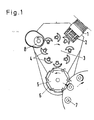
- the labeling device shown in FIG. 1 has a label magazine 1, in which labels 2 are stacked in such a way that the rear side of the foremost label faces a pallet carousel 3.
- the pallet carousel 3 contains individual pallets 4, each of which serves to transport a label to a gripper cylinder 5.
- the gripper cylinder 5 has grippers for removing the labels and cushions 6 for supporting one label each.
- the gripper cylinder transports the labels to a labeling station in which the back of the labels is brought into contact with containers 7 to be labeled. Because of the substance in the labels or in an additional layer applied to them, which is activated before or when the labels touch the containers, the labels adhere to the container.
- a dampening unit 8 which moistens the pallets 4 with a solvent suitable for activating the substance.
- This solvent can consist of water or a water-alcohol solution.
- the moistened pallets then arrive at the label magazine 1, the pallet 4 running past it coming into contact with the back of the foremost label 2 and taking it along.
- the adhesion of the label 2 to the pallet 4 can be achieved by suction air.
- liability may arise due to the activation of the substance by the solvent.
- the labels are then conveyed to the gripper cylinder 5, removed from the pallets 4 by the grippers and brought to the labeling station, where they come into contact with the containers 7 and adhere to them due to the activated substance.
- the pallets 4 are not, like the previous glue pallets, made of metal, in particular aluminum, but consist of solvent-friendly plastics or are coated with such a plastic.
- Solvent shower led If only water is used as the solvent, the condensation water frequently occurring on the outer surface of the container during the filling process can be sufficient for the activation of the substance causing the adhesion.
- the condensation water frequently occurring on the outer surface of the container during the filling process can be sufficient for the activation of the substance causing the adhesion.
- the containers After labeling, the containers are directed to a packing device. Here they can pass through a heating tunnel or a heating section, whereby a better activation of the adhesive substance and a stronger adhesion of the label to the container can be achieved.
- the labeling device according to FIG. 1 differs from a corresponding conventional device with gluing essentially in that the glue station has been replaced by the dampening unit and that the pallets or their surface coating consist of a different material.
- a conventional device can thus be converted into a device according to the invention with little effort.
- the pallet carousel 9 is designed differently than that in the device according to FIG. 1.
- the pallets 10 are not rotatable here, but rather are arranged fixed on the pallet carousel 9.
- the labels 2 are taken away from the rotating pallets 10 by the action of suction air.
- the adhesive substance in or on the labels is not activated by a solvent, but by an increase in temperature.
- the back of the labels transferred to the gripper cylinder 5 are guided past a heating device 11.
- the substance located in or on the labels is activated so that perfect adhesion of the labels to the containers 7 is ensured.
- the labels can also be heated by the pallets 4 being heated and / or the labels being transferred from the gripper cylinder to the containers by means of hot blown air passed through the cushions 6.
- a further heating device for example in the form of a heating tunnel, can be provided between the labeling station and the packaging device, which causes the adhesive substance to be activated again and thus improves the adhesion of the label to the container.
- a roll 12 printed with labels is provided with tax stamps.
- the roll width preferably corresponds to the label height.
- the control marks are scanned by a control device 13, as a result of which a paper tension regulation 14 and a cross cutter 15 for separating the labels from the unrolled label strip are controlled accordingly.
- Via a gripper or vacuum system 16 the labels then reach an activating device in the manner that can be seen, for example, from FIGS. 1 to 3, before they are applied to the objects to be labeled.
- the return bottles 17 provided with labels and coming from a depalletizer are arranged in a row via an inclined guide.
- Bottle guiding devices of this type are known, for example, in labeling machines.
- the bottles 17 then reach the area of action of an activation device 18, by means of which the adhesive substance incorporated into the labels is activated.
- this can be activated, for example, by a solvent or by heat, so that the activation device 18 is designed accordingly as a spray device for the solvent or as a heating device.
- the activation reduces the adhesion of the labels on the bottles 17 so that their mechanical detachment is facilitated.
- the bottles 17 are gripped by a screw roller 19, when the bottles 17 are rotated in the direction of the arrow be transported.
- the bottles 17 are guided past a brush arrangement opposite the screw roller 19, which consists of cylindrical brushes 20 arranged vertically, ie in the longitudinal direction of the bottles 17, and at least one horizontally arranged cylindrical brush 21 lying behind them in the bottle conveying direction.
- the bristles of the brushes 20 and 21 are short and hard and run in helical lines around the outer surfaces of the brush bodies.
- the brushes 20 and 21 are arranged rotatably and are driven, the brushes 20 being able to rotate in the same direction either in the counterclockwise direction or in the counterclockwise direction.
- the labels are laterally lifted off the bottles 17 by the brushes 20 and largely detached.
- the detachment can be facilitated by the fact that the adhesive substance is only incorporated into or applied to some areas of the labels, so that there is only adhesion between the label and the bottle in these areas.
- Crescent-shaped recesses in the adhesive substance on the upper and lower edge of the label have proven to be particularly advantageous.
- the horizontally arranged brush 21 has the task of wiping down the labels largely detached by the brushes 20.
- the direction of rotation of the brush 21 must accordingly be selected so that its bristles always move downwards in the area of contact with the bottles 17.
- a collecting container for the stripped labels this can be connected to a large container outside the bottle cellar by a suction line, so that the detached labels are conveyed directly into this container and stored there until they are recycled by a new one Use are fed.
- a further horizontal brush corresponding to the brush 21 is provided above the brush arrangement shown.
- the neck label is brushed directly through this and can then be blown down into the collecting container, for example by means of directed air radiation.
- a washing device is connected to the label detaching device shown is known manner and in which the bottles are cleaned before refilling.
- a lye bath is therefore not required when using the present mechanical detaching device. This means that no alkali-resistant materials have to be used for the labels. Furthermore, the effort for the washing device is considerably less than in the conventional washing machines for reusable bottles. In addition, there is considerable energy savings, since the soft liquor in the previous washing machines has to be kept constantly at a temperature in the range from about 75 to 82.degree. Finally, an important aspect is the lower environmental impact, since there is no soft lye and therefore no contaminating substances that would be discharged into the wastewater.
- the device according to FIG. 6 serves to remove labels adhering to bottle crates.
- the emptied boxes 22 are successively on a conveyor belt 23 moved in the direction of the arrow. This is arranged between a depalletizer (not shown) and a box washing device (also not shown).
- a depalletizer not shown
- a box washing device also not shown.
- the boxes 22 carry on the lower side in FIG. 6 labels which are to be removed by the device shown.
- an air suction device in the form of a suction bell 26 and a brush arrangement in the form of a rotating brush 27 are provided on the side of the conveyor belt.
- the suction Direction is in the conveying direction of the boxes 22 in front of the brush arrangement.
- the suction bell 26 is designed to be movable transversely to the conveyor belt 23 and can thus be brought into contact with the boxes 22 and also moved away from them again.
- the control of the movement and the mode of operation of the suction bell 26 is carried out in such a way that it is moved laterally towards the box 22 in the region of the front edge of the label, the label in this area is drawn to itself by suction and is moved away from the box 22 again so that the leading edge of the label is detached from the box 22. This is still held by the suction cup 26, so that the entire label is detached at the appropriate speed as the box 22 moves further.
- the brush 27 helps with this.
- the brush arrangement consists of only one brush with an axis running perpendicular to the plane of the conveyor belt 23; however, several spring-type brushes can also be provided, the transport direction lying one behind the other.
- the suction effect of the suction bell 26 is interrupted and with the aid of directed air radiation the label is conveyed down into a collecting container, which in turn can be connected to a waste container by a suction pipe.
- an activation device can be provided in the transport direction in front of the suction device and the brush arrangement, which activates any adhesive substance incorporated into or applied to the label and thereby facilitates detachment.
- the device according to FIG. 6 is particularly suitable for the detachment of labels which are surrounded by struts projecting beyond the outer surface of the box. If brushes are used exclusively for detachment, it is not possible to lift off the front edge of a label lying behind a strut.
- the suction device which can be moved transversely to the conveyor belt, is therefore provided for this measure.
- the incorporation or application of the adhesive substance can only take place in some areas, for example in the form of a grid, as a result of which the adhesion of the label to the outer surface of the box is reduced accordingly.
Landscapes
- Engineering & Computer Science (AREA)
- Physics & Mathematics (AREA)
- General Physics & Mathematics (AREA)
- Theoretical Computer Science (AREA)
- Mechanical Engineering (AREA)
- Labeling Devices (AREA)
- Adhesives Or Adhesive Processes (AREA)
- Application Of Or Painting With Fluid Materials (AREA)
- Cleaning In General (AREA)
Applications Claiming Priority (4)
| Application Number | Priority Date | Filing Date | Title |
|---|---|---|---|
| DE3414919 | 1984-04-17 | ||
| DE3414919 | 1984-04-17 | ||
| DE3508150 | 1985-03-07 | ||
| DE19853508150 DE3508150A1 (de) | 1984-04-17 | 1985-03-07 | Etikett und verfahren und vorrichtung zum aufbringen eines etiketts sowie verfahren und vorrichtung zum abloesen eines etiketts |
Publications (2)
| Publication Number | Publication Date |
|---|---|
| EP0159286A2 true EP0159286A2 (fr) | 1985-10-23 |
| EP0159286A3 EP0159286A3 (fr) | 1988-07-27 |
Family
ID=25820574
Family Applications (1)
| Application Number | Title | Priority Date | Filing Date |
|---|---|---|---|
| EP85730054A Withdrawn EP0159286A3 (fr) | 1984-04-17 | 1985-04-03 | Etiquette et procédé et dispositif pour arracher une étiquette et procédé et dispositif pour détacher une étiquette |
Country Status (3)
| Country | Link |
|---|---|
| EP (1) | EP0159286A3 (fr) |
| BE (1) | BE902217A (fr) |
| DE (1) | DE3508150A1 (fr) |
Cited By (11)
| Publication number | Priority date | Publication date | Assignee | Title |
|---|---|---|---|---|
| EP0235872A1 (fr) * | 1986-02-24 | 1987-09-09 | Owens-Illinois, Inc. | Méthode et appareil pour appliquer une étiquette flexible en matière plastique sur un récipient rond |
| EP0229895A3 (fr) * | 1985-10-29 | 1988-03-16 | McBrady, William J. | Mécanisme pour enlever des particules de l'extérieur d'une bouteille |
| EP0312037A3 (en) * | 1987-10-13 | 1990-09-26 | Toepfer Gmbh Kulmbach | Mechanically removable label |
| EP0499654A1 (fr) * | 1989-07-19 | 1992-08-26 | McBRADY ENGINEERING CO., Inc. | Dispositif de dépoussiérage des bouteilles avec une ceinture de brosses |
| EP0623503A1 (fr) * | 1993-05-07 | 1994-11-09 | Minnesota Mining And Manufacturing Company | Dispositif et procédé d'application d'un film sur des articles |
| EP1690795A1 (fr) * | 2005-02-09 | 2006-08-16 | Papierfabriken Cham-Tenero AG | Etiquette avec revêtement adhésif sensible à fluide, utilisation d'une telle étiquette, procédé d'application automatique d'une étiquette avec revêtement adhésif sensible à fluide et procédé de fabrication de papier d'étiquettes |
| WO2007077036A1 (fr) * | 2005-12-23 | 2007-07-12 | Töpfer Kulmbach GmbH | Procede d'application d'une etiquette et installation d'etiquetage correspondante |
| WO2009070395A1 (fr) * | 2007-11-26 | 2009-06-04 | Exxonmobil Oil Corporation | Procédé et appareil d'étiquetage |
| EP2322292A1 (fr) * | 2009-11-13 | 2011-05-18 | Renner GmbH | Dispositif et procédé d'enlèvement d'étiquettes d'objets |
| US8939538B2 (en) | 2011-08-04 | 2015-01-27 | Nulabel Technologies, Inc. | Liner-free label printer with label adhesive activation |
| DE102014224440A1 (de) | 2014-11-28 | 2016-06-02 | Töpfer Kulmbach GmbH | Etikett für Anwendung auf Gebinden |
Families Citing this family (14)
| Publication number | Priority date | Publication date | Assignee | Title |
|---|---|---|---|---|
| DE3713811A1 (de) * | 1986-11-13 | 1988-05-26 | Toepfer Gmbh Kulmbach | Vorrichtung zum mechanischen abloesen von etiketten |
| DE4007958A1 (de) * | 1990-03-13 | 1991-09-19 | Eti Tec Maschinenbau | Vorrichtung zum entfernen von auf behaeltern, insbesondere flaschen haftenden etiketten und folienzuschnitten |
| DE4018113C2 (de) * | 1990-06-06 | 1995-05-18 | Eti Tec Maschinenbau | Vorrichtung und Verfahren zum Entfernen von auf Behältern insbesondere Flaschen aufgeklebten Etiketten und/oder Folienzuschnitten |
| DE10130747B4 (de) * | 2001-06-26 | 2010-07-01 | Horst Lattek | Verfahren zum Ablösen von Klebeetiketten |
| DE10337402A1 (de) * | 2003-08-13 | 2005-03-17 | Ingrid Judisch | Verfahren und Vorrichtung zum Etikettieren eines Produkts |
| DE202009017331U1 (de) | 2009-12-21 | 2011-05-05 | Kirsch, Anita | Universallösungs- und/oder -Reinigungsmittel, insbesondere Etikettenentferner, auf biologischer Basis |
| US9051495B2 (en) | 2011-02-07 | 2015-06-09 | Nulabel Technologies, Inc. | Fluid activatable adhesives and fluids for activating same for use with liner-free labels |
| US8840994B2 (en) | 2013-01-10 | 2014-09-23 | Nulabel Technologies, Inc. | Fluid activatable adhesive for glue-free, liner-free, labels for glass and plastic substrates and methods of use thereof |
| US9254936B2 (en) | 2014-06-20 | 2016-02-09 | Nulabel Technologies, Inc. | Fluid activatable adhesive for glue-free, liner-free, labels for glass and plastic substrates and methods of use thereof |
| BR112017024287B1 (pt) | 2015-05-12 | 2022-05-10 | Actega North America Technologies, Inc | Etiquetas adesivas de película fina e métodos para produzir as mesmas |
| DE102015212134A1 (de) * | 2015-06-30 | 2017-01-05 | Krones Ag | Vorrichtung und Verfahren zum Etikettieren von Behältern |
| DE102015223398A1 (de) * | 2015-11-26 | 2017-06-01 | Krones Aktiengesellschaft | Etikettierverfahren für Behälter |
| US9777196B2 (en) | 2015-12-22 | 2017-10-03 | Nulabel Technologies, Inc. | Fluid activatable adhesives for glue-free, liner-free, labels for glass and plastic substrates and methods of use thereof |
| MX2020005023A (es) | 2017-11-17 | 2020-10-22 | Actega North America Tech Inc | Etiquetas adhesivas de pelicula delgada y metodos para hacer las mismas. |
Family Cites Families (13)
| Publication number | Priority date | Publication date | Assignee | Title |
|---|---|---|---|---|
| DE504476C (de) * | 1930-08-05 | Schaeffler Maschinenfabrik Geb | Etikettiermaschine fuer Flaschen o. dgl. | |
| US2446414A (en) * | 1944-09-30 | 1948-08-03 | Marathon Corp | Method of applying heat-sealable labels |
| US2525741A (en) * | 1947-05-01 | 1950-10-10 | New Jersey Machine Corp | Label activating and applying apparatus |
| US2613007A (en) * | 1950-01-18 | 1952-10-07 | New Jersey Machine Corp | Method of and apparatus for activating labels |
| DE1111414B (de) * | 1957-11-05 | 1961-07-20 | Capitol Records | Verfahren und Vorrichtung zum Entfernen von Papieretiketten von Schallplatten |
| DE1142130B (de) * | 1959-08-12 | 1963-01-03 | Jagenberg Werke Ag | Etikettiermaschine |
| DE1586400A1 (de) * | 1967-06-22 | 1970-05-21 | Strunck & Co Maschf H | Etikettiervorrichtung |
| IE37450B1 (en) * | 1972-03-29 | 1977-07-20 | Farthingham Dev Ltd | Self-adhesive stamp |
| DE2460175C2 (de) * | 1974-12-19 | 1982-04-01 | Holstein Und Kappert Gmbh, 4600 Dortmund | Verfahren und Vorrichtung zur Vorbehandlung von Mehrwegbehältern |
| DE2642046C3 (de) * | 1976-09-18 | 1982-12-23 | Kronseder, Hermann, 8404 Wörth | Etikettiervorrichtung für Gefäße |
| DE2710337A1 (de) * | 1977-03-07 | 1978-09-14 | Schumann Gunther | Verfahren zur reinigung von etikettierten flaschen |
| DE2825667A1 (de) * | 1978-06-12 | 1979-12-20 | Guenther Wegele | Klebe- und abloesefaehiges etikett, insbesondere fuer mehrwegflaschen |
| US4325775A (en) * | 1980-02-04 | 1982-04-20 | Horst Moeller | Delabeler |
-
1985
- 1985-03-07 DE DE19853508150 patent/DE3508150A1/de not_active Withdrawn
- 1985-04-03 EP EP85730054A patent/EP0159286A3/fr not_active Withdrawn
- 1985-04-17 BE BE0/214860A patent/BE902217A/fr not_active IP Right Cessation
Cited By (15)
| Publication number | Priority date | Publication date | Assignee | Title |
|---|---|---|---|---|
| EP0229895A3 (fr) * | 1985-10-29 | 1988-03-16 | McBrady, William J. | Mécanisme pour enlever des particules de l'extérieur d'une bouteille |
| EP0235872A1 (fr) * | 1986-02-24 | 1987-09-09 | Owens-Illinois, Inc. | Méthode et appareil pour appliquer une étiquette flexible en matière plastique sur un récipient rond |
| EP0312037A3 (en) * | 1987-10-13 | 1990-09-26 | Toepfer Gmbh Kulmbach | Mechanically removable label |
| EP0499654A1 (fr) * | 1989-07-19 | 1992-08-26 | McBRADY ENGINEERING CO., Inc. | Dispositif de dépoussiérage des bouteilles avec une ceinture de brosses |
| EP0623503A1 (fr) * | 1993-05-07 | 1994-11-09 | Minnesota Mining And Manufacturing Company | Dispositif et procédé d'application d'un film sur des articles |
| WO2006084567A1 (fr) * | 2005-02-09 | 2006-08-17 | Papierfabriken Cham-Tenero Ag | Etiquette a revetement adhesif sensible aux liquides, utilisation d'une telle etiquette, procede d'application automatique d'une etiquette a revetement adhesif sensible aux liquides et procede de production d'un papier a etiquettes |
| EP1690795A1 (fr) * | 2005-02-09 | 2006-08-16 | Papierfabriken Cham-Tenero AG | Etiquette avec revêtement adhésif sensible à fluide, utilisation d'une telle étiquette, procédé d'application automatique d'une étiquette avec revêtement adhésif sensible à fluide et procédé de fabrication de papier d'étiquettes |
| RU2416826C2 (ru) * | 2005-02-09 | 2011-04-20 | Хам Пейпер Груп Швайц АГ | Этикетка со слоем чувствительного к воздействию жидкости клея |
| WO2007077036A1 (fr) * | 2005-12-23 | 2007-07-12 | Töpfer Kulmbach GmbH | Procede d'application d'une etiquette et installation d'etiquetage correspondante |
| WO2009070395A1 (fr) * | 2007-11-26 | 2009-06-04 | Exxonmobil Oil Corporation | Procédé et appareil d'étiquetage |
| US8142604B2 (en) | 2007-11-26 | 2012-03-27 | Exxonmobil Oil Corporation | Labeling method |
| EP2322292A1 (fr) * | 2009-11-13 | 2011-05-18 | Renner GmbH | Dispositif et procédé d'enlèvement d'étiquettes d'objets |
| US8939538B2 (en) | 2011-08-04 | 2015-01-27 | Nulabel Technologies, Inc. | Liner-free label printer with label adhesive activation |
| DE102014224440A1 (de) | 2014-11-28 | 2016-06-02 | Töpfer Kulmbach GmbH | Etikett für Anwendung auf Gebinden |
| DE102014224440B4 (de) * | 2014-11-28 | 2018-02-22 | Töpfer Kulmbach GmbH | Etikett für Anwendung auf Gebinden |
Also Published As
| Publication number | Publication date |
|---|---|
| EP0159286A3 (fr) | 1988-07-27 |
| BE902217A (fr) | 1985-08-16 |
| DE3508150A1 (de) | 1985-10-24 |
Similar Documents
| Publication | Publication Date | Title |
|---|---|---|
| DE3508150A1 (de) | Etikett und verfahren und vorrichtung zum aufbringen eines etiketts sowie verfahren und vorrichtung zum abloesen eines etiketts | |
| EP3037357B1 (fr) | Dispositif et procede destines a l'etiquetage d'etiquettes adhesives pouvant etre activees | |
| EP0559005B1 (fr) | Méthode et appareil pour l'application d'une étiquette circulaire sur un récipient | |
| DE68928268T2 (de) | Verfahren zum anbringen eines etiketts auf einen behälter | |
| DE3442995C2 (fr) | ||
| EP2727849B1 (fr) | Dispositif et procédé d'équipement de récipients avec des étiquettes adhésives | |
| EP0499818B1 (fr) | Procédé et dispositif pour la pose d'étiquettes sur des récipients | |
| DE202016105825U1 (de) | Etikettieraggregat zum Aufbringen von Formetiketten auf Behälter | |
| WO2009071237A1 (fr) | Procédé d'étiquetage de récipients et poste d'étiquetage | |
| EP2495179A2 (fr) | Dispositif d'étiquetage | |
| DE69712040T2 (de) | Verfahren und vorrichtung zum etikettieren von behältern | |
| DE3008096A1 (de) | Verfahren und vorrichtung zum reparieren oberflaechenbeschaedigter glasbehaelter, insbesondere verkratzter glasflaschen | |
| DE2642046C3 (de) | Etikettiervorrichtung für Gefäße | |
| DE19706317C2 (de) | Verfahren zum Etikettieren und Etikettieranlage | |
| EP0584542B1 (fr) | Méthode et dispositif pour imprimer des objets | |
| DE4238189A1 (de) | Verfahren und Vorrichtung zum Aufbringen von Etiketten auf Verpackungen | |
| DE102004030298A1 (de) | Verfahren und Anlage zum blasen- und einschlussfreien Etikettieren von Folienetiketten | |
| WO2015113875A1 (fr) | Procédé et dispositif pour former des unités d'emballage | |
| EP1742846B1 (fr) | Procede et dispositif d'etiquetage sans bulles ni inclusions d'etiquettes en pellicule | |
| WO2017102642A1 (fr) | Étiqueteuse pourvue d'un moyen de transport et/ou de pose | |
| DE8506654U1 (de) | Vorrichtung zum Ablösen eines Etiketts | |
| DE3305350A1 (de) | Etikettiermaschine | |
| EP2322292B1 (fr) | Dispositif et procédé d'enlèvement d'étiquettes d'objets | |
| DE2825667A1 (de) | Klebe- und abloesefaehiges etikett, insbesondere fuer mehrwegflaschen | |
| EP0220377A2 (fr) | Procédé et dispositif de fabrication d'articles étiquetés en matière plastique |
Legal Events
| Date | Code | Title | Description |
|---|---|---|---|
| PUAI | Public reference made under article 153(3) epc to a published international application that has entered the european phase |
Free format text: ORIGINAL CODE: 0009012 |
|
| AK | Designated contracting states |
Designated state(s): AT BE CH DE FR GB IT LI LU NL SE |
|
| PUAL | Search report despatched |
Free format text: ORIGINAL CODE: 0009013 |
|
| AK | Designated contracting states |
Kind code of ref document: A3 Designated state(s): AT BE CH DE FR GB IT LI LU NL SE |
|
| STAA | Information on the status of an ep patent application or granted ep patent |
Free format text: STATUS: THE APPLICATION IS DEEMED TO BE WITHDRAWN |
|
| 18D | Application deemed to be withdrawn |
Effective date: 19890128 |
|
| RIN1 | Information on inventor provided before grant (corrected) |
Inventor name: TOEPFER, HANS-HEINRICH |