EP0159814A2 - Poignée de raquette - Google Patents
Poignée de raquette Download PDFInfo
- Publication number
- EP0159814A2 EP0159814A2 EP85301993A EP85301993A EP0159814A2 EP 0159814 A2 EP0159814 A2 EP 0159814A2 EP 85301993 A EP85301993 A EP 85301993A EP 85301993 A EP85301993 A EP 85301993A EP 0159814 A2 EP0159814 A2 EP 0159814A2
- Authority
- EP
- European Patent Office
- Prior art keywords
- racket
- handle
- ball
- major surface
- minor
- Prior art date
- Legal status (The legal status is an assumption and is not a legal conclusion. Google has not performed a legal analysis and makes no representation as to the accuracy of the status listed.)
- Withdrawn
Links
Images

Classifications
-
- A—HUMAN NECESSITIES
- A63—SPORTS; GAMES; AMUSEMENTS
- A63B—APPARATUS FOR PHYSICAL TRAINING, GYMNASTICS, SWIMMING, CLIMBING, OR FENCING; BALL GAMES; TRAINING EQUIPMENT
- A63B49/00—Stringed rackets, e.g. for tennis
- A63B49/02—Frames
- A63B49/08—Frames with special construction of the handle
-
- A—HUMAN NECESSITIES
- A63—SPORTS; GAMES; AMUSEMENTS
- A63B—APPARATUS FOR PHYSICAL TRAINING, GYMNASTICS, SWIMMING, CLIMBING, OR FENCING; BALL GAMES; TRAINING EQUIPMENT
- A63B60/00—Details or accessories of golf clubs, bats, rackets or the like
- A63B60/06—Handles
- A63B60/10—Handles with means for indicating correct holding positions
-
- A—HUMAN NECESSITIES
- A63—SPORTS; GAMES; AMUSEMENTS
- A63B—APPARATUS FOR PHYSICAL TRAINING, GYMNASTICS, SWIMMING, CLIMBING, OR FENCING; BALL GAMES; TRAINING EQUIPMENT
- A63B60/00—Details or accessories of golf clubs, bats, rackets or the like
- A63B60/06—Handles
-
- A—HUMAN NECESSITIES
- A63—SPORTS; GAMES; AMUSEMENTS
- A63B—APPARATUS FOR PHYSICAL TRAINING, GYMNASTICS, SWIMMING, CLIMBING, OR FENCING; BALL GAMES; TRAINING EQUIPMENT
- A63B60/00—Details or accessories of golf clubs, bats, rackets or the like
- A63B60/06—Handles
- A63B60/08—Handles characterised by the material
Definitions
- This invention relates generally to rackets and handles therefore and more particularly concerns tennis rackets in which the correct orientation of a player's grip on the racket handle is facilitated by the shape of the handle.
- a tennis racket In the play of tennis, a tennis racket is generally gripped in a different fashion for a forehand stroke than for a backhand stroke. If the tennis racket is properly gripped for each of these strokes, the ball is struck by the head of the racket with the ball-contacting surface of the racket head oriented so that a proper trajectory of the ball results. In such a case the ball-contacting surface, defined by the racket strings, is generally, though not necessarily exactly, perpendicular to the ground.
- the handle In the construction of a typical tennis racket, the handle is symmetrical, when viewed in endwise cross-section, about the plane of the striking surface of the racket head. Often the racket is also symmetrical about a plane perpendicular to the plane of the racket head.
- the principal, or longest, surfaces of the handle are generally either parallel or perpendicular to the plane of the strings of the head of the racket. Consequently, in order to effect the proper grip, whether forehand or backhand, on the racket handle the player must, by sense of feel, locate the appropriate major surface to be engaged by the hand and, by rotation of the racket handle in the hand, arrive at the desired orientation of these surfaces in the hand.
- the principal "feel" of the racket handle is obtained by the contact of the palm, fingers, and thumb of the player's hand with the major surfaces of the racket handle.
- the exact location of, for example, a major surface of the racket handle within the palm of the hand may be readily obtainable for an expert tennis player.
- obtaining this proper handle orientation is much more difficult for a less experienced player. Since even a relatively small degree of misorientation of the racket in the player's hand can result in an improper trajectory for the ball, inaccuracies in a player's grip can have a greatly adverse effect upon the player's game.
- racket handles which include such features as special contours, or finger and thumb-receiving grooves, for assisting in orienting a player's hand on the racket handle.
- Such proposed handles have been formed more or less in the shape of "pistol grips" and the like.
- Such grips while they permit better orientation of the hand on a racket handle, have been found objectionable because they lack the -feel 8 of a conventional tennis racket handle to which players have become accustomed.
- such "pistol grip" types of formed racket handles often fail to provide proper hand orientation for both forehand and backhand grips. In most cases, such rackets must be custom made for each individual player, which greatly adds to the cost of the racket.
- a tennis racket having a head portion with a substantially planar ball-striking surface and a handle portion having a pair of minor surfaces and at least one major surface in which, viewing the handle portion in cross-section, the minor surfaces are generally perpendicular to the ball-striking surface of the head portion and the major surface is at an angle of between 25° and 40° with a plane parallel to the ball-striking surface of the head portion of the racket.
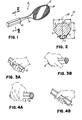
- a tennis racket 10 includes a head portion 11 and a handle portion 12 joined by a neck portion 13.
- the particular construction of the head 11 and the neck 13, and the internal construction of the handle 12, are not critical to the practice of the present invention.
- the perimeter of the handle 12 is made up of six faces, identified A through F. Viewed in cross section, the handle is symmetrical about a plane 14 of the striking surface of the head 11 of the racket 10, which may be regarded as a plane of the strings 16 in the racket head 11.
- the six handle surfaces include two longest, or major, surfaces A and B, two minor surfaces C and D, and two intermediate surfaces E and F.
- the minor surfaces C and D are perpendicular to the plane 14, and in the illustrated handle the surfaces D, E and F are equal in length, as viewed in the cross section of Figure 2.
- the illustrated major surfaces A and B are also equal in length, as viewed in Figure 2, and form equal angles "a” and “b” with planes parallel to the ball-striking plane 14.
- the angles "a” and “b” are between 25° and 40°, and preferably lie in the range of 29° to 37°. For angles falling within this range, it is presently believed that proper forehand and backhand grips on the racket, in a manner to be discussed, can be obtained by players having a range of forms in striking the ball. In rackets thus far constructed, it has been found that the angles "a” and “b” are between 31° and 36°. In the illustrated racket handle, the angles "a” and “b” are 34°.
- the handle 12 has two principal dimensions. The first is the distance between the minor surfaces C and D, indicated CD in the figure. The second principal dimension is the distance between the intersection points AE and BF, indicated W in the figure. In the illustrated form of the invention, the distance W is preferably greater than or equal to the distance CD.
- a right-handed player grips the racket 10 for a forehand stroke as shown in Figures 3a and 3b.
- the palm of the hand engages the major surface B of the handle 12.
- the thumb grasps the handle about the surfaces F and.D, with the tip of the thumb extending onto the surface E.
- the bases of the fingers contact the surface C, with the fingertips extending about the handle into contact with the surfaces E and D.
- the fingers encircle the surface A, without significantly contacting the surface.
- the principal gripping force on the racket is exerted between the surfaces B and E, with the spacing between these surfaces cooperating with the arrangement of the other faces to produce the "feel" of a conventional tennis racket handle.
- the angle of the racket face is ensured to be substantially correct due to the angle "b" of the major surface B with the ball-contacting plane 14 of the racket face.
- the relative size of the surface B results in the accurate orientation of the racket in the player's hand to produce the proper orientation of the racket head when the ball is struck.
- the racket handle is grasped as shown in Figures 4a and 4b.
- the palm of the hand engages the surfaces D and E, with the thumb extending along the surface A.
- the bases of the fingers lie along the surface F, and the fingers extend around the surface B, without significant contact thereon, with the fingertips engaging the surface C and extending partially onto the surface A.
- the primary grasping force for the backhand stroke is exerted between (a) the surfaces D and E and (b) the surface C. Due to the spacing between these surfaces, and the contour of the other surfaces, the "feel" of the racket in the backhand grip is similar to that of a conventional racket.
- the forehand and backhand grips for the racket handle 12, for a lefthanded player are analogous to those illustrated for a righthanded player.
- a lefthanded player grasps the racket handle 12 with the player's palm engaging the surface A.
- the palm-engaging surfaces are the surfaces D and F.
- the perimeter dimension of the handle 12 may be increased or decreased, preferably while maintaining the relative proportions of the handle surfaces, to properly size the handle dependent upon the size of the hand of the player.
- a racket handle of the configuration shown may be provided wherein the palm, fingers and thumb of any size hand lie on the requisite surfaces, as set forth above.
- the intermediate surfaces E and F and the minor surfaces D need not be of the same length, as viewed in the cross-sectional view of Figure 2.
- the end of the handle may be of an enlarged cross-section relative to the remainder of the handle to reduce the tendency of the handle to slide from the player's grasp during play.
- the major surfaces A' and B' are lengthened, and the intermediate surfaces E' and F' are slightly shortened (relative to the surfaces A, B, E and F of Figure 2).
- the lengths of the minor surfaces C and D remain the same, and the angles "a" and "b"remain the same, as those shown in the handle of Figure 2.
- the angles DF and DE are about 124°. In the handles illustrated in Figures 5a, 5b and 5c, these angles are increased, with resultant lengthening of the surfaces A' and B' ( Figure 5a), A" and B" ( Figure 5b), and A"' and B"' ( Figure 5c).
- the angles DF' and DE' are about 135°.
- the angles DF" and DE " are about 1401 ⁇ 2°
- the angles DF"' and DE"' are about 146°.
Landscapes
- Health & Medical Sciences (AREA)
- General Health & Medical Sciences (AREA)
- Physical Education & Sports Medicine (AREA)
- Golf Clubs (AREA)
Applications Claiming Priority (2)
| Application Number | Priority Date | Filing Date | Title |
|---|---|---|---|
| US60148884A | 1984-04-18 | 1984-04-18 | |
| US601488 | 1984-04-18 |
Publications (2)
| Publication Number | Publication Date |
|---|---|
| EP0159814A2 true EP0159814A2 (fr) | 1985-10-30 |
| EP0159814A3 EP0159814A3 (en) | 1986-11-20 |
Family
ID=24407678
Family Applications (1)
| Application Number | Title | Priority Date | Filing Date |
|---|---|---|---|
| EP85301993A Withdrawn EP0159814A3 (en) | 1984-04-18 | 1985-03-22 | Racket handle |
Country Status (8)
| Country | Link |
|---|---|
| EP (1) | EP0159814A3 (fr) |
| JP (1) | JPS61501961A (fr) |
| AU (1) | AU4291085A (fr) |
| BR (1) | BR8506614A (fr) |
| DD (1) | DD241856A5 (fr) |
| ES (1) | ES286150Y (fr) |
| IL (1) | IL74736A0 (fr) |
| WO (1) | WO1985004814A1 (fr) |
Families Citing this family (3)
| Publication number | Priority date | Publication date | Assignee | Title |
|---|---|---|---|---|
| US5409216A (en) * | 1984-04-18 | 1995-04-25 | R. H. Associates, Ltd. | Racket handle |
| US5158287A (en) * | 1991-03-27 | 1992-10-27 | Lisco, Inc. | Tennis racket handle |
| GB2274596B (en) * | 1992-12-23 | 1996-01-24 | Genhone Lai | Improved tennis racket handle |
Family Cites Families (5)
| Publication number | Priority date | Publication date | Assignee | Title |
|---|---|---|---|---|
| US3905598A (en) * | 1974-03-13 | 1975-09-16 | George M Ballog | Tennis racket hand grip |
| US4006896A (en) * | 1975-07-10 | 1977-02-08 | Soldavini Alfred C | Tennis racket |
| FR2407725A1 (fr) * | 1977-11-08 | 1979-06-01 | Rollet Claude | Poignee pour instrument de sport |
| CA1140609A (fr) * | 1980-10-06 | 1983-02-01 | Richard Vulcano | Manche de raquette |
| US4470599A (en) * | 1982-04-16 | 1984-09-11 | Usher Jr Donald K | Tennis racket grip |
-
1985
- 1985-03-22 EP EP85301993A patent/EP0159814A3/en not_active Withdrawn
- 1985-03-27 IL IL74736A patent/IL74736A0/xx unknown
- 1985-04-16 DD DD85275217A patent/DD241856A5/de unknown
- 1985-04-17 AU AU42910/85A patent/AU4291085A/en not_active Abandoned
- 1985-04-17 JP JP60501790A patent/JPS61501961A/ja active Pending
- 1985-04-17 WO PCT/US1985/000601 patent/WO1985004814A1/fr not_active Ceased
- 1985-04-17 BR BR8506614A patent/BR8506614A/pt unknown
- 1985-04-18 ES ES1985286150U patent/ES286150Y/es not_active Expired
Also Published As
| Publication number | Publication date |
|---|---|
| JPS61501961A (ja) | 1986-09-11 |
| ES286150U (es) | 1985-11-01 |
| EP0159814A3 (en) | 1986-11-20 |
| ES286150Y (es) | 1986-06-01 |
| AU4291085A (en) | 1985-11-15 |
| BR8506614A (pt) | 1986-04-15 |
| DD241856A5 (de) | 1987-01-07 |
| IL74736A0 (en) | 1985-06-30 |
| WO1985004814A1 (fr) | 1985-11-07 |
Similar Documents
| Publication | Publication Date | Title |
|---|---|---|
| US4226418A (en) | Game racket hand grip | |
| US4665565A (en) | Golf glove | |
| US5575724A (en) | Alignment-oriented golf club | |
| US4629191A (en) | Golf club including pentagonal grip | |
| US20240325837A1 (en) | Handle for sports or work equipment and equipment comprising the handle | |
| US5088733A (en) | Baseball bat with oval handle | |
| US4848746A (en) | Tennis racket grip | |
| US4961572A (en) | Grip guide for tennis racquet | |
| US7306526B2 (en) | Golf putter | |
| US3263998A (en) | Method of using a golf club | |
| US5409216A (en) | Racket handle | |
| US5551690A (en) | Racket handle | |
| US5795254A (en) | Racket handle | |
| US4349199A (en) | Racquet handle | |
| US6875125B1 (en) | Golf putter grip and method of use | |
| EP0159814A2 (fr) | Poignée de raquette | |
| US5106087A (en) | Set of golf clubs having progressively varying grip diameters | |
| EP0576630B1 (fr) | Poignee de raquette | |
| WO1993000969A1 (fr) | Structure pour raquette de tennis de table | |
| KR101686931B1 (ko) | 골프 퍼터 | |
| EP0049301A1 (fr) | Poignée pour raquette de jeu | |
| AU2024278229B1 (en) | A table tennis bat and a handle for table tennis bat | |
| KR960003663Y1 (ko) | 탁구용 라켓 | |
| WO1983003980A1 (fr) | Dispositif de support et facilitant la prise de revers au tennis | |
| GB2250924A (en) | Set of golf clubs with varying grip diameters |
Legal Events
| Date | Code | Title | Description |
|---|---|---|---|
| PUAI | Public reference made under article 153(3) epc to a published international application that has entered the european phase |
Free format text: ORIGINAL CODE: 0009012 |
|
| AK | Designated contracting states |
Designated state(s): AT BE CH DE FR GB IT LI LU NL SE |
|
| PUAL | Search report despatched |
Free format text: ORIGINAL CODE: 0009013 |
|
| AK | Designated contracting states |
Kind code of ref document: A3 Designated state(s): AT BE CH DE FR GB IT LI LU NL SE |
|
| 17P | Request for examination filed |
Effective date: 19870513 |
|
| 17Q | First examination report despatched |
Effective date: 19881014 |
|
| STAA | Information on the status of an ep patent application or granted ep patent |
Free format text: STATUS: THE APPLICATION IS DEEMED TO BE WITHDRAWN |
|
| 18D | Application deemed to be withdrawn |
Effective date: 19931001 |
|
| APAF | Appeal reference modified |
Free format text: ORIGINAL CODE: EPIDOSCREFNE |