EP0160743A2 - Miniaturisiertes System zur Identifizierung von Hefe - Google Patents
Miniaturisiertes System zur Identifizierung von Hefe Download PDFInfo
- Publication number
- EP0160743A2 EP0160743A2 EP84114230A EP84114230A EP0160743A2 EP 0160743 A2 EP0160743 A2 EP 0160743A2 EP 84114230 A EP84114230 A EP 84114230A EP 84114230 A EP84114230 A EP 84114230A EP 0160743 A2 EP0160743 A2 EP 0160743A2
- Authority
- EP
- European Patent Office
- Prior art keywords
- fungal growth
- media
- carbohydrate
- fungal
- growth medium
- Prior art date
- Legal status (The legal status is an assumption and is not a legal conclusion. Google has not performed a legal analysis and makes no representation as to the accuracy of the status listed.)
- Granted
Links
- 240000004808 Saccharomyces cerevisiae Species 0.000 title claims description 111
- 239000002609 medium Substances 0.000 claims abstract description 104
- 150000001720 carbohydrates Chemical class 0.000 claims abstract description 100
- 238000000034 method Methods 0.000 claims abstract description 76
- 239000001963 growth medium Substances 0.000 claims abstract description 63
- 230000002538 fungal effect Effects 0.000 claims abstract description 62
- 239000000758 substrate Substances 0.000 claims abstract description 34
- 239000000203 mixture Substances 0.000 claims abstract description 29
- 244000053095 fungal pathogen Species 0.000 claims abstract description 28
- 102000003425 Tyrosinase Human genes 0.000 claims abstract description 26
- 108060008724 Tyrosinase Proteins 0.000 claims abstract description 26
- 229930182490 saponin Natural products 0.000 claims abstract description 22
- 150000007949 saponins Chemical class 0.000 claims abstract description 22
- 239000003795 chemical substances by application Substances 0.000 claims abstract description 20
- 239000001397 quillaja saponaria molina bark Substances 0.000 claims abstract description 19
- -1 ammonium ions Chemical class 0.000 claims abstract description 16
- 238000007747 plating Methods 0.000 claims abstract description 12
- 230000006872 improvement Effects 0.000 claims abstract description 9
- 210000001124 body fluid Anatomy 0.000 claims abstract 16
- 239000010839 body fluid Substances 0.000 claims abstract 16
- QAIPRVGONGVQAS-DUXPYHPUSA-N trans-caffeic acid Chemical compound OC(=O)\C=C\C1=CC=C(O)C(O)=C1 QAIPRVGONGVQAS-DUXPYHPUSA-N 0.000 claims description 68
- 241000222122 Candida albicans Species 0.000 claims description 61
- 229920001817 Agar Polymers 0.000 claims description 49
- XSQUKJJJFZCRTK-UHFFFAOYSA-N Urea Chemical compound NC(N)=O XSQUKJJJFZCRTK-UHFFFAOYSA-N 0.000 claims description 48
- 239000008272 agar Substances 0.000 claims description 47
- 229930006000 Sucrose Natural products 0.000 claims description 40
- 239000005720 sucrose Substances 0.000 claims description 40
- 229940095731 candida albicans Drugs 0.000 claims description 39
- CZMRCDWAGMRECN-UGDNZRGBSA-N Sucrose Chemical compound O[C@H]1[C@H](O)[C@@H](CO)O[C@@]1(CO)O[C@@H]1[C@H](O)[C@@H](O)[C@H](O)[C@@H](CO)O1 CZMRCDWAGMRECN-UGDNZRGBSA-N 0.000 claims description 38
- ACEAELOMUCBPJP-UHFFFAOYSA-N (E)-3,4,5-trihydroxycinnamic acid Natural products OC(=O)C=CC1=CC(O)=C(O)C(O)=C1 ACEAELOMUCBPJP-UHFFFAOYSA-N 0.000 claims description 34
- 229940074360 caffeic acid Drugs 0.000 claims description 34
- 235000004883 caffeic acid Nutrition 0.000 claims description 34
- QAIPRVGONGVQAS-UHFFFAOYSA-N cis-caffeic acid Natural products OC(=O)C=CC1=CC=C(O)C(O)=C1 QAIPRVGONGVQAS-UHFFFAOYSA-N 0.000 claims description 34
- IJGRMHOSHXDMSA-UHFFFAOYSA-N Atomic nitrogen Chemical compound N#N IJGRMHOSHXDMSA-UHFFFAOYSA-N 0.000 claims description 32
- NLXLAEXVIDQMFP-UHFFFAOYSA-N Ammonia chloride Chemical compound [NH4+].[Cl-] NLXLAEXVIDQMFP-UHFFFAOYSA-N 0.000 claims description 30
- 201000007336 Cryptococcosis Diseases 0.000 claims description 28
- 241000221204 Cryptococcus neoformans Species 0.000 claims description 28
- 239000000975 dye Substances 0.000 claims description 27
- XLYOFNOQVPJJNP-UHFFFAOYSA-N water Chemical compound O XLYOFNOQVPJJNP-UHFFFAOYSA-N 0.000 claims description 27
- 230000015572 biosynthetic process Effects 0.000 claims description 26
- 238000011534 incubation Methods 0.000 claims description 25
- 239000004202 carbamide Substances 0.000 claims description 24
- 150000003863 ammonium salts Chemical class 0.000 claims description 23
- 230000008859 change Effects 0.000 claims description 21
- 108010046334 Urease Proteins 0.000 claims description 20
- 230000012010 growth Effects 0.000 claims description 20
- 238000004519 manufacturing process Methods 0.000 claims description 20
- 239000008367 deionised water Substances 0.000 claims description 17
- 229910021641 deionized water Inorganic materials 0.000 claims description 17
- 229910052757 nitrogen Inorganic materials 0.000 claims description 16
- 235000019270 ammonium chloride Nutrition 0.000 claims description 15
- ABIUHPWEYMSGSR-UHFFFAOYSA-N bromocresol purple Chemical compound BrC1=C(O)C(C)=CC(C2(C3=CC=CC=C3S(=O)(=O)O2)C=2C=C(Br)C(O)=C(C)C=2)=C1 ABIUHPWEYMSGSR-UHFFFAOYSA-N 0.000 claims description 13
- WQZGKKKJIJFFOK-GASJEMHNSA-N Glucose Natural products OC[C@H]1OC(O)[C@H](O)[C@@H](O)[C@@H]1O WQZGKKKJIJFFOK-GASJEMHNSA-N 0.000 claims description 7
- 239000000049 pigment Substances 0.000 claims description 7
- GLDQAMYCGOIJDV-UHFFFAOYSA-N 2,3-dihydroxybenzoic acid Chemical compound OC(=O)C1=CC=CC(O)=C1O GLDQAMYCGOIJDV-UHFFFAOYSA-N 0.000 claims description 6
- 239000008121 dextrose Substances 0.000 claims description 6
- HDTRYLNUVZCQOY-UHFFFAOYSA-N α-D-glucopyranosyl-α-D-glucopyranoside Natural products OC1C(O)C(O)C(CO)OC1OC1C(O)C(O)C(O)C(CO)O1 HDTRYLNUVZCQOY-UHFFFAOYSA-N 0.000 claims description 5
- OWEGMIWEEQEYGQ-UHFFFAOYSA-N 100676-05-9 Natural products OC1C(O)C(O)C(CO)OC1OCC1C(O)C(O)C(O)C(OC2C(OC(O)C(O)C2O)CO)O1 OWEGMIWEEQEYGQ-UHFFFAOYSA-N 0.000 claims description 5
- GUBGYTABKSRVRQ-XLOQQCSPSA-N Alpha-Lactose Chemical compound O[C@@H]1[C@@H](O)[C@@H](O)[C@@H](CO)O[C@H]1O[C@@H]1[C@@H](CO)O[C@H](O)[C@H](O)[C@H]1O GUBGYTABKSRVRQ-XLOQQCSPSA-N 0.000 claims description 5
- 241000222178 Candida tropicalis Species 0.000 claims description 5
- GUBGYTABKSRVRQ-QKKXKWKRSA-N Lactose Natural products OC[C@H]1O[C@@H](O[C@H]2[C@H](O)[C@@H](O)C(O)O[C@@H]2CO)[C@H](O)[C@@H](O)[C@H]1O GUBGYTABKSRVRQ-QKKXKWKRSA-N 0.000 claims description 5
- GUBGYTABKSRVRQ-PICCSMPSSA-N Maltose Natural products O[C@@H]1[C@@H](O)[C@H](O)[C@@H](CO)O[C@@H]1O[C@@H]1[C@@H](CO)OC(O)[C@H](O)[C@H]1O GUBGYTABKSRVRQ-PICCSMPSSA-N 0.000 claims description 5
- 241000235645 Pichia kudriavzevii Species 0.000 claims description 5
- HDTRYLNUVZCQOY-WSWWMNSNSA-N Trehalose Natural products O[C@@H]1[C@@H](O)[C@@H](O)[C@@H](CO)O[C@@H]1O[C@@H]1[C@H](O)[C@@H](O)[C@@H](O)[C@@H](CO)O1 HDTRYLNUVZCQOY-WSWWMNSNSA-N 0.000 claims description 5
- HDTRYLNUVZCQOY-LIZSDCNHSA-N alpha,alpha-trehalose Chemical compound O[C@@H]1[C@@H](O)[C@H](O)[C@@H](CO)O[C@@H]1O[C@@H]1[C@H](O)[C@@H](O)[C@H](O)[C@@H](CO)O1 HDTRYLNUVZCQOY-LIZSDCNHSA-N 0.000 claims description 5
- WQZGKKKJIJFFOK-PHYPRBDBSA-N alpha-D-galactose Chemical compound OC[C@H]1O[C@H](O)[C@H](O)[C@@H](O)[C@H]1O WQZGKKKJIJFFOK-PHYPRBDBSA-N 0.000 claims description 5
- GUBGYTABKSRVRQ-QUYVBRFLSA-N beta-maltose Chemical compound OC[C@H]1O[C@H](O[C@H]2[C@H](O)[C@@H](O)[C@H](O)O[C@@H]2CO)[C@H](O)[C@@H](O)[C@@H]1O GUBGYTABKSRVRQ-QUYVBRFLSA-N 0.000 claims description 5
- WWAABJGNHFGXSJ-UHFFFAOYSA-N chlorophenol red Chemical compound C1=C(Cl)C(O)=CC=C1C1(C=2C=C(Cl)C(O)=CC=2)C2=CC=CC=C2S(=O)(=O)O1 WWAABJGNHFGXSJ-UHFFFAOYSA-N 0.000 claims description 5
- 239000003269 fluorescent indicator Substances 0.000 claims description 5
- 229930182830 galactose Natural products 0.000 claims description 5
- 238000007689 inspection Methods 0.000 claims description 5
- 239000008101 lactose Substances 0.000 claims description 5
- 241000222173 Candida parapsilosis Species 0.000 claims description 4
- WTDRDQBEARUVNC-UHFFFAOYSA-N L-Dopa Natural products OC(=O)C(N)CC1=CC=C(O)C(O)=C1 WTDRDQBEARUVNC-UHFFFAOYSA-N 0.000 claims description 4
- MUPFEKGTMRGPLJ-RMMQSMQOSA-N Raffinose Natural products O(C[C@H]1[C@@H](O)[C@H](O)[C@@H](O)[C@@H](O[C@@]2(CO)[C@H](O)[C@@H](O)[C@@H](CO)O2)O1)[C@@H]1[C@H](O)[C@@H](O)[C@@H](O)[C@@H](CO)O1 MUPFEKGTMRGPLJ-RMMQSMQOSA-N 0.000 claims description 4
- MUPFEKGTMRGPLJ-UHFFFAOYSA-N UNPD196149 Natural products OC1C(O)C(CO)OC1(CO)OC1C(O)C(O)C(O)C(COC2C(C(O)C(O)C(CO)O2)O)O1 MUPFEKGTMRGPLJ-UHFFFAOYSA-N 0.000 claims description 4
- WQZGKKKJIJFFOK-VFUOTHLCSA-N beta-D-glucose Chemical compound OC[C@H]1O[C@@H](O)[C@H](O)[C@@H](O)[C@@H]1O WQZGKKKJIJFFOK-VFUOTHLCSA-N 0.000 claims description 4
- 229940055022 candida parapsilosis Drugs 0.000 claims description 4
- 230000003247 decreasing effect Effects 0.000 claims description 4
- SFLSHLFXELFNJZ-UHFFFAOYSA-N norepinephrine Natural products NCC(O)C1=CC=C(O)C(O)=C1 SFLSHLFXELFNJZ-UHFFFAOYSA-N 0.000 claims description 4
- MUPFEKGTMRGPLJ-ZQSKZDJDSA-N raffinose Chemical compound O[C@H]1[C@H](O)[C@@H](CO)O[C@@]1(CO)O[C@@H]1[C@H](O)[C@@H](O)[C@H](O)[C@@H](CO[C@@H]2[C@@H]([C@@H](O)[C@@H](O)[C@@H](CO)O2)O)O1 MUPFEKGTMRGPLJ-ZQSKZDJDSA-N 0.000 claims description 4
- SFLSHLFXELFNJZ-QMMMGPOBSA-N (-)-norepinephrine Chemical compound NC[C@H](O)C1=CC=C(O)C(O)=C1 SFLSHLFXELFNJZ-QMMMGPOBSA-N 0.000 claims description 3
- 229940082044 2,3-dihydroxybenzoic acid Drugs 0.000 claims description 3
- MHUWZNTUIIFHAS-CLFAGFIQSA-N dioleoyl phosphatidic acid Chemical compound CCCCCCCC\C=C/CCCCCCCC(=O)OCC(COP(O)(O)=O)OC(=O)CCCCCCC\C=C/CCCCCCCC MHUWZNTUIIFHAS-CLFAGFIQSA-N 0.000 claims description 3
- 229960004502 levodopa Drugs 0.000 claims description 3
- 150000004702 methyl esters Chemical class 0.000 claims description 3
- 229960002748 norepinephrine Drugs 0.000 claims description 3
- PCMORTLOPMLEFB-ONEGZZNKSA-N sinapic acid Chemical compound COC1=CC(\C=C\C(O)=O)=CC(OC)=C1O PCMORTLOPMLEFB-ONEGZZNKSA-N 0.000 claims description 3
- YWYZEGXAUVWDED-UHFFFAOYSA-N triammonium citrate Chemical compound [NH4+].[NH4+].[NH4+].[O-]C(=O)CC(O)(CC([O-])=O)C([O-])=O YWYZEGXAUVWDED-UHFFFAOYSA-N 0.000 claims description 3
- 241000222126 [Candida] glabrata Species 0.000 claims description 2
- BFNBIHQBYMNNAN-UHFFFAOYSA-N ammonium sulfate Chemical compound N.N.OS(O)(=O)=O BFNBIHQBYMNNAN-UHFFFAOYSA-N 0.000 claims description 2
- 229910052921 ammonium sulfate Inorganic materials 0.000 claims description 2
- 235000011130 ammonium sulphate Nutrition 0.000 claims description 2
- 208000032343 candida glabrata infection Diseases 0.000 claims description 2
- LQHXWZKKJHDWRJ-UHFFFAOYSA-O diazanium hydrogen sulfate nitrate Chemical compound [NH4+].[NH4+].[O-][N+]([O-])=O.OS([O-])(=O)=O LQHXWZKKJHDWRJ-UHFFFAOYSA-O 0.000 claims description 2
- YQUVCSBJEUQKSH-UHFFFAOYSA-N 3,4-dihydroxybenzoic acid Chemical compound OC(=O)C1=CC=C(O)C(O)=C1 YQUVCSBJEUQKSH-UHFFFAOYSA-N 0.000 claims 4
- APJYDQYYACXCRM-UHFFFAOYSA-N tryptamine Chemical compound C1=CC=C2C(CCN)=CNC2=C1 APJYDQYYACXCRM-UHFFFAOYSA-N 0.000 claims 4
- 125000000185 sucrose group Chemical group 0.000 claims 2
- PAWQVTBBRAZDMG-UHFFFAOYSA-N 2-(3-bromo-2-fluorophenyl)acetic acid Chemical compound OC(=O)CC1=CC=CC(Br)=C1F PAWQVTBBRAZDMG-UHFFFAOYSA-N 0.000 claims 1
- 241000235048 Meyerozyma guilliermondii Species 0.000 claims 1
- 241000233866 Fungi Species 0.000 abstract description 17
- 239000002054 inoculum Substances 0.000 abstract description 10
- 230000000050 nutritive effect Effects 0.000 abstract description 3
- 230000005757 colony formation Effects 0.000 abstract 2
- 235000014633 carbohydrates Nutrition 0.000 description 75
- 238000012360 testing method Methods 0.000 description 50
- 235000010419 agar Nutrition 0.000 description 46
- 238000005755 formation reaction Methods 0.000 description 25
- HEMHJVSKTPXQMS-UHFFFAOYSA-M Sodium hydroxide Chemical compound [OH-].[Na+] HEMHJVSKTPXQMS-UHFFFAOYSA-M 0.000 description 21
- 238000006243 chemical reaction Methods 0.000 description 18
- 241000894007 species Species 0.000 description 17
- 239000000725 suspension Substances 0.000 description 17
- 235000017709 saponins Nutrition 0.000 description 14
- 239000000243 solution Substances 0.000 description 14
- 230000000694 effects Effects 0.000 description 12
- 241001527609 Cryptococcus Species 0.000 description 11
- 241000222120 Candida <Saccharomycetales> Species 0.000 description 9
- 238000011081 inoculation Methods 0.000 description 9
- 238000003860 storage Methods 0.000 description 9
- 238000009835 boiling Methods 0.000 description 8
- 210000004027 cell Anatomy 0.000 description 8
- 210000005253 yeast cell Anatomy 0.000 description 8
- 230000006978 adaptation Effects 0.000 description 7
- 239000011521 glass Substances 0.000 description 7
- 230000004048 modification Effects 0.000 description 7
- 238000012986 modification Methods 0.000 description 7
- QCVGEOXPDFCNHA-UHFFFAOYSA-N 5,5-dimethyl-2,4-dioxo-1,3-oxazolidine-3-carboxamide Chemical compound CC1(C)OC(=O)N(C(N)=O)C1=O QCVGEOXPDFCNHA-UHFFFAOYSA-N 0.000 description 6
- 102000002322 Egg Proteins Human genes 0.000 description 6
- 108010000912 Egg Proteins Proteins 0.000 description 6
- 238000001514 detection method Methods 0.000 description 6
- 235000014103 egg white Nutrition 0.000 description 6
- 210000000969 egg white Anatomy 0.000 description 6
- 229960002413 ferric citrate Drugs 0.000 description 6
- 238000010438 heat treatment Methods 0.000 description 6
- 239000012449 sabouraud dextrose agar Substances 0.000 description 6
- 238000007711 solidification Methods 0.000 description 6
- 230000008023 solidification Effects 0.000 description 6
- 238000012546 transfer Methods 0.000 description 6
- 238000001816 cooling Methods 0.000 description 5
- 230000018044 dehydration Effects 0.000 description 5
- 238000006297 dehydration reaction Methods 0.000 description 5
- 230000019612 pigmentation Effects 0.000 description 5
- 235000000346 sugar Nutrition 0.000 description 5
- QGZKDVFQNNGYKY-UHFFFAOYSA-O Ammonium Chemical compound [NH4+] QGZKDVFQNNGYKY-UHFFFAOYSA-O 0.000 description 4
- 102000004190 Enzymes Human genes 0.000 description 4
- 108090000790 Enzymes Proteins 0.000 description 4
- XYFCBTPGUUZFHI-UHFFFAOYSA-N Phosphine Chemical compound P XYFCBTPGUUZFHI-UHFFFAOYSA-N 0.000 description 4
- 240000003705 Senecio vulgaris Species 0.000 description 4
- 239000002253 acid Substances 0.000 description 4
- XAGFODPZIPBFFR-UHFFFAOYSA-N aluminium Chemical compound [Al] XAGFODPZIPBFFR-UHFFFAOYSA-N 0.000 description 4
- 229910052782 aluminium Inorganic materials 0.000 description 4
- 230000008901 benefit Effects 0.000 description 4
- 239000000306 component Substances 0.000 description 4
- 238000007796 conventional method Methods 0.000 description 4
- 201000010099 disease Diseases 0.000 description 4
- 208000037265 diseases, disorders, signs and symptoms Diseases 0.000 description 4
- 238000009472 formulation Methods 0.000 description 4
- 239000004615 ingredient Substances 0.000 description 4
- NPFOYSMITVOQOS-UHFFFAOYSA-K iron(III) citrate Chemical compound [Fe+3].[O-]C(=O)CC(O)(CC([O-])=O)C([O-])=O NPFOYSMITVOQOS-UHFFFAOYSA-K 0.000 description 4
- 239000007788 liquid Substances 0.000 description 4
- BTJIUGUIPKRLHP-UHFFFAOYSA-N 4-nitrophenol Chemical compound OC1=CC=C([N+]([O-])=O)C=C1 BTJIUGUIPKRLHP-UHFFFAOYSA-N 0.000 description 3
- 108091003079 Bovine Serum Albumin Proteins 0.000 description 3
- 229920000742 Cotton Polymers 0.000 description 3
- CEAZRRDELHUEMR-URQXQFDESA-N Gentamicin Chemical compound O1[C@H](C(C)NC)CC[C@@H](N)[C@H]1O[C@H]1[C@H](O)[C@@H](O[C@@H]2[C@@H]([C@@H](NC)[C@@](C)(O)CO2)O)[C@H](N)C[C@@H]1N CEAZRRDELHUEMR-URQXQFDESA-N 0.000 description 3
- 229930182566 Gentamicin Natural products 0.000 description 3
- 230000034303 cell budding Effects 0.000 description 3
- 150000001875 compounds Chemical class 0.000 description 3
- 230000001010 compromised effect Effects 0.000 description 3
- 239000006783 corn meal agar Substances 0.000 description 3
- 230000034373 developmental growth involved in morphogenesis Effects 0.000 description 3
- 239000006160 differential media Substances 0.000 description 3
- 230000004069 differentiation Effects 0.000 description 3
- 239000012091 fetal bovine serum Substances 0.000 description 3
- 239000011888 foil Substances 0.000 description 3
- 239000007789 gas Substances 0.000 description 3
- 229960002518 gentamicin Drugs 0.000 description 3
- 230000007062 hydrolysis Effects 0.000 description 3
- 238000006460 hydrolysis reaction Methods 0.000 description 3
- 230000004660 morphological change Effects 0.000 description 3
- 230000001954 sterilising effect Effects 0.000 description 3
- 239000000126 substance Substances 0.000 description 3
- 150000008163 sugars Chemical class 0.000 description 3
- 239000010409 thin film Substances 0.000 description 3
- 206010017533 Fungal infection Diseases 0.000 description 2
- 208000031888 Mycoses Diseases 0.000 description 2
- 229910002651 NO3 Inorganic materials 0.000 description 2
- NHNBFGGVMKEFGY-UHFFFAOYSA-N Nitrate Chemical compound [O-][N+]([O-])=O NHNBFGGVMKEFGY-UHFFFAOYSA-N 0.000 description 2
- 208000001388 Opportunistic Infections Diseases 0.000 description 2
- WCUXLLCKKVVCTQ-UHFFFAOYSA-M Potassium chloride Chemical compound [Cl-].[K+] WCUXLLCKKVVCTQ-UHFFFAOYSA-M 0.000 description 2
- VYPSYNLAJGMNEJ-UHFFFAOYSA-N Silicium dioxide Chemical compound O=[Si]=O VYPSYNLAJGMNEJ-UHFFFAOYSA-N 0.000 description 2
- FAPWRFPIFSIZLT-UHFFFAOYSA-M Sodium chloride Chemical compound [Na+].[Cl-] FAPWRFPIFSIZLT-UHFFFAOYSA-M 0.000 description 2
- 241000223231 Trichosporon beigelii Species 0.000 description 2
- 230000002378 acidificating effect Effects 0.000 description 2
- 239000003242 anti bacterial agent Substances 0.000 description 2
- 229940088710 antibiotic agent Drugs 0.000 description 2
- 238000013459 approach Methods 0.000 description 2
- 239000001058 brown pigment Substances 0.000 description 2
- 239000002775 capsule Substances 0.000 description 2
- 210000002421 cell wall Anatomy 0.000 description 2
- 230000000052 comparative effect Effects 0.000 description 2
- 230000007123 defense Effects 0.000 description 2
- 239000003995 emulsifying agent Substances 0.000 description 2
- 238000002474 experimental method Methods 0.000 description 2
- 230000009215 host defense mechanism Effects 0.000 description 2
- 208000015181 infectious disease Diseases 0.000 description 2
- 230000036512 infertility Effects 0.000 description 2
- 239000000463 material Substances 0.000 description 2
- 229910000073 phosphorus hydride Inorganic materials 0.000 description 2
- 235000010482 polyoxyethylene sorbitan monooleate Nutrition 0.000 description 2
- 229920000053 polysorbate 80 Polymers 0.000 description 2
- 238000011533 pre-incubation Methods 0.000 description 2
- 238000002360 preparation method Methods 0.000 description 2
- 230000004044 response Effects 0.000 description 2
- 150000003839 salts Chemical class 0.000 description 2
- 230000035945 sensitivity Effects 0.000 description 2
- 210000002966 serum Anatomy 0.000 description 2
- 238000001228 spectrum Methods 0.000 description 2
- 238000004659 sterilization and disinfection Methods 0.000 description 2
- 238000012800 visualization Methods 0.000 description 2
- MOWLUBGHVYJYTK-UHFFFAOYSA-N 3-(2-aminoethyl)indol-3-ol Chemical compound C1=CC=C2C(CCN)(O)C=NC2=C1 MOWLUBGHVYJYTK-UHFFFAOYSA-N 0.000 description 1
- CJIJXIFQYOPWTF-UHFFFAOYSA-N 7-hydroxycoumarin Natural products O1C(=O)C=CC2=CC(O)=CC=C21 CJIJXIFQYOPWTF-UHFFFAOYSA-N 0.000 description 1
- ZCYVEMRRCGMTRW-UHFFFAOYSA-N 7553-56-2 Chemical compound [I] ZCYVEMRRCGMTRW-UHFFFAOYSA-N 0.000 description 1
- 241000283690 Bos taurus Species 0.000 description 1
- XZHWAGZSWOAEPI-UHFFFAOYSA-N C(C=CC1=CC(O)=C(O)C=C1)(=O)O.OC=1C=C(C=CC(=O)O)C=CC1O Chemical compound C(C=CC1=CC(O)=C(O)C=C1)(=O)O.OC=1C=C(C=CC(=O)O)C=CC1O XZHWAGZSWOAEPI-UHFFFAOYSA-N 0.000 description 1
- KCXVZYZYPLLWCC-UHFFFAOYSA-N EDTA Chemical compound OC(=O)CN(CC(O)=O)CCN(CC(O)=O)CC(O)=O KCXVZYZYPLLWCC-UHFFFAOYSA-N 0.000 description 1
- WTDRDQBEARUVNC-LURJTMIESA-N L-DOPA Chemical compound OC(=O)[C@@H](N)CC1=CC=C(O)C(O)=C1 WTDRDQBEARUVNC-LURJTMIESA-N 0.000 description 1
- RINSJDWDXSWUOK-UHFFFAOYSA-N OC(=O)C1=CC=C(O)C(O)=C1.OC(=O)C1=CC=C(O)C(O)=C1 Chemical compound OC(=O)C1=CC=C(O)C(O)=C1.OC(=O)C1=CC=C(O)C(O)=C1 RINSJDWDXSWUOK-UHFFFAOYSA-N 0.000 description 1
- 241000283973 Oryctolagus cuniculus Species 0.000 description 1
- BPGDAMSIGCZZLK-UHFFFAOYSA-N acetyloxymethyl acetate Chemical compound CC(=O)OCOC(C)=O BPGDAMSIGCZZLK-UHFFFAOYSA-N 0.000 description 1
- 239000004480 active ingredient Substances 0.000 description 1
- 238000013019 agitation Methods 0.000 description 1
- 230000004075 alteration Effects 0.000 description 1
- 230000003466 anti-cipated effect Effects 0.000 description 1
- QVGXLLKOCUKJST-UHFFFAOYSA-N atomic oxygen Chemical compound [O] QVGXLLKOCUKJST-UHFFFAOYSA-N 0.000 description 1
- 230000001580 bacterial effect Effects 0.000 description 1
- 238000013142 basic testing Methods 0.000 description 1
- 235000015278 beef Nutrition 0.000 description 1
- 230000003115 biocidal effect Effects 0.000 description 1
- 239000006227 byproduct Substances 0.000 description 1
- 230000025938 carbohydrate utilization Effects 0.000 description 1
- 210000003169 central nervous system Anatomy 0.000 description 1
- 230000001684 chronic effect Effects 0.000 description 1
- 230000007423 decrease Effects 0.000 description 1
- 238000001784 detoxification Methods 0.000 description 1
- FHIVAFMUCKRCQO-UHFFFAOYSA-N diazinon Chemical compound CCOP(=S)(OCC)OC1=CC(C)=NC(C(C)C)=N1 FHIVAFMUCKRCQO-UHFFFAOYSA-N 0.000 description 1
- 210000002969 egg yolk Anatomy 0.000 description 1
- 235000013601 eggs Nutrition 0.000 description 1
- 238000000855 fermentation Methods 0.000 description 1
- 230000004151 fermentation Effects 0.000 description 1
- 230000001605 fetal effect Effects 0.000 description 1
- 238000007710 freezing Methods 0.000 description 1
- 210000001035 gastrointestinal tract Anatomy 0.000 description 1
- 239000000499 gel Substances 0.000 description 1
- 230000002068 genetic effect Effects 0.000 description 1
- 239000008103 glucose Substances 0.000 description 1
- 235000003642 hunger Nutrition 0.000 description 1
- 239000003018 immunosuppressive agent Substances 0.000 description 1
- 229940124589 immunosuppressive drug Drugs 0.000 description 1
- 230000001771 impaired effect Effects 0.000 description 1
- 229910052740 iodine Inorganic materials 0.000 description 1
- 239000011630 iodine Substances 0.000 description 1
- RIWUZCPNZAUGCE-UHFFFAOYSA-L magnesium;2-carboxyquinolin-8-olate Chemical compound [Mg+2].C1=C(C([O-])=O)N=C2C(O)=CC=CC2=C1.C1=C(C([O-])=O)N=C2C(O)=CC=CC2=C1 RIWUZCPNZAUGCE-UHFFFAOYSA-L 0.000 description 1
- 239000012092 media component Substances 0.000 description 1
- 239000012533 medium component Substances 0.000 description 1
- 239000012528 membrane Substances 0.000 description 1
- 239000002068 microbial inoculum Substances 0.000 description 1
- 244000005700 microbiome Species 0.000 description 1
- 238000002156 mixing Methods 0.000 description 1
- 230000000877 morphologic effect Effects 0.000 description 1
- 210000003097 mucus Anatomy 0.000 description 1
- 230000037125 natural defense Effects 0.000 description 1
- 230000007935 neutral effect Effects 0.000 description 1
- 239000001301 oxygen Substances 0.000 description 1
- 229910052760 oxygen Inorganic materials 0.000 description 1
- 238000010979 pH adjustment Methods 0.000 description 1
- 238000004806 packaging method and process Methods 0.000 description 1
- 230000001717 pathogenic effect Effects 0.000 description 1
- 230000007918 pathogenicity Effects 0.000 description 1
- 150000002989 phenols Chemical class 0.000 description 1
- 238000012809 post-inoculation Methods 0.000 description 1
- 239000001103 potassium chloride Substances 0.000 description 1
- 235000011164 potassium chloride Nutrition 0.000 description 1
- 230000008569 process Effects 0.000 description 1
- 239000000047 product Substances 0.000 description 1
- 230000002035 prolonged effect Effects 0.000 description 1
- 230000001737 promoting effect Effects 0.000 description 1
- 239000001047 purple dye Substances 0.000 description 1
- 238000001959 radiotherapy Methods 0.000 description 1
- 239000001044 red dye Substances 0.000 description 1
- 238000005057 refrigeration Methods 0.000 description 1
- 229920006395 saturated elastomer Polymers 0.000 description 1
- 238000012216 screening Methods 0.000 description 1
- 239000000377 silicon dioxide Substances 0.000 description 1
- 239000011780 sodium chloride Substances 0.000 description 1
- IAAKNVCARVEIFS-UHFFFAOYSA-M sodium;4-hydroxynaphthalene-1-sulfonate Chemical compound [Na+].C1=CC=C2C(O)=CC=C(S([O-])(=O)=O)C2=C1 IAAKNVCARVEIFS-UHFFFAOYSA-M 0.000 description 1
- 239000007787 solid Substances 0.000 description 1
- 230000037351 starvation Effects 0.000 description 1
- 239000008223 sterile water Substances 0.000 description 1
- 239000011550 stock solution Substances 0.000 description 1
- 238000001356 surgical procedure Methods 0.000 description 1
- 230000009885 systemic effect Effects 0.000 description 1
- 230000001225 therapeutic effect Effects 0.000 description 1
- 238000002560 therapeutic procedure Methods 0.000 description 1
- JADVWWSKYZXRGX-UHFFFAOYSA-M thioflavine T Chemical compound [Cl-].C1=CC(N(C)C)=CC=C1C1=[N+](C)C2=CC=C(C)C=C2S1 JADVWWSKYZXRGX-UHFFFAOYSA-M 0.000 description 1
- ORHBXUUXSCNDEV-UHFFFAOYSA-N umbelliferone Chemical compound C1=CC(=O)OC2=CC(O)=CC=C21 ORHBXUUXSCNDEV-UHFFFAOYSA-N 0.000 description 1
- HFTAFOQKODTIJY-UHFFFAOYSA-N umbelliferone Natural products Cc1cc2C=CC(=O)Oc2cc1OCC=CC(C)(C)O HFTAFOQKODTIJY-UHFFFAOYSA-N 0.000 description 1
- 238000010792 warming Methods 0.000 description 1
Images

Classifications
-
- C—CHEMISTRY; METALLURGY
- C12—BIOCHEMISTRY; BEER; SPIRITS; WINE; VINEGAR; MICROBIOLOGY; ENZYMOLOGY; MUTATION OR GENETIC ENGINEERING
- C12M—APPARATUS FOR ENZYMOLOGY OR MICROBIOLOGY; APPARATUS FOR CULTURING MICROORGANISMS FOR PRODUCING BIOMASS, FOR GROWING CELLS OR FOR OBTAINING FERMENTATION OR METABOLIC PRODUCTS, i.e. BIOREACTORS OR FERMENTERS
- C12M23/00—Constructional details, e.g. recesses, hinges
- C12M23/02—Form or structure of the vessel
- C12M23/04—Flat or tray type, drawers
-
- C—CHEMISTRY; METALLURGY
- C12—BIOCHEMISTRY; BEER; SPIRITS; WINE; VINEGAR; MICROBIOLOGY; ENZYMOLOGY; MUTATION OR GENETIC ENGINEERING
- C12M—APPARATUS FOR ENZYMOLOGY OR MICROBIOLOGY; APPARATUS FOR CULTURING MICROORGANISMS FOR PRODUCING BIOMASS, FOR GROWING CELLS OR FOR OBTAINING FERMENTATION OR METABOLIC PRODUCTS, i.e. BIOREACTORS OR FERMENTERS
- C12M23/00—Constructional details, e.g. recesses, hinges
- C12M23/02—Form or structure of the vessel
- C12M23/10—Petri dish
-
- C—CHEMISTRY; METALLURGY
- C12—BIOCHEMISTRY; BEER; SPIRITS; WINE; VINEGAR; MICROBIOLOGY; ENZYMOLOGY; MUTATION OR GENETIC ENGINEERING
- C12M—APPARATUS FOR ENZYMOLOGY OR MICROBIOLOGY; APPARATUS FOR CULTURING MICROORGANISMS FOR PRODUCING BIOMASS, FOR GROWING CELLS OR FOR OBTAINING FERMENTATION OR METABOLIC PRODUCTS, i.e. BIOREACTORS OR FERMENTERS
- C12M23/00—Constructional details, e.g. recesses, hinges
- C12M23/02—Form or structure of the vessel
- C12M23/12—Well or multiwell plates
-
- C—CHEMISTRY; METALLURGY
- C12—BIOCHEMISTRY; BEER; SPIRITS; WINE; VINEGAR; MICROBIOLOGY; ENZYMOLOGY; MUTATION OR GENETIC ENGINEERING
- C12M—APPARATUS FOR ENZYMOLOGY OR MICROBIOLOGY; APPARATUS FOR CULTURING MICROORGANISMS FOR PRODUCING BIOMASS, FOR GROWING CELLS OR FOR OBTAINING FERMENTATION OR METABOLIC PRODUCTS, i.e. BIOREACTORS OR FERMENTERS
- C12M35/00—Means for application of stress for stimulating the growth of microorganisms or the generation of fermentation or metabolic products; Means for electroporation or cell fusion
- C12M35/08—Chemical, biochemical or biological means, e.g. plasma jet, co-culture
-
- C—CHEMISTRY; METALLURGY
- C12—BIOCHEMISTRY; BEER; SPIRITS; WINE; VINEGAR; MICROBIOLOGY; ENZYMOLOGY; MUTATION OR GENETIC ENGINEERING
- C12Q—MEASURING OR TESTING PROCESSES INVOLVING ENZYMES, NUCLEIC ACIDS OR MICROORGANISMS; COMPOSITIONS OR TEST PAPERS THEREFOR; PROCESSES OF PREPARING SUCH COMPOSITIONS; CONDITION-RESPONSIVE CONTROL IN MICROBIOLOGICAL OR ENZYMOLOGICAL PROCESSES
- C12Q1/00—Measuring or testing processes involving enzymes, nucleic acids or microorganisms; Compositions therefor; Processes of preparing such compositions
- C12Q1/02—Measuring or testing processes involving enzymes, nucleic acids or microorganisms; Compositions therefor; Processes of preparing such compositions involving viable microorganisms
- C12Q1/04—Determining presence or kind of microorganism; Use of selective media for testing antibiotics or bacteriocides; Compositions containing a chemical indicator therefor
-
- G—PHYSICS
- G01—MEASURING; TESTING
- G01N—INVESTIGATING OR ANALYSING MATERIALS BY DETERMINING THEIR CHEMICAL OR PHYSICAL PROPERTIES
- G01N2333/00—Assays involving biological materials from specific organisms or of a specific nature
- G01N2333/37—Assays involving biological materials from specific organisms or of a specific nature from fungi
- G01N2333/39—Assays involving biological materials from specific organisms or of a specific nature from fungi from yeasts
- G01N2333/40—Assays involving biological materials from specific organisms or of a specific nature from fungi from yeasts from Candida
Definitions
- This invention relates to methods and compositions useful in the rapid and efficient identification of fungal pathogens.
- the methods and compositions disclosed in the present invention utilize the differential morphologic and nutritive features of the genera and species of pathogenic fungi sought to be identified.
- fungal pathogens are differentially identified by methods utilizing an improved formulation of a medium comprising a mixture of purified saponin, oxgall, a substrate for phenol oxidase, a supporting agent, and an ammonium salt.
- rapid and differential identification of fungal pathogens is provided by an improved method of carbohydrate assimilation, the improvement comprising preincubation of said fungal pathogens in a carbohydrate depleted medium prior to the plating of said fungal pathogens on culture plates containing a carbohydrate assimilation medium.
- methods utilizing miniaturized culture plates for example having the dimensions of 33 x 75 x 5 millimeters, capable of differentiating fungal pathogens on five to fifteen fold less amount of fungal growth media than required by standard culture plates, are described.
- methods employing surface inoculation procedures are described which achieve a greater surface area to volume ratio than conventional techniques.
- methods utilizing a single miniaturized culture plate containing either a combination of various fungal growth media or a number of different fungal pathogens, or both are described.
- the improved fungal growth media, the improved carbohydrate assimilation method, and the methods utilizing miniaturized culture plates alone, and in combination provide especially rapid and reliable techniques for the detection and differentiation of three clinically important fungi: Candida albicans, Candida stellatoidea and
- Fungal pathogens vary in their pathogenicity, that is, their capacity to cause disease. At one end of the spectrum, highly pathogenic fungi may produce systemic disease when they infect. At the other end of the spectrum, some fungi may establish a more or less permanent residence on, and even in, the superficial body tissue. These fungi are unable to penetrate the body's natural defenses unless these defenses are seriously impaired. Such opportunistic infections have become more common as a byproduct of therapeutic advances and currently pose a significant medical threat to certain classes of individuals or patients.
- Candida albicans is an example of a relatively non-pathogenic yeast (that is, single cell fungus) that is frequently present on normal mucus .membranes of the mouth and intestinal tract.
- Candida albicans generally will not establish an infection in healthy humans but can cause opportunistic infections resulting in chronic local infections in those with compromised host defense mechanisms.
- Cryptococcus neoformans is especially important because of its predilection for the central nervous system which can cause severe disease in biologically defenseless patients.
- the presumptive identification of Candida albicans depends solely upon morphological changes which occur when this fungus is plated and allowed to grow on an appropriate medium.
- the first morphological change inaicative of the presence of Candiaa albicans is the formation of germ tubes, which appear as tiny appendages extending from the plated unicellular specimens. These germ tubes eventually grow into elongated filaments extending outwardly from a body of the Candida albicans. Formation of germ tubes within 2 to 3 hours after plating of the fungus is presumptive evidence that Candida albicans or Candida stellatoidea are present. In a second stage of growth, generally round bodies appear at the ends of the filaments.
- chlamydospores Only three species of the Candida genus will form chlamydospores. These are Candida albicans, Candida stellatoidea, and Candida tropicalis. Thus, chlamydospore formation is indicative of the presence of Candida albicans, Candida stellatoidea, or Candida tropicalis.
- the differential identification of Candida albicans and Candida stellatoidea is made by a subsequent carbohydrate assimilation test.
- the basic concept for these tests includes a series of differential media which contain one specific carbohydrate, a nitrogen source and a color dye such as bromcresol purple which is pH sensitive.
- carbohydrate assimilation is an acidic reaction which can be monitored with pH-indicating dyes, while fermentation involves acid and gas production, requiring a pH-indicating dye and gas trap.
- the modified Wickerham method uses test tubes of carbohydrate agar media which contain a pH sensitive dye.
- the tubes are inoculated directly from a yeast subculture plated on a growth medium such as Sabouraud's dextrose agar by transferring a loop of organism to the surface of the carbohydrate agar.
- Positive assimilation reactions are noticeable in one to seven days.
- a conventional example of this method includes the inoculation of a test tube of sucrose media containing bromcresol purple with yeast followed by an examination at 24 to 72 hours for a color change from purple to yellow indicating sucrose assimilation.
- Candida albicans will give a positive assimilation while Candida stellatoidea is negative.
- the basic disadvantages are a long time-to-positivity and cumbersome and large storage space requiring specialized racks for storage.
- Another conventional plate also utilizes the modified Wickerham method with one basic alteration.
- the plate is composed of a series of wedges arranged in a circular configuration which contain a carbohydrate media with bromcresol purple, an urea agar and a nitrate media.
- the yeast is first suspended in sterile water and then transferred by sterile pipet to the various media. The plate is then incubated and examined at 24 hours to 6 days for positive reactions. Disadvantages of this system are long time-to-positivity, relative expense and an increased amount of media used, each well requiring about ten milliliters of media.
- the auxanographic method involves a pour plate technique where the yeast is suspended into molten carbohydrate agar medium. The yeast suspension is then poured into a sterile culture (hereinafter sometimes referred to as "petri") plate and allowed to solidify.
- petri a sterile culture
- the medium does not contain carbohydrate
- sterile paper discs impregnated with a specific carbohydrate are placed onto the agar surface of the inoculated pour plate. The carbohydrate then diffuses from the disc into the inoculated medium.
- Positive assimilation is then measured either by a pH change around the disc in the presence of a pH sensitive dye or by a ring of turbidity forming around the paper disc indicating the ability of the yeast to assimilate, or to grow on, that particular carbohydrate source.
- Sterile carbohydrate discs are available which can be incorporated into an identification system. With this system, eight or twelve different carbohydrate discs can be delivered in one application to a standard 100 x 15 mm petri plate of inoculated yeast assimilation medium. The disadvantages of this method are the necessity of a boiling bath to melt the agar medium, prolonged technician time, cumbersome storage, and the long time-to-positivity. Additionally, the temperature of the molten agar is typically between 40° and 45°C at the time of yeast suspension in said agar. Temperatures above these temperatures can kill yeast cultures and thus produce false negatives in the assimilation test results.
- A.P.I. 20C System Another approach to the auxanographic method is illustrated by the A.P.I. 20C System.
- a series of twenty wells containing lyophilized carbohydrates and a glass vial filled with the basic yeast assimilation medium, without a pH sensitive dye, is provided.
- the glass vial is placed in a boiling water bath to melt the agar medium.
- the yeast is transferred to the medium using a sterile wooden applicator stick and the medium is stirred to make a uniform suspension.
- This suspension is then transferred by sterile pipet to the twenty carbohydrate wells and allowed to solidify.
- the inoculated strip of wells is then placed in a plastic incubation tray provided by A.P.I. and incubated at 30°C.
- This system requires reactions to be read at 24, 48 and 72 hours with a positive reaction determined by increasing turbidity. Disadvantages of this system are the necessity of a boiling water bath to melt the agar medium, technician time, long time-to-positivity, and relative expense. Additionally, the temperature of the melted agar is typically between 40° and 45°C at the time of yeast suspension in said agar. Temperatures above these temperatures can kill yeast cultures and thus produce false negatives in the test results.
- Identification of Cryptococcus neoformans is generally recognized to be more difficult than the identification of Candida albicans in that Cryptococcus neoformans undergoes no morphological changes which can be observed and remains unicellular throughout its growth cycles.
- one or more of three basic tests, or a combination thereof, were employed to identify the presence of the C ryptococcus.
- One of the methods of identification comprises microscopic inspection of a specimen to identify whether or not a capsule-like formation around the cells of the fungi is present. In order to aid in the inspection of such capsule-like formations, a specimen is surrounded with india ink which enhances the appearance of the capsule by providing a clear and translucent image against the black background making such capsules easier to identify during microscopic examination.
- a second method employed to identify the genus Cryptococcus comprises plating the specimen in a medium containing urea and a color indicator. Because Cryptococcus produces an enzyme known as urease it has the capability to break down and use the nitrogen contained in the urea, causing the pH to rise, thereby changing the color of the indicator. Therefore, growth on a urea containing medium is indicative of the presence of Cryptococcus, Trichosporon beigelii or Candida krusei.
- a third method of identification of the genus Cryptococcus relies on the ability of that genus to produce a starch-like compound. When the starch-like compound is present, addition of iodine will cause a purple ring to appear around the colony. It is to be noted that none of these tests is specific for Cryptococcus neoformans by itself or in combination, as other species within the genus Cryptococcus and other genera of yeast may also give a positive reaction.
- urease test is not specific for Cryptococcus neoformans, it is a relatively rapid preliminary screen for the genus C ryptococcus which characteristically possess the enzyme urease that is necessary for the hydrolysis of urea.
- Three methods are currently employed to detect urease production by yeast cultures: (1) urea agar slant, (2) urea broth and (3) urease swab test.
- the urea agar slants are prepared from commercially dehydrated medium containing a color indicator. After autoclaving, slanting and solidification, the tubes are ready to use. Positive urease reactions are noted by a color change from orange to pink which occurs within 24 to 72 hours.
- the primary disadvantages are long time-to-positivity and technician time.
- the urea broth test essentially changes the test to a liquid state and increases the inoculum to substrate ratio.
- the urea broth can be purchased commercially in a lyophilized form and must therefore be reconstituted prior to use. This test requires 3 to 4 hours for positive reactions indicated by a color change from orange to pink.
- the major disadvantages are preparation time and desirability of an even more rapid preliminary screen.
- the urea swabs are prepared by impregnating sterile cotton applicator swabs with concentrated urea agar base, quick-freezing at -70°C and lyophilizing overnight.
- the swabs are inoculated with 2 to 3 yeast colonies, placed into a test medium, the pH of the media is adjusted to pH 4.6, then incubated and examined for a positive reaction indicated by a color change which occurs within 15 to 20 minutes.
- the basic problem with this test is that the swabs are not commercially available and the pH adjustment for the swab is so critical that there is a likelihood of false negative or positive reactions occuring.
- a still further refinement of the use of caffeic acid to identify Cryptococcus neoformans is set forth in an article by Hopfer and Groschel entitled "Six Hour Pigmentation Tests for the Identification of Cryptococcus neoformans", Journal of Clinical Microbiology, August 1975, Vol. II, No. 2, p. 96-98.
- the improvement set forth therein includes combining caffeic acid with ferric citrate and incorporating these compounds onto paper discs for use as substrates for the phenol oxidase enzyme activity of Cryptococcus neoformans.
- Use of these caffeic acid-ferric citrate impregnated paper discs further lowered the identification time to 3 to 6 hours.
- caffeic acid and ferric citrate used to impregnate the paper discs is quite unstable when exposed to light and temperature and therefore presents serious storage problems. These discs must be stored at -20°C. Furthermore, the relative concentration of caffeic acid and ferric citrate are critical and an unbalanced combination will require longer incubation periods for production of a dark pigment, or, in some cases, nonspecific pigmentation of saprophytic Cryptococcus and several Candida species. In an article entitled “Two Rapid Pigmentation Tests for Identification of Cryptococcus neoformans," Journal of Clinical Microbiology, February, 1982, Vol. 15, No. 2, p.
- the first test employs corn meal agar containing an emulsifying agent sold under the tradename Tween 80 by Atlas Chemical Company supplemented with caffeic acid.
- the second is a non- medium test utilizing a phenol oxidase detection strip saturated with buffered L-8-3,4-dihydroxyphenylalanine (L-DOPA)-ferric citrate solution. While substrate stability is increased in these tests, storage still presents some problems as ferric citrate, for example, must be stored at -20°C.
- a new culture medium for the identification of Cryptococcus neoformans, Candida albicans and Candida stellatoidea which includes caffeic acid, oxgall, saponin and a supporting agent.
- This medium (hereinafter sometimes referred to as original SOC) is disclosed in U.S. Patent No. 4,144,133, issued March 13, 1979 and entitled "Fungal Growth Media”.
- the phenol oxidase substrate preferably in the form of caffeic acid, provides for a specific identification of Cryptococcus neoformans by means of the appearance of the characteristic brown pigmentation which results from specific enzyme activity of Cryptococcus neoformans on the phenol oxidase substrate.
- the oxgall in addition to its known function of suppressing bacterial growth, has also been discovered to enhance filament and chlamydospore production of the medically important fungi Candida albicans and Candida stellatoidea.
- the purified saponin employed in the fungal media significantly enhances the germ tube and chlamydospore formation of Candida albicans thus providing for rapid identification of these especially serious types of pathogenic fungi.
- the carrying agent such as common agar or silica gels for example, simply provides a supporting base for the above described active ingredients.
- SOC culture media are specific for identification of Cryptococcus neoformans and rapidly indicate the presence of either the albicans or stellatoidea species of the genus Candida, chlamydospore formation is weak in some strains of Candida albicans requiring 48 to 72 hours for formation rather than 28 to 48 hours for the strong chlamydospore formers.
- the present invention provides a miniaturized yeast identification system which allows for the rapid and reliable identification of the most commonly encountered opportunistic fungi infecting patients with compromised body defenses.
- Existing and improved differential fungal growth media are modified or adapted to miniature culture containers having dimensions such that it will fit on the viewing stand of a conventional microscope, for example a size of approximately 33 x 75 x 5 millimeters.
- flip-up lid is pivotally attached to the sidewalls which when in the lowered or closed position will enclose the media within the container, but when pivotally open will allow easy addition, removal and inspection of the samples.
- These miniature plates have a physical form which is convenient for storage, examination and easily maintained sterility. The miniature configuration also affects the performance of various differential growth media.
- the larger surface area to volume in the miniature plate allows rapid heat transfer between the incubation environment and the medium thus providing an enhanced temperature control essential with the SOC medium, and provides an easily attainable high organism to substrate ratio required by the carbohydrate assimilation and urea containing media, for example, from about 105 to about 10 12 organisms per about 0.2 centimeters squared to about 5 centimeters squared media.
- the present invention additionally provides an improved SOC medium, the improvement comprising the addition of ammonium ions.
- the addition of ammonium ions enhances chlamydospore formations in previously weak c hlamydospore forming strains of Candida albicans.
- this improved SOC medium has been further modified by increasing the concentration of the phenol oxidase substrate, caffeic acid, to allow for the adaptation of the SOC medium to the miniaturized system.
- the methods of the present invention further describe the use of these miniature plates so as to accommodate one or more organisms, one or more differential growth media, or a combination thereof to provide a compact and rapid yeast identification system.
- the novel miniature culture container has dimensions such that it will fit on the viewing stand of a conventional microscope, for example, a size of approximately 33 x 75 x 5 millimeters.
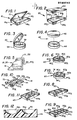
- the several embodiments of the novel containers can be more easily understood from a study of the drawings in which:
- the present invention relates to methods and compositions useful in the rapid and efficient identification of fungal pathogens.
- the miniaturized yeast identification system of the present invention provides an especially rapid, reliable, economic and technically efficient method for the differentiation of most medically important types of potentially pathogenic fungi.
- the yeast identification system contains at least one differential medium which is provided in a miniature culture plate described in more detail below.
- the media include an improved fungal growth medium, the improvement comprising the addition of ammonium ions to a medium comprising purified saponin, oxgall, a substrate for phenol oxidase and a supporting agent (hereinafter sometimes referred to as S O C), carbohydrate assimilation media and a urease medium.
- the miniature media containing plates may be constructed to contain a single medium, as shown in FIGS. 1 through 4, or may be partitioned, as shown by example in FIGS. 6 through 11. It is envisioned that plates may be so partitioned to accommodate as many as twenty different media.
- saponins may be purified using the techniques set forth in U.S. Pat. No. 3,883,425 entitled "DETOXIFICATION OF SAPONINS", issued May 13, 1975, incorporated by reference herein, and the purified saponins can then be employed in the fungal medium of the present invention.
- the use and adaptation of these media to miniature culture plates significantly enhances the performance of these media in differentially identifying various genera and species of clinically important fungi.
- the miniaturized yeast identification system of the present invention also includes a modification of the carbohydrate assimilation test, said modification comprising the preincubation of the fungi in a carbohydrate depleted medium prior to plating on a carbohydrate assimilation media.
- the described modification significantly decreases the time-to-positivity, specifically, from 24 to between four and six hours for some species.
- the use and adaptation of these mecia to the miniaturized system provides both a surface inoculation method and greater surface area to volume ratio than conventional methods which can reduce the number of false negative identifications that may occur when pour plate methods are used.
- This miniaturization also has economic and mechanical advantages.
- the miniaturized yeast identification system of the present invention is particularly useful in the differential identification Cryptococcus neoformans, Candida albicans and Candida stellatoidea.
- the miniature plate has dimensions such that it will fit on the viewing stand of a conventional microscope, for example of from about 0.03 to about 3 centimeters by from about 0.7 to about 8 centimeters with a depth of from about 0.025 centimeters to about 1.0 centimeters.
- the preferred size is approximately 35 x 75 x 5 millimeters, embodiments 10 and 20 in FIGS. 1 and 2 respectively, and has a flip-up lid 12 which is pivotally attached to the sidewalls 14a and 14b and which when in the lowered position, see FIG . 5 , will enclose the media 16 within the plate 18 but when pivotally open, see FIG. 1, will allow easy addition, removal and inspection of the samples.
- the standard petri plate is a circular plate with the approximate dimensions of 100 x 15 millimeters and has a non-attached lid which fits over the bottom, media containing, plate.
- the miniaturized configuration has several advantages. Specifically, these advantages include, ease of packaging and storage, requiring little refrigeration room, and increased facility in maintaining sterility as the plates are easily handled and stacked without the fear of knocking off the lid which is a common occurrence with conventional petri plates. , Additionally, with the morphology medium SOC, the miniature plate configuration fits the microscope stage slide holder allowina rapid manipulation of the plates as opposed to the slow, awkward manipulation of standard petri plates by hand and by eliminating the need to transfer the yeast specimen to a second microscope slide for examination.
- FIGS. 1, 2, 8, 9, 10 and 11 represent rectangular embodiments of the miniature culture plate of the present invention.
- these embodiments may possess a flip-up lid 12 which is pivotally attached to side walls 14a and 14b or may possess an unattached lid 22.
- Both lids 12 and 22 may be lowered upon plates 18 and 28, respectively, to enclose the media 16 contained within plates 18, 28, 50, 54, 60 and 70 in a manner best shown in FIG. 5.
- the rectangular plates 18 and 28 of embodiments 10 and 20 respectively, may be partitioned in such a manner as to create circular wells 62a, 62b, 72a-h, shown in detail in FIG.
- the miniature culture plates may be circular in configuration as shown by embodiments 30 and 40 in FIGS. 3 and 4, respectively.
- the circular plates 38, 48, 80 and 90 may similarly possess a flip-up lid 32 which is pivotally attached to the circumferential sidewall 34 or may possess an unattached lid 42, both of which enclose the media 16 contained within plates 38, 48, 80, and 90 when the lids 32 and 42 are lowered upon the circumferential sidewalls 34 and 44, respectively.
- the circular plates 38, 48, 80 and 90 may be partitioned as shown in FIGS.
- the shape of the miniature culture plate and media containing wells therein, shown in FIGS. 1 through 12, are set forth as examples and are not meant to limit the types of possible shapes and combinations thereof employed.
- the miniature culture plate may be constructed of plastic or such material presently employed in the manufacture of petri plates.
- the miniature plates are more economical in that they utilize between about 2.5 to 5 milliliters of media as opposed to the about 20 to 30 milliliters of media required by the standard petri plates.
- the miniaturized yeast identification system has been designed to utilize a slide warmer as an alternative mini-incubator.
- One such slide warmer is commercially available from Fisher Scientific Company.
- the miniaturized yeast identification system of the present invention provides pre-poured, sterilized, ready to use media and thereby circumvents the disadvantages of existing systems, such as the auxanographic carbohydrate assimilation method which necessitates such steps as boiling, to dissolve the agar supporting agent and sterilization prior to use.
- a conventional product with a ready- to-use agar for chlamydospore production uses corn meal agar with an emulsifying agent sold under the tradename Tween 80 by Atlas Chemical Company and accompanies media for urea, nitrate and carbohydrate utilization.
- the corn meal agar is inoculated and examined at 24 to 72 hours for chlamydospore production.
- the two main disadvantages of this system are that the chlamydospore tests cannot be performed apart from utilizing the entire plate which is relatively expensive and there is a long time-to-positivity.
- the media are prepared, poured into the miniature plates and after solidification, the lids are closed, and the plates are wrapped in a plastic lined aluminum pouch. These plates may be stored up to at least 8 months at 4° C without loss of differential growth capabilities.
- the miniature configuration also affects the performance of the media. Temperature control is essential with these media and the smaller volume of media in the miniature plate allows rapid heat transfer between incubation environment and the medium.
- the sensitivity and accuracy of short term incubations, such as the three hour, 37°C, incubation for germ tube formation and subsequent shift to room temperature for chlamydospore production on the SOC medium, is significantly enhanced by the miniaturization of the system.
- the performance of the sucrose assimilation and urease tests is also enhanced. Both of the latter tests require a very high organism to substrate ratio which is easily attainable in the small media volume of the miniature plate.
- both tests involve a color change which is more easily visualized with a medium depth of about 1 to 4.5 millimeters than at about 5 to 15 millimeters.
- This increased organism to substrate ratio and more easily visualized color change are thought to be partially responsible for the decreased time-to-positivity of the sucrose and urease tests in the miniaturized system of the present invention, the times being 5 and 1 hours, respectively.
- phenol oxidase substrates include 2,3-dihydroxybenzoic acid, 3,4-dihydroxybenzoic acid (protocatechuic acid), DOPA, 3,4-dihydroxycinnamic acid (caffeic acid), the methyl ester and diacetate of caffeic acid, 3-hydroxytryptamine, 3,4-dihydroxyphenylethanolamine (norepinephrine), and 4-hydroxy-3,5-dimethoxycinnamic acid.
- the substrate of phenol oxidase is employed as an identification agent for Cryptococcus neoformans since the reaction of the phenol oxidase enzymes of that fungus with such a substrate produce a brownish pigmentation which is specific for Cryptococcus neoformans.
- the original SOC formulation as given in U.S. Pat. No. 4,144,133, issued March 13, 1979 and entitled "FUNGAL GROWTH MEDIA", was from about 0.005 to about 0.05 weight percent caffeic acid. Adaptation of the original SOC media to the miniaturized system requires an increased range of about 0.005 to about 0.5 weight percent, with a preferred concentration of about 0.012 to about 0.12 weight percent and a most preferred concentration of about 0.06 weight percent caffeic acid. This higher concentration of caffeic acid necessitated an upward adjustment of the pH of the medium to a neutral p H due to the acidic nature of caffeic acid.
- ammonium salts supporting chlamydospore formation was found to be between about 0.001 M and about 0.5 M with a preferred concent- atior -f about 0.005 M to about 0.05 M and a most preferred concentration of ammonium salt at about 0.01 M.
- Ammonium salts may be selected from a non-exclusive class comprising, ammonium chloride, ammonium sulfate ammonium nitrate and ammonium citrate, of which the preferred ammonium salt is ammonium chloride.
- Other salts such as sodium chloride and potassium chloride were tested by formulation in the S O C media but were found to be less effective in promoting chlamydospore formation than the ammonium salts.
- Miniaturization of the SOC medium also required an increase in the preferred concentration of purified saponin from the original concentration of about 0.5 weight percent to about 1.0 weight percent in the improved S O C medium of the present invention.
- the SOC medium used in the miniaturized yeast identification system was prepared by adding a powdered supporting agent such as agar, oxgall, purified saponin, a substance for phenol oxidase such as caffeic acid, and ammonium salt to deionized water. The resulting mixture is then stirred and heated to boiling to dissolve the ingredients and adjusted to a final pH of about 6.5 to about 7.5. The solution is then sterilized at 121°C at about 15 psi for 15 minutes. After cooling, the medium was dispensed to a depth of about 2 millimeters into 33 x 75 x 5 mm rectangular plastic plates with attached flip-up lids. The medium was allowed to solidify, and the plates were wrapped in plastic lined aluminum foil pouches and stored at 4°C. Preparation and storage in this fashion gives a shelf life of at least 8 months.
- a powdered supporting agent such as agar, oxgall, purified saponin, a substance for phenol oxidase
- the improved SOC medium of the present invention comprises from about 1.0 to about 5.0 weight percent agar, from about 0.25 to about 30.0 weight percent oxgall, from about 0.1 to about 5 .0 weight percent purified saponin, from about 0.05 to about 0.5 weight percent caffeic acid, based on the amount of water added to these components and from about 0.001 M to about 0.5 M ammonium salts.
- Preferred media can be prepared following the procedure outlined above and employing from about 1.0 to about 5.0 weight percent agar, from about 0.5 to about 5.0 weight percent oxgall, from about 0.1 to about 2.5 weight percent purified saponin, from about 0.012 to about 0.12 weight percent caffeic acid, and from about 0.005 M to about 0.05 M ammonium salts.
- a most preferred medium contains about 2.0 weight percent agar, about 1.0 weight percent oxgall, about 1.0 weight percent purified saponin, about 0.06 weight percent caffeic acid, and about 0.01 M ammonium salts.
- yeasts prior to inoculation of the miniature SOC media-containing plates with the yeast samples, the yeasts are grown on a general growth medium, such as Sabouraud dextrose agar with gentamicin, for up to about 72 hours. Anywhere from about one to three yeast colonies may be taken from the general growth medium and plated on each miniature plate. All yeasts were first grown on a general growth media prior to inoculation of media-containing miniature plates. These general growth media may contain antibiotics.
- a general growth medium such as Sabouraud dextrose agar with gentamicin
- the miniaturized yeast identification system of the present invention has also been adapted to accommodate carbohydrate assimilation media. Adaptation of these assimilation media to the miniaturized system allows clinical technicians to selectively choose those assimilations required for a specific speciation of potential pathogenic fungi and thereby shortens the time of species identification from one week to about five to twenty four hours.
- Sucrose assimilation for example, specifically differentiates Candida albicans, which assimilates sucrose, from Candida stellatoidea, which does not.
- sucrose assimilation tests When used in conjunction with such morphology tests as germ tube and chlamydospore formation, which gives a presumptive identification of the albicans or stellatoidea species, the conducting of sucrose assimilation tests will give a conclusive species identification. Additionally, adaptation of such carbohydrate assimilation media as sucrose has dramatically shortened the time-to-positivity for Candida albicans and Candida stellatoidea differentiation.
- the method of the present invention shortens the time-to-positivity for sucrose assimilation from 24 hours, and in some tests 6 days, to a period of about 5 hours. This increased efficiency is believed to be due to at least two novel features of the present invention.
- the procedure employed for sucrose assimilation utilizes a starvation step, in a carbohydrate depleted media, prior to plating of the fungi on the assimilation media.
- the purpose of this prestarvation step is to deplete the yeast cells of essentially all of the internal carbohydrate pools which prevents false positive reaction. This prestarvation is believed to increase the rate of carbohydrate assimilation once the yeast are plated .on carbohydrate containing media and thus increase the time-to-positivity.
- the miniature plates have a media depth of about 1 millimeter to about 4.5 millimeters as opposed to 5 millimeters to 15 millimeters in the standard petri plate.
- the shallower depth of the miniature plates is thought to aid in a more rapid visualization of the color change resulting from positive carbohydrate assimilation and to provide the essential high organism to substrate ratio.
- a sucrose assimilation is utilized to differentiate between Candida albicans and Candida stellatoidea.
- the medium was prepared by adding a powdered supporting agent, such as agar, a pH sensitive color dye, such as bromcresol purple, and a yeast nitrogen base to deionized water. The resulting mixture is then stirred, heated to boiling to dissolve the media components and adjusted to a pH of about 6.85 to about 7.55 with a base, such as sodium hydroxide. The medium is then sterilized by heating to 121° C at 15 psi for 15 minutes. The sucrose is presterilized and then added asceptically to the medium mixture.
- the cooled sucrose-containing medium is then dispensed in about 5 milliliter aliquots into sterile rectangular plates with attached flip-up lids, the plates having the approximate dimensions of 33 x 75 x 5 millimeters. After solidification, the lids are closed, and the plates wrapped in plastic lined aluminum foil pouches and stored at 4°C. These plates may be stored up to at least 8 months at 4°C without dehydration or loss of color.
- Other sugars such as maltose, galactose, trehalose, and lactose, may be substituted for sucrose to provide additional carbohydrate assimilation media. These sugars are but non-exclusive examples of carbohydrates which may be substituted for sucrose in the above-described carbohydrate assimilation media.
- Fluorescent indicators operable in the pH range, pH 5 to pH 8, of the carbohydrate assimilation system include, for example, Acid R Phosphine, Brilliant Diazol Yellow, Cleves acid, Coumaric acid, 3,6-Dioxyphthalic dinitrile, Magnesium 8-hydroxyquinolinate, p-Methylumbelliferone, 1-Naphthol-4-sulfonic acid, Orcinaurine, Patent Phosphine, Thioflavine and Umbelliferone.
- a preferred medium can be prepared following the procedure outlined above and employing from about one to about five weight percent agar, from about 0.0005 to about 0.02 weight percent bromcresol purple, from about 0.02 to about 0.7 weight percent yeast nitrogen base, and about 0.02 to about 1.0 percent sucrose, based on the amount of water added to these components.
- the preferred pH of the medium, prior to sterilization is about 6.85 to about 7.55.
- the yeasts Prior to inoculation of the assimilation media, the yeasts were taken from plates containing a general growth medium and suspended in sterile, carbohydrate depleted media at a pH of about 7.0 to about 8.5 and held at room temperature.
- carbohydrate depleted media include sterile, deionized water or deionized water supplemented with a yeast nitrogen base.
- the prestarvation period may run from about 30 minutes to 24 hours with a preferred range from about 30 minutes to about 8 hours, and a most preferred period of about one hour. Prestarvations are carried out in non-glass, sealed and sterile containers. Such prestarvation techniques have been employed in genetic and biochemical studies of microorganisms generally, but have not been previously employed in yeast assimilation methods for taxonomic purposes.
- the carbohydrate depleted medium containing the yeast is vigorously mixed and, thereafter, at least ten microliters of yeast suspension is placed onto the surface of the assimilation media. Multiple individual aliquots of yeast suspensions may be placed on each miniature plate. The plates are then incubated at room temperature for about 4 to 6 hours and thereafter checked for color change from purple to yellow denoting carbohydrate assimilation.
- miniaturized yeast assimilation system which combines prestarvation of the yeast inocula with subsequent inoculation of the prestarved yeast onto a series of miniaturized carbohydrate agars, incubation of said inocula on said agars and post-incubation dye' or fluorescent indicator addition for detection of carbohydrate assimilation.
- the yeasts were again taken from plates containing a general yeast growth medium and suspended at a concentration of M cFarland No. 8, approximately 10 8 organisms, in either the prestarvation media previously described or 1 x 10⁻⁵ M N aOH.
- the prestarvation period may run from about 30 minutes to about 24 hours with a preferred range from about 30 minutes to about 8 hours, and a most preferred prestarvation incubation period of about one hour at a preferred temperature of about 20 to 25°C.
- Prestarvations are, again, performed in sterile, sealed, non-glass containers at the previously described pH.
- the carbohydrate depleted medium containing the yeast is vigorously mixed and, thereafter, at least 10 microliters of yeast suspension is placed onto the surface of the assimilation medium.
- the carbohydrate assimilation media employed in this alternative embodiment were prepared by suspending appropriate amounts of yeast nitrogen base and agar into deionized water. The resulting mixture was stirred with heat sufficient to dissolve the ingredients and the pH of the suspension was adjusted to about 7.2 with an allowable pH range of from about 6.65 to about 7.35. The mixture was then sterilized at 121°C at 15 psi for 15 minutes, cooled to about 40 to 55°C and, thereafter, an appropriate amount of filter-sterilized carbohydrate added aseptically. About 5 milliliter aliquots of this molten medium was then pipetted into sterile rectangular plates with attached flip-up lids, the plates having the approximate dimensions of 33 x 75 x 5 millimeters.
- the lids are closed and the plates wrapped in plastic lined aluminum foil pouches and stored at 4°C. These plates may be stored up to at least 8 months at 4°C without dehydration.
- a non-exclusive list of the type of sugars which may be employed in this alternative embodiment includes dextrose, galactose, sucrose, maltose, cellibiose, trehalose, lactose, me'libiose, and raffinose.
- the miniaturized plates shown in FIGS. 6 through 11 may be employed.
- the individual wells such as 72a through 72h in FIG. 10 or compartments such as 55a through 55h in FIG. 9 will each contain a different carbohydrate-containing medium and at least 10 microliters of yeast suspension was distributed per individual well or compartment.
- a preferred medium can be prepared following the procedure outlined above and employing from about 0.02 to about 0.5 weight percent yeast nitrogen base, from about 1.0 to about 5.0 weight percent agar, and from about 0.02 to about 1.0 weight percent carbohydrate, based on the amount of water added to these components.
- the preferred pH of the medium is from about 6.65 to about 7.35.
- a most preferred medium contains about 0.067 weight percent yeast nitrogen base, about 2.0 weight percent agar, and about 0.1 weight percent carbohydrate, based on the amount of water added to these components.
- the most preferred pH is about 7.2.
- the plates are then covered with a sterile lid and incubated at room temperature for about 6 to 24 hours. After incubation, an appropriate amount of dye solution is added to each assimilation test plate and assimilation detected by color changes in the dye.
- dyes were examined for possible use in this system, bromcresol purple, chlorophenol red and p-nitrophenol which give a purple to yellow, red to yellow and a colorless to yellow color change, respectively, when carbohydrate assimilation occurs.
- the dyes were prepared by dissolving an appropriate amount of dye into water, adjusting the pH of the dye solution to about 7.2 using 0.05N NaOH, and filter-sterilizing the solution through a 0.22 ⁇ m filter.
- a broad concentration range of dye solutions from about 20 mq. to 250 mg. bromcresol purple or chlorophenol red per milliliter or from about 15 mg. to 45 mg. p-nitrophenol per milliliter, may be employed as stock solutions from which an appropriate aliquot of dye is taken and added to the carbohydrate assimilation test plates.
- the preferred concentration for the stock dye solutions is about 40 mg. bromcresol purple dye per milliliter, 60 mg. chlorophenol red dye per milliliter and 20 mg. _p-nitrophenol dye per milliliter.
- the most preferred dye is bromcresol purple. Approximately 0.02 ml to about 1.0 ml stock dye solution is added per about 0.1 to about 5.0 milliliters of yeast inoculated carbohydrate assimilation test medium, respectively. The bromcresol purple reaction requires about 5 to 15 minutes for completion, whereas the chlorophenol red requires about 15 to 60 minutes for completion.
- the miniaturized yeast identification system of the present invention has also been adapted to accommodate urea containing media.
- the Cryptococcus species, and occasional Trichosporon beigelii, and a very rare Candida krusei possess the enzyme, urease, that is necessary for hydrolysis of urea. Presence of the urease enzyme in yeast cultures i ⁇ indicated by color change from orange to pink.
- urea containing medium provides a positive detection of the enzyme, urease, in about one hour as opposed to the 24 to 72 hours and 3 to 4 hours required for urease detection in presently available urea agar slants and urea broth, respectively.
- the shortened time-to-positivity of the present method is believed to be due to the increased organism to substrate ratio provided by the small media volume and increased relative surface area and by easier visualization of the color change afforded by the shallower media depth in the miniaturized system as compared to standard petri plates and broth tubes.
- the miniature urease plates of the present invention are made by preparing urea agar in accordance with manufacturer's instructions.
- the medium was sterilized by heating to 121°C at about 15 psi for 15 minutes and is then dispensed in about 5 milliliter aliquots into the miniature plates described above. After solidification, the plates were wrapped and stored as described above so as to remain stable for at least eight months when stored as described above.
- the plates were inoculated by transferring one to three yeast colonies from a general growth media onto the urease media. The plates were then allowed to incubate at 35°C for one hour.
- each plate may, for example, contain a single type of medium inoculated with several different yeasts, or each plate may contain multiple, different differential media inoculated with the same or multiple yeasts.
- the fungal media of the present invention alone and in combination provide a rapid screening process for the identification of clinically important yeasts.
- the miniaturized yeast identification systems described herein provide for the relatively rapid differential identification of C ryptococcus neoformans and the two Candida species, albicans and stellatoidea.
- This example was performed in order to compare the accuracy and sensitivity of egg white media, fetal bovine media, two commercial systems, Flow GBE and A.P.I. GT Microtest, respectively, and the miniaturized SOC media of the present invention in detecting germ tube formation. The ease of manipulation and microscopic examination of these media was also compared.
- the substrate was added to a test tube, inoculated with yeast and incubated at 37°C for 3 hours. Following incubation, a drop of yeast suspension was placed on a microscope slide, covered with a glass coverslip, and examined under the microscope at 100X to 400X magnification for germ tubes.
- Egg white substrate was prepared by separating the eggwhite from the yolk of an egg. Fetal bovine serum substrate was purchased from Gibco. The Flow GBE tube, containing 0.1 percent weight per volume glucose and 2.6 percent weight per volume beef extract was inoculated with yeast and incubated as per manufacturer's directions in a 35° to 37°C incubator for 2 to 4 hours.
- One to four colonies of yeast are picked up with a sterile cotton swab and the bulk of the inoculum was deposited as a single mound onto the miniaturized SOC media. From the remaining inoculum on the swab, a thin film of yeast was streaked onto the medium in a dollar sign shape and the thin film of yeast thereafter covered with a glass coverslip. The lid of the miniaturized plate was closed, and the plate was incubated at 37° to 40°C for 3 hours. Following incubation, the miniaturized plate was opened, placed under the microscope, and the inoculum, centrally located under the coverslip, was examined at 100X to 400X magnification for germ tubes.
- Table 1 gives the comparative results on the performance of germ tube systems. Twenty strains of Candida albicans were tested for germ tube formation and ease of microscopic examination on egg white, fetal bovine serum, Flow GBE, A.P.I. GT* Microtest and the miniaturized SOC medium of the present invention. Each strain was examined after three hours of incubation and marked as positive (+) for germ tube formation when at least eight out of ten microscopic fields showed germ tube formation. The strains were marked as marginal ( f ) when germ tubes were visible in only one or two out of ten microscopic fields. Clumping was said to occur when, despite agitation, the germinated cells remained knotted together in masses, making it difficult to observe, microscopically, whether there is true germ tube or pseudohyphal formation.
- the miniaturized SOC medium is a solid support medium on which yeast cells are dispersed in a thin film allowing observation of single stationary cells. In the other systems, the yeasts are usually in motion in the liquid under the coverslip, making it difficult to focus on any one cell.
- the miniaturized SOC plate requires only an initial inoculum transfer, whereas the other systems require a second transfer to a microscope slide which increases technician time and necessitates additional materials.
- This example was performed in order to establish the effect of various concentrations of the phenol oxidase substrate, caffeic acid, on yeast morphology and pigment formation on SOC media in the miniaturized system.
- the specific morphologies observed were germ tube, chlamydospore, blastospore, filaments and pseudohyphae formation.
- the brown pigment production characteristic of several Cryptococcus neoformans strains was also monitored.
- the test medium the miniaturized SOC medium, of the present example was prepared as follows: 20 grams of agar, 10 grams of oxgall, 10 grams of purified saponin, 0.54 grams of ammonium chloride, and various amounts of caffeic acid, listed in Table 2 below, were added to one liter of deionized water. The mixture thus formed was stirred and heated to boiling to dissolve the ingredients and adjusted to a final pH of about 7.2. The solution is then sterilized by heating to about 121°C at 15 psi for 15 minutes. After cooling, the medium was dispensed to a depth of about 2 millimeters (approximately 5 milliliters) into sterile, miniature plates, previously described, and allowed to solidify.
- yeast colonies were transferred from a general growth medium to the test medium, as described in Example 1.
- the inoculated plates were incubated for 3 hours at 37°C and thereafter at room temperature.
- Table 2 sets forth the results of the test performed in order to compare the effect of various concentrations of caffeic acid on yeast morphology and pigment production on the miniaturized SOC medium.
- Six species of Candida and four species of Cryptococcus were plated on the test medium and observed at the time interval specified in Table 2. Microscopic examination at the time intervals designated in Table 2 was conducted at 100X magnification in the manner described in Example 1.
- Positive morphology (+) was defined as at least 8 out of 10 microscopic fields having shown a particular morphology or combination of morphologies.
- Negative . morphology (-) was defined as less than 1 or 2 out of 10 microscopic fields having shown a particular anticipated morphology or combination thereof.
- the miniaturized SOC media supported the characteristic yeast morphologies and pigment production at a relatively wide range of caffeic acid concentrations, from about 0.005 weight percent to about 0.5 weight percent.
- 10 percent of the C ryptococcus neoformans strains tested produced brown coloration at 18 hours on SOC with 0.006 weight percent caffeic acid.
- SOC itself was dark brown, making the yeast's color change difficult to recognize and, also, the SOC medium became a darker brown color each day, indicating instability.
- the effect of caffeic acid concentration on general yeast morphology as shown in Table 2 below, establishes an upper limit for caffeic acid. Essentially all filamentation of Candida species was inhibited at 0.6 weight percent caffeic acid.
- This example was performed to determine the effects of ammonium chloride addition to SOC medium on chlamydospore production by Candida albicans.
- test medium of the present example was prepared as follows: 20 grams of agar, 10 grams of oxgall, 10 grams of purified saponin, 0.06 grams caffeic acid, and varying concentrations of ammonium chloride, indicated in Table 3 below, were added to one liter of deionized water. The mixture was then stirred, heated to boiling, adjusted to a final pH of about 7.2, and sterilized by heating to 121°C at 15 psi for 15 minutes. After a cooling period, about 5 milliliters of cooled medium was dispensed into the miniature plates as described in Example 1. These plates may be stored up to 8 months when stored as described in Example 1.
- yeast colonies grown on Sabouraud dextrose agar were plated as described in Example 1 on S O C medium containing the various concentrations of ammonium chloride listed in Table 3 below. At 1.0 M ammonium chloride, some of the medium components precipitated making it impossible to test that formulation.
- the yeast colonies so plated comprised 20 different strains of Candida albicans which had, on occasion, given negative or weak chlamydospore production. The plates were incubated for 3 hours at 37°C and examined for germ tube formation. All 20 strains produced numerous germ tubes on all concentrations of ammonium chloride listed in Table 3. The plates were then incubated at room temperature for 24 to 72 hours and examined for chlamydospore production by the methods described in Example 1 and at the time intervals indicated in Table 3 below.
- This example was performed in order to test the ability of the miniaturized carbohydrate assimilation media of the present invention, performed by the method of the present invention, to differentiate between Candida albicans and Candida stellatoidea.
- the miniaturized sucrose assimilation media employed in this example was prepared by adding 20 grams of agar, 20 milligrams of bromcresol purple, 0.67 grams yeast nitrogen base and 4 milliliters of 0.5 N sodium hydroxide to one liter of deionized water and adjusted to a pH of about 7.2.
- the media was sterilized by heating to about 121°C at 15 psi for 15 minutes and after cooling, presterilized sucrose is added asceptically to yield a final sucrose concentration of 1.0 percent.
- the media was then dispensed in about 5 milliliter aliquots into the miniature plates, as described above. These plates may be stored, by the method described in Example 1, up to eight months without dehydration or loss of color.
- Candida Six species of Candida were first grown on Sabouraud dextrose agar containing gentamicin, as previously described. Yeasts were taken from this primary growth medium and suspended in sterile deionized water and held for at least one hour at room temperature for purposes of prestarvation. After prestarvation, the suspension was vortexed and, using a sterile pipet, one to about three drops of yeast suspension was placed onto the surface of the miniaturized sucrose media. The plates were then incubated at room temperature for 4 to 6 hours. Following the incubation period the plates were checked for color change from purple to yellow indicating sucrose assimilation. The plates were held at room temperature for 24 hours and read a second time.
- Candida albicans, Candida stellatoidea, Candida tropicalis, Candida krusei and Candida glabrata gave the correct assimilation response on the miniaturized sucrose assimilation plates after 5 hours incubation at room temperature and maintained the correct response for 24 hours.
- Candida parapsilosis did not show a characteristic positive reaction until 18 to 24 hours. From this data, it is apparent that Candida albicans and Candida stellatoidea can be differentiated in 5 hours.
- This example was performed to test the ability of miniaturized urease media to detect the presence of the urease enzyme in various species of Cryptococcus.
- the miniature urease plates in the present example were made by preparing urea agar according to manufacturer's instructions, sterilizing by heating at 121°C at 15 psi for 15 minutes and then dispensing the media into the plates as described in the previous examples. Again, by storing as described in Example 1, the plates remain stable for up to at least 8 months.
- the plates were inoculated with four species of Cryptococcus and six species of Candida, by transferring, with a sterile cotton swab, two to three yeast colonies from a general growth medium such as Sabouraud dextrose agar. Two to three yeasts of a single species were inoculated per plate and the plates were incubated at 35°C for 24 hours.
- the results of this example are shown in Table 5.
- the Cryptococcus species were positive in one hour and the other yeast isolates remained negative for 24 hours.
- a hydrolysis of urea releases ammonium gas which is basic and rapidly spreads throughout the medium turning the medium from orange to pink.
- a positive organism completely changes the medium color in the miniature plate within two to three hours. Therefore, if more than one organism is inoculated onto the miniaturized urease plate, the plate must be read between about one and two hours or false positive reactions can occur.
- the Microtiter" carbohydrate assimilation media employed in this example were prepared by adding 20 grams of agar and 0.67 grams of yeast nitrogen base to 950 milliliters deionized water. The mixture was stirred with heat to dissolve the ingredients, adjusted to a pH of about 7.2 with 0.5N NaOH, divided into eight equal parts, sterilized at 121°C at 15 psi for 15 minutes and, thereafter, allowed to cool to about 45 to 55°C. Then, 6.25 milliliters of a two percent, filter sterilized, carbohydrate solution containing one of each of the eight carbohydrates listed in Table 6A or 6B, below, was asceptically added to one of each of the cooled solutions.
- The, two percent carbohydrate solutions were prepared by adding 0.2 grams of carbohydrate to 10 milliliters deionized water and adjusting to a pH of about 7.0 with 0.05 N NaOH. After mixing, 0.15 milliliters aliquots of carbohydrate-containing medium was sterily dispensed into the wells of a Microtiter" plate.
- the yeast listed in Tables 6A and 6 B were taken from plates containing a general yeast growth medium as described in Example 4 and suspended at a concentration of McFarland No. 8, approximately 10 8 organisms, in 1 x 10⁻⁵M NaOH and held for about one hour at room temperature for purposes of prestarvation. Following prestarvation, the suspension was vortexed and 0.02 milliliter aliquots were aseptically transferred into each medium containing well of the Microtiter' plate. The plates were covered with a sterile lid and incubated at room temperature for 24 hours. After incubation, 0.02 milliliter aliquots of filter sterilized, 20 micrograms bromcresol purple per milliliter dye solution was added to each well of the Microtiter" plates. The plates were read 5 to 10 minutes after dye addition for a purple to yellow color change indicative of positive assimilation of carbohydrate.
- the results of the Microtiter carbohydrate agar assimilations are given in Tables 6A and 6B, below, wherein the data are compared to reports for conventional methods given in The Yeasts by Lodder and the A.P.I. 20C Strip.
- the conventional methods include, Wickerham liquid, Saito agar, and auxanographic technique.
- This example was performed in order to test the effect of an increased ratio of surface area of organisms to volume of medium on the time-to-positivity in carbohydrate assimilation.
- One way to demonstrate the effect of said increased ratio is to hold the surface area and microbial inoculum constant while varying the volume, herein expressed as depth. of medium, in a given test plate or tube.
- Candida albicans the test organism, was first grown on Sabourand dextrose agar containing gentamicin, as previously described. Yeasts were taken from this primary growth medium and suspended in sterile deionized water and held at least one hour at room temperature for purposes of prestarvation. Following prestarvation, the suspension was vortexed and, using a sterile pipet, one to about three drops of yeast suspensior was placed onto the surface of each miniaturized plate and culture tube containing sucrose medium and three one-drop inoculations of yeast were placed on each 100 x 15 millimeter (mm) petri plate containing sucrose medium. The plates and tubes were then incubated at room temperature for not more than 12 hours.
- the medium depth in the standard petri plate is typically 5 mm corresponding to 18 to 20 milliliters of medium per 100 x 15 mm plate which is shown to yield about a 10 hour time-to-positivity for Candida albicans in the sucrose assimilation test.
- medium depths of 3 mm or less in the 100 x 15 mm petri plates are not preferred due to possible problems with dehydration during storage.
- the greater time-to-positivity seen in the 16 x 125 mm flat-bottom culture tubes ( ) is thought to be due to problems with oxygen tension created by the closed environment of the culture tubes as compared to the open system of the plates.
Landscapes
- Health & Medical Sciences (AREA)
- Life Sciences & Earth Sciences (AREA)
- Chemical & Material Sciences (AREA)
- Organic Chemistry (AREA)
- Engineering & Computer Science (AREA)
- Zoology (AREA)
- Wood Science & Technology (AREA)
- Bioinformatics & Cheminformatics (AREA)
- Genetics & Genomics (AREA)
- Biotechnology (AREA)
- Biochemistry (AREA)
- Microbiology (AREA)
- General Engineering & Computer Science (AREA)
- General Health & Medical Sciences (AREA)
- Sustainable Development (AREA)
- Biomedical Technology (AREA)
- Clinical Laboratory Science (AREA)
- Molecular Biology (AREA)
- Proteomics, Peptides & Aminoacids (AREA)
- Biophysics (AREA)
- Physics & Mathematics (AREA)
- Immunology (AREA)
- Toxicology (AREA)
- General Chemical & Material Sciences (AREA)
- Physiology (AREA)
- Cell Biology (AREA)
- Analytical Chemistry (AREA)
- Measuring Or Testing Involving Enzymes Or Micro-Organisms (AREA)
- Micro-Organisms Or Cultivation Processes Thereof (AREA)
- Preparation Of Compounds By Using Micro-Organisms (AREA)
- Apparatus Associated With Microorganisms And Enzymes (AREA)
- Soy Sauces And Products Related Thereto (AREA)
- Adjustment And Processing Of Grains (AREA)
- Emergency Alarm Devices (AREA)
- Signal Processing For Digital Recording And Reproducing (AREA)
- Drying Of Solid Materials (AREA)
- Interconnected Communication Systems, Intercoms, And Interphones (AREA)
- Cold Air Circulating Systems And Constructional Details In Refrigerators (AREA)
- Coloring Foods And Improving Nutritive Qualities (AREA)
- Enzymes And Modification Thereof (AREA)
Priority Applications (1)
| Application Number | Priority Date | Filing Date | Title |
|---|---|---|---|
| AT84114230T ATE41678T1 (de) | 1984-03-22 | 1984-11-24 | Miniaturisiertes system zur identifizierung von hefe. |
Applications Claiming Priority (2)
| Application Number | Priority Date | Filing Date | Title |
|---|---|---|---|
| US06/592,072 US4728607A (en) | 1984-03-22 | 1984-03-22 | Miniaturized yeast identification system |
| US592072 | 1984-03-22 |
Publications (3)
| Publication Number | Publication Date |
|---|---|
| EP0160743A2 true EP0160743A2 (de) | 1985-11-13 |
| EP0160743A3 EP0160743A3 (en) | 1986-04-30 |
| EP0160743B1 EP0160743B1 (de) | 1989-03-22 |
Family
ID=24369161
Family Applications (1)
| Application Number | Title | Priority Date | Filing Date |
|---|---|---|---|
| EP84114230A Expired EP0160743B1 (de) | 1984-03-22 | 1984-11-24 | Miniaturisiertes System zur Identifizierung von Hefe |
Country Status (14)
| Country | Link |
|---|---|
| US (1) | US4728607A (de) |
| EP (1) | EP0160743B1 (de) |
| JP (1) | JPS60199399A (de) |
| AT (1) | ATE41678T1 (de) |
| AU (1) | AU583019B2 (de) |
| CA (1) | CA1263945A (de) |
| DE (1) | DE3477403D1 (de) |
| DK (1) | DK116585A (de) |
| ES (2) | ES8609730A1 (de) |
| FI (1) | FI86083C (de) |
| IL (1) | IL74606A (de) |
| NO (1) | NO851165L (de) |
| NZ (1) | NZ210485A (de) |
| ZA (1) | ZA848929B (de) |
Cited By (2)
| Publication number | Priority date | Publication date | Assignee | Title |
|---|---|---|---|---|
| FR2624274A1 (fr) * | 1987-12-02 | 1989-06-09 | Univ Dijon | Procede pour la detection de la contamination microbiologique de produits liquides contenus dans un emballage |
| FR2636073A1 (fr) * | 1988-09-02 | 1990-03-09 | Escarguel Claude | Boite perfectionnee pour milieux de culture utilisables en bacteriologie |
Families Citing this family (20)
| Publication number | Priority date | Publication date | Assignee | Title |
|---|---|---|---|---|
| US4874695A (en) * | 1983-03-08 | 1989-10-17 | American Home Products Corp. | Rapid indentification of yeast and other fungal microorganisms by enzyme detection |
| US4824788A (en) * | 1987-11-09 | 1989-04-25 | Ferre Penelope J | Humidity chamber for immunoperoxidase staining |
| US4945061A (en) * | 1989-11-27 | 1990-07-31 | Ezzat Iskander | Disposable culture dish with reinforcement ribs |
| USD331807S (en) | 1990-01-18 | 1992-12-15 | Pharmacia Biosensor Ab | Sheath for a biosensor surface carrier |
| US5098830A (en) * | 1990-07-16 | 1992-03-24 | Diagnostic Markers, Inc. | Very rapid detection of fungal infections |
| EP0516814B1 (de) * | 1990-12-28 | 1996-09-04 | Dade MicroScan Inc. | Verfahren und zusammensetzung zur bestimmung der antimikrobiellen empfindlichkeit der mehrheit klinisch signifikanter grampositiver organismen |
| US5417576A (en) * | 1993-11-12 | 1995-05-23 | Iowa Methodist Medical Center | Means and method for microbiological growth and in situ observation with microscopes |
| US5681743A (en) * | 1995-07-20 | 1997-10-28 | Becton Dickinson And Company | Plate assembly useful for microbiological laboratory procedures |
| GB9613499D0 (en) * | 1996-06-27 | 1996-08-28 | Perkin Elmer Ltd | Reflectance sampler |
| DE29618623U1 (de) * | 1996-10-25 | 1997-02-06 | Jencons (Scientific) Ltd., Leighton Buzzard, Bedfordshire | Vorrichtung zum Kultivieren von Mikroorganismen |
| US6114137A (en) * | 1996-10-31 | 2000-09-05 | Genentech Inc | Assay using marked microbial host cell strains |
| US5733736A (en) * | 1996-12-16 | 1998-03-31 | Springfield College | Motility channel pathogen detector and method of use |
| US6567214B2 (en) | 1997-09-04 | 2003-05-20 | Andrew E. Lorincz | Microscope slide having culture media and method for use |
| US6395537B1 (en) * | 2001-08-04 | 2002-05-28 | Ruth F. Eden | Double container device and method for detecting and enumerating microorganisms in a sample |
| US6843962B2 (en) * | 2001-09-06 | 2005-01-18 | Genetix Limited | Apparatus for and methods of handling biological sample containers |
| US6998094B2 (en) * | 2001-09-06 | 2006-02-14 | Genetix Limited | Apparatus for and methods of handling biological sample containers |
| US20030199101A1 (en) * | 2002-04-18 | 2003-10-23 | Diggens Albert A. | Chlorine test reagent, and reagent storing, packaging and dosing |
| GB0414222D0 (en) * | 2004-06-24 | 2004-07-28 | Univ Cardiff | pH sensor |
| US7537913B2 (en) * | 2005-01-21 | 2009-05-26 | Falcon Genomics, Inc. | High throughput assay for cancer cell growth inhibition |
| DE102013022032A1 (de) * | 2013-12-19 | 2015-06-25 | Technische Universität Ilmenau | Verfahren zum Nachweis von Fremdstoffen oder Degradationsprodukten in verkapselten Systemen sowie dessen Verwendung |
Family Cites Families (17)
| Publication number | Priority date | Publication date | Assignee | Title |
|---|---|---|---|---|
| US2561339A (en) * | 1944-01-10 | 1951-07-24 | Chediak Alejandro | Apparatus for laboratory investigations |
| US3097070A (en) * | 1958-11-06 | 1963-07-09 | Falcon Plastic Products | Plastic ware for scientific use |
| US3073750A (en) * | 1959-05-07 | 1963-01-15 | Talb Ind Inc | Culture dish |
| GB1026253A (en) * | 1964-11-27 | 1966-04-14 | St Luke S Hospital Res Foundat | Anaerobic culturing device |
| GB1132455A (en) * | 1965-10-30 | 1968-11-06 | Albert John Oliver | Means for testing the action of chemical compounds on micro-organisms |
| US3875015A (en) * | 1969-02-03 | 1975-04-01 | Abbott Lab | Applicator for uniformly applying a sample to bacterial growth media |
| US3649463A (en) * | 1969-10-10 | 1972-03-14 | Microbiological Ass Inc | Petri dish |
| US3870600A (en) * | 1971-03-29 | 1975-03-11 | Kamal Abdou Youssef | Selective and enrichment medium for the isolation identification and propagation of yeasts and fungi |
| US3728228A (en) * | 1971-10-12 | 1973-04-17 | Md Labor Inc | Device for indication of bacterial sensitivity to antibiotics |
| FR2204689B1 (de) * | 1972-10-26 | 1975-01-03 | Launey Pierre | |
| US3883398A (en) * | 1973-05-07 | 1975-05-13 | Bellco Glass Inc | Microculture slide chamber |
| US3883425A (en) * | 1973-12-10 | 1975-05-13 | Wadley Res Inst & Blood Bank | Detoxification of saponins |
| US4030980A (en) * | 1975-05-15 | 1977-06-21 | Corning Glass Works | Apparatus and method for identification of selected clinical yeast |
| GB1535643A (en) * | 1976-10-26 | 1978-12-13 | Ayerst Mckenna & Harrison | Determination of the susceptibility of bacteria to antibacterial agents |
| AU515954B2 (en) * | 1977-03-16 | 1981-05-14 | Beecham Group Limited | Device for testing sensitivity of microorganisms to antibiotics |
| US4179266A (en) * | 1977-04-22 | 1979-12-18 | Lukacsek Patricia A | Method and apparatus for culturing and examining fungi |
| US4144133A (en) * | 1977-08-25 | 1979-03-13 | J. K. And Susie L. Wadley Research Institute And Blood Bank | Fungal growth media |
-
1984
- 1984-03-22 US US06/592,072 patent/US4728607A/en not_active Expired - Fee Related
- 1984-11-15 ZA ZA848929A patent/ZA848929B/xx unknown
- 1984-11-21 AU AU35728/84A patent/AU583019B2/en not_active Ceased
- 1984-11-24 AT AT84114230T patent/ATE41678T1/de active
- 1984-11-24 EP EP84114230A patent/EP0160743B1/de not_active Expired
- 1984-11-24 DE DE8484114230T patent/DE3477403D1/de not_active Expired
- 1984-12-07 NZ NZ210485A patent/NZ210485A/xx unknown
- 1984-12-18 CA CA000470400A patent/CA1263945A/en not_active Expired
- 1984-12-28 JP JP59275002A patent/JPS60199399A/ja active Pending
-
1985
- 1985-01-23 FI FI850298A patent/FI86083C/fi not_active IP Right Cessation
- 1985-03-14 IL IL74606A patent/IL74606A/xx unknown
- 1985-03-14 DK DK116585A patent/DK116585A/da not_active Application Discontinuation
- 1985-03-22 ES ES541510A patent/ES8609730A1/es not_active Expired
- 1985-03-22 NO NO851165A patent/NO851165L/no unknown
-
1986
- 1986-05-16 ES ES555040A patent/ES8708163A1/es not_active Expired
Cited By (2)
| Publication number | Priority date | Publication date | Assignee | Title |
|---|---|---|---|---|
| FR2624274A1 (fr) * | 1987-12-02 | 1989-06-09 | Univ Dijon | Procede pour la detection de la contamination microbiologique de produits liquides contenus dans un emballage |
| FR2636073A1 (fr) * | 1988-09-02 | 1990-03-09 | Escarguel Claude | Boite perfectionnee pour milieux de culture utilisables en bacteriologie |
Also Published As
| Publication number | Publication date |
|---|---|
| ES8708163A1 (es) | 1987-09-16 |
| AU583019B2 (en) | 1989-04-20 |
| ZA848929B (en) | 1985-09-25 |
| IL74606A0 (en) | 1985-06-30 |
| DE3477403D1 (en) | 1989-04-27 |
| ES541510A0 (es) | 1986-08-16 |
| EP0160743A3 (en) | 1986-04-30 |
| IL74606A (en) | 1989-05-15 |
| FI86083B (fi) | 1992-03-31 |
| US4728607A (en) | 1988-03-01 |
| EP0160743B1 (de) | 1989-03-22 |
| ATE41678T1 (de) | 1989-04-15 |
| DK116585A (da) | 1985-09-23 |
| ES555040A0 (es) | 1987-09-16 |
| AU3572884A (en) | 1985-09-26 |
| FI850298A0 (fi) | 1985-01-23 |
| ES8609730A1 (es) | 1986-08-16 |
| FI850298L (fi) | 1985-09-23 |
| CA1263945A (en) | 1989-12-19 |
| NZ210485A (en) | 1988-08-30 |
| NO851165L (no) | 1985-09-23 |
| DK116585D0 (da) | 1985-03-14 |
| FI86083C (fi) | 1992-07-10 |
| JPS60199399A (ja) | 1985-10-08 |
Similar Documents
| Publication | Publication Date | Title |
|---|---|---|
| EP0160743B1 (de) | Miniaturisiertes System zur Identifizierung von Hefe | |
| US5627045A (en) | Multi-test format with gel-forming matrix for characterization of microorganisms | |
| Samaranayake et al. | Factors affecting the phospholipase activity of Candida species in vitro | |
| CN101948902B (zh) | 念珠菌显色培养基、检测试剂盒及检测方法 | |
| US4144133A (en) | Fungal growth media | |
| US5081033A (en) | Miniaturized yeast identification system | |
| US4847128A (en) | Miniaturized yeast identification system | |
| CN106868094A (zh) | 一种原料乳中抗生素残留的快速检测方法 | |
| Fitzgerald et al. | Inhibition of oral spirochetes by antibiotic agents in vitro | |
| Gray et al. | Laboratory diagnosis of systemic fungal diseases | |
| Citron | Specimen collection and transport, anaerobic culture techniques, and identification of anaerobes | |
| RU2098486C1 (ru) | Способ диагностики бактериемии | |
| US4217411A (en) | Novel enrichments for blood culture media | |
| Lin | Detection of wild yeasts in the brewery. III. A new differential medium | |
| JP5850741B2 (ja) | 酵母及びカビの検出具 | |
| CA2028165C (en) | Selective fungal medium | |
| Ceccato-Antonini | Microbiological Techniques and Methods for the Assessment of Microbial Contamination | |
| SU840736A1 (ru) | Способ определени активности анти-биОТиКА лАКТОцидА пРи СпиРТОВОМ бРО-жЕНии | |
| RU2111245C1 (ru) | Питательная среда для культивирования дрожжевидных грибов рода candida | |
| Weymann et al. | Evaluation of a modified dye pour-plate auxanographic method for the rapid identification of clinically significant yeasts: Comparison with two commercial systems | |
| Wilkinson | Notes on the bacteriological diagnosis of gonorrhoea | |
| KANAI et al. | TETRAZOLIUM REDUCTION TEST AS A MEASURE TO EXAMINE THE TOTAL VIABILITY OF SUSPENSIONS OF TUBERCLE BACILLI I. STUDIES ON THE TECHNIOUES OF THE TEST | |
| Pital et al. | Rapid method for determining carbohydrate utilization by Brucellae | |
| Merson-Davies | The" morphology index"-an objective measurement of cell shae in Candida albicans | |
| SU1104153A1 (ru) | Способ дифференциации грибов @ . @ и @ . @ от других дрожжеподобных грибов |
Legal Events
| Date | Code | Title | Description |
|---|---|---|---|
| PUAI | Public reference made under article 153(3) epc to a published international application that has entered the european phase |
Free format text: ORIGINAL CODE: 0009012 |
|
| AK | Designated contracting states |
Designated state(s): AT BE DE FR GB IT NL SE |
|
| PUAL | Search report despatched |
Free format text: ORIGINAL CODE: 0009013 |
|
| AK | Designated contracting states |
Kind code of ref document: A3 Designated state(s): AT BE DE FR GB IT NL SE |
|
| 17P | Request for examination filed |
Effective date: 19861004 |
|
| 17Q | First examination report despatched |
Effective date: 19871001 |
|
| GRAA | (expected) grant |
Free format text: ORIGINAL CODE: 0009210 |
|
| AK | Designated contracting states |
Kind code of ref document: B1 Designated state(s): AT BE DE FR GB IT NL SE |
|
| REF | Corresponds to: |
Ref document number: 41678 Country of ref document: AT Date of ref document: 19890415 Kind code of ref document: T |
|
| REF | Corresponds to: |
Ref document number: 3477403 Country of ref document: DE Date of ref document: 19890427 |
|
| ITF | It: translation for a ep patent filed | ||
| ET | Fr: translation filed | ||
| RAP2 | Party data changed (patent owner data changed or rights of a patent transferred) |
Owner name: WADLEY TECHNOLOGIES, INC. |
|
| NLT2 | Nl: modifications (of names), taken from the european patent patent bulletin |
Owner name: WADLEY TECHNOLOGIES, INC. TE DALLAS, TEXAS, VER. S |
|
| NLXE | Nl: other communications concerning ep-patents (part 3 heading xe) |
Free format text: IN PAT.BUL.16/89,PAGES 2131 AND 2167:CORR.:WADLEY TECHNOLOGIES, INC. PAT.BUL.16/89,PAGE 2177 SHOULD BE DELETED |
|
| BECN | Be: change of holder's name |
Effective date: 19890322 |
|
| PLBE | No opposition filed within time limit |
Free format text: ORIGINAL CODE: 0009261 |
|
| STAA | Information on the status of an ep patent application or granted ep patent |
Free format text: STATUS: NO OPPOSITION FILED WITHIN TIME LIMIT |
|
| 26N | No opposition filed | ||
| ITTA | It: last paid annual fee | ||
| PGFP | Annual fee paid to national office [announced via postgrant information from national office to epo] |
Ref country code: AT Payment date: 19921029 Year of fee payment: 9 |
|
| PGFP | Annual fee paid to national office [announced via postgrant information from national office to epo] |
Ref country code: FR Payment date: 19921109 Year of fee payment: 9 |
|
| PGFP | Annual fee paid to national office [announced via postgrant information from national office to epo] |
Ref country code: SE Payment date: 19921116 Year of fee payment: 9 Ref country code: GB Payment date: 19921116 Year of fee payment: 9 |
|
| PGFP | Annual fee paid to national office [announced via postgrant information from national office to epo] |
Ref country code: NL Payment date: 19921130 Year of fee payment: 9 |
|
| PGFP | Annual fee paid to national office [announced via postgrant information from national office to epo] |
Ref country code: DE Payment date: 19921212 Year of fee payment: 9 |
|
| PGFP | Annual fee paid to national office [announced via postgrant information from national office to epo] |
Ref country code: BE Payment date: 19921223 Year of fee payment: 9 |
|
| PG25 | Lapsed in a contracting state [announced via postgrant information from national office to epo] |
Ref country code: GB Effective date: 19931124 Ref country code: AT Effective date: 19931124 |
|
| PG25 | Lapsed in a contracting state [announced via postgrant information from national office to epo] |
Ref country code: SE Effective date: 19931125 |
|
| PG25 | Lapsed in a contracting state [announced via postgrant information from national office to epo] |
Ref country code: BE Effective date: 19931130 |
|
| BERE | Be: lapsed |
Owner name: WADLEY TECHNOLOGIES INC. Effective date: 19931130 |
|
| PG25 | Lapsed in a contracting state [announced via postgrant information from national office to epo] |
Ref country code: NL Effective date: 19940601 |
|
| NLV4 | Nl: lapsed or anulled due to non-payment of the annual fee | ||
| GBPC | Gb: european patent ceased through non-payment of renewal fee |
Effective date: 19931124 |
|
| PG25 | Lapsed in a contracting state [announced via postgrant information from national office to epo] |
Ref country code: FR Effective date: 19940729 |
|
| PG25 | Lapsed in a contracting state [announced via postgrant information from national office to epo] |
Ref country code: DE Effective date: 19940802 |
|
| REG | Reference to a national code |
Ref country code: FR Ref legal event code: ST |
|
| EUG | Se: european patent has lapsed |
Ref document number: 84114230.0 Effective date: 19940610 |