EP0160799A2 - Vorrichtung zur Kontrolle der Menge des Tabakfüllgutes in einer Zigarettenherstellungsmaschine - Google Patents
Vorrichtung zur Kontrolle der Menge des Tabakfüllgutes in einer Zigarettenherstellungsmaschine Download PDFInfo
- Publication number
- EP0160799A2 EP0160799A2 EP85102174A EP85102174A EP0160799A2 EP 0160799 A2 EP0160799 A2 EP 0160799A2 EP 85102174 A EP85102174 A EP 85102174A EP 85102174 A EP85102174 A EP 85102174A EP 0160799 A2 EP0160799 A2 EP 0160799A2
- Authority
- EP
- European Patent Office
- Prior art keywords
- tobacco
- cigarette
- radio
- amount
- content
- Prior art date
- Legal status (The legal status is an assumption and is not a legal conclusion. Google has not performed a legal analysis and makes no representation as to the accuracy of the status listed.)
- Withdrawn
Links
- 241000208125 Nicotiana Species 0.000 title claims abstract description 126
- 235000002637 Nicotiana tabacum Nutrition 0.000 title claims abstract description 126
- 235000019504 cigarettes Nutrition 0.000 title claims abstract description 119
- 238000009966 trimming Methods 0.000 claims abstract description 41
- 230000004044 response Effects 0.000 claims abstract description 6
- 230000001678 irradiating effect Effects 0.000 claims description 6
- 230000001276 controlling effect Effects 0.000 description 26
- 230000035699 permeability Effects 0.000 description 6
- 230000004043 responsiveness Effects 0.000 description 5
- 238000010276 construction Methods 0.000 description 4
- 239000007788 liquid Substances 0.000 description 4
- 229910052751 metal Inorganic materials 0.000 description 4
- 239000002184 metal Substances 0.000 description 4
- 238000012935 Averaging Methods 0.000 description 3
- 230000000694 effects Effects 0.000 description 3
- CIOAGBVUUVVLOB-NJFSPNSNSA-N Strontium-90 Chemical compound [90Sr] CIOAGBVUUVVLOB-NJFSPNSNSA-N 0.000 description 2
- 238000010586 diagram Methods 0.000 description 2
- 238000006073 displacement reaction Methods 0.000 description 2
- 239000004744 fabric Substances 0.000 description 2
- 239000012530 fluid Substances 0.000 description 2
- 238000005259 measurement Methods 0.000 description 2
- 230000007246 mechanism Effects 0.000 description 2
- 230000009467 reduction Effects 0.000 description 2
- 239000011435 rock Substances 0.000 description 2
- RTAQQCXQSZGOHL-UHFFFAOYSA-N Titanium Chemical compound [Ti] RTAQQCXQSZGOHL-UHFFFAOYSA-N 0.000 description 1
- 238000005299 abrasion Methods 0.000 description 1
- 230000015572 biosynthetic process Effects 0.000 description 1
- 239000003990 capacitor Substances 0.000 description 1
- 230000008878 coupling Effects 0.000 description 1
- 238000010168 coupling process Methods 0.000 description 1
- 238000005859 coupling reaction Methods 0.000 description 1
- 230000007423 decrease Effects 0.000 description 1
- 230000006872 improvement Effects 0.000 description 1
- 230000010354 integration Effects 0.000 description 1
- 230000001105 regulatory effect Effects 0.000 description 1
- XLYOFNOQVPJJNP-UHFFFAOYSA-N water Substances O XLYOFNOQVPJJNP-UHFFFAOYSA-N 0.000 description 1
Images




Classifications
-
- A—HUMAN NECESSITIES
- A24—TOBACCO; CIGARS; CIGARETTES; SIMULATED SMOKING DEVICES; SMOKERS' REQUISITES
- A24C—MACHINES FOR MAKING CIGARS OR CIGARETTES
- A24C5/00—Making cigarettes; Making tipping materials for, or attaching filters or mouthpieces to, cigars or cigarettes
- A24C5/32—Separating, ordering, counting or examining cigarettes; Regulating the feeding of tobacco according to rod or cigarette condition
- A24C5/34—Examining cigarettes or the rod, e.g. for regulating the feeding of tobacco; Removing defective cigarettes
- A24C5/3412—Examining cigarettes or the rod, e.g. for regulating the feeding of tobacco; Removing defective cigarettes by means of light, radiation or electrostatic fields
-
- G—PHYSICS
- G01—MEASURING; TESTING
- G01N—INVESTIGATING OR ANALYSING MATERIALS BY DETERMINING THEIR CHEMICAL OR PHYSICAL PROPERTIES
- G01N23/00—Investigating or analysing materials by the use of wave or particle radiation, e.g. X-rays or neutrons, not covered by groups G01N3/00 – G01N17/00, G01N21/00 or G01N22/00
- G01N23/02—Investigating or analysing materials by the use of wave or particle radiation, e.g. X-rays or neutrons, not covered by groups G01N3/00 – G01N17/00, G01N21/00 or G01N22/00 by transmitting the radiation through the material
- G01N23/06—Investigating or analysing materials by the use of wave or particle radiation, e.g. X-rays or neutrons, not covered by groups G01N3/00 – G01N17/00, G01N21/00 or G01N22/00 by transmitting the radiation through the material and measuring the absorption
-
- Y—GENERAL TAGGING OF NEW TECHNOLOGICAL DEVELOPMENTS; GENERAL TAGGING OF CROSS-SECTIONAL TECHNOLOGIES SPANNING OVER SEVERAL SECTIONS OF THE IPC; TECHNICAL SUBJECTS COVERED BY FORMER USPC CROSS-REFERENCE ART COLLECTIONS [XRACs] AND DIGESTS
- Y10—TECHNICAL SUBJECTS COVERED BY FORMER USPC
- Y10S—TECHNICAL SUBJECTS COVERED BY FORMER USPC CROSS-REFERENCE ART COLLECTIONS [XRACs] AND DIGESTS
- Y10S131/00—Tobacco
- Y10S131/905—Radiation source for sensing condition or characteristic
-
- Y—GENERAL TAGGING OF NEW TECHNOLOGICAL DEVELOPMENTS; GENERAL TAGGING OF CROSS-SECTIONAL TECHNOLOGIES SPANNING OVER SEVERAL SECTIONS OF THE IPC; TECHNICAL SUBJECTS COVERED BY FORMER USPC CROSS-REFERENCE ART COLLECTIONS [XRACs] AND DIGESTS
- Y10—TECHNICAL SUBJECTS COVERED BY FORMER USPC
- Y10S—TECHNICAL SUBJECTS COVERED BY FORMER USPC CROSS-REFERENCE ART COLLECTIONS [XRACs] AND DIGESTS
- Y10S131/00—Tobacco
- Y10S131/906—Sensing condition or characteristic of continuous tobacco rod
-
- Y—GENERAL TAGGING OF NEW TECHNOLOGICAL DEVELOPMENTS; GENERAL TAGGING OF CROSS-SECTIONAL TECHNOLOGIES SPANNING OVER SEVERAL SECTIONS OF THE IPC; TECHNICAL SUBJECTS COVERED BY FORMER USPC CROSS-REFERENCE ART COLLECTIONS [XRACs] AND DIGESTS
- Y10—TECHNICAL SUBJECTS COVERED BY FORMER USPC
- Y10S—TECHNICAL SUBJECTS COVERED BY FORMER USPC CROSS-REFERENCE ART COLLECTIONS [XRACs] AND DIGESTS
- Y10S131/00—Tobacco
- Y10S131/908—Sensing unique characteristic or specific condition of finished product
Definitions
- This invention relates to a content tobacco amount controlling device for a cigarette making machine, and more particularly to a content tobacco amount controlling device for maintaining amounts of content tobacco constant to assure desired average and uniform amounts of content tobacco.
- One of solutions to reduce a production cost is to improve the productivity of a cigarette making machine, and at present, cigarette making machines which can produce up to 8,000 cigarettes per minute are being put to practical use.
- Another solution to reduce a production cost is to reduce variations of weight of content tobacco in individual cigarettes to be produced.
- a further one of the systems makes use of the fact that there is some correlation between radio rays, particularly beta rays emitted from strontium 90, and the density of shredded tobacco to control the amount of shredded tobacco using the permeability of shredded tobacco to the radio rays. Since this system handles radio rays, it involves a problem of assuring the safety and another problem of a drift and responsiveness of an amplifier at a latter stage arising from the fact that an electric current outputted from an ion box which forms a detecting means is very weak. However, since a very good correlation exists between the permeability to radio, rays and the density of shredded tobacco, this system is employed in almost all of cigarette making machines at present to detect an amount of content tobacco.
- Japanese Publication Patent No. 39-9450 discloses a system which includes a radio ray detector to provide a signal for controlling an amount of content tobacco of a cigarette to be produced by a cigarette making machine.
- this system is designed to obtain a desired amount of content tobacco by controlling the speed of a feeder for shredded tobacco, the entire system becomes large-scaled and the responsiveness becomes low. Accordingly, the system has been seldom put into practical use.
- a device which employs a radio ray detector to control an amount of content tobacco of a cigarette is also disclosed in Japanese Publication Patent No. 36-16250.
- the speed of a conveyor for shredded tobacco is regulated to obtain a desired amount of content tobacco and is thus superior to the system which is designed to regulate the speed of an entire feeder.
- this system is also inferior in the responsiveness and hence has not been put into practical use as yet.
- Japanese Pat. Appln. Pub . No. 39-15949 discloses a different system which involves control utilizing air permeability and control using a radio ray density detector.
- a signal provided from the radio ray density detector is processed to move a trimmer up and down to vary an amount of content tobacco to be contained in a cigarette. since responsiveness of this system is thus very quick comparing with the systems disclosed in Japanese Pat. Appln. Pub. No. 39-9450 and No. 36-15250 described above, this system is employed in almost all of cigarette making machines at present.
- Fig. 1 is a perspective view showing a general construction of a cigarette making machine
- shredded tobacco is attracted into and moved up within a chimney 10 and is then attracted into a layer on a bottom face of a perforated cigarette conveyor located at the bottom of a suction chamber 12.
- the shredded tobacco thus layered is carried in a leftward direction in Fig. 1 and is adjusted into a layer of a suitable thickness by means of a trimming device 14.
- the shredded tobacco of the adjusted layer thickness is transferred onto wrapping paper 18 placed on a cloth tape 16 and is wrapped into the wrapping paper 18 here.
- the wrapping paper 18 in which the shredded tobacco is wrapped is pasted by means of a pasting device 20 and is dried into a bar-like cigarette by a heater 22.
- Reference numeral 18' designates a wrapping paper supply roll.
- the bar-like cigarette thus formed is passed through a radio ray density detector 24 to measure the density of content tobacco and is then cut into separate cigarettes by a cutter 26.
- the separately cut cigarettes are transferred onto and transported by a conveyor 28, and during such transportation, rejected products are removed by a magnet valve 30 to allow only accepted products to be loaded onto a tray 32.
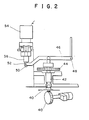
- a trimming disk 40 is secured to an end of a shaft 42 so that it may be rotated by way of a gear 44 mounted on the other end of the shaft 42.
- the trimming disk 40 is vertically positioned by a link 46 which is in turn positioned by moving either one of fulcra 48 and 50.
- a nut 52 is secured at the fulcrum 50, and a threaded portion of a rotary shaft 56 of a motor 54 is screwed in the nut 52.
- the motor 54 can rotate in opposite directions, and as the motor 54 is rotated in a forward or reverse direction, the link 46 is moved up or down relative to the fulcrum 48 to move up or down the disk 40.
- a thickness of a layer of shredded tobacco which passes this station is varied in response to up or down movement of the disk 40.
- radio rays emitted from a radio ray source 60 for example, beta rays emitted from strontium 90, pass through a bar-like cigarette 62 and are thrown into an ion box 64. If the density of content tobacco of the cigarette 62 is then high, the number of radio rays received by the ion box is reduced so that an ionization current produced by the ion box 64 is reduced. Meanwhile, radio rays emitted from another radio ray source 66 are passed through a standard density body 68 and is thrown into another ion box 70 which thus produces a standard ionization current.
- a radio ray source 60 for example, beta rays emitted from strontium 90
- ionization currents of opposite polarity are generated at the ion boxes 64 and 70. Accordingly, if the density of content tobacco of a bar-like cigarette 62 to be measured is equal to that of a standard one, an output of an amplifier 72 is zero. Meanwhile, if the density of the bar-like cigarette 62 is higher than the standard density, an ionization current produced at the ion box 64 is lower in an absolute value than an ionization current produced at the ion box 70, and hence an electric current flows through a high resistor 74 so that the amplifier 72 provides a negative output therefrom. On the contrary, if the density of the bar-like cigarette 62 is lower than the standard density, the amplifier provides a positive output.
- An averaging circuit 76 for averaging the output of the amplifier 72 includes an amplifier 76a and a negative feedback circuit therefore including a resistor 76b and a capacitor 76c connected in parallel to the resistor 76b.
- Motor driving circuits 78 and 80 are connected to the motor 54, and when a signal averaged by the averaging circuit 76 is lower than a predetermined level, the driving circuit 78 drives the motor 54 to rotate in a direction to lower the disk 40 so as to raise the density of the bar-like cigarette 62, and on the contrary when the density is higher and the averaged signal is lower than another predetermined level, the driving circuit 80 drives the motor 54 to rotate in a direction to life the disk 40 so as to lower the density of the bar-like cigarette 40. In this way, the density of bar-like cigarettes is adjusted to be maintained constant.
- Each of the motor driving circuits 78 and 80 includes a comparator 78a or 80a and a driver transistor 78b or 80b.
- upward or downward of the trimmer disk 40 is attained by forward or reverse rotation of the motor 54 in response to a result of determination whether an average in density over the length of a bar-like cigarette corresponding up to 50 cut cigarettes is higher or lower than a desired or aimed value. Accordingly, a desired responding speed cannot always be attained by the system.
- the proposed controlling device includes means for irradiating radio rays onto tobacco fed into a cigarette making machine and for measuring an amount of radio rays passing through the tobacco to detect a density of the tobacco and convert the same into a corresponding electric signal, trimming means including a trimming disk for removing an excessive amount of shredded tobacco fed on a conveyor belt to adjust a cross sectional size of content tobacco, a piston means operated to move back and forth by pressure fluid from a pressure fluid distributor for moving the trimming disk up and down, and an electric hydraulic servo mechanism responsive to an electric signal from the means for outputting an electric signal proportional to an amount of radio rays passing through tobacco for operating the liquid pressure distributor, the electric signal having a negative feedback thereto of a vertical displacement of the trimming disk via a differential transformer.
- the proposed controlling device is improved particularly in the responding speed comparing with a device of the type including a motor to effect required controlling as described above.
- a ratio between a deviation of an average amount of content tobacco of cigarettes when controlled and a deviation of an average amount of content tobacco of cigarettes when not controlled which ratio is regarded as an aim of an amount controlling performance, is 1/1.5 with the device using a motor while it is 1/4 with the last described device, providing particular improvement in the performance.
- the last mentioned Japanese laid-open patent application further proposes a device comprising trimming means including a trimming disk for removing an excessive amount of shredded tobacco fed on a conveyor band to adjust a cross sectional size of content tobacco, compressing means located adjacent the trimming disk for compressing shredded tobacco fed thereto against the conveyor band to remove a gap between the shredded tobacco and the conveyor band, means for irradiating radio rays to a portion of the shredded tobacco positioned between the compressing means and the conveyor band and for measuring an amount of radio rays passing through the tobacco to detect the density of the shredded tobacco and convert the same into a corresponding electric signal, a piston means operated to move back and forth by pressure liquid from a pressure liquid distributor for moving the trimming disk up and down, and an electric hydraulic servo mechanism responsive to an electric signal from the means for outputting an electric signal proportional to an amount of radio rays passing through tobacco for operating the liquid pressure distributor, the electric signal having a negative feedback thereto of a vertical displacement of the trimming disk via a differential transformer.
- the device of the proposal has a few drawbacks, too.
- the radio ray density detector is installed in the neighborhood of a trimming device 14 (Fig. 1) in order to effect controlling of an amount of content tobacco of cigarettes, a slight difference appears between a signal from the density detector and another signal from a radio ray density detector 24 (Fig. 1) for measuring after cigarette rods are formed.
- the difference is 0.5 to 1% or so, but it cannot be ignored at present days in which management of content tobacco of higher accuracy is required.
- a signal obtained by measurement by the radio ray density detector before cigarette rods are formed contains a component caused by an amount of shredded tobacco which has passed out of holes of a perforated cigarette conveyor on the bottom of a suction chamber 12 (Fig. 1) before the shredded tobacco is wrapped into wrapping paper after the measurement by the radio ray density detector, and such an amount of shredded tobacco escaped causes a difference of the density when measured after cigarette rods are formed.
- a most desirable content tobacco amount controlling device is such that a responding speed of control is the same as that in a device wherein a radio ray density detector is located directly behind a trimming disk while an aimed value of control is associated with a measured value by a radio ray density detector after cigarette rods are formed.
- the present invention has been made to eliminate such drawbacks of the conventional content tobacco amount controlling devices, and it is an object of the invention to provide a content tobacco amount controlling device for a cigarette making machine wherein a responding speed in controlling an amount of content tobacco of cigarettes is as high as that where a radio ray density detector is installed within a suction chamber directly behind trimming means and an aimed value of control is controlled in accordance with a measure value after a bar-like cigarette is formed so that the aimed value of cigarettes produced may always be maintained properly during production of cigarettes by a cigarette making machine.
- a content tobacco amount controlling device comprises a first radio ray density detecting means for irradiating radio rays to tobacco on a cigarette conveyor directly after the tobacco has been trimmed by a trimming device and for measuring an amount of radio rays passing through the tobacco to output an electric signal representative of a difference between a measured density of the tobacco and a reference density, a second radio ray density detecting means for irradiating radio rays to a bar-like cigarette made by a tobacco wrapping means and for measuring an amount of radio rays passing through the bar-like cigarette to output an electric signal representative of a difference between a measured density of the bar-like cigarette and a reference density, a first integrating means for integrating an electric signal from the second radio ray density detecting means, an adding means for adding an output of the first integrating means to an output of the first radio ray density detecting means, and a second integrating means for integrating an output of the adding means, the trimming device being
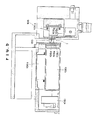
- Pig. 8 is a perspective view showing details of a different portion of the machine of Fig. 4.
- shredded tobacco is attracted into and moved-up within a chimney 100 and is then attracted into a layer on a bottom face of a perforated cigarette conveyor located at the bottom of a suction chamber 102.
- the shredded tobacco thus layered is carried in a leftward direction in Fig. 4 and is adjusted into a layer of a suitable thickness by means of a trimming device 104.
- the shredded tobacco of the adjusted layer thickness is measured for density by a first radio ray density detector 106 located directly behind the trimming device 104 and is then transferred onto wrapping paper supplied from a wrapping paper roll and placed on a cloth tape 106 whereafter it is wrapped into the wrapping paper which is then pasted by means of a pasting device 112.
- the pasted portion of the wrapping paper is dried to form a bar-like cigarette by a heater 114.
- the bar-like cigarette thus formed is passed through a second radio ray density detector 116 to measure the density of content tobacco and is then cut into separate cigarettes by a cutter 118.
- the separately cut cigarettes are transferred onto and transported by a conveyor not shown in a similar manner as in case of the cigarette making machine shown in Fig. 1. Finally, the cigarettes are loaded onto a tray.
- Fig. 5 illustrates a structure of the first radio ray density detector 106.
- the first radio ray density detector 106 includes a radio ray source 106a for emitting radio rays, and an ion box 106b for receiving radio rays from the radio ray source 106a.
- the radio ray source 106a and the ion box 106b are disposed in opposing relationship through window holes 106c and 106d perforated in respective casings which are located in a spaced relationship by a predetermined distance.
- Metal films lo6e and 106f preferably made of titanium foil extend across the window holes 106c and 106d, respectively, and a channel through which shredded tobacco T on the perforated cigarette conveyor 103 passes after trimming is formed between the metal films 106e and 106f.
- a shutter 106g is located between the radio ray source 106a and the window hole 106c for preventing radio rays from inadvertently escaping externally therefrom when radio rays are not required.
- radio rays from the radio ray source 106a pass, when the shutter 106g is open, through the metal film 106e in the window hole 106c and then through the shredded tobacco in the form of a layer and is then received by the ion box 106b via the metal film 106f in the window opening 106d.
- a high voltage is applied to an outer periphery of the ion box 106b from a high voltage power source 106h so that when the density of the shredded tobacco T is relatively high, a small electric current is supplied to an amplifier 1061, and on the contrary when the density of the shredded tobacco T is relatively low, a large electric current is supplied to the amplifier 106i. Accordingly, at an output of the amplifier 106i, a signal is obtained which represents the density of the layered shredded tobacco before it is wrapped into wrapping paper.
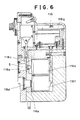
- Fig. 6 illustrates a structure of the second radio ray density detector 116.
- a detector of the type is already employed in most cigarette making machines. Radio rays emitted from the radio ray source 116a pass through a bar-like cigarette S and is received by the ion box 116b. When the density of the bar-like cigarette 5 is relatively high, an amount of radio rays passing through the cigarette S and received by the ion box 116b decreases so that an ionization current produced by the ion box 116b is reduced, and on the contrary when the density of the cigarette S is relatively low, an amount of radio rays received by the ion box ll6b increases so that an ionization current is also increased.
- a shutter 116c is provided for opening and closing operation between the radio ray source 116a and the cigarette S.
- Another radio ray source 116d is located adjacent the radio ray source 116a such that radio rays from the radio ray source 116d may pass through a reference or standard density body 116e and be received by an ion box 116f so that a reference ionization current may be produced by the ion box 116f.
- a negative voltage is applied to the ion box 116b while a positive voltage is applied to the ion box 116f.
- an amplifier 116g to which ionization currents are applied from the ion boxes 116b and 116f provides an output of the zero level
- the amplifier 116g provides a negative or positive output, respectively. Accordingly, at the output of the amplifier 116g, a signal is obtained which has a magnitude corresponding to a deviation of the density of the bar-like cigarette S from the reference density.
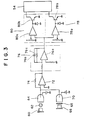
- Fig. 7 illustrates a controlling circuit for the device according to the present invention, and in this figure, like parts or components are designated by like reference numerals to those of Figs. 4 to 6.
- shredded tobacco T is attracted into and moved up within the chimney 100 and is then attracted into a layer on a bottom face of the perforated cigarette conveyor 103 located at the bottom of a suction chamber 102.
- the shredded tobacco thus layered is carried in a leftward direction in Fig. 4 and an excessive amount of the shredded tobacco is cut off or removed by means of a trimming disk 104a of the trimming device 104.
- the shredded tobacco is carried to the first radio ray density detector 106 as shown in a dotted line, and the density is measured thereat.
- radio rays emitted from the radio ray source 106a pass through the tobacco T and are received by the ion box 106b. Since a high voltage is applied to the ion box 106b, a weak ionization current is produced at an output of the ion box 106b. The weak current is amplified by the amplifier 106i and is then added to a reference signal from the reference voltage generator 100 and amplified by another amplifier 202.
- a signal produced at an output of the amplifier 202 is thus a voltage signal having a polarity and a magnitude corresponding to a deviation of a measured density from the reference density.
- the shredded tobacco T is wrapped into wrapping paper and then pasted and fromed into a bar-like cigarette.
- the shredded tobacco in the form of a bar-like cigarette S is advanced to the second radio ray density detector 116.
- radio rays emitted from the radio ray source 116a pass through a bar-like cigarette S and are received by the ion box 106b. Meanwhile, radio rays emitted from the other radio ray source 116d pass through the reference density body 116e and are received by the ion box 106f. Since voltages of opposite polarities are applied to the ion boxes 106b and 106f, a voltage signal having a polarity and a magnitude corresponding to a deviation of a measured density of the bar-like cigarette S from the reference density is produced at the output cf the amplifier 116g. An output of the amplifier 116g is amplified by an amplifier 204.
- a deviation of the density of the bar-like cigarette S appears at the output of the amplifier 204 while a deviation of the density of the shredded tobacco T in the form of a layer appears at the output of the amplifier 202.
- the two outputs must essentially be identical with each other, actually seme error appears between them since fine shreds are sucked into the suction chamber 102 through the holes formed in the perforated cigarette conveyor 103 even after the shredded tobacco T has left the first density detector 106 as hereinafter described.
- the output of the amplifier 204 is inputted to another amplifier 208 to which an output of the amplifier 202 inverted by a further amplifier 206 is inputted in order to obtain a difference between the outputs of the amplifiers 204 and 202.
- a signal is obtained which is proportional to a difference between the output of the first radio ray density detector 106 and the output of the second radio ray density detector 116.
- comparators 214 and 216 When the output signal of the amplifier 208 is a value between two voltage values provided by voltage generators 210 and 212 t comparators 214 and 216 both provide a low level output, and when the signal is otherwise not between the vcltage values, either one of the outputs of the comparators 214 and 216 presents a high level so that a signal of a high level appears at an output 220 of an OR gate 218.
- the output signal of the high level of the OR gate 218 indicates that there is an extraordinary difference appearing between two measured values of the two radio ray density detectors.
- the machine can be stopped or such an emergency can be indicated using such a signal of the OR gate 218. Accordingly, an amount of content tobacco can be assured for all of cigarettes produced, and appearance of a most dishonorable situation to cigarette produces that rejected products caused by a trouble should be shipped can be prevented beforehand.
- the output of the amplifier 202 which outputs a measured value of the first radio ray density detector 106 is applied as a first signal to an adder 226 while the output of the amplifier 204 which outputs a measured value of the second radio ray density detector 116 is integrated by an integrator 222 and then adjusted for a gain by an amplifier 224 and is thus applied as a second signal to the adder 226 so that the first and second signals may be added to each other by the adder 226.
- An output of the adder 226 is integrated by an integrator 228 and amplified by an amplifier 230 and is then inputted to an electric hydraulic servo, valve 232.
- the electric hydraulic servo valve 232 supplies, in accordance with a voltage supplied thereto, a flow of oil generated by a gear pump 234 alternatively to an upper or lower section -of a cylinder 236 to move a piston 238 up or down within the cylinder 236. Up or down movement of the piston 238 is transmitted via a link 240, a shaft 242, another link 244 and a connecting rod 246 to move the trimming disk 104a of the trimming device 104.
- the position of the trimming disk 104a is detected by a differential transformer 248.
- a signal of several kHz generated by an oscillator 250 is applied to the differential transformer 248, and a piston 238 is connected to a central core of the differential transformer 248 by way of a shaft 242 and a link 240. Accordingly, a signal appears at an output of the differential transformer 248 in response to up or down movement of the piston 238, and the signal is amplified by an amplifier 252.
- An output of the amplifier 252 is grounded at half wave portions thereof by a switch 254 which is operated by the output signal of the oscillator 250 while only the other half wave portions of the output of the amplifier 252 are smoothed by a low-pass filter 256 and are DC amplified by an amplifier 258.
- An output of the amplifier 258 is applied as a third input signal to the adder 226.
- the trimming disk 104a is lowered until the third signal becomes equal to a sum of the first and second signals.
- the device operates in the reverse polarities to those of the case described just above.
- the speed of such operation can be adjusted by changing the speed of integration by the integrator 228, and the extent of such operation can be adjusted by changing the gain of the amplifier 230.
- the second signal that is, a signal associated with the radio ray density detector 116
- the first signal that is, a signal associated with the radio ray density detector 106
- the second signal is integrated and becomes larger until finally it has a magnitude prevailing over the first signal although the first signal may prevail over the second signal within a short period of time. Therefore, an amount of content tobacco of cigarettes is determined and controlled by the first signal for fluctuations of a short period while it is determined and controlled by the second signal for fluctuations of a long period.
- Fig. 8 which illustrates details of the driving device for driving the trimming disk 104a
- the piston 238 is mounted for sliding up and down movement within the piston cylinder 236 which is secured to an outer casing, and when oil pressure is introduced into a cylinder chamber 236a through a pipe 300, the piston 238 is pushed down thereby while oil within another cylinder chamber 236b on the opposite side relative to the piston 238 is discharged into a tank passing a pipe 302 and then a return pipe 304.
- a filter 308 is provided at an exit of the return pipe 304.
- the hydraulic pressure is maintained constant in the hydraulic system.
- a relief pipe 314 is operated via a pipe 312 branched from an intermediate portion of a pipe 310 extending from the gear pump 234 to the electric hydraulic servo valve 232 so that pressure oil is discharged into the tank through the return pipe 316 and the filter 308.
- Oil pressure within the hydraulic system is set or determined by adjusting a pressure adjusting screw 318.
- Up and down movement of the piston 238 is taken out by means of a connecting rod 320 pivotally connected to the piston 238.
- the other end of the connecting rod 320 is pivotally supported on the link 240 so that up and down movement of the piston 238 will pivotally rock the link 240 together with the shaft 242.
- the link 240 is fixedly mounted on the shaft 242 which is supported for rotation on the outer casing 306. Pivotal rocking motion transmitted to the shaft 242 will move, by way of the link 244 securely mounted on an end of the shaft 242, the connecting shaft 246 pivotally supported at the other end of the link 244 vertically up and down.
- the trimming disk 104a is moved up and down by up and down movement of the connecting shaft 246.
- a link 330 is securely mounted at the other end of the shaft 242 so that pivotal motion of the shaft 242 will pivotally rock the link 330.
- Another link 332 is mounted on the link 330 so that pivotal rocking motion of the link 330 will move the link 332 up and down.
- the central core of the differential transformer 248 is secured to the link 332 so that the core may be moved by up and down movement of the link 332.
- the differential transformer 248 is constituted such that when the core moves up, it produces a positive voltage in proportion, for example, to a distance of travel of the core, and on the contrary when the core moves down, it produces a negative voltage.
- a positive voltage is generated by the differential transformer 248 when the connecting shaft 246 is mcved upwardly and on the contrary when the connecting shaft 246 is moved downwardly, a negative voltage is generated by the differential transformer 248.
- a motor 336 is connected to the gear pump 234 by way of a universal coupling 338.
- control of an amount of content tobacco can be attained wherein a responding speed of control of an amount of content tobacco of cigarettes is quick since a measured value directly behind a trimming device is used and accuracy of control is high since another measured value directly after formation of cigarettes is used.
- an examination is made of a ratio between a deviation of an average amount of content tobacco of cigarettes when controlled and a deviation of an average amount of content tobacco of cigarettes when not controlled, which ratio is regarded as an aim for judging merits and demerits of a control. While the ratio is 1/1.5 to 1/4 with a conventional cigarette making machine having a capacity to produce 4,000 cigarettes per minute, where a device according to the present invention is employed, the ratio becomes a good value of 1/8. This is apparent from the fact that a device according to the present invention has such a high speed that, for example, when an amount of content tobacco varies by 2 percent, correction will require only 200 milliseconds while correction in a conventional device requires 5 to 1 minute.
Landscapes
- Health & Medical Sciences (AREA)
- General Health & Medical Sciences (AREA)
- Physics & Mathematics (AREA)
- Life Sciences & Earth Sciences (AREA)
- Chemical & Material Sciences (AREA)
- Analytical Chemistry (AREA)
- Biochemistry (AREA)
- General Physics & Mathematics (AREA)
- Immunology (AREA)
- Pathology (AREA)
- Toxicology (AREA)
- Manufacturing Of Cigar And Cigarette Tobacco (AREA)
Applications Claiming Priority (2)
| Application Number | Priority Date | Filing Date | Title |
|---|---|---|---|
| JP59090256A JPS60234574A (ja) | 1984-05-08 | 1984-05-08 | シガレツト製造機における中味たばこ量制御装置 |
| JP90256/84 | 1984-05-08 |
Publications (2)
| Publication Number | Publication Date |
|---|---|
| EP0160799A2 true EP0160799A2 (de) | 1985-11-13 |
| EP0160799A3 EP0160799A3 (de) | 1988-05-04 |
Family
ID=13993411
Family Applications (1)
| Application Number | Title | Priority Date | Filing Date |
|---|---|---|---|
| EP85102174A Withdrawn EP0160799A3 (de) | 1984-05-08 | 1985-02-27 | Vorrichtung zur Kontrolle der Menge des Tabakfüllgutes in einer Zigarettenherstellungsmaschine |
Country Status (3)
| Country | Link |
|---|---|
| US (1) | US4766910A (de) |
| EP (1) | EP0160799A3 (de) |
| JP (1) | JPS60234574A (de) |
Cited By (3)
| Publication number | Priority date | Publication date | Assignee | Title |
|---|---|---|---|---|
| EP0268124A1 (de) * | 1986-10-31 | 1988-05-25 | Japan Tobacco Inc. | Vorrichtung zur Kontrolle des Tabakfüllguts in einer Zigarettenherstellungsmaschine |
| EP0339250A1 (de) * | 1988-04-28 | 1989-11-02 | Japan Tobacco Inc. | Vorrichtung zur Kontrolle des Tabakfüllguts in einer Zigarettenherstellungsmaschine |
| US6062226A (en) * | 1996-06-13 | 2000-05-16 | Japan Tobacco Inc. | Cigarette manufacturing apparatus |
Families Citing this family (5)
| Publication number | Priority date | Publication date | Assignee | Title |
|---|---|---|---|---|
| DE3711142A1 (de) * | 1987-04-02 | 1988-10-20 | Bat Cigarettenfab Gmbh | Verfahren zur automatischen kalibrierung von mindestens einer regelgroesse der physikalischen eigenschaften eines materialstrangs fuer die herstellung von rauchbaren artikeln |
| US4942363A (en) * | 1989-04-25 | 1990-07-17 | Philip Morris Incorporated | Apparatus and method for measuring two properties of an object using scattered electromagnetic radiation |
| US5010904A (en) * | 1989-12-21 | 1991-04-30 | R. J. Reynolds Tobacco Company | Method and apparatus for detecting loose ends of cigarettes |
| DE60032150T2 (de) * | 1999-08-24 | 2007-09-27 | Glycozym Aps | Udp-n-acetylglucosamin: galaktose-beta 1,3-n-acetylgalaktosamin-alpha-r/(glcnac -galnac) beta 1,6-n-acetylglucosaminyltransferase, c2gnt3 |
| ITBO20030130A1 (it) * | 2003-03-10 | 2004-09-11 | Gd Spa | Metodo di controllo di una macchina automatica per la lavorazione |
Family Cites Families (8)
| Publication number | Priority date | Publication date | Assignee | Title |
|---|---|---|---|---|
| FR1167113A (fr) * | 1957-01-11 | 1958-11-20 | Decoufle Usines | Perfectionnement aux machines à confectionner des cigarettes |
| GB945839A (en) * | 1959-07-18 | 1964-01-08 | Korber Kurt | Method and apparatus for producing a continuous tobacco rod |
| JPS5195198A (en) * | 1975-02-10 | 1976-08-20 | Shigaretsutoseizoki ni okeru nakamitabakoryo no seigyosochi | |
| DE2545416C2 (de) * | 1975-10-10 | 1985-09-19 | Hauni-Werke Körber & Co KG, 2050 Hamburg | Verfahren und Vorrichtung zum Bilden eines Zigarettenstranges |
| DE2635391C2 (de) * | 1976-08-06 | 1987-04-09 | Hauni-Werke Körber & Co KG, 2050 Hamburg | Vorrichtung zum Bilden eines Zigarettenstranges |
| DE2800748A1 (de) * | 1978-01-09 | 1979-07-12 | Hauni Werke Koerber & Co Kg | Verfahren und vorrichtung zum bilden eines stranges aus fasern aus tabak oder aus einem anderen rauchfaehigen material |
| US4474190A (en) * | 1981-03-21 | 1984-10-02 | Hauni-Werke Korber & Co. Kg | Method and apparatus for regulating the operation of machines for the production of cigarettes or the like |
| US4595027A (en) * | 1984-05-08 | 1986-06-17 | Philip Morris Incorporated | Rod weight control for a cigarette making machine |
-
1984
- 1984-05-08 JP JP59090256A patent/JPS60234574A/ja active Granted
-
1985
- 1985-02-26 US US06/705,877 patent/US4766910A/en not_active Expired - Fee Related
- 1985-02-27 EP EP85102174A patent/EP0160799A3/de not_active Withdrawn
Cited By (3)
| Publication number | Priority date | Publication date | Assignee | Title |
|---|---|---|---|---|
| EP0268124A1 (de) * | 1986-10-31 | 1988-05-25 | Japan Tobacco Inc. | Vorrichtung zur Kontrolle des Tabakfüllguts in einer Zigarettenherstellungsmaschine |
| EP0339250A1 (de) * | 1988-04-28 | 1989-11-02 | Japan Tobacco Inc. | Vorrichtung zur Kontrolle des Tabakfüllguts in einer Zigarettenherstellungsmaschine |
| US6062226A (en) * | 1996-06-13 | 2000-05-16 | Japan Tobacco Inc. | Cigarette manufacturing apparatus |
Also Published As
| Publication number | Publication date |
|---|---|
| JPS60234574A (ja) | 1985-11-21 |
| EP0160799A3 (de) | 1988-05-04 |
| US4766910A (en) | 1988-08-30 |
| JPH0131872B2 (de) | 1989-06-28 |
Similar Documents
| Publication | Publication Date | Title |
|---|---|---|
| US4766910A (en) | Content tobacco amount controlling device for a cigarette making machine | |
| US4836221A (en) | Device for controlling contents of tobacco on cigarette manufacturing machine | |
| US4190061A (en) | Method and apparatus for producing a rod-like tobacco filler | |
| US4063563A (en) | Method and apparatus for building a tobacco filler | |
| US4595027A (en) | Rod weight control for a cigarette making machine | |
| US4037608A (en) | Method and apparatus for producing cigarettes with dense ends | |
| US4251925A (en) | Apparatus for drying tobacco | |
| JPH04277137A (ja) | ばら積材料の供給方法とこの方法を実施するための装置 | |
| US2815759A (en) | Machines for manipulating cut tobacco | |
| US4638817A (en) | Device for controlling contents of tobacco on cigarette machine | |
| US4875494A (en) | Method of and apparatus for making a rod of fibrous material | |
| EP0202874A1 (de) | Zigarettenherstellungsmaschinen | |
| US4771794A (en) | Method and apparatus for controlling at least two physical properties, decisive for the quality of the finished product, of a rod made of smokable material | |
| EP0339250B1 (de) | Vorrichtung zur Kontrolle des Tabakfüllguts in einer Zigarettenherstellungsmaschine | |
| EP0371066A1 (de) | Regelung der herstellung raffinierter pulpe. | |
| US4697603A (en) | Apparatus for building a stream of fibrous material | |
| JPS5875218A (ja) | 供給管中を風送されるばら材料の配量法 | |
| US5318796A (en) | Method for variably controlling the speed of a slave drive roller in a web coating machine | |
| US3052242A (en) | Control system | |
| US4030511A (en) | Control system for cigarette producing and processing machines or the like | |
| US4920987A (en) | Device for controlling the content of tobacco on a cigarette manufacturing machine | |
| US4024394A (en) | Method and apparatus for measuring and regulating the density of rod-like fillers consisting of tobacco or the like | |
| GB1603718A (en) | Tobacco shredding apparatus | |
| DE3440251A1 (de) | Verfahren und anordnung zum steuern der trocknung von tabak | |
| US3736942A (en) | Apparatus for comminuting and drying of tabacco leaves |
Legal Events
| Date | Code | Title | Description |
|---|---|---|---|
| PUAI | Public reference made under article 153(3) epc to a published international application that has entered the european phase |
Free format text: ORIGINAL CODE: 0009012 |
|
| AK | Designated contracting states |
Designated state(s): DE GB IT |
|
| RAP1 | Party data changed (applicant data changed or rights of an application transferred) |
Owner name: JAPAN TOBACCO INC. |
|
| PUAL | Search report despatched |
Free format text: ORIGINAL CODE: 0009013 |
|
| AK | Designated contracting states |
Kind code of ref document: A3 Designated state(s): DE GB IT |
|
| 17P | Request for examination filed |
Effective date: 19880426 |
|
| 17Q | First examination report despatched |
Effective date: 19900215 |
|
| STAA | Information on the status of an ep patent application or granted ep patent |
Free format text: STATUS: THE APPLICATION HAS BEEN WITHDRAWN |
|
| 18W | Application withdrawn |
Withdrawal date: 19910514 |
|
| R18W | Application withdrawn (corrected) |
Effective date: 19910514 |
|
| RIN1 | Information on inventor provided before grant (corrected) |
Inventor name: OKUMOTO, YUTAKA |