EP0160833B1 - Carte d'identification individuelle - Google Patents
Carte d'identification individuelle Download PDFInfo
- Publication number
- EP0160833B1 EP0160833B1 EP85103963A EP85103963A EP0160833B1 EP 0160833 B1 EP0160833 B1 EP 0160833B1 EP 85103963 A EP85103963 A EP 85103963A EP 85103963 A EP85103963 A EP 85103963A EP 0160833 B1 EP0160833 B1 EP 0160833B1
- Authority
- EP
- European Patent Office
- Prior art keywords
- data
- erroneous
- card
- secret code
- memory
- Prior art date
- Legal status (The legal status is an assumption and is not a legal conclusion. Google has not performed a legal analysis and makes no representation as to the accuracy of the status listed.)
- Expired
Links
Images
Classifications
-
- G—PHYSICS
- G07—CHECKING-DEVICES
- G07F—COIN-FREED OR LIKE APPARATUS
- G07F7/00—Mechanisms actuated by objects other than coins to free or to actuate vending, hiring, coin or paper currency dispensing or refunding apparatus
- G07F7/08—Mechanisms actuated by objects other than coins to free or to actuate vending, hiring, coin or paper currency dispensing or refunding apparatus by coded identity card or credit card or other personal identification means
- G07F7/10—Mechanisms actuated by objects other than coins to free or to actuate vending, hiring, coin or paper currency dispensing or refunding apparatus by coded identity card or credit card or other personal identification means together with a coded signal, e.g. in the form of personal identification information, like personal identification number [PIN] or biometric data
- G07F7/1008—Active credit-cards provided with means to personalise their use, e.g. with PIN-introduction/comparison system
-
- G—PHYSICS
- G06—COMPUTING OR CALCULATING; COUNTING
- G06Q—INFORMATION AND COMMUNICATION TECHNOLOGY [ICT] SPECIALLY ADAPTED FOR ADMINISTRATIVE, COMMERCIAL, FINANCIAL, MANAGERIAL OR SUPERVISORY PURPOSES; SYSTEMS OR METHODS SPECIALLY ADAPTED FOR ADMINISTRATIVE, COMMERCIAL, FINANCIAL, MANAGERIAL OR SUPERVISORY PURPOSES, NOT OTHERWISE PROVIDED FOR
- G06Q20/00—Payment architectures, schemes or protocols
- G06Q20/30—Payment architectures, schemes or protocols characterised by the use of specific devices or networks
- G06Q20/34—Payment architectures, schemes or protocols characterised by the use of specific devices or networks using cards, e.g. integrated circuit [IC] cards or magnetic cards
- G06Q20/341—Active cards, i.e. cards including their own processing means, e.g. including an IC or chip
-
- G—PHYSICS
- G07—CHECKING-DEVICES
- G07F—COIN-FREED OR LIKE APPARATUS
- G07F7/00—Mechanisms actuated by objects other than coins to free or to actuate vending, hiring, coin or paper currency dispensing or refunding apparatus
- G07F7/08—Mechanisms actuated by objects other than coins to free or to actuate vending, hiring, coin or paper currency dispensing or refunding apparatus by coded identity card or credit card or other personal identification means
- G07F7/10—Mechanisms actuated by objects other than coins to free or to actuate vending, hiring, coin or paper currency dispensing or refunding apparatus by coded identity card or credit card or other personal identification means together with a coded signal, e.g. in the form of personal identification information, like personal identification number [PIN] or biometric data
- G07F7/1025—Identification of user by a PIN code
- G07F7/1083—Counting of PIN attempts
Definitions
- the present invention relates to a discrimination card for being carried by a person, for confirming or identifying the bearer by means of a secret code assigned to the bearer, which includes a memory for memorizing the number of erroneous inputs of the secret code and a judging means for judging whether or not inputted secret code data is erroneous and is constructed so as to render the card useless if erroneous inputs take place for a prescribed number of times.
- a discrimination card is known from FR-A-2 471 000.
- the memory has a two-bit pattern, with a first bit (first data) representing an erroneous input and a second bit (second data) representing a successful input. Based on the stored data, the number of erroneous data inputs is determined.
- This method of arranging the memory means has the disadvantage that all inputs have to be stored, thus increasing the size of memory store required.
- Japanese Patent Publication No. 57-29498 a card with a system by which the processing apparatus in the card detects the frequency of successive erroneous inputs by specially arranging for memorizing a successful operation subsequent to an erroneous input operation, to judge whether the number of successive erroneous inputs is less than a prescribed member.
- the above system has a defect in that it requires a special memory for memorizing a successful operation subsequent to an erroneous input operation.
- An object of the present invention is to provide an individual discrimination card which is capable of detecting an illicit use by means of a smaller number of memories.
- Another object of the present invention is to provide an individual discrimination card which is capable of memorizing the cumulative total or frequency of erroneous inputs and the total number or frequency of successive erroneous inputs up to the present time, by means of a . smaller number of memories.
- Another object of the present invention is to provide an individual discrimination card which does not require a special memory for memorizing a successful operation subsequent to an erroneous input operation.
- the memorized data consists of only first data and second data, said first and second data being represented by 2-bit patterns, where the first data is a pattern in which a bit of two unused bits is rewritten, while the second data is a pattern in which the bit in the first data, that has not been rewritten, is rewritten, the total number of erroneous inputs of the secret code data being indicated by the location in the memory means of the latest first data, and the number of successive erroneous inputs of the secret code data being indicated by the location of the latest first data minus the location of the latest second data, all of the first data being rewritten to the second data in said memory means when the inputted secret code data is legitimate, and the card being rendered useless when the number of successive erroneous inputs exceeds a predetermined number.
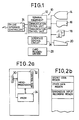
- the terminal equipment 12 includes 16-bit microcomputers, a color display 14, a printer 16, a floppy disk unit 18, and a keyboard 20.
- the main body of the terminal equipment 12 is equipped further with a 2-channel communication control unit 22, where one channel is connected via an on-line interface controller 24 to the communication circuit, while the other is connected via an interface control circuit 26 to a card reader/writer 28.
- the terminal equipment 12 Upon inputting necessary secret code data through the keyboard 20, after a user inserted his card into the card reader/writer 28, the terminal equipment 12 is connected through the on-line interface controller 24 and the communication circuit to an on-line system of a bank or the like, enabling the user to exchange desired information.
- Figure 2a shows a card embodying the present invention to be inserted to the reader/writer 28.
- the card includes a connection unit 30 for receiving transmitting signals from to the card reader/ writer 28, a microprocessor 32 which has a built-in control program, and a memory unit 34 consisting, for example, of an 8k byte PROM or EPROM.
- the main functions of the microprocessor 32 are the collation of the secret code data and the control on the recording of the data on the erroneous inputs in the memory unit 34.
- Figure 2b is for illustrating the memory content of the memory unit 34 which includes a secret code region for memorizing the secret code data proper to the user, a region for other data for memorizing data necessary for information exchange with other host systems, and an erroneous input recording region for memorizing the information regarding the erroneous inputtings of the secret code data that have been done so far to the card.
- a message "Insert the card” will be displayed on the display 14.
- the reader/writer 28 takes in the card to the inside, supplies the card with a power via the connection unit 30, and enables the transmission and reception of the necessary data.
- the microprocessor 32 in the card is initialized.
- the terminal equipment displays a message "Key in the secret code” on the display 14. With this the user inputs his secret code data through the keyboard 20.
- the terminal equipment 10 Upon completion of inputting of the secret code data, the terminal equipment 10 supplies, together with a secret code collation command, the input secret code data to the microprocessor 32.
- the microprocessor 32 collates the secret code data which has been memorized in advance in the secret code region of the memory unit 34 with the secret code data supplied by the input through the keyboard 20. If the input was judged erroneous, the result of the collation is forwarded to the terminal equipment 10 through the reader/ writer 28 and the control circuit 26. On the other hand, if it is judged that correct secret code data is inputted, the microprocessor 32 reads necessary data from the region for other data to start required processing.
- the terminal equipment permits input for a second time of a secret code, but in the case of a terminating (second) erroneous input, the terminal equipment issues a card discharge command to the card reader/writer 28 to discharge the card, so that the card is now ineffective.
- an erroneous input recording region for indicating the situation of erroneous inputs which took place in the past, in order to prevent an illicit use of the card.
- the recording is carried out in the following manner to reduce the number of memories required.
- a PROM or an EPROM is employed so as to make return to a state of "1" for another time after it was changed once to a state of "0", either to be impossible (at least by the use of the reader/writer 28 alone) or to require a separate special writer.
- a change from "1" to "0” requires ordinarily a special voltage for writing so that it also is desirable to supply the writing voltage from the reader/writer 28 to the memory unit 34 through the connection unit 30.
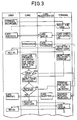
- the erroneous input recording region in this embodiment includes of two parts, i.e. an upper memory 36 and a lower memory 38, as shown by Fig. 4, in which a "1" state of the erroneous input is represented by a pattern of two corresponding bits.
- the traces of the erroneous input up to now are represented, for example, by the two kinds of 2-bit patterns (g) and (0), whereas it is ( ⁇ ) for an unused portion.
- the used bit number is recorded so as not to exceed twice the cumulative frequency or total of erroneous inputs.
- a secret code data input is erroneous
- a set of ( ⁇ ) which has so far remained as an unused bit is changed to an erroneous input pattern (10).
- an erroneous input pattern (°) in the erroneous input recording region is changed to another erroneous input pattern (g).
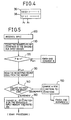
- Fig. 5 is shown a flow diagram for such a collation operation by the microprocessor 32.
- step 100 the microprocessor 32 is waiting for the supply of a secret code data input from the keyboard 20 through the connection unit 30 and a secret code collation command.
- the microprocessor 32 executes the routine for checking the successive erroneous inputs kept in the control ROM (steps 110 and 120). In this routine, determination is made first of the number P of the erroneous input (?) in which the upper and lower numbers of the erroneous input recording region are "0" and "1", respectively.
- P the number of times in which erroneous inputs were made in a row, up to the present time
- n the prescribed number
- the microprocessor 32 reads the secret code data which has been registered in advance in the secret code region of the memory unit 34 (step 130), and checks whether it coincides with the input secret code data which was supplied via the connection unit 30 and is being held there (step 140).
- the microprocessor 32 executes the routine (step 150) for an erroneous input in the control ROM.
- the routine is for changing the unused bit (1) to (°) so that the microprocessor 32 needs, for example, only to write "0", by the required voltage, to the bit position A in the upper memory 36 which has been found previously.
- the microprocessor 32 notifies via the connection unit 30 the terminal equipment that the result of the judgement is an erroneous input A.
- the microprocessor 32 executes the routine (step 160) for changing the erroneous input patterns in the control ROM.
- the routine is for changing all of the erroneous input pattern (?) in the erroneous input recording region to (0).
- the microprocessor 32 writes, for example, "0" for each bit in the bit positions A 2 , A Z +1, ..., A i -1 in the lower memory 38. Following the completion of the processing in the step 160 it then becomes ready to start desired exchange of information.
- the system according to the present invention to memorize the cumulative frequency or total of erroneous inputs and the frequency (or total) of successive erroneous inputs up to the present time by the use of a lesser number of memories, since memory bits for memorizing successful operation subsequent to an erroneous input operation is not required.
Landscapes
- General Physics & Mathematics (AREA)
- Physics & Mathematics (AREA)
- Engineering & Computer Science (AREA)
- Business, Economics & Management (AREA)
- Accounting & Taxation (AREA)
- Computer Networks & Wireless Communication (AREA)
- Microelectronics & Electronic Packaging (AREA)
- Strategic Management (AREA)
- General Business, Economics & Management (AREA)
- Theoretical Computer Science (AREA)
- Storage Device Security (AREA)
- Credit Cards Or The Like (AREA)
- Financial Or Insurance-Related Operations Such As Payment And Settlement (AREA)
Claims (6)
Applications Claiming Priority (2)
| Application Number | Priority Date | Filing Date | Title |
|---|---|---|---|
| JP59063419A JPS60207991A (ja) | 1984-04-02 | 1984-04-02 | カード装置 |
| JP63419/84 | 1984-04-02 |
Publications (2)
| Publication Number | Publication Date |
|---|---|
| EP0160833A1 EP0160833A1 (fr) | 1985-11-13 |
| EP0160833B1 true EP0160833B1 (fr) | 1989-07-12 |
Family
ID=13228747
Family Applications (1)
| Application Number | Title | Priority Date | Filing Date |
|---|---|---|---|
| EP85103963A Expired EP0160833B1 (fr) | 1984-04-02 | 1985-04-02 | Carte d'identification individuelle |
Country Status (4)
| Country | Link |
|---|---|
| US (1) | US4650980A (fr) |
| EP (1) | EP0160833B1 (fr) |
| JP (1) | JPS60207991A (fr) |
| DE (1) | DE3571516D1 (fr) |
Families Citing this family (12)
| Publication number | Priority date | Publication date | Assignee | Title |
|---|---|---|---|---|
| AT389776B (en) * | 1985-10-29 | 1990-01-25 | Voest Alpine Ag | Chip card |
| GB2188180A (en) * | 1986-03-21 | 1987-09-23 | Eft Pos Uk Limited | EFT-POS terminal apparatus |
| FR2618000B1 (fr) * | 1987-07-07 | 1989-11-03 | Schlumberger Ind Sa | Procede et dispositif antifraude pour un systeme a acces selectif |
| JPH01114995A (ja) * | 1987-10-29 | 1989-05-08 | Toppan Printing Co Ltd | Icカード |
| JP3028815B2 (ja) * | 1988-08-19 | 2000-04-04 | 株式会社東芝 | 携帯可能電子装置の伝送方法と携帯可能電子装置 |
| JP2567699B2 (ja) * | 1989-04-13 | 1996-12-25 | 三菱電機株式会社 | 半導体記憶装置 |
| FR2668278A1 (fr) * | 1990-10-19 | 1992-04-24 | Gemplus Card Int | Procede pour la ratification de codes secrets pour cartes a memoires. |
| US5354974A (en) * | 1992-11-24 | 1994-10-11 | Base 10 Systems, Inc. | Automatic teller system and method of operating same |
| EP0723251A3 (fr) * | 1995-01-20 | 1998-12-30 | Tandem Computers Incorporated | Procédé et appareil pour un utilisateur et dispositif de sécurité d'authentification |
| US6422460B1 (en) | 1999-01-29 | 2002-07-23 | Verisign, Inc. | Authorization system using an authorizing device |
| US20030195850A1 (en) * | 2002-04-12 | 2003-10-16 | Stallworth Bruce P. | Teller one |
| US7798396B1 (en) * | 2007-05-18 | 2010-09-21 | Tidel Engineering, L. P. | Method for cleaning components of a cash control safe |
Family Cites Families (5)
| Publication number | Priority date | Publication date | Assignee | Title |
|---|---|---|---|---|
| FR2311360A1 (fr) * | 1975-05-13 | 1976-12-10 | Innovation Ste Int | Systeme pour memoriser des donnees de maniere confidentielle au moyen d'objets portatifs electroniques comportant un circuit de memorisation des erreurs de code confidentiel |
| FR2471000B1 (fr) * | 1979-11-30 | 1985-06-28 | Dassault Electronique | Procede et dispositif de controle du nombre de tentatives d'acces a une memoire electronique, notamment celle d'un circuit integre d'un objet comme une carte de credit ou une carte d'achat |
| FR2486684A1 (fr) * | 1980-07-11 | 1982-01-15 | Transac Cie Developp Transact | Objet portatif individualise du genre carte de credit |
| GB2091461B (en) * | 1980-12-06 | 1985-09-18 | Omron Tateisi Electronics Co | Validation id code for transaction processing |
| US4549663A (en) * | 1983-02-16 | 1985-10-29 | Scott S. Corbett, Jr. | Storage system for trailer frames |
-
1984
- 1984-04-02 JP JP59063419A patent/JPS60207991A/ja active Granted
-
1985
- 1985-03-21 US US06/714,498 patent/US4650980A/en not_active Expired - Lifetime
- 1985-04-02 DE DE8585103963T patent/DE3571516D1/de not_active Expired
- 1985-04-02 EP EP85103963A patent/EP0160833B1/fr not_active Expired
Also Published As
| Publication number | Publication date |
|---|---|
| JPS60207991A (ja) | 1985-10-19 |
| JPH0416838B2 (fr) | 1992-03-25 |
| EP0160833A1 (fr) | 1985-11-13 |
| DE3571516D1 (en) | 1989-08-17 |
| US4650980A (en) | 1987-03-17 |
Similar Documents
| Publication | Publication Date | Title |
|---|---|---|
| US4758718A (en) | High security IC card with an updatable password | |
| EP0218176B1 (fr) | Dispositif électronique portatif | |
| EP0348932B1 (fr) | Dispositif de traitement de transactions à carte de crédit, support de programmation à utiliser avec un tel dispositif et méthode d'emploi d'un tel dispositif ou support | |
| US4887234A (en) | Portable electronic device with plural memory areas | |
| US5729717A (en) | IC card and issuing apparatus allowing multiple applications | |
| EP0363122B1 (fr) | Système de validation de transaction | |
| US5442645A (en) | Method for checking the integrity of a program or data, and apparatus for implementing this method | |
| EP0286094B1 (fr) | Système à carte à circuit intégré | |
| CA1056503A (fr) | Terminal d'utilisateur dote d'un nombre indetermine de fonctions | |
| US5379344A (en) | Smart card validation device and method | |
| EP0138386B1 (fr) | Carte d'identification | |
| EP1168137A1 (fr) | Lecteur de carte à puce avec interface USB pour permettre une connection avec des ordinateurs personnels | |
| US5161231A (en) | Processing system which transmits a predetermined error code upon detection of an incorrect transmission code | |
| EP0127424A2 (fr) | Système terminal pour transaction | |
| EP0160833A1 (fr) | Carte d'identification individuelle | |
| JPS63788A (ja) | Icカード | |
| EP0743622B1 (fr) | Support de mémoire portable et système pour sa délivrance | |
| US4912308A (en) | Device and method for effecting personal identification utilizing an IC card | |
| US5101410A (en) | Data transmission system for a portable data storage medium | |
| EP1615164A2 (fr) | Carte à puce munie d'une fonction d'autodiagnostic | |
| US5148543A (en) | Ic card with a stored data change inhibition function | |
| US20090184799A1 (en) | Information storage medium and information storage medium processing apparatus | |
| US5296687A (en) | Method of ratifying secret codes for memory cards | |
| CA1246240A (fr) | Mecanisme pour clavier | |
| JPH11282991A (ja) | Icカード |
Legal Events
| Date | Code | Title | Description |
|---|---|---|---|
| PUAI | Public reference made under article 153(3) epc to a published international application that has entered the european phase |
Free format text: ORIGINAL CODE: 0009012 |
|
| 17P | Request for examination filed |
Effective date: 19850402 |
|
| AK | Designated contracting states |
Designated state(s): DE FR GB NL |
|
| 17Q | First examination report despatched |
Effective date: 19870504 |
|
| GRAA | (expected) grant |
Free format text: ORIGINAL CODE: 0009210 |
|
| AK | Designated contracting states |
Kind code of ref document: B1 Designated state(s): DE FR GB NL |
|
| REF | Corresponds to: |
Ref document number: 3571516 Country of ref document: DE Date of ref document: 19890817 |
|
| ET | Fr: translation filed | ||
| PLBE | No opposition filed within time limit |
Free format text: ORIGINAL CODE: 0009261 |
|
| STAA | Information on the status of an ep patent application or granted ep patent |
Free format text: STATUS: NO OPPOSITION FILED WITHIN TIME LIMIT |
|
| 26N | No opposition filed | ||
| PGFP | Annual fee paid to national office [announced via postgrant information from national office to epo] |
Ref country code: NL Payment date: 19990426 Year of fee payment: 15 |
|
| PGFP | Annual fee paid to national office [announced via postgrant information from national office to epo] |
Ref country code: GB Payment date: 20000329 Year of fee payment: 16 |
|
| PGFP | Annual fee paid to national office [announced via postgrant information from national office to epo] |
Ref country code: DE Payment date: 20000403 Year of fee payment: 16 |
|
| PGFP | Annual fee paid to national office [announced via postgrant information from national office to epo] |
Ref country code: FR Payment date: 20000411 Year of fee payment: 16 |
|
| PG25 | Lapsed in a contracting state [announced via postgrant information from national office to epo] |
Ref country code: NL Free format text: LAPSE BECAUSE OF NON-PAYMENT OF DUE FEES Effective date: 20001101 |
|
| NLV4 | Nl: lapsed or anulled due to non-payment of the annual fee |
Effective date: 20001101 |
|
| PG25 | Lapsed in a contracting state [announced via postgrant information from national office to epo] |
Ref country code: GB Free format text: LAPSE BECAUSE OF NON-PAYMENT OF DUE FEES Effective date: 20010402 |
|
| PG25 | Lapsed in a contracting state [announced via postgrant information from national office to epo] |
Ref country code: FR Free format text: THE PATENT HAS BEEN ANNULLED BY A DECISION OF A NATIONAL AUTHORITY Effective date: 20010430 |
|
| GBPC | Gb: european patent ceased through non-payment of renewal fee |
Effective date: 20010402 |
|
| PG25 | Lapsed in a contracting state [announced via postgrant information from national office to epo] |
Ref country code: DE Free format text: LAPSE BECAUSE OF NON-PAYMENT OF DUE FEES Effective date: 20020201 |
|
| REG | Reference to a national code |
Ref country code: FR Ref legal event code: ST |