EP0160942A2 - Résonateur pour le domaine des radio fréquences en forme de tube fendu à section elliptique pour l'imagerie par résonance magnétique nucléaire - Google Patents
Résonateur pour le domaine des radio fréquences en forme de tube fendu à section elliptique pour l'imagerie par résonance magnétique nucléaire Download PDFInfo
- Publication number
- EP0160942A2 EP0160942A2 EP85105377A EP85105377A EP0160942A2 EP 0160942 A2 EP0160942 A2 EP 0160942A2 EP 85105377 A EP85105377 A EP 85105377A EP 85105377 A EP85105377 A EP 85105377A EP 0160942 A2 EP0160942 A2 EP 0160942A2
- Authority
- EP
- European Patent Office
- Prior art keywords
- resonator
- portions
- outer structure
- wing
- elliptical cross
- Prior art date
- Legal status (The legal status is an assumption and is not a legal conclusion. Google has not performed a legal analysis and makes no representation as to the accuracy of the status listed.)
- Ceased
Links
Images
Classifications
-
- G—PHYSICS
- G01—MEASURING; TESTING
- G01R—MEASURING ELECTRIC VARIABLES; MEASURING MAGNETIC VARIABLES
- G01R33/00—Arrangements or instruments for measuring magnetic variables
- G01R33/20—Arrangements or instruments for measuring magnetic variables involving magnetic resonance
-
- G—PHYSICS
- G01—MEASURING; TESTING
- G01R—MEASURING ELECTRIC VARIABLES; MEASURING MAGNETIC VARIABLES
- G01R33/00—Arrangements or instruments for measuring magnetic variables
- G01R33/20—Arrangements or instruments for measuring magnetic variables involving magnetic resonance
- G01R33/28—Details of apparatus provided for in groups G01R33/44 - G01R33/64
- G01R33/32—Excitation or detection systems, e.g. using radio frequency signals
- G01R33/34—Constructional details, e.g. resonators, specially adapted to MR
- G01R33/345—Constructional details, e.g. resonators, specially adapted to MR of waveguide type
-
- A—HUMAN NECESSITIES
- A61—MEDICAL OR VETERINARY SCIENCE; HYGIENE
- A61B—DIAGNOSIS; SURGERY; IDENTIFICATION
- A61B6/00—Apparatus or devices for radiation diagnosis; Apparatus or devices for radiation diagnosis combined with radiation therapy equipment
-
- G—PHYSICS
- G01—MEASURING; TESTING
- G01R—MEASURING ELECTRIC VARIABLES; MEASURING MAGNETIC VARIABLES
- G01R33/00—Arrangements or instruments for measuring magnetic variables
- G01R33/20—Arrangements or instruments for measuring magnetic variables involving magnetic resonance
- G01R33/28—Details of apparatus provided for in groups G01R33/44 - G01R33/64
- G01R33/32—Excitation or detection systems, e.g. using radio frequency signals
- G01R33/34—Constructional details, e.g. resonators, specially adapted to MR
- G01R33/343—Constructional details, e.g. resonators, specially adapted to MR of slotted-tube or loop-gap type
-
- G—PHYSICS
- G01—MEASURING; TESTING
- G01R—MEASURING ELECTRIC VARIABLES; MEASURING MAGNETIC VARIABLES
- G01R33/00—Arrangements or instruments for measuring magnetic variables
- G01R33/20—Arrangements or instruments for measuring magnetic variables involving magnetic resonance
- G01R33/28—Details of apparatus provided for in groups G01R33/44 - G01R33/64
- G01R33/32—Excitation or detection systems, e.g. using radio frequency signals
- G01R33/36—Electrical details, e.g. matching or coupling of the coil to the receiver
- G01R33/3628—Tuning/matching of the transmit/receive coil
-
- Y—GENERAL TAGGING OF NEW TECHNOLOGICAL DEVELOPMENTS; GENERAL TAGGING OF CROSS-SECTIONAL TECHNOLOGIES SPANNING OVER SEVERAL SECTIONS OF THE IPC; TECHNICAL SUBJECTS COVERED BY FORMER USPC CROSS-REFERENCE ART COLLECTIONS [XRACs] AND DIGESTS
- Y10—TECHNICAL SUBJECTS COVERED BY FORMER USPC
- Y10S—TECHNICAL SUBJECTS COVERED BY FORMER USPC CROSS-REFERENCE ART COLLECTIONS [XRACs] AND DIGESTS
- Y10S505/00—Superconductor technology: apparatus, material, process
- Y10S505/825—Apparatus per se, device per se, or process of making or operating same
- Y10S505/842—Measuring and testing
- Y10S505/843—Electrical
- Y10S505/844—Nuclear magnetic resonance, NMR, system or device
Definitions
- the present application relates to nuclear magnetic resonance (NMR) imaging and, more particularly, to a novel slotted-tube radio-frequency (RF) resonator having an ellip-tical cross-section, for use in obtaining NMR images in a NMR imaging system.
- NMR nuclear magnetic resonance
- RF radio-frequency
- a slotted-tube resonator has been used at an even higher frequency of 300 MHz., for small-sample 1 H NMR analysis, but this resonator (described by D. Alderman et al., in "An Efficient Decoupler Coil Design which Reduces Heating in Conductive Samples in Safer Conducting Spectrometers", Volume 36, J. of Mag. Resonance, pp. 447-451, 1979), has such a small working volume diameter (e.g. about .72”) as to preclude access of the human head, extremities and/or torso therein for imaging purposes.
- a small working volume diameter e.g. about .72
- the coil loss noise-inducing term (aR c 2 F 1 ⁇ 2 ) can be considered optimal when its noise contribution is insignificant compared to the inductive losses in the body sample being imaged.
- the observed losses in the imaged object e.g. the patient's head, were only about 0.4 times the coil losses.
- the coil noise contribution in this experiment is not insignificant compared to the body loss contribution and coil noise cannot be considered optimized.
- a radio-frequency coil for NMR imaging which will not only be capable of operation at the Larmor frequencies (between about 20 MHz. to about 100 MHz.) associated with static magnetic fields of magnitude greater than about 0.5 Tesla, but will also have a relatively insignificant loss contribution compared to the losses introduced by the object being imaged.
- the ratio of the RF coil quality Q factor measured with the NMR coil substantially filled or loaded by the body (Q L ) can be compared to the Q factor measured with the coil empty or unloaded (Q u ) and is a measure of the relative noise contribution from the RF coil. Therefore, a high Q U/QL ratio is most desirable to optimize the signal-to-noise ratio for NMR imaging.
- a radio-frequency coil for nuclear magnetic resonance imaging at Larmor frequencies associated with.a static magnetic field of magnitude greater than about 0.5 Tesla, comprises a slotted-tube radio-frequency resonator having an elliptical cross-section.
- the resonator contains first and second complementary outer structure portions having relatively wide bands connecting juxtaposed wing structures, with the end of each of the four wings (leftwardly and rightwardly arranged respectively at the top and bottom of each outer structure portion band) being spaced from a complementary one of the wing portions of the other outer structure portion band and capacitively coupled thereto.
- An inner guard structure utilizes a pair of elliptical rings placed substantially in registration with the elliptical portions of the outer structure formed by the capacitively-coupled juxtaposed upper or lower wing portions.
- the resonator wings and band portions define a pair of complementary windows, which may be placed upon either the regions of greatest or least curvature of the elliptical cross-sectioned resonator.
- One of the guard rings is directly connected to system common potential while radio-frequency energy is coupled to one of the complementary outer section portions at an edge substantially at the midpoint of a band portion thereof.
- the eccentricity ratio of the elliptical cross-section of the resonator and the resonator dimensions are arranged to provide an interior volume into which a human head or body extremity can be placed and which human body portion fills the interior volume of the resonator to an extent such that the quality factor Q L of the resonator is reduced by about one order of magnitude with respect to the unloaded resonator quality factor.
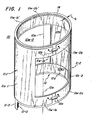
- a first presently preferred embodiment 10 of our novel elliptical cross-section slotted-tube radio-frequency resonator for nuclear magnetic resonance imaging is illustrated.
- the resonator has a central axis 10a; the resonator is normally positioned with the NMR static field parallel to axis 10a.
- Resonator 10 comprises first and second outer structure portions 11-1 and 11-2 formed about an inner structure comprised of a lower guard ring 12a and an upper guard ring 12b.
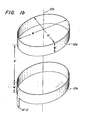
- the guard rings are-continuous conductors of substantially identical shape, but spaced from one another in the direction of the central axis 10a of the resonator.
- a guard ring feed terminal 12-0 is connected to that edge of lower guard ring 12a furthest from upper guard ring 12b, at a position thereon underlying a resonator outer structure feed point 11-0.
- a dielectric member 14 is interposed between at least each of lower and upper guard rings 12a and 12b and the overlying portions of outer structure portions 11-1 and 11-2.
- the dielectric member 14 is a one-piece member having an elliptical cross-section in planes substantially orthogonal to the direction of resonator central axis 10-a, and extends from at least the lower edge of lower guard ring 12a to the upper-edge of upper guard ring 12b; the presence of the insulative material of member 14 in a pair of window areas lOw-1 and lOw-2, devoid of any portion of outer structure 11 or inner structure 12, does not substantially affect the radio-frequency operation of the resonator, yet provides additional structural integrity thereto.
- Member 14 can be fabricated of any suitable material having a low loss factor at the frequency of use; plastic, glass or ceramic material can be used.
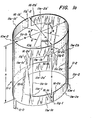
- Each of outer structure portions 11-1 and 11-2 (best viewed in Figure la) comprises an I-shaped electrode each having a relatively wide central band lla-1 or lla-2 which has wing portions extending to the right and left thereof at both the upper and lower central band side edges lla-la and lla-lb or lla-2a and lla-2b.
- central band lla-1 extended from the respective lower right and left peripheral edges lla-la and lla-lb, respectively, of central band lla-1 are respective lower right wing portion llw-la and lower left wing portion llw-la' and extended from the upper portions of central band side edges lla-la and lla-lb, respectively are respective upper right wing portion llw-lb and upper left wing portion llw-lb'.
- lower left wing portion llw-2a and lower right wing portion llw-2a' respectively extend from the lower peripheries of second central band sides lla-2a and lla-2b, respectively, while respective upper left wing portion llw-2b and upper right wing portion llw-2b' respectively extend from the respective upper sides of second central band lla-2.
- the outer structure feed portion 11-0 extends from the lower edge of first central band lla-1, substantially along a line midway between the side edges thereof (e.g. substantially at one of the points of maximum cross-section curvature).
- Each of outer structure portions 11-1 and 11-2 are advantageously fabricated from a flat sheet, typically having a thickness on the order of about 5 milli-inches (i.e..005"), of a highly conductive material, such as copper and the like.
- Each outer structure section 11-1 and 11-2 may have a substantially rectangular central band section lla-1 and lla-2, and substantially rectangular wing sections llw-la, llw-la', llw-lb and llw-lb' or llw-2a, llw-2a', llw-2b and llw-2b'.
- central band sides lla-la and lla-lb or lla-2a and lla-2b lie along straight lines either parallel to the resonator central axis 10a (as illustrated) or skewed at some angle thereto, or to deviate from a substantially straight edge, so as to be concave, convex or of more complex convoluted form with respect to a line joining the end points of the central band sides.
- each of wing portions llw-la, llw-la', llw-2a, llw-2a', llw-lb, llw-lb', llw-2b and llw-2b' are advantageously formed as rectangular extensions from the associated central band sides, but may have the upper and lower edges thereof formed, when the pair of outer structure electrodes 11-1 and 11-2 are bent to the desired elliptical cross-sectioned shape, to be either in one of a number of parallel planes substantially orthogonal to the resonator central axis 10a or to be skewed therefrom; advantageously, each of outer structure portions 11-1 and 11-2 will be symmetrical about resonator axis 10a and complementary to the other outer structure portion.
- the wing edges 16-la, 16-la', 16-lb, 16-lb', 16-2a, 16-2a', 16-2b and 16-2b' are straight edges lying parallel to resonator axis 10a such that adjacent pair of edges (e.g. wing edge pairs 16-la and 16-2a, 16-la' and 16-2a', 16-lb and 16-2b, and 16-lb' and 16-2b') are parallel to one another but spaced apart over the wing edge lengths W thereof, to form associated outer structure wing gaps llg-1, 11g'-1, llg-2 and llg'-2, respectively.
- adjacent pair of edges e.g. wing edge pairs 16-la and 16-2a, 16-la' and 16-2a', 16-lb and 16-2b, and 16-lb' and 16-2b'
- the distance of each of gaps llg-1, llg-2, llg'-l and llg'-2 are on the order of one-eighth inch.
- Outer resonator structure portions 11-1 and 11-2 are, as previously mentioned hereinabove, formed into a tube having an elliptical cross-section, in planes substantially perpendicular to resonator central axis 10a. This geometry has a better fit to the cross-section of the body or head to be imaged and allows for a better coil-filling-factor, than does a round cross-section.
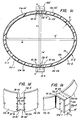
- the central band portions lla-1 and lla-2 of the two outer structure portions 11-1 and 11-2 respectively, subtend angles 0 to each side of the major axis M; advantageously, angle 0 is in the range of 30-50° and is most preferably about 40°.
- each of windows lOw-1 and lOw-2 subtend an angle of (180-20)°, e.g. about 100°, if 0 is 40°.
- the principal useful RF magnetic field generated by the resonator is substantially directed parallel to an axis drawn through the centers of windows lOw-1 and lOw-2, i.e. in a direction perpendicular to the resonator axis 10a.
- Each of inner structure lower and upper guard rings 12a and 12b are also formed of a highly conductive material, e.g. copper and the like, typically as_a band of a conductive foil, having a thickness on the order of 5 milli-inches, and attached to the interior surface of the elliptical cross-section dielectric member 14.
- a single strip of foil may be utilized to fabricate each of bands 12a or 12b, with the foil ends being joined together in essentially conductive manner to complete each of the elliptical guard rings.
- Each ring has a dimension W' which is substantially, though not necessarily exactly, equal to the dimension W of the overlying outer structure wing portions.
- each elliptically cross-sectioned guard ring has a major axis M' of dimension slightly less than the dimension M of the major axis of the outer structure, by an amount substantially equal to twice the thickness G of dielectric member 14, and has a minor axis M' of dimension slightly less than the minor axis M of the outer structure, by an amount substantially equal to twice the thickness G of the interposed dielectric member 14.
- the dielectric member thickness G is chosen, typically in the range of about 1/32" to about 5/8", to tune the natural unloaded resonance of the resonator to a frequency about 10% higher than the desired NMR imaging frequency to be used.
- a first coupling capacitor 18a is connected between the ends of adjacent wings llw-la and llw-2a and a second coupling capacitor 18b is connected between the ends of wings llw-lb and llw-2b.
- a third coupling capacitor 18b' is connected (Figure 1c) between the ends of adjacent wings llw-lb' and llw-2b', across the gap llg'-2 therebetween, while a -fourth capacitive coupling element 18a' (not visible in the views of Figures 1 and 1a-1c) is connected between the ends of lower wings llw-la' and llw-2a', across the gap llg'-l therebetween.
- Each of the four wing-gap capacitances (selected to tune, in conjunction with the member 14 thickness G dimension, the resonator to resonance at or slightly above the desired NMR imaging frequency of operation) may be a fixed or variable type and should possess as high a quality Q factor as possible at the frequency of intended use.
- Each coupling capacitance 18 may be of any form desired, such as the fixed-value, tubular capacitances 18a and 18b shown in Figure 1, the fixed-value chip capacitor structures 18b and 18b' shown in Figure lc or of suitable variable configuration, such as air, quartz, sapphire and the like dielectric variable trimmer capacitors, of piston or other types well known to the variable capacitor arts.
- suitable variable configuration such as air, quartz, sapphire and the like dielectric variable trimmer capacitors, of piston or other types well known to the variable capacitor arts.
- variable capacitance can take either of the forms shown in Figure 1d; the total inter-wing coupling capacitance can be formed either by the parallel combination of a variable capacitance 18-bl and a fixed capacitance 18-b2, where the total capacitance required is greater than the maximum capacitance of variable capacitor 18-bl alone, or by the series connection of variable capacitor 18-bl' and fixed capacitor 18-b2', where the minimum capacitance required may be less than the minimum capacitance available from variable capacitor 18-bl' alone.
- a particularly rugged wing-gap tuning capacitance 18' can be fabricated as shown in Figure le, by use of double-sided printed circuit board material.
- the printed circuit board capacitor 18' is moved adjacent to wing ends 16-lb and 16-2b, between which the gap llg-2 has been previously adjusted to equal the thickness T of the printed circuit capacitor dielectric thickness.
- the wing ends 16-lb and 16-2b are respectively joined to the abutting ends of circuit board conductor portions 18w-1 and 18w-2, as by soldering, welding and the like processes.
- Capacitor 18' is, advantageously, fabricated of a printed circuit board having a very low loss- tangent substrate 18c material, such as glass-Teflon R and the like, and with the substrate 18c of a standard thickness, such as 1/32 inch, 1/16 inch and the like.
- Each printed circuit capacitor 18' can be tuned by trimming the length X thereof, by cutting, filing and the like processes, whereby the total equivalent capacitance C of each of the four capacitors 18 can be adjusted for the desired symmetry of the radio-frequency field within the resonator.
- the same adjustment of the four wing-gap bridging capacitances C can be effected by use of either method shown in Figure ld or by selection of the exact values of fixed value capacitance, if variable capacitance cannot, for some reason, be utilized.
- an elliptical cross-section slotted-tube radio-frequency resonator 10 for body imaging has a major axis M' dimension of about 17 inches and a minor axis m dimension of about 13 inches, for an eccentricity ratio e of about 1.3, with a height H of about 21 inches, a wing end height W of about 4 inches and a window height S of 13 inches.
- Dielectric tube 14 may have a thickness G of between 1/32 inch and about 5/8 inch, whereby the inner guard ring major axis M' dimension is between about 15 3/4inches and about 17 inches and the minor axis m is between about 11 3/4 inches and about 13 inches, dependent upon the actual dielectric tube thickness G utilized and the thickness of the outer structure and inner guard ring electrodes.
- the inner guard ring height W' is also about 4 inches and the spacing S' therebetween is about 13 inches. This resonator is relatively easily tuned to the approximately 64 MHz. resonance frequency for 1 H imaging at a field of 1.5 Tesla.
- an elliptical cross-section, slotted-tube radio-frequency resonator 10 was built utilizing a tube 14 of about 5/16 inch thickness G, with an outer structure major axis M dimension of about 11 3/8 inches and minor axis m dimension of about 8 3/4 inches; the resonator height H is about 11 1/4 inches with wing height W and inner guard ring height W' of about 1 3/4 inches, a window height S and inner guard ring separation S' of about 7 3/4 inches and a window periphery, between complementary band portion edges lla-la and lla-2a or lla-lb and lla-2b of about 8 1/4 inches.
- variable capacitors 18 are tuned using variable capacitors 18 across all four inter-wing gaps llg-1, llg'l, llg-2 and llg'-2.
- NMR frequencies in the complete range of about 20 MHz. to 75 MHz. are accessible using the variable wing-gap capacitors 18 alone, without requiring readjustment of the inner ring to outer electrode gap distance G.
- resonator 10 provides an unloaded quality factor Q U of about 225 in the 60 MHz. range and a loaded quality factor Q L of about 25 when loaded by the insertion of a patient's head within the interior resonator volume.
- the ratio of loaded to unloaded Q is thus about one-ninth, assuring that the resonator provides significantly less noise/loss contribution than the body portion being imaged.
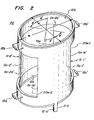
- the first and second outer vertical bands 11a-1' and lla-2' of the respective first and second outer structure portions 11-1' and 11-2' are, as shown in Figure 2, placed about the portion of least curvature of the elliptical cross-section, rather than about the greatest curvature ends of the resonator, as in the embodiment 10.
- the angle e' is formed between each of the central band edges lla-la', lla-lb', Ila-2a' and lla-2b', and the minor axis m, and is again preferably on the order of 40°.
- Embodiment 20 offers windows 20w-1 and 20w-2 of somewhat reduced area and may provide a somewhat reduced loaded quality factor Q L , resulting in reduced resonator loss/noise contributions due to the greater optimization of filling factor obtained when a portion of a patient's body, such as the head, arm, leg and the like, fills the elliptical cross section of resonator 20, as opposed to the decrease in loaded quality factor Q L of resonator 10.
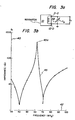
- Figure 3b illustrates the terminal impedance Z r of the resonator connected in the circuit of Figure 3a, plotted along ordinate 40, for frequencies, plotted along abscessa 42, in the range from about 30 MHz. to about 100 MHz., for a 1 H resonator at an unloaded resonant frequency of about 63 MHz. and tuned to resonance with an additional variable parallel capacitance C p of about 30 picofarad maximum value, shown in Figure 3a.
- the extrema of curve 45 at about 41 MHz., 63 MHz.
- each of these extrema corresponds to a frequency at which the reactive component of the resonator impedance Z r is zero. It will be seen that two of these extrema correspond to minima of the measured impedance Z , and a third extrema 45a corresponds to a maxima.
- the resonances corresponding to Z r minima it is more desirable to use the high-impedance parallel-resonance point 45a, at which the impedance Z r is on the order of 400 ohms in this example, because the resistance of connecting cables is likely to be comparable to the values of Z r at the minima.
- the connecting cables could therefore contribute a more significant proportion of noise to the detected NMR signal.
- the elliptically cross-sectioned slotted-tube radio-frequency resonator of the present invention provides a minimal --noise/loss contribution to the NMR imaging signal. This is particularly important in that a single radio-frequency resonator is normally utilized, with an external " transmit/receive switch.(not shown) for both excitation of the imaged sample and subsequent reception of the image return signal. Thus, the proportion of the excitation signal dissipated by the resonator is reduced, while the signal-to-noise ratio of the image return signal is maximized.
- a very course adjustment factor is provided by varying the distance G between the inner guard rings 12 and outer electrodes 11-1 and 11-2.
- the particular resonator resonance frequency to be used e.g. point 45a
- the desired NMR frequency e.g. is at about 70-90 MHz. if it is desired to operate at about 63 MHz.
- the capacitance between inner guard ring members 12 and outer electrode portions 11-1 and 11-2 is inversely proportional to distance G, the larger the value of distance G, the higher the natural resonator frequency obtained.
- the four inter-wing gap capacitors 18 are added between the wing portions of the outer electrodes. These gap capacitors are adjusted to lower the particular resonator resonance frequency substantially to, but not below, the NMR frequency.
- a final adjustment factor is provided by the parallel capacitance C p of input capacitor 38 (see Figure 3a).
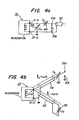
- the circuit of Figure 4a schematically illustrates the final circuit utilized to match resonator 10 (or resonator 20 of Figure 2) to the system impedance Z , between antenna terminals 10a and lOb.
- a series tuning capacitance 48 is connected between antenna feed terminal 10a and resonator feed terminal 11-0 and the associated terminal of capacitor 38.
- instrumentation would be provided between antenna coaxial cable 50 and the antenna terminals 10a and lOb, to measure forward and reflected power and allow capacitors 38 and 48 to be adjusted for minimum reflected power at the desired frequency of operation, with a resonator loaded by the sample to be imaged.
- impedance adjustment and matching circuitry may be equally as well utilized and may contain-inductive, in lieu of, or in addition to, capacitive elements.
- each of cables 52 and/or 54 is a coaxial cable having a physical length 1 1 or 1 2 equal to one-half of an effective cable wavelength ( ⁇ e /2) at the frequency of operation or equal to an integral multiple of one-half of an effective cable wavelength. It is well known to the art to calculate the effective wavelength of a particular cable, e.g. for a 50 ohm coaxial cable having an effective velocity of propagation of about 0.666, a one-half wavelength line at about 60 MHz. (i.e. a wavelength of about 5 meters) has a length 1 of about 65 1/2" and allows the adjusting personnel to be positioned at a distance of almost 5 1/2' from the loaded resonator.
- each of cables 52 and 54 can be increased in multiples of one-half wavelength and still have the value of capacitors 38 and 48 be the same as that required if the capacitor were connected directly to resonator terminal 11-0, capacitors 38 and 48 can easily be located outside of the imaging magnet bore and the loaded resonator can be adjusted in the exact location of use, compensating for substantially all loading elements.
Landscapes
- Physics & Mathematics (AREA)
- Condensed Matter Physics & Semiconductors (AREA)
- General Physics & Mathematics (AREA)
- Health & Medical Sciences (AREA)
- Life Sciences & Earth Sciences (AREA)
- Medical Informatics (AREA)
- Engineering & Computer Science (AREA)
- Optics & Photonics (AREA)
- Heart & Thoracic Surgery (AREA)
- Nuclear Medicine, Radiotherapy & Molecular Imaging (AREA)
- Biophysics (AREA)
- Pathology (AREA)
- Radiology & Medical Imaging (AREA)
- Biomedical Technology (AREA)
- High Energy & Nuclear Physics (AREA)
- Molecular Biology (AREA)
- Surgery (AREA)
- Animal Behavior & Ethology (AREA)
- General Health & Medical Sciences (AREA)
- Public Health (AREA)
- Veterinary Medicine (AREA)
- Magnetic Resonance Imaging Apparatus (AREA)
- Control Of Motors That Do Not Use Commutators (AREA)
Applications Claiming Priority (2)
| Application Number | Priority Date | Filing Date | Title |
|---|---|---|---|
| US06/609,043 US4641097A (en) | 1984-05-10 | 1984-05-10 | Elliptical cross-section slotted-tube radio-frequency resonator for nuclear magnetic resonance imaging |
| US609043 | 2009-10-30 |
Publications (2)
| Publication Number | Publication Date |
|---|---|
| EP0160942A2 true EP0160942A2 (fr) | 1985-11-13 |
| EP0160942A3 EP0160942A3 (fr) | 1987-04-15 |
Family
ID=24439133
Family Applications (1)
| Application Number | Title | Priority Date | Filing Date |
|---|---|---|---|
| EP85105377A Ceased EP0160942A3 (fr) | 1984-05-10 | 1985-05-02 | Résonateur pour le domaine des radio fréquences en forme de tube fendu à section elliptique pour l'imagerie par résonance magnétique nucléaire |
Country Status (6)
| Country | Link |
|---|---|
| US (1) | US4641097A (fr) |
| EP (1) | EP0160942A3 (fr) |
| JP (1) | JPS612404A (fr) |
| KR (1) | KR850008093A (fr) |
| FI (1) | FI851163L (fr) |
| IL (1) | IL75025A0 (fr) |
Cited By (11)
| Publication number | Priority date | Publication date | Assignee | Title |
|---|---|---|---|---|
| EP0171972A3 (en) * | 1984-08-16 | 1987-04-15 | Picker International, Inc. | Nuclear magnetic resonance radio frequency antenna |
| EP0222982A1 (fr) * | 1985-11-18 | 1987-05-27 | Siemens Aktiengesellschaft | Bobine de surface pour l'analyse par résonance magnétique nucléaire |
| US4720680A (en) * | 1986-02-18 | 1988-01-19 | Mitsubishi Denki Kabushiki Kaisha | Adjustable radio frequency coil for nuclear magnetic resonance imaging |
| EP0256370A1 (fr) * | 1986-08-12 | 1988-02-24 | Siemens Aktiengesellschaft | Dispositif d'antenne pour l'excitation et l'enregistrement de la résonance magnétique nucléaire |
| EP0268083A1 (fr) * | 1986-10-28 | 1988-05-25 | Siemens Aktiengesellschaft | Résonateur de surface pour tomographie à spin nucléaire |
| US4755756A (en) * | 1986-02-18 | 1988-07-05 | Mitsubishi Denki Kabushiki Kaisha | Radio frequency coil for nuclear magnetic resonance imaging |
| US4837515A (en) * | 1986-09-26 | 1989-06-06 | Mitsubishi Denki Kabushiki Kaisha | Radio frequency coil for nuclear magnetic resonance imaging |
| EP0257782A3 (fr) * | 1986-08-07 | 1989-09-20 | Picker International, Inc. | Appareil de résonance magnétique |
| WO1991000528A1 (fr) * | 1989-07-05 | 1991-01-10 | MAX-PLANCK-Gesellschaft zur Förderung der Wissenschaften e.V. | Sonde pour la tomographie a resonance magnetique nucleaire de tout le corps ou pour la spectroscopie a resonance magnetique nucleaire in-vivo localisee |
| GB2258046A (en) * | 1991-07-10 | 1993-01-27 | Bruker Medizintech | Coil arrangement for measurements using magnetic resonance |
| US5542424A (en) * | 1993-03-25 | 1996-08-06 | Rochester Institute Of Technology | Resonator for magnetic resonance imaging |
Families Citing this family (32)
| Publication number | Priority date | Publication date | Assignee | Title |
|---|---|---|---|---|
| EP0170514B1 (fr) * | 1984-07-31 | 1990-09-19 | Oxford Research Systems Limited | Procédé et appareil pour l'obtention de spectres de résonance magnétique nucléaire et bobines utilisées dans le dit appareil |
| JPS6144560U (ja) * | 1984-08-27 | 1986-03-24 | 株式会社島津製作所 | Nmrイメ−ジング装置用高周波信号送受信端素子 |
| US4725780A (en) * | 1984-10-19 | 1988-02-16 | Mitsubishi Denki Kabushiki Kaisha | RF field generator and detector |
| JPS61176841A (ja) * | 1985-02-01 | 1986-08-08 | Jeol Ltd | Nmrプロ−ブ用コイル |
| DE3515190A1 (de) * | 1985-04-26 | 1986-11-06 | Siemens AG, 1000 Berlin und 8000 München | Kernspin-tomographiegeraet |
| US4950993A (en) * | 1985-11-29 | 1990-08-21 | Thomson-Cgr | Device and method for adjusting a radiofrequency antenna of a nuclear magnetic resonance apparatus |
| JPH0728857B2 (ja) * | 1986-03-07 | 1995-04-05 | 株式会社日立製作所 | 核磁気共鳴を用いた検査装置 |
| IL78767A (en) * | 1986-05-13 | 1989-09-10 | Elscint Ltd | Probe for nuclear magnetic resonance systems |
| JPH0423529Y2 (fr) * | 1986-09-04 | 1992-06-02 | ||
| NL8603252A (nl) * | 1986-12-22 | 1988-07-18 | Philips Nv | Magnetisch resonantie-apparaat met verstemde rf-spoel. |
| US4875013A (en) * | 1987-03-13 | 1989-10-17 | Hitachi, Ltd. | High-frequency coil for nuclear magnetic imaging |
| JP2602223B2 (ja) * | 1987-03-13 | 1997-04-23 | 株式会社日立製作所 | 核磁気共鳴イメージング用高周波コイル |
| US4751464A (en) * | 1987-05-04 | 1988-06-14 | Advanced Nmr Systems, Inc. | Cavity resonator with improved magnetic field uniformity for high frequency operation and reduced dielectric heating in NMR imaging devices |
| JPS63292949A (ja) * | 1987-05-25 | 1988-11-30 | Yokogawa Medical Syst Ltd | 核磁気共鳴イメ−ジング装置用rfコイル |
| US4783629A (en) * | 1987-10-07 | 1988-11-08 | The Regents Of The University Of California | RF coil for MRI with self-tracking ganged coupling capacitors |
| US5024229A (en) * | 1987-11-16 | 1991-06-18 | The University Of Rochester | Resonators for magnetic resonance imaging |
| US5139024A (en) * | 1987-11-16 | 1992-08-18 | The University Of Rochester | Resonators for magnetic resonance imaging |
| US4827219A (en) * | 1988-01-07 | 1989-05-02 | The Regents Of The University Of California | Remotely adjustable MRI RF coil impedance matching circuit with mutualy coupled resonators |
| US4833412A (en) * | 1988-04-08 | 1989-05-23 | Varian Associates, Inc. | Double tuned circuit for distributed lumped capacitance observe coils |
| JPH01299542A (ja) * | 1988-05-27 | 1989-12-04 | Hitachi Ltd | 核磁気共鳴を用いた検査装置 |
| JPH0619102Y2 (ja) * | 1988-09-22 | 1994-05-18 | 日本電子株式会社 | Nmrプローブ |
| IL89107A (en) * | 1989-01-27 | 1992-07-15 | Elscint Ltd | Miniaturized surface coil |
| JPH02203839A (ja) * | 1989-02-03 | 1990-08-13 | Hitachi Ltd | 核磁気共鳴を用いた検査装置 |
| DE4221759C2 (de) * | 1991-10-11 | 1997-11-20 | Hitachi Medical Corp | Empfangsspulenvorrichtung für ein Kernspintomographiegerät |
| DE4218635C2 (de) * | 1992-06-05 | 1996-05-23 | Siemens Ag | Hochfrequenz-Empfangsantenne einer Einrichtung zur Kernspintomographie mit mindestens einem Kondensator |
| US5453692A (en) * | 1992-08-06 | 1995-09-26 | Hitachi, Ltd. | RF probe for nuclear magnetic resonance imaging (MRI) devices |
| US5515855A (en) * | 1994-08-05 | 1996-05-14 | Sloan-Kettering Institute For Cancer Research | Dome-shaped resonator for nuclear magnetic resonance imaging and spectroscopy |
| US5744957A (en) * | 1995-08-15 | 1998-04-28 | Uab Research Foundation | Cavity resonator for NMR systems |
| US6008650A (en) * | 1998-05-15 | 1999-12-28 | Varian, Inc. | Slotted RF shields for NMR probes |
| NO20053093D0 (no) * | 2005-06-23 | 2005-06-23 | Radiumhospitalets Forskningsst | A device for MRI soleniod coils and method for adjusting same. |
| DE102006046044B4 (de) * | 2006-09-28 | 2010-04-08 | Siemens Ag | Hochfrequenzsendeanordnung einer Magnetresonanzanlage |
| JP6048868B2 (ja) * | 2012-06-29 | 2016-12-21 | 国立研究開発法人理化学研究所 | 核磁気共鳴現象測定用rfコイル |
Family Cites Families (4)
| Publication number | Priority date | Publication date | Assignee | Title |
|---|---|---|---|---|
| US4398149A (en) * | 1981-02-02 | 1983-08-09 | Varian Associates, Inc. | NMR Probe coil system |
| US4435680A (en) * | 1981-10-09 | 1984-03-06 | Medical College Of Wisconsin | Microwave resonator structure |
| US4480239A (en) * | 1983-02-07 | 1984-10-30 | The Medical College Of Wisconsin Inc. | Loop-gap resonator network |
| US4517516A (en) * | 1983-04-08 | 1985-05-14 | Varian Associates, Inc. | NMR Probe coil form structure |
-
1984
- 1984-05-10 US US06/609,043 patent/US4641097A/en not_active Expired - Fee Related
-
1985
- 1985-03-22 FI FI851163A patent/FI851163L/fi not_active Application Discontinuation
- 1985-04-22 KR KR1019850002694A patent/KR850008093A/ko not_active Ceased
- 1985-04-26 IL IL75025A patent/IL75025A0/xx unknown
- 1985-05-02 EP EP85105377A patent/EP0160942A3/fr not_active Ceased
- 1985-05-07 JP JP60095676A patent/JPS612404A/ja active Pending
Non-Patent Citations (1)
| Title |
|---|
| REVIEW OF SCIENTIFIC INSTRUMENTS, vol. 48, no. 1, January 1977, pages 68-73, American Institute of Physics, New York, US; H.J. SCHNEIDER et al.: "Slotted tube resonator: A new NMR probe head at high observing frequencies" * |
Cited By (13)
| Publication number | Priority date | Publication date | Assignee | Title |
|---|---|---|---|---|
| EP0171972A3 (en) * | 1984-08-16 | 1987-04-15 | Picker International, Inc. | Nuclear magnetic resonance radio frequency antenna |
| EP0222982A1 (fr) * | 1985-11-18 | 1987-05-27 | Siemens Aktiengesellschaft | Bobine de surface pour l'analyse par résonance magnétique nucléaire |
| US4720680A (en) * | 1986-02-18 | 1988-01-19 | Mitsubishi Denki Kabushiki Kaisha | Adjustable radio frequency coil for nuclear magnetic resonance imaging |
| US4755756A (en) * | 1986-02-18 | 1988-07-05 | Mitsubishi Denki Kabushiki Kaisha | Radio frequency coil for nuclear magnetic resonance imaging |
| EP0257782A3 (fr) * | 1986-08-07 | 1989-09-20 | Picker International, Inc. | Appareil de résonance magnétique |
| EP0256370A1 (fr) * | 1986-08-12 | 1988-02-24 | Siemens Aktiengesellschaft | Dispositif d'antenne pour l'excitation et l'enregistrement de la résonance magnétique nucléaire |
| US4837515A (en) * | 1986-09-26 | 1989-06-06 | Mitsubishi Denki Kabushiki Kaisha | Radio frequency coil for nuclear magnetic resonance imaging |
| US4841249A (en) * | 1986-10-28 | 1989-06-20 | Siemens Aktiengesellschaft | Truncated cone shaped surface resonator for nuclear magnetic resonance tomography |
| EP0268083A1 (fr) * | 1986-10-28 | 1988-05-25 | Siemens Aktiengesellschaft | Résonateur de surface pour tomographie à spin nucléaire |
| WO1991000528A1 (fr) * | 1989-07-05 | 1991-01-10 | MAX-PLANCK-Gesellschaft zur Förderung der Wissenschaften e.V. | Sonde pour la tomographie a resonance magnetique nucleaire de tout le corps ou pour la spectroscopie a resonance magnetique nucleaire in-vivo localisee |
| GB2258046A (en) * | 1991-07-10 | 1993-01-27 | Bruker Medizintech | Coil arrangement for measurements using magnetic resonance |
| GB2258046B (en) * | 1991-07-10 | 1995-08-09 | Bruker Medizintech | Coil arrangement for measurements using nuclear magnetic resonance |
| US5542424A (en) * | 1993-03-25 | 1996-08-06 | Rochester Institute Of Technology | Resonator for magnetic resonance imaging |
Also Published As
| Publication number | Publication date |
|---|---|
| JPS612404A (ja) | 1986-01-08 |
| US4641097A (en) | 1987-02-03 |
| FI851163A7 (fi) | 1985-11-11 |
| KR850008093A (ko) | 1985-12-13 |
| EP0160942A3 (fr) | 1987-04-15 |
| FI851163A0 (fi) | 1985-03-22 |
| IL75025A0 (en) | 1985-08-30 |
| FI851163L (fi) | 1985-11-11 |
Similar Documents
| Publication | Publication Date | Title |
|---|---|---|
| US4641097A (en) | Elliptical cross-section slotted-tube radio-frequency resonator for nuclear magnetic resonance imaging | |
| US4746866A (en) | High-frequency coil system for a magnetic resonance imaging apparatus | |
| US7023209B2 (en) | Method and apparatus for magnetic resonance imaging and spectroscopy using microstrip transmission line coils | |
| US4594566A (en) | High frequency rf coil for NMR device | |
| EP0180121B1 (fr) | Dispositif pour adapter une bobine de RMN à l'aide de l'induction mutuelle | |
| US4621237A (en) | Radiofrequency transducer and method of using same | |
| US4740751A (en) | Whole body MRI resonator | |
| EP0171972A2 (fr) | Antenne haute fréquence pour appareil à résonance magnétique nucléaire | |
| EP1555539A2 (fr) | Circuit de sonde RMN pour la génération de fréquences de résonance voisines | |
| US4987370A (en) | Rf quadrature coil system for an MRI apparatus | |
| US4641098A (en) | Parallel single turn saddle resonator for nuclear magnetic resonance signal reception | |
| JP2904858B2 (ja) | 核磁気共鳴断層撮影装置 | |
| US7106063B1 (en) | Axially constrained RF probe coil | |
| US5162739A (en) | Balanced multi-tuned high-power broadband coil for nmr | |
| US6175237B1 (en) | Center-fed paralleled coils for MRI | |
| US20030057948A1 (en) | Device for suppressing electromagnetic coupling phenomena | |
| US7135866B2 (en) | Multifrequency power circuit and probe and NMR spectrometer comprising such a circuit | |
| Gonord et al. | Twin‐horseshoe resonator—An investigation | |
| US12019129B2 (en) | NMR probehead | |
| US7196522B2 (en) | Power circuit of a coil and probe and NMR spectrometer comprising such a circuit | |
| US6605944B2 (en) | NMR probehead with a line resonator configured as a delay line | |
| US4721915A (en) | High frequency antenna system for nuclear magnetic resonance tomography devices | |
| US6366093B1 (en) | Re-entrant RF cavity resonator for magnetic resonance | |
| Stensgaard | Planar quadrature coil design using shielded-loop resonators | |
| JP2874988B2 (ja) | Nmr用サンプルコイル |
Legal Events
| Date | Code | Title | Description |
|---|---|---|---|
| PUAI | Public reference made under article 153(3) epc to a published international application that has entered the european phase |
Free format text: ORIGINAL CODE: 0009012 |
|
| AK | Designated contracting states |
Designated state(s): CH DE FR GB IT LI NL SE |
|
| PUAL | Search report despatched |
Free format text: ORIGINAL CODE: 0009013 |
|
| AK | Designated contracting states |
Kind code of ref document: A3 Designated state(s): CH DE FR GB IT LI NL SE |
|
| 17P | Request for examination filed |
Effective date: 19870923 |
|
| 17Q | First examination report despatched |
Effective date: 19880119 |
|
| STAA | Information on the status of an ep patent application or granted ep patent |
Free format text: STATUS: THE APPLICATION HAS BEEN REFUSED |
|
| 18R | Application refused |
Effective date: 19880715 |
|
| RIN1 | Information on inventor provided before grant (corrected) |
Inventor name: SCHENCK, JOHN FREDERIC Inventor name: BOTTOMLEY, PAUL ARTHUR |