EP0160950A2 - Fliegenfänger - Google Patents
Fliegenfänger Download PDFInfo
- Publication number
- EP0160950A2 EP0160950A2 EP85105440A EP85105440A EP0160950A2 EP 0160950 A2 EP0160950 A2 EP 0160950A2 EP 85105440 A EP85105440 A EP 85105440A EP 85105440 A EP85105440 A EP 85105440A EP 0160950 A2 EP0160950 A2 EP 0160950A2
- Authority
- EP
- European Patent Office
- Prior art keywords
- trap
- array
- conductors
- charges
- insects
- Prior art date
- Legal status (The legal status is an assumption and is not a legal conclusion. Google has not performed a legal analysis and makes no representation as to the accuracy of the status listed.)
- Granted
Links
Images

Classifications
-
- A—HUMAN NECESSITIES
- A01—AGRICULTURE; FORESTRY; ANIMAL HUSBANDRY; HUNTING; TRAPPING; FISHING
- A01M—CATCHING, TRAPPING OR SCARING OF ANIMALS; APPARATUS FOR THE DESTRUCTION OF NOXIOUS ANIMALS OR NOXIOUS PLANTS
- A01M1/00—Stationary means for catching or killing insects
- A01M1/14—Catching by adhesive surfaces
-
- A—HUMAN NECESSITIES
- A01—AGRICULTURE; FORESTRY; ANIMAL HUSBANDRY; HUNTING; TRAPPING; FISHING
- A01M—CATCHING, TRAPPING OR SCARING OF ANIMALS; APPARATUS FOR THE DESTRUCTION OF NOXIOUS ANIMALS OR NOXIOUS PLANTS
- A01M1/00—Stationary means for catching or killing insects
- A01M1/02—Stationary means for catching or killing insects with devices or substances, e.g. food, pheronones attracting the insects
-
- A—HUMAN NECESSITIES
- A01—AGRICULTURE; FORESTRY; ANIMAL HUSBANDRY; HUNTING; TRAPPING; FISHING
- A01M—CATCHING, TRAPPING OR SCARING OF ANIMALS; APPARATUS FOR THE DESTRUCTION OF NOXIOUS ANIMALS OR NOXIOUS PLANTS
- A01M1/00—Stationary means for catching or killing insects
- A01M1/14—Catching by adhesive surfaces
- A01M1/145—Attracting and catching insects using combined illumination or colours and adhesive surfaces
-
- A—HUMAN NECESSITIES
- A01—AGRICULTURE; FORESTRY; ANIMAL HUSBANDRY; HUNTING; TRAPPING; FISHING
- A01M—CATCHING, TRAPPING OR SCARING OF ANIMALS; APPARATUS FOR THE DESTRUCTION OF NOXIOUS ANIMALS OR NOXIOUS PLANTS
- A01M1/00—Stationary means for catching or killing insects
- A01M1/22—Killing insects by electric means
- A01M1/223—Killing insects by electric means by using electrocution
-
- A—HUMAN NECESSITIES
- A01—AGRICULTURE; FORESTRY; ANIMAL HUSBANDRY; HUNTING; TRAPPING; FISHING
- A01M—CATCHING, TRAPPING OR SCARING OF ANIMALS; APPARATUS FOR THE DESTRUCTION OF NOXIOUS ANIMALS OR NOXIOUS PLANTS
- A01M2200/00—Kind of animal
- A01M2200/01—Insects
- A01M2200/012—Flying insects
Definitions
- This invention is related to the field of insect control I and more specifically to devices for trapping and killing common houseflies and other flying insects.
- a variety of devices and methods have been used to control the number of common houseflies and other flying insects.
- these are chemical sprays, evaporating insecticides, strips for capturing flies and other insects by means of an exposed adhesive, and electrocution devices.
- Each of these devices and methods has certain advantages and drawbacks.
- electrocution devices are deemed undesirable because of the noise that they cause when a spark is discharged to kill an insect passing between two oppositely charged electrodes. Furthermore, such devices often are covered with partially-dried dead insects, which is unsightly and a problem to clean. Also, such devices may be dangerous because of the high voltage required to electrocute the insects.
- Examples of devices for electrocuting insects include the disclosures of the following patent documents:
- electrocution devices also include a bright light or other insect-attracting device. Such devices draw the insects into what is believed to be essentially inadvertent contact or near contact with oppositely charged electrodes. Such contact or near contact bridges or nearly bridges the gap between the oppositely charged electrodes causing a spark to jump the gap by passing through the insect.
- Another type of electrical device for killing insects stuns the insect causing it to fall into a receptacle of some kind. Examples of such devices are those disclosed in the following patent documents: Such devices relate to the trapping and killing of crawling insects and are not concerned with control of flying insects.
- the device of this invention is a safe, silent, non-messy and effective trap for common houseflies and flying insects of comparable or greater size.
- the trap of this invention has an upright array of substantially parallel exposed conductors.
- Each of the conductors are of insufficient width to allow an adult housefly to easily alight on only one conductor, but adjacent pairs of conductors are separated by air and closely spaced such that an alighting housefly, in almost every case, must contact two conductors.
- the device includes means to periodically generate opposing pulsating charges in adjacent pairs of the conductors, the charges having about 25 to 40 volts peak (i.e., 50-80 volts peak-to-peak) and a frequency of about 60 to 600 Hz.
- Below the upright array of conductors is a means to receive and hold insects diving from the array.
- the conductors are preferably generally vertical wires, since flies are known to be attracted to vertical wires.
- the array may have as few as two parallel wires or may have a great many.
- the device preferably includes a fly-attracting backdrop adjacent to the array. This may be a backdrop surface of contrasting color or may be a surface of a color known to be attractive to houseflies, such as red or black.
- the array preferably surrounds a fly-attracting core member of some kind, whether it be an attractive and/or contrasting color, ultraviolet light, feeding stimulants, aggregation pheromones or mating pheromones.
- the array may be configured in several ways, such as a loop of vertical parallel conductors or any other convenient shape or configuration.
- the holding means at the base of the array is preferably a replaceable sheet covered with an adhesive for holding insects.
- Such sheet is preferably circular.
- the device preferably includes a funnel above the sheet in position to direct the diving insects onto such sheet.
- the device preferably includes a lateral wall which shields the replaceable sheet, and the insects stuck thereto, from view at least from a side direction.
- the periodically generated charges are preferably generated for short periods at equal intervals, with no charges being generated in the intervening periods.
- the charges may be generated for one second every thirty seconds. That gives alighting flies and other insects an opportunity to get well attached to a pair of conductors before the charges are applied.
- the opposing charges are applied as square waves.
- the use of square waves provides a significantly higher capture rate than sine waves or a variety of other pulsating wave forms.
- This invention is based in part upon the discovery that houseflies (Nusca domestica) will behave in an unexpected and unusual way when subjected to a less than lethal electric shock of the type described herein. When subjected to such shock, houseflies actually fly with considerable force in a generally downward direction, rather than simply dropping or flying off in somewhat random directions.
- houseflies When attempting to escape from some perceived threat, houseflies normally fly away in a generally backward direction. Thus, if their heads are oriented in a downward direction, the houseflies would normally fly tail-first in an upward direction, or vice versa. Or, if their heade are to the right, they will fly toward the left. However, with this invention, regardless of their direction of orientation on the array of conductors, the houseflies nearly all dive with power in a downward direction.
- the voltage applied in the device of this invention is so low, the exposed conductors can be touched without noticeable electric shock, even to a- damp hand. Furthermore, because no noisy sparks are generated, the device operates silently and flies do not get stuck on the conductors. And, the preferred replaceable sheets can easily be discarded.
- An object of this invention is to provide an improved device for trapping and killing common houseflies and other flying insects of comparable or larger size.
- Another object of this invention is to provide a device for killing flying insects which is silent in operation.
- Another object of this invention is to provide a device for killing flying insects which is safer than devices of the prior art for electrocuting such insects.
- Another object of this invention is to provide a device for killing flying insects which is not messy in its appearance and may be cared for with relative ease.
- Another object of this invention is to provide a device for automatically killing common houseflies and certain other flying insects which is effective in operation.
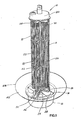
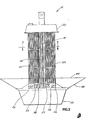
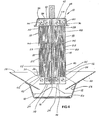
- the figures illustrate a preferred trap 10 for common houseflies and other flying insects in accordance with this invention.
- F lytrap 10 includes a base cup 12 supporting a stanchion 14 sized at its lower end 16 to be received into base cup 12.
- Stanchion 14 includes four narrow vertical plastic boards 18 which flare outwardly near lower end 16. Above the flared portions, vertical boards 18 form a right-angle cross when viewed i in top crosssection. The top of stanchion 14 is received in a control cap 20.
- each of the four vertical boards 18 is an array 22 of substantially parallel vertical wires extending from near lower end 16 to above the open bottom of control cap 20 Since each of the eight arrays in this preferred embodiment are identical, only one will be described in detail.
- Array 22 has a first part 24 and a second part 26, each of which is an exposed conductor indirectly secured onto vertical board 18.
- the upper end 28 and lower end 30 of each of first and second array parts 24 and 26 are each sandwiched in a plastic mounting plate 32.
- Mounting plates 32 serve as spacers to maintain about 0.40 cm or more in spacing between the wires of array 22'and the surface of plastic board 18.
- Mounting plates 32 at each end of array 22 are secured to vertical board 18 by bolts 36.
- Bolts 36 also serve to conduct the applied electrical charges between similar array parts on the opposite surface of each board 18.
- Wire locators 34 are attached to vertical board 18 at points along the length of the array. Wire locators 34 serve to maintain the intended spacing between the wires of array 22.
- First part 24 of array 22 includes a bottom end portion 38 from which a main vertical wire 40 extends upwardly to a top end portion 42.
- Five wires 44 extend downwardly from top end portion 42 of first array part 24.
- Second part 26 of array 22 includes similar end portions, but with the bottom and top portions being reversed such that second array part 26 has five upwardly extending wires 46 which are between and closely adjacent to downwardly extending wires 44, in alternating fashion. The use of first and second array parts 24 and 26 allows opposing charges to be applied to every other wire.
- All of wires 44 and 46 of array 22 are parallel and vertical. Each of these conducting wires is of insufficient width to allow an adult housefly to easily alight on only one such conductor. Since the wires of array 22 are spaced from the surface of vertical board 18, adjacent pairs of wires 44 and 46 are separated only by air. The wires of each such pair are closely spaced such that an alighting housefly contacts both wires of the pair. The wires are preferably close enough to prevent adult houseflies from passing easily between them.
- Each vertical board 18 of stanchion 14 serves not only as means to support the array 22 of wires, but as a backdrop which attracts flies.
- the attraction occurs either because of the color of such backdrop or because of the visual contrast between the wires and the backdrop.
- Fly-attracting colors include red and black, so the use of such colors is believed to be helpful.
- the eight separate arrays 22 together form a large array surrounding a fly-attracting core 48 consisting of the four boards 18 forming stanchion 14.
- a surrounding array can be in other forms, such as a cylindrical or square form (when viewed from above).
- the fly-attracting core member may have its fly-attracting qualities by virtue of color or contrast, as noted, or because it i includes a feeding stimulant (such as sugar), aggregation pheromones, mating pheromones, ultraviolet light or some other kind of stimuli.
- a feeding stimulant such as sugar
- aggregation pheromones such as sugar
- mating pheromones such as a feeding stimulant
- ultraviolet light such as ultraviolet light or some other kind of stimuli.
- a combination of fly-attracting means may be used.
- control cap 20 Contained within control cap 20 are electrical circuit means (not shown) to periodically generate opposing pulsating charges in alternating wires 44 and 46. Such charges have about 25 to 40 volts peak (50 to 80 volts peak to peak). Higher voltages give rise to safety problems. Lower voltages have insufficient effectiveness. A preferred voltage is about 35 volts. While effective fly-catching is possible within a frequency range of about 60 to 600 I:z, the most preferred frequency is on the order of 300 Hz.
- the charges are preferably applied at equal time intervals and for equal durations each time. For example, applying such pulsating charges one second at thirty second intervals has been found very acceptable. This timing provides flies an opportunity to get well attached to a pair of wires but probably not depart tnerefrom before the pulsating charges are applied.
- the device can be designed to detect the presence of a fly or other insect of comparable or larger size on array 22 and to trigger the pulsating charge because of such presence.
- Acceptable circuit means for generating such pulsating charges are well known to those skilled in the art who are familiar with the disclosure of this invention.
- the circuit would preferably have an appropriate simple gated oscillating circuit, including integrated circuit chips and discrete capacitor(s), transistor(s) and resistor(s), and a transformer to step up the voltage. All such circuit elements can be located in control cap 20. Mires in control cap 20 would connect the circuitry to array parts 24 and 26 by means of bolts 36. If the power source is house current, the same circuitry can be used with the addition of an appropriate adaptor.
- Circular sheet 50 Placed on the inside bottom of base cup 12 below stanchion 14 is replaceable circular sheet 50, made of paper covered with an adhesive on its exposed upper surface.
- the adhesive causes flies diving onto it to adhere such that they will be trapped and die.
- Suitable adhesives are well-known to those'skilled in the art.
- a soft highly tacified hot melt compound known as B.F. Goodrich 490, from B.F. Goodrich, Akron, Ohio.
- Circular sheet 50 is sized to fit into base cup 12, and may be removed and replaced by lifting stanchion 14 from base cup 12.
- Funnel 52 Secured to the outwardly flaring lower ends of vertical boards 18 is a funnel 52.
- Funnel 52 has an upper edge 54 defining an open upper end of wide diameter relative to the top of base cup 12 and a lower edge of reduced diameter which is received into base cup 12.
- flies When flies receive the shock provided by the pulsating charge referred to above, they dive in a generally downward direction to-hit the funnel surface and be directed into the base cup 12 and onto the adhesive surface of circular sheet 50.
- Use of the funnel allows capture of more of the diving flies coming from wire array 22.
- the trap of this invention works as follows: Flies which are attracted to stanchion 14 or array 22 alight on a pair of aojacent wires of array 22. Alighting normally occurs when no charge is applied to such adjacent wires. After a few seconds has elapsed, pulsating charges are applied to the pair of wires. This does not electrocute the fly, but instead causes it to dive forcefully in a downward direction. The fly enters the base cup 12, either directly or after being guided there after contact with funnel 52. The fly then impacts the adhesive surface of circular sheet 50 and is stuck thereon and soon perishes.
- the base cup 12 includes an upright wall 56 which can shield the fly-covered adhesive sheet from view. Such shield is particularly effective when flytrap 10 is hanging high, such as from the ceiling of a room. Eyelet 58 facilitates such hanging.
- a bucket or jar filled with a water-surfactant solution as the means to receive and hold insects diving from the wire array.
- the solution has low surface tension, so the insect is received into the mixture to quickly drown.
- Other receiving and holding means may be used.
Landscapes
- Life Sciences & Earth Sciences (AREA)
- Pest Control & Pesticides (AREA)
- Engineering & Computer Science (AREA)
- Insects & Arthropods (AREA)
- Wood Science & Technology (AREA)
- Zoology (AREA)
- Environmental Sciences (AREA)
- Catching Or Destruction (AREA)
- Portable Nailing Machines And Staplers (AREA)
- Agricultural Chemicals And Associated Chemicals (AREA)
- Mechanical Treatment Of Semiconductor (AREA)
- Devices For Conveying Motion By Means Of Endless Flexible Members (AREA)
- Closing And Opening Devices For Wings, And Checks For Wings (AREA)
- Supercharger (AREA)
- Addition Polymer Or Copolymer, Post-Treatments, Or Chemical Modifications (AREA)
- Preparation Of Compounds By Using Micro-Organisms (AREA)
- Pharmaceuticals Containing Other Organic And Inorganic Compounds (AREA)
Priority Applications (1)
| Application Number | Priority Date | Filing Date | Title |
|---|---|---|---|
| AT85105440T ATE63034T1 (de) | 1984-05-07 | 1985-05-03 | Fliegenfaenger. |
Applications Claiming Priority (2)
| Application Number | Priority Date | Filing Date | Title |
|---|---|---|---|
| US06/607,371 US4689915A (en) | 1984-05-07 | 1984-05-07 | Trap for houseflies |
| US607371 | 1984-05-07 |
Publications (3)
| Publication Number | Publication Date |
|---|---|
| EP0160950A2 true EP0160950A2 (de) | 1985-11-13 |
| EP0160950A3 EP0160950A3 (en) | 1987-10-28 |
| EP0160950B1 EP0160950B1 (de) | 1991-05-02 |
Family
ID=24431980
Family Applications (1)
| Application Number | Title | Priority Date | Filing Date |
|---|---|---|---|
| EP85105440A Expired - Lifetime EP0160950B1 (de) | 1984-05-07 | 1985-05-03 | Fliegenfänger |
Country Status (9)
| Country | Link |
|---|---|
| US (1) | US4689915A (de) |
| EP (1) | EP0160950B1 (de) |
| AT (1) | ATE63034T1 (de) |
| BR (1) | BR6500551U (de) |
| DE (1) | DE3582694D1 (de) |
| DK (1) | DK200785A (de) |
| ES (1) | ES286518Y (de) |
| NO (1) | NO160402C (de) |
| PT (1) | PT80403B (de) |
Cited By (1)
| Publication number | Priority date | Publication date | Assignee | Title |
|---|---|---|---|---|
| US4696126A (en) * | 1984-05-07 | 1987-09-29 | S. C. Johnson & Son, Inc. | Method of trapping flying insects |
Families Citing this family (9)
| Publication number | Priority date | Publication date | Assignee | Title |
|---|---|---|---|---|
| US4959923A (en) * | 1989-04-14 | 1990-10-02 | S. C. Johnson & Son, Inc. | Electronic insect trap |
| USD323015S (en) | 1989-05-25 | 1992-01-07 | Donald S. Showalter | Insect electrocutor |
| GB9513259D0 (en) * | 1995-06-29 | 1995-09-06 | Univ Southampton | Insect trap device |
| US6055766A (en) * | 1996-08-09 | 2000-05-02 | Biosensory Insect Control Corporation | Apparatus for attracting and destroying insects |
| US7166094B2 (en) * | 2002-05-28 | 2007-01-23 | Tyco Healthcare Retail Services Ag | Multiple layer absorbent article |
| DE102004025528B4 (de) * | 2004-05-25 | 2010-03-04 | Eisenmann Anlagenbau Gmbh & Co. Kg | Verfahren und Vorrichtung zum Trocknen von beschichteten Gegenständen |
| CN102308780B (zh) * | 2011-08-19 | 2013-01-09 | 广州甘蔗糖业研究所 | 害虫诱捕监测设备 |
| WO2021247409A1 (en) * | 2020-06-01 | 2021-12-09 | Alliance Sports Group, L.P. | Multi-frequency targeting insect control |
| US20260130353A1 (en) * | 2024-11-14 | 2026-05-14 | Randy J. Sasaki | Insect harvester |
Family Cites Families (33)
| Publication number | Priority date | Publication date | Assignee | Title |
|---|---|---|---|---|
| US1065782A (en) * | 1912-02-05 | 1913-06-24 | Adolphus V Cronk | Insect-destroyer. |
| FR454726A (fr) * | 1913-02-24 | 1913-07-11 | Enrico Capra | Appareil électrique pour tuer les mouches |
| FR537566A (fr) * | 1921-04-08 | 1922-05-26 | Tue-mouches électrique | |
| US1549161A (en) * | 1922-03-28 | 1925-08-11 | Birt E Sutton | Insect trap |
| US2038495A (en) * | 1935-01-05 | 1936-04-21 | August F Keller | Electric insect trap |
| DE702467C (de) * | 1938-01-06 | 1941-02-08 | Heinrich Nothhausen | Elektrischer Insektenfaenger |
| US2307163A (en) * | 1941-07-15 | 1943-01-05 | Shea Evan | Vermin trap |
| US2384190A (en) * | 1944-08-28 | 1945-09-04 | Milo F Miller | Insect attractor and destroyer |
| US2881554A (en) * | 1958-10-21 | 1959-04-14 | Thomas H Laine | Fly swatter |
| US3077050A (en) * | 1961-05-26 | 1963-02-12 | Makara Frank | Continuous insect film |
| US3321862A (en) * | 1964-12-28 | 1967-05-30 | Sylvania Electric Prod | Electrical insect killer |
| US3465468A (en) * | 1967-04-28 | 1969-09-09 | George S Takamoto | Radiant energy insect trap |
| DE1607361A1 (de) * | 1967-09-13 | 1970-08-27 | Bbc Brown Boveri & Cie | Vorrichtung zum Vernichten von Fluginsekten |
| US3491478A (en) * | 1968-04-01 | 1970-01-27 | Gilbert Electronics Inc | Traps for flying insects |
| US3680251A (en) * | 1970-06-12 | 1972-08-01 | Charles H Springer | Insect electrocutor |
| US3729857A (en) * | 1971-02-23 | 1973-05-01 | Insect O Cutor Inc | Insect electrocutor |
| US3758980A (en) * | 1971-06-29 | 1973-09-18 | W Bialobrzeski | Electrical grid |
| US3768196A (en) * | 1971-12-02 | 1973-10-30 | Rid O Ray | Electric fly killer |
| GB1444089A (en) * | 1972-10-13 | 1976-07-28 | Plessey Co Ltd | Apparatus for killing insects or the like |
| US3894351A (en) * | 1974-06-20 | 1975-07-15 | Rid O Ray | Indoor, horizontal insect killer |
| US3935662A (en) * | 1974-10-25 | 1976-02-03 | Alladin Enterprises Ltd. | Electronic insect trap |
| US3986292A (en) * | 1975-05-05 | 1976-10-19 | Harold Payne | Insect killing device |
| US3998000A (en) * | 1975-08-04 | 1976-12-21 | Gilbert Donald E | Electrocution trap for insects |
| US4037351A (en) * | 1975-12-15 | 1977-07-26 | Springer Charles H | Apparatus for attracting and electrocuting flies |
| SU547201A2 (ru) * | 1976-01-12 | 1977-02-25 | Ловушка дл насекомых | |
| IL48833A (en) * | 1976-01-14 | 1980-11-30 | Amcor Bm | Insect electrocution device |
| US4165577A (en) * | 1976-06-10 | 1979-08-28 | Shock-M-All, Inc. | Electric baseboard trap for crawling insects |
| US4144668A (en) * | 1977-09-19 | 1979-03-20 | Kris Darncharnjitt | Insect trap |
| IT7867666A0 (it) * | 1978-03-24 | 1978-03-24 | Fiat Spa | Dispositivo per tenere sotto controllo la popolazione di specie selezionate di insetti |
| FR2441563A1 (fr) * | 1978-11-14 | 1980-06-13 | Chavand Et Cie | Perfectionnements aux bandes transporteuses |
| US4226043A (en) * | 1979-02-02 | 1980-10-07 | Beatrice Foods Co. | Insect killing apparatus |
| CA1144369A (en) * | 1979-03-02 | 1983-04-12 | Alan R. Davies | Traps and trapping techniques |
| WO1982000567A1 (en) * | 1980-08-14 | 1982-03-04 | K Funaki | Combined illuminator and insecticidal apparatus |
-
1984
- 1984-05-07 US US06/607,371 patent/US4689915A/en not_active Expired - Lifetime
-
1985
- 1985-05-03 AT AT85105440T patent/ATE63034T1/de not_active IP Right Cessation
- 1985-05-03 DE DE8585105440T patent/DE3582694D1/de not_active Expired - Fee Related
- 1985-05-03 EP EP85105440A patent/EP0160950B1/de not_active Expired - Lifetime
- 1985-05-03 BR BR6500551U patent/BR6500551U/pt not_active IP Right Cessation
- 1985-05-03 NO NO851777A patent/NO160402C/no unknown
- 1985-05-06 ES ES1985286518U patent/ES286518Y/es not_active Expired
- 1985-05-06 DK DK200785A patent/DK200785A/da not_active Application Discontinuation
- 1985-05-07 PT PT80403A patent/PT80403B/pt unknown
Cited By (1)
| Publication number | Priority date | Publication date | Assignee | Title |
|---|---|---|---|---|
| US4696126A (en) * | 1984-05-07 | 1987-09-29 | S. C. Johnson & Son, Inc. | Method of trapping flying insects |
Also Published As
| Publication number | Publication date |
|---|---|
| NO160402C (no) | 1989-04-19 |
| NO160402B (no) | 1989-01-09 |
| PT80403A (en) | 1985-06-01 |
| NO851777L (no) | 1985-11-08 |
| DK200785D0 (da) | 1985-05-06 |
| ATE63034T1 (de) | 1991-05-15 |
| ES286518U (es) | 1985-12-16 |
| US4689915A (en) | 1987-09-01 |
| PT80403B (en) | 1986-10-20 |
| DE3582694D1 (de) | 1991-06-06 |
| ES286518Y (es) | 1986-07-16 |
| EP0160950B1 (de) | 1991-05-02 |
| BR6500551U (pt) | 1986-12-16 |
| EP0160950A3 (en) | 1987-10-28 |
| DK200785A (da) | 1985-11-08 |
Similar Documents
| Publication | Publication Date | Title |
|---|---|---|
| US4696126A (en) | Method of trapping flying insects | |
| US4959923A (en) | Electronic insect trap | |
| US5205064A (en) | Device for attracting and destroying insects | |
| EP0024402B1 (de) | Falle und fangtechnik für ungeziefer | |
| US5519963A (en) | Electronic insect-killing swatter | |
| US2307163A (en) | Vermin trap | |
| EP0160950B1 (de) | Fliegenfänger | |
| AU763870B2 (en) | Insect killer | |
| US6609330B1 (en) | Method and apparatus for controlling fire ants | |
| KR101545083B1 (ko) | 휴대용 전자 살충기 | |
| KR20130021762A (ko) | 유인 포충기 | |
| US5632115A (en) | Method and apparatus for controlling fire ants | |
| US20070144056A1 (en) | Insect Erradication Apparatus | |
| JP2000501605A (ja) | 電子虫捕り機 | |
| KR101822098B1 (ko) | 엘이디를 이용한 살충 소음이 최소화된 휴대용 해충 기피 및 유인 살충기 | |
| CN211185545U (zh) | 一种爬虫诱捕装置 | |
| CN215123563U (zh) | 灭蟑器 | |
| CN210143631U (zh) | 一种高效的昆虫捕捉装置 | |
| JP2002051681A (ja) | 自動捕虫装置 |
Legal Events
| Date | Code | Title | Description |
|---|---|---|---|
| PUAI | Public reference made under article 153(3) epc to a published international application that has entered the european phase |
Free format text: ORIGINAL CODE: 0009012 |
|
| AK | Designated contracting states |
Designated state(s): AT BE CH DE FR GB IT LI LU NL SE |
|
| PUAL | Search report despatched |
Free format text: ORIGINAL CODE: 0009013 |
|
| AK | Designated contracting states |
Kind code of ref document: A3 Designated state(s): AT BE CH DE FR GB IT LI LU NL SE |
|
| 17P | Request for examination filed |
Effective date: 19880128 |
|
| 17Q | First examination report despatched |
Effective date: 19890717 |
|
| GRAA | (expected) grant |
Free format text: ORIGINAL CODE: 0009210 |
|
| AK | Designated contracting states |
Kind code of ref document: B1 Designated state(s): AT BE CH DE FR GB IT LI LU NL SE |
|
| REF | Corresponds to: |
Ref document number: 63034 Country of ref document: AT Date of ref document: 19910515 Kind code of ref document: T |
|
| REF | Corresponds to: |
Ref document number: 3582694 Country of ref document: DE Date of ref document: 19910606 |
|
| ITF | It: translation for a ep patent filed | ||
| ET | Fr: translation filed | ||
| PLBE | No opposition filed within time limit |
Free format text: ORIGINAL CODE: 0009261 |
|
| STAA | Information on the status of an ep patent application or granted ep patent |
Free format text: STATUS: NO OPPOSITION FILED WITHIN TIME LIMIT |
|
| 26N | No opposition filed | ||
| EPTA | Lu: last paid annual fee | ||
| EAL | Se: european patent in force in sweden |
Ref document number: 85105440.3 |
|
| PGFP | Annual fee paid to national office [announced via postgrant information from national office to epo] |
Ref country code: LU Payment date: 19950401 Year of fee payment: 11 |
|
| PGFP | Annual fee paid to national office [announced via postgrant information from national office to epo] |
Ref country code: GB Payment date: 19960325 Year of fee payment: 12 Ref country code: AT Payment date: 19960325 Year of fee payment: 12 |
|
| PGFP | Annual fee paid to national office [announced via postgrant information from national office to epo] |
Ref country code: FR Payment date: 19960404 Year of fee payment: 12 |
|
| PGFP | Annual fee paid to national office [announced via postgrant information from national office to epo] |
Ref country code: CH Payment date: 19960411 Year of fee payment: 12 |
|
| PGFP | Annual fee paid to national office [announced via postgrant information from national office to epo] |
Ref country code: SE Payment date: 19960416 Year of fee payment: 12 |
|
| PGFP | Annual fee paid to national office [announced via postgrant information from national office to epo] |
Ref country code: NL Payment date: 19960417 Year of fee payment: 12 |
|
| PGFP | Annual fee paid to national office [announced via postgrant information from national office to epo] |
Ref country code: DE Payment date: 19960418 Year of fee payment: 12 |
|
| PG25 | Lapsed in a contracting state [announced via postgrant information from national office to epo] |
Ref country code: LU Free format text: LAPSE BECAUSE OF NON-PAYMENT OF DUE FEES Effective date: 19960503 |
|
| PGFP | Annual fee paid to national office [announced via postgrant information from national office to epo] |
Ref country code: BE Payment date: 19960510 Year of fee payment: 12 |
|
| PG25 | Lapsed in a contracting state [announced via postgrant information from national office to epo] |
Ref country code: GB Effective date: 19970503 Ref country code: AT Effective date: 19970503 |
|
| PG25 | Lapsed in a contracting state [announced via postgrant information from national office to epo] |
Ref country code: SE Effective date: 19970504 |
|
| PG25 | Lapsed in a contracting state [announced via postgrant information from national office to epo] |
Ref country code: LI Free format text: LAPSE BECAUSE OF NON-PAYMENT OF DUE FEES Effective date: 19970531 Ref country code: CH Free format text: LAPSE BECAUSE OF NON-PAYMENT OF DUE FEES Effective date: 19970531 Ref country code: BE Effective date: 19970531 |
|
| REG | Reference to a national code |
Ref country code: FR Ref legal event code: D6 |
|
| BERE | Be: lapsed |
Owner name: S.C. JOHNSON & SON INC. Effective date: 19970531 |
|
| PG25 | Lapsed in a contracting state [announced via postgrant information from national office to epo] |
Ref country code: NL Effective date: 19971201 |
|
| GBPC | Gb: european patent ceased through non-payment of renewal fee |
Effective date: 19970503 |
|
| REG | Reference to a national code |
Ref country code: CH Ref legal event code: PL |
|
| PG25 | Lapsed in a contracting state [announced via postgrant information from national office to epo] |
Ref country code: FR Free format text: LAPSE BECAUSE OF NON-PAYMENT OF DUE FEES Effective date: 19980130 |
|
| EUG | Se: european patent has lapsed |
Ref document number: 85105440.3 |
|
| NLV4 | Nl: lapsed or anulled due to non-payment of the annual fee |
Effective date: 19971201 |
|
| PG25 | Lapsed in a contracting state [announced via postgrant information from national office to epo] |
Ref country code: DE Free format text: LAPSE BECAUSE OF NON-PAYMENT OF DUE FEES Effective date: 19980203 |
|
| REG | Reference to a national code |
Ref country code: FR Ref legal event code: ST |