EP0160959A2 - Verfahren und Gerät zur Detektierung des Abwürgens einer Innenbrennkraftmaschine - Google Patents
Verfahren und Gerät zur Detektierung des Abwürgens einer Innenbrennkraftmaschine Download PDFInfo
- Publication number
- EP0160959A2 EP0160959A2 EP85105499A EP85105499A EP0160959A2 EP 0160959 A2 EP0160959 A2 EP 0160959A2 EP 85105499 A EP85105499 A EP 85105499A EP 85105499 A EP85105499 A EP 85105499A EP 0160959 A2 EP0160959 A2 EP 0160959A2
- Authority
- EP
- European Patent Office
- Prior art keywords
- engine
- surging
- set forth
- concentration
- specific composition
- Prior art date
- Legal status (The legal status is an assumption and is not a legal conclusion. Google has not performed a legal analysis and makes no representation as to the accuracy of the status listed.)
- Granted
Links
Images








Classifications
-
- F—MECHANICAL ENGINEERING; LIGHTING; HEATING; WEAPONS; BLASTING
- F02—COMBUSTION ENGINES; HOT-GAS OR COMBUSTION-PRODUCT ENGINE PLANTS
- F02D—CONTROLLING COMBUSTION ENGINES
- F02D41/00—Electrical control of supply of combustible mixture or its constituents
- F02D41/02—Circuit arrangements for generating control signals
- F02D41/14—Introducing closed-loop corrections
- F02D41/1438—Introducing closed-loop corrections using means for determining characteristics of the combustion gases; Sensors therefor
- F02D41/1473—Introducing closed-loop corrections using means for determining characteristics of the combustion gases; Sensors therefor characterised by the regulation method
- F02D41/1475—Regulating the air fuel ratio at a value other than stoichiometry
- F02D41/1476—Biasing of the sensor
-
- F—MECHANICAL ENGINEERING; LIGHTING; HEATING; WEAPONS; BLASTING
- F02—COMBUSTION ENGINES; HOT-GAS OR COMBUSTION-PRODUCT ENGINE PLANTS
- F02D—CONTROLLING COMBUSTION ENGINES
- F02D41/00—Electrical control of supply of combustible mixture or its constituents
- F02D41/02—Circuit arrangements for generating control signals
- F02D41/14—Introducing closed-loop corrections
- F02D41/1438—Introducing closed-loop corrections using means for determining characteristics of the combustion gases; Sensors therefor
- F02D41/1473—Introducing closed-loop corrections using means for determining characteristics of the combustion gases; Sensors therefor characterised by the regulation method
- F02D41/1474—Introducing closed-loop corrections using means for determining characteristics of the combustion gases; Sensors therefor characterised by the regulation method by detecting the commutation time of the sensor
Definitions
- the present invention relates to a method and apparatus for detecting surging in an internal combustion engine.
- a lean burn system As measures taken against exhaust gas pollution and fuel consumption, a lean burn system has recently been developed. According to this lean burn system, a lean mixture sensor is provided for generating an analog current proportional to the lean air-fuel mixture in an exhaust pipe of an engine. Feedback control of the air-fuel ratio of the engine is possible using the analog output of the lean mixture sensor, thereby attaining an arbitrary air-fuel ratio on the lean side.
- the controlled air-fuel ratio is brought close to a misfiring limit to reduce the NOx emission. If the characteristics of the lean mixture sensor fluctuate, the engine may suffer from surging or misfiring, thus reducing drivability.
- Another object of the present invention is to suppress surging in the engine.
- Still another object of the present invention is to reduce the NOx emission in the exhaust gas without inviting surging.
- the concentration of a specific composition is detected, and the fluctuation thereof is calculated.
- Surging in the engine is detected by comparing the calculated fluctuation with a predetermined value.
- a parameter of the engine such as the fuel supply (injection) amount, fuel supply (injection) timing, exhaust gas recirculation (EGR) amount, or the coolant temperature of the engine, is controlled so as to suppress surging.
- the above-mentioned parameter of the engine is controlled to a level close to surging, thus reducing the NOx emission. That is, in this case, feedback of the air-fuel ratio is carried out to bring the ratio close to an optimum air-fuel ratio for both suppressing surging and reducing the NOx emission.
- reference numeral 1 designates a four-cycle spark ignition engine disposed in an automotive vehicle.
- reference numeral 1 designates a four-cycle spark ignition engine disposed in an automotive vehicle.
- a surge tank 3 in which a pressure sensor 4 is provided.
- the pressure sensor 4 is used for detecting the absolute pressure within the intake-air passage 2 and transmits its output signal to a multiplexer-incorporating analog-to-digital (A/D) converter 101 of a control circuit 10.
- A/D analog-to-digital
- a fuel injector 5 for supplying pressurized fuel from the fuel system (not shown) to the air-intake port of the cylinder of the engine 1.
- other fuel injectors are also provided for other cylinders, though not shown in Fig. 1.
- a lean mixture sensor 7 for detecting the concentration of oxygen composition in the exhaust gas.
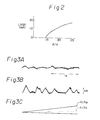
- the lean mixture sensor 7 generates a limit current signal LNSR as shown in Fig. 2 and transmits it via a current-to-voltage converter circuit 102 of the control circuit 10 to the A/D converter 101 thereof.
- a coolant sensor 9 Disposed in a water jacket 8 of a cylinder block of the engine 1 is a coolant sensor 9 for detecting the coolant temperature THW.
- the coolant sensor 9 generates an analog voltage signal in response to the coolant temperature THW and transmits it to the A/D converter 101.
- crank angle sensors 12 and 13 Disposed in a distributor 11 are crank angle sensors 12 and 13 for detecting the angle of the crankshaft (not shown) of the engine 1.
- the crank-angle sensor 12 generates a pulse signal at every 720° crank angle (CA) while the crank-angle sensor 13 generates a pulse signal at every 30°CA.
- the pulse signals of the crank angle sensors 12 and 13 are supplied to an input/output (I/O) interface 103 of the control circuit 10.
- the output of the crank angle sensor 13 is then supplied to interruption terminals of a central processing unit (CPU) 105.
- CPU central processing unit
- each cylinder is a spark plug 14 connected via the distributor 11 to an ignition coil 15 which is driven by an igniter 16.
- the igniter 16 is connected to the I/O interface 103 of the control circuit 10. That is, current is supplied to the igniter 16 at a current supply start timing such as at 30°CA before a current supply end timing, thus turning on the igniter 16. Then, at a current supply end timing, i.e., at an ignition timing, the igniter 16 is turned off. This ignition of one cylinder of the engine is performed.
- EGR passage 17 Linked between the exhaust gas passage 6 and the intake air passage 2 is an EGR passage 17 having an EGR valve 18 therein.
- the EGR valve 18 is linked to a negative pressure actuator 19 which is selectively connected by a solenoid 20 to a negative pressure port of the surge tank 3 or to an atmosphere filter 21.
- the solenoid 20 When the solenoid 20 is energized by the control circuit 10, the negative pressure of the surge tank 3 is introduced via the solenoid 20 into the actuator 19 to open the EGR valve 18. Contrary to this, when the solenoid 20 is not energized, the atmospheric air is introduced via the filter 21 and the solenoid 20 into the actuator 19 to close the EGR valve 18.
- the solenoid 20 is controlled by the duty ratio of a driven signal generated from a driver circuit 110 of the control circuit 10.
- Reference numeral 22 designates a radiator having a bottom tank linked via a water pipe 23 to a water jacket 8' of the engine 1 and an upper tank linked via a water pipe 24 to the water pump (not shown). Disposed in the water pipe 24 is a coolant temperature control valve 25 for adjusting the coolant temperature.
- the control circuit 10 which may be constructed by a microcomputer, includes a driver circuit 104 for driving the fuel injector 5, a timer counter 106, a read-only memory (ROM) 107 for storing a main routine, interrupt routines such as a fuel injection routine, an ignition timing routine, tables (maps), constants, etc., a random-access memory 108 (RAM) for storing temporary data, a clock generator 109 for generating various clock signals, and the like, in addition to the A/D converter 101, the current-to-voltage converter circuit 102, the I/O interface 103, the CPU 105, and the driven circuit 110.
- ROM read-only memory
- RAM random-access memory
- the timer counter 106 may include a free-run counter, a first compare register, a first comparator for comparing the content of the free-run counter with that of the first compare register, flag registers for a first compare interruption, injection control, and the like, thus controlling the injection start and end operation. Further, the timer counter 106 may include a second compare register, a second comparator for comparing the content of the free-run counter with that of the second compare register, flag registers for a second compare interruption ignition control, and the like, thus controlling the current supply start and end operation for ignition.
- Interruptions occur at the CPU 105, when the A/D converter 101 completes an A/D conversion and generates an interrupt signal; when one of the crank angle sensors 13 generates a pulse signal; when the timer counter 106 generates a compare interrupt signal; and when the clock generator 109 generates a special clock signal.
- the pressure data PM of the pressure sensor 4 and the limit current data LNSR of the lean mixture sensor 7 are fetched by an A/D conversion routine executed at every predetermined time period and are then stored in the RAM 108. That is, the data PM and LNSR in the RAM 108 are renewed at every predetermined time period.
- the engine speed Ne is calculated by an interrupt routine executed at 30°CA, i.e., at every pulse signal of the crank angle sensor 13, and is then stored in the RAM 108.
- At least one engine parameter such as the fuel amount, the fuel supply timing, the ignition timing, the EGR amount, or the coolant temperature, is controlled in accordance with the detection of surging.
- Figure 4 is a routine for detecting surging, which is one part of an A/D conversion routine executed at every predetermined time period.
- the output signal LNSR of the lean mixture sensor 7 is fetched from the lean mixture sensor 7 via the A/D converter 101 and is stored in the RAM 108.
- other A/D conversions such as the intake air pressure data PM and the coolant temperature data THW, are also fetched and then stored in the RAM 108.
- an absolute value S between the current output LNSR and the previously fetched output LNSR of the lean mixture sensor 7 is calculated by: S ⁇ ILNSR - LNSROI - 1 where "1" is a constant for eliminating the fluctuation of the output signal LNSR of the lean mixture sensor 7 due to the feedback control of the air-fuel ratio. Therefore, this value "1" is not always necessary.
- the value S is guarded by a minimum value, which is, in this case, 0. That is, at step 403, it is determined whether or not S ⁇ 0 is satisfied. Only if S ⁇ 0 does the control proceed to step 404, which causes the value S to be 0.
- the value S is added to its cumulative value ⁇ LN, i.e., ⁇ LN ⁇ ⁇ LN + S.
- step 406 it is determined whether or not the engine is in a steady state.
- the conditions for a steady state are as follows:
- step 410 clears a counter T.
- the counter T is an up counter incremented at every predetermined time period, such as 32 ms, and is used for measuring the duration of the steady state.
- the control proceeds to step 411, which clears the cumulative value ALN.
- step 412 the value LNSRO is replaced by the content of LNSR the next execution.
- step 406 proceeds via step 407 to steps 411 and 412.
- step 407 the measuring operation of the steady state duration continues.
- step 407 proceeds via step 408 to step 412.
- step 408 the control at step 407 proceeds via step 408 to step 412.
- step 408 After 1.5 s after entering the steady state, the control at step 408 proceeds to step 409, which calculates
- ⁇ LN is a blunt value (mean value) of ⁇ LN, and n is, for example, 16. Then, the control proceeds via steps 410, 411, and 412 to step 413.
- step 406 proceeds to step 410, thus returning to an initial state.
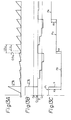
- the output signal LNSR of the lean mixture sensor 7 represents the change of the combustion state of the engine and, accordingly, the cumulative value ⁇ LN represents a surging level. That is, when the change of the combustion state of the engine is small, as illustrated in Fig. 3A, the cumulative value ⁇ LN increases slowly as indicated by a solid-dotted line ⁇ LN A in Fig. 3C. Contrary to this, when the change of the combustion state of the engine is large, as illustrated in Fig. 3B, the cumulative value ⁇ LN increases rapidly as indicated by a solid line ⁇ LN B in Fig. 3C. Thus, the degree of surging can be determined by ⁇ LN. In addition, the past surging levels can be reflected in the current surging level by using the blunt value ⁇ LN.
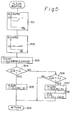
- Figure 5 is a routine for calculating a lean air-fuel ratio correction coefficient KLEAN executed at every predetermined time period. Note that the coefficient KLEAN satisfies the condition: KLEAN ⁇ 1.0.
- KLEANPM is calculated from a one-dimensional map stored in the ROM 107 by using the parameter PM as shown in the block of step 501.
- KLEANNE is calculated from a one-dimensional map stored in the ROM 107 by using the parameter Ne as shown on the block of step 502. Then at step 703, KLEAN ⁇ KLEANPM ⁇ KLEANNE.
- step 504 it is determined whether or not the blunt value ⁇ LN satisfies ⁇ LN ⁇ C 1 , and at step 506, it is determined whether or not the blunt value ⁇ LN satisfies ⁇ LN > C 2 .
- C 1 and C 2 are surging determination levels. That is, the surging determination results have hysteresis characteristics.
- step 505 decreases KLEAN by K 1 (definite value). If ⁇ LN > C 2 , the control proceeds to step 507, which increases KLEAN by K 2 (definite value). That is, if no surging is detected, KLEAN is decreases to decrease the fuel injection amount, while if surging is detected, KLEAN is increased to increase the fuel injection amount.
- step 508 causes the blunt value ⁇ LN to be (C 1 + C 2 )/2, which is an initial value, thereby avoiding an overrich air-fuel ratio.
- this step 508 is also not always necessary.
- step 509 KLEAN is not changed.
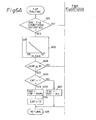
- Figure 6 is a routine for calculating an air-fuel ratio feedback correction coefficient FAF executed at every predetermined time period.
- step 601 it is determined whether or not all the feedback control (closed-loop control) conditions are satisfied.
- the feedback control conditions are as follows:
- a comparison reference value IR is calculated from a one-dimensional map stored in the ROM 107 by using the parameter KLEAN obtained by the routine of Fig. 5. Note that this one-dimensional map is shown in the block of step 602. That is, the comparison reference value IR is variable in accordance with the coefficient KLEAN, thereby changing the aimed air-fuel ratio of the feedback control in accordance with the coefficient KLEAN.
- step 603 the output LNSR Of the lean mixture sensor 7 stored in the RAM 108 is compared with the comparison reference value IR, thereby determining whether the current air-fuel ratio is on the rich side or on the lean side with respect to the aimed air-fuel ratio. If LNSR ⁇ IR so that the current air-fuel ratio is on the rich side, the control proceeds to step 604 which determines whether or not a skip flag CAF is "1".
- the value "1" of the skip flag CAF is used for a skip operation when a first change from the rich side to the lean side occurs in the controlled air-fuel ratio, while the value "0" is used for a skip operation when a first change from the lean side to the rich side occurs in the controlled air-fuel ratio.
- step 605 decreases the coefficient FAF by a relatively large amount SKP 1 .
- step 606 the skip flag CAF is cleared, i.e. CAF ⁇ "0".
- step 607 decreases the coefficient FAF by a relatively small amount K 1 .
- SKP1 is a constant for a skip operation which remarkably increases the coefficient FAF when a first change from the lean side (LNSR > IR) to the rich side (LNSR ⁇ IR) occurs in the controlled air-fuel ratio
- KI 1 is a constant for an integration operation which gradually decreases the coefficient FAF when the controlled air-fuel ratio is on the rich side.
- step 603 if LNSR > IR so that the current air-fuel ratio is on the lean side, the control proceeds to step 608, which determines whether or not the skip flag CAF is "0". As a result, if the skip flag CAF is "0", the control proceeds to step 609, which increases the coefficient FAF by a relatively large amount SKP2. Then, at step 610, the skip flag CAF is set, i.e., CAF ⁇ "1". Thus, when the control at step 608 is further carried out, the control proceeds to step 611, which increases the coefficient FAF by a relatively small amount KI 2 .
- SKP 2 is a constant for a skip operation which remarkably increases the coefficient FAF when a first change from the rich side (LNSR ⁇ IR) to the lean side (LNSR > IR) occurs in the controlled air-fuel ratio
- KI 2 is a constant for an integration operation which gradually increases the coefficient FAF when the controlled air-fuel ratio is on the lean side.
- the air-fuel ratio feedback correction coefficient FAF obtained at step 605, 607, 609, 611, or 612 is stored in the RAM 108, and the routine of Fig. 6 is completed by step 613.
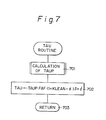
- Figure 7 is a routine for calculating a fuel injection time period TAU executed at every predetermined crank angle.
- this routine is executed at every 360°CA in a simultaneous fuel injection system for simultaneously injecting all the injectors and is executed at every 180°CA in a sequential fuel injection system applied to a four-cylinder engine for sequentially injecting the injectors thereof.
- a fuel injection time period TAUP is calculated from a two-dimensional map stored in the ROM 107 by using the parameters PM and Ne. Then, at step 702, a fuel injection time period TAU is calculated by TAU + TAUP ⁇ FAF ⁇ (1+KLEAN+ ⁇ ) ⁇ + ⁇ where a, 8, and y are correction factors determined by other parameters such as the signal of the intake air temperature sensor, the voltage of the battery (both not shown), and the like. Then the calculated fuel injection time period TAU is stored in the RAM 108, and the routine of Fig. 7 is completed by step 703.
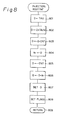
- Figure 8 is a routine for controlling the fuel injection in accordance with the fuel injection time period TAU calculated by the routine of Fig. 7, executed at every predetermined crank angle. Also, this routine is executed at every 360°CA in a simultaneous fuel injection system and is executed at every 180°CA in an sequential fuel injection system applied to a four-cylinder engine.
- the fuel injection time period TAU stored in the RAM 108 is read out and is transmitted to the D register (not shown) included in the CPU 105.
- an invalid fuel injection time period TAUV which is also stored in the RAM 108 is added to the content of the D register.
- the current time CNT of the free-run counter of the timer counter 106 is read out and is added to the content of the D register, thereby obtaining an injection end time t in the D register. Therefore, at step 804, the content of the D register is stored as the injection end time t in the RAM 108.
- step 805 the current time CNT of the free-run counter is read out and is set in the D register. Then, at step 806, a small time period t 0 , which is definite or determined by the predetermined parameters, is added to the content of the D register. At step 807, the content of the D register is set in the first compare register of the timer counter 106, and at step 808, a fuel injection execution flag and a compare I interrupt permission flag are set in the registers of the timer counter 106. The routine of Fig. 8 is completed by step 809.
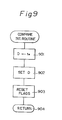
- step 901 the injection end time t e stored in the RAM 108 is read out and is transmitted to the D register.
- the content of the D register is set in the first compare register of the timer counter 106 and at step 903, the fuel injection execution flag and the compare I interrupt permission flag are reset.
- the routine of Fig. 9 is completed by step 904.
- the lean air-fuel ratio correction coefficient KLEAN is controlled in accordance with the surging level, i.e., aLN, and accordingly, the fuel injection time period TAU is controlled in accordance with the surging level ALN.
- FIG. 10 A second embodiment of the present invention will be explained with reference to Figs. 10 through 14. Note that this second embodiment also includes the routines of Figs. 4, 6, 7, and 9.
- the routine of Fig. 10 is provided instead of Fig. 5 of the first embodiment. That is, the steps 504 through 508 of Fig. 5 are deleted. Therefore, in the second embodiment, the lean air-fuel ratio correction coefficient KLEAN does not change in response to the surging level, i.e., ALN.
- the routine of Fig. 11 is provided instead of Fig. 8 of the first embodiment, thereby controlling the fuel injection timing in accordance with the surging level, i.e, ALN.
- an injection start time t i is calculated from a two-dimensional map stored on the ROM 107 by using the parameters PM and Ne. However, note that t i can be a definite time.
- an injection end time t e is calculated by: t e ⁇ t i + TAU + TAUV
- TAU is the fuel injection time period calculated by the routine of Fig. 7, and TAU is an invalid fuel injection time period.
- step 1103 it is determined whether or not the blunt value ⁇ LN satisfies ⁇ LN ⁇ C 1 , and at step 1104, it is determined whether or not the blunt value ALN satisfies ⁇ LN > C2 (> C1).
- step 1104 advances the injection start time t i by K 3 (definite value), and further proceeds to step 1105, which advances the injection end time t e by K 3 .
- step 1107 delays the injection start time t i by K 4 , (definite value), and further proceeds to step 1108, which delays the injection end time t e by K 4 . That is, if no surging is detected, the fuel injection timing is advanced, while if surging is detected, the fuel injection timing is delayed.
- step 1108 proceeds to step 1109, which causes the blunt value ⁇ LN to be (C1 + C 2 )/2, which is an initial value, thereby avoiding an overrich air-fuel ratio.
- this step 1109 is not always necessary.
- step 1110 If C 1 ⁇ ⁇ LN ⁇ C 2 , the control proceeds directly to step 1110. That is, the fuel injection timing is not changed.
- the current time CNT of the free-run counter is read out and is set in the D register. Then, at step 1111, the injection end time t e is added to the content of the D register. At step 1112, the content of the D register is stored as the final injection end time t in the RAM 108.
- step 1113 the current time CNT of the free-run counter is read out and is set in the D register. Then, at step 1114, the injection start time tiis added to the content of the D register. At step 1115, the content of the D register is set in the first compare register of the timer counter 106, and at step 1116, the fuel injection execution flag and the compare I interrupt permission flag are set in the registers of the timer counter 106. The routine of Fig. 11 is completed by step 1117.
- the driven circuit 104 of the control circuit 10 generates in injection pulse as shown in Fig. 12, in which DC and TDC designate a bottom dead center and a top dead center, respectively, of one cylinder.
- the output signal LNSR of the lean sensor 7 is accumulated for 1 s at every 1.5 s, as illustrated in FIg. 13A, and the blunt value ALN is calculated at every 1.5 s as illustrated in Fig. 13B. If the blunt value ⁇ LN exceeds the value C 2 , the fuel injection timing is delayed from P 1 to P 2 , as illustrated in Fig. 13C, while if the blunt value LN becomes smaller than the value C 1 , the fuel injection timing is advanced from P 2 to P 3 (or from P 3 to P 4 ), as illustrated in Fig. 13C.
- the values C 1 and C 2 are determined suitably for the surging level ⁇ LN and the NOx emission.
- feedback of the fuel injection timing is controlled so that the degree of surging is brought close to (C l + C 2 )/2.
- the delay amount K 4 is considerably larger than the advance amount K 3 .
- the surging level ⁇ LN is changed as indicated by ⁇ LN 1 in Fig. 15, when it exceeds the value C 1 , while it is changed as indicated by ⁇ LN 2 in Fig. 15, when it becomes smaller than the value C 2 .
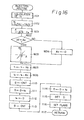
- Figure 16 is a modification of the routine of Fig. 11.
- steps 1601 through 1606 are provided instead of steps 1103 through 1109 of Fig. 11. That is, at step 1601, the difference A between the blunt value LN and a definite value C A is calculated, i.e., A ⁇ ⁇ LN - C A .
- the definite value C A is, for example, equal to (C 1 + C 2 )/2 (see step 1109 of Fig. 11). Then, at step 1602, it is determined whether or not
- the injection start time t i is changed by adding K 0 thereto.
- the injection end time t e is changed by adding K 0 thereto. In this case, if K 0 is positive, the fuel injection timing is delayed, while if K 0 is negative, the fuel injection time is advanced.
- correction amount K 0 can be also changed by the engine speed N , the coolant temperature THW, the intake air pressure PM, and the like, in addition to the value
- a third embodiment of the present invention will be explained with reference to Figs. 18 and 19. Note that this third embodiment also includes the routine of Fig. 4.
- Figure 18 is a routine for controlling an ignition timing executed at every predetermined crank angle, such as 180°CA, in a four-cylinder engine.
- a base advance angle ⁇ B (°CA) is calculated from a two-dimensional map stored on the ROM 107 using the parameters PM and N .
- step 1802 it is determined whether or not the blunt value ⁇ LN satisfies ⁇ LN ⁇ C 1 , and at step 1804, it is determined whether or not the blunt value ⁇ LN satisfies ⁇ LN > C 2 .
- step 1803 decreases ⁇ B by K 5 (definite value), while if ⁇ LN > C 2 , the control proceeds to step 1805, which increases 6 B by K 6 (definite value). That is, if no surging is detected, ⁇ B is decreased to delay the ignition timing, while if surging is detected, 6 B is increased to advance the ignition timing. That is, in this case, the engine torque is increased by advancing the ignition timing, thus reducing surging.
- step 1805 proceeds to step 1806 which causes the blunt value ALN to be (C 1 + C 2 )/2, which is an initial value, thereby avoiding the overadvance of the ignition timing.
- this step 1806 is also not always necessary.
- the base advance value ⁇ B is corrected by other parameters to obtain a final ignition timing.
- the ignition timing is converted into time (current supply start timing), and a term of 30°CA is converted into time t ' , which is then stored in the RAM 108.
- the current time CNT of the free-run counter is read out and is set in the D register.
- the current supply start timing t i is added to the content of the D register.
- the content of the D register is set in the second compare register of the timer counter 106.
- step 1810 a current supply execution flag and a compare II interrupt permission flag are set in the registers of the timer counter 106.
- the routine of Fig. 18 is completed by step 1811.
- a current supply signal due to the presence of the current supply execution flag is transmitted from the timer counter 106 via the I/O interface 103 to the igniter 16 thereby initiating current supply to the igniter 16.
- a compare II interrupt signal due to. the presence of the compare II interrupt permission flag is transmitted from the timer counter 106 to the CPU 105, thereby initiating a compare II interrupt routine as illustrated in Fig. 19.
- step 1901 the current supply end timing t' stored in the RAM 108 is read out and is transmitted to the D register.
- the content of the D register is set in the second compare register of the timer counter 106, and at step 1903, the current supply execution flag and the compare II interrupt permission flag are reset.
- the routine of Fig. 19 is completed by step 1904.
- the igniter 16 is turned on before 30° CA of the ignition timing, and the igniter 16 is turned otf at the ignition timing.
- an ignition signal as shown in Fig. 20 is generated.
- A6 of Fig. 20 represents the correction amount by steps 1803, 1805, and 1807.
- feedback of the ignition timing is controlled so that the surging level is brought close to (C1 + C 2 )/2.
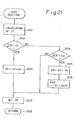
- FIG. 21 A fourth embodiment of the present invention will be explained with reference to Fig. 21. Note that this fourth embodiment also includes the routine of Fig. 4.
- Figure 21 is a routine for controlling the opening of the EGR value 17 executed at every predetermined time period.
- a duty ratio DT is calculated from a two-dimensional map stored on the ROM 107 using the parameters PM and N .
- step 2102 it is determined whether or not the blunt value ⁇ LN satisfies ⁇ LN ⁇ C 1 , and at step 2104, it is determined whether or not the blunt value ⁇ LN satisfies ⁇ LN > C 2 .
- step 2103 which increases DT by K 7 (definite value)
- step 2105 which decreases DT by K 8 (definite value). That is, if no surging is detected, DT is increased to increase the EGR amount, while if surging is detected, DT is decreased to decrease the EGR amount.
- step 2105 the control at step 2105 proceeds to step 2106, which causes the blunt value ⁇ LN to be (C 1 + C 2 )/2, which is an initial value, thereby avoiding overage of the EGR amount.
- this step 2106 is not always necessary.
- step 2107 If C 1 ⁇ ⁇ LN ⁇ C 2 , the control proceeds directly to step 2107. That is, DT is not changed.
- the calculated duty ratio DT is set in the driver circuit 110, and accordingly, a driving signal having the duty-ratio DT is applied by the driver circuit 110 to the solenoid 19, thus controlling the EGR value 17.
- the opening of the EGR valve 17 has a relationship to the duty ratio DT of the driving signal as shown in Fig. 22.
- the routine of Fig. 21 is completed by step 2108.
- the EGR amount when the surging level, i.e., ⁇ LN is large, the EGR amount is decreased, while when the surging level is small, the EGR amount is increased. That is, feedback of the EGR amount is controlled so that the surging level is brought close to (C 1 + C 2 )/ 2,
- the present invention can be also applied to a system in which the EGR valve 17 is controlled by a step motor or the like, instead of the duty ratio control.
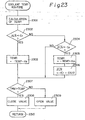
- a fifth embodiment of the present invention will be explained with reference to Fig. 23. Note that this fifth embodiment also includes the routine of Fig. 4.
- Figure 23 is a routine for controlling the coolant temperature THW executed at every predetermined time period.
- an aimed coolant duty ratio temperature TEMP is calculated from a two-dimensional map stored on the ROM 107 using the parameters PM and N .
- step 2302 it is determined whether or not the blunt value ALN satisfies ⁇ LN ⁇ C 1 , and at step 2304, it is determined whether or not the blunt value ⁇ LN satisfies ⁇ LN > C 2 .
- step 2303 which increases TEMP by K 9 (definite value)
- step 2305 which decreases TEMP by K 10 (definite value). That is, if no surging is detected, TEMP is decreased to decrease the coolant temperature THW, while if surging is detected, TEMP is decreased to increase coolant temperature THW.
- step 2305 proceeds to step 2306, which causes the blunt value ⁇ LN to be (C 1 + C 2 )/2, which is an initial value, thereby avoiding overheating of the coolant.
- this step 2306 is not always necessary.
- step 2307 If C 1 ⁇ ⁇ LN ⁇ C 2 , the control proceeds directly to step 2307. That is, TEMP is not changed.
- step 2307 it is determined whether or not the current coolant temperature THW is larger than the aimed temperature TEMP. It THW > TEMP, at step 2308, the (PL) 105 closes the control valve 25, while if THW ⁇ TEMP, the CPU 105 opens the control valve 25. That is, the control valve 25 is driven so that the coolant temperature THW is brought close to the aimed temperature TEMP. Then, this routine of Fig. 23 is completed by step 2310.
- the coolant temperature T HW is increased, while when the surging level is small, the coolant temperature THW is decreased. That is, feedback of the coolant temperature THW controlled so that the surging level is brought close to (C l + C 2 )/2.
- the present invention can be also applied to a fuel injection system using the other parameters such as the intake air amount and the engine speed or the throttle opening value and the engine speed.
- surging or misfiring can be detected without using a gravity sensor, thus reducing manufacturing costs.
Landscapes
- Engineering & Computer Science (AREA)
- Chemical & Material Sciences (AREA)
- Combustion & Propulsion (AREA)
- Mechanical Engineering (AREA)
- General Engineering & Computer Science (AREA)
- Electrical Control Of Air Or Fuel Supplied To Internal-Combustion Engine (AREA)
Applications Claiming Priority (4)
| Application Number | Priority Date | Filing Date | Title |
|---|---|---|---|
| JP8924884A JPS60233334A (ja) | 1984-05-07 | 1984-05-07 | 内燃機関の燃料噴射量制御装置 |
| JP89248/84 | 1984-05-07 | ||
| JP7275585A JPS61232364A (ja) | 1985-04-08 | 1985-04-08 | 内燃機関のサ−ジング制御装置 |
| JP72755/85 | 1985-04-08 |
Publications (3)
| Publication Number | Publication Date |
|---|---|
| EP0160959A2 true EP0160959A2 (de) | 1985-11-13 |
| EP0160959A3 EP0160959A3 (en) | 1986-12-03 |
| EP0160959B1 EP0160959B1 (de) | 1989-05-03 |
Family
ID=26413894
Family Applications (1)
| Application Number | Title | Priority Date | Filing Date |
|---|---|---|---|
| EP85105499A Expired EP0160959B1 (de) | 1984-05-07 | 1985-05-06 | Verfahren und Gerät zur Detektierung des Abwürgens einer Innenbrennkraftmaschine |
Country Status (3)
| Country | Link |
|---|---|
| US (1) | US4653451A (de) |
| EP (1) | EP0160959B1 (de) |
| DE (1) | DE3569959D1 (de) |
Cited By (2)
| Publication number | Priority date | Publication date | Assignee | Title |
|---|---|---|---|---|
| GB2197093A (en) * | 1986-11-04 | 1988-05-11 | Ford Motor Co | Adaptive air fuel control using hydrocarbon variability feedback |
| US5060618A (en) * | 1990-01-30 | 1991-10-29 | Toyota Jidosa Kabushiki Kaisha | Method and apparatus for controlling torque variations in an internal combustion engine |
Families Citing this family (4)
| Publication number | Priority date | Publication date | Assignee | Title |
|---|---|---|---|---|
| JPH0718359B2 (ja) * | 1987-03-14 | 1995-03-01 | 株式会社日立製作所 | エンジンの空燃比制御方法 |
| JPH04365947A (ja) * | 1991-06-11 | 1992-12-17 | Nippondenso Co Ltd | エンジン用空燃比制御装置 |
| JP3326811B2 (ja) * | 1992-05-19 | 2002-09-24 | 株式会社デンソー | 内燃機関のリーンバーン制御装置 |
| US5551410A (en) * | 1995-07-26 | 1996-09-03 | Ford Motor Company | Engine controller with adaptive fuel compensation |
Family Cites Families (7)
| Publication number | Priority date | Publication date | Assignee | Title |
|---|---|---|---|---|
| JPS5213250B2 (de) * | 1973-05-31 | 1977-04-13 | ||
| DE2554988C2 (de) * | 1975-12-06 | 1985-01-10 | Robert Bosch Gmbh, 7000 Stuttgart | Verfahren zur Bestimmung der Zusammensetzung des einer Brennkraftmaschine zugeführten Betriebsgemisches bzw. des Verbrennungsablaufs des Betriebsgemisches und Einrichtung zur Durchführung des Verfahrens |
| US4031747A (en) * | 1976-08-16 | 1977-06-28 | Beckman Instruments, Inc. | Misfire monitor for engine analysis having automatic rescaling |
| US4030349A (en) * | 1976-08-16 | 1977-06-21 | Beckman Instruments, Inc. | Engine analysis apparatus |
| JPS57135243A (en) * | 1981-02-17 | 1982-08-20 | Fuji Heavy Ind Ltd | Air-fuel ratio controller |
| DE3210810C2 (de) * | 1982-03-24 | 1984-11-08 | Mataro Co. Ltd., Georgetown, Grand Cayman Islands | Regelsystem zur Beeinflussung der Zusammensetzung der in einer fremdgezündeten Brennkraftmaschine zu verbrennenden Ladungen |
| US4445326A (en) * | 1982-05-21 | 1984-05-01 | General Motors Corporation | Internal combustion engine misfire detection system |
-
1985
- 1985-05-06 EP EP85105499A patent/EP0160959B1/de not_active Expired
- 1985-05-06 DE DE8585105499T patent/DE3569959D1/de not_active Expired
- 1985-05-07 US US06/731,522 patent/US4653451A/en not_active Expired - Lifetime
Cited By (3)
| Publication number | Priority date | Publication date | Assignee | Title |
|---|---|---|---|---|
| GB2197093A (en) * | 1986-11-04 | 1988-05-11 | Ford Motor Co | Adaptive air fuel control using hydrocarbon variability feedback |
| GB2197093B (en) * | 1986-11-04 | 1990-12-12 | Ford Motor Co | Adaptive air fuel control using hydrocarbon variability feedback |
| US5060618A (en) * | 1990-01-30 | 1991-10-29 | Toyota Jidosa Kabushiki Kaisha | Method and apparatus for controlling torque variations in an internal combustion engine |
Also Published As
| Publication number | Publication date |
|---|---|
| DE3569959D1 (en) | 1989-06-08 |
| US4653451A (en) | 1987-03-31 |
| EP0160959A3 (en) | 1986-12-03 |
| EP0160959B1 (de) | 1989-05-03 |
Similar Documents
| Publication | Publication Date | Title |
|---|---|---|
| US5278762A (en) | Engine control apparatus using exhaust gas temperature to control fuel mixture and spark timing | |
| US5711272A (en) | Fuel property detection for an engine using engine speed | |
| US4644921A (en) | Method and apparatus for controlling air-fuel ratio in internal combustion engine | |
| EP0162365B1 (de) | Verfahren und Gerät zur Steuerung des Luft-Kraftstoffverhältnisses in einer Innenbrennkraftmaschine | |
| US4469072A (en) | Method and apparatus for controlling the fuel-feeding rate of an internal combustion engine | |
| US4627402A (en) | Method and apparatus for controlling air-fuel ratio in internal combustion engine | |
| EP0490393A2 (de) | Gerät zur Steuerung von Drehmomentänderungen in einer Brennkraftmaschine | |
| US4651700A (en) | Method and apparatus for controlling air-fuel ration in internal combustion engine | |
| JPH0258459B2 (de) | ||
| US4727841A (en) | System for controlling internal combustion engine using knocking and overtemperature preventing fuel correction | |
| US4653451A (en) | Method and apparatus for detecting surging in internal combustion engine | |
| US4648370A (en) | Method and apparatus for controlling air-fuel ratio in internal combustion engine | |
| US7448360B2 (en) | Controller of internal combustion engine | |
| US4854124A (en) | Double air-fuel ratio sensor system having divided-skip function | |
| US5899192A (en) | Fuel supply control system for internal combustion engines | |
| EP0160949A2 (de) | Verfahren und Gerät zur Steuerung des Luft-Kraftstoffverhältnisses in einer Innenbrennkraftmaschine mit sequentieller Kraftstoffeinspritzung | |
| US4502448A (en) | Method for controlling control systems for internal combustion engines immediately after termination of fuel cut | |
| US4713766A (en) | Method and apparatus for controlling air-fuel ratio in internal combustion engine | |
| US5172676A (en) | Air-fuel ratio control apparatus in internal combustion engine using different kinds of fuels | |
| JP2001082302A (ja) | 内燃機関の点火時期制御装置 | |
| US4694805A (en) | Air-fuel ratio control method for internal combustion engines | |
| JP2551378Y2 (ja) | 内燃機関の電子制御燃料噴射装置 | |
| JP2600824B2 (ja) | 内燃機関の空燃比制御装置 | |
| JPH0633855A (ja) | イオン電流によるmbt制御方法 | |
| JP3170046B2 (ja) | 内燃機関の空燃比学習方法 |
Legal Events
| Date | Code | Title | Description |
|---|---|---|---|
| PUAI | Public reference made under article 153(3) epc to a published international application that has entered the european phase |
Free format text: ORIGINAL CODE: 0009012 |
|
| 17P | Request for examination filed |
Effective date: 19850506 |
|
| AK | Designated contracting states |
Designated state(s): DE FR GB |
|
| PUAL | Search report despatched |
Free format text: ORIGINAL CODE: 0009013 |
|
| AK | Designated contracting states |
Kind code of ref document: A3 Designated state(s): DE FR GB |
|
| 17Q | First examination report despatched |
Effective date: 19871012 |
|
| GRAA | (expected) grant |
Free format text: ORIGINAL CODE: 0009210 |
|
| AK | Designated contracting states |
Kind code of ref document: B1 Designated state(s): DE FR GB |
|
| REF | Corresponds to: |
Ref document number: 3569959 Country of ref document: DE Date of ref document: 19890608 |
|
| ET | Fr: translation filed | ||
| PLBE | No opposition filed within time limit |
Free format text: ORIGINAL CODE: 0009261 |
|
| STAA | Information on the status of an ep patent application or granted ep patent |
Free format text: STATUS: NO OPPOSITION FILED WITHIN TIME LIMIT |
|
| 26N | No opposition filed | ||
| REG | Reference to a national code |
Ref country code: GB Ref legal event code: 746 Effective date: 19940523 |
|
| PGFP | Annual fee paid to national office [announced via postgrant information from national office to epo] |
Ref country code: DE Payment date: 20010430 Year of fee payment: 17 |
|
| PGFP | Annual fee paid to national office [announced via postgrant information from national office to epo] |
Ref country code: GB Payment date: 20010502 Year of fee payment: 17 |
|
| PGFP | Annual fee paid to national office [announced via postgrant information from national office to epo] |
Ref country code: FR Payment date: 20010518 Year of fee payment: 17 |
|
| REG | Reference to a national code |
Ref country code: GB Ref legal event code: IF02 |
|
| PG25 | Lapsed in a contracting state [announced via postgrant information from national office to epo] |
Ref country code: GB Free format text: LAPSE BECAUSE OF NON-PAYMENT OF DUE FEES Effective date: 20020506 |
|
| PG25 | Lapsed in a contracting state [announced via postgrant information from national office to epo] |
Ref country code: DE Free format text: LAPSE BECAUSE OF NON-PAYMENT OF DUE FEES Effective date: 20021203 |
|
| GBPC | Gb: european patent ceased through non-payment of renewal fee |
Effective date: 20020506 |
|
| PG25 | Lapsed in a contracting state [announced via postgrant information from national office to epo] |
Ref country code: FR Free format text: LAPSE BECAUSE OF NON-PAYMENT OF DUE FEES Effective date: 20030131 |
|
| REG | Reference to a national code |
Ref country code: FR Ref legal event code: ST |