EP0161332B1 - Marque en élastomère pour signalisation routière - Google Patents
Marque en élastomère pour signalisation routière Download PDFInfo
- Publication number
- EP0161332B1 EP0161332B1 EP84111987A EP84111987A EP0161332B1 EP 0161332 B1 EP0161332 B1 EP 0161332B1 EP 84111987 A EP84111987 A EP 84111987A EP 84111987 A EP84111987 A EP 84111987A EP 0161332 B1 EP0161332 B1 EP 0161332B1
- Authority
- EP
- European Patent Office
- Prior art keywords
- pavement marker
- marker
- base
- raised surface
- elastomer
- Prior art date
- Legal status (The legal status is an assumption and is not a legal conclusion. Google has not performed a legal analysis and makes no representation as to the accuracy of the status listed.)
- Expired
Links
- 239000003550 marker Substances 0.000 title claims description 46
- 229920001971 elastomer Polymers 0.000 claims description 28
- 239000000463 material Substances 0.000 claims description 20
- 239000000806 elastomer Substances 0.000 claims description 12
- 239000010410 layer Substances 0.000 claims description 12
- 229920002635 polyurethane Polymers 0.000 claims description 12
- 239000004814 polyurethane Substances 0.000 claims description 12
- 239000000853 adhesive Substances 0.000 claims description 10
- 230000001070 adhesive effect Effects 0.000 claims description 10
- 230000001413 cellular effect Effects 0.000 claims description 10
- 229920000642 polymer Polymers 0.000 claims description 10
- 229910003460 diamond Inorganic materials 0.000 claims description 9
- 239000010432 diamond Substances 0.000 claims description 9
- 230000001681 protective effect Effects 0.000 claims description 8
- 229920002943 EPDM rubber Polymers 0.000 claims description 7
- 239000004820 Pressure-sensitive adhesive Substances 0.000 claims description 7
- 239000011159 matrix material Substances 0.000 claims description 7
- 230000006835 compression Effects 0.000 claims description 6
- 238000007906 compression Methods 0.000 claims description 6
- 229920001084 poly(chloroprene) Polymers 0.000 claims description 4
- 239000007787 solid Substances 0.000 claims description 4
- 239000000203 mixture Substances 0.000 claims description 3
- 230000003287 optical effect Effects 0.000 claims description 3
- 239000012790 adhesive layer Substances 0.000 claims description 2
- 229920002379 silicone rubber Polymers 0.000 claims description 2
- 239000004945 silicone rubber Substances 0.000 claims description 2
- 210000001364 upper extremity Anatomy 0.000 claims description 2
- 230000001419 dependent effect Effects 0.000 claims 1
- 239000005060 rubber Substances 0.000 description 16
- 239000003981 vehicle Substances 0.000 description 13
- 239000011248 coating agent Substances 0.000 description 9
- 238000000576 coating method Methods 0.000 description 9
- 238000000034 method Methods 0.000 description 7
- 239000011324 bead Substances 0.000 description 5
- 239000006260 foam Substances 0.000 description 5
- 239000011521 glass Substances 0.000 description 5
- 239000004005 microsphere Substances 0.000 description 4
- 238000002310 reflectometry Methods 0.000 description 4
- YXFVVABEGXRONW-UHFFFAOYSA-N Toluene Chemical compound CC1=CC=CC=C1 YXFVVABEGXRONW-UHFFFAOYSA-N 0.000 description 3
- 125000001931 aliphatic group Chemical group 0.000 description 3
- 230000008901 benefit Effects 0.000 description 3
- 238000001035 drying Methods 0.000 description 3
- 239000003973 paint Substances 0.000 description 3
- 239000004604 Blowing Agent Substances 0.000 description 2
- KFZMGEQAYNKOFK-UHFFFAOYSA-N Isopropanol Chemical compound CC(C)O KFZMGEQAYNKOFK-UHFFFAOYSA-N 0.000 description 2
- 229910052782 aluminium Inorganic materials 0.000 description 2
- XAGFODPZIPBFFR-UHFFFAOYSA-N aluminium Chemical compound [Al] XAGFODPZIPBFFR-UHFFFAOYSA-N 0.000 description 2
- 238000005452 bending Methods 0.000 description 2
- QXJJQWWVWRCVQT-UHFFFAOYSA-K calcium;sodium;phosphate Chemical compound [Na+].[Ca+2].[O-]P([O-])([O-])=O QXJJQWWVWRCVQT-UHFFFAOYSA-K 0.000 description 2
- 239000003795 chemical substances by application Substances 0.000 description 2
- 230000006378 damage Effects 0.000 description 2
- 238000001125 extrusion Methods 0.000 description 2
- 229920000728 polyester Polymers 0.000 description 2
- 238000003825 pressing Methods 0.000 description 2
- 230000008569 process Effects 0.000 description 2
- 239000000243 solution Substances 0.000 description 2
- 239000004593 Epoxy Substances 0.000 description 1
- CTQNGGLPUBDAKN-UHFFFAOYSA-N O-Xylene Chemical compound CC1=CC=CC=C1C CTQNGGLPUBDAKN-UHFFFAOYSA-N 0.000 description 1
- 239000005062 Polybutadiene Substances 0.000 description 1
- 239000004698 Polyethylene Substances 0.000 description 1
- 208000027418 Wounds and injury Diseases 0.000 description 1
- 238000009825 accumulation Methods 0.000 description 1
- 230000009471 action Effects 0.000 description 1
- 230000001154 acute effect Effects 0.000 description 1
- 239000012267 brine Substances 0.000 description 1
- 238000005266 casting Methods 0.000 description 1
- 239000000919 ceramic Substances 0.000 description 1
- 230000008859 change Effects 0.000 description 1
- 150000001875 compounds Chemical class 0.000 description 1
- 238000005520 cutting process Methods 0.000 description 1
- 238000000354 decomposition reaction Methods 0.000 description 1
- 230000006866 deterioration Effects 0.000 description 1
- 230000000694 effects Effects 0.000 description 1
- 238000005516 engineering process Methods 0.000 description 1
- HQQADJVZYDDRJT-UHFFFAOYSA-N ethene;prop-1-ene Chemical group C=C.CC=C HQQADJVZYDDRJT-UHFFFAOYSA-N 0.000 description 1
- 239000004744 fabric Substances 0.000 description 1
- 239000000835 fiber Substances 0.000 description 1
- 239000011152 fibreglass Substances 0.000 description 1
- 208000014674 injury Diseases 0.000 description 1
- 238000005304 joining Methods 0.000 description 1
- 238000011068 loading method Methods 0.000 description 1
- 238000004519 manufacturing process Methods 0.000 description 1
- 229910052751 metal Inorganic materials 0.000 description 1
- 239000002184 metal Substances 0.000 description 1
- 238000012986 modification Methods 0.000 description 1
- 230000004048 modification Effects 0.000 description 1
- ISWSIDIOOBJBQZ-UHFFFAOYSA-N phenol group Chemical group C1(=CC=CC=C1)O ISWSIDIOOBJBQZ-UHFFFAOYSA-N 0.000 description 1
- 229920002857 polybutadiene Polymers 0.000 description 1
- -1 polyethylene Polymers 0.000 description 1
- 229920000573 polyethylene Polymers 0.000 description 1
- 229920001296 polysiloxane Polymers 0.000 description 1
- 230000002787 reinforcement Effects 0.000 description 1
- 238000007763 reverse roll coating Methods 0.000 description 1
- 230000000630 rising effect Effects 0.000 description 1
- 239000002356 single layer Substances 0.000 description 1
- HPALAKNZSZLMCH-UHFFFAOYSA-M sodium;chloride;hydrate Chemical compound O.[Na+].[Cl-] HPALAKNZSZLMCH-UHFFFAOYSA-M 0.000 description 1
- 239000008259 solid foam Substances 0.000 description 1
- 239000002904 solvent Substances 0.000 description 1
- 239000000126 substance Substances 0.000 description 1
- XLYOFNOQVPJJNP-UHFFFAOYSA-N water Substances O XLYOFNOQVPJJNP-UHFFFAOYSA-N 0.000 description 1
- 239000008096 xylene Substances 0.000 description 1
Images

Classifications
-
- E—FIXED CONSTRUCTIONS
- E01—CONSTRUCTION OF ROADS, RAILWAYS, OR BRIDGES
- E01F—ADDITIONAL WORK, SUCH AS EQUIPPING ROADS OR THE CONSTRUCTION OF PLATFORMS, HELICOPTER LANDING STAGES, SIGNS, SNOW FENCES, OR THE LIKE
- E01F9/00—Arrangement of road signs or traffic signals; Arrangements for enforcing caution
- E01F9/50—Road surface markings; Kerbs or road edgings, specially adapted for alerting road users
- E01F9/553—Low discrete bodies, e.g. marking blocks, studs or flexible vehicle-striking members
- E01F9/565—Low discrete bodies, e.g. marking blocks, studs or flexible vehicle-striking members having deflectable or displaceable parts
- E01F9/573—Self-righting, upright flexible or rockable markers, e.g. resilient flaps bending over
-
- E—FIXED CONSTRUCTIONS
- E01—CONSTRUCTION OF ROADS, RAILWAYS, OR BRIDGES
- E01F—ADDITIONAL WORK, SUCH AS EQUIPPING ROADS OR THE CONSTRUCTION OF PLATFORMS, HELICOPTER LANDING STAGES, SIGNS, SNOW FENCES, OR THE LIKE
- E01F9/00—Arrangement of road signs or traffic signals; Arrangements for enforcing caution
- E01F9/50—Road surface markings; Kerbs or road edgings, specially adapted for alerting road users
- E01F9/553—Low discrete bodies, e.g. marking blocks, studs or flexible vehicle-striking members
- E01F9/565—Low discrete bodies, e.g. marking blocks, studs or flexible vehicle-striking members having deflectable or displaceable parts
- E01F9/571—Low discrete bodies, e.g. marking blocks, studs or flexible vehicle-striking members having deflectable or displaceable parts displaceable vertically under load, e.g. in combination with rotation
Definitions
- This invention pertains to pavement markers used in delineating traffic lanes on highways.
- pavement markings have fallen into three basic classes:
- Raised pavement markers offer a greater degree of night delineation or retroreflection, wet or dry, than is offered by painted lines and tapes.
- Most commercial forms of raised lane delineators comprise a flat-bottomed disk or base (ceramic, polymeric or metal) having a raised portion which carries a reflector portion made of reflective glass micropheres or cube-corner reflector inserts. After the passage of time, these devices can move or slide out of position under the repeated impact of vehicle wheels.
- Raised markers or delineators have found wide application in road markings, but their application would be even wider except for some disadvantages, specifically: cost (more expensive than tape or reflective paint), poor durability (broken upon impact, scratched reflective surface, etc.) and placement, requiring curable adhesives (epoxy), holes or anchors to remain in place. In geographic areas in which roadways must be plowed to clear them of snow, such lane delineators are quickly removed by the plowing operation. Furthermore, raised markers made of a hard or heavy material could cause property damage and injury if they were thrown into the air by a snowplow, e.g., breaking a passing motorist's windshield.
- Some known pavement markers have a raised rubber reflecting portion or tab which is intended to bend over under a vehicle tire. Others have a reflecting portion which is supposed to retract into a recess in the pavement.
- the former type is illustrated by U.S. Patents 4,111,581; 3,963,362; 3,879,148; and 3,785,719 corresponding to DE-U-7,136,160.
- the reflecting portion is a flat reflectorized rubber piece or tab rising above the pavement surface. The tab is supported at its bottom by attachment to the base portion.
- the object of this invention is a raised pavement marker offering a high degree of reflectivity, low cost, ease of placement with adequate durability, and safety while alleviating the support and creasing problems of primr raised rubber markers. Another object is to provide a preformed tape offering the same advantages of high reflectivity, low cost, and good durability.
- a compressive strength of a certain pressure at 25 percent compression means the pressure necessary to compress the material by 25%.
- Compressive strength is measured by ASTM test specification D1056.
- the compressive strength at 25% compression of the material used in an embodiment of the invention is at least 41 kPa.
- a soft, easily compressed elastomer preferably a sponge or cellular polymer (cellular rubber)
- a retroreflective film may be applied to the foam to provide the desired reflective properties.
- Pavement markers tested in reducing this invention to practice exhibited brightness far beyond conventional paints or tapes, and similar to that of known raised pavement markers. In addition, these markers reflected effectively both wet and dry.
- markers may also utilize pressure-sensitive adhesive on the bottom for adhering to the road surface, making their placement very easy by simply pressing them to the surface. ' Several other advantages are realized over known raised markers:
- the uncompressed marker height is normally in the range of 5 mm to 25 mm, and is preferably not greater than 20 mm.
- Reflective tapes for such purposes as lane delineation can take advantage of the same principle. That is, they can be made of slightly raised foam or cellular polymer which easily compresses under the weight of a vehicle tire. Preferably, the total thickness of the tape is up to about 2.5 mm maximum. With ordinary tapes, much of the frictional force from a vehicle tire are believed to be transmitted to the interface between the adhesive and the road. Known tapes can smear, break or slide under these forces, e.g. the shear stress created by a tire being turned on a tape. The cellular polymer would dampen these applied forces, reducing the effect on the adhesive interface.
- the tape could be produced by cutting a strip of foam polymer from a cylinder of such material and applying a reflective layer to the strip. The reflective (preferably retroreflective) layer could be applied by reverse roll coating polyurethane to the foam strip and next placing glass beads on the polyurethane while it is still wet.
- a pressure sensitive adhesive may be placed on the bottom surface for adhering
- the type of raised pavement markers disclosed herein may be produced at very low cost, thereby allowing placement of a series of numerous markers so drivers would see a continuous stripe along the road. Where reflector height is 9.5 mm and viewing distance is about 61 meters the markers should be placed at about 760 mm intervals for reflecting from automobile headlights.
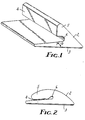
- Fig. 1 shows the components of one embodiment of this invention.
- Item 2 is an elastomeric body, for example made of a sponge elastomer such as polyurethane, silicone rubber, ethylene propylene diene terpolymer (EPDM), neoprene or blends of EPDM and neoprene.
- Adhesive layer 3 is attached to the base of the body, and reflecting material 4 is attached to the raised reflecting surface portion 5 of the body.
- a surprisingly small amount of adhesive is necessary to hold these flexible foam markers on the road (e.g., peel strength of 4.2 pounds per inch, 0.74 kN/m).
- the angle 8 between the reflecting surface and the base for between the reflecting surface and the road surface) is usually between 45 and 135°, preferably between 45 and 90°.
- Reflecting portion 4 is preferably a thin retroreflective sheet comprising a polymeric support sheet in which a monolayer of transparent microspheres or beads are embedded to slightly more than half their diameter.
- the glass beads carry a coating of reflective material such as aluminum over their embedded surfaces.
- the reflector support sheet has a layer of adhesive on the back by which it is adhered to the pavement marker body as shown.
- enclosed lens sheeting appears to perform best (i.e., glass beads covered by a clear polymer layer) although an exposed lens sheeting and cube corner reflectors may also be used.
- Reinforcement may be used within the body (e.g., fiberglass fabric or fibers) to strengthen the markers.
- the pavement marker bodies of this invention can be made by an extrusion process.
- the manufacture of cellular or sponge rubbers in an extrusion process is known.
- the uncured elastomer is generally compounded with vulcanizing chemicals and a blowing agent at a temperature below the decomposition temperature of the blowing agent.
- a suitable EPDM sponge rubber is described in Borg, E. L., "Ethylene/Propylene Rubber", in Rubber Technology, 2d ed., Morton, M. ed., Van Nostrand Reinhold Company, New York, 1973, at pages 242 and 243. Further description of sponge rubber is found in Otterstedt, C. W., "Closed Cell Sponge Rubber", in The Vanderbilt Rubber Handbook, R. T. Vanderbilt Co., Inc., Norwalk, Conn., 1978, at pages 728-729.
- the compound is extruded through a die of specified shape.
- the extrudate is then cured and simultaneously expanded at elevated temperature. Curing may be done in a brine bath at about 204°C.
- a reflective (preferably retroreflective) film is applied to the raised surface adapted to face oncoming traffic, generally by use of an adhesive such as a pressure sensitive adhesive.
- the retroreflective film is preferably of the type known as wide angle flat top sheet which comprises: a back reflector; an overlying transparent matrix; a light-returning layer of small transparent spheres embedded in the transparent matrix in optical connection with the back reflector but spaced from it a distance to increase substantially the brilliance of reflected light; and a transparent overlying solid covering and conforming to the front extremities of the spheres and having a flat front face.
- Such sheeting reflects a cone of light back toward a light source, even though the incident beam strikes the reflector at an angle other than perpendicular to the sheeting.
- U.S. Patent 2,407,680 The transparent film occupying the space between the spheres and the reflector is called the spacing film.
- This wide angle flat top sheeting can be considered an embedded lens or enclosed lens sheeting having a spacing film or layer with a thickness which locates the back reflector at the approximate focal point of the optical system.
- Wide angle flat top retroreflective sheeting may be made, for example, by a solution casting technique comprising the following process steps: (a) providing a paper carrier web coated with a release agent such as polyethylene; (b) coating the release agent side of the carrier web with a 25% solids solution of fully reacted aliphatic elastomeric polyurethane of the polyester type in an isopropanol, toluene, xylene solvent (e.g., Q13787 from K. J.
- a solution casting technique comprising the following process steps: (a) providing a paper carrier web coated with a release agent such as polyethylene; (b) coating the release agent side of the carrier web with a 25% solids solution of fully reacted aliphatic elastomeric polyurethane of the polyester type in an isopropanol, toluene, xylene solvent (e.g., Q13787 from K. J.
- a polyurethane hard coating may be applied to the front surface of the sheeting to reduce the accumulation of dirt on the sheeting in use.
- Such a hard coating has a generally tack-free surface and substantially higher 100% modulus of elasticity and lower ultimate elongation than the polyurethane used for the transparent matrix in the reflective sheeting.
- a typical suitable hard coat polymer is K. J. Quinn QI3515 having a 100% modulus of 5840 psi (40.2 MPa) and 210% ultimate elongation, fully reacted aliphatic elastomeric polyurethane of the polyester type.
- the polyurethane polymers used for the transparent matrix and spacing layers are useful because they are somewhat elastic and can follow the movement of the pavement marker body without delaminating.
- an adhesive is applied to the bottom surface of the marker body.
- it is a phenolic modified polybutadiene pressure sensitive adhesive at least about 250 microns thick cast on a disposable (paper) liner. The liner is removed prior to placement of the marker on the road surface.
- the markers may be applied to the road by at least two methods.
- One such method is removing the adhesive liner and pressing the marker to the road surface or onto other marking materials (tape or paint).
- a second method comprises applying the markers to a tape which is thereafter applied to the road.
- Hollow cross-section markers may help to dissipate the heat of compression better than solid foam, and they may compress better, offering less resistance to vehicles travelling over them.
- marker shapes of this invention provide some form of lateral or back support for the reflector, unlike the markers with raised reflective rubber tabs discussed in the background section.
- the body has a connecting portion which joins the base and the back side of the raised surface which it supports.
- the marker of Fig. 1 supports the whole back of the reflector 4 with raised body portion 5.
- the reflecting portion is not simply a thin pliable tab in the roadway, as with the older designs.
- the connecting portion forms an acute angle with the plane of the bottom of the base portion and has two ribs located on the back side of said connecting portion oriented parallel to the plane of the base. More than two such ribs can be used.
- An alternative embodiment of the invention shown in Fig. 5, comprises an elastomeric body with the compressive strength and base as described above but having:
- the marker should be placed so that there is set at least one protective rib located in front of raised surface adapted to face oncoming traffic.
- the height of the protective rib is generally a minimum of 45% of the height of the diamond-shaped portion, as measured from the bottom of the base. However, it should not be so high as to obscure the reflecting material.
- the ribs are believed to protect the diamond-shaped portion from stress concentration which would hasten its deterioration. Thus the protected diamond shape should have a longer service life.
- the characteristic of lying flat under a load is obtained using the sponge rubbers described previously. It can also be attained by using normal vulcanized rubbers in a hollow configuration.
- the hollow diamond-shaped portion is joined to the base along the line defined by one of the corners of the diamond shape and is oriented so that at least one of its surfaces is a raised surface adapted to face oncoming traffic.
- the reflecting layer is adhered to at least one such surface.
- the back of the reflecting surface is inherently supported at the top and bottom by the portions of the diamond that connect to it at an angle.
- the two protective ribs running parallel to and on opposite sides of the elongated sides of the diamond extend the life of the marker over that of similar designs without the ribs.
- the aspect ratios (width at the widest point- divided by height) for the diamond shape and the ribs are preferably in the ranges of 0.6 to 1.0 and about 1 to 1.3 respectively. Height of the diamond shape is measured from the point where it joins the base, and height of the ribs is measured from the bottom of the marker.
Landscapes
- Engineering & Computer Science (AREA)
- Architecture (AREA)
- Civil Engineering (AREA)
- Structural Engineering (AREA)
- Road Signs Or Road Markings (AREA)
Claims (12)
Applications Claiming Priority (2)
| Application Number | Priority Date | Filing Date | Title |
|---|---|---|---|
| EP84302441 | 1984-04-10 | ||
| EP84302441A EP0125785B1 (fr) | 1983-04-11 | 1984-04-10 | Marque en élastomère pour signalisation routière |
Related Child Applications (1)
| Application Number | Title | Priority Date | Filing Date |
|---|---|---|---|
| EP88100849.4 Division-Into | 1984-10-05 |
Publications (2)
| Publication Number | Publication Date |
|---|---|
| EP0161332A1 EP0161332A1 (fr) | 1985-11-21 |
| EP0161332B1 true EP0161332B1 (fr) | 1989-02-01 |
Family
ID=8192618
Family Applications (1)
| Application Number | Title | Priority Date | Filing Date |
|---|---|---|---|
| EP84111987A Expired EP0161332B1 (fr) | 1984-04-10 | 1984-10-05 | Marque en élastomère pour signalisation routière |
Country Status (1)
| Country | Link |
|---|---|
| EP (1) | EP0161332B1 (fr) |
Families Citing this family (2)
| Publication number | Priority date | Publication date | Assignee | Title |
|---|---|---|---|---|
| DE3719261A1 (de) * | 1987-06-10 | 1988-12-22 | Klasen Geb Tesdorff Renate | Strassenmarkierung |
| ES1063124Y (es) * | 2006-06-06 | 2007-01-01 | Municipal De Transportes De Ma | Modulos para separadores de carril bux-taxi |
Family Cites Families (7)
| Publication number | Priority date | Publication date | Assignee | Title |
|---|---|---|---|---|
| DE7136160U (de) * | 1970-09-21 | 1974-11-28 | Minnesota Mining And Manufacturing Co | Überfahrbares Straßenmarkierungselement |
| IT1045336B (it) * | 1973-03-21 | 1980-05-10 | Eigenmann Ludwig | Materiale retroriflettente associabile a strisce elastoplastiche e simili per segnaletica stradale orizzontale per esaltarne la vis filita sotto luce radente |
| US3963362A (en) * | 1974-11-27 | 1976-06-15 | Carlisle Corporation | Road marker |
| US4111581A (en) * | 1978-01-03 | 1978-09-05 | Auriemma Robert S | Highway marker |
| US4203685A (en) * | 1978-05-05 | 1980-05-20 | Sanchez Richard E | Automotive vehicle speed arrestor |
| DE2903215A1 (de) * | 1979-01-27 | 1980-07-31 | Debuschewitz Kg H | Bodenrueckstrahler |
| BR8401650A (pt) * | 1983-04-11 | 1984-11-20 | Minnesota Mining & Mfg | Marcador elastomerico de pavimentacao |
-
1984
- 1984-10-05 EP EP84111987A patent/EP0161332B1/fr not_active Expired
Also Published As
| Publication number | Publication date |
|---|---|
| EP0161332A1 (fr) | 1985-11-21 |
Similar Documents
| Publication | Publication Date | Title |
|---|---|---|
| US4534673A (en) | Elastomeric pavement marker | |
| US4648689A (en) | Pavement marking tape | |
| US4521129A (en) | Elastomeric pavement marker having improved configuration | |
| US4626127A (en) | Elastomeric pavement marker | |
| US3785719A (en) | Roadway lane delineator having an elastomeric reflective portion | |
| EP0125785B1 (fr) | Marque en élastomère pour signalisation routière | |
| US5392728A (en) | Roadway markers with concave curved edges | |
| US4232979A (en) | Pavement marker | |
| US4035059A (en) | Low-profile raised retroreflective pavement marker | |
| EP0349323B1 (fr) | Marqueur de chaussée rétroréfléchissant | |
| US4428320A (en) | Reflective paving marker | |
| US4340319A (en) | Pavement marker | |
| US5087148A (en) | Surface marker strip and methods for providing improved integrity and adhesion to roadways and the like | |
| US3879148A (en) | Grazing light reflector for roadway pavement markers | |
| US5316406A (en) | Surface marker strip and methods for providing improved integrity and adhesion to roadway and the like | |
| US5139590A (en) | Surface marker strip and methods for providing improved integrity and adhesion to roadways and the like | |
| JPS585327B2 (ja) | ジゼンケイセイシタドウロヒヨウシキヨウストリツプザイリヨウ | |
| US6303058B1 (en) | Method of making profiled retroreflective marking material | |
| JPH10508957A (ja) | 再帰反射性構造体およびその製造法 | |
| US4659248A (en) | Self cleaning pavement marker | |
| US4182548A (en) | Retroreflective marking tape | |
| EP0279205B1 (fr) | Marque en élastomère pour signalisation routière | |
| EP0161332A1 (fr) | Marque en élastomère pour signalisation routière | |
| JP2718779B2 (ja) | 路面標識ストリップ及び道路等に対するより良好な一体性及び接着性をもたらすための方法 | |
| US5098217A (en) | Abrasion resistant coating for pavement marker |
Legal Events
| Date | Code | Title | Description |
|---|---|---|---|
| PUAI | Public reference made under article 153(3) epc to a published international application that has entered the european phase |
Free format text: ORIGINAL CODE: 0009012 |
|
| AK | Designated contracting states |
Designated state(s): AT CH DE FR GB IT LI SE |
|
| RBV | Designated contracting states (corrected) |
Designated state(s): CH LI |
|
| 17P | Request for examination filed |
Effective date: 19850905 |
|
| 17Q | First examination report despatched |
Effective date: 19870514 |
|
| RAP1 | Party data changed (applicant data changed or rights of an application transferred) |
Owner name: MINNESOTA MINING AND MANUFACTURING COMPANY |
|
| GRAA | (expected) grant |
Free format text: ORIGINAL CODE: 0009210 |
|
| AK | Designated contracting states |
Kind code of ref document: B1 Designated state(s): CH LI |
|
| PLBE | No opposition filed within time limit |
Free format text: ORIGINAL CODE: 0009261 |
|
| STAA | Information on the status of an ep patent application or granted ep patent |
Free format text: STATUS: NO OPPOSITION FILED WITHIN TIME LIMIT |
|
| 26N | No opposition filed | ||
| PGFP | Annual fee paid to national office [announced via postgrant information from national office to epo] |
Ref country code: CH Payment date: 19990924 Year of fee payment: 16 |
|
| PG25 | Lapsed in a contracting state [announced via postgrant information from national office to epo] |
Ref country code: LI Free format text: LAPSE BECAUSE OF NON-PAYMENT OF DUE FEES Effective date: 20001031 Ref country code: CH Free format text: LAPSE BECAUSE OF NON-PAYMENT OF DUE FEES Effective date: 20001031 |
|
| REG | Reference to a national code |
Ref country code: CH Ref legal event code: PL |