EP0161490A2 - Tamis moléculaires à base d'oxydes de silicium, phosphore, aluminium et manganèse - Google Patents
Tamis moléculaires à base d'oxydes de silicium, phosphore, aluminium et manganèse Download PDFInfo
- Publication number
- EP0161490A2 EP0161490A2 EP85104390A EP85104390A EP0161490A2 EP 0161490 A2 EP0161490 A2 EP 0161490A2 EP 85104390 A EP85104390 A EP 85104390A EP 85104390 A EP85104390 A EP 85104390A EP 0161490 A2 EP0161490 A2 EP 0161490A2
- Authority
- EP
- European Patent Office
- Prior art keywords
- mnapso
- process according
- molecular sieves
- sub
- powder diffraction
- Prior art date
- Legal status (The legal status is an assumption and is not a legal conclusion. Google has not performed a legal analysis and makes no representation as to the accuracy of the status listed.)
- Granted
Links
Images

Classifications
-
- C—CHEMISTRY; METALLURGY
- C07—ORGANIC CHEMISTRY
- C07C—ACYCLIC OR CARBOCYCLIC COMPOUNDS
- C07C5/00—Preparation of hydrocarbons from hydrocarbons containing the same number of carbon atoms
- C07C5/32—Preparation of hydrocarbons from hydrocarbons containing the same number of carbon atoms by dehydrogenation with formation of free hydrogen
- C07C5/373—Preparation of hydrocarbons from hydrocarbons containing the same number of carbon atoms by dehydrogenation with formation of free hydrogen with simultaneous isomerisation
- C07C5/393—Preparation of hydrocarbons from hydrocarbons containing the same number of carbon atoms by dehydrogenation with formation of free hydrogen with simultaneous isomerisation with cyclisation to an aromatic six-membered ring, e.g. dehydrogenation of n-hexane to benzene
- C07C5/41—Catalytic processes
-
- B—PERFORMING OPERATIONS; TRANSPORTING
- B01—PHYSICAL OR CHEMICAL PROCESSES OR APPARATUS IN GENERAL
- B01J—CHEMICAL OR PHYSICAL PROCESSES, e.g. CATALYSIS OR COLLOID CHEMISTRY; THEIR RELEVANT APPARATUS
- B01J29/00—Catalysts comprising molecular sieves
- B01J29/82—Phosphates
- B01J29/84—Aluminophosphates containing other elements, e.g. metals, boron
- B01J29/85—Silicoaluminophosphates [SAPO compounds]
-
- C—CHEMISTRY; METALLURGY
- C01—INORGANIC CHEMISTRY
- C01B—NON-METALLIC ELEMENTS; COMPOUNDS THEREOF; METALLOIDS OR COMPOUNDS THEREOF NOT COVERED BY SUBCLASS C01C
- C01B37/00—Compounds having molecular sieve properties but not having base-exchange properties
- C01B37/06—Aluminophosphates containing other elements, e.g. metals, boron
- C01B37/08—Silicoaluminophosphates [SAPO compounds], e.g. CoSAPO
-
- C—CHEMISTRY; METALLURGY
- C07—ORGANIC CHEMISTRY
- C07C—ACYCLIC OR CARBOCYCLIC COMPOUNDS
- C07C2/00—Preparation of hydrocarbons from hydrocarbons containing a smaller number of carbon atoms
- C07C2/02—Preparation of hydrocarbons from hydrocarbons containing a smaller number of carbon atoms by addition between unsaturated hydrocarbons
- C07C2/04—Preparation of hydrocarbons from hydrocarbons containing a smaller number of carbon atoms by addition between unsaturated hydrocarbons by oligomerisation of well-defined unsaturated hydrocarbons without ring formation
- C07C2/06—Preparation of hydrocarbons from hydrocarbons containing a smaller number of carbon atoms by addition between unsaturated hydrocarbons by oligomerisation of well-defined unsaturated hydrocarbons without ring formation of alkenes, i.e. acyclic hydrocarbons having only one carbon-to-carbon double bond
- C07C2/08—Catalytic processes
- C07C2/12—Catalytic processes with crystalline alumino-silicates or with catalysts comprising molecular sieves
-
- C—CHEMISTRY; METALLURGY
- C07—ORGANIC CHEMISTRY
- C07C—ACYCLIC OR CARBOCYCLIC COMPOUNDS
- C07C2/00—Preparation of hydrocarbons from hydrocarbons containing a smaller number of carbon atoms
- C07C2/54—Preparation of hydrocarbons from hydrocarbons containing a smaller number of carbon atoms by addition of unsaturated hydrocarbons to saturated hydrocarbons or to hydrocarbons containing a six-membered aromatic ring with no unsaturation outside the aromatic ring
-
- C—CHEMISTRY; METALLURGY
- C07—ORGANIC CHEMISTRY
- C07C—ACYCLIC OR CARBOCYCLIC COMPOUNDS
- C07C5/00—Preparation of hydrocarbons from hydrocarbons containing the same number of carbon atoms
- C07C5/02—Preparation of hydrocarbons from hydrocarbons containing the same number of carbon atoms by hydrogenation
-
- C—CHEMISTRY; METALLURGY
- C07—ORGANIC CHEMISTRY
- C07C—ACYCLIC OR CARBOCYCLIC COMPOUNDS
- C07C5/00—Preparation of hydrocarbons from hydrocarbons containing the same number of carbon atoms
- C07C5/22—Preparation of hydrocarbons from hydrocarbons containing the same number of carbon atoms by isomerisation
- C07C5/2206—Catalytic processes not covered by C07C5/23 - C07C5/31
- C07C5/2226—Catalytic processes not covered by C07C5/23 - C07C5/31 with inorganic acids; with salt or anhydrides of acids
- C07C5/224—Acids of phosphorus; Salts thereof; Phosphorus oxides
-
- C—CHEMISTRY; METALLURGY
- C07—ORGANIC CHEMISTRY
- C07C—ACYCLIC OR CARBOCYCLIC COMPOUNDS
- C07C5/00—Preparation of hydrocarbons from hydrocarbons containing the same number of carbon atoms
- C07C5/22—Preparation of hydrocarbons from hydrocarbons containing the same number of carbon atoms by isomerisation
- C07C5/27—Rearrangement of carbon atoms in the hydrocarbon skeleton
- C07C5/2702—Catalytic processes not covered by C07C5/2732 - C07C5/31; Catalytic processes covered by both C07C5/2732 and C07C5/277 simultaneously
- C07C5/271—Catalytic processes not covered by C07C5/2732 - C07C5/31; Catalytic processes covered by both C07C5/2732 and C07C5/277 simultaneously with inorganic acids; with salts or anhydrides of acids
- C07C5/2716—Acids of phosphorus; Salts thereof; Phosphorus oxides
-
- C—CHEMISTRY; METALLURGY
- C07—ORGANIC CHEMISTRY
- C07C—ACYCLIC OR CARBOCYCLIC COMPOUNDS
- C07C2529/00—Catalysts comprising molecular sieves
- C07C2529/82—Phosphates
- C07C2529/84—Aluminophosphates containing other elements, e.g. metals, boron
Definitions
- the instant invention relates to a novel class of crystalline microporous molecular sieves, to the method of their preparation and to their use as adsorbents and catalysts.
- the invention relates to manganese-aluminum-phosphorus-silicon-oxide molecular sieves having manganese, aluminum, phosphorus and silicon in the form of framework tetrahedral oxides.
- These compositions may be prepared hydrothermally from gels containing reactive compounds of manganese, aluminum, phosphorus and silicon capable of forming framework tetrahedral oxides, and preferably at least one organic templating agent which functions in part to determine the course of the crystallization mechanism and the structure of the crystalline product.
- crystalline aluminosilicate zeolite type are well known in the art and now comprise over 150 species of both naturally occurring and synthetic compositions.
- the crystalline zeolites are formed from corner-sharing A10 2 and SiO 2 tetrahedra and are characterized by having pore openings of uniform dimensions, having a significant ion-exchange capacity and being capable of reversibly desorbing an adsorbed phase which is dispersed throughout the internal voids of the crystal without displacing any atoms which make up the permanent crystal structure.
- crystalline microporous compositions which are not zeolitic, i.e. do not contain A10 2 tetrahedra as essential framework constituents, but which exhibit the ion-exchange and/or adsorption characteristics of the zeolites are also known.
- Metal organosilicates which are said to possess ion-exchange properties, have uniform pores and are capable of reversibly adsorbing molecules having molecular diameters of about 6A or less, are reported in U.S. Patent No. 3,941,871 issued March 2. 1976 to Dwyer et al.
- a pure silica polymorph. silicalite, having molecular sieving properties and a neutral framework containing neither cations nor cation sites is disclosed in U.S. Patent No. 4,061,724 issued December 6. 1977 to R.W. Grose et al.
- the minimum value for each of "x”, "y”, and “z” is 0.01 and preferably 0.02.
- the maximum value for "x” is 0.98; for “y” is 0.60; and for "z” is 0.52.
- These silicoaluminophosphates exhibit several physical and chemical properties which are characteristic of aluminosilicate zeolites and aluminophosphates.
- the instant invention relates to new molecular sieves comprising framework tetrahedral units of MnO -2 2 . AlO 2 - and PO + 2 and SiO 2 .
- the instant invention relates to a new class of molecular sieves having a three-dimensional microporous crystal framework structures of MnO -2 2 , AlO 2 - , PO 2 + and SiO 2 tetrahedral oxide units.
- These new manganese-aluminum-phosphorus-silicon-oxide molecular sieves exhibit ion-exchange. adsorption and catalytic properties and, accordingly, find wide use as adsorbents and catalysts.
- the members of this novel class of compositions have crystal framework structures of MnO -2 2 , AlO 2 - , PO2 and S0 2 tetrahedral oxide units and have an empirical chemical composition on an anhydrous basis expressed by the formula: wherein "R” represents at least one organic templating agent present in the intracrystalline pore system; “m” represents the molar amount of “R” present per mole of (Mn w Al x P y Si z )O 2 and has a value of zero to about 0.3; and “w”, "x", “y” and “z” represent the mole fractions of manganese, aluminum. phosphorus and silicon, respectively. present as tetrahedral oxides.
- the instant molecular sieve compositions are characterized in several ways as distinct from heretofore known molecular sieves, including the aforementioned ternary compositions.
- the instant molecular sieves are characterized by the enhanced thermal stability of certain species and by the exisjtence of species heretofore unknown for binary and ternary molecular sieves.
- the molecular sieves of the instant invention will be generally referred to by the acronym "MnAPSO” to designate a structure framework of MnO -2 2 , AlO 2 - , PO 2 + and SiO 2 tetrahedral units.
- Actual class members will be identified as structural species by assigning a number to the species and, accordingly, are identified as "MnAPSO-i" wherein "i” is an integer.
- the given species designation is not intended to denote a similarity in structure to any other species denominated by a numbering system.
- the instant invention relates to a new class of molecular sieves having a three-dimensional microporous crystal framework structures of MnO -2 2 , AlO 2 - , PO 2 + and SiO 2 tetrahedral oxide units.
- These new molecular sieves exhibit ion-exchange, adsorption and catalytic properties and, accordingly, find wide use as adsorbents and catalysts.
- the MnAPSO molecular sieves of the instant invention have a framework structure of MnO -2 2 , AlO 2 - , PO 2 + , and Si0 2 tetrahedral units having an empirical chemical composition on an anhydrous basis expressed by the formula: wherein "R” represents at least one organic templating agent present in the intracrystalline pore system; “m” represents the molar amount of “R” present per mole of (Mn w Al x P y Si z )O 2 and has a value of zero to about 0.3; and “w”, "x", “y” and “z” represent the mole fractions of element manganese, aluminum, phosphorus and silicon, respectively, present as tetrahedral oxides.
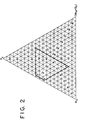
- the mole fractions "w”, "x”, “y” and “z” are generally defined as being within the pentagonal compositional area defined by points A, B, C, D and E of the ternary diagram of FIG. 1 and more preferably are generally defined as being within the tetragonal compositional area defined by points a, b, c and d of the ternary diagram of FIG. 2.
- Points A, B, C, D and E of FIG. I have the following values for "w”, "x”, “y”, and “z”:
- Points a. b, c, and d of FIG. 2 have the following values for "w", "x", y”. and "z":
- MnAPSOs of this invention are useful as adsorbents, catalysts, ion-exchangers, and the like in much the same fashion as aluminosilicates have been employed heretofore, although their chemical and physical properties are not necessarily similar to those observed for aluminosilicates.
- MnAPSO compositions are generally synthesized by hydrothermal crystallization from a reaction mixture containing reactive sources of manganese, silicon, aluminum and phosphorus, preferably an organic templating, i.e., structure-directing, agent, preferably a compound of an element or Group VA of the Periodic Table, and/or optionally an alkali or other metal.
- the reaction mixture is generally placed in a sealed pressure vessel, preferably lined with an inert plastic material such as polytetrafluoroethylene and heated, preferably under autogenous pressure at a temperature between about 50°C and about 250°C, and preferably between about 100°C and about 200°C until crystals of the MnAPSO product are obtained, usually a period of from several hours to several weeks. Typical effective times of from 2 hours to about 30 days with generally from about 4 hours to about 20 days have been observed.
- the product is recovered by any convenient method such as centrifugation or filtration.
- reaction mixture composition expressed in terms of the molar ratios as follows: wherein "R” is an organic templating agent; “a” is the amount of organic templating agent “R” and has a value of from zero to about 6 and is preferably an effective amount within the range of greater than zero (0) to about 6; “b” has a value of from zero (0) to about 500, preferably between about 2 and about 300; and "w", "x", “y” and “z” represent the mole fractions of manganese, aluminum, phosphorus and silicon, respectively, and each has a value of at least 0.01.
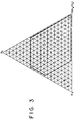
- the reaction mixture is selected such that the mole fractions "w”, "x”, “y” and “z” are generally defined as being within the pentagonal compositional area defined by points E, F, G, H and I of the ternary diagram of FIG. 3. Points E, F, G. H and I of FIG. 3 have the following values for "w", "x”, “y” and "z”:
- Points E, F, G. H and I of FIG. 3 have the following values for "w”, "x”, "y” and "z”:
- This latter form is readily converted to the former form by routine calculations by dividing the number of moles of each component (including the template and water) by the total number of moles of manganese, aluminum, phosphorus and silicon which results in normalized mole fractions based on total moles of the aforementioned components.
- the organic templating agent can be any of those heretofore proposed for use in the synthesis of conventional zeolite aluminosilicates.
- these compounds contain elements of Group VA of the'Periodic Table of Elements, particularly nitrogen, phosphorus, arsenic and antimony, preferably nitrogen or phosphorus and most preferably nitrogen, which compounds also contain at least one alkyl or aryl group having from 1 to 8 carbon atoms.
- Particularly preferred compounds for use as templating agents are the amines quatenary phosphonium and quaternary ammonium compounds, the latter two being represented generally by the formula R 4 X + wherein "X" is nitrogen or phosphorous and each R is an alkyl or aryl group containing from 1 to.8 carbon atoms.
- Polymeric quaternary ammonium salts such as [(C 14 H 32 N 2 ) (OH) 2 ] x wherein "x" has a value of at least 2 are also suitably employed.
- the mono-, di- and tri-amines are advantageously utilized, either alone or in combination with a quaternary ammonium compound or other templating compound.
- templating agents can either produce mixtures of the desired MnAPSOs or the more strongly directing templating species may control the course of the reaction with the other templating species serving primarily to establish the pH conditions of the reaction gel.
- Representative templating agents include: tetramethylammonium: tetraethylammonium; tetrapropylammonium: tetrabutylammonium ions: tetrapentylammonium ions; di-n-propylamine; tripropylamine: triethylamine: triethanolamine; piperidine; cyclohexylamine; 2-methylpyridine: N,N-dimethylbenzylamine; N,N-dimethylethanolamine; choline: N,N'-dimethylpiperazine; 1,4-diazabicyclo (2.2,2,) octane: N-methyldiethanolamine, N-methylethanolamine; N-methylpiperidine; 3-methylpiperidine:
- templating agent will direct the formation of every species of MnAPSO, i.e., a single templating agent can, with proper manipulation of the reaction conditions, direct the formation of several MnAPSO compositions, and a given MnAPSO composition can be produced using several different templating agents.
- the reactive source of silicon may be silica, either as a silica sol or as fumed silica, a reactive solid amorphous precipitated silica, silica gel, alkoxides of silicon, silicic acid or alkali metal silicate and the like.
- the reactive phosphorus source is phosphoric acid, but organic phosphates such as triethyl phosphate may be satisfactory, and so also may crystalline or amorphous aluminophosphates such as the ALPO 4 compositions of U.S.P. 4,310,440.
- Organo-phosphorus compounds such as tetrabutylphosphonium bromide do not, apparently, serve as reactive sources of phosphorus, but these compounds may function as templating agents.
- Conventional phosphorus salts such as sodium metaphosphate, may be used, at least in part, as the phosphorus source, but are not preferred.
- the preferred aluminum source is either an aluminum alkoxide, such as aluminum isoproproxide, or pseudoboehmite.
- the crystalline or amorphous aluminophosphates which are a suitable source of phosphorus are, of course, also suitable sources of aluminum.
- the source of manganese can be introduced into the reaction system in any form which permits the formation in situ of reactive form of manganese, i.e., reactive to form the framework tetrahedral unit of manganese.
- Compounds of manganese which may be employed herein include oxides, alkoxides, acetates, hydroxides, chlorides briomides, iodides, sulfates, nitrates, carboxylates and the like.
- manganese acetate, manganese bromide, manganese sulfate, and the like are employable herein.
- the as-synthesized MnAPSO generally contains within its internal pore system at least one form of the templating agent employed in its formation. Most commonly any organic moiety derived from any organic template is present, at least in part, as a charge-balancing cation as is generally the case with as-synthesized aluminosilicate zeolites prepared from organic-containing reaction systems. It is possible, however, that some or all of the organic moiety is an occluded molecular species in a particular MnAPSO species.
- the templating agent and hence the occluded organic species, is too large to move freely through the pore system of the MnAPSO product and must be removed by calcining the MnAPSO at temperatures of 200°C to 700°C to thermally degrade the organic species.
- the pores of the MnAPSO product are sufficiently large to permit transport of the templating agent, particularly if the latter is a small molecule, and accordingly complete or partial removal thereof can be accomplished by conventional desorption procedures such as carried out in the case of zeolites.
- the term "as-synthesized" as used herein does not include the condition of the MnAPSO phase wherein the organic moiety occupying the intracrystalline pore system as a result of the hydrothermal crystallization process has been reduced by post-synthesis treatment such that the value of "m” in the composition formula has a value of less than 0.02.
- the other symbols of the formula are as defined hereinabove.
- the corresponding alcohol is necessarily present in the reaction mixture since it is a hydrolysis product of the alkoxide. It has not been determined whether this alcohol participates in the synthesis process as a templating agent. For the purposes of this application, however, this alcohol is arbitrarily omitted from the class of templating agents, even if it is present in the as-synthesized MnAPSO material.
- MnAPSO compositions are formed from Mn0 2 , A10 2 , P0 2 and SiO 2 tetrahedral units which, respectively, have a net charge of -2. -1. +1 and 0.
- the matter of cation exchangeability is considerably more complicated than in the case of zeolitic molecular sieves in which, ideally, there is a stoichiometric relationship between AlO 2 - tetrahedra and charge-balancing cations.
- an AlO 2 - tetrahedron can be balanced electrically either by association with a PO 2 + tetrahedron or a simple cation such as an alkali metal cation, a cation of manganese present in the reaction mixture, or an organic cation derived from the templating agent.
- an MnO -2 2 tetrahedron can be balanced electrically by association with PO 2 + tetrahedra, a cation of manganese, organic cations derived from the templating agent, a simple cation such as an alkali metal cation, or other divalent or polyvalent metal cations introduced from an extraneous source.
- the MnAPSO compositions of the present invention may exhibit cation-exchange capacity when analyzed using ion-exchange techniques heretofore employed with zeolitic aluminosilicates and have pore diameters which are inherent in the lattice structure of each species and which are at least about 3A in diameter.
- Ion exchange of MnAPSO compositions is ordinarily possible only after the organic moiety present as a result of synthesis has been removed from the pore system.
- Dehydration to remove water present in the as-synthesized MnAPSO compositions can usually be accomplished, to some degree at least, in the usual manner without removal of the organic moiety, but the absence of the organic species greatly facilitates adsorption and desorption procedures.
- the MnAPSO materials will have various degrees of hydrothermal and thermal stability, some being quite remarkable in this regard, and will function as molecular sieve adsorbents and hydrocarbon conversion catalysts or catalyst bases.
- the MnAPSOs are generally prepared using a stainless steel reaction vessel lined with the inert plastic material, polytetrafluoroethylene, to avoid contamination of the reaction mixture.
- the final reaction mixture from which each MnAPSO composition is crystallized is prepared by forming " mixtures of less than all of the reagents and thereafter incorporating into these mixtures additional reagents either singly or in the form of other intermediate mixtures of two or more reagents. In some instances the reagents admixed retain their identity in the intermediate mixture and in other cases some or all of the reagents are involved in chemical reactions to produce new reagents. The term "mixture” is applied in both cases. Further, unless otherwise specified, each intermediate mixture as well as the final reaction mixture was stirred until substantially homogeneous.
- X-ray analysis of reaction products are obtained by X-ray analysis using standard X-ray powder diffraction techniques.
- the radiation source is a high-intensity, copper target, X-ray tube operated at 50 Kv and 40 ma.
- the diffraction pattern from the copper K-alpha radiation and graphite monochromator is suitably recorded by an X-ray spectrometer scintillation counter, pulse height analyzer and strip chart recorder.
- Flat compressed powder samples are scanned at 2° (2 theta) per minute, using a two second time constant. Interplanar spacings (d) in Angstrom units are obtained from the position of the diffraction peaks expressed as 2e where 6 is the Bragg angle as observed on the strip chart.
- Intensities are determined from the heights of diffraction peaks after subtracting background. "I o " being the intensity of the strongest line or peak, and "I” being the intensity of each of the other peaks.
- the X-ray patterns are obtained from the copper K-alpha radiation by use of. computer based techniques using Siemens D-500 X-ray powder diffractometers, Siemens Type K-805 X-ray sources, available from Siemens Corporation, Cherry Hill. New Jersey, with appropriate computer interface.
- the determination of the parameter 2 theta is subject to both human and mechanical error, which in combination, can impose an uncertainty of about ⁇ 0.4° on each reported value of 2 theta.
- This uncertainty is, of course, also manifested in the reported values of the d-spacings, which are calculated from the 2 theta values.
- This imprecision is general throughout the art and is not sufficient to preclude the differentiation of the present crystalline materials from each other and from the compositions of the prior art.
- the relative intensities of the d-spacings are indicated by the notations vs, s, m, w and vw which represent very strong, strong, medium, weak and very weak respectively.
- the purity of a synthesized product may be assessed with reference to its X-ray powder diffraction pattern.
- a sample is stated to be pure, it is intended only that the X-ray pattern of the sample is free of lines attributable to crystalline impurities, not that there are no amorphous materials present.
- the molecular sieves of the instant invention may be characterized by their x-ray powder diffraction patterns and such may have one of the x-ray patterns set forth in the following Tables A through K, wherein said x-ray patterns are for both the as-synthesized and calcined forms unless otherwise noted:
- MnAPSO compositions were prepared using numerous reagents.
- the reagents employed and abbreviations employed herein, if any, for such reagents are as follows:
- the organic templating agent was then added to the resulting mixture and the resulting mixture blended until a homogeneous mixture was observed, i.e., about 2 to 4 minutes. (The pH of the mixture was measured and adjusted for temperature). The mixture was then placed in a lined (polytetrafluoroethylene) stainless steel pressure vessel and digested at a temperature (150°C or 200°C) for a time or placed in lined screw top bottles for digestion at 100°C. All digestions were carried out at the autogeneous pressure.
- the molar composition for each preparation will be given by the relative moles of the components of the reaction mixture.
- H 3 PO 4 and MnAc are given respectively in terms of P 2 O 5 and MnO content of the reaction mixture.
- MnAPSO molecular sieves were prepared according to the above identified procedure and the MnAPSO products determined by X-ray analysis. The results of examples 1 to 64 are set forth in Tables I to IV.
- MnAPSO-35 was calcined at 500°C in nitrogen for 2 hours.
- EDAX energy dispersive analysis by x-ray microprobe analysis in conjunction with SEM (scanning electron microscope) was carried out on clear crystals from the products of certain examples, as identified in parenthesis hereinafter. Analysis of crystals having a morphology characteristic of each MnAPSO product gave the following analysis based on relative peak heights:
- the catalytic activity was determined using a reactor comprising a cylindrical quartz tube 254 mm. in length and 10.3 mm. I.D.
- MnAPSO which were 20-40 mesh (U.S. std.) in size and in an amount of from 0.5 to 5 grams, the quantity being selected so that the conversion of n-butane was at least 5% and not more than 90% under the test conditions.
- Most of the MnAPSO samples had been previously calcined in air or nitrogen to remove organic materials from the pore system, and were activated in situ in the reactor in a flowing stream of helium at 500°C for one hour.
- the feedstock was a helium- n-butane mixture containing 2 mole percent n-butane and was passed through the reactor at a rate of 50 cc./minute. Analysis of the feedstock and the reactor effluent were carried out using conventional gas chromatography techniques. The reactor effluent was analyzed after 10 minutes of on-stream operation.
- the pseudo-first-order rate constant (k A ) was calculated to determine the relative catalytic activity of the MnAPSO compositions.
- the k A value (cm 3 /g min) obtained for the MnAPSO compositions are set forth, below, in Table XXV:
- the MnAPSO compositions of the present invention are, in general, hydrophilic and adsorb water preferentially over common hydrocarbon molecules such as paraffins, olefins and aromatic species, e.g., benzene, xylenes and cumene.
- the MnAPSOs as a class are useful as desiccants in such adsorption separation/ purification processes as natural gas drying, cracked gas drying. Water is also preferentially adsorbed over the so-called permanent gases such as carbon dioxide, nitrogen, oxygen and hydrogen.
- These MnAPSOs are therefore suitably employed in the drying of reformer hydrogen streams and in the drying of oxygen, nitrogen or air prior to liquifaction.
- the present MnAPSO compositions also exhibit novel surface selectivity characteristics which render them useful as catalyst or catalyst bases in a number of hydrocarbon conversion and oxidative combustion reactions. They can be impregnated or otherwise loaded with catalytically active metals by methods well known in the art and used, for example, in fabricating catalyst compositions having silica or alumina bases. Of the general class, those species having pores larger than about 4A are preferred for catalytic applications.
- hydrocarbon conversion reactions catalyzed by MnAPSO compositions are cracking, hydrocracking, alkylation for both the aromatic and isoparaffin types,isomerization including xylene isomerization, polymerization, reforming, hydrogenation, dehydrogenation, transalkylation, dealkylation, hydrodecyclization and dehydrocyclization.
- MnAPSO catalyst compositions which contain a hydrogenation promoter such as platinum or palladium, heavy petroleum residual stocks, cyclic stocks and other hydrocrackable charge stocks, can be hydrocracked at temperatures in the range of 400°F to 825°F using molar ratios of hydrogen to hydrocarbon in the range of between 2 and 80, pressures between 10 and 3500 p.s.i.g.. and a liquid hourly space velocity (LHSV) of from 0.1 to 20, preferably 1.0 to 10.
- a hydrogenation promoter such as platinum or palladium, heavy petroleum residual stocks, cyclic stocks and other hydrocrackable charge stocks
- the MnAPSO catalyst compositions employed in hydrocracking are also suitable for use in reforming processes in which the hydrocarbon feedstocks contact the catalyst at temperatures of from about 700°F to 1000°F, hydrogen pressures of from 100 to 500 p.s.i.g., LHSV values in the range of 0.1 to 10 and hydrogen to hydrocarbon molar ratios in the range of 1 to 20, preferably between 4 and 12.
- hydroisomerizations processes in which feedstocks such as normal paraffins are converted to saturated branched chain isomers.
- Hydroisomerization is carried out at a temperature of from about 200°F to 600°F, preferably 300°F to 550°F with an LHSV value of from about 0.2 to 1.0.
- Hydrogen is supplied to the reactor in admixture with the hydrocarbon feedstock in molar proportions (hydrogen to hydrocarbon) of between 1 and 5.
- the same catalyst compositions are used to hydroisomerize normal paraffins.
- the paraffin feedstock comprises normal paraffins having a carbon number range of C 7 -C 20 .
- Contact time between the feedstock and the catalyst is generally relatively short to avoid undesireable side reactions such as olefin polymerization and paraffin cracking. LHSV values in the range of 0.1 to 10, preferably 1.0 to 6.0 are suitable.
- the unique crystal structure of the present MnAPSO catalysts and their availability in a form totally void of alkali metal content favor their use in the conversion of alkylaromatic compounds, particularly the catalytic disproportionation of toluene, ethylene, trimethyl benzenes, tetramethyl benzenes and the like. In the disproportionation process, isomerization and transalkylation can also occur.
- Group VIII noble metal adjuvants alone or in conjunction with Group VI-B metals such as tungsten, molybdenum and chromium are preferably included in the catalyst composition in amounts of from about 3 to 15 weight-% of the overall composition.
- Extraneous hydrogen can. but need not, be present in the reaction zone which is maintained at a temperature of from about 400 to 750°F, pressures in the range of 100 to 2000 p.s.i.g. and LHSV values in the range of 0.1 to 15.
- Catalytic cracking processes are preferably carried out with MnAPSO compositions using feedstocks such as gas oils, heavy naphthas, deasphalted crude oil residua, etc., with gasoline being the principal desired product.
- feedstocks such as gas oils, heavy naphthas, deasphalted crude oil residua, etc.
- gasoline being the principal desired product.
- Temperature conditions 850 to l100°F, LHSV values of 0.5 to 10 and pressure conditions of from about 0 to 50 p.s.i.g. are suitable.
- Dehydrocyclization reactions employing paraffinic hydrocarbon feedstocks, preferably normal paraffins having more than 6 carbon atoms, to form benzene, xylenes, toluene and the like are carried out using essentially the same reaction conditions as for catalytic cracking.
- paraffinic hydrocarbon feedstocks preferably normal paraffins having more than 6 carbon atoms
- MnAPSO catalyst in conjunction with a Group VIII non-noble metal cation such as cobalt and nickel.
- the primary objective is to promote the selective hydrodecomposition of organic sulfur and/or nitrogen compounds in the feed, without substantially affecting hydrocarbon molecules therein.
- Feedstocks include gasoline fractions, kerosenes, jet fuel fractions, diesel fractions, light and heavy gas oils, deasphalted crude oil residual and the like any of which may contain up to about 5 weight-percent of sulfur and up to about 3 weight-percent of nitrogen.
- organonitrogen compounds As a result of the effect of organonitrogen compounds on the hydrocracking activity of these compositions it is not at all unlikely that the conditions most suitable for denitrogenation of a given feedstock having a relatively high organonitrogen content with minimal hydrocracking, e.g., less than 20 volume percent of fresh feed per pass, might be the same as those preferred for hydrocracking another feedstock having a lower concentration of hydrocracking inhibiting constituents e.g., organonitrogen compounds. Consequently, it has become the practice in this art to establish the conditions under which a certain feed is to be contacted on the basis of preliminary screening tests with the specific catalyst and feedstock.
- Isomerization reactions are carried out under conditions similar to those described above for reforming, using somewhat more acidic catalysts.
- Olefins are preferably isomerized at temperatures of 500°-900°F, while paraffins.
- naphthenes and alkyl aromatics are isomerized at temperatures of 700°-1000°F.
- Particularly desirable isomerization reactions contemplated herein include the conversion of n-heptene and/or n-octane to isoheptanes, iso-octanes, butane to iso-butane, methylcyclopentane to cyclohexane, meta-xylene and/or ortho-xylene to paraxylene, 1-butene to 2-butene and/or isobutene, n-hexene to isohexene, cyclohexene to methylcyclopentene etc.
- the preferred form of the catalyst is a combination of the MnAPSO with polyvalent metal compounds (such as sulfides) of metals of Group II-A.
- the MnAPSO compositions having pores of at least 5A are preferred.
- the.temperature is usually at least 350°F and ranges up to a temperature at which substantial cracking of the feedstock or conversion products occurs, generally up to about 700°F.
- the temperature is preferably at least 450°F and not greater than the critical temperature of the compound undergoing dealkylation.
- Pressure conditions are applied to retain at least the aromatic feed in the liquid state.
- the temperature can be as low as 250°F but is preferably at least 350°F.
- the preferred alkylating agents are olefins such as ethylene and propylene.
Landscapes
- Chemical & Material Sciences (AREA)
- Organic Chemistry (AREA)
- Chemical Kinetics & Catalysis (AREA)
- Inorganic Chemistry (AREA)
- Crystallography & Structural Chemistry (AREA)
- Engineering & Computer Science (AREA)
- Materials Engineering (AREA)
- Catalysts (AREA)
- Silicates, Zeolites, And Molecular Sieves (AREA)
- Production Of Liquid Hydrocarbon Mixture For Refining Petroleum (AREA)
- Solid-Sorbent Or Filter-Aiding Compositions (AREA)
Applications Claiming Priority (2)
| Application Number | Priority Date | Filing Date | Title |
|---|---|---|---|
| US06/600,175 US4686092A (en) | 1984-04-13 | 1984-04-13 | Manganese-aluminum-phosphorus-silicon-oxide molecular sieves |
| US600175 | 1984-04-13 |
Publications (3)
| Publication Number | Publication Date |
|---|---|
| EP0161490A2 true EP0161490A2 (fr) | 1985-11-21 |
| EP0161490A3 EP0161490A3 (en) | 1985-12-18 |
| EP0161490B1 EP0161490B1 (fr) | 1988-05-25 |
Family
ID=24402599
Family Applications (1)
| Application Number | Title | Priority Date | Filing Date |
|---|---|---|---|
| EP85104390A Expired EP0161490B1 (fr) | 1984-04-13 | 1985-04-11 | Tamis moléculaires à base d'oxydes de silicium, phosphore, aluminium et manganèse |
Country Status (5)
| Country | Link |
|---|---|
| US (1) | US4686092A (fr) |
| EP (1) | EP0161490B1 (fr) |
| JP (1) | JPS60231413A (fr) |
| CA (1) | CA1246530A (fr) |
| DE (1) | DE3562890D1 (fr) |
Cited By (24)
| Publication number | Priority date | Publication date | Assignee | Title |
|---|---|---|---|---|
| WO1986003139A1 (fr) * | 1984-11-27 | 1986-06-05 | Union Carbide Corporation | Catalyseurs de craquage et procede utilisant des filtres moleculaires non zeolitiques |
| WO1986003770A1 (fr) * | 1984-12-18 | 1986-07-03 | Union Carbide Corporation | Procedes et catalyseurs de deparaffinage utilisant des tamis moleculaires non-zeolithiques |
| WO1986003771A1 (fr) * | 1984-12-18 | 1986-07-03 | Union Carbide Corporation | Catalyseurs d'hydrocraquage et procedes utilisant des tamis moleculaires non zeolitiques |
| EP0242616A1 (fr) * | 1986-03-27 | 1987-10-28 | Uop | Catalyseurs et procédés de reformage ou de deshydrocyclisation |
| EP0249913A1 (fr) * | 1986-06-16 | 1987-12-23 | Union Carbide Corporation | Production sélective d'hydrocarbures para-aromatiques |
| EP0249914A1 (fr) * | 1986-06-16 | 1987-12-23 | Uop | Isomérisation de xylènes |
| US4803185A (en) * | 1987-06-04 | 1989-02-07 | Uop | Octane boosting catalyst |
| US4814316A (en) * | 1987-06-04 | 1989-03-21 | Uop | Novel catalyst composition, and processes for making and using same |
| US4826804A (en) * | 1987-06-04 | 1989-05-02 | Uop | Catalyst for oligomerization process |
| US4861739A (en) * | 1987-06-04 | 1989-08-29 | Uop | Microporous crystalline composite compositions |
| US4880611A (en) * | 1983-12-19 | 1989-11-14 | Mobil Oil Corp. | Crystalline composition |
| US4922050A (en) * | 1987-12-28 | 1990-05-01 | Mobil Oil Corporation | Catalytic dehydrogenation of hydrocarbons over indium-containing crystalline microporous materials |
| US4923594A (en) * | 1987-06-04 | 1990-05-08 | Uop | Fluid catalytic cracking process |
| US5141729A (en) * | 1988-04-08 | 1992-08-25 | Mobil Oil Corporation | Synthesis of crystalline metalloaluminophosphate composition |
| US5141728A (en) * | 1988-04-08 | 1992-08-25 | Mobil Oil Corporation | Synthesis of crystalline aluminophosphate composition |
| US5147626A (en) * | 1988-04-08 | 1992-09-15 | Mobil Oil Corporation | Synthesis of crystalline aluminophosphate composition |
| US5147525A (en) * | 1983-12-19 | 1992-09-15 | Mobil Oil Corporation | Synthesis of crystalline metalloaluminophosphate composition |
| US5147627A (en) * | 1988-04-08 | 1992-09-15 | Mobil Oil Corporation | Synthesis of crystalline silicoaluminophosphate composition |
| US5169614A (en) * | 1988-04-08 | 1992-12-08 | Mobil Oil Corporation | Synthesis of crystalline silicoaluminophosphate composition |
| DE4139552A1 (de) * | 1991-11-30 | 1993-06-03 | Leuna Werke Ag | Verfahren zur skelettisomerisierung von n-alkenen |
| US5326464A (en) * | 1983-12-19 | 1994-07-05 | Mobil Oil Corp. | Crystalline composition |
| EP0640576A1 (fr) * | 1993-08-25 | 1995-03-01 | Shell Internationale Researchmaatschappij B.V. | Procédé pour l'isomérisation d'une charge hydrocarbonée |
| EP2325143A2 (fr) | 2009-11-24 | 2011-05-25 | Basf Se | Procédé pour la préparation de zéolites présentant une structure B-CHA |
| WO2011064186A1 (fr) | 2009-11-24 | 2011-06-03 | Basf Se | Procédé pour la préparation de zéolites ayant une structure cha |
Families Citing this family (30)
| Publication number | Priority date | Publication date | Assignee | Title |
|---|---|---|---|---|
| US4801309A (en) * | 1984-04-13 | 1989-01-31 | Uop | Titanium-aluminum-phosphorus-silicon-oxide molecular sieves |
| US4846956A (en) * | 1984-04-13 | 1989-07-11 | Uop | Manganese-aluminum-phosphorus-silicon-oxide Molecular sieves |
| US4913799A (en) * | 1984-12-18 | 1990-04-03 | Uop | Hydrocracking catalysts and processes employing non-zeolitic molecular sieves |
| US4752651A (en) * | 1986-06-16 | 1988-06-21 | Union Carbide Corporation | Production of light olefins |
| US4734538A (en) * | 1986-12-24 | 1988-03-29 | Union Carbide Corporation | Process for the production of dienes |
| US4778780A (en) * | 1987-07-23 | 1988-10-18 | Mobil Oil Corporation | Synthesis of crystalline SAPO-17 |
| US4973709A (en) * | 1987-12-18 | 1990-11-27 | Union Carbide Chemicals And Plastics Company, Inc. | Process for the production of amines, hydroxyamines and aziridines |
| US5120860A (en) * | 1987-12-18 | 1992-06-09 | Union Carbide Chemicals & Plastics Technology Corporation | Process for the production of aziridines |
| US5091073A (en) * | 1990-07-13 | 1992-02-25 | Mobil Oil Corp. | Crystalline molecular sieve compositions mcm-37 |
| CN1249734A (zh) | 1997-01-08 | 2000-04-05 | 赫尔克里士公司 | 用于制备烃树脂的氟化固体酸催化剂 |
| US6733767B2 (en) | 1998-03-19 | 2004-05-11 | Merck & Co., Inc. | Liquid polymeric compositions for controlled release of bioactive substances |
| US6846403B2 (en) * | 1998-12-28 | 2005-01-25 | Mobil Oil Corporation | Gasoline sulfur reduction in fluid catalytic cracking |
| US6974787B2 (en) | 1998-08-31 | 2005-12-13 | Exxonmobil Corporation | Gasoline sulfur reduction in fluid catalytic cracking |
| US20020153283A1 (en) * | 1998-12-28 | 2002-10-24 | Arthur W Chester | Gasoline sulfur reduction in fluid catalytic cracking |
| US7803267B2 (en) * | 1998-12-28 | 2010-09-28 | W. R. Grace & Co.-Conn. | Gasoline sulfur reduction in fluid catalytic cracking |
| US6787342B2 (en) | 2000-02-16 | 2004-09-07 | Merial Limited | Paste formulations |
| US6531639B1 (en) | 2000-02-18 | 2003-03-11 | Exxonmobil Chemical Patents, Inc. | Catalytic production of olefins at high methanol partial pressures |
| JP4896110B2 (ja) * | 2001-06-25 | 2012-03-14 | 三菱樹脂株式会社 | ゼオライト及び吸着材 |
| US7227048B2 (en) | 2001-12-31 | 2007-06-05 | Exxonmobil Chemical Patents Inc. | Converting oxygenates to olefins over a catalyst comprising acidic molecular sieve of controlled carbon atom to acid site ratio |
| WO2004016574A1 (fr) | 2002-08-14 | 2004-02-26 | Exxonmobil Chemical Patents Inc. | Procede de preparation d'olefines a partir de composes oxygenes |
| US7507686B2 (en) * | 2002-12-03 | 2009-03-24 | W. R. Grace & Co. - Conn. | Gasoline sulfur reduction in fluid catalytic cracking |
| US7122500B2 (en) | 2003-09-22 | 2006-10-17 | Exxonmobil Chemical Patents Inc. | Molecular sieve catalyst composition, its making and use in conversion processes |
| US7241716B2 (en) | 2003-11-10 | 2007-07-10 | Exxonmobil Chemical Patents Inc. | Protecting catalytic sites of metalloaluminophosphate molecular sieves |
| EP1850958B1 (fr) | 2005-01-31 | 2018-07-04 | ExxonMobil Chemical Patents Inc. | Composition d'un catalyseur de tamis moléculaire, sa fabrication et son utilisation dans un processus de conversion |
| US8362086B2 (en) | 2005-08-19 | 2013-01-29 | Merial Limited | Long acting injectable formulations |
| EP3016738B1 (fr) | 2013-07-04 | 2019-04-24 | Total Research & Technology Feluy | Compositions de catalyseur comprenant des cristaux de tamis moléculaires de petite taille déposés sur un matériau poreux |
| US9790139B2 (en) | 2013-12-20 | 2017-10-17 | Exxonmobil Chemical Patents Inc. | Process for converting oxygenates to aromatic hydrocarbons |
| US9783463B2 (en) | 2014-09-30 | 2017-10-10 | Exxonmobil Chemical Patents Inc. | Conversion of acetylene and methanol to aromatics |
| CN107428628B (zh) | 2015-03-31 | 2021-03-02 | 埃克森美孚化学专利公司 | 氧化烃转化的分区方法 |
| KR102408667B1 (ko) | 2016-08-01 | 2022-06-13 | 더블유.알. 그레이스 앤드 캄파니-콘. | 유동화가능한 촉매를 위한 알루미나를 해교하는 방법 |
Family Cites Families (10)
| Publication number | Priority date | Publication date | Assignee | Title |
|---|---|---|---|---|
| US4310440A (en) * | 1980-07-07 | 1982-01-12 | Union Carbide Corporation | Crystalline metallophosphate compositions |
| DE3170192D1 (en) * | 1980-12-11 | 1985-05-30 | Ici Plc | Zeolites |
| EP0054386B1 (fr) * | 1980-12-17 | 1985-03-27 | Imperial Chemical Industries Plc | Zéolithes |
| EP0055529B2 (fr) * | 1980-12-19 | 1990-09-19 | Imperial Chemical Industries Plc | Zéolites |
| DE3167118D1 (en) * | 1980-12-19 | 1984-12-13 | Ici Plc | Zeolites |
| DE3261217D1 (en) * | 1981-02-23 | 1984-12-20 | Ici Plc | Zeolites |
| US4440871A (en) * | 1982-07-26 | 1984-04-03 | Union Carbide Corporation | Crystalline silicoaluminophosphates |
| US4500651A (en) * | 1983-03-31 | 1985-02-19 | Union Carbide Corporation | Titanium-containing molecular sieves |
| US4567029A (en) * | 1983-07-15 | 1986-01-28 | Union Carbide Corporation | Crystalline metal aluminophosphates |
| US4486397A (en) * | 1983-12-27 | 1984-12-04 | The Standard Oil Company | Group IIIB metallophosphates |
-
1984
- 1984-04-13 US US06/600,175 patent/US4686092A/en not_active Expired - Lifetime
-
1985
- 1985-03-28 CA CA000477828A patent/CA1246530A/fr not_active Expired
- 1985-04-11 EP EP85104390A patent/EP0161490B1/fr not_active Expired
- 1985-04-11 DE DE8585104390T patent/DE3562890D1/de not_active Expired
- 1985-04-12 JP JP60076914A patent/JPS60231413A/ja active Pending
Cited By (31)
| Publication number | Priority date | Publication date | Assignee | Title |
|---|---|---|---|---|
| US4880611A (en) * | 1983-12-19 | 1989-11-14 | Mobil Oil Corp. | Crystalline composition |
| US5326464A (en) * | 1983-12-19 | 1994-07-05 | Mobil Oil Corp. | Crystalline composition |
| US5147525A (en) * | 1983-12-19 | 1992-09-15 | Mobil Oil Corporation | Synthesis of crystalline metalloaluminophosphate composition |
| WO1986003139A1 (fr) * | 1984-11-27 | 1986-06-05 | Union Carbide Corporation | Catalyseurs de craquage et procede utilisant des filtres moleculaires non zeolitiques |
| WO1986003770A1 (fr) * | 1984-12-18 | 1986-07-03 | Union Carbide Corporation | Procedes et catalyseurs de deparaffinage utilisant des tamis moleculaires non-zeolithiques |
| WO1986003771A1 (fr) * | 1984-12-18 | 1986-07-03 | Union Carbide Corporation | Catalyseurs d'hydrocraquage et procedes utilisant des tamis moleculaires non zeolitiques |
| EP0187308A1 (fr) * | 1984-12-18 | 1986-07-16 | Uop | Catalyseurs et procédés de déparaffinage avec des tamis moléculaires non-zéolitiques |
| EP0242616A1 (fr) * | 1986-03-27 | 1987-10-28 | Uop | Catalyseurs et procédés de reformage ou de deshydrocyclisation |
| EP0249913A1 (fr) * | 1986-06-16 | 1987-12-23 | Union Carbide Corporation | Production sélective d'hydrocarbures para-aromatiques |
| EP0249914A1 (fr) * | 1986-06-16 | 1987-12-23 | Uop | Isomérisation de xylènes |
| US4814316A (en) * | 1987-06-04 | 1989-03-21 | Uop | Novel catalyst composition, and processes for making and using same |
| US4861739A (en) * | 1987-06-04 | 1989-08-29 | Uop | Microporous crystalline composite compositions |
| US4923594A (en) * | 1987-06-04 | 1990-05-08 | Uop | Fluid catalytic cracking process |
| US4826804A (en) * | 1987-06-04 | 1989-05-02 | Uop | Catalyst for oligomerization process |
| US4803185A (en) * | 1987-06-04 | 1989-02-07 | Uop | Octane boosting catalyst |
| US4922050A (en) * | 1987-12-28 | 1990-05-01 | Mobil Oil Corporation | Catalytic dehydrogenation of hydrocarbons over indium-containing crystalline microporous materials |
| US5141729A (en) * | 1988-04-08 | 1992-08-25 | Mobil Oil Corporation | Synthesis of crystalline metalloaluminophosphate composition |
| US5141728A (en) * | 1988-04-08 | 1992-08-25 | Mobil Oil Corporation | Synthesis of crystalline aluminophosphate composition |
| US5147627A (en) * | 1988-04-08 | 1992-09-15 | Mobil Oil Corporation | Synthesis of crystalline silicoaluminophosphate composition |
| US5169614A (en) * | 1988-04-08 | 1992-12-08 | Mobil Oil Corporation | Synthesis of crystalline silicoaluminophosphate composition |
| US5147626A (en) * | 1988-04-08 | 1992-09-15 | Mobil Oil Corporation | Synthesis of crystalline aluminophosphate composition |
| DE4139552A1 (de) * | 1991-11-30 | 1993-06-03 | Leuna Werke Ag | Verfahren zur skelettisomerisierung von n-alkenen |
| WO1993011091A1 (fr) * | 1991-11-30 | 1993-06-10 | Veba Oel Ag | PROCEDE POUR L'ISOMERISATION STRUCTURALE DE n-ALCENES |
| EP0545179A1 (fr) * | 1991-11-30 | 1993-06-09 | Leuna-Werke Gmbh | Procédé pour l'isomérisation du squelette de n-alcènes |
| US5396015A (en) * | 1991-11-30 | 1995-03-07 | Veba Oel Ag | Process for skeletal isomerization of n-alkenes |
| EP0640576A1 (fr) * | 1993-08-25 | 1995-03-01 | Shell Internationale Researchmaatschappij B.V. | Procédé pour l'isomérisation d'une charge hydrocarbonée |
| EP2325143A2 (fr) | 2009-11-24 | 2011-05-25 | Basf Se | Procédé pour la préparation de zéolites présentant une structure B-CHA |
| WO2011064186A1 (fr) | 2009-11-24 | 2011-06-03 | Basf Se | Procédé pour la préparation de zéolites ayant une structure cha |
| US8409546B2 (en) | 2009-11-24 | 2013-04-02 | Basf Se | Process for the preparation of zeolites having B-CHA structure |
| US8883119B2 (en) | 2009-11-24 | 2014-11-11 | Basf Se | Process for the preparation of zeolites having CHA structure |
| US9895684B2 (en) | 2009-11-24 | 2018-02-20 | Basf Se | Process for the preparation of zeolites having CHA structure |
Also Published As
| Publication number | Publication date |
|---|---|
| EP0161490B1 (fr) | 1988-05-25 |
| JPS60231413A (ja) | 1985-11-18 |
| DE3562890D1 (en) | 1988-06-30 |
| CA1246530A (fr) | 1988-12-13 |
| EP0161490A3 (en) | 1985-12-18 |
| US4686092A (en) | 1987-08-11 |
Similar Documents
| Publication | Publication Date | Title |
|---|---|---|
| EP0161490B1 (fr) | Tamis moléculaires à base d'oxydes de silicium, phosphore, aluminium et manganèse | |
| EP0161488B1 (fr) | Tamis moléculaires à base d'oxydes de silicium, phosphore, aluminium et titane | |
| EP0158975B1 (fr) | Compositions d'oxydes de zinc, d'aluminium, de phosphore et de silicium pour tamis moléculaires | |
| EP0158348B1 (fr) | Compositions d'oxydes de magnésium, aluminium, phosphore et silicium pour tamis moléculaires | |
| EP0161489B1 (fr) | Tamis moléculaires à base d'oxydes de silicium, phosphore, aluminium et cobalt | |
| EP0161491B1 (fr) | Tamis moléculaires à base d'oxydes de silicium, phosphore, aluminium et fer | |
| EP0158350B1 (fr) | Composition pour tamis moléculaires quinaires et senaires | |
| EP0131946B1 (fr) | Phosphates cristallins d'aluminium et de fer | |
| EP0158976A2 (fr) | Compositions pour tamis moléculaires | |
| EP0132708B1 (fr) | Phosphates cristallins d'aluminium et de métal | |
| US4853197A (en) | Crystalline metal aluminophosphates | |
| US4686093A (en) | Molecular sieve compositions with aluminum, phosphorus and at least two other elements | |
| US4737353A (en) | Beryllium-aluminum-phosphorus-silicon-oxide molecular sieve compositions | |
| US4793833A (en) | Manganese-aluminum-phosphorus-silicon-oxide molecular sieves | |
| EP0158349B1 (fr) | Compositions de tamis moléculaires | |
| EP0158977B1 (fr) | Compositions de tamis moléculaires | |
| US4744885A (en) | Hydro-carbon conversion using ferroaluminophosphates | |
| US4738837A (en) | Chromium-aluminum-phosphorus-silicon-oxide molecular sieve compositions | |
| US4956165A (en) | Molecular sieve compositions | |
| US4801309A (en) | Titanium-aluminum-phosphorus-silicon-oxide molecular sieves | |
| US4952384A (en) | Molecular sieve compositions | |
| US4992250A (en) | Germanium-aluminum-phosphorus-silicon-oxide molecular sieve compositions | |
| US5057295A (en) | Boron-aluminum-phosphorus-silicon-oxide molecular sieve compositions | |
| US4917876A (en) | Iron-titanium-aluminum-phosphorus-oxide molecular sieve compositions | |
| US4846956A (en) | Manganese-aluminum-phosphorus-silicon-oxide Molecular sieves |
Legal Events
| Date | Code | Title | Description |
|---|---|---|---|
| PUAI | Public reference made under article 153(3) epc to a published international application that has entered the european phase |
Free format text: ORIGINAL CODE: 0009012 |
|
| PUAL | Search report despatched |
Free format text: ORIGINAL CODE: 0009013 |
|
| AK | Designated contracting states |
Designated state(s): BE DE FR GB IT NL |
|
| AK | Designated contracting states |
Designated state(s): BE DE FR GB IT NL |
|
| 17P | Request for examination filed |
Effective date: 19860319 |
|
| 17Q | First examination report despatched |
Effective date: 19870414 |
|
| GRAA | (expected) grant |
Free format text: ORIGINAL CODE: 0009210 |
|
| AK | Designated contracting states |
Kind code of ref document: B1 Designated state(s): BE DE FR GB IT NL |
|
| ITF | It: translation for a ep patent filed | ||
| REF | Corresponds to: |
Ref document number: 3562890 Country of ref document: DE Date of ref document: 19880630 |
|
| ET | Fr: translation filed | ||
| PLBE | No opposition filed within time limit |
Free format text: ORIGINAL CODE: 0009261 |
|
| STAA | Information on the status of an ep patent application or granted ep patent |
Free format text: STATUS: NO OPPOSITION FILED WITHIN TIME LIMIT |
|
| 26N | No opposition filed | ||
| ITTA | It: last paid annual fee | ||
| PGFP | Annual fee paid to national office [announced via postgrant information from national office to epo] |
Ref country code: DE Payment date: 20010320 Year of fee payment: 17 |
|
| REG | Reference to a national code |
Ref country code: GB Ref legal event code: IF02 |
|
| PG25 | Lapsed in a contracting state [announced via postgrant information from national office to epo] |
Ref country code: DE Free format text: LAPSE BECAUSE OF NON-PAYMENT OF DUE FEES Effective date: 20021101 |
|
| PGFP | Annual fee paid to national office [announced via postgrant information from national office to epo] |
Ref country code: NL Payment date: 20030325 Year of fee payment: 19 |
|
| PGFP | Annual fee paid to national office [announced via postgrant information from national office to epo] |
Ref country code: GB Payment date: 20030402 Year of fee payment: 19 |
|
| PGFP | Annual fee paid to national office [announced via postgrant information from national office to epo] |
Ref country code: FR Payment date: 20030418 Year of fee payment: 19 |
|
| PGFP | Annual fee paid to national office [announced via postgrant information from national office to epo] |
Ref country code: BE Payment date: 20030514 Year of fee payment: 19 |
|
| PG25 | Lapsed in a contracting state [announced via postgrant information from national office to epo] |
Ref country code: GB Free format text: LAPSE BECAUSE OF NON-PAYMENT OF DUE FEES Effective date: 20040411 |
|
| PG25 | Lapsed in a contracting state [announced via postgrant information from national office to epo] |
Ref country code: BE Free format text: LAPSE BECAUSE OF NON-PAYMENT OF DUE FEES Effective date: 20040430 |
|
| BERE | Be: lapsed |
Owner name: *UNION CARBIDE CORP. Effective date: 20040430 |
|
| PG25 | Lapsed in a contracting state [announced via postgrant information from national office to epo] |
Ref country code: NL Free format text: LAPSE BECAUSE OF NON-PAYMENT OF DUE FEES Effective date: 20041101 |
|
| GBPC | Gb: european patent ceased through non-payment of renewal fee |
Effective date: 20040411 |
|
| PG25 | Lapsed in a contracting state [announced via postgrant information from national office to epo] |
Ref country code: FR Free format text: LAPSE BECAUSE OF NON-PAYMENT OF DUE FEES Effective date: 20041231 |
|
| NLV4 | Nl: lapsed or anulled due to non-payment of the annual fee |
Effective date: 20041101 |
|
| REG | Reference to a national code |
Ref country code: FR Ref legal event code: ST |