EP0161596A2 - Wasch- und Reinigungsmittel - Google Patents
Wasch- und Reinigungsmittel Download PDFInfo
- Publication number
- EP0161596A2 EP0161596A2 EP85105456A EP85105456A EP0161596A2 EP 0161596 A2 EP0161596 A2 EP 0161596A2 EP 85105456 A EP85105456 A EP 85105456A EP 85105456 A EP85105456 A EP 85105456A EP 0161596 A2 EP0161596 A2 EP 0161596A2
- Authority
- EP
- European Patent Office
- Prior art keywords
- phenyl
- alkyl
- cycloalkyl
- alkali metal
- mol
- Prior art date
- Legal status (The legal status is an assumption and is not a legal conclusion. Google has not performed a legal analysis and makes no representation as to the accuracy of the status listed.)
- Withdrawn
Links
- 238000005406 washing Methods 0.000 title claims abstract description 17
- 239000012459 cleaning agent Substances 0.000 title claims abstract description 14
- 125000001997 phenyl group Chemical group [H]C1=C([H])C([H])=C(*)C([H])=C1[H] 0.000 claims abstract description 56
- -1 alkali metal salts Chemical class 0.000 claims abstract description 31
- 229910052783 alkali metal Inorganic materials 0.000 claims abstract description 20
- 229920001577 copolymer Polymers 0.000 claims abstract description 18
- 150000001875 compounds Chemical class 0.000 claims abstract description 11
- 150000001340 alkali metals Chemical class 0.000 claims abstract description 10
- 150000001735 carboxylic acids Chemical class 0.000 claims abstract description 10
- ABLZXFCXXLZCGV-UHFFFAOYSA-N phosphonic acid group Chemical group P(O)(O)=O ABLZXFCXXLZCGV-UHFFFAOYSA-N 0.000 claims abstract description 9
- 150000003009 phosphonic acids Chemical class 0.000 claims abstract description 9
- 239000000654 additive Substances 0.000 claims abstract description 8
- 150000008064 anhydrides Chemical class 0.000 claims abstract description 8
- 239000000178 monomer Substances 0.000 claims abstract description 8
- 239000004094 surface-active agent Substances 0.000 claims abstract description 5
- 230000000996 additive effect Effects 0.000 claims abstract description 3
- 125000000753 cycloalkyl group Chemical group 0.000 claims description 16
- 229910052799 carbon Inorganic materials 0.000 claims description 13
- OKTJSMMVPCPJKN-UHFFFAOYSA-N Carbon Chemical compound [C] OKTJSMMVPCPJKN-UHFFFAOYSA-N 0.000 claims description 5
- 238000007334 copolymerization reaction Methods 0.000 claims description 5
- 239000003599 detergent Substances 0.000 abstract description 21
- 125000004178 (C1-C4) alkyl group Chemical group 0.000 abstract description 12
- 125000002843 carboxylic acid group Chemical group 0.000 abstract description 2
- 239000003795 chemical substances by application Substances 0.000 abstract description 2
- 239000008139 complexing agent Substances 0.000 description 9
- 230000000694 effects Effects 0.000 description 8
- 150000003839 salts Chemical class 0.000 description 8
- 239000002253 acid Substances 0.000 description 7
- 125000004432 carbon atom Chemical group C* 0.000 description 7
- NIXOWILDQLNWCW-UHFFFAOYSA-N 2-Propenoic acid Natural products OC(=O)C=C NIXOWILDQLNWCW-UHFFFAOYSA-N 0.000 description 6
- UBWXUGDQUBIEIZ-QNTYDACNSA-N nandrolone phenpropionate Chemical compound O([C@H]1CC[C@H]2[C@H]3[C@@H]([C@H]4CCC(=O)C=C4CC3)CC[C@@]21C)C(=O)CCC1=CC=CC=C1 UBWXUGDQUBIEIZ-QNTYDACNSA-N 0.000 description 6
- 239000000243 solution Substances 0.000 description 6
- 239000000126 substance Substances 0.000 description 6
- 238000012360 testing method Methods 0.000 description 6
- 102000005701 Calcium-Binding Proteins Human genes 0.000 description 5
- 108010045403 Calcium-Binding Proteins Proteins 0.000 description 5
- 150000001447 alkali salts Chemical class 0.000 description 5
- 239000011734 sodium Substances 0.000 description 5
- XLYOFNOQVPJJNP-UHFFFAOYSA-N water Substances O XLYOFNOQVPJJNP-UHFFFAOYSA-N 0.000 description 5
- 229920000742 Cotton Polymers 0.000 description 4
- 229910019142 PO4 Inorganic materials 0.000 description 4
- 239000003513 alkali Substances 0.000 description 4
- 235000021317 phosphate Nutrition 0.000 description 4
- 235000019832 sodium triphosphate Nutrition 0.000 description 4
- SMZOUWXMTYCWNB-UHFFFAOYSA-N 2-(2-methoxy-5-methylphenyl)ethanamine Chemical compound COC1=CC=C(C)C=C1CCN SMZOUWXMTYCWNB-UHFFFAOYSA-N 0.000 description 3
- QTBSBXVTEAMEQO-UHFFFAOYSA-N Acetic acid Chemical compound CC(O)=O QTBSBXVTEAMEQO-UHFFFAOYSA-N 0.000 description 3
- UHOVQNZJYSORNB-UHFFFAOYSA-N Benzene Chemical class C1=CC=CC=C1 UHOVQNZJYSORNB-UHFFFAOYSA-N 0.000 description 3
- IAYPIBMASNFSPL-UHFFFAOYSA-N Ethylene oxide Chemical compound C1CO1 IAYPIBMASNFSPL-UHFFFAOYSA-N 0.000 description 3
- HEMHJVSKTPXQMS-UHFFFAOYSA-M Sodium hydroxide Chemical compound [OH-].[Na+] HEMHJVSKTPXQMS-UHFFFAOYSA-M 0.000 description 3
- YXFVVABEGXRONW-UHFFFAOYSA-N Toluene Chemical class CC1=CC=CC=C1 YXFVVABEGXRONW-UHFFFAOYSA-N 0.000 description 3
- 229910021536 Zeolite Inorganic materials 0.000 description 3
- 230000002378 acidificating effect Effects 0.000 description 3
- 150000007513 acids Chemical class 0.000 description 3
- 230000009471 action Effects 0.000 description 3
- 239000003945 anionic surfactant Substances 0.000 description 3
- 239000007844 bleaching agent Substances 0.000 description 3
- KRKNYBCHXYNGOX-UHFFFAOYSA-N citric acid Chemical compound OC(=O)CC(O)(C(O)=O)CC(O)=O KRKNYBCHXYNGOX-UHFFFAOYSA-N 0.000 description 3
- 239000007859 condensation product Substances 0.000 description 3
- 235000014113 dietary fatty acids Nutrition 0.000 description 3
- HNPSIPDUKPIQMN-UHFFFAOYSA-N dioxosilane;oxo(oxoalumanyloxy)alumane Chemical compound O=[Si]=O.O=[Al]O[Al]=O HNPSIPDUKPIQMN-UHFFFAOYSA-N 0.000 description 3
- 238000004453 electron probe microanalysis Methods 0.000 description 3
- UFZOPKFMKMAWLU-UHFFFAOYSA-N ethoxy(methyl)phosphinic acid Chemical compound CCOP(C)(O)=O UFZOPKFMKMAWLU-UHFFFAOYSA-N 0.000 description 3
- 238000002474 experimental method Methods 0.000 description 3
- 239000004744 fabric Substances 0.000 description 3
- 239000000194 fatty acid Substances 0.000 description 3
- 229930195729 fatty acid Natural products 0.000 description 3
- 150000004665 fatty acids Chemical class 0.000 description 3
- 230000002401 inhibitory effect Effects 0.000 description 3
- 238000000034 method Methods 0.000 description 3
- 239000000203 mixture Substances 0.000 description 3
- MGFYIUFZLHCRTH-UHFFFAOYSA-N nitrilotriacetic acid Chemical compound OC(=O)CN(CC(O)=O)CC(O)=O MGFYIUFZLHCRTH-UHFFFAOYSA-N 0.000 description 3
- NBIIXXVUZAFLBC-UHFFFAOYSA-K phosphate Chemical compound [O-]P([O-])([O-])=O NBIIXXVUZAFLBC-UHFFFAOYSA-K 0.000 description 3
- 239000010452 phosphate Substances 0.000 description 3
- 238000002360 preparation method Methods 0.000 description 3
- 239000000047 product Substances 0.000 description 3
- YOKDQEBPBYOXHX-UHFFFAOYSA-N prop-1-en-2-ylphosphonic acid Chemical compound CC(=C)P(O)(O)=O YOKDQEBPBYOXHX-UHFFFAOYSA-N 0.000 description 3
- 229910052708 sodium Inorganic materials 0.000 description 3
- DZCAZXAJPZCSCU-UHFFFAOYSA-K sodium nitrilotriacetate Chemical compound [Na+].[Na+].[Na+].[O-]C(=O)CN(CC([O-])=O)CC([O-])=O DZCAZXAJPZCSCU-UHFFFAOYSA-K 0.000 description 3
- 239000010457 zeolite Substances 0.000 description 3
- 238000004679 31P NMR spectroscopy Methods 0.000 description 2
- KAKZBPTYRLMSJV-UHFFFAOYSA-N Butadiene Chemical compound C=CC=C KAKZBPTYRLMSJV-UHFFFAOYSA-N 0.000 description 2
- KCXVZYZYPLLWCC-UHFFFAOYSA-N EDTA Chemical compound OC(=O)CN(CC(O)=O)CCN(CC(O)=O)CC(O)=O KCXVZYZYPLLWCC-UHFFFAOYSA-N 0.000 description 2
- CERQOIWHTDAKMF-UHFFFAOYSA-N Methacrylic acid Chemical compound CC(=C)C(O)=O CERQOIWHTDAKMF-UHFFFAOYSA-N 0.000 description 2
- OAICVXFJPJFONN-UHFFFAOYSA-N Phosphorus Chemical compound [P] OAICVXFJPJFONN-UHFFFAOYSA-N 0.000 description 2
- ZLMJMSJWJFRBEC-UHFFFAOYSA-N Potassium Chemical compound [K] ZLMJMSJWJFRBEC-UHFFFAOYSA-N 0.000 description 2
- GOOHAUXETOMSMM-UHFFFAOYSA-N Propylene oxide Chemical compound CC1CO1 GOOHAUXETOMSMM-UHFFFAOYSA-N 0.000 description 2
- VYPSYNLAJGMNEJ-UHFFFAOYSA-N Silicium dioxide Chemical class O=[Si]=O VYPSYNLAJGMNEJ-UHFFFAOYSA-N 0.000 description 2
- QAOWNCQODCNURD-UHFFFAOYSA-N Sulfuric acid Chemical class OS(O)(=O)=O QAOWNCQODCNURD-UHFFFAOYSA-N 0.000 description 2
- 238000004380 ashing Methods 0.000 description 2
- 239000006185 dispersion Substances 0.000 description 2
- 229960001484 edetic acid Drugs 0.000 description 2
- 238000009533 lab test Methods 0.000 description 2
- JVTAAEKCZFNVCJ-UHFFFAOYSA-N lactic acid Chemical compound CC(O)C(O)=O JVTAAEKCZFNVCJ-UHFFFAOYSA-N 0.000 description 2
- FPYJFEHAWHCUMM-UHFFFAOYSA-N maleic anhydride Chemical compound O=C1OC(=O)C=C1 FPYJFEHAWHCUMM-UHFFFAOYSA-N 0.000 description 2
- 125000005341 metaphosphate group Chemical group 0.000 description 2
- 238000002156 mixing Methods 0.000 description 2
- 230000007935 neutral effect Effects 0.000 description 2
- 229910052757 nitrogen Inorganic materials 0.000 description 2
- 239000002736 nonionic surfactant Substances 0.000 description 2
- HWGNBUXHKFFFIH-UHFFFAOYSA-I pentasodium;[oxido(phosphonatooxy)phosphoryl] phosphate Chemical compound [Na+].[Na+].[Na+].[Na+].[Na+].[O-]P([O-])(=O)OP([O-])(=O)OP([O-])([O-])=O HWGNBUXHKFFFIH-UHFFFAOYSA-I 0.000 description 2
- 229910052698 phosphorus Inorganic materials 0.000 description 2
- 239000011574 phosphorus Substances 0.000 description 2
- 239000000049 pigment Substances 0.000 description 2
- 229910052700 potassium Inorganic materials 0.000 description 2
- 239000011591 potassium Substances 0.000 description 2
- USHAGKDGDHPEEY-UHFFFAOYSA-L potassium persulfate Chemical compound [K+].[K+].[O-]S(=O)(=O)OOS([O-])(=O)=O USHAGKDGDHPEEY-UHFFFAOYSA-L 0.000 description 2
- 235000019394 potassium persulphate Nutrition 0.000 description 2
- 150000003254 radicals Chemical class 0.000 description 2
- 230000009467 reduction Effects 0.000 description 2
- 238000001179 sorption measurement Methods 0.000 description 2
- 239000003381 stabilizer Substances 0.000 description 2
- 238000004448 titration Methods 0.000 description 2
- 239000001226 triphosphate Substances 0.000 description 2
- JIRHAGAOHOYLNO-UHFFFAOYSA-N (3-cyclopentyloxy-4-methoxyphenyl)methanol Chemical class COC1=CC=C(CO)C=C1OC1CCCC1 JIRHAGAOHOYLNO-UHFFFAOYSA-N 0.000 description 1
- ZPFAVCIQZKRBGF-UHFFFAOYSA-N 1,3,2-dioxathiolane 2,2-dioxide Chemical compound O=S1(=O)OCCO1 ZPFAVCIQZKRBGF-UHFFFAOYSA-N 0.000 description 1
- CFPOJWPDQWJEMO-UHFFFAOYSA-N 2-(1,2-dicarboxyethoxy)butanedioic acid Chemical class OC(=O)CC(C(O)=O)OC(C(O)=O)CC(O)=O CFPOJWPDQWJEMO-UHFFFAOYSA-N 0.000 description 1
- URDCARMUOSMFFI-UHFFFAOYSA-N 2-[2-[bis(carboxymethyl)amino]ethyl-(2-hydroxyethyl)amino]acetic acid Chemical compound OCCN(CC(O)=O)CCN(CC(O)=O)CC(O)=O URDCARMUOSMFFI-UHFFFAOYSA-N 0.000 description 1
- VUIWJRYTWUGOOF-UHFFFAOYSA-N 2-ethenoxyethanol Chemical compound OCCOC=C VUIWJRYTWUGOOF-UHFFFAOYSA-N 0.000 description 1
- ZMPRRFPMMJQXPP-UHFFFAOYSA-N 2-sulfobenzoic acid Chemical class OC(=O)C1=CC=CC=C1S(O)(=O)=O ZMPRRFPMMJQXPP-UHFFFAOYSA-N 0.000 description 1
- LIFHMKCDDVTICL-UHFFFAOYSA-N 6-(chloromethyl)phenanthridine Chemical compound C1=CC=C2C(CCl)=NC3=CC=CC=C3C2=C1 LIFHMKCDDVTICL-UHFFFAOYSA-N 0.000 description 1
- HRPVXLWXLXDGHG-UHFFFAOYSA-N Acrylamide Chemical compound NC(=O)C=C HRPVXLWXLXDGHG-UHFFFAOYSA-N 0.000 description 1
- BVKZGUZCCUSVTD-UHFFFAOYSA-M Bicarbonate Chemical class OC([O-])=O BVKZGUZCCUSVTD-UHFFFAOYSA-M 0.000 description 1
- 235000011293 Brassica napus Nutrition 0.000 description 1
- 240000008100 Brassica rapa Species 0.000 description 1
- 235000000540 Brassica rapa subsp rapa Nutrition 0.000 description 1
- GAWIXWVDTYZWAW-UHFFFAOYSA-N C[CH]O Chemical group C[CH]O GAWIXWVDTYZWAW-UHFFFAOYSA-N 0.000 description 1
- OYPRJOBELJOOCE-UHFFFAOYSA-N Calcium Chemical compound [Ca] OYPRJOBELJOOCE-UHFFFAOYSA-N 0.000 description 1
- 229920002134 Carboxymethyl cellulose Polymers 0.000 description 1
- 244000060011 Cocos nucifera Species 0.000 description 1
- 235000013162 Cocos nucifera Nutrition 0.000 description 1
- FEWJPZIEWOKRBE-JCYAYHJZSA-N Dextrotartaric acid Chemical compound OC(=O)[C@H](O)[C@@H](O)C(O)=O FEWJPZIEWOKRBE-JCYAYHJZSA-N 0.000 description 1
- QEVGZEDELICMKH-UHFFFAOYSA-N Diglycolic acid Chemical compound OC(=O)COCC(O)=O QEVGZEDELICMKH-UHFFFAOYSA-N 0.000 description 1
- VGGSQFUCUMXWEO-UHFFFAOYSA-N Ethene Chemical compound C=C VGGSQFUCUMXWEO-UHFFFAOYSA-N 0.000 description 1
- 239000005977 Ethylene Substances 0.000 description 1
- PIICEJLVQHRZGT-UHFFFAOYSA-N Ethylenediamine Chemical compound NCCN PIICEJLVQHRZGT-UHFFFAOYSA-N 0.000 description 1
- DBVJJBKOTRCVKF-UHFFFAOYSA-N Etidronic acid Chemical class OP(=O)(O)C(O)(C)P(O)(O)=O DBVJJBKOTRCVKF-UHFFFAOYSA-N 0.000 description 1
- DGAQECJNVWCQMB-PUAWFVPOSA-M Ilexoside XXIX Chemical compound C[C@@H]1CC[C@@]2(CC[C@@]3(C(=CC[C@H]4[C@]3(CC[C@@H]5[C@@]4(CC[C@@H](C5(C)C)OS(=O)(=O)[O-])C)C)[C@@H]2[C@]1(C)O)C)C(=O)O[C@H]6[C@@H]([C@H]([C@@H]([C@H](O6)CO)O)O)O.[Na+] DGAQECJNVWCQMB-PUAWFVPOSA-M 0.000 description 1
- 102000035195 Peptidases Human genes 0.000 description 1
- 108091005804 Peptidases Proteins 0.000 description 1
- 229920000388 Polyphosphate Polymers 0.000 description 1
- 229920002125 Sokalan® Chemical class 0.000 description 1
- 229920002472 Starch Polymers 0.000 description 1
- FEWJPZIEWOKRBE-UHFFFAOYSA-N Tartaric acid Natural products [H+].[H+].[O-]C(=O)C(O)C(O)C([O-])=O FEWJPZIEWOKRBE-UHFFFAOYSA-N 0.000 description 1
- XTXRWKRVRITETP-UHFFFAOYSA-N Vinyl acetate Chemical compound CC(=O)OC=C XTXRWKRVRITETP-UHFFFAOYSA-N 0.000 description 1
- ZUBJEHHGZYTRPH-KTKRTIGZSA-N [(z)-octadec-9-enyl] hydrogen sulfate Chemical compound CCCCCCCC\C=C/CCCCCCCCOS(O)(=O)=O ZUBJEHHGZYTRPH-KTKRTIGZSA-N 0.000 description 1
- 235000011054 acetic acid Nutrition 0.000 description 1
- BAPJBEWLBFYGME-UHFFFAOYSA-N acrylic acid methyl ester Natural products COC(=O)C=C BAPJBEWLBFYGME-UHFFFAOYSA-N 0.000 description 1
- 125000001931 aliphatic group Chemical group 0.000 description 1
- 125000002947 alkylene group Chemical class 0.000 description 1
- 150000003863 ammonium salts Chemical class 0.000 description 1
- 125000000129 anionic group Chemical group 0.000 description 1
- 239000007864 aqueous solution Substances 0.000 description 1
- 239000012298 atmosphere Substances 0.000 description 1
- 230000008901 benefit Effects 0.000 description 1
- 230000033228 biological regulation Effects 0.000 description 1
- 238000009835 boiling Methods 0.000 description 1
- KGBXLFKZBHKPEV-UHFFFAOYSA-N boric acid Chemical class OB(O)O KGBXLFKZBHKPEV-UHFFFAOYSA-N 0.000 description 1
- 239000004327 boric acid Chemical class 0.000 description 1
- PVEOYINWKBTPIZ-UHFFFAOYSA-N but-3-enoic acid Chemical compound OC(=O)CC=C PVEOYINWKBTPIZ-UHFFFAOYSA-N 0.000 description 1
- 239000011575 calcium Substances 0.000 description 1
- 229910052791 calcium Inorganic materials 0.000 description 1
- 229910000019 calcium carbonate Inorganic materials 0.000 description 1
- BVKZGUZCCUSVTD-UHFFFAOYSA-N carbonic acid Chemical class OC(O)=O BVKZGUZCCUSVTD-UHFFFAOYSA-N 0.000 description 1
- 150000004649 carbonic acid derivatives Chemical class 0.000 description 1
- 125000003178 carboxy group Chemical group [H]OC(*)=O 0.000 description 1
- 239000001768 carboxy methyl cellulose Substances 0.000 description 1
- 235000010948 carboxy methyl cellulose Nutrition 0.000 description 1
- 125000002057 carboxymethyl group Chemical group [H]OC(=O)C([H])([H])[*] 0.000 description 1
- 239000008112 carboxymethyl-cellulose Substances 0.000 description 1
- 238000006243 chemical reaction Methods 0.000 description 1
- 239000007795 chemical reaction product Substances 0.000 description 1
- YACLQRRMGMJLJV-UHFFFAOYSA-N chloroprene Chemical compound ClC(=C)C=C YACLQRRMGMJLJV-UHFFFAOYSA-N 0.000 description 1
- 235000015165 citric acid Nutrition 0.000 description 1
- 238000004140 cleaning Methods 0.000 description 1
- 238000010668 complexation reaction Methods 0.000 description 1
- WOSVXXBNNCUXMT-UHFFFAOYSA-N cyclopentane-1,2,3,4-tetracarboxylic acid Chemical class OC(=O)C1CC(C(O)=O)C(C(O)=O)C1C(O)=O WOSVXXBNNCUXMT-UHFFFAOYSA-N 0.000 description 1
- 230000007423 decrease Effects 0.000 description 1
- 239000000645 desinfectant Substances 0.000 description 1
- FSBVERYRVPGNGG-UHFFFAOYSA-N dimagnesium dioxido-bis[[oxido(oxo)silyl]oxy]silane hydrate Chemical compound O.[Mg+2].[Mg+2].[O-][Si](=O)O[Si]([O-])([O-])O[Si]([O-])=O FSBVERYRVPGNGG-UHFFFAOYSA-N 0.000 description 1
- 239000002270 dispersing agent Substances 0.000 description 1
- 125000003438 dodecyl group Chemical class [H]C([H])([H])C([H])([H])C([H])([H])C([H])([H])C([H])([H])C([H])([H])C([H])([H])C([H])([H])C([H])([H])C([H])([H])C([H])([H])C([H])([H])* 0.000 description 1
- MOTZDAYCYVMXPC-UHFFFAOYSA-N dodecyl hydrogen sulfate Chemical compound CCCCCCCCCCCCOS(O)(=O)=O MOTZDAYCYVMXPC-UHFFFAOYSA-N 0.000 description 1
- 229940043264 dodecyl sulfate Drugs 0.000 description 1
- RTZKZFJDLAIYFH-UHFFFAOYSA-N ether Substances CCOCC RTZKZFJDLAIYFH-UHFFFAOYSA-N 0.000 description 1
- 238000012851 eutrophication Methods 0.000 description 1
- 150000002191 fatty alcohols Chemical class 0.000 description 1
- 210000003608 fece Anatomy 0.000 description 1
- 239000003337 fertilizer Substances 0.000 description 1
- 239000006260 foam Substances 0.000 description 1
- 229940083124 ganglion-blocking antiadrenergic secondary and tertiary amines Drugs 0.000 description 1
- 239000011521 glass Substances 0.000 description 1
- LPTIRUACFKQDHZ-UHFFFAOYSA-N hexadecyl sulfate;hydron Chemical compound CCCCCCCCCCCCCCCCOS(O)(=O)=O LPTIRUACFKQDHZ-UHFFFAOYSA-N 0.000 description 1
- 125000001165 hydrophobic group Chemical group 0.000 description 1
- NBZBKCUXIYYUSX-UHFFFAOYSA-N iminodiacetic acid Chemical class OC(=O)CNCC(O)=O NBZBKCUXIYYUSX-UHFFFAOYSA-N 0.000 description 1
- 239000011261 inert gas Substances 0.000 description 1
- 239000004615 ingredient Substances 0.000 description 1
- 239000003999 initiator Substances 0.000 description 1
- 150000002500 ions Chemical class 0.000 description 1
- 239000001034 iron oxide pigment Substances 0.000 description 1
- 150000002576 ketones Chemical class 0.000 description 1
- 239000004310 lactic acid Substances 0.000 description 1
- 235000014655 lactic acid Nutrition 0.000 description 1
- 239000007788 liquid Substances 0.000 description 1
- 239000000391 magnesium silicate Substances 0.000 description 1
- 229910052919 magnesium silicate Inorganic materials 0.000 description 1
- 235000019792 magnesium silicate Nutrition 0.000 description 1
- 238000005259 measurement Methods 0.000 description 1
- MBKDYNNUVRNNRF-UHFFFAOYSA-N medronic acid Chemical class OP(O)(=O)CP(O)(O)=O MBKDYNNUVRNNRF-UHFFFAOYSA-N 0.000 description 1
- FQPSGWSUVKBHSU-UHFFFAOYSA-N methacrylamide Chemical compound CC(=C)C(N)=O FQPSGWSUVKBHSU-UHFFFAOYSA-N 0.000 description 1
- 229920000609 methyl cellulose Polymers 0.000 description 1
- XJRBAMWJDBPFIM-UHFFFAOYSA-N methyl vinyl ether Chemical compound COC=C XJRBAMWJDBPFIM-UHFFFAOYSA-N 0.000 description 1
- 239000001923 methylcellulose Substances 0.000 description 1
- 235000010981 methylcellulose Nutrition 0.000 description 1
- 238000013508 migration Methods 0.000 description 1
- 230000005012 migration Effects 0.000 description 1
- 239000003921 oil Substances 0.000 description 1
- 230000003287 optical effect Effects 0.000 description 1
- 229920000620 organic polymer Polymers 0.000 description 1
- 230000036961 partial effect Effects 0.000 description 1
- JRKICGRDRMAZLK-UHFFFAOYSA-N peroxydisulfuric acid Chemical compound OS(=O)(=O)OOS(O)(=O)=O JRKICGRDRMAZLK-UHFFFAOYSA-N 0.000 description 1
- 150000003013 phosphoric acid derivatives Chemical class 0.000 description 1
- 150000003014 phosphoric acid esters Chemical class 0.000 description 1
- FAIAAWCVCHQXDN-UHFFFAOYSA-N phosphorus trichloride Chemical compound ClP(Cl)Cl FAIAAWCVCHQXDN-UHFFFAOYSA-N 0.000 description 1
- VSAISIQCTGDGPU-UHFFFAOYSA-N phosphorus trioxide Inorganic materials O1P(O2)OP3OP1OP2O3 VSAISIQCTGDGPU-UHFFFAOYSA-N 0.000 description 1
- 239000004584 polyacrylic acid Chemical class 0.000 description 1
- 229920000728 polyester Polymers 0.000 description 1
- 229920001444 polymaleic acid Chemical class 0.000 description 1
- 229920000642 polymer Polymers 0.000 description 1
- 238000006116 polymerization reaction Methods 0.000 description 1
- 239000001205 polyphosphate Substances 0.000 description 1
- 235000011176 polyphosphates Nutrition 0.000 description 1
- 229920001451 polypropylene glycol Polymers 0.000 description 1
- 159000000001 potassium salts Chemical class 0.000 description 1
- 239000002244 precipitate Substances 0.000 description 1
- 238000001556 precipitation Methods 0.000 description 1
- 230000008569 process Effects 0.000 description 1
- UIIIBRHUICCMAI-UHFFFAOYSA-N prop-2-ene-1-sulfonic acid Chemical compound OS(=O)(=O)CC=C UIIIBRHUICCMAI-UHFFFAOYSA-N 0.000 description 1
- MRXVCTWDXRBVLW-UHFFFAOYSA-N prop-2-enoylsulfamic acid Chemical compound OS(=O)(=O)NC(=O)C=C MRXVCTWDXRBVLW-UHFFFAOYSA-N 0.000 description 1
- PNXMTCDJUBJHQJ-UHFFFAOYSA-N propyl prop-2-enoate Chemical compound CCCOC(=O)C=C PNXMTCDJUBJHQJ-UHFFFAOYSA-N 0.000 description 1
- 229940024999 proteolytic enzymes for treatment of wounds and ulcers Drugs 0.000 description 1
- 150000003856 quaternary ammonium compounds Chemical class 0.000 description 1
- 238000010526 radical polymerization reaction Methods 0.000 description 1
- 230000002829 reductive effect Effects 0.000 description 1
- 238000010992 reflux Methods 0.000 description 1
- 238000011160 research Methods 0.000 description 1
- 239000011347 resin Chemical class 0.000 description 1
- 229920005989 resin Chemical class 0.000 description 1
- 238000005204 segregation Methods 0.000 description 1
- 150000004760 silicates Chemical class 0.000 description 1
- 239000000377 silicon dioxide Chemical class 0.000 description 1
- 239000002002 slurry Substances 0.000 description 1
- 239000000344 soap Substances 0.000 description 1
- 239000001509 sodium citrate Substances 0.000 description 1
- NLJMYIDDQXHKNR-UHFFFAOYSA-K sodium citrate Chemical compound O.O.[Na+].[Na+].[Na+].[O-]C(=O)CC(O)(CC([O-])=O)C([O-])=O NLJMYIDDQXHKNR-UHFFFAOYSA-K 0.000 description 1
- 229960001922 sodium perborate Drugs 0.000 description 1
- 159000000000 sodium salts Chemical class 0.000 description 1
- IWMMSZLFZZPTJY-UHFFFAOYSA-M sodium;3-(dodecylamino)propane-1-sulfonate Chemical compound [Na+].CCCCCCCCCCCCNCCCS([O-])(=O)=O IWMMSZLFZZPTJY-UHFFFAOYSA-M 0.000 description 1
- HWCHICTXVOMIIF-UHFFFAOYSA-M sodium;3-(dodecylamino)propanoate Chemical compound [Na+].CCCCCCCCCCCCNCCC([O-])=O HWCHICTXVOMIIF-UHFFFAOYSA-M 0.000 description 1
- 238000004162 soil erosion Methods 0.000 description 1
- 239000007921 spray Substances 0.000 description 1
- 238000001694 spray drying Methods 0.000 description 1
- 239000008107 starch Substances 0.000 description 1
- 235000019698 starch Nutrition 0.000 description 1
- 239000000758 substrate Substances 0.000 description 1
- AGGIJOLULBJGTQ-UHFFFAOYSA-N sulfoacetic acid Chemical class OC(=O)CS(O)(=O)=O AGGIJOLULBJGTQ-UHFFFAOYSA-N 0.000 description 1
- DIORMHZUUKOISG-UHFFFAOYSA-N sulfoformic acid Chemical class OC(=O)S(O)(=O)=O DIORMHZUUKOISG-UHFFFAOYSA-N 0.000 description 1
- 150000003460 sulfonic acids Chemical class 0.000 description 1
- 150000003467 sulfuric acid derivatives Chemical class 0.000 description 1
- 208000024891 symptom Diseases 0.000 description 1
- 239000003760 tallow Substances 0.000 description 1
- 239000011975 tartaric acid Substances 0.000 description 1
- 235000002906 tartaric acid Nutrition 0.000 description 1
- 150000003512 tertiary amines Chemical class 0.000 description 1
- 238000004154 testing of material Methods 0.000 description 1
- 150000004685 tetrahydrates Chemical class 0.000 description 1
- 239000004753 textile Substances 0.000 description 1
- UNXRWKVEANCORM-UHFFFAOYSA-I triphosphate(5-) Chemical compound [O-]P([O-])(=O)OP([O-])(=O)OP([O-])([O-])=O UNXRWKVEANCORM-UHFFFAOYSA-I 0.000 description 1
- ZTWTYVWXUKTLCP-UHFFFAOYSA-N vinylphosphonic acid Chemical compound OP(O)(=O)C=C ZTWTYVWXUKTLCP-UHFFFAOYSA-N 0.000 description 1
- NLVXSWCKKBEXTG-UHFFFAOYSA-N vinylsulfonic acid Chemical compound OS(=O)(=O)C=C NLVXSWCKKBEXTG-UHFFFAOYSA-N 0.000 description 1
- 239000003643 water by type Substances 0.000 description 1
Classifications
-
- C—CHEMISTRY; METALLURGY
- C11—ANIMAL OR VEGETABLE OILS, FATS, FATTY SUBSTANCES OR WAXES; FATTY ACIDS THEREFROM; DETERGENTS; CANDLES
- C11D—DETERGENT COMPOSITIONS; USE OF SINGLE SUBSTANCES AS DETERGENTS; SOAP OR SOAP-MAKING; RESIN SOAPS; RECOVERY OF GLYCEROL
- C11D3/00—Other compounding ingredients of detergent compositions covered in group C11D1/00
- C11D3/16—Organic compounds
- C11D3/37—Polymers
- C11D3/3746—Macromolecular compounds obtained by reactions only involving carbon-to-carbon unsaturated bonds
- C11D3/3784—(Co)polymerised monomers containing phosphorus
Definitions
- NTPP phosphates from other sources, such as fertilizers, faeces, soil erosion, etc. - contributes to the entry of phosphorus into the water. Excessive phosphorus concentrations, especially in stagnant and slow-flowing waters, can lead to symptoms of eutrophication.
- the task was therefore to find phosphate substitutes which improve the action of the builders system and thus the action of the detergent again.
- NTPP replacements e.g. Zeolite A, trisodium nitrilotriacetate and sodium citrate.
- Zeolite A trisodium nitrilotriacetate
- sodium citrate sodium citrate
- copolymers of the invention are preferably polymerized to give the copolymers used according to the invention.
- copolymers of the invention are preferably incorporated into the detergents and cleaning agents as builders or builders additives together with pentasodium triphosphate, zeolite A or trisodium nitrilotriacetate as further builders.
- acrylic acid, methacrylic acid, vinyl acetic acid or maleic anhydride are used as ethylenically unsaturated carboxylic acids or as their anhydrides
- 1-phenylvinyl-1-phosphonic acid or propene-2-phosphonic acid is preferably used as ethylenically unsaturated phosphonic acids.
- the copolymerization of other olefinically unsaturated compounds without carbon or phosphonic acid groups is not necessary, but e.g.
- Ethylene, butadiene, chloroprene, acrylamide, methacrylamide, acrylamidosulfonic acid, vinyl sulfonic acid, allylsulfonic acid, vinyl acetate, hydroxyethyl or propyl acrylate, vinyl glycol or (meth) acrylic acid methyl ester can be copolymerized.
- copolymers functioning as builders according to the invention also have the character of polymeric carboxylic acids and phosphonic acids and develop their excellent incrustation-inhibiting and dispersing properties with different builders systems, e.g. in combination with NTPP and zeolite A.
- the monomeric ethylenically unsaturated carboxylic acids are generally commercially available products; the monomeric ethylenically unsaturated phosphonic acids are simple and economical e.g. by reacting ketones with phosphorus trichloride (DE-OS 33 23 392) or with tetraphosphorus hexoxide (DE-OS 31 25 329 and DE-OS 32 10 419).
- DE-OS 18 01 411 describes the use of water-soluble salts of organic polymer compounds which contain phosphonic and carboxylic acid groups in the side chains as the sole builders in detergents and cleaning agents.
- Vinylphosphonic acid serves as the phosphonic acid monomer.
- the sole use of these builders is not economically feasible.
- the builders contained in the detergents and cleaning agents according to the invention can be incorporated into the detergents and cleaning agents in a customary manner by spray drying, mixing or spray mixing processes.
- Another advantage of the builders or builders additives according to the invention is their contribution to "anti-caking", i.e. to prevent segregation in detergent slurries that are rich in non-ionic surfactants.
- the washing and cleaning agents according to the invention are distinguished by excellent washing results. They have a very high calcium binding capacity as well as excellent dispersing and threshold effects, so that besides the incrustation-inhibiting effect they have to be attributed clear graying-inhibiting properties.
- the detergent and cleaning agent of the invention preferably contains anionic, zwitterionic (ampholytic) or nonionic in nature as surfactants.
- Nonionic surfactants are understood to mean those compounds which have an organic, hydrophobic group and a hydrophilic radical, for example the condensation products of alkylphenols or higher fatty alcohols with ethylene oxide, the condensation products of polypropylene glycol with ethylene oxide or propylene oxide, the condensation products of ethylene oxide with the reaction product from ethylenediamine and propylene oxide, as well as long-chain tertiary amine oxides
- Suitable builders for the detergents according to the invention are weakly acidic, neutral or alkaline inorganic or organic salts, in particular inorganic or organic complexing agents.
- Useful, weakly acidic, neutral or alkaline-reacting salts are, for example, the bicarbonates, carbonates or silicates of the alkalis, and also mono-, di- or trialkali orthophosphates.
- water-soluble salts of benzene, toluene or xylene sulfonic acid water-soluble salts of sulfoacetic acid, sulfobenzoic acid or salts of sulfodicarboxylic acids as well as the salts of acetic acid, lactic acid, citric acid, tartaric acid, oxydiacetic acid (HOOC-CH 2 -0-CH 2 -COOH) , Oxydisuccinic acid, 1,2,3,4-cyclopentanetetracarboxylic acid, polyacrylic acid and polymaleic acid.
- acetic acid lactic acid, citric acid, tartaric acid, oxydiacetic acid (HOOC-CH 2 -0-CH 2 -COOH)
- Oxydisuccinic acid 1,2,3,4-cyclopentanetetracarboxylic acid
- polyacrylic acid and polymaleic acid polymaleic acid.
- the weakly acidic metaphosphates and the alkaline polyphosphates, in particular tripolyphosphate, are also suitable as complex-forming framework substances. They can be replaced in whole or in part by organic complexing agents.
- Organic complexing agents include, for example, nitrilotriacetic acid, ethylenediaminetetra acetic acid, N-hydroxyethylethylenediamine triacetic acid, polyalkylene-polyamine-N-polycarboxylic acids and other known organic complexing agents, it also being possible to use combinations of different complexing agents.
- Detergent additives according to the invention include products such as the alkali or ammonium salts of sulfuric acid, silica, carbonic acid, boric acid, alkylene, hydroxyalkylene or aminoalkylenephosphonic acid, as well as bleaching agents, stabilizers for peroxide compounds (bleaching agents) and water-soluble organic complexing agents.
- the bleaching agents include sodium perborate mono- or tetrahydrate, the alkali salts of peroxomono- or peroxodisulfuric acid, the alkali salts of peroxodiphosphoric acid (Fi 4 P 2 0 8 ).
- water-soluble, precipitated magnesium silicate acts as a stabilizer for these bleaches.
- Organic complexing agents are the alkali salts of iminodiacetic acid, nitrilotriacetic acid, ethylenediaminetetraacetic acid, methylenediphosphonic acid, 1-hydroxyethane-1,1-diphosphonic acid and nitrilotrismethylenephosphonic acid.
- Washing aids that increase the dirt-carrying capacity of washing liquors, such as carboxymethyl cellulose, carboxymethyl starch, methyl cellulose or copolymers of maleic anhydride with methyl vinyl ether, foam regulators, such as mono- and dialkyl phosphoric acid esters with 16 to 20 carbon atoms in the alkyl radical, and optical brighteners, disinfectants and / or proteolytic enzymes additional components of the softening detergent.
- the product obtained is 952 g of an aqueous, viscous solution which, according to 31 P-NMR spectroscopy, is free of monomeric 1-phenyl-vinyl-1-phosphonic acid.
- Example 2 In an apparatus analogous to Example 1, 240 g (3.3 mol) of acrylic acid and 40.3 g (0.33 mol) of propene-2-phosphonic acid are boiled in 500 ml of water. The polymerization is started by adding 5 ml of 5% potassium peroxydisulfate solution as a radical initiator. After 15 min. 780 g of a viscous, colorless solution are obtained, the residual monomer content of propene-2-phosphonic acid being determined by 31 P-NMR spectroscopy. 90% of the phosphonic acid used is polymer-bound.
- the amount of complexing agent was determined in the form of the sodium salt present at pH 10, which is required to redissolve a given amount of freshly precipitated CaC0 3 precipitate.
- this method can also be used at elevated temperatures. If the solution remains clear at 60 ° C in the same proportions as at 20 ° C, the 20 ° C value also applies to the elevated temperature.
- the method has an error of the order of ⁇ 5% because the titration rate influences the titration result.
- the resulting Numerical values therefore only give an indication of the magnitude of the calcium binding capacity. In general, calcium binding capacity decreases with increasing temperature. The results are shown in Table I.
- the threshold effect can be made visible by scattered light measurement (TYNDALL effect).
- the assessment is based on the following grading scale
- EMPA cotton as in Example 6 was washed 25 times at 60 ° C and 18 ° d with a test detergent B of the following composition (dosage 160 g, only plain wash):
- the inorganic tissue incrustation was determined by ashing at 800 ° C. The experiment was repeated in the presence of 1.6% by weight of copolymer according to Example 2, based on the amount of detergent, whereby almost the same reduction in tissue incrustation was achieved as by adding 3.1% by weight of sodium nitrilotriacetate (NTA) (Table II).
- NTA sodium nitrilotriacetate
- test detergent B by adding 1.6% by weight of copolymer acrylic acid-1-phenylvinyl-1-phosphonic acid (ACS / PVP; molar ratio 10: 1) (Table II).
Landscapes
- Chemical & Material Sciences (AREA)
- Life Sciences & Earth Sciences (AREA)
- Engineering & Computer Science (AREA)
- Chemical Kinetics & Catalysis (AREA)
- Oil, Petroleum & Natural Gas (AREA)
- Wood Science & Technology (AREA)
- Organic Chemistry (AREA)
- Detergent Compositions (AREA)
Abstract
Das Wasch- und Reinigungsmittel der Erfindung mit 5-70 Gew.% mindestens eines Tensids, 0,1-50 Gew.% mindestens eines Gerüststoffes sowie üblichen Waschhilfsmitteln ist durch folgende Gerüststoffgehalte gekennzeichnet: a) 0,1-25 Gew.% eines Copolymers, erhältlich durch an sich bekannte Copolymerisation folgender Monomere:
- aa) 40-99,9 Mol-% ethylenisch ungesättigter Carbonsäuren oder deren Alkalisalze der allgemeinen Formel
R1(R2)C=C(R3)COOX, worin X = H, Alkalimetall;- R2 = H, COOX, C1-C4-Alkyl, C5-C8-Cycloalkyl, Phenyl oder substituiertes Phenyl;
- R1, R3 = H, C1-C4-Alkyl, C5-C8-Cycloalkyl, Phenyl, substituiertes Phenyl bedeuten.
- oder deren Anhydride;
- bb) 0,1-40 Mol-% ethylenisch ungesättigter Phosphonsäuren oder deren Alkalisalze der allgemeinen Formel
R4(R5)C=C(R6)PO3X2, worin X = H, Alkalimetall;- R4, R5 = H, C1-C4-Alkyl, C5-C8-Cycloalkyl, Phenyl, substituiertes Phenyl;
- R6 = C1-C4-Alkyl, C5-C8-Cycloalkyl, Phenyl, substituiertes Phenyl;
- cc) 0-20 Mol-% olefinisch ungesättigte Verbindungen ohne Carbon- oder Phosphonsäuregruppen.
- b) 0-49,9 Gew.% übliche Gerüststoffe.
Die Erfindung betrifft weiterhin die Verwendung des Copolymers als Gerüststoff oder Gerüststoffadditiv in Wasch-und Reinigungsmitteln.
Description
- Ein für den Wascherfolg von Wasch- und Reinigungsmitteln entscheidender Waschmittelinhaltsstoff ist das Pentanatriumtriphosphat, Na5 p 301., technisch auch Natriumtripolyphosphat, NTPP, genannt. Die Verbindung verfügt über folgende wirksame Eigenschaften:
- - Komplexierung von Erdalkaliionen,
- - selektive Adsorption an Grenzflächen von Textilsubstrat und Schmutz,
- - Verstärkung der Wirkung von Anion-Tensiden,
- - Dispergierung von Pigmentschmutz,
- - Alkalische Reaktion,
- - Pufferwirkung,
- - "Threshold"-Wirkung,
- - Gerüstsubstanz für Wasch- und Reinigungsmittel.
- Von besonderer Bedeutung für die Reinigungsleistung heutiger Waschmittel sind dabei das Calciumbindevermögen, die Dispergierwirkung sowie der "Threshold"-effekt, worunter man die Eigenschaft einer Substanz, im unterstöchiometrischen Einsatz die Ausfällung von Härtebildnern zu verzögern bzw. zu verhindern, versteht.
- Ein unerwünschter Nebeneffekt von NTPP ist, daß es - neben Phosphaten aus anderen Quellen, wie Düngemitteln, Fäkalien, Bodenerosion u.a.m. - zum Phosphoreintrag in die Gewässer beiträgt. Überhöhte Phosphorkonzentrationen, besonders in stehenden und langsam fließenden Gewässern, können zu Eutrophierungserscheinungen führen.
- Aus diesem Grund sucht man seit langem nach vergleichbar gut geeigneten Phosphatersatzstoffen. In verschiedenen Ländern wurden behördliche Schritte unternommen, um den Einsatz von NTPP in Waschmitteln einzuschränken bzw. ganz zu verbieten. In der Bundesrepublik Deutschland führte die Phosphatverminderung bei den Waschmitteln zu schlechteren Waschergebnissen. Insbesondere wurden erhöhte anorganische Gewebeinkrustierungen beobachtet; zweifelsohne beeinträchtigt eine zu hohe GewebeInkrustierung die Gebrauchseigenschaften des Waschgutes.
- Es bestand also die Aufgabe, Phosphatersatzstoffe zu finden, die die Wirkung des Gerüststoffsystems und damit die Wirkung des Waschmittels wieder verbessern.
- Es sind viele Substanzen als völliger oder teilweiser NTPP-Ersatz diskutiert worden, z.B. Zeolith A, Trinatriumnitrilotriacetat und Natriumcitrat. Aus verschiedenen Gründen - z.T. ökologische Bedenken, mangelnde Wirtschaftlichkeit, nicht in jeder Beziehung befriedigende Leistungsfähigkeit - ist bisher keine Substanz gefunden worden, die sich allein als NTPP-Substitut durchsetzen konnte. Vielmehr ist zunehmend die Meinung vertreten worden, daß Kombinationen von Gerüststoffen bzw. Gerüststoffadditiven optimale Leistungsfähigkeit erbringen können. Als Gerüststoffadditive sind dabei Verbindungen zu bezeichnen, die in relativ kleinen Anwendungskonzentrationen merklichen Einfluß auf das Gerüststoffsystem ausüben.
- Die Erfindung betrifft ein Wasch- und Reinigungsmittel mit 5 bis 70 Gew% mindestens eines Tensids, 0,1 bis 50 Gew% mindestens eines Gerüststoffes sowie üblichen Waschhilfsstoffen, welches gekennzeichnet ist durch folgende Gerüststoffgehalte:
- a) 0,1 bis 25 Gew% eines Copolymers, erhältlich durch an sich bekannte Copolymerisation folgender Monomere:
- aa) 40 bis 99,9 Mol% ethylenisch ungesättigter Carbonsäuren oder deren Alkalisalze der allgemeinen For- mel R 1(R 2)C=C(R 3)COOX, worin X = H, Alkalimetall;
- R2= H, COOX,C1-C4-Alkyl, C5-C8-Cycloalkyl, Phenyl oder substituiertes Phenyl;
- R1, R3 = H, C1-C4-Alkyl, C5-C8-Cycloalkyl, Phenyl, substituiertes Phenyl bedeuten,
oder deren Anhydride; - bb) 0,1 bis 40 Mol% ethylenisch ungesättigter Phosphonsäuren oder deren Alkalisalze der allgemeinen Formel
R4(R5)C=C(R6)PO3X2, worin X = H, Alkalimetall;- R4, R5 = H, C1-C4-Alkyl, C5-C8-Cycloalkyl, Phenyl, substituiertes Phenyl;
- R 6 = C1-C4-Alkyl, C5-C8-Cycloalkyl, Phenyl, substituiertes Phenyl;
- cc) 0-20 Mol% olefinisch ungesättigte Verbindungen ohne Carbon- oder Phosphonsäuregruppen.
- aa) 40 bis 99,9 Mol% ethylenisch ungesättigter Carbonsäuren oder deren Alkalisalze der allgemeinen For- mel R 1(R 2)C=C(R 3)COOX, worin X = H, Alkalimetall;
- b) 0 bis 49,9 Gew% übliche Gerüststoffe.
- Die Erfindung betrifft ebenso die Verwendung eines Copolymers, erhältlich durch an sich bekannte Copolymerisation folgender Monomere:
- a) 40 bis 99,9 Mol% ethylenisch ungesättigter Carbonsäuren oder deren Alkalisalze der allgemeinen Formel
R1(R2)C= C(R3)COOX, worin X = H, Alkalimetall;- R2 = H, COOX,C1-C4-Alkyl, C5-C8-Cycloalkyl, Phenyl oder substituiertes Phenyl;
- R , R3 = H, C1-C4-Alkyl, C5-C8-Cycloalkyl, Phenyl, substituiertes Phenyl bedeuten
oder deren Anhydride; - b) 0,1 bis 40 Mol% ethylenisch ungesättigter Phosphonsäuren oder deren Alkalisalze der allgemeinen Formel
R4(R5)C=C(R6)PO3X2, worin X = H, Alkalimetall;- R4,R5 = H, C1-C4-Alkyl, C5-Ca-Cycloalkyl, Phenyl, substituiertes Phenyl;
- R6 = C1-C4-Alkyl, C5-C8-Cycloalkyl, Phenyl, substituiertes Phenyl;
- c) 0-20 Mol% olefinisch ungesättigte Verbindungen ohne Carbon- oder Phosphonsäuregruppen;
- Vorzugsweise werden 65 bis 98 Mol% ethylenisch ungesättigte Carbonsäuren, 2 bis 30 Mol% ethylenisch ungesättigte Phosphonsäuren und 0 bis 5 Mol% andere olefinisch ungesättigte Verbindungen zu den erfindungsgemäß eingesetzten Copolymeren polymerisiert. Diese Copolymeren der Erfindung werden als Gerüststoffe bzw. Gerüststoffadditive bevorzugt zusammen mit Pentanatriumtriphosphat, Zeolith A oder Trinatriumnitrilotriacetat als weiteren Gerüststoffen in die Wasch- und Reinigungsmittel eingearbeitet.
- Zur Darstellung der Copolymere werden als ethylenisch ungesättigte Carbonsäuren bzw. als deren Anhydride bevorzugt Acrylsäure, Methacrylsäure, Vinylessigsäure oder Maleinsäureanhydrid, als ethylenisch ungesättigte Phosphonsäuren bevorzugt 1-Phenylvinyl-1-phosphonsäure oder Propen-2-phosphonsäure eingesetzt. Die Copolymerisierung anderer olefinisch ungesättigter Verbindungen ohne Carbon- oder Phosphonsäuregruppen ist nicht erforderlich, doch können z.B. Ethylen, Butadien, Chloropren, Acrylamid, Methacrylamid, Acrylamidosulfonsäure, Vinylsulfonsäure, Allylsulfonsäure, Vinylacetat, Hydroxyethyl- oder -propylacrylat, Vinylglykol oder (Meth) acrylsäuremethylester mit einpolymerisiert werden.
- Die erfindungsgemäß als Gerüststoff fungierenden Copolymere weisen zugleich den Charakter polymerer Carbonsäuren und von Phosphonsäuren auf und entfalten ihre hervorragenden inkrustierungsinhibierenden und dispergierenden Eigenschaften mit verschiedenen Gerüststoffsystemen gleichermaßen, z.B. in Kombination mit NTPP und Zeolith A.
- Die monomeren ethylenisch ungesättigten Carbonsäuren sind im allgemeinen großtechnisch verfügbare Produkte; die monomeren ethylenisch ungesättigten Phosphonsäuren sind in einfacher und wirtschaftlicher Weise z.B. durch Umsetzung von Ketonen mit Phosphortrichlorid (DE-OS 33 23 392) oder mit Tetraphosphorhexoxid (DE-OS 31 25 329 und DE-OS 32 10 419) erhältlich.
- Die DE-OS 18 01 411 beschreibt die Verwendung von wasserlöslichen Salzen organischer Polymerverbindungen, die Phosphon-und Carbonsäuregruppen in den Seitenketten enthalten, als alleinige Gerüststoffe in Wasch- und Reinigungsmitteln. Als Phosphonsäuremonomer dient dabei die Vinylphosphonsäure. Die alleinige Anwendung dieser Gerüststoffe ist jedoch wirtschaftlich nicht durchführbar.
- Die Herstellung der erfindungsgemäß als Gerüststoff fungierenden Copolymere aus den genannten Monomeren durch radikalische Polymerisation ist an sich bekannt oder kann nach vergleichbaren Vorschriften durchgeführt werden (vgl. z.B. DE-OS 24 55 624, Beispiel 10; DE-OS 18 01 411, Seite 5).
- Die erfindungsgemäß in den Wasch- und Reinigungsmitteln enthaltenen Gerüststoffe können in üblicher Weise durch Sprühtrocknen, Mischen oder Sprühnebelmischverfahren in die Wasch-und Reinigungsmittel eingearbeitet werden. Ein weiterer Vorteil der Gerüststoffe bzw. Gerüststoffadditive gemäß der Erfindung ist ihr Beitrag zum "anti-caking", d.h. zur Verhinderung von Entmischungserscheinungen in Waschmittelslurries, die reich an nicht-ionischen Tensiden sind.
- Die erfindungsgemäBen Wasch- und Reinigungsmittel zeichnen sich durch hervorragende Waschergebnisse aus. Sie haben ein ausgesprochen hohes Calciumbindevermögen sowie ausgezeichnete Dispergier- und Thresholdwirkung, so daß man ihnen neben der inkrustierungsinhibierenden Wirkung deutliche vergrauungsinhibierende Eigenschaften zuschreiben muß.
- Das Wasch- und Reinigungsmittel der Erfindung enthält als Tenside bevorzugt solche anionischer, zwitterionischer (ampholytischer) oder nichtionischer Natur.
- Unter anionischen Tensiden sind die wasserlöslichen Salze höherer Fettsäuren oder Harzsäuren, wie Natrium- oder Kaliumseifen von Kokos-, Palmkern- oder Rüböl sowie von Talg und Gemischen davon zu verstehen. Weiterhin zählen dazu höhere alkylsubstituierte, aromatische Sulfonate, wie Alkylbenzolsulfonate mit 9 bis 14 C-Atomen im Alkylrest, Alkylnaphthalinsulfonate, Alkyltoluolsulfonate, Alkylxylolsulfonate oder Alkylphenolsulfonate; Fettalkoholsulfonate (R-CH2-O-SO3Na; R = C11-17) oder Fettalkoholethersulfate, wie Alkalilaurylsulfat oder Alkalihexadecylsulfat, Triethanolaminlaurylsulfat, Natrium- oder Kaliumoleylsulfat, Natrium- oder Kaliumsalze von mit 2 bis 6 Mol Ethylenoxid ethoxyliertem Laurylsulfat. Weitere geeignete anionische Tenside sind sekundäre lineare Alkansulfonate sowieac-Olefinsulfonate mit einer Kettenlänge von 12-20 C-Atomen.
- Unter nichtionischen Tensiden sind solche Verbindungen zu verstehen, die eine organische, hydrophobe Gruppe sowie einen hydrophilen Rest aufweisen, z.B. die Kondensationsprodukte von Alkylphenolen oder höheren Fettalkoholen mit Ethylenoxid, die Kondensationsprodukte von Polypropylenglykol mit Ethylenoxid oder Propylenoxid, die Kondensationsprodukte von Ethylenoxid mit dem Reaktionsprodukt aus Ethylendiamin und Propylenoxid, sowie langkettige tertiäre Aminoxide

- Schließlich umfassen Tenside mit zwitterionischem (ampholytischen) Charakter folgende Verbindungen:
- Derivate von aliphatischen, sekundären und tertiären Aminen oder quaternären Ammoniumverbindungen mit 8 bis 18 C-Atomen und einer hydrophilen Gruppe im aliphatischen Rest, wie z.B. Natrium-3-dodecylaminopropionat, Natrium-3-dodecyl- aminopropansulfonat, 3-(N,N-Dimethyl-N-hexadecyl-amino)-propan-1-sulfonat oder Fettsäureaminoalkyl-N,N-dimethyl- acetobetain, wobei die Fettsäure 8 bis 18 C-Atome und der Alkylrest 1-3 C-Atome enthält.
- Als Gerüstsubstanzen für die Waschmittel gemäß der Erfindung eignen sich schwach sauer, neutral oder alkalisch reagierende anorganische oder organische Salze, insbesondere anorganische oder organische Komplexbildner.
- Brauchbare, schwach sauer, neutral oder alkalisch reagierende Salze sind beispielsweise die Bicarbonate, Carbonate oder Silikate der Alkalien, weiterhin Mono-, Di- oder Trialkaliorthophosphate. Di- oder Tetraalkalipyrophosphate, als Komplexbildner bekannte Metaphosphate, Alkalisulfate sowie die Alkalisalze von organischen,nicht kapillaraktiven, 1 bis 8 C-Atome enthaltenden Sulfonsäuren, Carbonsäuren und Sulfocarbonsäuren. Hierzu gehören beispielsweise wasserlösliche Salze der Benzol-, Toluol- oder Xylolsulfonsäure, wasserlösliche Salze der Sulfoessigsäure, Sulfobenzoesäure oder Salze von Sulfodicarbonsäuren sowie die Salze der Essigsäure, Milchsäure, Zitronensäure, Weinsäure, Oxydiessigsäure (HOOC-CH2-0-CH2-COOH), Oxydibernsteinsäure, 1,2,3,4-Cyclopentantetracarbonsäure, Polyacrylsäure und Polymaleinsäure.
- Als komplexbildende Gerüstsubstanzen eignen sich auch die schwach sauer reagierenden Metaphosphate sowie die alkalisch reagierenden Polyphosphate, insbesondere das Tripolyphosphat. Sie können ganz oder teilweise durch organische Komplexbildner ersetzt werden. Zu den organischen Komplexbildnern gehören beispielsweise Nitrilotriessigsäure, Ethylendiamintetraessigsäure, N-Hydroxyethylethylendiamintriessigsäure, Polyalkylen-polyamin-N-polycarbonsäuren und andere bekannte organische Komplexbildner, wobei auch Kombinationen verschiedener Komplexbildner eingesetzt werden können.
- Waschhilfastoffe gemäß der Erfindung umfassen Produkte wie die Alkali- oder Ammoniumsalze der Schwefelsäure, Kieselsäure, Kohlensäure, Borsäure, Alkylen-, Hydroxyalkylen-oder Aminoalkylenphosphonsäure sowie Bleichmittel, Stabilisatoren für Peroxidverbindungen (Bleichmittel) und wasserlösliche organische Komplexbildner.
- Im einzelnen gehören zu den Bleichmitteln Natriumperboratmono- oder tetrahydrat, die Alkalisalze der Peroxomono-oder Peroxodischwefelsäure, die Alkalisalze der Peroxodiphosphorsäure (Fi4P208). Als Stabilisator für diese Bleichmittel fungiert z.B. wasserlösliches, gefälltes Magnesiumsilikat. Organische Komplexbildner sind die Alkalisalze der Iminodiessigsäure, Nitrilotriessigsäure, Ethylendiamintetraessigsäure, Methylendiphosphonsäure, 1-Hydroxyethan-1,1- diphosphonsäure und Nitrilotrismethylenphosphonsäure.
- Waschhilfsstoffe, die das Schmutztragevermögen von Waschflotten erhöhen, wie Carboxymethylcellulose, Carboxymethylstärke, Methylcellulose oder Copolymere von Maleinsäureanhydrid mit Methylvinylether, Schaumregulatoren, wie Mono-und Dialkylphosphorsäureester mit 16 bis 20 C-Atomen im Alkylrest sowie optische Aufheller, Desinfizienzien und/ oder proteolytische Enzyme können ebenfalls zusätzliche Bestandteile des weichmachenden Waschmittels sein.
- In einem 2-Liter-Mehrhalskolben mit Rührer, Rückflußkühler, Thermometer und Tropftrichter werden 216 g (3 mol) Acrylsäure und 110,4 g (0,6 mol) 1-Phenylvinyl-1-phosphonsäure in 326 ml Wasser unter Inertgasatmosphäre zum Sieden erhitzt. Innerhalb von 18 h werden 15 g Kaliumperoxidisulfat als 5 %ige wäßrige Lösung zugetropft.
- Als Produkt erhält man 952 g einer wäßrigen, viskosen Lösung, die laut 31P-NMR-Spektroskopie frei von monomerer 1-Phenyl- vinyl-1-phosphonsäure ist.
- In einer Apparatur analog Beispiel 1 werden 240 g (3,3 mol) Acrylsäure und 40,3 g (0,33 mol) Propen-2-phosphonsäure in 500 ml Wasser zum Sieden erhitzt. Durch Zugabe von 5 ml 5%iger Kaliumperoxidisulfat-Lösung als Radikalstarter wird die Polymerisation in Gang gesetzt. Nach 15 min. erhält man 780 g einer viskosen, farblosen Lösung, deren Restmonomeren-Gehalt an Propen-2-phosphonsäure 31P-NMR-spektroskopisch bestimmt wird. 90 % der eingesetzten Phosphonsäure liegen polymergebunden vor.
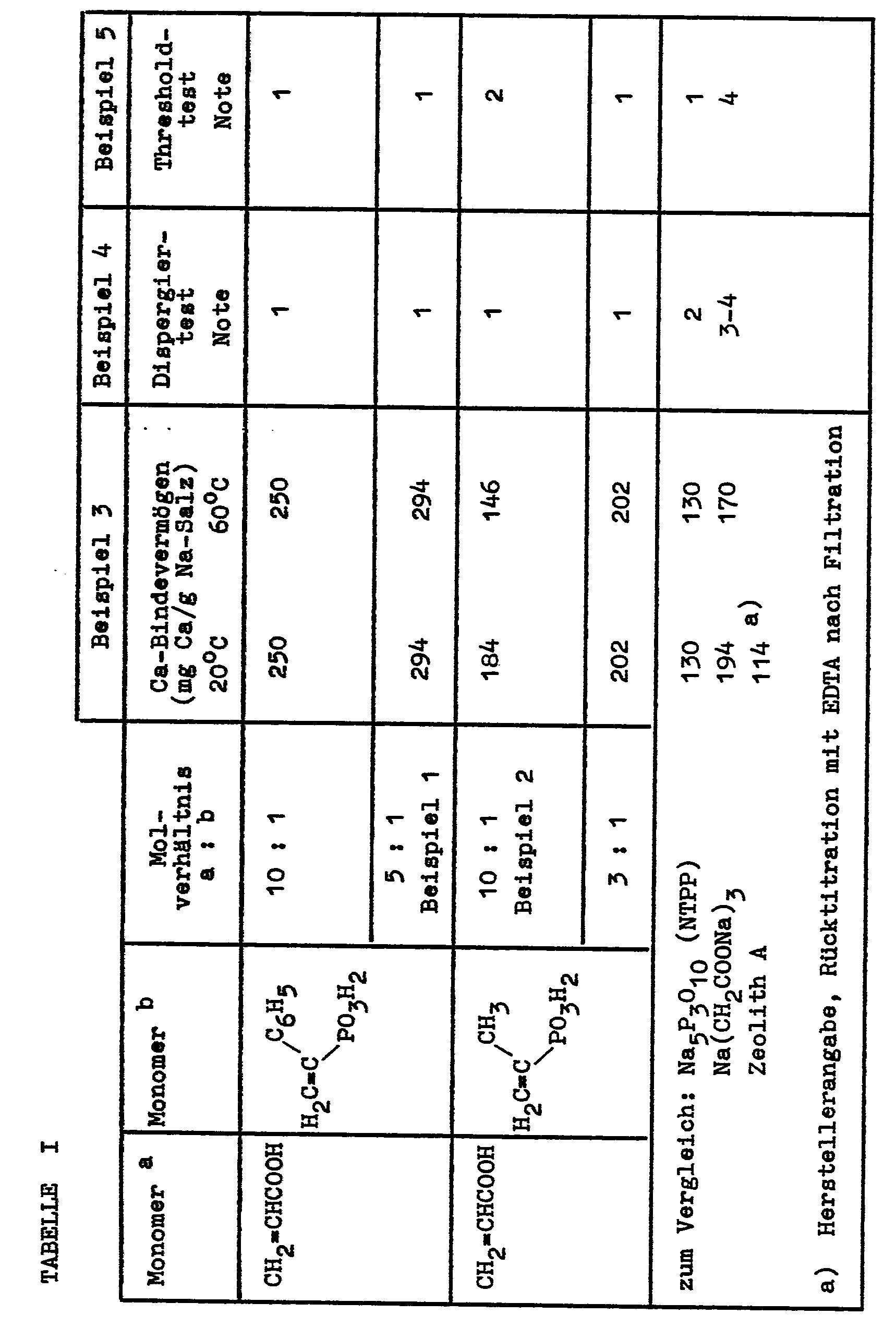
- Ermittelt wurde die Menge Komplexbildner in Form des bei pH 10 vorliegenden Natriumsalzes, die zum Wiederauflösen einer gegebenen Menge an frisch gefälltem CaC03-Niederschlag erforderlich ist. Diese Methode ist im Gegensatz zur z.B. Calciumsensitiven Elektrode auch bei erhöhter Temperatur einsetzbar. Bleibt die Lösung bei gleichen Mengenverhältnissen wie bei 20°C auch bei 60°C klar, so gilt der 20-°C-Wert auch für die erhöhte Temperatur. Die Methode ist mit einem Fehler in der Größenordnung von ± 5 % behaftet, da die Titrationsgeschwindigkeit das Titrationsergebnis beeinflußt. Die resultierenden Zahlenwerte geben also nur einen Hinweis auf die Größenordnung des Calciumbindevermögens. Im allgemeinen nimmt das Calciumbindevermögen mit steigender Temperatur ab. Die Ergebnisse sind in Tabelle I dargestellt.
- In einem Hartglasbecher wurden in 100 ml Wasser von 23°d, das mit Natronlauge auf pH 10 eingestellt war, 0,2 g des zu prüfenden Dispergiermittels vorgelegt und 0,5 Gew% Eisenoxid-Pigment (Bayferrox 130) zugegeben. Es wurde 5 min. mit 2 000 UpM mit einem Sägezahnrührer von 40 mm Scheibendurchmesser dispergiert. Für die vorliegenden Versuche wurde gegebenenfalls der pH nochmal auf 10 nachgestellt. 30 ml der Dispersion wurden in einen PVC-Becher gegeben, ein Filterpapierstreifen (mittel- bis weitporig, 90 g/m2) eingehängt und die Flüssigkeitssäule 2 h aufsteigen gelassen. Je nach Mitwandern des Pigments wurde die Benotung 1 (sehr gut), 2 (gut), 3 (mäßig), 4 (schlecht) vorgenommen. Die Ergebnisse sind Tabelle I zu entnehmen.
- Die Thresholdwirkung kann durch Streulichtmessung (TYNDALL-Effekt) sichtbar gemacht werden. Zur Messung eingesetzt werden CaC03-Trüben, die durch Vereinigen von
225 ml Wasser (560 d CaCl2 Härte) mit 25 ml NaHC03-Lösung (Molverhältnis CaC12 : NaHCO3 = 1:1,15)
in Gegenwart von 80 ppm Prüfsubstanz hergestellt werden. Bei Raumtemperatur wird dann mittels eines Streulichtphotometers der Trübungsverlauf verfolgt und beurteilt. - Die Beurteilung erfolgt nach folgender Notenskala

- Die Ergebnisse sind in Tabelle I wiedergegeben.
- Verschiedene Testgewebe (Frottee, EMPA-Baumwolle (EMPA = Eidgenössiche Materialprüfungsanstalt St. Gallen, Schweiz), WFK-Baumwolle (WFK = Wäschereiforschung Krefeld), WFK-Polyester/Baumwolle, Doppelripp) wurden 20-mal bei 93°C und 18° d mit einem Versuchswaschmittel A folgender Zusammensetzung gewaschen (Dosierung je 150 g Vor- und Hauptwäsche):

- Durch Wiederholung des Versuches unter Zugabe von 1 Gew% Copolymer Acrylsäure/1-Phenylvinyl-1-phosphonsäure (ACS/PVP; Molverhältnis 10 : 1), bezogen auf die Waschmittelmenge, konnte die anorganische Gewebeinkrustierung deutlich gesenkt werden (Tabelle II).
- EMPA-Baumwolle wie in Beispiel 6 wurde 25-mal bei 60°C und 18° d mit einem Versuchswaschmittel B der folgenden Zusammensetzung gewaschen (Dosierung 160 g, nur Klarwäsche):

- Die anorganische Gewebeinkrustierung wurde durch Veraschen bei 800°C ermittelt. Der Versuch wurde wiederholt in Gegenwart von 1,6 Gew% Copolymer gemäß Beispiel 2, bezogen auf die Waschmittelmenge, wodurch fast die gleiche Senkung der Gewebeinkrustierung erreicht wurde wie durch Zusatz von 3,1 Gew% Natriumnitrilotriacetat (NTA) (Tabelle II).
- Ein noch besseres Ergebnis wurde bei Versuchswaschmittel B erreicht durch Zusatz von 1,6 Gew% Copolymer Acrylsäure-1-Phenylvinyl-1-phosphonsäure (ACS/PVP; Molverhältnis 10 : 1) (Tabelle II).

als Gerüststoff oder Gerüststoffadditiv in Wasch- und Reinigungsmitteln.
Claims (2)
1. Wasch- und Reinigungsmittel mit 5 bis 70 Gew% mindestens eines Tensids, 0,1 bis 50 Gew% mindestens eines Gerüststoffes sowie üblichen Waschhilfsstoffen, gekennzeichnet durch folgende Gerüststoffgehalte:
a) 0,1 bis 25 Gew% eines Copolymers, erhältlich durch an sich bekannte Copolymerisation folgender Monomere:
aa) 40 bis 99,9 Mol % ethylenisch ungesättigter Carbonsäuren oder deren Alkalisalze der allgemeinen For-
mel R1(R2)C=C(R3)COOX, worin X = H, Alkalimetall;
oder deren Anhydride;
mel R1(R2)C=C(R3)COOX, worin X = H, Alkalimetall;
R2= H, COOX,C1-C4-Alkyl, C5-C8-Cycloalkyl, Phenyl oder substituiertes Phenyl;
R1, R3 = H, C1-C4-Alkyl, C5-C8-Cycloalkyl, Phenyl, substituiertes Phenyl bedeuten,
oder deren Anhydride;
bb) 0,1 bis 40 Mol% ethylenisch ungesättigter Phosphonsäuren oder deren Alkalisalze der allgemeinen Formel
R4(R5)C=C(R6)PO3X2, worin X = H, Alkalimetall;
R4(R5)C=C(R6)PO3X2, worin X = H, Alkalimetall;
R4, R5 = H, C1-C4-Alkyl, C5-C8-Cycloalkyl, Phenyl, substituiertes Phenyl;
R6 = C 1-C4-Alkyl, C5-C8-Cycloalkyl, Phenyl, substituiertes Phenyl;
cc) 0-20 Mol% olefinisch ungesättigte Verbindungen ohne Carbon- oder Phosphonsäuregruppen.
b) 0 bis 49,9 Gew% übliche Gerüststoffe.
2. Verwendung eines Copolymers, erhältlich durch an sich bekannte Copolymerisation folgender Monomere:
als Gerüststoff oder Gerüststoffadditiv in Wasch- und Reinigungsmitteln.
a) 40 bis 99,9 Mol% ethylenisch ungesättigter Carbonsäuren oder deren Alkalisalze der allgemeinen Formel
R 1(R 2)C=C(R3)COOX, worin X = H, Alkalimetall;
oder deren Anhydride;
R 1(R 2)C=C(R3)COOX, worin X = H, Alkalimetall;
R2 = H, COOX, C1-C4-Alkyl, C5-C8-Cycloalkyl, Phenyl oder substituiertes Phenyl;
R1, R3 = H, C1-C4-Alkyl, C5-C8-Cycloalkyl, Phenyl, substituiertes Phenyl bedeuten
oder deren Anhydride;
b) 0,1 bis 40 Mol% ethylenisch ungesättigter Phosphonsäuren oder deren Alkalisalze der allgemeinen Formel
R4(R5)C=C(R6)PO3X2, worin X = H, Alkalimetall;
R4(R5)C=C(R6)PO3X2, worin X = H, Alkalimetall;
R4, R 5 = H, C1-C4-Alkyl, C5-C8-Cycloalkyl, Phenyl, substituiertes Phenyl;
R6 = C1-C4-Alkyl, C5-C8-Cycloalkyl, Phenyl, substituiertes Phenyl;
c) 0-20 Mol% olefinisch ungesättigte Verbindungen ohne Carbon- oder Phosphonsäuregruppen;
als Gerüststoff oder Gerüststoffadditiv in Wasch- und Reinigungsmitteln.
Applications Claiming Priority (2)
| Application Number | Priority Date | Filing Date | Title |
|---|---|---|---|
| DE3418494 | 1984-05-18 | ||
| DE19843418494 DE3418494A1 (de) | 1984-05-18 | 1984-05-18 | Wasch- und reinigungsmittel |
Publications (1)
| Publication Number | Publication Date |
|---|---|
| EP0161596A2 true EP0161596A2 (de) | 1985-11-21 |
Family
ID=6236213
Family Applications (1)
| Application Number | Title | Priority Date | Filing Date |
|---|---|---|---|
| EP85105456A Withdrawn EP0161596A2 (de) | 1984-05-18 | 1985-05-04 | Wasch- und Reinigungsmittel |
Country Status (6)
| Country | Link |
|---|---|
| EP (1) | EP0161596A2 (de) |
| JP (1) | JPS60255899A (de) |
| DE (1) | DE3418494A1 (de) |
| DK (1) | DK217185A (de) |
| ES (1) | ES8607379A1 (de) |
| NO (1) | NO851975L (de) |
Cited By (12)
| Publication number | Priority date | Publication date | Assignee | Title |
|---|---|---|---|---|
| EP0468103A1 (de) * | 1989-02-22 | 1992-01-29 | The Procter & Gamble Company | Stabilisierte, Bleichmittel enthaltende, flüssige Reinigungsmittel |
| EP0495355A1 (de) * | 1991-01-12 | 1992-07-22 | Hoechst Aktiengesellschaft | Copolymere aus Diallylaminoalkylenphosphonaten und ungesättigten Carbonsäuren |
| WO1998030666A1 (en) * | 1997-01-13 | 1998-07-16 | Ecolab Inc. | Alkaline detergent containing mixed organic and inorganic sequestrants resulting in improved soil removal |
| US6258765B1 (en) | 1997-01-13 | 2001-07-10 | Ecolab Inc. | Binding agent for solid block functional material |
| US6410495B1 (en) | 1997-01-13 | 2002-06-25 | Ecolab Inc. | Stable solid block metal protecting warewashing detergent composition |
| US6583094B1 (en) | 1997-01-13 | 2003-06-24 | Ecolab Inc. | Stable solid block detergent composition |
| US6632291B2 (en) | 2001-03-23 | 2003-10-14 | Ecolab Inc. | Methods and compositions for cleaning, rinsing, and antimicrobial treatment of medical equipment |
| US6638902B2 (en) | 2001-02-01 | 2003-10-28 | Ecolab Inc. | Stable solid enzyme compositions and methods employing them |
| US7517846B2 (en) | 1991-05-14 | 2009-04-14 | Ecolab Inc. | Solid, two part chemical concentrate |
| WO2015197533A1 (en) * | 2014-06-27 | 2015-12-30 | Henkel Ag & Co. Kgaa | Dishwasher detergent comprising phosphate-containing polymers |
| EP3599273A1 (de) * | 2018-07-27 | 2020-01-29 | Henkel AG & Co. KGaA | Reinigungsmittel mit verbesserter leistungsfähigkeit |
| CN116063345A (zh) * | 2021-10-30 | 2023-05-05 | 中国石油化工股份有限公司 | 一种膦酸基单体及其制备方法 |
Families Citing this family (2)
| Publication number | Priority date | Publication date | Assignee | Title |
|---|---|---|---|---|
| JP2772841B2 (ja) * | 1989-12-22 | 1998-07-09 | タイホー工業株式会社 | インクジェットプリンター用メンテナンス液 |
| DE10342632A1 (de) * | 2003-09-15 | 2005-04-07 | Henkel Kgaa | Maschinelle Geschirrspülmittel mit speziellen Polymeren |
-
1984
- 1984-05-18 DE DE19843418494 patent/DE3418494A1/de not_active Withdrawn
-
1985
- 1985-05-04 EP EP85105456A patent/EP0161596A2/de not_active Withdrawn
- 1985-05-15 NO NO851975A patent/NO851975L/no unknown
- 1985-05-15 DK DK217185A patent/DK217185A/da not_active Application Discontinuation
- 1985-05-17 JP JP60104154A patent/JPS60255899A/ja active Pending
- 1985-05-17 ES ES543261A patent/ES8607379A1/es not_active Expired
Cited By (25)
| Publication number | Priority date | Publication date | Assignee | Title |
|---|---|---|---|---|
| EP0468103A1 (de) * | 1989-02-22 | 1992-01-29 | The Procter & Gamble Company | Stabilisierte, Bleichmittel enthaltende, flüssige Reinigungsmittel |
| TR25960A (tr) * | 1989-02-22 | 1993-11-01 | Procter & Gamble | Kararli hale getirilmis agartici ihtiva eden, sivi deterjan terkipleri. |
| EP0495355A1 (de) * | 1991-01-12 | 1992-07-22 | Hoechst Aktiengesellschaft | Copolymere aus Diallylaminoalkylenphosphonaten und ungesättigten Carbonsäuren |
| US7517846B2 (en) | 1991-05-14 | 2009-04-14 | Ecolab Inc. | Solid, two part chemical concentrate |
| US7087569B2 (en) | 1997-01-13 | 2006-08-08 | Ecolab Inc. | Stable solid block metal protecting warewashing detergent composition |
| US6831054B2 (en) | 1997-01-13 | 2004-12-14 | Ecolab Inc. | Stable solid block detergent composition |
| US6258765B1 (en) | 1997-01-13 | 2001-07-10 | Ecolab Inc. | Binding agent for solid block functional material |
| US6410495B1 (en) | 1997-01-13 | 2002-06-25 | Ecolab Inc. | Stable solid block metal protecting warewashing detergent composition |
| US6436893B1 (en) | 1997-01-13 | 2002-08-20 | Ecolab Inc. | Alkaline detergent containing mixed organic and inorganic sequestrants resulting in improved soil removal |
| US6503879B2 (en) | 1997-01-13 | 2003-01-07 | Ecolab Inc. | Alkaline detergent containing mixed organic and inorganic sequestrants resulting in improved soil removal |
| US6583094B1 (en) | 1997-01-13 | 2003-06-24 | Ecolab Inc. | Stable solid block detergent composition |
| US8906839B2 (en) | 1997-01-13 | 2014-12-09 | Ecolab Usa Inc. | Alkaline detergent containing mixing organic and inorganic sequestrants resulting in improved soil removal |
| WO1998030666A1 (en) * | 1997-01-13 | 1998-07-16 | Ecolab Inc. | Alkaline detergent containing mixed organic and inorganic sequestrants resulting in improved soil removal |
| US6653266B2 (en) | 1997-01-13 | 2003-11-25 | Ecolab Inc. | Binding agent for solid block functional material |
| US6660707B2 (en) | 1997-01-13 | 2003-12-09 | Ecolab Inc. | Stable solid block metal protecting warewashing detergent composition |
| US6150324A (en) * | 1997-01-13 | 2000-11-21 | Ecolab, Inc. | Alkaline detergent containing mixed organic and inorganic sequestrants resulting in improved soil removal |
| US6835706B2 (en) | 1997-01-13 | 2004-12-28 | Ecolab Inc. | Alkaline detergent containing mixed organic and inorganic sequestrants resulting in improved soil removal |
| MY119471A (en) * | 1997-01-13 | 2005-05-31 | Ecolab Inc | Alkaline detergent containing mixed organic and inorganic sequestrants resulting in improved soil removal |
| AU724865B2 (en) * | 1997-01-13 | 2000-10-05 | Ecolab Inc. | Alkaline detergent containing mixed organic and inorganic sequestrants resulting in improved soil removal |
| US7094746B2 (en) | 1997-01-13 | 2006-08-22 | Ecolab Inc. | Stable solid block detergent composition |
| US6638902B2 (en) | 2001-02-01 | 2003-10-28 | Ecolab Inc. | Stable solid enzyme compositions and methods employing them |
| US6632291B2 (en) | 2001-03-23 | 2003-10-14 | Ecolab Inc. | Methods and compositions for cleaning, rinsing, and antimicrobial treatment of medical equipment |
| WO2015197533A1 (en) * | 2014-06-27 | 2015-12-30 | Henkel Ag & Co. Kgaa | Dishwasher detergent comprising phosphate-containing polymers |
| EP3599273A1 (de) * | 2018-07-27 | 2020-01-29 | Henkel AG & Co. KGaA | Reinigungsmittel mit verbesserter leistungsfähigkeit |
| CN116063345A (zh) * | 2021-10-30 | 2023-05-05 | 中国石油化工股份有限公司 | 一种膦酸基单体及其制备方法 |
Also Published As
| Publication number | Publication date |
|---|---|
| NO851975L (no) | 1985-11-19 |
| DK217185A (da) | 1985-11-19 |
| JPS60255899A (ja) | 1985-12-17 |
| ES8607379A1 (es) | 1986-06-01 |
| ES543261A0 (es) | 1986-06-01 |
| DK217185D0 (da) | 1985-05-15 |
| DE3418494A1 (de) | 1985-11-21 |
Similar Documents
| Publication | Publication Date | Title |
|---|---|---|
| EP0165452B1 (de) | Verfahren zur Herstellung von Mischpolymerisaten aus Vinylphosphonsäure und (Meth-)Acrylsäure in wässriger Lösung und ihre Verwendung | |
| DE69417538T2 (de) | Maleinsäurecopolymer, verfahren zur herstellung und dessen anwendung | |
| EP0451508B1 (de) | Verfahren zur Herstellung von Homo- und Copolymerisaten monoethylenisch ungesättigter Dicarbonsäuren und ihre Verwendung | |
| DE3926059C2 (de) | Phosphonomethylierte Polyvinylamine, Verfahren zu ihrer Herstellung und ihre Verwendung | |
| EP0471710B1 (de) | Copolymerisate, die polyalkylenoxid-blöcke enthaltende monomere einpolymerisiert enthalten, ihre herstellung und ihre verwendung | |
| DE69819593T2 (de) | Detergensformulierungen | |
| DE3716543A1 (de) | Verwendung von wasserloeslichen copolymerisaten, die monomere mit mindestens zwei ethylenisch ungesaettigten doppelbindungen einpolymerisiert enthalten, in wasch- und reinigungsmitteln | |
| DE3418494A1 (de) | Wasch- und reinigungsmittel | |
| EP0444415B1 (de) | Teilentwässertes Disilikat enthaltendes Waschmittel | |
| EP0292766B1 (de) | Verwendung von wasserlöslichen Copolymerisaten, die Monomere mit mindestens zwei ethylenisch ungesättigten Doppelbindungen einpolymerisiert enthalten, in Wasch-und Reinigungsmitteln | |
| DE112014006990T5 (de) | Sulfonatgruppenhaltiges polymer und verfahren zur herstellung hiervon | |
| EP0603236B1 (de) | Copolymerisate von hydroxyalkylvinylethern und verwendung von homo- und copolymerisaten von hydroxyalkylvinylethern in wasch- und reinigungsmitteln | |
| DE4344029A1 (de) | Copolymerisate ungesättigter Carbonsäuren, Verfahren zur Herstellung und ihre Verwendung | |
| DE3528460A1 (de) | Verwendung von neutralisierten und amidierten, carboxylgruppen enthaltenden polymerisaten als zusatz zu waschmitteln und reinigungsmitteln | |
| DE60105347T2 (de) | Herstellungsverfahren für ein Polymer auf Allylether-Basis | |
| KR900004495B1 (ko) | 인산염이 없는 세제 증강제 | |
| EP0637627B1 (de) | Waschmittelformulierungen | |
| DE69602305T2 (de) | Polycarboxylmonomer, Polymer daraus, und dieses Polymer enthaltende reinigende Zusammensetzung | |
| EP0622449B1 (de) | Wasserenthärtende Formulierungen | |
| DE4019418A1 (de) | Verwendung von pfropfcopolymeren als zusatz zu phospatfreien oder phosphatarmen wasch- und reinigungsmitteln | |
| DE2212623A1 (de) | Gerueststoffe fuer wasch- und reinigungsmittel | |
| EP1513916B1 (de) | Verwendung von alkylenoxideinheiten enthaltenden copolymeren als zusatz in geschirrspülmitteln | |
| DE4001420A1 (de) | Alkenylaminomethylenphosphonsaeuren und deren copolymere mit ungesaettigten carbonsaeuren | |
| DE102005028460A1 (de) | Verwendung von Alkylenoxideinheiten enthaltenden Copolymeren als Zusatz zu wäßrigen Systemen | |
| DE102004031040A1 (de) | Verfahren zur Herstellung von granulären oder pulverförmigen Waschmittelzusammensetzungen |
Legal Events
| Date | Code | Title | Description |
|---|---|---|---|
| PUAI | Public reference made under article 153(3) epc to a published international application that has entered the european phase |
Free format text: ORIGINAL CODE: 0009012 |
|
| AK | Designated contracting states |
Designated state(s): AT BE CH DE FR GB IT LI NL SE |
|
| STAA | Information on the status of an ep patent application or granted ep patent |
Free format text: STATUS: THE APPLICATION HAS BEEN WITHDRAWN |
|
| 18W | Application withdrawn |
Withdrawal date: 19880516 |
|
| RIN1 | Information on inventor provided before grant (corrected) |
Inventor name: PIEPER, WERNER, DR. Inventor name: GROSSE, JURGEN, DR. Inventor name: GOHLA, WERNER |