EP0161660A2 - Verfahren zur Herstellung von Schutzlackbildern und Zusammensetzung dafür - Google Patents
Verfahren zur Herstellung von Schutzlackbildern und Zusammensetzung dafür Download PDFInfo
- Publication number
- EP0161660A2 EP0161660A2 EP85105876A EP85105876A EP0161660A2 EP 0161660 A2 EP0161660 A2 EP 0161660A2 EP 85105876 A EP85105876 A EP 85105876A EP 85105876 A EP85105876 A EP 85105876A EP 0161660 A2 EP0161660 A2 EP 0161660A2
- Authority
- EP
- European Patent Office
- Prior art keywords
- group
- represent
- hydrogen atom
- diazonium salt
- pattern
- Prior art date
- Legal status (The legal status is an assumption and is not a legal conclusion. Google has not performed a legal analysis and makes no representation as to the accuracy of the status listed.)
- Granted
Links
Images


Classifications
-
- G—PHYSICS
- G03—PHOTOGRAPHY; CINEMATOGRAPHY; ANALOGOUS TECHNIQUES USING WAVES OTHER THAN OPTICAL WAVES; ELECTROGRAPHY; HOLOGRAPHY
- G03F—PHOTOMECHANICAL PRODUCTION OF TEXTURED OR PATTERNED SURFACES, e.g. FOR PRINTING, FOR PROCESSING OF SEMICONDUCTOR DEVICES; MATERIALS THEREFOR; ORIGINALS THEREFOR; APPARATUS SPECIALLY ADAPTED THEREFOR
- G03F7/00—Photomechanical, e.g. photolithographic, production of textured or patterned surfaces, e.g. printing surfaces; Materials therefor, e.g. comprising photoresists; Apparatus specially adapted therefor
- G03F7/004—Photosensitive materials
- G03F7/09—Photosensitive materials characterised by structural details, e.g. supports, auxiliary layers
- G03F7/095—Photosensitive materials characterised by structural details, e.g. supports, auxiliary layers having more than one photosensitive layer
Definitions
- This invention relates to a pattern forming method suitable for minute working and a composition for pattern formation to be used therefor, more particularly to a method for pattern formation for obtaining a minute pattern by a simple method and yet with good dimensional precision and stably and also a composition for pattern formation to be used therefor.
- a step of forming a minute pattern on a semiconductor wafer This step.is generally constituted of the operations as described below. First, a substrate such as wafer is coated with a resist solution and dried to form a resist film thereon. Thereafter, with this resist film brought into contact with a desired pattern, a light to which the resist film is sensitive is irradiated thereon to effect pattern exposure. Next, the resist film is developed to form a desired minute pattern.
- the prior art techniques are available as such to be very advantageous in bulk productivity and also in aspect of economy. Practically, there remains sufficient room for improving the UV-ray exposure technique so as to be applicable for submicron minute working of ultra-LSI.
- the elemental techniques required for improvement of UV-ray exposure technique as viewed from the standpoint of pattern miniaturization are as follows:
- the techniques (1) and (2) concern primarily improvement of optical system, and improvement of resolution can be expected also from the optical theory, but no sufficient dose can be obtained at a short wavelength due to decreased transmittance of the lens. Further, enlargement of a numerical aperture will pose a problem such that the focal depth becomes shallower to become weak against uneven steppage difference on the wafer surface. On the other hand, (3), (4) and (5) concern improvement of the resist itself.
- the method (1) which is generally applied for a cross-linked type resist, is limited to the attainable ⁇ -value, and also the approach (2), which can give some effect, is.limited in the amount of the fading material added, because the resist function is affected thereby. In view of such situations, improvement of y-value is also limited.
- the specific feature of these methods resides in apparent improvement in optical contrast relative to the resist by alternating the illumination distribution of the pattern to pass through the photobleachable film.
- the faded quantity is smaller at a shadow portion where the dose is relatively smaller, while contrariwise it is greater at a highlight portion.
- the transmitted light at the highlight portion is relatively intensified, which means that apparent optical contrast has been improved relative to the resist film.
- the photobleachable substance is required to satisfy the following conditions:
- Japanese Provisional Patent Publication No. 104642/ 1984 discloses use of arylnitrone as the color fading substance.
- this substance due to large coefficient of light absorption, the photosensitive film can be made thin to result in improvement of resolution.
- arylnitrone is chemically unstable and therefore suceptible to decomposion by water or heat, thus posing a problem in difficult control in the manufacturing steps. Accordingly, there is also involved the problem that it is not possible to produce minute patterns stably.
- An object of the present invention is to provide a method for pattern formation which has cancelled the problems as described above, is suitable for minute working even by use of visible light and can give minute patterns with good dimensional precision and stability by a simple method, and a composition for pattern formation to be used therefor.
- the present inventors have studied intensively about the materials of the photosensitive film to be formed on the resist film in order to accomplish the above object, and consequently found that the photosensitive film containing photosensitive diazonium salts as described hereinafter has the advantages of having sufficiently greater light shielding ability against UV-rays with wavelengths of 300 - 450 nm as compared with the color fading dye or positive-type resist itself used in the prior art, having a light fading speed approximate to the sensitizing speed of the resist and giving a substantially transparent film after bleaching, to develop the pattern forming method and a composition to be used therefor of the present invention.
- the pattern forming method of the present invention comprises the steps of providing a resist film on a substrate; providing a photosensitive film containing a photosensitive diazonium salt on the resist film; and then subjecting the resultant composite to pattern exposure by use of a light to which both of the resist film and the photosensitive diazonium salt are sensitive.
- composition to be used in the pattern forming method of the present invention comprises a photosensitive diazonium salt, a resin binder and a solvent.
- composition for pattern formation of the present invention there may further be contained organic acids.
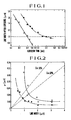
- Fig. 1 through Fig. 8 are graphs for explanation of the effects of the present invention, Fig. 1 and Fig. 3 being graphs showing dependency of the line width after pattern developing on exposure time; Fig. 2 and Fig. 4 being graphs showing dependency of variance in dimensional precision on line width; and Fig. 5 through Fig. 8 are graphs showing relationship between the deviation from the mask dimension of the pattern formed in Example 20 and the exposure time; and all the marks ⁇ • ⁇ representing the results of the invention and all the marks ⁇ those of Comparative example, respectively.
- a resist film is formed on a semiconductor wafer.
- the resist used in not particularly limited and may include, for example, the so-called positive-type resist comprising an esterified product of naphthoquinonediazidesulfonic acid and cresol novolac resin, the so-called rubbery negative-type resist comprising a bisazide compound formulated in a cyclized polyisoprene, a negative-type resist comprising an azide compound formulated in polyvinylphenol resin or phenol-novolac resin, various resist materials comprising bichromates formulated in a water-soluble resin, water-soluble resist comprising a bisazide compound formulated in polyvinylpyrrolidone and others.
- the composition for pattern formation of the present invention namely a photosensitive solution comprising a photosensitive diazonium salt as described below and a resin binder dissolved in a suitable solvent by, for example, a spinner, followed by drying, to provide a photosensitive film thereon.
- a photosensitive solution comprising a photosensitive diazonium salt as described below and a resin binder dissolved in a suitable solvent by, for example, a spinner, followed by drying, to provide a photosensitive film thereon.
- pattern exposure is effected.
- the diazo photosensitive layer is removed, followed subsequently by developing the resist layer, to give a pattern.
- photosensitive diazonium salts to be used in the method and the composition of the present invention, any of those known in the prior art may be available.
- diazonium salts those described in the following literatures may be available:
- R 1 and R 2 may be either identical or different and represent alkyl groups, or R 1 and R 2 taken together may be cyclized through a carbon, oxygen or nitrogen atom;
- R 3 and R 4 may either be identical or different and each represent a hydrogen atom, an alkyl group, an aryl group, an aralkyl group, an alkoxy group, an alkylmercapto group, an aralkylmercapto group, an acyl group, a halogen atom, a sulfo group or a carboxyl group;
- X ⁇ represents a halogen ion or an anion constituted of a halide of boron, aluminum, iron, zinc, arsenic, antimony or phosphorus.
- R 1 and R 2 each represent an alkyl group, or R 1 and R 2 taken together may be cyclized through carbon, oxygen or nitrogen atom;
- R 3 and R 4 each represent hydrogen atom, or a substituent such as an alkyl group, an aryl group, an aralkyl group, an alkoxy group, an alkylmercapto group, an aralkylmercapto group, an acyl group, a halogen atom, a sulfo group or a carboxyl group;
- X ⁇ represents a halogen ion or an anion constituted of a halide of boron, aluminum, iron, zinc, arsenic, antimony or phosphorus,
- diazonium salts represented by the formula (I) may include 3,4-dimethyl-6-pyrrolidyl- benzenediazonium salts, 3,4-dimethyl-6-morpholinobenzene- diazonium salts, 4-benzoyl-2-(N,N-dimethylamino)benzenediazonium salts, 2-(N,N-diphenylamino)benzenediazonium salts, 3-bromo-6-(N,N-dimethylamino)-5-methylthiobenzene- diazonium salts, 4-acetylamino-2-(N,N-dimethylamino)-diazonium salts, 4-ethoxy-2-(N,N-dimethylamino)benzenediazonium salts, 3-methoxy-4-benzoylamino-2-piperidino- benzenediazonium salts and the like.
- R 3 , R 4 and X ⁇ are the same as defined above.
- R 3 and R 4 each represent a hydrogen atom or a substituent such as an alkyl group, an aryl group, an aralkyl group, an alkoxy group, an alkylmercapto group, an aralkylmercapto group, an acyl group, a halogen atom, a sulfo group, a carboxyl group, etc
- X represents a halogen ion or an anion constituted of a halide of boron, aluminum, iron, zinc, arsenic, antimony, phosphorus, etc.
- Typical examples of the diazonium salts represented by the formula (II) may include 4-a-naphthylaminobenzene- diazonium salts, 4-8-naphthylaminobenzenediazonium salts, 4-6'-sodiumsulfonate- ⁇ -naphthylaminobenzenediazonium salts, 4-5'-acenaphtheneaminobenzenediazonium salts, diazo compounds of 5-(4-aminophenylamino)-l,8-naphtho- sultane.
- R 5 , R 6 , R 7 and R may be either identical or different and each represent a hydrogen atom, a halogen atom, an amino group, a sulfo group, a carboxyl group, an alkyl group, an alkoxy group, a dialkylamino group, an alkylmercapto group or an acyl group each having 1 to 6 carbon atoms, an aryl group or an aralkyl group each having 6 to 12 carbon atoms; and X represents a halogen ion, a sulfate ion or an anion consisting of a halide of either boron, phosphorus, zinc, arsenic, aluminum, iron or antimony.
- R 5 , R 6 , R 7 , R 8 of the above formula when they are alkyl groups, alkoxy groups, dialkylamino groups, alkylmercapto groups or acyl groups, those having carbon atoms greater than 6 are not preferable, because solubility and film forming property will lowered. Also, in the case of aryl groups or aralkyl groups, those having carbon atoms greater than 12 are not preferable for the same reason.
- X ⁇ may be BF 4 ⁇ , PF 6 ⁇ , HSO 4 ⁇ , 1/2SO 4 2 ⁇ , ZnCl 2 ⁇ Cl ⁇ , etc.
- Such diazonium salts represented by the formula (III) may be, for example, 2-(4'-methoxyphenyl)-6-chloro-l,3-benzotriazole-5-diazonium salts, 2-(4'-methoxyphenyl)-6-methyl-l,3-benzotriazole-5-diazonium salts, 2-naphthyl- l,3-benzotriazole-5-diazonium salts, 2-(3'-N,N-dimethyl- aminonaphthyl)-l,3-benzotriazole-5-diazonium salts and the like.
- R 9 and R 10 each represent a hydrogen atom, a halogen atom, an alkyl group, an alkenyl group, an alkoxy group, an aryl group, an aralkyl group, an amino group, a dialkylamino group, an alkylmercapto group, an acyl group, a sulfo group, a carboxyl group or ;
- R 11 and R 12 each represent a hydrogen atom, a halogen atom, an alkyl group, an alkenyl group, an alkoxy group, an aryl group, an aralkyl group, an amino group, a dialkylamino group, an alkylmercapto group, an acyl group, a sulfo group or a carboxyl group
- X represents an anion capable of forming a diazonium salt.
- R 9 and R 10 each represent a hydrogen atom, a halogen atom, an alkyl group, an alkenyl group, an alkoxy group, an aryl group, an aralkyl group, an amino group, a dialkylamino group, an alkylmercapto group, an acyl group, a sulfo group, a carboxyl group or
- R 11 and R 12 each represent a hydrogen atom, an alkyl group, an alkenyl group, an alkoxy group, an aryl group, an aralkyl group, an amino group, a dialkylamino group, an alkylmercapto group, an acyl group, a sulfo group or a carboxyl group; and
- X represents an anion capable of forming a diazonium salt.
- the halogen atom may be a fluorine atom, a chlorine atom, a bromine atom and an iodine atom.
- the alkyl group and the alkenyl group refer to straight or branched alkyl groups and alkenyl groups having 1 to 5 carbon atoms, respectively.
- the aryl group is an unsubstituted or substituted phenyl group, and the substituent on the phenyl group may be any one, provided it does not interfere with photosensitization of the diazonium compound to a light with a wavelength of 300 nm or longer to not more than 450 nm.
- alkyl moiety in the alkoxy group, the dialkylamino group, the alkylmercapto group and the acyl group has the same meaning as described above.
- the aryl moiety in the aralkyl group has the same meaning as described above, and the alkylene group included in the aralkyl group refers to one having 1 to 3 carbon atoms.
- the anion capable of forming a diazonium salt represented by X is not specifically limited, but may include, for example, a halogen ion, a sulfate ion or an anion consiting of a halogen compound of boron, phosphorus, zinc, arsenic, aluminum, iron and antimony.
- Typical examples of the diazonium salts represented by the formula (IV) may include 4-N-phenylamino-naphthalene diazonium salts, 4-N-(4'-methoxy-phenyl)amino-naphtha- lenediazonium salts, 4-N-(2',5'-di-methoxyphenyl)amino- naphthalenediazonium salts, 4-N-(4'-N,N-dimethylaminophenyl)amino-naphthalenediazoniuin salts, 4-N,N-dimethyl- amino-naphthalenediazonium salts, 4-N,N-diethylamino- naphthalenediazonium salts, 4-N,N-dibutylamino-naphtha- lenediazonium salts and the like.
- R 13 , R 14 , R 15 and R 16 each represent a hydrogen atom, a halogen atom, an alkyl group, an alkenyl group, an alkoxy group, an aryl group, an aralkyl group, an amino group, a dialkylamino group, an alkylmercapto group, an acyl group, a sulfo group or a carboxyl group; and X represents an anion capable of forming a diazonium salt.
- X has the same meaning as defined in the formula ( IV ), and R 13 , R14, R 15 and R 16 each represent a hydrogen atom, a halogen atom, an alkyl, an alkenyl, an alkoxy, an aryl, an aralkyl, an amino, a dialkylamino, an alkylmercapto, an acyl, a sulfo or a carboxyl.
- Typical examples represented by the formula (V) may include N,N-bis-(4-diazophenyl)amine, N,N-bis-(3-methoxy-4-diazophenyl)amine, N,N-bis-(3-N,N'-dimethylamine-4-diazophenyl)amine, N,N-bis-(2,5-dimethoxy-4-diazophenyl)-amine, and the like.
- R 17 and R 18 each represent a hydrogen atom, an alkyl group having 1 to 6 carbon atoms, a phenyl group, or R 17 and R 18 taken together may be cyclized through a carbon, oxygen or nitrogen atom;
- R 19 and R 20 each represent a hydrogen atom, a halogen atom, an alkyl group, an alkoxy group or an alkenyl group each having 1 to 6 carbon atoms;
- R 21 and R 22 each represent a hydrogen atom, a hydroxyl group, a carboxyl group, a sulfo group, an alkyl group or an alkoxy group each having 1 to 6 carbon atoms, an amino group, a nitro group or a benzoyl group.
- R 17 to R 22 in the above formulae (VI) - (IX) when they are alkyl groups, alkoxy groups or alkenyl groups, those having carbon atoms greater than 6 are not preferable, because solubility and film forming property of the photosensitive diazonium salt will be lowered.
- R17 and R18 are cyclized through carbon, oxygen or nitrogen atom may include, for example, an ethyleneimino group, a trimethyleneimino group, a pyrrolidino group, a piperidino group, a morpholino group, a cycloheptylamino group, and the like.
- the photosensitive dizaonium salts represented by the above formulae (VI) - (IX) may be exemplified by 3,4-dimethyl-6-pyrrolidylbenzenediazonium-p-toluenesulfonic acid salts, 3-methoxy-4-pyrrolidylbenzenediazonium- sulfosalicylic acid salts, 2-chloro-6-morpholinobenzene- diazonium-p-toluenesulfonic acid salts, 2,5-dibutoxy-4-morpholinobenzenediazoniumnaphthalenesulfonic acid, 4-N,N-dibutylaminobenzenediazonium-p-phenolsulfonic acid, 4-N-phenylamino-naphthalenediazoniumnaphthalenesulfonic acid, 4-N,N-dimethylamino-naphthalenediazoniumsulfo- salicylic acid salts, 4-N,N-dibuty
- the reason why the photosensitive diazonium salts represented by the.formulae (I) - (IX) are excellently effective in the method of the present invention is in the first place that the absorption band of these diazonium salts exists near 350 - 450 nm. This means that the g-line (wavelength 436 nm), h-line (wavelength 405 nm) and i-line (wavelength 365 nm) of the light source (mercury lamp) used presently in pattern exposure of an integrated circuit can very effectively be shielded.
- the diazonium salts used in the field of copying in general particularly in photosensitive material for microflush or diazo photosensitive paper for copying, even those having absorption band at the longest wavelength region are limited in the absorption peak wavelength to around 405 nm, whereby the light shielding ability against the above g-line is not sufficient.
- the diazonium salts dissolved in the resin binder By having a large amount of diazonium salts dissolved in the resin binder, its shielding ability can be increased, but when the dissolving limit is surpassed, the diazonium salt will be crystallized out to give no uniform transparent film.
- the compatibility of the diazonium salt with the resin binder can be improved.
- R 23 and R 24 may be either identical or different and each represent a hydrogen atom, a halogen atom, a hydroxyl group, a carboxyl group, an alkyl group, etc.
- R 25 and R 26 may be either identical or different and each represent a hydrogen atom, a halogen atom, a hyroxyl group, a carboxyl group, a sulfo group, an alkyl group having 1 to 5 carbon atoms, an amino group, a nitro group, etc.
- the benzenesulfonic acid or its derivatives represented by the formula (X) used in the present invention may include, for example, benzenesulfonic acid, p-toluenesulfonic acid, p-ethylbenzenesulfonic acid, p-hydroxybenzenesulfonic acid, cumenesulfonic acid, dodecylbenzenesulfonic acid and sulfosalicylic acid.
- R 25 and R 26 are alkyl groups, they should preferably have 1 to 5 carbon atoms. If the carbon atoms are greater than 5, the solubility of the photosensitive diazonium salt and the film forming property of the photosensitive film will undesirably be lowered.
- the naphthalenesulfonic acid derivative represented by the formula (XI) may include, for example, naphthalenesulfonic acid, 1,5-naphthalenedisulfonic acid, l-naphthol-8-sulfonic acid, l-naphthol-3,6-disulfonic acid, l-naphthylamine-4-sulfonic acid and the like.
- phenol derivative represented by the formula (XII) there may be mentioned, for example, phenol, 4-methylphenol, 4-ethylphenol, 2,6-dimethylphenol, p-tert-butylphenol, phenol-4-sulfonic acid, p-chlorophenol, resorcin, p-aminophenol, salicylic acid, sulfosalicylic acid and the like.
- naphthol derivative represented by the formula (XIII) there may be mentioned, for example, 1-naphthol, 1,2-naphthalenediol, l-naphthol-4-carboxylic acid, 2,4-dichloro-l-naphthol, 6-amino-l-naphthol-3-sulfonic acid and the like.
- the amount of the compound represented by the formula (X) added may be preferably at a ratio of 0.5 to 5.0 moles, more preferably 0.7 to 1.5 moles per mole of the diazonium salt.
- these compounds of the formula (XI), (XII) or (XIII) may be added at a ratio preferably of 0.5 to 5.0 moles, more preferably 0.5 to 2.0 moles, per mole of the diazonium salt. If the amount of these compounds to be added is less than 0.5 mole, the above effect is insufficient, while an amount in excess of 5.0 moles will lower film forming property and resolution of the photosensitive film.
- the effect of "having sufficiently greater light shielding ability against UV-rays, having a bleaching speed matching to the sensitizing speed of the resist and giving a substantially transparent film after bleaching" can be obtained.
- a sulfonic acid derivative, phenol derivative or naphthol derivative into the diazo photosensitive solution according to the present invention, the solubility of the diazonium salt under photosensitive solution state and the solubility of under the photosensitive film state (solubility with resin binder) have been found to be dramatically improved.
- Improvement of the solubility of the diazonium salt under the photosensitive film state means that a large amount of the diazonium salt can be dissolved per unit weight of resin binder, with the result that the UV-ray shielding ability of the diazo photosensitive film can dramatically be improved.
- additional effects of "improvement in resolution with little unfocused image, due to the diazo photosensitive member which can be made thinner", and “enlarged scope of applicable diazonium salts”, etc. were found to be obtained.
- the present inventors have investigated about solubility of various diazonium salts with resin binders. As the result, it was found that the compatibility could not be stated to be so great. For, even according to a combination with good compatibility, the diazonium salt capable of dissolving 1 g of a resin is about 2 mmol. Accordingly, it is very advantageous, if the solubility of the diazonium salt relative to the resin binder can be increased.
- the present inventors have made various studies on improvement of solubility of the diazonium salt in the resin binder, and consequently found a phenomenon that the solubility of the diazonium salt can be surprisingly improved if a sulfonic acid derivative, phenol derivative or naphthol derivative is added in an amount of 0.5 to 5 moles per mole of the diazonium salt into the diazo photosensitive solution.
- solubility of the diazonium salt in 1 g of a resin binder is about 2 mmol at the highest as mentioned above
- another embodiment of the present invention which employs a sulfonic acid derivative, phenol derivative or naphthol derivative, about 20 mmol, namely about 10-fold of solubility as compared with the case of no addition, was found to be obtained, and thus it is more preferred.
- the resin binder to be added in the diazo photosensitive solution of the present invention there may be employed any of water-soluble resins and organic solvent-soluble resins.
- the water-soluble resins may include polyvinylpyrrolidone, copolymers of vinyl methyl ether and maleic anhydride, polyvinyl alcohol, cellulose derivatives such as methyl cellulose, hydroxymethyl cellulose, hydroxypropyl cellulose, hydroxypropylmethyl cellulose, natural resins such as gelatin, egg white, casein and shellac, etc.
- the organic solvent soluble resin binders may include cellulose derivatives such as cellulose acetate butyrate resin, cellulose acetate, ethyl cellulose, etc., polyvinylbutyral, polystyrene, cyclized polyisoprene, polyvinyl chloride, polyvinyl acetate, phenolic resins, polyester resin, acrylic resins such as copolymers of methyl methacrylate and methacrylic acid, copolymers of methyl acrylate and acrylic acid, but the present invention is not limited thereto.
- the diazonium photosensitive solution may further contain other additives, for example, organic acids such as p-toluenesulfonic acid, sulfosalicylic acid, citric acid, tartaric acid, acetic acid, nicotinic acid, etc. as the pyrolysis stabilizer of the diazonium salt, or surfactants, defoaming agents and others as the materials for improving the coating characteristic, film forming property of the coated films, if desired.
- organic acids such as p-toluenesulfonic acid, sulfosalicylic acid, citric acid, tartaric acid, acetic acid, nicotinic acid, etc.
- surfactants defoaming agents and others as the materials for improving the coating characteristic, film forming property of the coated films, if desired.
- the above diazonium salt, the resin binder and the additives are dissolved in an appropriate solvent.
- Organic solvents may suitably be selected from alcohols, cellosolves, esters, ketones, halogenated hydrocarbons, toluene, xylene, THF and DMF.
- a photosensitive solution dissolves or partially dissolves the resist film when the photosensitive solution was provided thereon to form a mixed layer comprising resist materials and a diazonium salt, since the aforasaid fact made lower the resolving property.
- the photosensitive solution to be coated thereon should preferably be composed of an organic solvent, a diazonium salt to be soluble therein and a resin binder as main components
- the photosensitive solution to be applied thereon should preferably be composed of water, a water-soluble diazonium salt and a water-soluble resin binder as main components.
- a solvent having substantially no solubility to the resist film is used in the photosensitive solution.
- the proportions of the components constituting the diazo photosensitive solution should be such that the proportion of the diazonium salt formulated relative to the resin binder may be as near as possible to the limiting concentration at which the diazonium salt will be crystallized out in the solution state and during formation of the coated film, because the shielding ability against UV-ray can thereby preferably be made greater.
- the viscosity of the photosensitive solution should desirably be within the range from 5 to 1000 cPs, preferably from 5 to 200 cPs.
- the film thickness of the film of the diazo photosensitive solution which is also related to the light-shielding ability of the film, cannot independently be determined, but it may be generally 500 A to 5 ⁇ m, preferably 1000 A to 2 ⁇ m. With a thickness less than 500 A, pinholes may be generated, while a thickness over 5 um will undesirably give rise to unfocused images.
- drying is performed.
- the drying conditions should be determined primarily in view of the thermal stability of the resist material which is provided under the photosensitive film and the diazonium salt. Since diazonium salts begin to be decomposed usually at around 90 °C, the drying time should be made shorter at a temperature of 90 °C or higher. If the solvent remain in the photosensitive film, scattering of the exposure light will be increased, whereby resolution is undesirably lowered.
- pattern exposure is effected by irradiating a light with a wavelength of 300 nm or longer to 450 nm or less. Then, the photosensitive layer is removed, and subsequently the resist layer is developed to give a desired minutely worked pattern.
- the present inventors have made various studies about methods for coating of diazo photosensitive solutions on a resist film soluble in a diazo photosensitive solvent.
- a diazo photosensitive soution comprising a solvent capable of dissolving the resist film can be used, and further confirmed that provision of such a transparent thin film has no adverse influence on the fading effect of the diazonium salt to give a minute pattern.
- a polymer solution substantially transparent to a light having wavelength from 300 nm or longer to 450 nm or less is subjected to spin coating on a resist film to form a transparent thin film.
- said polymer solution must not dissolve substantially the lower layer of the resist film during spin coating, and that the transparent film obtained after drying must not be dissolved in the diazo photosensitive solution during the later step of coating thereof.
- the polymer and the solvent system suited for these conditions there may be employed polymer solutions of rubbery polymers such as cyclized polyisoprene, polybutadiene, neoprene, etc.
- the thickness of the transparent thin film obtained by spin coating of these polymer solutions should desirably be as thin as possible, but generally 0.03 to 3 um, preferably 0.05 to 1 um. In the case of a thickness less than 0.03 um, pinholes will be formed to lose the meaning of formation of a transparent thin film. On the other hand, a thickness over 3 ⁇ m will undesirably give rise to unfocused images.
- the diazo photosensitive film and the transparent thin film are peeled off in the order mentioned, and finally the resist film is subjected to development.
- the solvents employed for preparation of respective coating solutions are generally employed.
- a positive-type resist [esterified product of l,2-naphthoquinone-diazide-5-sulfonic acid dissolved in m-cresol novolac resin (trade name OFPR-800, produced by Tokyo Oka Kogyo K.K.)] with a film thickness of 1 um.
- a diazo photosensitive solution comprising the composition shown below was applied by rotary coating on the above positive-type resist, followed by drying at 80 °C for 10 minutes to provide a diazo photosensitive film with a thickness of 0.4 ⁇ m.
- comparative sample was prepared in the same manner as in Example 1 except that only the positive-type photoresist film was used.
- Fig. 2 results of comparison with respect to dimensional precision are shown in Fig. 2.
- the dimensional precision ordinarily required is 3 ⁇ , and it is stated to be within 10 % of its dimension. To determine the minimum line width, it is about 1.2 um in the prior art method, and about 0.9 um in the method of the present invention. Thus, improvement to a great extent can be recognized.
- Example 1 The same experiment as in Example 1 was conducted except for employing 2,5-diethoxy-4-p-methoxyphenylthiobenzene- diazonium chloride 1/2 zinc chloride double salt in place of the diazonium salt employed in Example 1, and the same pattern of 0.9 um in the line width as in Example 1 was obtained.
- Example 2 When the same experiment as in Example 1 was conducted except for employing the photosensitive solution having the following composition in place of the diazo photosensitive solution employed in Example 1, a clear pattern of 0.9 ⁇ m in the line width was obtained.
- the viscosity of the diazo photosensitive solution was 50 cPs.
- Example 3 The same experiment as in Example 3 was conducted except for employing 3-methoxy-4-pyrrolidinylbenene chloride 1/2 zinc chloride double salt as the diazonium salt in the diazo photosensitive solution employed in Example 3. As the result, a clear pattern of 0.8 to 0.9 um in the line width was obtained.
- the following mixture was prepared as a solution containing a fading dye.
- This dye solution was applied on the positive-type resist film as employed in Example 1 to provide a dye film with a dried film thickness of 0.7 um.
- an ordinary negative-type resist [2,6-bis-(4-azidobenzal)cyclohexanone derivative dissolved in cyclized polyisoprene (trade name: OMR-83, produced by Tokyo Oka K.K.)] with a film thickness of 1.0 um.
- the positive-type resist as used in Example 1 was applied on the resist film to a thickness of 0.5 ⁇ m. Exposure was effected by means of a reduction-type projection aligner mounted with 1 : 1 mirror (trade name: PLA-520, produced by Canon K.K.).
- Exposure was effected by varying the exposure time, and the positive-type resist was removed with cellosolve acetate after exposure, followed by developing with a xylene type developer, and the patterns obtained were evaluated. As the result, it was found that no minute pattern of 2.0 ⁇ m or less was obtained irrespectively of whether there was the positive-type resist film or not.
- a positive-type resist (trade name: OFPR-800, produced by Tokyo Oka Kogyo K.K.) with a film thickness of 1 ⁇ m.
- a diazo photosensitive solution comprising the composition shown below was applied by rotary coating on the above positive-type resist, followed by drying at 80 °C for 10 minutes to provide a diazo photosensitive film with a thickness of 0.4 um.
- FIG. 3 shows the results of measurement of the dimensions of resist patterns after development.
- the exposure second for obtaining a line width of 1 pm is about 0.4 second, while it is prolonged to 4 seconds according to the present invention.
- examination of the dependency of the line width on the exposure time after development gives the result that the slope of the straight line is about 1/3 to 1/4 as compared with the prior art method, thus indicating that the dimensional stability is greatly improved in the present invention.
- Example 5 In place of the diazonium salt employed in Example 5, 3,4-dimethyl-6-morpholinobenzenediazonium chloride 1/2 zinc chloride double salt (absorption peak wavelength: 445 nm) was employed, following otherwise the same conditions as in Example 5, to carry out the experiment. As the result, a pattern of 0.7 ⁇ m was obtained similarly as in Example 5.
- Example 5 In place of the diazo photosensitive solution employed in Example 5, the solution having the composition shown below was used, following otherwise the same conditions as in Example 5, to obtain a clear pattern of 0.8 um.
- Example 8 The same experiment as in Example 8 was conducted except for employing 4-8-naphthylaminobenzenediazonium chloride 1/2 zinc chloride double salt in place of the diazonium salt employed in Example 8. As the result, a pattern of 0.8 ⁇ m in the line width was obtained similarly as in
- Example 8 The same experiment as in Example 8 was conducted except for replacing the diazo photosensitive solution employed in Example 8 with the photosensitive solution as shown below to obtain a clear pattern of 0.8 ⁇ m in the line width.
- a positive-type resist (trade name: OFPR-800, produced by Tokyo Oka K.K.) to a film thickness of 1 ⁇ m.
- a transparent thin film with a thickness of 0.1 um was formed according to the rotary coating method on the above resist film.
- a diazo photosensitive solution having the composition shown below was prepared, and the photosensitive solution was applied according to the rotary coating method to provide a diazo photosensitive film with a film thickness of 0.4 ⁇ m on the above transparent thin film.
- Example 11 The same experiment as in Example 11 was repeated by use of an aqueous 10 % solution of hydroxypropyl cellulose as the polymer solution for formation of a transparent thin film. As the result, a clear pattern with the minimum line width of 0.9 ⁇ m was obtained.
- a transparent thin film with a film thickness of 0.1 ⁇ m was provided by use of a 5 % xylene solution of a cyclilzed polyisoprene.
- a diazo photosensitive solution having the composition shown below was prepared and applied on the above tranparent thin film according to the rotary coating method to a film thickness of 0.4 ⁇ m.
- the viscosity of the photosensitive solution was 30 cPs.
- the exposure time for obtaining a pattern with a line width of 1 ⁇ m was about 4 seconds.
- the minimum line width satisfying the dimensional precision of 3 ⁇ , and the condition within 10 % was about 0.7 ⁇ m.
- Example 15 The same experiment as in Example 15 was carried out by use of an aqueous 10 % solution of hydroxypropyl cellulose as the polymer solution for formation of a transparent thin film. As the result, a clear pattern with the minimum line width of 0.7 ⁇ m was obtained.
- Example 15 On the positive-type resist of Example 15 was applied a diazo photosensitive solution having the following composition to provide a diazo photosensitive film with a film thickness of 0.4 ⁇ m thereon.
- a positive-type resist [esterified product of l,2-naphthoquinone-diazide-5-sulfonic acid dissolved in m-cresol novolac resin (trade name: OFPR-800, produced by Tokyo Oka Kogyo K.K.)] with a film thickness of 1 um.
- a diazo photosensitive solution comprising the composition shown below was applied by rotary coating on the above positive-type resist, followed by drying at 80 °C for 10 minutes to provide a diazo photosensitive film with a thickness of 0.4 ⁇ m.
- Pattern formation was carried out in the same manner as in Example 20 except for employing a photosensitive solution having the composition shown below.
- a positive-type resist [esterified product of 1,2-naphthoquinone-diazide-5-sulfonic acid dissolved in m-cresol novolac resin (trade name: OFPR-800, produced by Tokyo Oka Kogyo K.K.)] to a film thickness of 1 um.
- a diazo photosensitive solution comprising the composition shown below was applied by rotary coating on the above positive-type resist, followed by drying at 80 °C for 10 minutes to provide a diazo photosensitive film with a thickness of 0.4 um.
- a sample was prepared according to entirely the same procedure as in Example 22 except for providing no diazo photosensitive film.
- Example 22 The same experiment as in Example 22 was carried out except for using the diazo photosensitive solution having the composition shown below. As the result, a clear pattern having a line width of 0.8 um was obtained.
- Example 22 In the same manner as in Example 22 except for using the diazo photosensitive solution having the composition shown below, a diazo photosensitive film was provided on the positive-type resist.
- a sample was prepared according to entirely the same procedure as in Example 22 except for providing no diazo photosensitive film.
- Example 24 The same experiment as in Example 24 was carried out except for using the diazo photosensitive solution having the composition shown below. As the result, a clear pattern having a line width of 0.7 um was obtained.
- a positive-type resist film [esterified product of 1,2-naphthoquinone-diazide-5-sulfonic acid dissolved in m-cresol novolac resin (trade name: OFPR-800, produced by Tokyo Oka Kogyo K.K.)] to a film thickness of 1.2 um.
- a diazo photosensitive solution comprising the composition shown below was applied by rotary coating on the above positive-type resist film, followed by drying at 80 °C for 10 minutes to provide a diazo photosensitive film with a thickness of 0.5 um.
- a sample was prepared according to entirely the same procedure as in Example 26 except for providing no diazo photosensitive film.
- the exposure second for obtaining a line width of 1.2 um is prolonged to about 1.2 seconds by the present invention, as contrasted to the prior art in which it is about 0.3 sec. Also, examination of the dependency of line width on the exposure time after development gives the result that the slope of the straight line is about 1/2 with smaller deviation from the mask dimension in the present invention as compared with the Comparative example, and therefore it can be understood that controllability of dimensions is greatly improved.
- a positive-type resist [esterified product of 1,2-naphthoquinone-diazide-5-sulfonic acid dissolved in m-cresol novolac resin (trade name: OFPR-800, produced by Tokyo Oka Kogyo K.K.)] to a film thickness of 1.2 um.
- a diazo photosensitive solution comprising the composition shown below was applied by rotary coating on the above positive-type resist, followed by drying at 80 °C for 10 minutes to provide a diazo photosensitive film with a thickness of 0.4 um. Then, the photosensitive film was exposed by means of a reduction-type projection aligner mounted with a 10 : 1 reducing lens with a numerical aperture of 0.35 and, after development, the resist pattern was observed. For comparison, the same exposure was carried out also in the case of providing no photosensitive film of the present invention. As the result, in the case of the sample of the present invention, a pattern of 0.8 ⁇ m could be resolved, and the cross-sectional shape of the pattern was also found to be very good. In contrast, in the case of Comparative example, the resolution was 1.2 um.
Landscapes
- Engineering & Computer Science (AREA)
- Architecture (AREA)
- Structural Engineering (AREA)
- Physics & Mathematics (AREA)
- General Physics & Mathematics (AREA)
- Photosensitive Polymer And Photoresist Processing (AREA)
- Exposure And Positioning Against Photoresist Photosensitive Materials (AREA)
- Non-Silver Salt Photosensitive Materials And Non-Silver Salt Photography (AREA)
- Materials For Photolithography (AREA)
Applications Claiming Priority (6)
| Application Number | Priority Date | Filing Date | Title |
|---|---|---|---|
| JP94603/84 | 1984-05-14 | ||
| JP59094603A JPH061373B2 (ja) | 1984-05-14 | 1984-05-14 | パタ−ン形成方法 |
| JP59242281A JPS61121053A (ja) | 1984-11-19 | 1984-11-19 | パタ−ン形成方法 |
| JP242281/84 | 1984-11-19 | ||
| JP26445084A JPS61143744A (ja) | 1984-12-17 | 1984-12-17 | パタ−ン形成方法 |
| JP264450/84 | 1984-12-17 |
Publications (3)
| Publication Number | Publication Date |
|---|---|
| EP0161660A2 true EP0161660A2 (de) | 1985-11-21 |
| EP0161660A3 EP0161660A3 (en) | 1987-05-20 |
| EP0161660B1 EP0161660B1 (de) | 1991-10-09 |
Family
ID=27307589
Family Applications (1)
| Application Number | Title | Priority Date | Filing Date |
|---|---|---|---|
| EP85105876A Expired - Lifetime EP0161660B1 (de) | 1984-05-14 | 1985-05-13 | Verfahren zur Herstellung von Schutzlackbildern und Zusammensetzung dafür |
Country Status (2)
| Country | Link |
|---|---|
| EP (1) | EP0161660B1 (de) |
| DE (1) | DE3584306D1 (de) |
Cited By (19)
| Publication number | Priority date | Publication date | Assignee | Title |
|---|---|---|---|---|
| EP0110165A3 (en) * | 1982-11-01 | 1987-01-07 | General Electric Company | A method of enhancing the contrast of images and materials therefor |
| US4777111A (en) * | 1985-06-03 | 1988-10-11 | Fairmount Chemical Company, Inc. | Photographic element with diazo contrast enhancement layer and method of producing image in underlying photoresist layer of element |
| EP0293704A3 (de) * | 1987-06-01 | 1989-02-15 | Hoechst Celanese Corporation | Aufzeichnungsmaterial mit einer wasserlöslichen Kontrastverstärkungsschicht |
| US4849323A (en) * | 1986-08-12 | 1989-07-18 | Matsushita Electric Industrial Co., Ltd. | Pattern forming method using contrast enhanced material |
| EP0260899A3 (en) * | 1986-09-12 | 1989-09-13 | Toyo Soda Manufacturing Co., Ltd. | Photosensitive resin composition and method for producing fine patterns using the photosensitive resin |
| US4889795A (en) * | 1987-02-23 | 1989-12-26 | Oki Electric Industry Co., Ltd. | Process for forming photoresist pattern using contrast enhancement layer with abietic acid |
| EP0320907A3 (de) * | 1987-12-16 | 1990-04-11 | Tosoh Corporation | Lichtempfindliche Kunststoffzusammensetzung und Verfahren zur Herstellung feinster Strukturen |
| EP0318324A3 (de) * | 1987-11-27 | 1990-05-23 | Tosoh Corporation | Lichtempfindliche Kunststoffzusammensetzung und Verfahren zur Herstellung von Feinstrukturen |
| EP0303967A3 (de) * | 1987-08-20 | 1990-10-31 | Hoechst Celanese Corporation | Aufzeichnungsmaterial mit einer Kontrastverstärkungsschicht sowie Verfahren zur Herstellung eines Aufzeichnungsmaterials mit einer darauf aufgebrachten Maske |
| US4983500A (en) * | 1987-10-30 | 1991-01-08 | Hitachi, Ltd. | Radiation imaging process for formation of contrast enhanced pattern using two photosensitive dialonium salt layers with removal of overlayer and developed resist pattern in underlayer |
| US4985344A (en) * | 1986-07-04 | 1991-01-15 | Hitachi, Ltd. | Radiation imaging process for forming pattern without alkali-soluble polymer underlayer and water soluble radiation-sensitive diazonium salt overlayer |
| WO1991001516A3 (en) * | 1989-07-21 | 1991-04-18 | Univ Texas | Pattern forming and transferring processes |
| EP0353600A3 (de) * | 1988-08-01 | 1992-02-12 | Hitachi, Ltd. | Aromatisches Diazoniumsalz, dieses enthaltende strahlungsempfindliche Zusammensetzung und Verfahren zur Herstellung von Mustern, die diese Zusammensetzung anwenden |
| US5108874A (en) * | 1982-11-01 | 1992-04-28 | Microsi, Inc. | Composite useful in photolithography |
| US5116715A (en) * | 1987-12-18 | 1992-05-26 | U C B S.A. | Photosensitive compositions containing aromatic fused polycyclic sulfonic acid and partial ester of phenolic resin with diazoquinonesulfonic acid or diazoquinonecarboxylic acid |
| US5223376A (en) * | 1986-06-20 | 1993-06-29 | Toyo Soda Manufacturing Co., Ltd. | Method for producing fine patterns utilizing specific polymeric diazonium salt, or diazonium salt/sulfone group containing polymer, as photobleachable agent |
| US5240807A (en) * | 1987-08-20 | 1993-08-31 | Hoechst Celanese Corporation | Photoresist article having a portable, conformable, built-on mask |
| US5272026A (en) * | 1987-12-18 | 1993-12-21 | Ucb S.A. | Negative image process utilizing photosensitive compositions containing aromatic fused polycyclic sulfonic acid and partial ester or phenolic resin with diazoquinone sulfonic acid or diazoquinone carboxylic acid, and associated imaged article |
| US5290666A (en) * | 1988-08-01 | 1994-03-01 | Hitachi, Ltd. | Method of forming a positive photoresist pattern utilizing contrast enhancement overlayer containing trifluoromethanesulfonic, methanesulfonic or trifluoromethaneacetic aromatic diazonium salt |
Family Cites Families (10)
| Publication number | Priority date | Publication date | Assignee | Title |
|---|---|---|---|---|
| AT289152B (de) * | 1968-12-09 | 1971-04-13 | Kalle Ag | Lichtempfindliches Kopiermaterial zum Herstellen einer Flachdruckform |
| GB1335343A (en) * | 1970-01-02 | 1973-10-24 | Howson Algraphy Ltd | Light sensitive plates |
| US3899332A (en) * | 1972-09-11 | 1975-08-12 | Lith Kem Corp | Printing plate and method of making the same |
| US3836366A (en) * | 1972-09-11 | 1974-09-17 | Lith Kem Corp | Planographic printing plates and method for their preparation |
| NL7216227A (de) * | 1972-11-30 | 1974-06-04 | ||
| JPS52130286A (en) * | 1976-04-26 | 1977-11-01 | Hitachi Ltd | Negative type photo resist |
| GB2005855A (en) * | 1977-10-03 | 1979-04-25 | Polychrome Corp | Lithographic imaging composition having improved image visibility |
| JPS5784450A (en) * | 1980-11-13 | 1982-05-26 | Konishiroku Photo Ind Co Ltd | Photosensitive composition |
| JPS5785049A (en) * | 1980-11-18 | 1982-05-27 | Konishiroku Photo Ind Co Ltd | Photosensitive composition |
| GB2111705A (en) * | 1981-11-04 | 1983-07-06 | Bicc Plc | Printing plates |
-
1985
- 1985-05-13 EP EP85105876A patent/EP0161660B1/de not_active Expired - Lifetime
- 1985-05-13 DE DE8585105876T patent/DE3584306D1/de not_active Expired - Lifetime
Cited By (21)
| Publication number | Priority date | Publication date | Assignee | Title |
|---|---|---|---|---|
| US5108874A (en) * | 1982-11-01 | 1992-04-28 | Microsi, Inc. | Composite useful in photolithography |
| EP0355934A3 (en) * | 1982-11-01 | 1990-11-28 | Huls America Inc. | Photobleachable compositions |
| EP0110165A3 (en) * | 1982-11-01 | 1987-01-07 | General Electric Company | A method of enhancing the contrast of images and materials therefor |
| US4777111A (en) * | 1985-06-03 | 1988-10-11 | Fairmount Chemical Company, Inc. | Photographic element with diazo contrast enhancement layer and method of producing image in underlying photoresist layer of element |
| US5223376A (en) * | 1986-06-20 | 1993-06-29 | Toyo Soda Manufacturing Co., Ltd. | Method for producing fine patterns utilizing specific polymeric diazonium salt, or diazonium salt/sulfone group containing polymer, as photobleachable agent |
| US4985344A (en) * | 1986-07-04 | 1991-01-15 | Hitachi, Ltd. | Radiation imaging process for forming pattern without alkali-soluble polymer underlayer and water soluble radiation-sensitive diazonium salt overlayer |
| US4849323A (en) * | 1986-08-12 | 1989-07-18 | Matsushita Electric Industrial Co., Ltd. | Pattern forming method using contrast enhanced material |
| EP0260899A3 (en) * | 1986-09-12 | 1989-09-13 | Toyo Soda Manufacturing Co., Ltd. | Photosensitive resin composition and method for producing fine patterns using the photosensitive resin |
| US4889795A (en) * | 1987-02-23 | 1989-12-26 | Oki Electric Industry Co., Ltd. | Process for forming photoresist pattern using contrast enhancement layer with abietic acid |
| EP0293704A3 (de) * | 1987-06-01 | 1989-02-15 | Hoechst Celanese Corporation | Aufzeichnungsmaterial mit einer wasserlöslichen Kontrastverstärkungsschicht |
| US5240807A (en) * | 1987-08-20 | 1993-08-31 | Hoechst Celanese Corporation | Photoresist article having a portable, conformable, built-on mask |
| EP0303967A3 (de) * | 1987-08-20 | 1990-10-31 | Hoechst Celanese Corporation | Aufzeichnungsmaterial mit einer Kontrastverstärkungsschicht sowie Verfahren zur Herstellung eines Aufzeichnungsmaterials mit einer darauf aufgebrachten Maske |
| US4983500A (en) * | 1987-10-30 | 1991-01-08 | Hitachi, Ltd. | Radiation imaging process for formation of contrast enhanced pattern using two photosensitive dialonium salt layers with removal of overlayer and developed resist pattern in underlayer |
| EP0318324A3 (de) * | 1987-11-27 | 1990-05-23 | Tosoh Corporation | Lichtempfindliche Kunststoffzusammensetzung und Verfahren zur Herstellung von Feinstrukturen |
| EP0320907A3 (de) * | 1987-12-16 | 1990-04-11 | Tosoh Corporation | Lichtempfindliche Kunststoffzusammensetzung und Verfahren zur Herstellung feinster Strukturen |
| US5116715A (en) * | 1987-12-18 | 1992-05-26 | U C B S.A. | Photosensitive compositions containing aromatic fused polycyclic sulfonic acid and partial ester of phenolic resin with diazoquinonesulfonic acid or diazoquinonecarboxylic acid |
| US5272026A (en) * | 1987-12-18 | 1993-12-21 | Ucb S.A. | Negative image process utilizing photosensitive compositions containing aromatic fused polycyclic sulfonic acid and partial ester or phenolic resin with diazoquinone sulfonic acid or diazoquinone carboxylic acid, and associated imaged article |
| EP0353600A3 (de) * | 1988-08-01 | 1992-02-12 | Hitachi, Ltd. | Aromatisches Diazoniumsalz, dieses enthaltende strahlungsempfindliche Zusammensetzung und Verfahren zur Herstellung von Mustern, die diese Zusammensetzung anwenden |
| US5290666A (en) * | 1988-08-01 | 1994-03-01 | Hitachi, Ltd. | Method of forming a positive photoresist pattern utilizing contrast enhancement overlayer containing trifluoromethanesulfonic, methanesulfonic or trifluoromethaneacetic aromatic diazonium salt |
| WO1991001516A3 (en) * | 1989-07-21 | 1991-04-18 | Univ Texas | Pattern forming and transferring processes |
| US5178989A (en) * | 1989-07-21 | 1993-01-12 | Board Of Regents, The University Of Texas System | Pattern forming and transferring processes |
Also Published As
| Publication number | Publication date |
|---|---|
| DE3584306D1 (de) | 1991-11-14 |
| EP0161660A3 (en) | 1987-05-20 |
| EP0161660B1 (de) | 1991-10-09 |
Similar Documents
| Publication | Publication Date | Title |
|---|---|---|
| EP0161660B1 (de) | Verfahren zur Herstellung von Schutzlackbildern und Zusammensetzung dafür | |
| EP0187295B1 (de) | Photolithographisches Verfahren | |
| KR960010025B1 (ko) | 페놀성 수지의 디아조퀴논 화합물을 함유하는 광민감성 조성물 | |
| US4882260A (en) | Positive-working photosensitive quinone diazide composition with alkali insoluble dye and alkali soluble dye | |
| JPS62234148A (ja) | コントラスト増強用の光脱色性層 | |
| CA1263822A (en) | Method for producing a positive photoresist | |
| US4702992A (en) | Method of preparing photoresist material with undercoating of photoextinction agent and condensation product | |
| JPS60238829A (ja) | パタ−ン形成方法 | |
| US5015559A (en) | Process for forming a fine resist pattern | |
| US5108870A (en) | Positive-working photoresist composition containing purified broadband dye and process of using | |
| WO1998014832A1 (en) | Bottom antireflective coatings containing an arylhydrazo dye | |
| US5188924A (en) | Pattern forming method utilizing material with photoresist film underlayer and contrast enhancement overlayer containing photosensitive diazonium salt | |
| US4292395A (en) | Photographic process of developing and etching an element containing a tin sulfide | |
| US5348842A (en) | Method for producing positive photoresist image utilizing diazo ester of benzolactone ring compound and diazo sulfonyl chloride | |
| TW509821B (en) | Positive photoresist composition for reducing linewidth swing ratio containing a 2,4-dinitro-1-naphthol and it use for producing a photoresist image on a substrate | |
| EP0260899B1 (de) | Photoempfindliche Kunststoffzusammensetzung und Verfahren zur Herstellung von Feinstrukturen mit dieser Zusammensetzung | |
| EP0249941B1 (de) | Verfahren zur Herstellung von Feinstrukturen | |
| US5223376A (en) | Method for producing fine patterns utilizing specific polymeric diazonium salt, or diazonium salt/sulfone group containing polymer, as photobleachable agent | |
| JPS6313029A (ja) | ホトレジスト層のパターニング方法 | |
| EP0282201A2 (de) | Verfahren zur Herstellung von Mustern | |
| TW421732B (en) | Light-sensitive composition containing an arylhydrazo dye | |
| KR100213589B1 (ko) | 나프토퀴논 디아지드 설폰산 혼합 에스테르를 함유하는 조성물 및 이를 사용하여 제조한 감방사선 기록 물질 | |
| JPS61143744A (ja) | パタ−ン形成方法 | |
| JPS61219038A (ja) | 感光剤及びそれを用いたパタ−ン形成方法 | |
| JPS61121053A (ja) | パタ−ン形成方法 |
Legal Events
| Date | Code | Title | Description |
|---|---|---|---|
| PUAI | Public reference made under article 153(3) epc to a published international application that has entered the european phase |
Free format text: ORIGINAL CODE: 0009012 |
|
| AK | Designated contracting states |
Designated state(s): DE FR GB |
|
| PUAL | Search report despatched |
Free format text: ORIGINAL CODE: 0009013 |
|
| AK | Designated contracting states |
Kind code of ref document: A3 Designated state(s): DE FR GB |
|
| 17P | Request for examination filed |
Effective date: 19871007 |
|
| 17Q | First examination report despatched |
Effective date: 19890526 |
|
| GRAA | (expected) grant |
Free format text: ORIGINAL CODE: 0009210 |
|
| AK | Designated contracting states |
Kind code of ref document: B1 Designated state(s): DE FR GB |
|
| REF | Corresponds to: |
Ref document number: 3584306 Country of ref document: DE Date of ref document: 19911114 |
|
| ET | Fr: translation filed | ||
| PLBE | No opposition filed within time limit |
Free format text: ORIGINAL CODE: 0009261 |
|
| STAA | Information on the status of an ep patent application or granted ep patent |
Free format text: STATUS: NO OPPOSITION FILED WITHIN TIME LIMIT |
|
| 26N | No opposition filed | ||
| PGFP | Annual fee paid to national office [announced via postgrant information from national office to epo] |
Ref country code: GB Payment date: 19960507 Year of fee payment: 12 |
|
| PGFP | Annual fee paid to national office [announced via postgrant information from national office to epo] |
Ref country code: FR Payment date: 19960510 Year of fee payment: 12 |
|
| PGFP | Annual fee paid to national office [announced via postgrant information from national office to epo] |
Ref country code: DE Payment date: 19960513 Year of fee payment: 12 |
|
| PG25 | Lapsed in a contracting state [announced via postgrant information from national office to epo] |
Ref country code: GB Effective date: 19970513 |
|
| GBPC | Gb: european patent ceased through non-payment of renewal fee |
Effective date: 19970513 |
|
| PG25 | Lapsed in a contracting state [announced via postgrant information from national office to epo] |
Ref country code: FR Free format text: LAPSE BECAUSE OF NON-PAYMENT OF DUE FEES Effective date: 19980130 |
|
| PG25 | Lapsed in a contracting state [announced via postgrant information from national office to epo] |
Ref country code: DE Free format text: LAPSE BECAUSE OF NON-PAYMENT OF DUE FEES Effective date: 19980203 |
|
| REG | Reference to a national code |
Ref country code: FR Ref legal event code: ST |