EP0161696A2 - Verfahren zur Behandlung von Kupfer und Anwendung dieses behandelten Kupfers - Google Patents
Verfahren zur Behandlung von Kupfer und Anwendung dieses behandelten Kupfers Download PDFInfo
- Publication number
- EP0161696A2 EP0161696A2 EP85200442A EP85200442A EP0161696A2 EP 0161696 A2 EP0161696 A2 EP 0161696A2 EP 85200442 A EP85200442 A EP 85200442A EP 85200442 A EP85200442 A EP 85200442A EP 0161696 A2 EP0161696 A2 EP 0161696A2
- Authority
- EP
- European Patent Office
- Prior art keywords
- copper
- weight
- grain growth
- boron
- inhibiting component
- Prior art date
- Legal status (The legal status is an assumption and is not a legal conclusion. Google has not performed a legal analysis and makes no representation as to the accuracy of the status listed.)
- Withdrawn
Links
Images
Classifications
-
- B—PERFORMING OPERATIONS; TRANSPORTING
- B23—MACHINE TOOLS; METAL-WORKING NOT OTHERWISE PROVIDED FOR
- B23K—SOLDERING OR UNSOLDERING; WELDING; CLADDING OR PLATING BY SOLDERING OR WELDING; CUTTING BY APPLYING HEAT LOCALLY, e.g. FLAME CUTTING; WORKING BY LASER BEAM
- B23K20/00—Non-electric welding by applying impact or other pressure, with or without the application of heat, e.g. cladding or plating
- B23K20/22—Non-electric welding by applying impact or other pressure, with or without the application of heat, e.g. cladding or plating taking account of the properties of the materials to be welded
- B23K20/227—Non-electric welding by applying impact or other pressure, with or without the application of heat, e.g. cladding or plating taking account of the properties of the materials to be welded with ferrous layer
-
- B—PERFORMING OPERATIONS; TRANSPORTING
- B32—LAYERED PRODUCTS
- B32B—LAYERED PRODUCTS, i.e. PRODUCTS BUILT-UP OF STRATA OF FLAT OR NON-FLAT, e.g. CELLULAR OR HONEYCOMB, FORM
- B32B15/00—Layered products comprising a layer of metal
- B32B15/01—Layered products comprising a layer of metal all layers being exclusively metallic
- B32B15/013—Layered products comprising a layer of metal all layers being exclusively metallic one layer being formed of an iron alloy or steel, another layer being formed of a metal other than iron or aluminium
Definitions
- This invention relates to a method for treating copper which will be used for manufacturing a bimetal plate which is comprised of two layers from different metals, whereby the one metal is copper and the other metal is preferably chromium-nickel steel.
- Such a bimetal plate may be obtained by pressing together a copper plate and another metal plate, which is thus preferably from chromium-nickel steel, by rolling or explosion plating, until a very strong binding is formed.
- the most suitable annealing temperature for chromium-nickel steel is generally at least 950°C.
- Another solution lies in galvanically copper-plating a chromium-nickel steel plate. This does however have as particularly heavy disadvantage that the copper layer remains limited to a few microns and consequently there is obtained a relatively low heat conduction, which is of particular importance for cooking pans and similar.
- the invention has thus mainly for object to obviate such various drawbacks and to provide a method which allows to manufacture a bimetal plate whereby a copper layer with an arbitrary thickness is directly secured in a very strong way, on another metal plate which is preferably from chromium-nickel steel.
- At least one grain growth-inhibiting component is added to the copper.
- said grain growth-inhibiting component is added in solid condition, in the form of a parent alloy with copper, to the liquid bath.
- a grain growth-inhibiting component which contains boron, zirconium and/or titanium, combined or not with aluminum.
- a copper alloy is prepared with about the following composition: 99.58 weight-% Cu, 0.40 weight-% Al, and 0.02 weight-% B.
- the invention further pertains to a method for the machining of the above-described bimetal plate, which method has for characteristic that said bimetal plate is annealed at a temperature lying between 800°C and 1100°C, and preferably in the range from 950°C to 1000°C, the thus-annealed bimetal plate is then subjected to a deep-drawing or forming operation to form a preferably-hollow object, such as cooking pans and similar.
- the invention also relates to the resulting bimetal plate and the object which is manufactured by means thereof.
- the method according to the invention for treating copper which will be used for manufacturing a bimetal plate which on the one hand is comprised of a copper layer, and on the other hand is comprised of another metal, which is preferably chromium-nickel steel, lies in adding to the liquid copper bath at least one grain growth-inhibiting component, also called a grain-refining component.
- Such grain-refining components are notably described in "Journal of Institute of Metals” 1953-54, Vol.82 - “Grain-refining additions for Cast Copper Alloys” by Cibula p.513-524, and in “Foundry”, “Grain-refinement of Copper-Alloy Castings” by J.F.Wallace and R.J.Kissling - August 1963 and September 1963.
- the grain-refining component being used is stable up to at least 1000°C.
- this component is preferably added to the liquid copper bath in solid condition, in the form of a parent alloy with copper.
- grain-refining component which contains boron, zirconium and/or titanium, combined or not with aluminum.
- the boron amount may lie between 0.01 and 0.1 weight-%, preferably between 0.015 and 0.05 weight-%, while the aluminum amount generally lies between 0.1 and 1 weight-%, preferably between 0.015 and 0.6 weight-%.
- zirconium or titanium When use is made of zirconium or titanium, the addition of aluminum is not required and it is for example possible not to exceed an amount from 0.1 to 0.5 weight-% zirconium.
- composition which may substantially lie between 0.5 and 2 weight-% boron, preferably between 1.5 and 2% boron.
- the corresponding aluminum amount may possibly be incorporated in said parent alloy or be added separately to the liquid copper bath.
- zirconium as grain growth-inhibiting component, one may then possibly start from a parent alloy which contains between 5 and 15% zirconium.
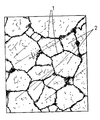
- Said precipitates mainly form a skeleton-like fine network which is distributed over the complete copper mass and which somehow isolates the copper grains from one another to thus prevent the growth thereof during the annealing.
- the precipitates are actually comprised of very hard and stable inclusions the thickness of which generally varies between 1 and 3 microns, while the size of the grains 2 generally varies between 90 and 150 microns.
- the resulting copper which either forms an alloy with boron and aluminum, or with zirconium, or else with titanium, solidifies in the form of a prism-like casting, which may then be converted into a bimetal with a plate from stainless steel, more particularly chromium-nickel steel.
- the total and relative thickness of both metal layers varies depending on the desired application for the resulting bimetal.
- a bimetal having a total thickness from 2 to 2.5 mm, wherein the thickness ratio between the stainless steel layer and the copper layer varies between 4 and 9.
- compositions are for example 18/10 copper and 2/10 chromium-nickel steel, as well as 16/10 copper and 4/10 chromium-nickel steel.
- the annealing temperature generally lies between 800 and 1100°C, and preferably in the range from 950 to 1000°C for chromium-nickel steel.
- Said copper layer will thus show after deep-drawing and forming the already-mentioned "orange-peel effect" and even lose in some cases every resilient property.
- said network 1 around the copper grains 2 will hamper in such a way and even prevent the growth thereof, that the bimetal plate, after annealing, without particular precautions, can be deep-drawn and formed to obtain hollow objects, such as cooking pans and similar.
- the grain growth-inhibiting component be stable up to above the annealing temperature to which the bimetal is subjected, in such a way that it may hamper the grain growth at this temperature.
- the grain growth-inhibiting component being used is formed by boron which forms in the presence of aluminum, aluminum boride which is stable at high temperature.
- the following alloy is thus composed: in weight-%: 99.45 % copper + 0.05 % boron + 0.5 % aluminum.
- the cast part After solidifying, the cast part is cold-rolled at room temperature with a thickness reduction from originally 11.5 5 mm to 2.2 mm.
- Samples from the resulting rolled plate have been soft-annealed at 1000°C during respectively 3 minutes, 5 minutes and 8 minutes, and thereafter quenched in water. A single sample after an annealing time of 5 minutes, has been hand-bent over 90°.
- the grain size has been determined by means of the ASTM comparison method (for a rolled sample in cross-section, in parallel relationship with the rolling direction "W.R.”).
- the Rockwell F hardness (HR F ) has been taken as hardness value.
- composition of the network has been tested by micro-analysis, and it did appear that said network was rich in boron and aluminum.
- the network which is precipitated on the boundaries of the copper grains is mainly comprised of boron and aluminum, and it is effective to limit the grain growth in copper at high temperature.
- the resulting cold-rolled and annealed alloy is bendable without problems at 1000°C.
- a copper-aluminum-boron alloy has been prepared with the following composition:
- the cast part After cooling, the cast part is cold-rolled at room temperature with a thickness reduction from 11.5 to 2.2 mm. Thereafter a sample from the resulting plate is annealed at 1000°C during 5 minutes, while a sample has been hand-bent over 90°.
- Said composition may thus be considered as a preferred composition.
- a mean grain size of 150 microns has been obtained for the first sample (varying between 120 and 250 microns), and for the second sample a mean grain size of 250 microns (varying between 130 and 350 microns).
- said component be formed by an element which is stable at a temperature above the annealing temperature of the bimetal plate to be manufactured, and which is such that it forms around the copper grains a network which is stable at said temperature, with enough hardness, fineness and homogeneity.
- the bimetal plate of copper-stainless steel has after annealing, a hardness which is equal to or smaller than 70 Rockwell-C (HR C ), whereby the bimetal is distortable, such as deep-drawable and formable at room temperature.
Landscapes
- Engineering & Computer Science (AREA)
- Mechanical Engineering (AREA)
- Heat Treatment Of Steel (AREA)
- Conductive Materials (AREA)
- Chemically Coating (AREA)
Applications Claiming Priority (2)
| Application Number | Priority Date | Filing Date | Title |
|---|---|---|---|
| BE212782 | 1984-04-17 | ||
| BE0/212782A BE899443A (nl) | 1984-04-17 | 1984-04-17 | Werkwijze voor het behandelen van koper en voor het toepassen van het aldus behandeld koper. |
Publications (2)
| Publication Number | Publication Date |
|---|---|
| EP0161696A2 true EP0161696A2 (de) | 1985-11-21 |
| EP0161696A3 EP0161696A3 (de) | 1985-12-18 |
Family
ID=3843748
Family Applications (1)
| Application Number | Title | Priority Date | Filing Date |
|---|---|---|---|
| EP85200442A Withdrawn EP0161696A3 (de) | 1984-04-17 | 1985-03-21 | Verfahren zur Behandlung von Kupfer und Anwendung dieses behandelten Kupfers |
Country Status (3)
| Country | Link |
|---|---|
| US (1) | US4591394A (de) |
| EP (1) | EP0161696A3 (de) |
| BE (1) | BE899443A (de) |
Families Citing this family (1)
| Publication number | Priority date | Publication date | Assignee | Title |
|---|---|---|---|---|
| CN112233513B (zh) * | 2020-09-02 | 2022-06-07 | 云南云铝涌鑫铝业有限公司 | 表征铝液相变晶粒生长过程的晶粒组织及其制备方法 |
Family Cites Families (17)
| Publication number | Priority date | Publication date | Assignee | Title |
|---|---|---|---|---|
| CA642377A (en) * | 1962-06-05 | S. Cooper Hugh | Copper-boron alloys | |
| DE496935C (de) * | 1927-05-25 | 1930-04-30 | Metallgesellschaft Ag | Walz- und ziehbares Doppelmetall mit hoher Festigkeit |
| US2161468A (en) * | 1939-02-24 | 1939-06-06 | Mallory & Co Inc P R | Copper base alloy |
| US2718690A (en) * | 1950-05-20 | 1955-09-27 | John B Ulam | Method of producing composite metals |
| US2964397A (en) * | 1958-07-28 | 1960-12-13 | Walter M Weil | Copper-boron alloys |
| GB892902A (en) * | 1959-04-27 | 1962-04-04 | Allegheny Ludlum Steel | Improvements in or relating to a composite stainless steel-copper alloy article |
| US3251660A (en) * | 1962-06-13 | 1966-05-17 | Texas Instruments Inc | Composite electrically conductive spring materials |
| US3298803A (en) * | 1965-03-15 | 1967-01-17 | Composite Metal Products Inc | Composite metal article of stainless steel and copper |
| US3381364A (en) * | 1965-05-07 | 1968-05-07 | Olin Mathieson | Process for obtaining a clad article with a copper base alloy core |
| US3615922A (en) * | 1968-09-19 | 1971-10-26 | Olin Mathieson | Inhibiting grain growth in metal composites |
| US3615374A (en) * | 1969-11-18 | 1971-10-26 | Berry Metal Co | Alloyed copper |
| US3836360A (en) * | 1972-07-10 | 1974-09-17 | Anaconda Co | Method and apparatus for pre-heating and adding master alloy to a copper melt |
| JPS4943052A (de) * | 1972-08-29 | 1974-04-23 | ||
| JPS50122418A (de) * | 1974-03-13 | 1975-09-26 | ||
| HU170948B (hu) * | 1975-10-24 | 1977-10-28 | Csepeli Femmue | Sposob izgotovlenija vysokodeformiruemykh lent i listov s izotropicheskimi mekhanicheskimi svojstvami iz medi ili splavov medi |
| US4088475A (en) * | 1976-11-04 | 1978-05-09 | Olin Corporation | Addition of reactive elements in powder wire form to copper base alloys |
| JPS5752413A (en) * | 1980-09-12 | 1982-03-27 | Asahi Giken Kogyo | Tablewear made of copper |
-
1984
- 1984-04-17 BE BE0/212782A patent/BE899443A/nl not_active IP Right Cessation
-
1985
- 1985-03-21 EP EP85200442A patent/EP0161696A3/de not_active Withdrawn
- 1985-03-26 US US06/716,344 patent/US4591394A/en not_active Expired - Fee Related
Also Published As
| Publication number | Publication date |
|---|---|
| EP0161696A3 (de) | 1985-12-18 |
| US4591394A (en) | 1986-05-27 |
| BE899443A (nl) | 1984-08-16 |
Similar Documents
| Publication | Publication Date | Title |
|---|---|---|
| US4073667A (en) | Processing for improved stress relaxation resistance in copper alloys exhibiting spinodal decomposition | |
| KR930005072B1 (ko) | 전자기기용 구리합금 및 그 제조방법 | |
| US5167726A (en) | Machinable lead-free wrought copper-containing alloys | |
| US3923558A (en) | Copper base alloy | |
| CA2710311A1 (en) | Copper-nickel-silicon alloys | |
| EP0663452B1 (de) | Legierung auf Kupferbasis | |
| US4047980A (en) | Processing chromium-containing precipitation hardenable copper base alloys | |
| US4305762A (en) | Copper base alloy and method for obtaining same | |
| US3880678A (en) | Processing copper base alloy | |
| KR20230002292A (ko) | 구리 합금 조재 및 그 제조 방법, 그것을 사용한 저항기용 저항 재료 및 저항기 | |
| US4525325A (en) | Copper-nickel-tin-cobalt spinodal alloy | |
| US3357824A (en) | Copper alloy | |
| US3403997A (en) | Treatment of age-hardenable coppernickel-zinc alloys and product resulting therefrom | |
| CA1093437A (en) | Processing for improved stress relaxation resistance in copper alloys exhibiting spinodal decompositon | |
| JPS591653A (ja) | ラジエ−タ−フイン用銅合金 | |
| EP0161696A2 (de) | Verfahren zur Behandlung von Kupfer und Anwendung dieses behandelten Kupfers | |
| US3930894A (en) | Method of preparing copper base alloys | |
| EP0299605B1 (de) | Eisen-Kupfer-Chrom-Legierung für einen hochfesten Leiterrahmen oder ein Steckstiftgitter und Verfahren zu ihrer Herstellung | |
| JPH032341A (ja) | 高強度高導電性銅合金 | |
| CA1045010A (en) | Copper base alloy | |
| DE1902209A1 (de) | Verfahren zur Oberflaechenhaertung | |
| JPS62250136A (ja) | Cu合金製端子 | |
| US4606889A (en) | Copper-titanium-beryllium alloy | |
| JPH07224338A (ja) | 硬質陽極酸化皮膜の形成方法および硬質陽極酸化皮膜形成用アルミニウム合金 | |
| EP0707084B1 (de) | Hochfeste beryllium-kupfer-legierung mit guter bearbeitbarkeit und wärmebeständigkeit und deren herstellung |
Legal Events
| Date | Code | Title | Description |
|---|---|---|---|
| PUAI | Public reference made under article 153(3) epc to a published international application that has entered the european phase |
Free format text: ORIGINAL CODE: 0009012 |
|
| PUAL | Search report despatched |
Free format text: ORIGINAL CODE: 0009013 |
|
| AK | Designated contracting states |
Designated state(s): AT CH DE FR GB IT LI LU NL SE |
|
| AK | Designated contracting states |
Designated state(s): AT CH DE FR GB IT LI LU NL SE |
|
| 17P | Request for examination filed |
Effective date: 19860606 |
|
| 17Q | First examination report despatched |
Effective date: 19870608 |
|
| R17C | First examination report despatched (corrected) |
Effective date: 19870612 |
|
| STAA | Information on the status of an ep patent application or granted ep patent |
Free format text: STATUS: THE APPLICATION HAS BEEN WITHDRAWN |
|
| 18W | Application withdrawn |
Withdrawal date: 19870917 |