EP0162010A1 - Magasin pour munition sans étui - Google Patents
Magasin pour munition sans étui Download PDFInfo
- Publication number
- EP0162010A1 EP0162010A1 EP85810174A EP85810174A EP0162010A1 EP 0162010 A1 EP0162010 A1 EP 0162010A1 EP 85810174 A EP85810174 A EP 85810174A EP 85810174 A EP85810174 A EP 85810174A EP 0162010 A1 EP0162010 A1 EP 0162010A1
- Authority
- EP
- European Patent Office
- Prior art keywords
- magazine
- annular bead
- outflow
- propellant
- explosive
- Prior art date
- Legal status (The legal status is an assumption and is not a legal conclusion. Google has not performed a legal analysis and makes no representation as to the accuracy of the status listed.)
- Granted
Links
Images
Classifications
-
- B—PERFORMING OPERATIONS; TRANSPORTING
- B25—HAND TOOLS; PORTABLE POWER-DRIVEN TOOLS; MANIPULATORS
- B25C—HAND-HELD NAILING OR STAPLING TOOLS; MANUALLY OPERATED PORTABLE STAPLING TOOLS
- B25C1/00—Hand-held nailing tools; Nail feeding devices
- B25C1/08—Hand-held nailing tools; Nail feeding devices operated by combustion pressure
- B25C1/10—Hand-held nailing tools; Nail feeding devices operated by combustion pressure generated by detonation of a cartridge
- B25C1/16—Cartridges specially adapted for impact tools; Cartridge and bolts units
- B25C1/166—Pellets
-
- F—MECHANICAL ENGINEERING; LIGHTING; HEATING; WEAPONS; BLASTING
- F42—AMMUNITION; BLASTING
- F42B—EXPLOSIVE CHARGES, e.g. FOR BLASTING, FIREWORKS, AMMUNITION
- F42B39/00—Packaging or storage of ammunition or explosive charges; Safety features thereof; Cartridge belts or bags
- F42B39/08—Cartridge belts
- F42B39/085—Cartridge belts for blank cartridges
Definitions
- the invention relates to a magazine for caseless propellant charges for use in powder-operated setting tools, with plate or strip-shaped magazine bodies, the magazine body having passage openings which are surrounded by an annular bead forming a receptacle for the propellant charges and the outer contour of the annular bead at least partially away from the magazine body rejuvenated.
- Caseless propellant charges have considerable advantages over the cartridges that are still common today. These advantages mainly consist in the much simpler manufacture and the resulting lower manufacturing costs. These advantages apply in particular to propellant charges without ignition charges. Such ignited propellant charges, however, lead to problems due to the not particularly good ignitability when used in setting tools. This is counteracted in known devices in that a small part is punched out of the propellant charge by means of an ignition pin and is brought to ignition in a blind hole with high compression. This type of ignition works relatively safely. However, the further burning off of the remaining propellant charge takes place poorly in these known devices. The cause of this phenomenon is that the outflow channels for the combustion gases leading away from the combustion chamber to the work space have a relatively small cross section and can be blocked by loose parts of the propellant charge. An enlargement of the cross section of outflow channels arranged in this way is problematic, since the insulation that is essential for maintaining the ignition would then no longer be guaranteed.
- Magazines consisting of a strip-shaped magazine body with receptacles for the propellant charges.
- the recordings are formed by an annular bead that tapers away from the magazine body.
- the ring bead mainly takes over the sealing of the magazine against the closure parts on the device side.
- axial discharge channels for the combustion gases are also required for the propellant charges arranged in such magazines, the disadvantages mentioned again occur.
- An increase in the cross section of the axial outflow channels is not possible, since the propellant charges have to be supported in the axial direction for the reasons described.
- the invention has for its object to provide a magazine for caseless propellant charges for use in powder-operated setting tools, which ensures simple and safe ignition and even burning of the propellant charges.
- the annular bead has at least one outflow opening for the combustion gases that can be made to coincide with an outflow channel on the device side.
- the combustion gases do not flow away from the combustion chamber in the axial but in the radial direction.
- the cross section available over the circumference for the outflow ducts and the outflow openings in the magazine which can be brought into register with the outflow ducts can thus be kept considerably larger than in the case of an axial course, without impairing the insulation.
- the propellant charge should be supported on all sides by device or magazine parts.
- the outflow opening it is expedient to design the outflow opening as a hole passing through the annular bead.
- the cross-sectional shape of the hole can be round, angular or a slot.
- the hole should be offset in the axial direction with respect to the propellant charge, so that it is at most partially covered by the propellant charge.
- grooves extending from the free end of the ring bead are also conceivable. This form of outflow openings is particularly suitable when the propellant charge, in powdery or still moist state, is finished pressed in the magazine itself in a manner known per se.
- the outflow openings can be provided with a membrane that can be destroyed by the pressure of the combustion gases. These The membrane is only destroyed when the combustion pressure in the combustion chamber has reached a minimum value. Due to a membrane temporarily closing the outflow opening, the propellant charges in the magazine are also better protected against external influences, such as moisture or mechanical damage.
- the annular bead has an elastic sealing lip for the closure parts on the device side in the area adjoining the outflow opening at the rear.
- Such a sealing lip adapts to the device-side closure parts and is additionally pressed against the device-side parts by the gas pressure. The seal therefore gets better with increasing gas pressure.
- the propellant charges are usually inserted into the magazine by machine. For the ignition to work properly, all propellant charges must be inserted equally far into the magazine. To make this possible, it is expedient to provide the ring bead on the inside with a stop shoulder for the propellant charge. Depending on the direction of insertion of the propellant charges into the magazine, the stop shoulder is arranged on the front or rear end of the receptacle.
- the magazine is in itself a so-called disposable part, ie it is used only once and is subsequently removed.
- An inexpensive material such as plastic, is therefore preferably used mainly for cost reasons. Since the temperatures when igniting a propellant charge are currently very high, but the entire ignition process takes only a fraction of a second, the temperature resistance of ordinary plastics is sufficient. In principle, however, it would also be possible to use the magazine several times, ie to refill it after use. In this case, materials can be used g s higher strength and temperature resistance, such aschtmetallegierun.
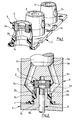
- the magazine shown in FIGS. 1 and 2 consists of a strip-shaped magazine body, designated as a whole by 1, which has lateral transport catches la and passage openings 1b.
- the passage openings 1b are surrounded by a total of 2 annular beads, which partially taper away on their outer side away from the magazine body 1.
- Sleeveless propellant charges 3 with an H-shaped cross section are arranged in the receptacle of the annular beads 2.
- the annular bead 2 is provided with lateral outflow openings designed as hole 2a. On its inside, the annular bead 2 has an elastic sealing lip 2b in the area adjoining the holes 2a.
- the magazine shown in FIG. 1 is inserted into a setting tool, which is indicated as consisting of a barrel part, generally designated 5, a piston 6, and a closure part, generally designated 7.
- the piston 6 is guided in a piston guide 5a of the running part 5.
- the barrel 5 has at its rear end a receiving hole 5b for the annular bead 2 of the magazine.
- At the bottom of the receiving bore 5b there is a blind bore designated as an anvil 5c.
- the cross section of the anvil hole 5c is substantially smaller than that of the receiving bore 5b.
- a closure part, designated overall by 7, interacts with the running part 5.
- the closure part 7 has a pin 7a which projects into the annular bead 2 and supports the propellant charge 3 arranged in the magazine on one side.
- the closure part 7 is provided with a guide bore 7b for an ignition pin which is axially displaceably mounted therein and is designated overall by 8.
- the firing pin 8 has a conically tapering projection 8a at its front end. The cross section of the extension 8a is slightly smaller than that of the anvil hole 5c.
- the firing pin 8 bounces against the propellant charge 3 by the force of an ignition spring or by the force of a hammer blow and thereby stamps out part of the propellant charge 3.
- the punched-out part of the propellant charge 3 is compressed by the attachment 8a of the ignition pin 8 in the anvil hole 5c and thereby ignited.
- the combustion spreads to the remaining propellant charge 3.
- the combustion gases which are now developing come under high pressure through the outflow openings designed as hole 2a and the outflow channels 5d which can be made to coincide with the holes 2a into the working space 5e of the running part 5, where they act on the piston 6 and drive it away from the magazine.
- the propellant gas losses are largely avoided by the sealing lip 2b cooperating with the pin 7a. Since the outflow channels 5d can be dimensioned relatively large, the flow losses occurring in the outflow channels 5d are also relatively small.
- Both the magazine body 1 and the annular bead 2 are expediently made from a relatively inexpensive material such as plastic. If the magazine is to be used several times, however, metals such as aluminum alloys can also be used.
Landscapes
- Engineering & Computer Science (AREA)
- Chemical & Material Sciences (AREA)
- Combustion & Propulsion (AREA)
- Mechanical Engineering (AREA)
- General Engineering & Computer Science (AREA)
- Portable Nailing Machines And Staplers (AREA)
- Medicinal Preparation (AREA)
- Detergent Compositions (AREA)
- Agricultural Chemicals And Associated Chemicals (AREA)
- Charge And Discharge Circuits For Batteries Or The Like (AREA)
Priority Applications (1)
| Application Number | Priority Date | Filing Date | Title |
|---|---|---|---|
| AT85810174T ATE28816T1 (de) | 1984-05-16 | 1985-04-19 | Magazin fuer huelsenlose treibladungen. |
Applications Claiming Priority (2)
| Application Number | Priority Date | Filing Date | Title |
|---|---|---|---|
| DE3418237A DE3418237A1 (de) | 1984-05-16 | 1984-05-16 | Magazin fuer huelsenlose treibladungen |
| DE3418237 | 1984-05-16 |
Publications (2)
| Publication Number | Publication Date |
|---|---|
| EP0162010A1 true EP0162010A1 (fr) | 1985-11-21 |
| EP0162010B1 EP0162010B1 (fr) | 1987-08-12 |
Family
ID=6236051
Family Applications (1)
| Application Number | Title | Priority Date | Filing Date |
|---|---|---|---|
| EP85810174A Expired EP0162010B1 (fr) | 1984-05-16 | 1985-04-19 | Magasin pour munition sans étui |
Country Status (6)
| Country | Link |
|---|---|
| EP (1) | EP0162010B1 (fr) |
| JP (1) | JPS60242981A (fr) |
| AT (1) | ATE28816T1 (fr) |
| AU (1) | AU4123885A (fr) |
| DE (2) | DE3418237A1 (fr) |
| ES (1) | ES286747Y (fr) |
Citations (2)
| Publication number | Priority date | Publication date | Assignee | Title |
|---|---|---|---|---|
| DE2436446A1 (de) * | 1974-07-29 | 1976-02-12 | Hilti Ag | Pulverkraftbetriebenes setzgeraet |
| AT347369B (de) * | 1975-04-01 | 1978-12-27 | Hilti Ag | Pulverkraftbetriebenes setzgeraet und magazin |
-
1984
- 1984-05-16 DE DE3418237A patent/DE3418237A1/de not_active Withdrawn
-
1985
- 1985-04-15 AU AU41238/85A patent/AU4123885A/en not_active Abandoned
- 1985-04-19 EP EP85810174A patent/EP0162010B1/fr not_active Expired
- 1985-04-19 AT AT85810174T patent/ATE28816T1/de not_active IP Right Cessation
- 1985-04-19 DE DE8585810174T patent/DE3560426D1/de not_active Expired
- 1985-05-07 JP JP60095668A patent/JPS60242981A/ja active Pending
- 1985-05-14 ES ES1985286747U patent/ES286747Y/es not_active Expired
Patent Citations (2)
| Publication number | Priority date | Publication date | Assignee | Title |
|---|---|---|---|---|
| DE2436446A1 (de) * | 1974-07-29 | 1976-02-12 | Hilti Ag | Pulverkraftbetriebenes setzgeraet |
| AT347369B (de) * | 1975-04-01 | 1978-12-27 | Hilti Ag | Pulverkraftbetriebenes setzgeraet und magazin |
Also Published As
| Publication number | Publication date |
|---|---|
| EP0162010B1 (fr) | 1987-08-12 |
| DE3418237A1 (de) | 1985-11-21 |
| ES286747Y (es) | 1986-06-01 |
| ATE28816T1 (de) | 1987-08-15 |
| JPS60242981A (ja) | 1985-12-02 |
| DE3560426D1 (en) | 1987-09-17 |
| AU4123885A (en) | 1985-11-21 |
| ES286747U (es) | 1985-11-16 |
Similar Documents
| Publication | Publication Date | Title |
|---|---|---|
| EP0490252B1 (fr) | Dispositif pour l'allumage d'une charge propulsive; cartouches et magasin pour des cartouches susceptibles d'être allumées adiabatiquement, notamment pour des appareils de clouage par explosion | |
| DE69104781T2 (de) | Patronenhülsenelement mit verbrennbarer Hülse, mit einem solchen Element versehene halbverbrennbare Munition und Verfahren zum Laden dieser Munition. | |
| DE1678396B2 (de) | Bandförmiger Ladestreifen | |
| EP0107766A1 (fr) | Cartouche d'exercice avec balle en plastique | |
| EP0656522B1 (fr) | Douille pour cartouche | |
| EP0608776B1 (fr) | Cartouche en plastique pour un dispositif de tir, notamment un dispositif scellement de chevilles | |
| EP0525613B1 (fr) | Cartouche en plastique et magasin-ruban en plastique pour cartouches | |
| EP0341543B1 (fr) | Cartouche à balle pour fusil | |
| EP0162010B1 (fr) | Magasin pour munition sans étui | |
| DE2324482C3 (de) | Patronenhülse für Schlagzündung | |
| DE1428680A1 (de) | Verbesserungen an Huelsen fuer Feuerwaffenmunition | |
| EP0579575A1 (fr) | Outil de scellement actionné par poudre | |
| DE2120210A1 (de) | Zündsatz | |
| DE9107094U1 (de) | Dichtungsventil für Behälteröffnungen | |
| DE19738937A1 (de) | Patronierte Munition | |
| EP0377433A1 (fr) | Cartouche d'exercice pour armes de défense sans recul | |
| EP1676092A1 (fr) | Projectile pour canon de fusil, a organe intermediaire et cartouche | |
| DE8401068U1 (de) | Pyrotechnisches Scheinziel | |
| DE313165C (fr) | ||
| DE19831053A1 (de) | Pulverkraftbetriebenes Setzgerät | |
| DE2852172C2 (fr) | ||
| DE2131051C3 (de) | Zweiteiliges Schrotpatronen-Zwischenmittel aus Kunststoff | |
| DE2446682A1 (de) | Magazin zur aufnahme von kartuschen | |
| DE2907612C2 (fr) | ||
| DE3206491C2 (de) | Leuchtsatz für eine Leuchtpatrone oder dergleichen |
Legal Events
| Date | Code | Title | Description |
|---|---|---|---|
| PUAI | Public reference made under article 153(3) epc to a published international application that has entered the european phase |
Free format text: ORIGINAL CODE: 0009012 |
|
| AK | Designated contracting states |
Designated state(s): AT BE CH DE FR GB IT LI NL SE |
|
| 17P | Request for examination filed |
Effective date: 19851214 |
|
| 17Q | First examination report despatched |
Effective date: 19861024 |
|
| ITF | It: translation for a ep patent filed | ||
| GRAA | (expected) grant |
Free format text: ORIGINAL CODE: 0009210 |
|
| AK | Designated contracting states |
Kind code of ref document: B1 Designated state(s): AT BE CH DE FR GB IT LI NL SE |
|
| REF | Corresponds to: |
Ref document number: 28816 Country of ref document: AT Date of ref document: 19870815 Kind code of ref document: T |
|
| REF | Corresponds to: |
Ref document number: 3560426 Country of ref document: DE Date of ref document: 19870917 |
|
| ET | Fr: translation filed | ||
| PLBE | No opposition filed within time limit |
Free format text: ORIGINAL CODE: 0009261 |
|
| STAA | Information on the status of an ep patent application or granted ep patent |
Free format text: STATUS: NO OPPOSITION FILED WITHIN TIME LIMIT |
|
| 26N | No opposition filed | ||
| ITTA | It: last paid annual fee | ||
| PGFP | Annual fee paid to national office [announced via postgrant information from national office to epo] |
Ref country code: NL Payment date: 19890430 Year of fee payment: 5 |
|
| PGFP | Annual fee paid to national office [announced via postgrant information from national office to epo] |
Ref country code: SE Payment date: 19900213 Year of fee payment: 6 |
|
| PGFP | Annual fee paid to national office [announced via postgrant information from national office to epo] |
Ref country code: BE Payment date: 19900216 Year of fee payment: 6 |
|
| PG25 | Lapsed in a contracting state [announced via postgrant information from national office to epo] |
Ref country code: NL Effective date: 19901101 |
|
| NLV4 | Nl: lapsed or anulled due to non-payment of the annual fee | ||
| PG25 | Lapsed in a contracting state [announced via postgrant information from national office to epo] |
Ref country code: SE Effective date: 19910420 |
|
| PG25 | Lapsed in a contracting state [announced via postgrant information from national office to epo] |
Ref country code: BE Effective date: 19910430 |
|
| BERE | Be: lapsed |
Owner name: HILTI A.G. Effective date: 19910430 |
|
| PGFP | Annual fee paid to national office [announced via postgrant information from national office to epo] |
Ref country code: GB Payment date: 19930408 Year of fee payment: 9 |
|
| PG25 | Lapsed in a contracting state [announced via postgrant information from national office to epo] |
Ref country code: GB Effective date: 19940419 |
|
| GBPC | Gb: european patent ceased through non-payment of renewal fee |
Effective date: 19940419 |
|
| EUG | Se: european patent has lapsed |
Ref document number: 85810174.4 Effective date: 19911108 |
|
| PGFP | Annual fee paid to national office [announced via postgrant information from national office to epo] |
Ref country code: DE Payment date: 19950321 Year of fee payment: 11 |
|
| PGFP | Annual fee paid to national office [announced via postgrant information from national office to epo] |
Ref country code: AT Payment date: 19950327 Year of fee payment: 11 |
|
| PGFP | Annual fee paid to national office [announced via postgrant information from national office to epo] |
Ref country code: FR Payment date: 19950330 Year of fee payment: 11 |
|
| PG25 | Lapsed in a contracting state [announced via postgrant information from national office to epo] |
Ref country code: AT Effective date: 19960419 |
|
| PG25 | Lapsed in a contracting state [announced via postgrant information from national office to epo] |
Ref country code: FR Effective date: 19961227 |
|
| PG25 | Lapsed in a contracting state [announced via postgrant information from national office to epo] |
Ref country code: DE Effective date: 19970101 |
|
| REG | Reference to a national code |
Ref country code: FR Ref legal event code: ST |
|
| PGFP | Annual fee paid to national office [announced via postgrant information from national office to epo] |
Ref country code: CH Payment date: 20000427 Year of fee payment: 16 |
|
| PG25 | Lapsed in a contracting state [announced via postgrant information from national office to epo] |
Ref country code: LI Free format text: LAPSE BECAUSE OF NON-PAYMENT OF DUE FEES Effective date: 20010518 Ref country code: CH Free format text: LAPSE BECAUSE OF NON-PAYMENT OF DUE FEES Effective date: 20010518 |
|
| REG | Reference to a national code |
Ref country code: CH Ref legal event code: PL |